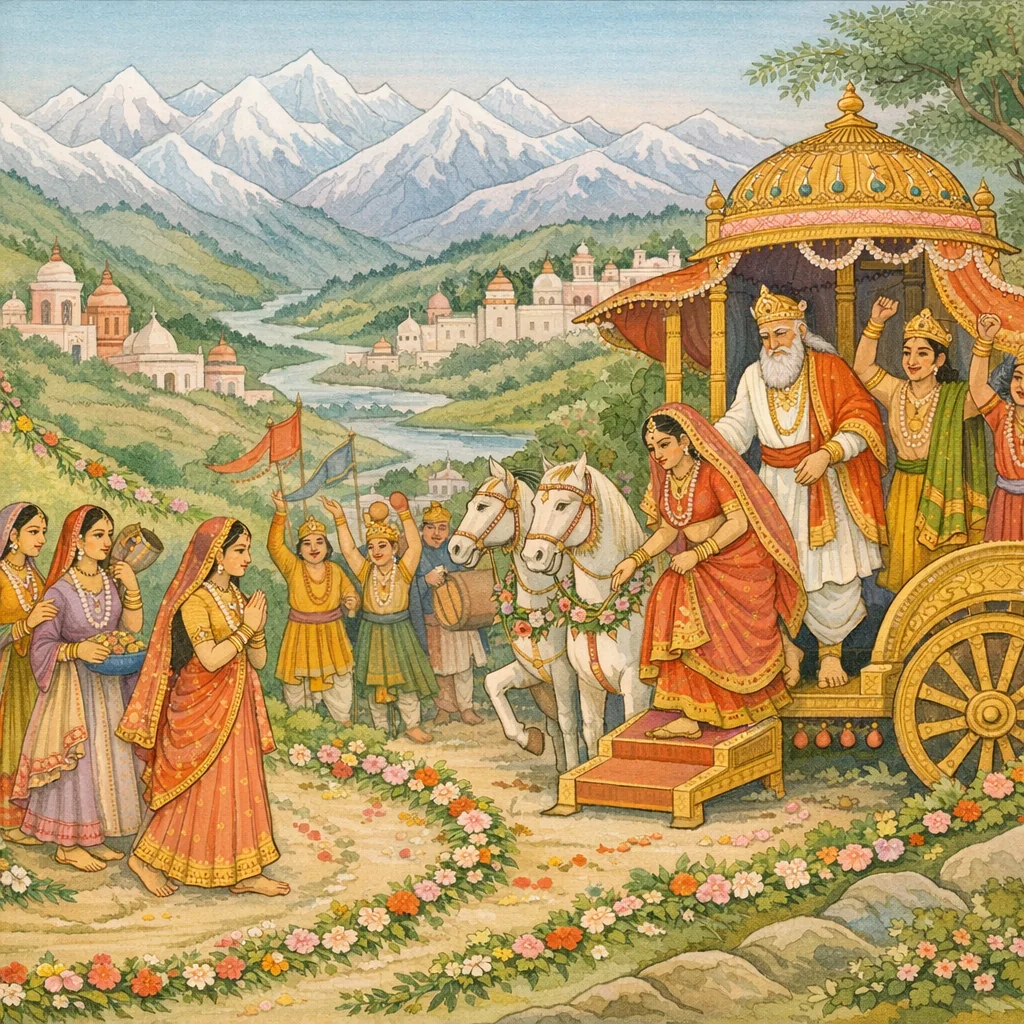
पार्वत्याः पितृगृहगमनं तथा मङ्गलस्वागतम् | Pārvatī’s Return to Her Father’s House and the Auspicious Welcome
Adhyāya 30 unfolds as a Nārada–Brahmā dialogue, immediately after Hari departs for his own abode. Nārada asks in detail what Pārvatī—praised as sarva-maṅgalā, the embodiment of all auspiciousness—did next and where she went. Brahmā relates that after her enchanting song-and-dance performance overwhelms the assembled gathering (including Menā), Pārvatī, accompanied by her companions, makes her form and intention fully accomplished and, invoking Mahādeva, proceeds to her father’s house. Hearing of her arrival, Menā and Himācala rejoice and set out in a divine vehicle to welcome her. Priests, townspeople, friends, and relatives assemble; her brothers led by Maināka also advance with victory-cries. The chapter highlights the public, ritual reception: the royal road is adorned, a maṅgala-ghaṭa is installed, costly fragrant offerings (sandalwood, agaru, musk, fruits and branches) are prepared, and brāhmaṇas, munis, women, and dancers participate—forming a civic-religious tableau of auspicious welcome that frames Pārvatī’s passage between the domestic and the divine.
Shlokas
Verse 1
नारद उवाच । विधे तात महाभाग धन्यस्त्वं परमार्थदृक् । अद्भुतेयं कथाश्रावि त्वदनुग्रहतो मया
Narada said: “O Creator (Brahmā), dear father, O greatly fortunate one—blessed are you, for you behold the highest truth. By your grace, I have heard this wondrous sacred narrative.”
Verse 2
गते हरे स्वशैले हि पार्वती सर्वमंगला । किं चकार गता कुत्र तन्मे वद महामते
When Hari had departed to his own mountain abode, what did Pārvatī—she who is wholly auspicious—do, and where did she go? O great-minded one, tell me that.
Verse 3
श्रुत्वा सुगीतं तद्दृष्ट्वा सुनृत्यं च मनोहरम् । सहसा मुमुहुस्सर्वे मेनापि च तदा मुने
O sage, hearing that exquisite singing and seeing that charming, graceful dance, everyone suddenly became overwhelmed and swooned—Menā as well, at that time.
Verse 4
पार्वत्यपि सखीयुक्ता रूपं कृत्वा तु सार्थकम् । जगाम स्वपितुर्गेहं महादेवेति वादिनी
Pārvatī too, accompanied by her companions, assumed a fitting and purposeful appearance, and went to her father’s house, continually speaking of Mahādeva.
Verse 5
पार्वत्यागमनं श्रुत्वा मेना च स हिमाचलः । दिव्यं यानं समारुह्य प्रययौ हर्षविह्वलः
Hearing of Pārvatī’s arrival, Menā and Himācala, the Lord of Mountains, were overwhelmed with joy; mounting a celestial conveyance, they set out at once.
Verse 6
पुरोहितश्च पौराश्च सख्यश्चैवाप्यनेकशः । सम्वन्धिनस्तथान्ये च सर्वे ते च समाययुः
The family priests, the townspeople, and many friends—together with relatives and others—indeed all assembled there as one.
Verse 7
भ्रातरः सकला जग्मुर्मैनाकप्रमुखास्तदा । जयशब्दं प्रब्रुवन्तो महाहर्षसमन्विताः
Then all the brothers—led by Maināka—set forth together, crying “Victory!” and filled with great joy.
Verse 8
संस्थाप्य मंगलघटं राजवर्त्मनि राजिते । चन्दनागरुकस्तूरीफलशाखासमन्विते
Having set the auspicious ritual pot (maṅgala-ghaṭa) upon the splendidly adorned royal pathway, they arranged it with sandalwood, agaru, musk, and fruit-bearing branches, so the rite might shine with sacred auspiciousness.
Verse 9
सपुरोधोब्राह्मणैश्च मुनिभिर्ब्रह्मवादिभिः । नारीभिर्नर्तकीभिश्च गजेन्द्राद्रिसुशोभितैः
Along with the family priests—brāhmaṇas, sages, and expounders of Brahman—there were also women and dancing girls; and the whole scene shone splendidly, as if adorned with mighty elephants and mountain-like grandeur.
Verse 10
परितः परितो रंभास्तम्भवृन्दसमन्विते । पतिपुत्रवतीयोषित्समूहैर्दीपहस्तकैः
All around, the place was adorned with clusters of plantain pillars; and it was encircled by groups of married women—blessed with husbands and sons—each holding lamps in their hands.
Verse 11
द्विजवृन्दैश्च संयुक्ते कुर्वद्भिर्मङ्गलध्वनिम् । नानाप्रकारवाद्यैश्च शंखध्वनिभिरन्विते
It was thronged with companies of twice-born Brahmins, raising auspicious sounds; it rang with many kinds of musical instruments and was filled with the reverberation of conch-blasts.
Verse 12
एतस्मिन्नन्तरे दुर्गा जगाम स्वपुरान्तिकम् । विशंती नगरं देवी ददर्श पितरौ पुनः
Meanwhile, Durgā went near her own city. As the Goddess entered the town, she once again beheld her parents.
Verse 13
सुप्रसन्नौ प्रधावन्तौ हर्षविह्वलमानसौ । दृष्ट्वा काली सुप्रहृष्टा स्वालिभिः प्रणनाम तौ
Radiant with delight, the two rushed forward, their minds overwhelmed with joy. Seeing them, Kālī too became exceedingly glad and, along with her female attendants, bowed down to them.
Verse 14
तौ सम्पूर्णाशिषं दत्त्वा चक्रतुस्तौ स्ववक्षसि । हे वत्से त्वेवमुच्चार्य रुदन्तौ प्रेमविह्वलौ
Having bestowed their complete blessings, the two drew her close to their own bosom. Saying, “O child, just so,” they wept—overwhelmed by love.
Verse 15
ततस्स्वकीया अप्यस्या अन्या नार्यापि संमुदा । भ्रातृस्त्रियोपि सुप्रीत्या दृढालिंगनमादधुः
Then her own womenfolk, and other women too, rejoicing with delight, and even the wives of her brothers, embraced her firmly with great affection.
Verse 16
साधितं हि त्वया सम्यक्सुकार्यं कुलतारणम् । त्वत्सदाचरणेनापि पाविताः स्माखिला वयम्
Truly, you have perfectly accomplished this noble task of redeeming the family. By your own righteous conduct as well, all of us have been purified.
Verse 17
इति सर्वे सुप्रशंस्य प्रणेमुस्तां प्रहर्षिताः । चन्दनैः सुप्रसूनैश्च समानर्चुश्शिवां मुदा
Thus, all of them, praising her highly, bowed down in great delight to the auspicious Goddess Śivā (Pārvatī); and with sandal paste and excellent flowers they worshipped her together in joy.
Verse 18
तस्मिन्नवसरे देवा विमानस्था मुदाम्बरे । पुष्पवृष्टिं शुभां चक्रुर्नत्वा तां तुष्टुवुः स्तवैः
At that very moment, the gods—seated in their celestial chariots in the joyous sky—showered auspicious flowers. Having bowed to her, they praised her with hymns.
Verse 19
तदा तां च रथे स्थाप्य सर्वे शोभान्विते वरे । पुरं प्रवेशयामासुस्सर्वे विप्रादयो मुदा
Then, placing her upon an excellent chariot adorned with splendour, all of them—led by the brāhmaṇas—joyfully conducted her into the city.
Verse 20
अथ विप्राः पुरोधाश्च सख्योन्याश्च स्त्रियः शिवाम् । गृहं प्रवेशयामासुर्बहुमानपुरस्सरम्
Then the brāhmaṇas, the family priests, and the other women—her companions—led Śivā (Pārvatī) into the house, going before her with great honor and reverent welcome.
Verse 21
स्त्रियो निर्मच्छनं चक्रुर्विप्रा युयुजुराशिषः । हिमवान्मेनका माता मुमोदाति मुनीश्वर
O lord of sages, the women performed the auspicious cleansing rites; the brāhmaṇas pronounced blessings. Himavān, Menakā, and the mother (of the bride) rejoiced greatly.
Verse 22
ततस्स हिमवान् तात सुप्रहृष्टाः प्रसन्नधीः । सम्मान्य सकलान्प्रीत्या स्नातुं गंगां जगाम ह
Then, O dear one, Himavān—exceedingly delighted and of serene understanding—honoured everyone with affection and went to the Gaṅgā to bathe.
Verse 23
ब्राह्मणेभ्यश्च बंदिभ्यः पर्वतेन्द्रो धनं ददौ । मङ्गलं पाठयामास स द्विजेभ्यो महोत्सवम्
The Lord of Mountains, Himālaya, bestowed wealth in charity upon the brāhmaṇas and the bards. Then he had the twice-born recite auspicious benedictions, celebrating the occasion as a great festival.
Verse 24
एवं स्वकन्यया हृष्टौ पितरौ भ्रातरस्तथा । जामयश्च महाप्रीत्या समूषुः प्रांगणे मुने
Thus, O sage, her parents, her brothers, and her sisters-in-law—delighted because of their own daughter—sat together in the courtyard with great joy.
Verse 26
एतस्मिन्नंतरे शंभुस्सुलीलो भक्तवत्सलः । सुनर्तकनटो भूत्वा मेनकासंनिधिं ययौ
Meanwhile, Śambhu—ever playful in His divine līlā and tender to His devotees—assumed the guise of an excellent dancing actor and went into the presence of Menakā.
Verse 27
शृंगं वामे करे धृत्वा दक्षिणे डमरु तथा । पृष्ठे कंथां रक्तवासा नृत्यगानविशारदः
Holding a horn in his left hand and a ḍamaru in his right, with a cloak upon his back and clad in red garments, he was highly skilled in dance and song.
Verse 28
ततस्सुनटरूपोसौ मेनकाया गणे मुदा । चक्रे सुनृत्यं विविधं गानं चातिमनोहरम्
Then, assuming the form of a dancer, he joyfully performed exquisite and varied dances among Menakā’s attendants, and also sang in a manner that was exceedingly captivating.
Verse 29
शृंगं च डमरुं तत्र वादयामास सुध्वनिम् । महतीं विविधां तत्र स चकार मनोहराम्
There he began to play the horn and the ḍamaru, producing a sweet, resonant sound; and in that place he created a great, varied, and enchanting music.
Verse 30
इति श्रीशिवमहापुराणे द्वितीयायां रुद्रसंहितायां तृतीये पार्वतीखंडे पार्वतीप्रत्यागमनमहोत्सववर्णनं नाम त्रिंशोऽध्यायः
Thus ends the thirtieth chapter, entitled “Description of the Grand Festival for Pārvatī’s Return,” in the third section—Pārvatīkhaṇḍa—of the second division, the Rudra Saṃhitā, of the glorious Śiva Mahāpurāṇa.
Verse 32
मूर्च्छां संप्राप्य सा दुर्गा सुदृष्ट्वा हृदि शंकरम् । त्रिशूलादिकचिह्नानि बिभ्रतं चातिसुन्दरम्
Overcome by a swoon, the Goddess Durgā beheld Śaṅkara within her own heart—exceedingly beautiful, bearing the marks and emblems such as the trident and the rest.
Verse 33
विभूतिविभूषितं रम्यमस्थिमालासमन्वितम् । त्रिलोचनोज्ज्वलद्वक्त्रं नागायज्ञोपवीतकम्
Adorned with sacred ash (vibhūti) and radiant in beauty, wearing a garland of bones, with a shining face and three eyes, and bearing a serpent as the sacred thread—thus was the auspicious, manifest form of Lord Śiva described.
Verse 34
वरं वृण्वित्युक्तवन्तं गौरवर्णं महेश्वरम् । दीनबन्धु दयासिन्धुं सर्वथा सुमनोहरम्
They beheld Mahādeva—Maheshvara of fair hue—who had spoken, “Choose a boon.” He was the friend of the distressed, an ocean of compassion, and in every way supremely enchanting to the mind.
Verse 35
हृदयस्थं हरं दृष्ट्वेदृशं सा प्रणनाम तम् । वरं वव्रे मानसं हि पतिर्मे त्वं भवेति च
Seeing Hara abiding within her heart in that very way, she bowed to Him. Then, within her mind, she chose a boon: “May You indeed be my husband.”
Verse 36
वरं दत्त्वा शिवं चाथ तादृशं प्रीतितो हृदा । अन्तर्धाय पुनस्तत्र सुननर्त्त स भिक्षुकः
Having granted such a boon to Śiva, that mendicant—his heart filled with delight—then disappeared; and again, right there, he danced exceedingly well.
Verse 37
ततो मेना सुरत्नानि स्वर्णपात्रस्थितानि च । तस्मै दातुं ययौ प्रीत्या तद्भूति प्रीतमानसः
Then Menā, with a heart delighted by that auspicious fortune, joyfully went to present him excellent jewels placed in golden vessels.
Verse 38
तानि न स्वीचकारासौ भिक्षां याचे शिवां च ताम् । पुनस्सुनृत्यं गानश्च कौतुकात्कर्तुमुद्यतः
He did not accept those offerings. Instead, he begged for alms from that auspicious Lady (Śivā, Pārvatī). Then, out of playful curiosity, he again set out to perform dancing and singing.
Verse 39
मेना तद्वचनं श्रुत्वा चुकोपाति सुविस्मिता । भिक्षुकं भर्त्सयामास बहिष्कर्तुमियेष सा
Hearing those words, Menā—utterly astonished—became greatly enraged. She rebuked the mendicant and resolved to drive him out.
Verse 40
एतस्मिन्नन्तरे तत्र गंगातो गिरिराययौ । ददर्श पुरतो भिक्षुं प्रांगणस्थं नराकृतिम्
Just then, the Lord of Mountains (Himālaya) came there from the Gaṅgā. Before him he beheld a mendicant, standing in the courtyard, in the form of a man.
Verse 41
श्रुत्वा मेनामुखाद्वृत्तं तत्सर्वं सुचुकोप सः । आज्ञां चकारानुचरान्बहिष्कर्तुञ्च तं नटम्
Hearing from Menā’s own mouth the full account of all that had occurred, he was seized by fierce wrath. He then commanded his attendants to drive that “actor” out of the assembly.
Verse 42
महाग्निमिव दुःस्पर्शं प्रज्वलन्तं सुतेजसम् । न शशाक बहिष्कर्तुं कोपि तं मुनिसत्तम
O best of sages, no one was able to drive him out; he was like a great fire—unapproachable to touch—blazing with his own radiant splendor.
Verse 43
ततस्स भिक्षुकस्तात नानालीलाविशारदः । दर्शयामास शैलाय स्वप्रभावमनन्तकम्
Then that mendicant, O dear one—skilled in many divine play-acts (līlās)—revealed to the Mountain (Himālaya) his own boundless, innate majesty.
Verse 44
शैलो ददर्श तं तत्र विष्णुरूपधरं द्रुतम् । किरीटिनं कुण्डलिनं पीतवस्त्रं चतुर्भुजम्
There, Śaila (Himālaya) quickly beheld him appearing in the form of Viṣṇu—crowned, wearing earrings, clad in yellow garments, and possessing four arms.
Verse 45
यद्यत्पुष्पादिकं दत्तं पूजाकाले गदाभृते । गात्रे शिरसि तत्सर्वं भिक्षुकस्य ददर्श ह
Whatever flowers and other offerings had been given at the time of worship to the mace-bearing Lord, he then saw all of that resting upon the body and head of that mendicant.
Verse 46
ततो ददर्श जगतां स्रष्टारं स चतुर्मुखम् । रक्तवर्णं पठन्तञ्च श्रुतिसूक्तं गिरीश्वरः
Then Girīśvara (Lord Śiva), the Lord of the mountains, beheld the Creator of the worlds—four-faced Brahmā—of a ruddy hue, reciting hymns drawn from the Śruti (the Vedas).
Verse 47
ततस्सूर्य्यस्वरूपञ्च जगच्चक्षुस्स्वरूपकम् । ददर्श गिरिराजस्स क्षणं कौतुककारिणाम्
Then Girirāja (Himālaya) beheld for a moment that wondrous manifestation—of the very form of the Sun, the ‘eye of the universe’—which stirred amazement in all who witnessed it.
Verse 48
ततो ददर्श तं तात रुद्ररूपं महाद्भुतम् । पार्वती सहितं रम्यं विहसन्तं सुतेजसम्
Then, dear one, he beheld Him in a wondrous Rudra-form—beautiful, radiant with supreme splendor, gently smiling, and accompanied by Pārvatī.
Verse 49
ततस्तेजस्स्वरूपञ्च निराकारं निरंजनम् । निरुपाधिं निरीहञ्च महाद्भुतमरूपकम्
Then there appeared that Reality whose very nature is pure radiance—formless, stainless, free from limiting adjuncts, without personal striving, wondrous beyond measure, and yet without any material form. In Shaiva understanding, this points to Śiva as Pati: the transcendent Light that is nirguṇa in essence, prior to all manifested appearances.
Verse 50
एवं बहूनि रूपाणि तस्य तत्र ददर्श सः । सुविस्मितो बभूवाशु परमानन्दसंयुतः
Thus, in that very place, he beheld many forms of that Lord. Instantly he was struck with wonder, filled with the supreme bliss—overwhelmed by the auspicious vision of Śiva’s manifold manifestations.
Verse 51
अथासौ भिक्षुवर्य्यो हि तस्मात्तस्याश्च सूतिकृत् । भिक्षां ययाचे दुर्गान्तां नान्यज्जग्राह किञ्चन
Then that foremost mendicant—who had performed for her the rite connected with childbirth—begged alms from Durgā herself, and he accepted nothing else whatsoever.
Verse 52
न स्वीचकार शैलैन्द्रो मोहितश्शिवमायया । भिक्षुः किंचिन्न जग्राह तत्रैवान्तर्दधे ततः
Deluded by Śiva’s māyā, the lord of mountains did not consent. The mendicant accepted nothing at all, and then vanished right there on the spot.
Verse 53
तदा बभूव सुज्ञानं मेनाशैलेशयोरिति । आवां शिवो वञ्चयित्वा स्वस्थानं गतवान्प्रभुः
Then clear understanding arose in Menā and the lord of the mountain: “The Lord Śiva, having playfully deceived us, has now returned to His own abode.”
Verse 54
तयोर्विचिन्त्य तत्रैव शिवे भक्तिरभूत्परा । महामोक्षकरी दिव्या सर्वानन्दप्रदायिनी
Reflecting upon those two, right there itself an unsurpassed devotion to Śiva arose—divine in nature, bestowing the supreme liberation, and granting the fullness of all bliss.
Frequently Asked Questions
The chapter narrates Pārvatī’s departure to her father Himācala’s house after Hari returns to his own abode, and the elaborate, auspicious public welcome organized by Menā, Himācala, relatives, priests, and townspeople.
Pārvatī’s movement is framed as maṅgala in action: the goddess as sarva-maṅgalā sacralizes space (royal road, maṅgala-ghaṭa) and community, while continuous Śiva-remembrance signals the non-duality of devotion and worldly transition.
Pārvatī is highlighted as sarva-maṅgalā and as one who ‘fulfills’ her form/intention; the narrative also emphasizes collective manifestations of dharma—ritual specialists, kin networks, and celebratory arts (song/dance) as expressions of sacred order.