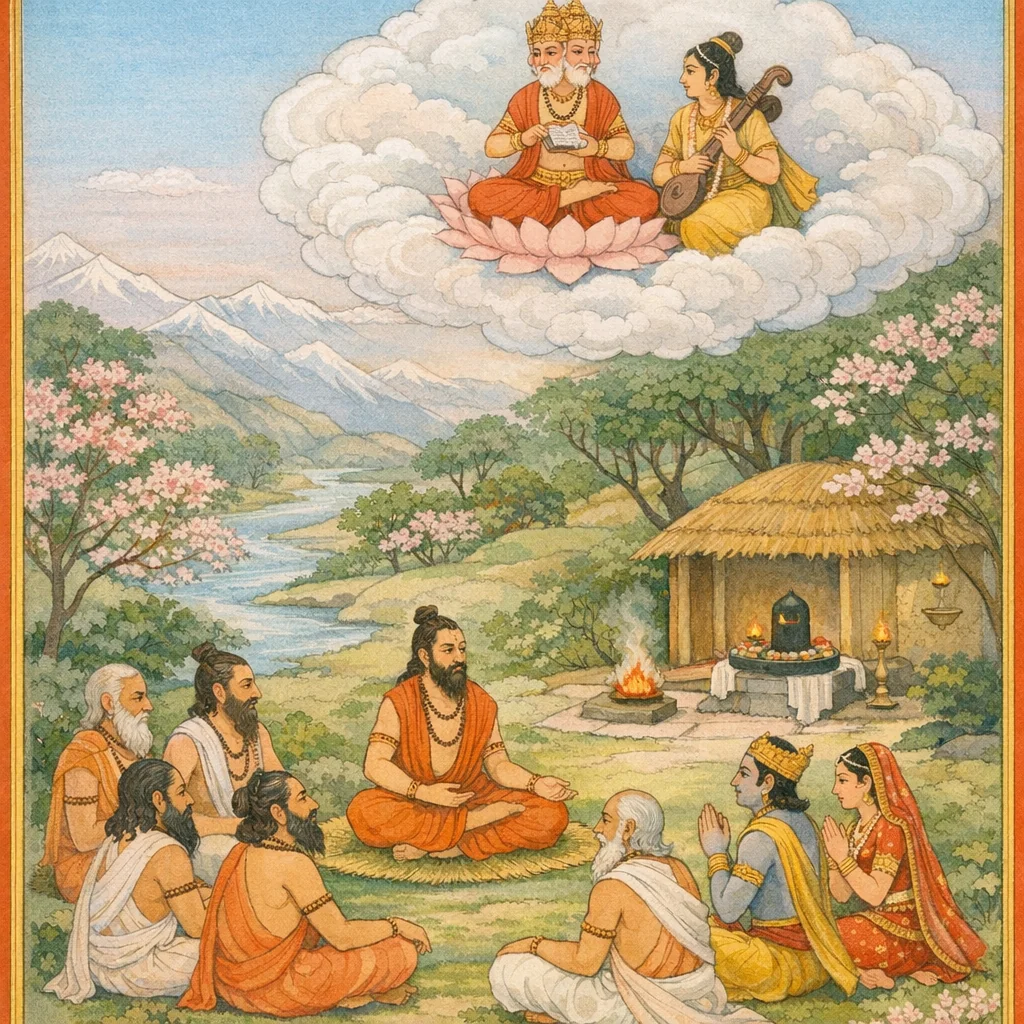
Śivapūjā-stuti: Deva-Ṛṣi-Paramparāyāṃ Śaṃkara-caritasya Prastāvaḥ (Prelude to Śaṃkara’s narrative and the lineage of Śiva-worship)
Adhyāya 37 begins with a formal request: the ṛṣis ask Sūta to recount Śiva’s deeds again, in fuller detail (vistarāt). Sūta introduces the coming “Śāṃkara-carita” as a sacred account that grants both bhukti (worldly fulfillment) and mukti (liberation), establishing its saving purpose at the outset. The chapter then turns to an earlier line of transmission: Nārada questions Pitāmaha (Brahmā), and Brahmā replies with pleased composure, promising a narration that destroys great sins (mahāpātaka-nāśana). The opening verses affirm Śiva-worship as a cosmic norm: Viṣṇu, with Ramā (Lakṣmī), performs Śiva-pūjā and attains desired ends through the Lord’s compassion; Brahmā too declares himself a worshipper of Śiva, and says his creative function endures by Śiva’s grace. The text further lists authoritative practitioners—Brahmā’s mind-born sons, other ṛṣis, especially Nārada, the Saptarṣis (beginning with Vasiṣṭha), and exemplary women such as Arundhatī, Lopāmudrā, and Ahalyā—thus forming a ritual genealogy and showing the social breadth of Śaiva devotion. As a proem, the Adhyāya legitimizes the discourse chain (ṛṣi → Sūta → audience; Nārada → Brahmā) and places śivapūjā as the interpretive key for the narrative that follows.
Shlokas
Verse 1
ऋषय ऊचुः । सूतसूत महाभाग ज्ञानवानसि सुव्रत । पुनरेव शिवस्य वै चरितं ब्रूहि विस्तरात्
The sages said: “O Sūta, son of Sūta, O greatly fortunate one—wise and steadfast in sacred vows—please narrate once again, in full detail, the divine deeds of Lord Śiva.”
Verse 2
पुरातनाश्च राजान ऋषयो देवतास्तथा । आराधनञ्च तस्यैव चकुर्देववरस्य हि
The ancient kings, the sages, and the gods as well performed worship of that very Supreme God—indeed, of the most excellent of the devas, Lord Śiva.
Verse 3
सूत उवाच । साधु पृष्टमृषिश्रेष्ठाः श्रूयतां कथयामि वः । चरित्रं शांकरं रम्यं शृण्वतां भुक्तिमुक्तिदम्
Sūta said: “O best of sages, you have asked well. Listen—I shall narrate to you the delightful sacred account of Śaṅkara (Lord Śiva), which, for those who hear it with devotion, bestows both worldly fulfillment and liberation.”
Verse 4
एतदेव पुरा पृष्टो नारदेन पितामहः । प्रत्युवाच प्रसन्नात्मा नारदं मुनिसत्तमम्
Long ago, on this very matter, the Grandsire Brahmā was questioned by Nārada; and with a serene and gracious mind, he replied to Nārada, the foremost among sages.
Verse 5
ब्रह्मोवाच । शृणु नारद सुप्रीत्या शांकरं चरितं वरम् । प्रवक्ष्यामि भवत्स्नेहान्महापातकनाशनम्
Brahmā said: “Listen, O Nārada, with glad devotion, to this excellent sacred account of Śaṅkara (Lord Śiva). Out of affection for you, I shall narrate it—an account that destroys even the gravest sins.”
Verse 6
रमया सहितो विष्णुश्शिवपूजां चकार ह । कृपया परमेशस्य सर्वान्कामानवाप हि
Accompanied by Ramā (Lakṣmī), Viṣṇu performed the worship of Śiva; and by the grace of Parameśvara, he indeed attained all desired aims.
Verse 7
अहं पितामहश्चापि शिवपूजनकारकः । तस्यैव कृपया तात विश्वसृष्टिकरस्सदा
I—Brahmā, the Grandfather of the worlds—am indeed one who performs the worship of Śiva. By His grace alone, dear one, I am ever empowered to carry out the creation of the universe.
Verse 8
शिवपूजाकरा नित्यं मत्पुत्राः परमर्षयः । अन्ये च ऋषयो ये ते शिवपूजनकारकाः
“My sons—the supreme sages—are ever engaged in the worship of Śiva; and those other ṛṣis who are there as well are also performers of Śiva’s worship.”
Verse 9
नारद त्वं विशेषेण शिवपूजनकारकः । सप्तर्षयो वसिष्ठाद्याः शिवपूजनकारकाः
“O Nārada, you are pre-eminently one who inspires and performs the worship of Śiva. The Seven Sages too—Vasiṣṭha and the others—are likewise devoted promoters and performers of Śiva’s worship.”
Verse 10
अरुंधती मदासाध्वी लोपामुद्रा तथैव च । अहल्या गौतमस्त्री च शिवपूजनकारिकाः
“Arundhatī, the virtuous Madāsādhvī, Lopāmudrā, and Ahalyā—the wife of Gautama—are all renowned as devoted performers of the worship of Lord Śiva.”
Verse 11
दुर्वासाः कौशिकश्शक्तिर्दधीचो गौतमस्तथा । कणादो भार्गवो जीवो वैशंपायन एव च
“Durvāsā, Kauśika, Śakti, Dadhīci, Gautama, Kaṇāda, Bhārgava, Jīva, and also Vaiśaṃpāyana—these revered sages are enumerated here as illustrious devotees connected with the sacred Śaiva tradition.”
Verse 12
एते च मुनयस्सर्वे शिवपूजाकरा मताः । तथा पराशरो व्यासश्शिवपूजारतस्सदा
“All these sages are regarded as devoted performers of Śiva’s worship; likewise Parāśara and Vyāsa are ever absorbed in the adoration of Lord Śiva.”
Verse 13
उपमन्युर्महाभक्तश्शिवस्य परमात्मनः । याज्ञवल्क्यो महाशैवो जैमिनिर्गर्ग एव च
Upamanyu is a great devotee of Śiva, the Supreme Self. Yājñavalkya is a great Śaiva; and likewise Jaimini and Garga as well.
Verse 14
शुकश्च शौनकाद्याश्च शङ्करस्य प्रपूजकाः । अन्येऽपि बहवस्सन्ति मुनयो मुनिसत्तमाः
Śuka, Śaunaka, and others too are devoted worshippers of Śaṅkara. Many other sages as well—the best among ascetics—are indeed present as His reverent devotees.
Verse 15
अदितिर्देवमाता च नित्यं प्रीत्या चकार ह । पार्थिवीं शैवपूजां वै सवधूः प्रेमतत्परा
Aditi, the Mother of the Devas, performed every day with heartfelt joy the Śaiva worship of the earthly (clay) Liṅga, together with her daughters-in-law, wholly intent on loving devotion.
Verse 16
शक्रादयो लोकपाला वसवश्च सुरास्तथा । महाराजिकदेवाश्च साध्याश्च शिवपूजकाः
Indra and the other guardians of the worlds, the Vasus, and the hosts of the Devas—likewise the Mahārājika deities and the Sādhyas—all are worshippers of Lord Śiva.
Verse 17
गन्धर्वा किन्नराद्याश्चोपसुराश्शिवपूजकाः । तथाऽसुरा महात्मानश्शिवपूजाकरा मताः
Gandharvas, Kinnaras and the other celestial beings, as well as the Upasuras, are worshippers of Śiva. Likewise, even the Asuras—when they become great-souled—are regarded as performers of Śiva’s worship.
Verse 18
हिरण्यकशिपुर्देत्यस्सानुजत्ससुतो मुने । शिवपूजाकरो नित्यं विरोचनबली तथा
O sage, the Daitya Hiranyakashipu—together with his younger brother and his son—was ever engaged in the worship of Lord Śiva; likewise were Virochana and Bali devoted to Śiva’s daily adoration.
Verse 19
महाशैव स्मृतो बाणो हिरण्याक्षसुतास्तथा । वृषपर्वा दनुस्तात दानवाः शिवपूजकाः
Bāṇa is remembered as a great devotee of Śiva; likewise the sons of Hiraṇyākṣa. O dear one, Vṛṣaparvā and Danu too—these Dānavas were worshippers of Lord Śiva.
Verse 20
शेषश्च वासुकिश्चैव तक्षकश्च तथा परे । शिवभक्ता महानागा गरुडाद्याश्च पक्षिणः
Śeṣa, Vāsuki, Takṣaka, and other great nāgas—as well as Garuḍa and the foremost of birds—are devoted worshippers of Lord Śiva.
Verse 21
सूर्यचन्द्रावुभौ देवौ पृथ्व्यां वंशप्रवर्त्तकौ । शिवसेवारतौ नित्यं सवंश्यौ तौ मुनीश्वर
O lord among sages, the deities Sun and Moon both became the founders of royal lineages upon the earth; ever intent on the service of Lord Śiva, they—together with their dynasties—remain firmly established in Śiva-centered devotion.
Verse 22
मनवश्च तथा चक्रुस्स्वायंभुवपुरस्सराः । शिवपूजां विशेषेण शिववेषधरा मुने
O sage, the Manus too acted in the same way—led by Svāyambhuva Manu—worshipping Śiva with special devotion, having assumed even the appearance and observances of Śiva.
Verse 23
प्रियव्रतश्च तत्पुत्रास्तथा चोत्तानपात्सुतः । तद्वंशाश्चैव राजानश्शिवपूजनकारकाः
Priyavrata and his sons, and likewise the son of Uttānapāda—along with the kings born in their lineages—were all devoted performers of the worship of Lord Śiva.
Verse 24
ध्रुवश्च ऋषभश्चैव भरतो नव योगिनः । तद्भ्रातरः परे चापि शिवपूजनकारकाः
Dhruva, Rishabha, and Bharata—together with the nine Yogins—and their other brothers as well, all became devoted performers of the worship of Lord Śiva.
Verse 25
वैवस्वतसुतास्तार्क्ष्य इक्ष्वाकुप्रमुखा नृपाः । शिवपूजारतात्मानः सर्वदा सुखभोगिनः
The royal lineages descended from Vaivasvata (Manu)—including Tārkṣya and the kings headed by Ikṣvāku—were ever devoted in heart to the worship of Lord Śiva; therefore they continually enjoyed well-being and the fruits of happiness.
Verse 26
ककुत्स्थश्चापि मांधाता सगरश्शैवसत्तमः । मुचुकुन्दो हरिश्चन्द्रः कल्माषांघ्रिस्तथैव च
Kakutstha, and also Māndhātā; Sagara—foremost among the devotees of Śiva; Mucukunda, Hariścandra, and likewise Kalmāṣāṅghri—these kings are renowned in this sacred tradition.
Verse 27
भगीरथादयो भूपा बहवो नृपसत्तमाः । शिवपूजाकरा ज्ञेयाः शिववेषविधायिनः
Bhagīratha and other kings—many of them the finest among rulers—are to be known as devoted performers of Śiva-worship, for they adopted the outward marks and disciplined observances of Śiva’s devotees.
Verse 28
खट्वांगश्च महाराजो देवसाहाय्यकारकः । विधितः पार्थिवीम्मूर्तिं शिवस्यापूजयत्सदा
King Khaṭvāṅga, the great monarch who aided the gods, would ever worship Lord Śiva according to the prescribed rites, venerating a Pārthiva mūrti—an earthen embodiment of Śiva.
Verse 29
तत्पुत्रो हि दिलीपश्च शिवपूजनकृत्सदा । रघुस्तत्तनयः शैवः सुप्रीत्याः शिवपूजकः
His son was Dilīpa, ever engaged in the worship of Śiva. Raghu, Dilīpa’s son, was a devoted Śaiva who adored Lord Śiva with deep love and wholehearted delight.
Verse 30
अजश्शिवार्चकस्तस्य तनयो धर्मयुद्धकृत् । जातो दशरथो भूयो महाराजो विशेषतः
Aja was a devoted worshipper of Śiva. From him was born Daśaratha, a doer of righteous warfare; indeed he became an especially eminent great king.
Verse 31
पुत्रार्थे पार्थिवी मूर्त्ति शैवी दशरथो हि सः । समानर्च विशेषेण वसि ष्ठस्याज्ञया मुनेः
Desiring a son, King Daśaratha fashioned a Śaiva Pārthiva mūrti—an earthen image of Śiva—and worshipped it with special devotion, in accordance with the command of the sage Vasiṣṭha.
Verse 32
पुत्रेष्टिं च चकारासौ पार्थिवो भवभक्तिमान् । ऋष्यशृङ्गमुनेराज्ञां संप्राप्य नृपसत्तमः
That best of kings, devoted to Bhava (Lord Śiva), performed the Putreṣṭi rite to obtain a son, after approaching the sage Ṛśyaśṛṅga and receiving his guidance and command.
Verse 33
कौसल्या तत्प्रिया मूर्त्ति पार्थिवीं शांकरीं मुदा । ऋष्यशृंगसमादिष्टा समानर्च सुताप्तये
Kausalyā—dear to him—joyfully worshipped the earthly (clay) embodiment of Śāṅkarī, as instructed by Ṛṣyaśṛṅga, for the attainment of a son.
Verse 34
सुमित्रा च शिवं प्रीत्या कैकेयी नृपवल्लभा । पूजयामास सत्पुत्रप्राप्तये मुनिसत्तम
O best of sages, Sumitrā and Kaikeyī, the beloved queen of the king, worshipped Lord Śiva with loving devotion, desiring the attainment of noble sons.
Verse 35
शिवप्रसादतस्ता वै पुत्रान्प्रापुश्शुभंकरान् । महाप्रतापिनो वीरान्सन्मार्गनिरतान्मुने
By Lord Śiva’s grace, they indeed obtained sons who were auspicious and welfare-bestowing—mighty in splendor, heroic, and devoted to the righteous path, O sage.
Verse 36
ततः शिवाज्ञया तस्मात्तासु राज्ञस्स्वयं हरिः । चतुर्भिश्चैव रूपैश्चाविर्बभूव नृपात्मजः
Then, by Lord Śiva’s command, Hari (Viṣṇu) himself manifested there for that king, appearing as the king’s son in four distinct forms.
Verse 37
कौसल्यायाः सुतो राम सुमित्रायाश्च लक्ष्मण । शत्रुघ्नश्चैव कैकेय्या भरतश्चेति सुव्रताः
Rāma was the son of Kausalyā; Lakṣmaṇa was born of Sumitrā; and Śatrughna and Bharata were the sons of Kaikeyī—thus were those noble, well-vowed princes.
Verse 38
रामस्ससहजो नित्यं पार्थिवं समपूजयत् । भस्म रुद्राक्षधारी च विरजागममास्थितः
Rāma, together with his brother, continually worshipped the earthen Pārthiva Liṅga. Wearing sacred ash (bhasma) and Rudrākṣa beads, he remained established in the Virajā āgama—pure Śaiva discipline that leads beyond impurity.
Verse 39
तद्वंशे ये समुत्पन्ना राजानः सानुगा मुने । ते सर्वे पार्थिवं लिंगं शिवस्य समपूजयन्
O sage, all the kings born in that lineage—together with their attendants—worshipped Lord Śiva by duly honoring the earthen Pārthiva Liṅga.
Verse 40
सुद्युम्नश्च महाराजश्शैवो मुनिसुतो मुने । शिवशापात्प्रियाहेतोरभून्नारी ससेवकः
O sage, King Sudyumna—devoted to Śiva and born as a sage’s son—because of Śiva’s curse (incurred for the sake of his beloved), became a woman, along with his attendants.
Verse 41
पार्थिवेशसमर्चातः पुनस्सोऽभूत्पुमान्वरः । मासं स्त्री पुरुषो मासमेवं स्त्रीत्वं न्यवर्त्तत
By worshipping Pārthiveśa (Śiva’s earthen Liṅga), he again became an excellent man. For one month he was a woman and for one month a man—thus, in this manner, the state of womanhood was repeatedly reversed.
Verse 42
ततो राज्यं परित्यज्य शिवधर्मपरायणः । शिववेषधरो भक्त्या दुर्लभं मोक्षमाप्तवान्
Thereafter, renouncing his kingdom, wholly devoted to the dharma of Śiva, and wearing the sacred guise of a Śaiva, he attained—through bhakti—the liberation that is hard to obtain.
Verse 43
पुरूरवाश्च तत्पुत्रो महाराजस्तु पूजक । शिवस्य देवदेवस्य तत्सुतः शिवपूजकः
Purūravas and his son—the great king—were devoted worshippers of Śiva, the God of gods. His son too became a worshipper of Śiva.
Verse 44
भरतस्तु महापूजां शिवस्यैव सदाकरोत् । नहुषश्च महा शैवः शिवपूजारतो ह्यभूत्
Bharata always performed great worship of Lord Śiva. And Nahuṣa too—being a great Śaiva devotee—became steadfastly devoted to Śiva’s worship.
Verse 45
ययातिः शिवपूजातः सर्वान्कामानवाप्तवान् । अजीजनत्सुतान्पंच शिवधर्मपरायणान्
By worshipping Lord Śiva, King Yayāti attained every desired blessing; and he begot five sons, all devoted to the dharma of Śiva.
Verse 46
तत्सुता यदुमुख्याश्च पंचापि शिवपूजकाः । शिवपूजाप्रभावेण सर्वान्कामांश्च लेभिरे
His sons—foremost among the Yadus—were all five devoted worshippers of Lord Śiva; and by the power and merit of Śiva-worship, they attained all their desired aims.
Verse 47
अन्येऽपि ये महाभागाः समानर्चुश्शिवं हि ते । तद्वंश्या अन्यवंश्याश्च भुक्तिमुक्तिप्रदं मुने
O sage, those other highly fortunate ones too who likewise worshipped Śiva—both their descendants and those of other lineages—receive from Him the bestowal of worldly enjoyment (bhukti) and liberation (mukti).
Verse 48
कृष्णेन च कृतं नित्यं बदरीपर्वतोत्तमे । पूजनं तु शिवस्यैव सप्तमासावधि स्वयम्
On the most excellent Badarī mountain, Kṛṣṇa himself performed the worship of Lord Śiva every day, continuing this devotion for a period of seven months.
Verse 49
प्रसन्नाद्भगवांस्तस्माद्वरान्दिव्यानने कशः । सम्प्राप्य च जगत्सर्वं वशेऽनयत शङ्करात्
When that Blessed Lord became pleased, he granted many divine boons. Having obtained them from Śaṅkara, he then brought the entire world under his control.
Verse 50
प्रद्युम्नः तत्सुतस्तात शिवपूजाकरस्सदा । अन्ये च कार्ष्णिप्रवरास्साम्बाद्याश्शिवपूजकाः
O dear one, Pradyumna and his son were ever engaged in the worship of Lord Śiva. Likewise, the foremost heroes of the Kārṣṇi lineage—beginning with Sāmba—were devoted worshippers of Śiva.
Verse 51
जरासंधो महाशैवस्तद्वंश्याश्च नृपास्तथा । निमिश्शैवश्च जनकस्तत्पुत्राश्शिवपूजकाः
Jarasandha was a great devotee of Śiva, and so too were the kings born in his lineage. Nimi also was a Śaiva, and King Janaka as well; and Janaka’s sons were worshippers of Lord Śiva.
Verse 52
नलेन च कृता पूजा वीरसेनसुतेन वै । पूर्वजन्मनि यो भिल्लो वने पान्थसुरक्षकः
That very worship was performed by Nala, indeed the son of Vīrasena. In his former birth he had been a Bhilla, a forest-dweller, a protector of travelers in the woods.
Verse 53
यतिश्च रक्षितस्तेन पुरा हरसमीपतः । स्वयंव्याघ्रादिभी रात्रौ भक्षितश्च मृतो वृषात्
Formerly, that ascetic was protected by him in the very presence of Hara (Śiva). Yet at night he was devoured by a tiger and other beasts and thus met his death—by Vṛṣa, that is, by the force of destiny and karmic consequence that worldly protection cannot override.
Verse 54
तेन पुण्यप्रभावेण स भिल्लो हि नलोऽभवत् । चक्रवर्ती महाराजो दमयन्ती प्रियोऽभवत्
By the power of that accumulated merit, that Bhilla became Nala. For a time he lived as a Bhilla, and thereafter became a cakravartin, a great king; and Damayantī once more became his beloved.
Verse 55
इति ते कथितं तात यत्पृष्टं भवतानघ । शाङ्करं चरितं दिव्यं किमन्यत्प्रष्टुमिच्छसि
Thus, dear child—O sinless one—I have told you what you asked. This divine account of Śaṅkara (Lord Śiva) has been related; what else do you now wish to inquire about?
Frequently Asked Questions
It advances a theological argument of ritual universality: Viṣṇu (with Ramā) and Brahmā themselves perform Śiva-pūjā and succeed by Śiva’s kṛpā, positioning Śiva-worship as the trans-deity foundation for attainment and cosmic function.
The pairing encodes a Purāṇic Śaiva soteriology in which devotion is not merely transactional; it is a graded path where the same practice that yields worldly order and desired ends can, when deepened, culminate in liberating knowledge and freedom from sin (mahāpātaka-nāśana).
Rather than a specialized iconographic form, the chapter foregrounds Śiva as ‘Śaṃkara/Parameśa’—the gracious supreme Lord whose favor empowers Viṣṇu and Brahmā; Śakti appears implicitly through Ramā’s presence with Viṣṇu, underscoring household and cosmic participation in Śiva-worship.