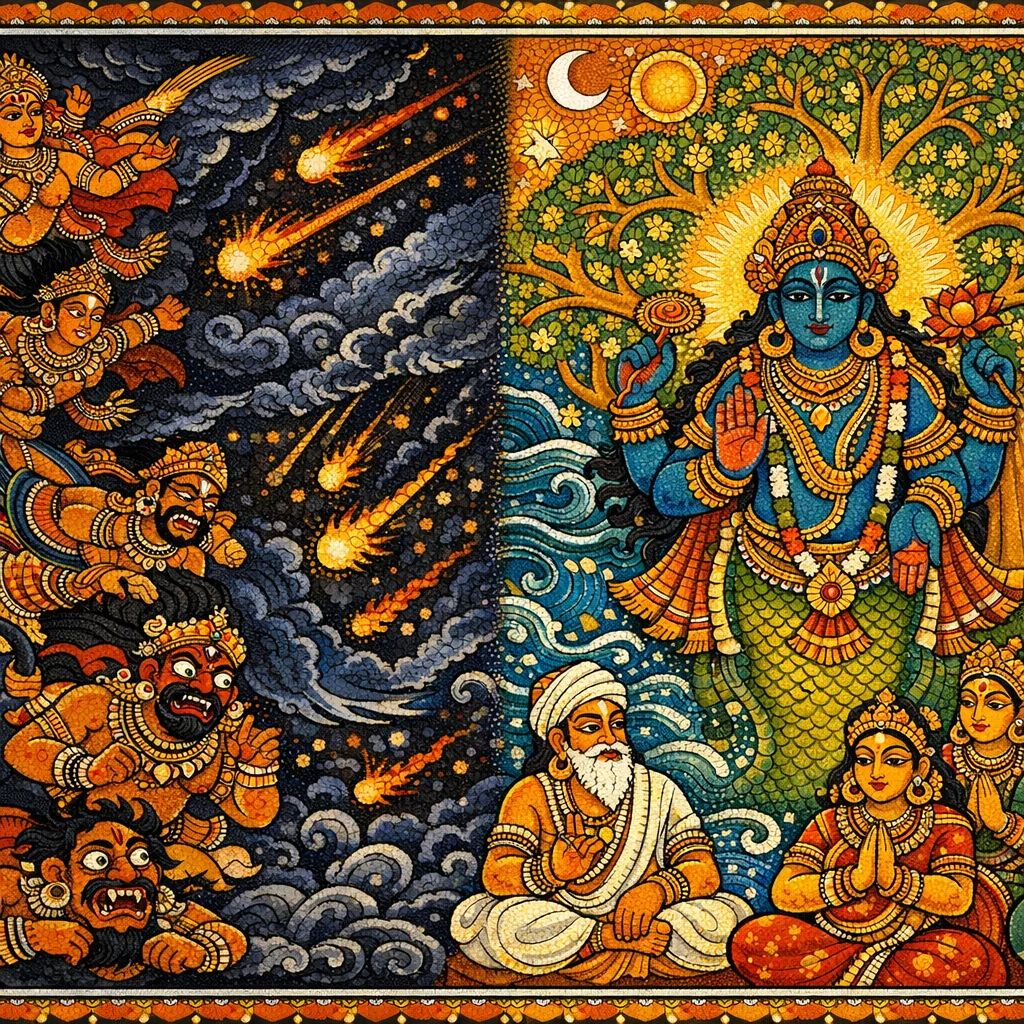
Adhyaya 172: Vishnu’s Names Across Yugas and the Gods’ Refuge During the Tārakāmaya War
विष्णोः विष्णुत्व-हरित्ववर्णनम् तथा तारकामय-युद्धे देवशरणागति-वर्णनम्
Speaker: Lord Matsya (speaker), King (listener/interlocutor)
Matsya addresses the king: he first defines Vishnu’s names and recognitions across yugas and worlds (Hari/Vaikuṇṭha/Kṛṣṇa), stressing the unfathomable depth of the Lord’s karma. Nārāyaṇa is described as the unmanifest source abiding within manifest signs. The account moves from creation (Brahmā → Prajāpatis → Manus and brahma-lineages) to a crisis: after Vṛtra’s slaying, the Tārakāmaya war erupts and the Dānavas rout the gods and their allies. Defeated, the gods take mental refuge in Nārāyaṇa; dire portents darken the universe. Hari then dispels the darkness and reveals a supreme radiant form, praised through vast cosmological similes. Vishnu vows, bound to truth, to destroy the Dānavas and grant victory. With the vow spoken, the omens subside and the cosmos returns to harmony—auspicious winds blow, the luminaries clear, nature and human senses grow calm, sages resume Vedic recitation, and dharma flows again.
Key Concepts
Shlokas in Adhyaya 172
Verse 1
*मत्स्य उवाच विष्णुत्वं शृणु विष्णोश्च हरित्वं च कृते युगे वैकुण्ठत्वं च देवेषु कृष्णत्वं मानुषेषु च //
Lord Matsya said: “Hear about Vishnu’s ‘Vishnu-ness’—and also his aspect as Hari: in the Kṛta Yuga (he is known) as Hari; among the gods (he is revered) as Vaikuṇṭha; and among human beings (he is known) as Kṛṣṇa.”
Verse 2
ईश्वरस्य हि तस्यैषा कर्मणां गहना गतिः संप्रत्यतीतान्भव्यांश्च शृणु राजन्यथातथम् //
For that Lord, the course of actions (karma) is indeed profound and hard to fathom. Now listen, O King, as I relate—just as it truly is—what has occurred in the past and what is yet to come.
Verse 3
अव्यक्तो व्यक्तलिङ्गस्थो य एष भगवान्प्रभुः नारायणो ह्यनन्तात्मा प्रभवो ऽव्यय एव च //
That Lord and Sovereign—Nārāyaṇa—though Himself unmanifest, abides in the marks of the manifest world; He is the infinite Self, the originating source, and indeed the imperishable one.
Verse 4
एष नारायणो भूत्वा हरिरासीत्सनातनः ब्रह्मा वायुश्च सोमश्च धर्मः शक्रो बृहस्पतिः //
Becoming this (all-pervading principle), he was Nārāyaṇa—Hari, the Eternal. From him are (known) Brahmā, Vāyu, Soma, Dharma, Śakra (Indra), and Bṛhaspati.
Verse 5
अदितेरपि पुत्रत्वम् एव याति युगे युगे एष विष्णुरिति ख्यात इन्द्रस्यावरजो विभुः //
In age after age, he indeed comes to be born as a son of Aditi; he is renowned as Vishnu—the mighty younger brother of Indra.
Verse 6
प्रसादजं ह्यस्य विभोर् अदित्याः पुत्रकारणम् वधार्थं सुरशत्रूणां दैत्यदानवरक्षसाम् //
For this son of Aditi was born from the grace of the all-pervading Lord—his very birth being the cause (and means) for the destruction of the enemies of the gods: the Daityas, Dānavas, and Rākṣasas.
Verse 7
प्रधानात्मा पुरा ह्येष ब्रह्माणमसृजत्प्रभुः सो ऽसृजत्पूर्वपुरुषः पुराकल्पे प्रजापतीन् //
In ancient times, the Lord—whose nature encompasses Pradhāna (primordial matter) and Ātman (conscious Self)—created Brahmā. That Primordial Person, in the former aeon, then brought forth the Prajāpatis (progenitor-lords).
Verse 8
असृजन्मानवांस्तत्र ब्रह्मवंशाननुत्तमान् तेभ्यो ऽभवन्महात्मभ्यो बहुधा ब्रह्म शाश्वतम् //
There (in that creation), he brought forth the Manus and the unsurpassed Brahma-lineages; and from those great-souled ones, the eternal Brahmanic order manifested in many forms.
Verse 9
एतदाश्चर्यभूतस्य विष्णोः कर्मानुकीर्तनम् कीर्तनीयस्य लोकेषु कीर्त्यमानं निबोध मे //
Now understand from me this narration that recounts the wondrous deeds of Vishnu—deeds that are fit to be praised in all the worlds, and are indeed being celebrated everywhere.
Verse 10
वृते वृत्रवधे तत्र वर्तमाने कृते युगे आसीत्त्रैलोक्यविख्यातः सङ्ग्रामस्तारकामयः //
After the slaying of Vṛtra had come to its close, in that age of Kṛta (the Golden Age), there occurred the battle famed throughout the three worlds—the war known as Tārakāmaya.
Verse 11
यत्र ते दानवा घोराः सर्वे सङ्ग्रामदुर्जयाः घ्नन्ति देवगणान्सर्वान् सयक्षोरगराक्षसान् //
There, those dreadful Dānava demons—invincible in battle—slay all the hosts of the gods, along with the Yakṣas, Nāgas (serpentine beings), and Rākṣasas.
Verse 12
ते वध्यमाना विमुखाः क्षीणप्रहरणा रणे त्रातारं मनसा जग्मुर् देवं नारायणं प्रभुम् //
Being struck down, turning away in defeat, and with their weapons spent in battle, they turned in their minds to Nārāyaṇa—the Lord God—seeking Him as their Protector.
Verse 13
एतस्मिन्नन्तरे मेघा निर्वाणाङ्गारवर्चसः सार्कचन्द्रग्रहगणं छादयन्तो नभस्तलम् //
Meanwhile, clouds with the dull glow of extinguished embers spread out, veiling the entire sky along with the sun, the moon, and the host of planets.
Verse 14
चण्डा विद्युद्गणोपेता घोरनिर्ह्रादकारिणः अन्योन्यवेगाभिहताः प्रववुः सह मारुताः //
Fierce winds, accompanied by masses of lightning and producing dreadful thunderous roars, blew forth—striking one another with opposing force as they surged.
Verse 15
दीप्ततोयाशनिपनैर् वज्रवेगानलानिलैः रवैः सुघोरैरुत्पातैर् दह्यमानम् इवाम्बरम् //
With blazing torrents, crashing thunder and lightning, winds swift as a thunderbolt, and the rush of fire and storm—amid dreadfully terrifying roars and ominous prodigies—the very sky seemed as though it were being consumed by flames.
Verse 16
तत उल्कासहस्राणि निपेतुः खगतान्यपि दिव्यानि च विमानानि प्रपतन्त्युत्पतन्ति च //
Then thousands of meteors fell; and even divine aerial cars, moving through the sky, were seen plunging down and rising up again.
Verse 17
चतुर्युगान्तपर्याये लोकानां यद्भयं भवेत् अरूपवन्ति रूपाणि तस्मिन्नुत्पातलक्षणे //
At the recurring juncture marking the end of the four-yuga cycle, whatever fear arises among the worlds—then, at that time characterized by ominous portents, even forms become formless (their appearance is distorted and unnatural).
Verse 18
जातं च निष्प्रभं सर्वं न प्राज्ञायत किंचन तिमिरौघपरिक्षिप्ता न रेजुश्च दिशो दश //
Everything became devoid of radiance; nothing at all could be clearly recognized. Enveloped by a mass of darkness, the ten directions no longer shone.
Verse 19
विवेश रूपिणी काली कालमेघावगुण्ठिता द्यौर्न भात्यभिभूतार्का घोरेण तमसावृता //
Then Kālikā—darkness embodied—entered, veiled by black storm-clouds; the sky no longer shone, the sun being overpowered, as a dreadful gloom enveloped everything.
Verse 20
तान्घनौघान्स तिमिरान् दोर्भ्यामाक्षिप्य स प्रभुः वपुः संदर्शयामास दिव्यं कृष्णवपुर्हरिः //
Casting aside those dense masses of darkness with His two arms, that Lord—Hari, of dark-hued body—then revealed His radiant, divine form.
Verse 21
बलाहकाञ्जननिभं बलाहकतनूरुहम् तेजसा वपुषा चैव कृष्णं कृष्णमिवाचलम् //
Dark like the collyrium-black of rain-clouds, with hair like the mass of a cloud, and by the splendor and beauty of his body—black, black indeed—he stands firm like an unmoving mountain.
Verse 22
दीप्तपीताम्बरधरं तप्तकाञ्चनभूषणम् धूमान्धकारवपुषं युगान्ताग्निमिवोत्थितम् //
Wearing blazing yellow garments and adorned with ornaments of heated gold, his body appeared like smoke and darkness—rising up like the fire that flares at the end of an age (yugānta).
Verse 23
चतुर्द्विगुणपीनांसं किरीटच्छन्नमूर्धजम् बभौ चामीकरप्रख्यैर् आयुधैरुपशोभितम् //
He shone forth with shoulders broad and powerfully built, his hair covered by a diadem; and he was further adorned by weapons gleaming like refined gold.
Verse 24
चन्द्रार्ककिरणोद्द्योतं गिरिकूटमिवोच्छ्रितम् नन्दकानन्दितकरं शराशीविषधारिणम् //
Blazing with the radiance of the moon and the sun’s rays, lofty like a mountain-peak; delighting the hand that bears Nandaka, and holding the arrows and the serpent-like poison (i.e., deadly missiles).
Verse 25
शक्तिचित्रबलोदग्रं शङ्खचक्रगदाधरम् विष्णुशैलं क्षमामूलं श्रीवृक्षं शार्ङ्गशृङ्गिणम् //
Depict him as resplendent with wondrous power and towering strength; bearing the conch, discus, and mace; firm as Viṣṇu’s mountain; rooted in forbearance; a tree of prosperity (Śrī); and marked by the horn-bow Śārṅga.
Verse 26
त्रिदशोदारफलदं स्वर्गस्त्रीचारुपल्लवम् सर्वलोकमनःकान्तं सर्वसत्त्वमनोहरम् //
It bestows splendid fruits fit for the gods; its tender shoots are as charming as the women of heaven—delighting the minds of all worlds and enchanting the hearts of all beings.
Verse 27
नानविमानविटपं तोयदाम्बुमधुस्रवम् विद्याहंकारसाराढ्यं महाभूतप्ररोहणम् //
It has many aerial mansions as its branches; its clouds are water, and it drips honey. Enriched with knowledge and the sense of ‘I’, it sprouts forth from the Great Elements.
Verse 28
विशेषपत्रैर्निचितं ग्रहनक्षत्रपुष्पितम् दैत्यलोकमहास्कन्धं मर्त्यलोकप्रकाशितम् //
Dense with distinctive leaves and blossoming with planets and constellations, it stands as a mighty trunk for the Daitya-world—yet it is made manifest to illuminate the world of mortals.
Verse 29
सागराकारनिर्ह्रादं रसातलमहाश्रयम् मृगेन्द्रपाशैर्विततं पक्षजन्तुनिषेवितम् //
Resounding like the ocean, it had Rasātala as its vast foundation; it was spread out with the nooses of lordly beasts, and was frequented by winged creatures.
Verse 30
शीलार्थचारुगन्धाढ्यं सर्वलोकमहाद्रुमम् अव्यक्तानन्तसलिलं व्यक्ताहंकारफेनिलम् //
Rich with virtue, purpose, and pleasing fragrance stands the great cosmic tree that bears all the worlds—set in the boundless waters of the Unmanifest, while the manifest ego-sense rises like foam upon it.
Verse 31
महाभूततरङ्गौघं ग्रहनक्षत्रबुद्बुदम् विमानविहगव्यातं तोयदाडम्बराकुलम् //
It appeared like a surging flood of waves made of the great elements, with planets and constellations rising like bubbles; crowded with aerial chariots and birds, and thrown into tumult by the roaring pageantry of rain-clouds.
Verse 32
जन्तुमत्स्यगणाकीर्णं शैलशङ्खकुलैर्युतम् त्रैगुण्यविषयावर्तं सर्वलोकतिमिङ्गिलम् //
It is crowded with hosts of creatures and fishes, filled with mountains and conch-bearing lineages; it churns as a whirlpool of the objects born of the three guṇas, and for all the worlds it is a devouring sea-monster (timiṅgila).
Verse 33
वीरवृक्षलतागुल्मं भुजगोत्कृष्टशैवलम् द्वादशार्कमहाद्वीपं रुद्रैकादशपत्तनम् //
It should be adorned with heroic (auspicious) trees, creepers, and shrubs; its waters should have excellent algae and be graced by serpents. It should be arranged with twelve ‘sun-like’ great divisions (islands/quarters), and the city should be established with eleven Rudra-sanctuaries (or Rudra-related precincts).
Verse 34
वस्वष्टपर्वतोपेतं त्रैलोक्याम्भोमहोदधिम् संध्यासंख्योर्मिसलिलं सुपर्णानिलसेवितम् //
He described the vast cosmic ocean—the great reservoir of the waters of the three worlds—adorned with mighty mountain-ridges, whose waves were as countless as the twilights, and whose waters were swept and attended by the wind that follows the winged (Garuda-like) flight.
Verse 35
दैत्यरक्षोगणग्राहं यक्षोरगझषाकुलम् पितामहमहावीर्यं सर्वस्त्रीरत्नशोभितम् //
It is to be depicted as seizing hosts of Daityas and Rakṣasas, teeming with Yakṣas, serpents, and great fish; endowed with the mighty prowess of the Grandfather (Brahmā), and adorned with every kind of jewel-like beauty associated with women (i.e., feminine ornaments and precious gems).
Verse 36
श्रीकीर्तिकान्तिलक्ष्मीभिर् नदीभिर् उपशोभितम् कालयोगिमहापर्वप्रलयोत्पत्तिवेगिनम् //
Adorned by rivers that are like prosperity, fame, radiance, and fortune, it rushes forth with the impetuous force of Time—its vast conjunctions and great critical junctures—bringing about the arising of dissolution (pralaya).
Verse 37
तं तु योगमहापारं नारायणमहार्णवम् देवाधिदेवं वरदं भक्तानां भक्तिवत्सलम् //
But Him—Nārāyaṇa, the vast ocean of divine being, the farthest shore of Yoga; the God above all gods; the giver of boons; and the one tenderly devoted to His devotees—they extol.
Verse 38
अनुग्रहकरं देवं प्रशान्तिकरणं शुभम् हर्यश्वरथसंयुक्ते सुपर्णध्वजसेविते //
I worship that gracious God—auspicious and the giver of peace—who is mounted upon a chariot drawn by tawny steeds, and who is attended by the banner bearing Suparṇa (Garuḍa).
Verse 39
ग्रहचन्द्रार्करचिते मन्दराक्षवरावृते अनन्तरश्मिभिर्युक्ते विस्तीर्णे मेरुगह्वरे //
In the vast hollow of Mount Meru—fashioned with the lights of the planets, the Moon, and the Sun—encircled by the noble Mandara and Akṣa mountains, and filled with unbroken rays of radiance.
Verse 40
तारकाचित्रकुसुमे ग्रहनक्षत्रबन्धुरे भयेष्वभयदं व्योम्नि देवा दैत्यपराजिताः //
In that sky—adorned as though with starry, variegated blossoms and made resplendent by planets and constellations—the gods, defeated by the Daityas, sought a giver of fearlessness amid their terrors.
Verse 41
ददृशुस्ते स्थितं देवं दिव्ये लोकमये रथे ते कृताञ्जलयः सर्वे देवाः शक्रपुरोगमाः //
They beheld the Deity standing upon a divine chariot fashioned of the worlds. All the gods—led by Śakra (Indra)—stood with folded hands in reverence.
Verse 42
जयशब्दं पुरस्कृत्य शरण्यं शरणं गताः स तेषां तां गिरं श्रुत्वा विष्णुर्दैवतदैवतम् //
Putting the cry of “Victory!” at the forefront, they took refuge in the Refuge of all. Hearing their utterance, Vishnu—God of gods—(responded).
Verse 43
मनश्चक्रे विनाशाय दानवानां महामृधे आकाशे तु स्थितो विष्णुर् उत्तमं वपुरास्थितः //
In that great battle, Viṣṇu resolved upon the destruction of the Dānavas; stationed in the sky, he assumed his supreme form.
Verse 44
उवाच देवताः सर्वाः सप्रतिज्ञमिदं वचः शान्तिं व्रजत भद्रं वो मा भैष्ट मरुतां गणाः //
All the gods then spoke these pledged words: “Go in peace; welfare be to you. Do not be afraid, O hosts of the Maruts.”
Verse 45
जिता मे दानवाः सर्वे त्रैलोक्यं परिगृह्यताम् ते तस्य सत्यसंधस्य विष्णोर्वाक्येन तोषिताः //
“All the Dānavas have been conquered by me; let the three worlds be taken under (your) dominion.” Thus, they were satisfied by the words of that truth-bound Viṣṇu.
Verse 46
देवाः प्रीतिं समाजग्मुः प्राश्यामृतमिवोत्तमम् ततस्तमः संहृतं तद् विनेशुश्च बलाहकाः //
The gods were filled with delight, as though they had tasted the finest nectar. Then that darkness was drawn back, and the rain-bearing clouds likewise vanished.
Verse 47
प्रववुश्च शिवा वाताः प्रशान्ताश्च दिशो दश शुद्धप्रभाणि ज्योतींषि सोमश्चक्रुः प्रदक्षिणाम् //
Auspicious winds began to blow; the ten directions grew calm. The luminaries shone with purified radiance, and the Moon made a rightward circumambulation.
Verse 48
न विग्रहं ग्रहाश्चक्रुः प्रशान्ताश्चापि सिन्धवः विरजस्काभवन्मार्गा नाकवर्गादयस्त्रयः //
The planets caused no conflict; the rivers too became tranquil. The roads were free from dust, and the three groups beginning with the celestial classes (nāka-varga) were likewise at peace and orderly.
Verse 49
यथार्थमूहुः सरितो नापि चुक्षुभिरे ऽर्णवाः आसञ्छुभानीन्द्रियाणि नराणामन्तरात्मसु //
The rivers flowed on in their proper course, and even the oceans did not heave; likewise, within the inner self of human beings, the senses became calm and auspicious.
Verse 50
महर्षयो वीतशोका वेदान् उच्चैरधीयत यज्ञेषु च हविः पाकं शिवमाप च पावकः //
The great seers, freed from sorrow, recited the Vedas aloud; and in the sacrifices the Fire-god attained an auspicious, sanctifying state through the proper cooking of the oblations.
Verse 51
प्रवृत्तधर्माः संवृत्ता लोका मुदितमानसाः विष्णोर्दत्तप्रतिज्ञस्य श्रुत्वारिनिधने गिरम् //
When they heard the deathless, enemy-destroying utterance of Viṣṇu—who had given his pledged assurance—the worlds became well-ordered again: dharma resumed its course, and people’s hearts were filled with joy.
Frequently Asked Questions
The chapter teaches that Nārāyaṇa/Vishnu is the unmanifest, imperishable source who nevertheless becomes accessible through manifest signs and names (Hari, Vaikuṇṭha, Kṛṣṇa). When cosmic order collapses (as in the Tārakāmaya war), the gods’ refuge (śaraṇāgati) and Vishnu’s truth-bound pledge (satya-saṅkalpa) restore stability: omens cease, nature settles, inner senses become calm, and dharma resumes its course.
This adhyaya is primarily Dharma and cosmology-centered rather than Vastu. It includes (1) creation/genealogy themes—Brahmā’s origin, Prajāpatis, Manus, and brahma-lineages; (2) dharmic world-order—how Vishnu’s vow re-establishes dharma and harmony in the three worlds; and (3) theological identification of Vishnu across yuga and realms (Hari/Vaikuṇṭha/Kṛṣṇa), framed within deva–asura conflict history (Tārakāmaya war).