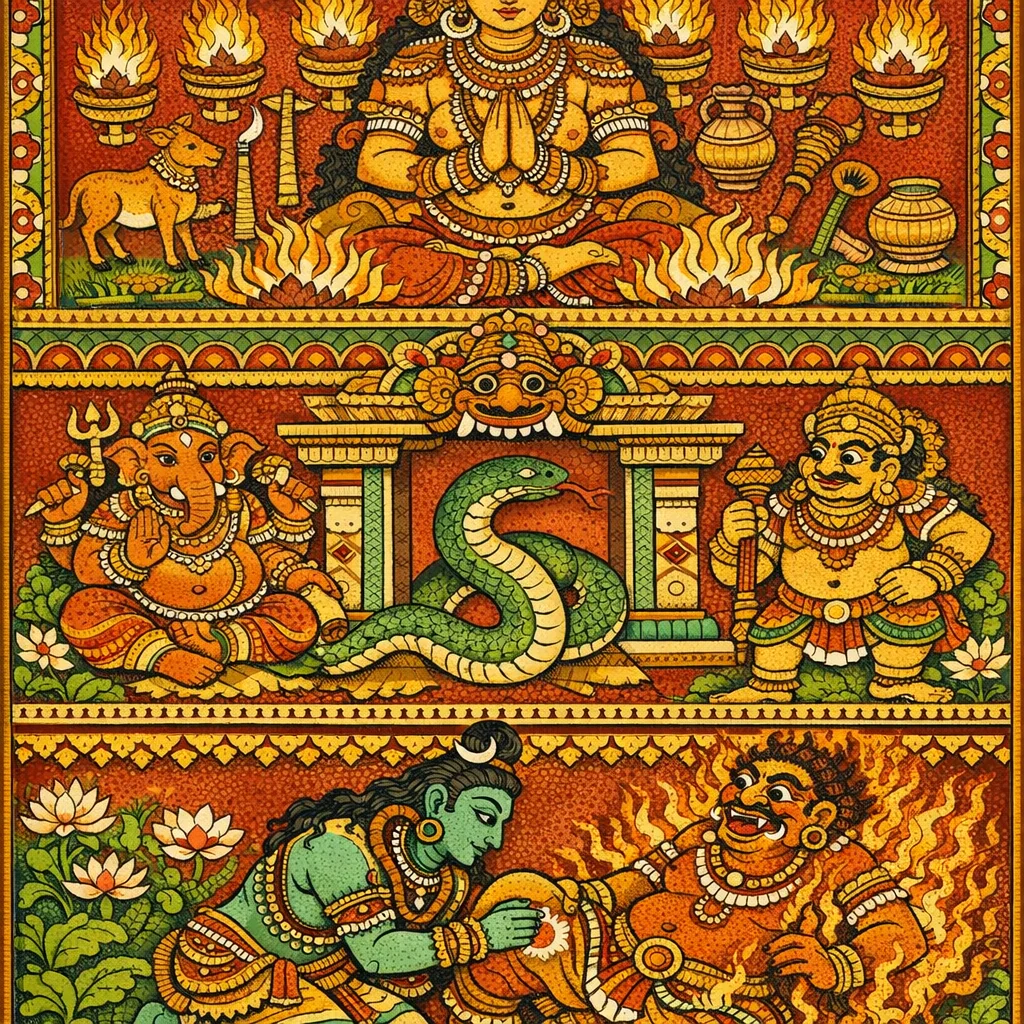
Adhyaya 156: Uma’s Austerities and the Slaying of the Deceiver Asura ĀḌi (Andhaka’s Son)
उमातपश्चर्या-आडिदैत्यच्छलवध-वर्णनम्
Speaker: Sūta, Umā (Girijā/Pārvatī), Brahmā (Padmajanman), Śiva (Śaṅkara/Girīśa/Tripuraghātin), Kusumamodinī (mountain presiding goddess)
Sūta narrates: Kusumamodinī approaches and embraces Girijā, asking where she is going. Girijā explains the cause of Śaṅkara’s anger and gives a confidential injunction—to guard against any association or entry involving another man’s wife—and asks Kusumamodinī to convey a secret teaching once inside Śiva’s mountain sanctuary; she agrees and departs. Umā then goes to her father’s garden and undertakes fierce austerities: wearing bark-cloth, enduring pañcāgni (five fires), immersing in water, and sleeping on the ground. Meanwhile ĀḌi, Andhaka’s son, a daitya (also called Baka’s brother), recalls Brahmā’s boon that he will die only at the second transformation of his form. He infiltrates Śiva’s city as a serpent, evades the gate-guard Vīraka and Gaṇeśa, and by māyā assumes Umā’s form to deceive and kill Śiva. Śiva at first embraces him, then doubts, checks the identifying lotus-mark, recognizes the illusion (Lomāvarta), and slays the asura. Confusion leads to reports, and the mountain-goddess, angered and grieving, curses her son Vīraka.
Key Concepts
Shlokas in Adhyaya 156
Verse 1
*सूत उवाच देवीं सापश्यद् आयान्तीं सखीं मातुर्विभूषिताम् कुसुममोदिनीं नाम तस्य शैलस्य देवताम् //
Sūta said: She then saw the goddess approaching—her mother’s adorned companion—named Kusumamodinī, the presiding deity of that mountain.
Verse 2
सापि दृष्ट्वा गिरिसुतां स्नेहविक्लवमानसा क्व पुत्रि गच्छसीत्युच्चैर् आलिङ्ग्योवाच देवता //
Seeing the daughter of the Mountain (Pārvatī), that goddess—her mind overwhelmed with affection—embraced her and cried aloud, “Daughter, where are you going?”
Verse 3
सा चास्यै सर्वमाचख्यौ शंकरात्कोपकारणम् पुनश्चोवाच गिरिजा देवतां मातृसंमताम् //
She told her everything—the cause of Śaṅkara’s anger. Then Girijā spoke again, indicating the Goddess approved by the Mothers (the Matṛs).
Verse 4
*उमोवाच नित्यं शैलाधिराजस्य देवता त्वमनिन्दिते सर्वतः संनिधानं ते मम चातीव वत्सला //
Umā said: “O blameless one, you are ever the presiding divinity of the King of Mountains (Himālaya). Your presence is on all sides, and you are exceedingly affectionate toward me.”
Verse 5
अतस्तुते प्रवक्ष्यामि यद्विधेयं तदा धिया अन्यस्त्रीसंप्रवेशस्तु त्वया रक्ष्यः प्रयत्नतः //
Therefore, O praised one, I shall declare with discernment what must be done: you must, with earnest effort, guard against the entry or association of another man’s woman within your private sphere.
Verse 6
रहस्यत्र प्रयत्नेन चेतसा सततं गिरौ पिनाकिनः प्रविष्टायां वक्तव्यं मे त्वयानघे //
O sinless one, when you have entered the mountain sanctuary of Pinākin (Śiva), you must, with steady mind and earnest effort, speak to me this secret teaching there.
Verse 7
ततो ऽहं संविधास्यामि यत्कृत्यं तदनन्तरम् इत्युक्ता सा तथेत्युक्त्वा जगाम स्वगिरिं शुभम् //
“Then I shall arrange whatever must be done thereafter.” Thus addressed, she replied, “So be it,” and departed to her own auspicious mountain.
Verse 8
उमापि पितुरुद्यानं जगामाद्रिसुता द्रुतम् अन्तरिक्षं समाविश्य मेघमालामिव प्रभा //
Uma too—the mountain-born daughter—swiftly went to her father’s garden; entering the open sky, she shone like a radiant streak amid a garland of clouds.
Verse 9
ततो विभूषणान्यस्य वृक्षवल्कलधारिणी ग्रीष्मे पञ्चाग्निसंतप्ता वर्षासु च जलोषिता //
Then, having cast off her ornaments, she wore garments of tree-bark; in the summer she endured the heat of the five fires, and in the rainy season she remained immersed in water.
Verse 10
शैशिरासु च रात्रीषु शुष्कस्थण्डिलशायिनी एवं साधयती तत्र तपसा संव्यवस्थिता //
And on the wintry nights, lying upon a dry patch of bare ground, she thus carried out her observance there—steadfast and fully disciplined in austerity.
Verse 11
ज्ञात्वा तु तां गिरिसुतां दैत्यस्तत्रान्तरे वशी अन्धकस्य सुतो दृप्तः पितुर्वधमनुस्मरन् //
But having recognized her as Girisutā (Pārvatī, the daughter of the Mountain), that self-controlled Daitya—Andhaka’s son—became arrogant there and then, recalling the slaying of his father.
Verse 12
देवान्सर्वान्विजित्याजौ बकभ्राता रणोत्कटः आडिर्नामान्तरप्रेक्षी सततं चन्द्रमौलिनः //
Having conquered all the gods in battle, the fierce war‑hero—known as Baka’s brother—ever kept his gaze on the Moon-crested Lord (Śiva), and was also recognized by the alternate name Āḍi.
Verse 13
आजगामामररिपुः पुरं त्रिपुरघातिनः स तत्रागत्य ददृशे वीरकं द्वार्यवस्थितम् //
The foe of the gods came to the city of the slayer of Tripura; arriving there, he saw Vīraka stationed at the gate.
Verse 14
विचिन्त्यासीद्वरं दत्तं स पुरा पद्मजन्मना हते तदान्धके दैत्ये गिरिशेनामरद्विषि //
Reflecting, he recalled the boon once granted by Padmajanman (Brahmā), when Andhaka—the demon who hated the gods—was slain by Girīśa (Śiva).
Verse 15
आडिश्चकार विपुलं तपः परमदारुणम् तमागत्याब्रवीद्ब्रह्मा तपसा परितोषितः //
Āḍi performed abundant austerity—extremely harsh and formidable. Pleased by that penance, Brahmā came to him and spoke.
Verse 16
किमाडे दानवश्रेष्ठ तपसा प्राप्तुमिच्छसि ब्रह्माणमाह दैत्यस्तु निर्मृत्युत्वमहं वृणे //
Brahmā said, “O Āḍi, best of the Dānavas, what do you wish to obtain by your austerities?” The Daitya replied, “I choose freedom from death—immortality.”
Verse 17
*ब्रह्मोवाच न कश्चिच् च विना मृत्युं नरो दानव विद्यते यतस्ततो ऽपि दैत्येन्द्र मृत्युः प्राप्यः शरीरिणा //
Brahmā said: O Dānava, no embodied being exists without death. Therefore, O lord of the Daityas, death is unavoidable for every being that has a body, from whatever quarter it may come.
Verse 18
इत्युक्तो दैत्यसिंहस्तु प्रोवाचाम्बुजसंभवम् रूपस्य परिवर्तो मे यदा स्यात्पद्मसंभव //
Thus addressed, the lion among the Daityas spoke to the Lotus-born (Brahmā): “O Padma-born, when will the transformation of my form take place?”
Verse 19
तदा मृत्युर्मम भवेद् अन्यथा त्वमरो ह्यहम् इत्युक्तस्तु तदोवाच तुष्टः कमलसंभवः //
“Then let death be mine; otherwise you would be immortal while I am (mortal).” Thus addressed, the Lotus-born (Brahmā), being pleased, spoke in reply.
Verse 20
यदा द्वितीयो रूपस्य विवर्तस्ते भविष्यति तदा ते भविता मृत्युर् अन्यथा न भविष्यति //
When the second transformation of your form occurs, then your death will come to pass; it will not happen otherwise.
Verse 21
इत्युक्तो ऽमरतां मेने दैत्यसूनुर् महाबलः तस्मिन्काले तु संस्मृत्य तद्वधोपायमात्मनः //
Thus addressed, the mighty son of the Daitya deemed himself to have attained immortality; but at that very time, recalling for himself the stratagem for his slaying, he reflected upon the means by which he could be killed.
Verse 22
परिहर्तुं दृष्टिपथं वीरकस्याभवत्तदा भुजंगरूपी रन्ध्रेण प्रविवेश दृशः पथम् //
Then, to evade Vīraka’s line of sight, it assumed a serpent’s form and, slipping through a crevice, entered the pathway of his gaze.
Verse 23
परिहृत्य गणेशस्य दानवो ऽसौ सुदुर्जयः अलक्षितो गणेशेन प्रविष्टो ऽथ पुरान्तकम् //
Evading Gaṇeśa, that invincible Dānava—unnoticed by Gaṇeśa—then entered (the place/person called) Purāntaka.
Verse 24
भुजगरूपं संत्यज्य बभूवाथ महासुरः उमारूपी छलयितुं गिरिशं मूढचेतनः //
Abandoning his serpent-form, the great asura then assumed the form of Umā, intending to deceive Girīśa (Śiva)—his mind deluded.
Verse 25
कृत्वा मायां ततो रूपम् अप्रतर्क्यमनोहरम् सर्वावयवसम्पूर्णं सर्वाभिज्ञानसंवृतम् //
Then, employing māyā (mystic illusion), he assumed a form—bewitching yet beyond the reach of reasoning—complete in every limb, and endowed with all marks of omniscience.
Verse 26
कृत्वा मुखान्तरे दन्तान् दैत्यो वज्रोपमान्दृढान् तीक्ष्णाग्रान् बुद्धिमोहेन गिरिशं हन्तुमुद्यतः //
Having fashioned within his mouth teeth—hard as thunderbolts (vajra) and sharp-pointed—the Daitya, his understanding deluded, set out with the intent to slay Girīśa (Śiva).
Verse 27
कृत्वोमारूपसंस्थानं गतो दैत्यो हरान्तिकम् पापो रम्याकृतिश्चित्रभूषणाम्बरभूषितः //
Assuming the guise and appearance of Umā, the sinful demon went into the presence of Hara (Śiva)—his form alluring, adorned with splendid garments and variegated ornaments.
Verse 28
तं दृष्ट्वा गिरिशस्तुष्टस् तदालिङ्ग्य महासुरम् मन्यमानो गिरिसुतां सर्वैरवयवान्तरैः //
Seeing him, Girīśa (Śiva) was pleased; and, embracing that mighty asura, he regarded him—through every limb and feature—as none other than the Daughter of the Mountain (Pārvatī) herself.
Verse 29
अपृच्छत्साधु ते भावो गिरिपुत्रि न कृत्रिमः या त्वं मदाशयं ज्ञात्वा प्राप्तेह वरवर्णिनी //
He asked: “Your intention in asking is truly good, O Daughter of the Mountain; it is not contrived. Having understood what is in my heart, you have come here, O most fair-complexioned one.”
Verse 30
त्वया विरहितं शून्यं मन्यमानो जगत्त्रयम् प्राप्ता प्रसन्नवदना युक्तमेवंविधं त्वयि //
“Thinking the three worlds to be empty without you, I have come to you with a serene face; such a state is indeed fitting in relation to you.”
Verse 31
इत्युक्तो दानवेन्द्रस्तु तदाभाषत्स्मयञ्छनैः न चाबुध्यदभिज्ञानं प्रायस्त्रिपुरघातिनः //
Thus addressed, the lord of the Dānavas replied slowly, with a smile; yet he did not perceive the true recognition (or identity) of the slayer of Tripura, as is usually the case.
Verse 32
*देव्युवाच यातास्म्यहं तपश्चर्तुं वाल्लभ्याय तवातुलम् रतिश्च तत्र मे नाभूत् ततः प्राप्ता त्वदन्तिकम् //
The Goddess said: “I went to perform austerities (tapas) in order to gain your incomparable love. Yet there, no delight arose in me; therefore I have come back into your presence.”
Verse 33
इत्युक्तः शंकरः शङ्कां कांचित्प्राप्यावधारयत् हृदयेन समाधाय देवः प्रहसिताननः //
Thus addressed, Śaṅkara (Śiva), entertaining a certain doubt, reflected inwardly; composing his mind within his heart, the god—his face lit by a gentle smile—resolved what was to be done.
Verse 34
कुपिता मयि तन्वङ्गी प्रकृत्या च दृढव्रता अप्राप्तकामा सम्प्राप्ता किमेतत्संशयो मम //
That slender-limbed woman is angry with me; and by nature she is steadfast in her vows (vrata). Though her desire has not been fulfilled, she has still come here—what is this doubt that has arisen in my mind?
Verse 35
इति चिन्त्य हरस्तस्या अभिज्ञानं विधारयन् नापश्यद्वामपार्श्वे तु तदङ्गे पद्मलक्षणम् //
Thinking thus, Hara (Śiva), holding in mind her identifying sign, looked—but on the left side of her body he did not see the lotus-mark that should have been there.
Verse 36
लोमावर्तं तु रचितं ततो देवः पिनाकधृक् अबुध्यद्दानवीं मायाम् आकारं गूहयंस्ततः //
When the “Lomāvarta” was fashioned, the divine bearer of Pināka (Śiva) understood it to be a Dānava’s illusion; and then, concealing his own form, he proceeded with deliberate strategy.
Verse 37
मेढ्रे वज्रास्त्रमादाय दानवं तमसूदयत् अबुध्यद्वीरको नैव दानवेन्द्रं निषूदितम् //
Seizing the Vajrāstra, the thunderbolt-weapon at his loins, he struck down that Dānava. Yet the hero Vīraka did not realize that the lord of the Dānavas had been slain.
Verse 38
हरेण सूदितं दृष्ट्वा स्त्रीरूपं दानवेश्वरम् अपरिच्छिन्नतत्त्वार्था शैलपुत्र्यै न्यवेदयत् //
Seeing the lord of the Dānavas—who had assumed a woman’s form—slain by Hari, and being unable to discern the true reality of what had occurred, she reported the matter to Śailaputrī, the Daughter of the Mountain.
Verse 39
दूतेन मारुतेनाशुगामिना नगदेवता श्रुत्वा वायुमुखाद्देवी क्रोधरक्तविलोचना अशपद्वीरकं पुत्रं हृदयेन विदूयता //
Hearing from the mouth of the Wind—who had come swiftly as a messenger—the mountain goddess, her eyes reddened with anger, cursed her son Vīraka, her heart burning with grief.
Frequently Asked Questions
The chapter’s central lesson is discernment (viveka) amid deceptive appearances: intense tapas can purify and empower, but māyā can imitate even sacred forms. Śiva’s detection of the false Umā through a missing identifying mark (lotus-lakṣaṇa) frames a dharmic principle—truth must be tested by signs, conduct, and inner consistency, not by surface beauty or persuasive speech.
This adhyaya is primarily Dharma and mythic narrative rather than Vastu. It treats vrata/tapas-dharma (Umā’s austerities), asura-boon logic (Brahmā’s conditional grant), and Shaiva theology (Śiva as Tripuraghātin who neutralizes māyā). Genealogical detail appears indirectly via Andhaka’s son and related demon epithets, but the focus is ethical-spiritual causality and recognition of illusion.
Kusumamodinī is presented as the presiding deity (śailadevata) of Himālaya’s mountain region and an adorned companion associated with Umā’s maternal circle. She functions as a protective intermediary: she embraces Girijā, receives a confidential instruction about guarding against improper association/entry, and is tasked to convey a secret teaching within Śiva’s mountain-sanctuary.
ĀḌi first avoids detection by taking a serpent form and slipping through a crevice, evading the gate context (Vīraka) and even Gaṇeśa. This infiltration sets up the key dramatic device of the chapter: māyā can penetrate boundaries, so divine and human guardianship must include insight, not merely physical vigilance.
Śiva experiences doubt and checks for an identifying sign (abhijñāna/lakṣaṇa). On the left side he does not see the lotus-mark that should be present on Umā. The absence of the expected sign reveals the figure as a Dānava’s illusion (māyā), prompting Śiva to act strategically and slay the deceiver.