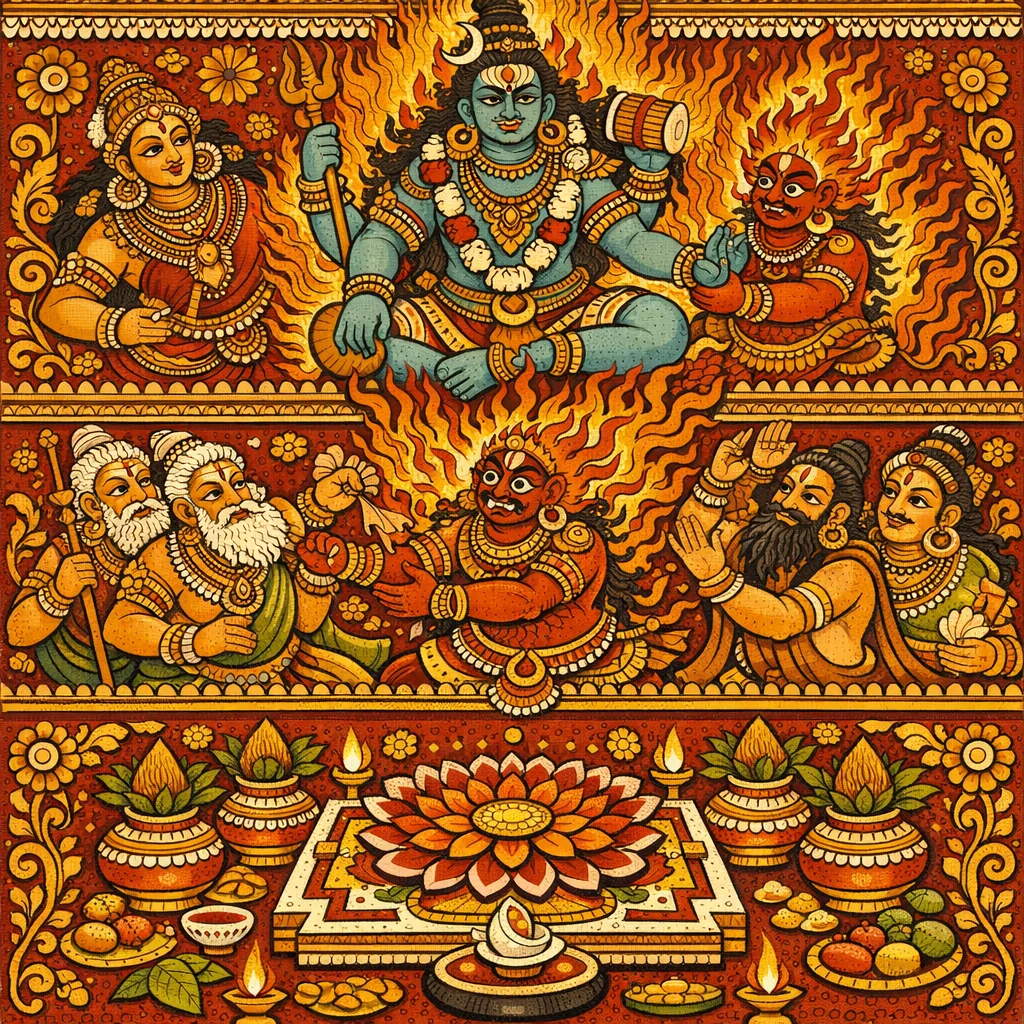
Adhyaya 72: The Greatness and Procedure of the Aṅgāra (Aṅgāraka/Maṅgala) Vrata
अङ्गारव्रत-माहात्म्य-विधि-सम्वादः
Speaker: Īśvara (narrating voice), Yudhiṣṭhira (Dharmaputra), Pippalāda, Śukra (Bhārgava), Virocana
Īśvara introduces a prophesied episode at the close of the Dvāpara age: in Naimiṣāraṇya, Yudhiṣṭhira asks Pippalāda how to gain health, prosperity, dharmic steadfastness, bodily wholeness, and devotion to Śiva/Viṣṇu. Pippalāda prescribes the Aṅgāra-vrata (Aṅgāraka/Maṅgala) and cites an ancient dialogue. In that itihāsa, Śukra tells Virocana he smiled in wonder at the vow’s power, then recounts Angāraka’s origin: a sweat-drop from the wrathful Śiva becomes a blazing being (Vīrabhadra), later restrained and appointed as a peace-giving graha named Aṅgāraka. Śukra then gives the Tuesday Caturthī vrata-vidhi—bath, japa posture, altar/lotus drawing, jars and offerings, dāna of a cow and a gold figure, mantra-based arghya and further gifts—followed by dietary observance and the phala-śruti. Pippalāda concludes that Virocana performed it fully; Yudhiṣṭhira should do likewise for imperishable merit, and Īśvara affirms that even attentive hearing bestows siddhi.
Key Concepts
Shlokas in Adhyaya 72
Verse 1
*ईश्वर उवाच शृणु चान्यद्भविष्यं यद् रूपसम्पद्विधायकम् भविष्यति युगे तस्मिन् द्वापरान्ते पितामह पिप्पलादस्य संवादो युधिष्ठिरपुरःसरैः //
The Lord said: “Hear yet another account of what is to come—one that bestows excellence of form and prosperity. In that age, at the close of the Dvāpara Yuga, O Grandsire, there will occur a dialogue of Pippalāda, with Yudhiṣṭhira and the others in the lead.”
Verse 2
वसन्तं नैमिषारण्ये पिप्पलादं महामुनिम् अभिगम्य तदा चैनं प्रश्नमेकं करिष्यति युधिष्ठिरो धर्मपुत्रो धर्मयुक्तस्तपोधनम् //
While staying in Naimiṣāraṇya, Yudhiṣṭhira—the son of Dharma, devoted to righteousness—approached the great sage Pippalāda, a treasure of ascetic power, and then put to him a single question.
Verse 3
*युधिष्ठिर उवाच कथमारोग्यमैश्वर्यं मतिर्धर्मे गतिस्तथा अव्यङ्गता शिवे भक्तिर् वैष्णवो वा भवेत्कथम् //
Yudhiṣṭhira said: How does one attain health and prosperity? How does one’s mind become established in dharma, and how is one’s right course in life secured? How does one become free from bodily defect, and how does devotion arise—either toward Śiva or as a Vaiṣṇava, a devotee of Viṣṇu?
Verse 4
*ईश्वर उवाच तस्योत्तरमिदं ब्रह्मन् पिप्पलादस्य धीमतः शृणुष्व यद्वक्ष्यति वै धर्मपुत्राय धार्मिकः //
The Lord said: “O Brahmin, hear this reply of the wise Pippalāda—what that righteous one is indeed about to declare to Dharmaputra.”
Verse 5
*पिप्पलाद उवाच साधु पृष्टं त्वया भद्र इदानीं कथयामि ते अङ्गारव्रतम् इत्येतत् स वक्ष्यति महीपतेः //
Pippalāda said: “O auspicious one, you have asked well. Now I shall explain to you this observance called the Aṅgāra-vrata; it will be taught for the benefit of the king.”
Verse 6
अत्राप्युदाहरन्तीमम् इतिहासं पुरातनम् विरोचनस्य संवादं भार्गवस्य च धीमतः //
Here too they cite an ancient traditional account—namely, the dialogue between Virocana and the wise Bhārgava.
Verse 7
प्रह्लादस्य सुतं दृष्ट्वा द्विरष्टपरिवत्सरम् रूपेणाप्रतिमं कान्त्या सो ऽहसद्भृगुनन्दनः //
Seeing Prahlāda’s son—sixteen years of age—unsurpassed in form and radiant with beauty, that descendant of Bhṛgu smiled.
Verse 8
साधु साधु महाबाहो विरोचन शिवं तव तत्तथा हसितं तस्य पप्रच्छ सुरसूदनः //
“Well said, well said, O mighty-armed Virocana—may auspiciousness be yours.” Having spoken thus, Surasūdana then asked him about that very smile.
Verse 9
ब्रह्मन्किमर्थमेतत्ते हास्यमाकस्मिकं कृतम् साधुसाध्विति मामेवम् उक्तवांस्त्वं वदस्व मे //
O Brahman, for what reason did you suddenly laugh like this? You said to me, “Well done, well done”—tell me why you spoke so.
Verse 10
तमेवंवादिनं शुक्र उवाच वदतां वरः विस्मयाद्व्रतमाहात्म्याद् धास्यमेतत्कृतं मया //
To him who spoke thus, Śukra—the best among speakers—said: “Out of wonder at the greatness of this vow (vrata), I have uttered this hymn/statement.”
Verse 11
पुरा दक्षविनाशाय कुपितस्य तु शूलिनः अथ तद्भीमवक्त्रस्य स्वेदबिन्दुर्ललाटजः //
Long ago, when the trident-bearing Lord (Śiva) was enraged for the destruction of Dakṣa, then from the forehead of that One of dreadful countenance there arose a bead of sweat.
Verse 12
भित्त्वा स सप्त पातालान् अदहत्सप्त सागरान् अनेकवक्त्रनयनो ज्वलज्ज्वलनभीषणः //
Breaking through the seven netherworlds, he scorched the seven oceans—many-faced and many-eyed, dreadful with blazing fire.
Verse 13
वीरभद्र इति ख्यातः करपादायुतैर्युतः कृत्वासौ यज्ञमथनं पुनर्भूतलसम्भवः त्रिजगन्निर्दहन्भूयः शिवेन विनिवारितः //
He became renowned as Vīrabhadra, endowed with a thousand hands and feet. Having shattered the sacrificial rite, he again emerged upon the earth; and when he once more began to burn the three worlds, Śiva restrained him.
Verse 14
कृतं त्वया वीरभद्र दक्षयज्ञविनाशनम् इदानीमलमेतेन लोकदाहेन कर्मणा //
O Vīrabhadra, you have already accomplished the destruction of Dakṣa’s sacrifice. Now let this be enough—cease this deed that scorches the worlds.
Verse 15
शान्तिप्रदाता सर्वेषां ग्रहाणां प्रथमो भव प्रेक्षिष्यन्ते जनाः पूजां करिष्यन्ति वरान्मम //
Become the foremost among all the planets, the bestower of peace. People will look upon you and will perform worship—granting boons in accordance with my command.
Verse 16
अङ्गारक इति ख्यातिं गमिष्यसि धरात्मज देवलोके ऽद्वितीयं च तव रूपं भविष्यति //
O son of the Earth, you shall attain renown by the name “Aṅgāraka”; and in the world of the gods, your form shall become unrivalled (without a second).
Verse 17
ये च त्वां पूजयिष्यन्ति चतुर्थ्यां त्वद्दिने नराः रूपमारोग्यमैश्वर्यं तेष्वनन्तं भविष्यति //
And those men who will worship you on the fourth lunar day—your sacred day—will obtain beauty, health, and prosperity; for them, these blessings will be endless.
Verse 18
एवमुक्तस्तदा शान्तिम् अगमत् कामरूपधृक् संजातस्तत्क्षणाद्राजन् ग्रहत्वम् अगमत्पुनः //
Thus addressed, the shape-shifting being at once became calm; and, O King, in that very moment—having manifested—he again assumed the state of a graha (a seizing and afflicting spirit).
Verse 19
स कदाचिद्भवांस्तस्य पूजार्घ्यादिकमुत्तमम् दृष्टवान्क्रियमाणं च शूद्रेण च व्यवस्थितः //
Once, you happened to see his excellent acts of worship—such as the offering of arghya and the like—being performed, duly arranged, by a Śūdra.
Verse 20
तेन त्वं रूपवाञ्जातः सुरशत्रुकुलोद्वह विविधा च रुचिर्जाता यस्मात्तव विदूरगा //
Therefore you have been born handsome, O foremost bearer of the race of the foes of the gods; and a manifold radiance has arisen in you, for your brilliance is far-reaching.
Verse 21
विरोचन इति प्राहुस् तस्मात्त्वां देवदानवाः शूद्रेण क्रियमाणस्य व्रतस्य तव दर्शनात् ईदृशीं रूपसम्पत्तिं दृष्ट्वा विस्मितवानहम् //
They call you “Virocana”; therefore the gods and the Dānavas alike—having witnessed your vow (vrata) being performed even by a Śūdra—on seeing such splendor of form in you, I have become amazed.
Verse 22
साधु साध्विति तेनोक्तम् अहो माहात्म्यमुत्तमम् पश्यतो ऽपि भवेद्रूपम् ऐश्वर्यं किमु कुर्वतः //
“Excellent, excellent!”—so he exclaimed: “Ah, what supreme greatness is this!” Even by merely beholding it, beauty of form and lordly prosperity arise—how much more for one who truly performs it?
Verse 23
यस्माच्च भक्त्या धरणीसुतस्य विनिन्द्यमानेन गवादिदानम् आलोकितं तेन सुरारिगर्भे सम्भूतिरेषा तव दैत्य जाता //
And because, with devotion to the “son of the Earth” (the king), you merely looked upon the gift of cows and the like while it was being disparaged, therefore you have taken birth from the womb of an enemy of the gods—born now as a Daitya.
Verse 24
*ईश्वर उवाच अथ तद्वचनं श्रुत्वा भार्गवस्य महात्मनः प्रह्रादनन्दनो वीरः पुनः पप्रच्छ विस्मितः //
The Lord said: Having heard the words of the great-souled Bhārgava, the heroic son of Prahrāda, astonished, questioned him again.
Verse 25
*विरोचन उवाच भगवंस्तद्व्रतं सम्यक् श्रोतुमिच्छामि तत्त्वतः दीयमानं तु यद्दानं मया दृष्टं भवान्तरे //
Virocana said: “O Blessed Lord, I wish to hear, correctly and in its true principles, about that vow (vrata). And I also wish to understand that gift (dāna) which I saw being given in another time (in a different existence/age).”
Verse 26
माहात्म्यं च विधिं तस्य यथावद्वक्तुमर्हसि इति तद्वचनं श्रुत्वा पुनः प्रोवाच विस्तरात् //
“You ought to explain, in the proper manner, both its greatness and its prescribed procedure (vidhi).” Hearing these words, he again spoke at length.
Verse 27
*शुक्र उवाच चतुर्थ्यङ्गारकदिने यदा भवति दानव मृदा स्नानं तदा कुर्यात् पद्मरागविभूषितः //
Śukra said: “O Dānava, when the fourth lunar day (Caturthī) falls on a Tuesday (Aṅgāraka-day), one should then perform a purificatory bath with sacred earth (mṛdā), adorned with a padmarāga ruby.”
Verse 28
अग्निर्मूर्धा दिवो मन्त्रं जपन्नास्ते उदङ्मुखः शूद्रस्तूष्णीं स्मरन्भौमम् आस्ते भोगविवर्जितः //
With Agni as the foremost (‘head’), one should sit facing north and recite the heavenly mantra. But a Śūdra should sit in silence, remembering what is earthly (bhauma), and remain free from indulgence.
Verse 29
तथास्तमित आदित्ये गोमयेनानुलेपयेत् प्राङ्गणं पुष्पमालाभिर् अक्षताभिः समन्ततः //
Then, when the sun has set, one should smear the courtyard with cow-dung and adorn it on all sides with garlands of flowers and with unbroken rice-grains (akṣata).
Verse 30
अभ्यर्च्याभिलिखेत्पद्मं कुङ्कुमेनाष्टपत्त्रकम् कुङ्कुमस्याप्यभावे तु रक्तचन्दनमिष्यते //
After performing worship, one should draw an eight-petalled lotus with kuṅkuma (saffron). If kuṅkuma is unavailable, red sandalwood paste is prescribed instead.
Verse 31
चत्वारः करकाः कार्या भक्ष्यभोज्यसमन्विताः तण्डुलै रक्तशालीयैः पद्मरागैश्च संयुताः //
Four water-jars (karakas) should be prepared, furnished with foods to eat and foods to be enjoyed; they should be accompanied by grains of red śālī rice and by padmarāga gemstones.
Verse 32
चतुष्कोणेषु तान्कृत्वा फलानि विविधानि च गन्धमाल्यादिकं सर्वं तथैव विनिवेदयेत् //
Having placed those offerings at the four corners, one should likewise present various kinds of fruits, and also everything such as perfumes and garlands, as offerings.
Verse 33
सुवर्णशृङ्गीं कपिलाम् अथार्च्य रौप्यैः सुरैः कांस्यदोहां सवत्साम् धुरंधरं रक्तमतीव सौम्यं धान्यानि सप्ताम्बरसंयुतानि //
After duly worshipping a tawny (kapilā) cow whose horns are sheathed in gold and adorning her with silver ornaments, one should offer a milch-cow that yields her milk into a bronze vessel, together with her calf—fit for the yoke, red-hued, and exceedingly gentle—along with grains, accompanied by seven garments.
Verse 34
अङ्गुष्ठमात्रं पुरुषं तथैव सौवर्णमत्यायतबाहुदण्डम् चतुर्भुजं हेममये निविष्टं पात्रे गुडस्योपरि सर्पियुक्ते //
Likewise, one should fashion a thumb-sized male figure, made of gold, with elongated arms; four-armed, it should be set within a golden vessel, placed upon jaggery and mixed with clarified butter (ghee).
Verse 35
समस्तयज्ञाय जितेन्द्रियाय पात्राय शीलान्वयसंयुताय दातव्यमेतत्सकलं द्विजाय कुटुम्बिने नैव तु दाम्भिकाय समर्पयेद्विप्रवराय भक्त्या कृताञ्जलिः पूर्वमुदीर्य मन्त्रम् //
One should give this entire offering to a twice-born Brahmin who is fit to receive—self-controlled, devoted to sacrificial duties, and endowed with good conduct and noble lineage—especially one who maintains a household; but never to a hypocrite. With devotion, having joined the palms, one should present it to an excellent Brahmin, first reciting the prescribed mantra.
Verse 36
भूमिपुत्र महाभाग स्वेदोद्भव पिनाकिनः रूपार्थी त्वां प्रपन्नो ऽहं गृहाणार्घ्यं नमो ऽस्तु ते //
O noble son of the Earth, O greatly fortunate one—O sweat-born attendant of the wielder of the Pināka (Śiva)—seeking a divine form, I have taken refuge in you. Accept this arghya-offering; homage be to you.
Verse 37
मन्त्रेणानेन दत्त्वार्घ्यं रक्तचन्दनवारिणा ततो ऽर्चयेद्विप्रवरं रक्तमाल्याम्बरादिभिः //
Having offered the arghya with this mantra, using water scented with red sandalwood, one should then worship the foremost Brahmana with red garlands, red garments, and similar offerings.
Verse 38
दद्यात्तेनैव मन्त्रेण भौमं गोमिथुनान्वितम् शय्यां च शक्तितो दद्यात् सर्वोपस्करसंयुताम् //
Using that very same mantra, one should donate a piece of land together with a pair of cows; and, according to one’s means, one should also give a bed fully furnished with all its accessories.
Verse 39
यद्यदिष्टतमं लोके यच्चास्य दयितं गृहे तत्तद्गुणवते देयं तदेवाक्षय्यमिच्छता //
Whatever one holds most dear in the world, and whatever is most beloved within one’s home—those very things should be given to a worthy person; for the one who seeks undiminishing merit, that alone becomes truly inexhaustible.
Verse 40
प्रदक्षिणं ततः कृत्वा विसर्ज्य द्विजपुंगवम् नक्तमक्षारलवणम् अश्नीयाद्घृतसंयुतम् //
Then, having circumambulated respectfully and having taken leave of that foremost Brahmin, one should eat a night-meal consisting of grains without alkaline additives, with salt, and mixed with ghee.
Verse 41
भक्त्या यस्तु पुनः कुर्याद् एवमङ्गारकाष्टकम् चतुरो वाथ वा तस्य यत्पुण्यं तद्वदामि ते //
But whoever, with devotion, recites this Aṅgārakāṣṭaka again—whether four times, or even more—of that person, the spiritual merit earned, I shall now tell you.
Verse 42
रूपसौभाग्यसम्पन्नः पुनर्जन्मनि जन्मनि विष्णौ वाथ शिवे भक्तः सप्तद्वीपाधिपो भवेत् //
Endowed with beauty and auspicious fortune, from birth to birth one becomes a devotee of either Viṣṇu or Śiva, and may even become the sovereign lord of the seven continents (saptadvīpas).
Verse 43
सप्त कल्पसहस्राणि रुद्रलोके महीयते तस्मात्त्वमपि दैत्येन्द्र व्रतमेतत्समाचर //
For seven thousand kalpas one is honoured in Rudra’s world; therefore, O lord of the Daityas, you too should duly undertake this vow (vrata).
Verse 44
*पिप्पलाद उवाच इत्येवमुक्त्वा भृगुनन्दनो ऽपि जगाम दैत्यश्च चकार सर्वम् त्वं चापि राजन्कुरु सर्वमेतद् यतो ऽक्षयं वेदविदो वदन्ति //
Pippalāda said: “Having spoken thus, the son of Bhṛgu also departed, and the Daitya carried out everything. You too, O King, should perform all of this, for those who know the Veda declare it to yield imperishable merit.”
Verse 45
*ईश्वर उवाच तथेति सम्पूज्य स पिप्पलादं वाक्यं चकाराद्भुतवीर्यकर्मा शृणोति यश्चैनमनन्यचेतास् तस्यापि सिद्धिं भगवान्विधत्ते //
The Lord said: “So be it.” Having duly honoured Pippalāda, he—whose valour and deeds were wondrous—spoke these words. And whoever listens to this with an undivided mind, for him too the Blessed Lord ordains spiritual accomplishment (siddhi).
Frequently Asked Questions
The chapter teaches that health, prosperity, bodily completeness, dharmic steadiness, and devotion can be cultivated through the Aṅgāra-vrata—especially when Caturthī coincides with Tuesday—performed with correct worship, mantra-based arghya, disciplined conduct, and substantial dāna to a worthy Brahmin. It emphasizes both ritual precision (vidhi) and ethical giving (pātratā).
The adhyāya primarily belongs to Vrata-Dharma and Graha-Śānti (planetary pacification) rather than Vāstu or genealogy. It includes dharmic discipline (fasting/night meal rules), dāna protocols, and a mythic-theological account linking Śiva, Vīrabhadra, and the graha Aṅgāraka (Mars).
Aṅgāraka is presented as a graha-form established by Śiva after the Dakṣa-yajña episode: a fiery being arising from Śiva’s sweat (identified with Vīrabhadra’s destructive blaze) is restrained and appointed as the foremost planet/graha who grants peace, worshipped for beauty, health, and prosperity.
Key steps include: purificatory bath with sacred earth; north-facing japa (with a special instruction of silent remembrance for a Śūdra); evening courtyard purification with cow-dung; decorating with flowers and unbroken rice; drawing an eight-petalled lotus with saffron or red sandal; arranging four jars with foods, red śālī rice, and padmarāga; offering fruits, perfumes, garlands; worship and donation involving a kapilā cow and further gifts; arghya with the given mantra; honoring a worthy Brahmin; then a regulated night meal (non-alkaline grains with salt and ghee).
It promises beauty (rūpa), health (ārogya), prosperity/lordly fortune (aiśvarya), repeated good birth, arising of devotion to Śiva or Viṣṇu, potential sovereignty imagery (saptadvīpa lordship), long honor in Rudra’s world, and siddhi even for focused listeners of the teaching.