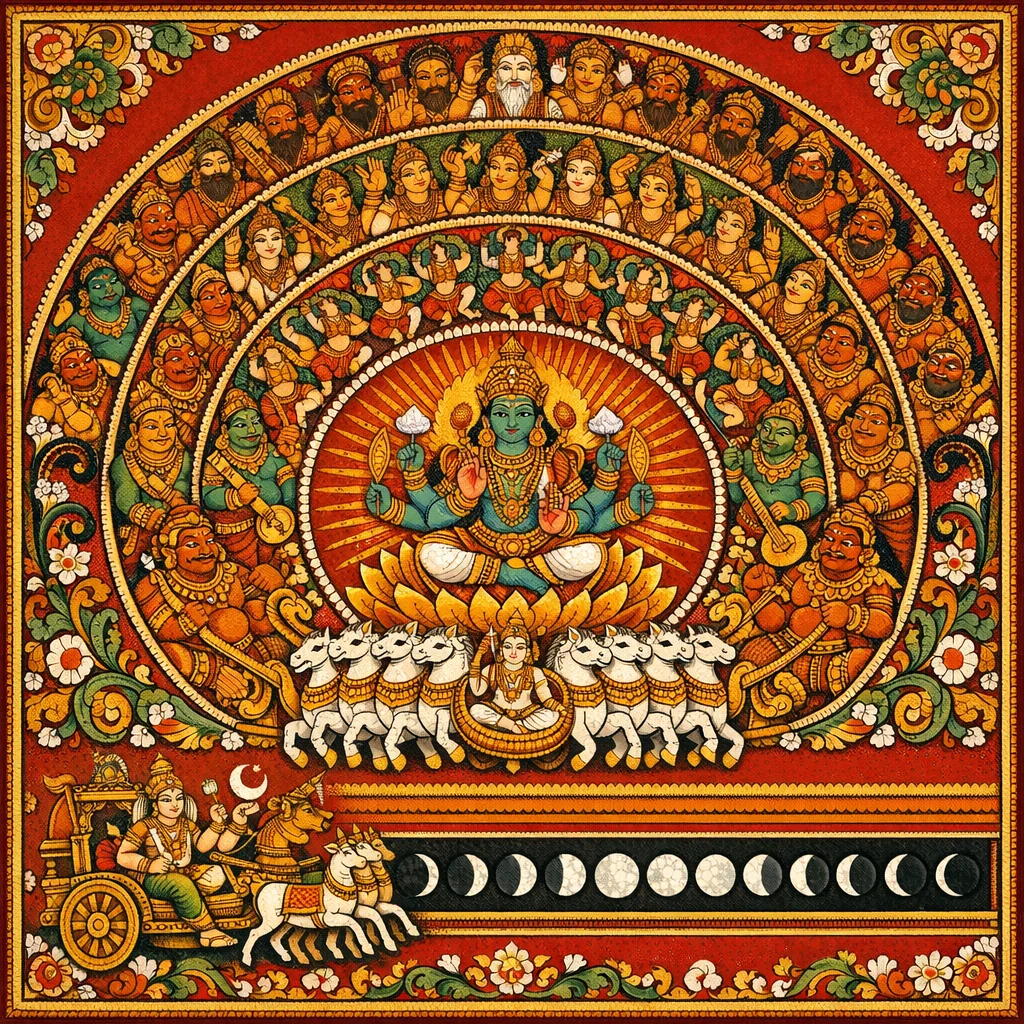
Adhyaya 126: The Attendant Hosts of the Sun and Moon: Monthly Gaṇas, Chariots, and the Waxing–Waning of Soma
सूर्यचन्द्ररथगणवर्णनम्
Speaker: Suta
Sūta continues the cosmological teaching by listing, in ordered sequences, the beings who accompany and preside with Sūrya through the months and seasons—Prajāpatis/Ādityas, Ṛṣis, Gandharvas, Apsarases, Nāgas, Yakṣas, Rākṣasas, and Yātudhānas. He explains their offices of praise, song-and-dance worship, marshalling the rays, and protection, presenting them as station-bearing powers (sthānābhimānin) working through the Manvantaras. The account then turns to process: how the Sun’s rays refine ambrosia, drive the water cycle, and satisfy Devas and Pitṛs at calendrical intervals. Finally, Sūta describes the Moon’s chariot, names its horses, and teaches Soma’s waxing and waning through the fortnightly “drinking” of his kalās by Devas and Pitṛs, linking astronomy with ritual observance (Paurṇamāsī/Amāvāsyā).
Key Concepts
Shlokas in Adhyaya 126
Verse 1
*सूत उवाच स रथो ऽधिष्ठितो देवैर् मासि मासि यथाक्रमम् ततो वहत्यथादित्यं बहुभिर् ऋषिभिः सह //
Sūta said: That chariot is presided over by the gods, month after month, in due order; thereafter it bears along Āditya (the Sun), accompanied by many Ṛṣis.
Verse 2
गन्धर्वैरप्सरोभिश्च सर्पग्रामणिराक्षसैः एते वसन्ति वै सूर्ये मासौ द्वौ द्वौ क्रमेण च //
Gandharvas, Apsarases, the leaders of the Nāga-tribes, and Rākṣasas—these dwell with the Sun, each group in due order for two months at a time.
Verse 3
धातार्यमा पुलस्त्यश्च पुलहश्च प्रजापती उरगौ वासुकिश्चैव संकीर्णश्चैव तावुभौ //
Dhātā and Aryaman, Pulastya and Pulaha—these are Prajāpatis; and among the serpent-beings are Vāsuki and Saṃkīrṇa—these two are mentioned together.
Verse 4
तुम्बुरुर् नारदश्चैव गन्धर्वौ गायतां वरौ कृतस्थलाप्सराश्चैव या च सा पुञ्जिकस्थला //
Tumburu and Nārada—both eminent Gandharvas among singers—together with the Apsarā Kṛtasthalā, and also she who is called Puñjikasthalā, are mentioned here.
Verse 5
ग्रामण्यौ रथकृत्तस्य रथौजाश्चैव तावुभौ रक्षो हेतिः प्रहेतिश्च यातुधानावुभौ ऋतौ //
For Rathakṛt, the two village-heads were Rathaujā and another of the same rank; and the two were the rākṣasas Heti and Praheti—both yātudhānas—according to their proper order and season.
Verse 6
मधुमाधवयोर्ह्येष गणो वसति भास्करे वसन्ग्रीष्मे तु द्वौ मासौ मित्रश्च वरुणश्च वै //
This very troop (of deities) abides in the Sun during the months of Madhu and Mādhava. In the seasons of spring and summer, those two months are indeed presided over by Mitra and Varuṇa.
Verse 7
ऋषी अत्रिर्वसिष्ठश्च नागौ तक्षकरम्भकौ मेनका सहजन्या च हाहा हूहूश्च गायकौ //
The sages Atri and Vasiṣṭha; the Nāgas Takṣaka and Rambhaka; the Apsarases Menakā and Sahajanyā; and the Gandharva singers Hāhā and Hūhū—these are named here.
Verse 8
रथंतरश्च ग्रामण्यौ रथकृच्चैव तावुभौ पुरुषादो वधश्चैव यातुधानौ तु तौ स्मृतौ //
Rathaṃtara and Grāmaṇya, as well as Rathakṛt—these two; and likewise Puruṣāda and Vadha—these two—are remembered as Yātudhānas (demonic beings).
Verse 9
एते वसन्ति वै सूर्ये मासयोः शुचिशुक्रयोः ततः सूर्ये पुनश्चान्या निवसन्ति स्म देवताः //
These deities indeed dwell in the Sun during the two months Śuci and Śukra; thereafter, again, other deities are said to reside in the Sun.
Verse 10
इन्द्रश्चैव विवस्वांश्च अङ्गिरा भृगुरेव च एलापत्त्रस्तथा सर्पः शङ्खपालश्च पन्नगः //
Indra and Vivasvān (the Sun), and also the sages Aṅgiras and Bhṛgu; likewise Elāpattra, the serpent, and Śaṅkhapāla, the nāga (serpent-lord).
Verse 11
विश्वावसुसुषेणौ च प्रातश्चैव रथश्च हि प्रम्लोचेत्यप्सराश्चैव निम्रोचन्ती च ते उभे //
And (the Gandharvas) Viśvāvasu and Suṣeṇa; and also Prāta and Ratha indeed. And the Apsarases are named Pramlocā, and also Nimrocantī—these two being the pair mentioned.
Verse 12
यातुधानस्तथा हेतिर् व्याघ्रश्चैव तु तावुभौ नभस्यनभसोरेतैर् वसन्तश्च दिवाकरे //
Likewise, Yātudhāna and Heti—and also Vyāghra—these pairs are associated with the months Nabhasya and Nabhas; and they are connected with Vasanta (the spring season) and with Divākara (the Sun).
Verse 13
मासौ द्वौ देवताः सूर्ये वसन्ति च शरदृतौ पर्जन्यश्चैव पूषा च भरद्वाजः सगौतमः //
For the two months of the autumn season (Śarad), the presiding deities are Parjanya and Pūṣan; and the associated seers are Bharadvāja and Gautama.
Verse 14
चित्रसेनश्च गन्धर्वस् तथा वा सुरुचिश्च यः विश्वाची च घृताची च उभे ते पुण्यलक्षणे //
Citrāsena the Gandharva, and likewise Suruci; and the Apsarases Viśvācī and Ghṛtācī—both are described as bearing auspicious characteristics.
Verse 15
नागश्चैरावतश्चैव विश्रुतश्च धनंजयः सेनजिच्च सुषेणश्च सेनानीर् ग्रामणीस् तथा //
Also there were Nāga and Airāvata, and likewise Viśruta and Dhanaṃjaya; Senajit and Suṣeṇa too—serving as army-commanders and also as village or clan chiefs.
Verse 16
चारो वातश्च द्वावेतौ यातुधानावुभौ स्मृतौ वसन्त्येते च वै सूर्ये मासयोश्च त्विषोर्जयोः //
Cāra and Vāta—these two are remembered as a pair of Yātudhānas. They are said to abide in the Sun, presiding over the two months and over the victory of brilliance (radiance).
Verse 17
हैमन्तिकौ च द्वौ मासौ निवसन्ति दिवाकरे अंशो भगश्च द्वावेतौ कश्यपश्च क्रतुश्च तौ //
During the two winter months (Hemanta), these dwell in the Sun: the two Ādityas—Aṁśa and Bhaga—and likewise the two sages—Kaśyapa and Kratu.
Verse 18
भुजंगश्च महापद्मः सर्पः कर्कोटकस्तथा चित्रसेनश्च गन्धर्वः पूर्णायुश्चैव गायनौ //
Bhujaṅga, Mahāpadma, Sarpa, and likewise Karkoṭaka; and the Gandharva Citrāsena, and also Pūrṇāyu—these are renowned celestial singers.
Verse 19
अप्सराः पूर्वचित्तिश्च गन्धर्वा ह्युर्वशी च या तार्क्ष्यश्चारिष्टनेमिश्च सेनानीर् ग्रामणीश् च तौ //
The Apsarases—Pūrvacitti and also Urvaśī—are mentioned; and the Gandharvas; likewise Tārkṣya and Ariṣṭanemi, and the two functionaries, the Senānī (commander) and the Grāmaṇī (leader of troops/settlements).
Verse 20
विद्युत्सूर्यश्च तावुग्रौ यातुधानौ तु तौ स्मृतौ सहे चैव सहस्ये च वसन्त्येते दिवाकरे //
Vidyutsūrya and (another named) Sūrya—those two are remembered as fierce yātudhānas (demonic beings). They dwell in the Sun during the months of Sahā and Sahasya.
Verse 21
ततस्तु शिशिरे चापि मासयोर्निवसन्ति ते त्वष्टा विष्णुर्जमदग्निर् विश्वामित्रस्तथैव च //
Then, in the two months of the cold season (Śiśira) they dwell—namely Tvaṣṭṛ, Viṣṇu, Jamadagni, and likewise Viśvāmitra.
Verse 22
काद्रवेयौ तथा नागौ कम्बलाश्वतरावुभौ गन्धर्वौ धृतराष्ट्रश्च सूर्यवर्चाश्च तावुभौ //
Likewise, the two Kādraveya Nāgas—Kambala and Aśvatara—are named; and among the Gandharvas, the two are Dhṛtarāṣṭra and Sūryavarcā.
Verse 23
तिलोत्तमाप्सराश्चैव देवी रम्भा मनोरमा ग्रामणीर् ऋतजिच्चैव सत्यजिच्च महाबलः //
Tilottamā, the apsaras; the divine Rambhā; the charming Manoramā; Grāmaṇī; and also Ṛtajit and Satyajit—heroes of great strength—are counted among those famed ones.
Verse 24
ब्रह्मोपेतश्च वै रक्षो यज्ञोपेतस्तथैव च इत्येते निवसन्ति स्म द्वौ द्वौ मासौ दिवाकरे //
Thus, the Rakṣa named Brahmopeta and likewise the Rakṣa named Yajñopeta reside in association with the Sun, two months each.
Verse 25
स्थानाभिमानिनो ह्येते गणा द्वादश सप्तकाः सूर्यमापादयन्त्येते तेजसा तेज उत्तमम् //
These attendant hosts—twelve groups arranged in sevens—preside with authority over their allotted stations; and by their own radiance they sustain and manifest the Sun, the supreme brilliance itself.
Verse 26
ग्रथितैस्तु वचोभिश्च स्तुवन्ति ऋषयो रविम् गन्धर्वाप्सरसश्चैव गीतनृत्यैरुपासते //
With well-composed words, the sages hymn and praise Ravi (the Sun); and the Gandharvas and Apsarases likewise worship him through song and dance.
Verse 27
विद्याग्रामणिनो यक्षाः कुर्वन्त्याभीषुसंग्रहम् सर्पाः सर्पन्ति वै सूर्ये यातुधानानुयान्ति च //
The Yakṣas, led by Vidyāgrāmaṇi, gather and marshal the Sun’s rays; the serpents glide upon the Sun, and the Yātudhānas also follow in his train.
Verse 28
वालखिल्या नयन्त्यस्तं परिवार्योदयाद्रविम् एतेषामेव देवानां यथावीर्यं यथातपः //
The Vālakhilyas, surrounding the Sun from his rising onward, lead him to his setting. Thus, among these divine beings, each performs according to his own power and ascetic heat (tapas).
Verse 29
यथायोगं यथाधर्मं यथातत्त्वं यथाबलम् तथा तपत्यसौ सूर्यस् तेषामिद्धस्तु तेजसा //
In keeping with their proper conjunction and discipline, with dharma, with the true nature of things, and with their capacity, thus indeed does that Sun shine and burn—kindled for them by his own radiance.
Verse 30
भूतानामशुभं सर्वं व्यपोहति स्वतेजसा मानवानां शुभैर्ह्येतैर् ह्रियते दुरितं तु वै //
By its own radiant power it drives away every inauspiciousness afflicting living beings; and for human beings, indeed, by these auspicious influences their sin and misfortune are carried off.
Verse 31
दुरितं शुभचाराणां व्यपोहन्ति क्वचित्क्वचित् एते सहैव सूर्येण भ्रमन्ति सानुगा दिवि //
From time to time they dispel the misfortune (sin) of those who walk in virtuous conduct; and these, together with their attendants, move through the heavens in the very company of the Sun.
Verse 32
तपन्तश्च जपन्तश्च ह्लादयन्तश्च वै प्रजाः गोपायन्ति स्म भूतानि ईहन्ते ह्यनुकम्पया //
Practising austerities and reciting sacred prayers, and indeed bringing gladness to the people, they would protect living beings; they would strive and act, moved by compassion.
Verse 33
स्थानाभिमानिनां ह्येतत् स्थानं मन्वन्तरेषु वै अतीतानागतानां च वर्तन्ते साम्प्रतं च ये //
Indeed, this is the appointed station of the presiding powers identified with their respective offices; it operates throughout the Manvantaras—of those that have passed, those yet to come, and those that are present now.
Verse 34
एवं वसन्ति वै सूर्ये सप्तकास्ते चतुर्दश चतुर्दशेषु वर्तन्ते गणा मन्वन्तरेषु वै //
Thus, within the Sun dwell those sevenfold groups—fourteen in number; and these gaṇas, in sets of fourteen, take their turns through the successive Manvantaras.
Verse 35
ग्रीष्मे हिमे च वर्षासु मुञ्चमाना यथाक्रमम् धर्मं हिमं च वर्षं च यथाक्रममहर्निशम् //
In summer, in winter, and in the rainy season—one should, in due order, adopt and relax the appropriate regimen, following the proper seasonal rule day and night, in sequence through heat, cold, and rain.
Verse 36
गच्छत्यसावनुदिनं परिवृत्य रश्मीन् देवान्पितॄंश्च मनुजांश्च सुतर्पयन्वै शुक्ले च कृष्णे तदहःक्रमेण कालक्षये चैव सुराः पिबन्ति //
He (the Sun) moves onward day after day, turning back and spreading his rays, truly satisfying the gods, the ancestors (Pitṛs), and humankind. In the bright fortnight and in the dark fortnight, in that very sequence of days, and at the waning of time as well, the gods drink their share.
Verse 37
मासेन तच्चामृतमस्य मृष्टं सुवृष्टये रश्मिषु रक्षितं तु सर्वे ऽमृतं तत्पितरः पिबन्ति देवाश्च सौम्याश्च तथैव काव्याः //
Month by month, that nectar (amṛta) of his is refined and, for the sake of abundant rainfall, is preserved within his rays. That very ambrosia is drunk by all the Pitṛs, and also by the Devas—along with the Saumyas and likewise the Kāvyas.
Verse 38
सूर्येण गोभिर्हि विवर्धिताभिर् अद्भिः पुनश्चैव समुच्छ्रिताभिः वृष्ट्याभिवृष्टाभिर् अथौषधीभिर् मर्त्या अथान्नेन क्षुधं जयन्ति //
By the Sun, the waters are indeed increased; and those waters, rising up again, become rain. From that rainfall herbs and plants flourish; and then, by food (grain), human beings overcome hunger.
Verse 39
तृप्तिश्च तेनार्धमासं सुराणां मासं सुधाभिः स्वधया पितॄणाम् अन्नेन जीवन्त्यनिशं मनुष्याः सूर्यः श्रितं तद्धि बिभर्ति गोभिः //
By that (solar power), the gods are satisfied for half a month; the ancestors are satisfied for a month through ambrosial offerings and the svadhā rites. Human beings live continually by food. For the Sun indeed sustains what depends upon him—through the agency of the cows.
Verse 40
इत्येष एकचक्रेण सूर्यस्तूर्णं प्रसर्पति तत्र तैरक्रमैरश्वैः सर्पते ऽसौ दिनक्षये //
Thus the Sun swiftly advances on his single-wheeled chariot; there, drawn by those horses whose steps are imperceptible, he glides on until the day comes to its end.
Verse 41
हरिर् हरिद्भिर् ह्रियते तुरंगमैः पिबत्यथापो हरिभिः सहस्रधा पुनः प्रमुञ्चत्यथ ताश्च यो हरिः स मुह्यमानो हरिभिस्तुरंगमैः //
Hari is carried by tawny horses; then, by those same tawny ones, he drinks up the waters in a thousand streams, and again releases them. That Hari—bewildered amid those tawny horses—thus appears in this ceaseless taking and letting-go.
Verse 42
अहोरात्रं रथेनासाव् एकचक्रेण वै भ्रमन् सप्तद्वीपसमुद्रांश्च सप्तभिः सप्तभिर्द्रुतम् //
Day and night are produced as he (the Sun), circling on his single-wheeled chariot, swiftly traverses the seven continents and the seven oceans—moving through them in sevenfold divisions.
Verse 43
छन्दोरूपैश्च तैरश्वैर् युतश्चक्रं ततः स्थितिः कामरूपैः सकृद्युक्तैः कामगैस्तैर्मनोजवैः //
Then the chariot is to be shown as stationed (in readiness), yoked with those horses whose forms embody the Vedic metres—horses that can assume any shape at will, that travel wherever desire directs, and that move with the speed of the mind.
Verse 44
हरितैरव्यथैः पिङ्गैर् ईश्वरैर् ब्रह्मवादिभिः बाह्यतो ऽनन्तरं चैव मण्डलं दिवसक्रमात् //
With the green ones, the untroubled ones, and the tawny ones—together with the divine lords and the sages who speak of Brahmā—the maṇḍala is to be arranged from the outer circuit inward, in accordance with the sequence of the days.
Verse 45
कल्पादौ सम्प्रयुक्ताश्च वहन्त्याभूतसंप्लवम् आवृतो वालखिल्यैश्च भ्रमते रात्र्यहानि तु //
At the beginning of the kalpa, once yoked to their appointed task, they bear (the world onward) until the pralaya, the deluge that reaches even to the elements. Encompassed by the Vālakhilya sages, it continues to move through nights and days.
Verse 46
ग्रथितैः स्ववचोभिश्च स्तूयमानो महर्षिभिः सेव्यते गीतनृत्यैश्च गन्धर्वाप्सरसां गणैः //
Praised by the great sages with well-wrought words, he is attended upon by hosts of Gandharvas and Apsarases through song and dance.
Verse 47
पतंगैः पतगैरश्वैर् भ्राम्यमाणो दिवस्पतिः वीथ्याश्रयाणि चरति नक्षत्राणि तथा शशी //
Whirled onward by his ‘winged’ and ‘soaring’ horses, the Lord of Day (the Sun) moves along the starry tracks (vīthis); and so too the Moon traverses the nakṣatras, the constellations that rest upon those celestial paths.
Verse 48
ह्रासवृद्धी तथैवास्य रश्मयः सूर्यवत्स्मृताः त्रिचक्रोभयतो ऽश्वश्च विज्ञेयः शशिनो रथः //
Its waning and waxing are likewise to be understood as arising from its rays, in the same manner as the Sun’s. The chariot of the Moon should be known as having three wheels, with horses yoked on both sides.
Verse 49
अपां गर्भसमुत्पन्नो रथः साश्वः ससारथिः सहारैस्तैस्त्रिभिश्चक्रैर् युक्तः शुक्लैर्हयोत्तमैः //
From the very womb of the waters there emerged a chariot—complete with horses and a charioteer—furnished with its fittings and equipped with three wheels, yoked to excellent white steeds.
Verse 50
दशभिस्तुरगैर्दिव्यैर् असङ्गैस् तन्मनोजवैः सकृद्युक्ते रथे तस्मिन् वहन्तस्त्वायुगक्षयम् //
With that chariot yoked just once, drawn by ten divine horses—unhindered and as swift as thought—they carry you onward, bringing about the wasting away of your allotted span of life.
Verse 51
संगृहीता रथे तस्मिञ् छ्वेतश्चक्षुःश्रवाश्च वै अश्वास्तमेकवर्णास्ते वहन्ते शङ्खवर्चसः //
Harnessed to that chariot are the horses Śveta and Cakṣuḥśravas; those steeds, all of one hue, draw it—radiant with the lustre of a conch-shell.
Verse 52
अजश्च त्रिपथश्चैव वृषो वाजी नरो हयः अंशुमान् सप्तधातुश्च हंसो व्योममृगस्तथा //
“(He is) Aja, Tripatha; the Bull; the Steed; the Man; the Horse; the Radiant One; the One of seven constituents; the Swan; and likewise the Sky‑roaming Deer.”
Verse 53
इत्येते नामभिश्चैव दश चन्द्रमसो हयाः एवं चन्द्रमसं देवं वहन्ति स्मायुगक्षयम् //
Thus, these are the ten horses of the Moon, known by their respective names; in this very manner they bear the Moon-god onward—enduring until the close of the age (yuga).
Verse 54
देवैः परिवृतः सोमः पितृभिः सह गच्छति सोमस्य शुक्लपक्षादौ भास्करे परतः स्थिते //
Surrounded by the gods, Soma (the Moon) proceeds together with the Pitṛs (ancestral spirits), when—at the beginning of Soma’s bright fortnight (śukla-pakṣa)—Bhāskara (the Sun) is positioned beyond/behind (parataḥ) him.
Verse 55
आपूर्यते परो भागः सोमस्य तु अहःक्रमात् ततः पीतक्षयं सोमं युपगद्व्यापयन् रविः //
Day by day, the further portion of Soma (the Moon) becomes filled in due order. Thereafter, when Soma has been diminished by being ‘drunk’ by the gods, Ravi (the Sun), moving on his course, causes Soma to wane to depletion.
Verse 56
पीतं पञ्चदशाहं च रश्मिनैकेन भास्करः आपूरयन्ददौ तेन भागं भागमहःक्रमात् //
For fifteen days, Bhāskara (the Sun), drawing up (the waters) with a single ray, fills them; and by that very process he apportions the day in successive portions—part by part—according to the order of the days.
Verse 57
सुषुम्नाप्ययमानस्य शुक्ले वर्धन्ति वै कलाः तस्माद्ध्रसन्ति वै कृष्णे शुक्ले ह्याप्याययन्ति च //
When the current of vitality is being absorbed into the Suṣumnā, the kalās (vital, constituent measures) indeed increase in the bright fortnight; therefore they diminish in the dark fortnight—while in the bright fortnight they are nourished and augmented.
Verse 58
इत्येवं सूर्यवीर्येण चन्द्रस्याप्यायते तनुः पौर्णमास्यां प्रदृश्येत शुक्लः सम्पूर्णमण्डलः //
Thus, by the Sun’s vital potency, the Moon’s body is nourished and increases; and on the full-moon night it is seen as bright—its orb complete and entire.
Verse 59
एवमाप्यायते सोमः शुक्लपक्षेष्वहःक्रमात् ततो द्वितीयाप्रभृति बहुलस्य चतुर्दशी //
Thus Soma (the Moon) is replenished day by day during the bright fortnight; thereafter, beginning from the second lunar day (tithi), he diminishes through the dark fortnight up to the fourteenth.
Verse 60
अपां सारमयस्येन्दो रसमात्रात्मकस्य च पिबन्त्यम्बुमयं देवा मधु सौम्यं तथामृतम् //
O gentle one, the gods drink what is made of water—the honey-like Soma and also amṛta (nectar); for Soma (the Moon), formed from the essence of the waters, is in nature pure rasa (sap) alone.
Verse 61
संभृतं त्वर्धमासेन अमृतं सूर्यतेजसा भक्षार्थमागतं सोमं पौर्णमास्यामुपासते //
Gathered and matured over a half-month, and made nectar-like by the Sun’s radiance, Soma—having come forth for sacred consumption—is worshipped on the night of the Full Moon (Paurṇamāsī).
Verse 62
एकरात्रं सुराः सार्धं पितृभिरृषिभिश्च वै सोमस्य कृष्णपक्षादौ भास्कराभिमुखस्य वै //
For a single night, at the beginning of the Moon’s dark fortnight, while facing the Sun, the gods—together with the Pitṛs (Fathers) and the Ṛṣis—are to be honored.
Verse 63
प्रक्षीयते परे ह्यात्मा पीयमानकलाक्रमात् त्रयश्च त्रिंशता सार्धं त्रयस्त्रिंशच्छतानि तु //
In the supreme state, the self (as embodied existence) is said to waste away gradually, as the kalās (parts or digits of time) are successively ‘drunk up’ (withdrawn). This proceeds through three-and-thirty levels, and indeed through three hundred and thirty-three in total.
Verse 64
त्रयस्त्रिंशत्सहस्राणि देवाः सोमं पिबन्ति वै इत्येवं पीयमानस्य कृष्णे वर्धन्ति ताः कलाः //
The gods—thirty-three thousand in number—indeed drink Soma. Thus, as it is drunk in this manner, in the dark fortnight (kṛṣṇa-pakṣa) those lunar portions (kalās) increase.
Verse 65
क्षीयन्ते च ताः शुक्लाः कृष्णा ह्याप्याययन्ति च एवं दिनक्रमात्पीते देवैश्चापि निशाकरे //
Those lunar portions (kalās) diminish in the bright fortnight (śukla), and in the dark fortnight (kṛṣṇa) they are indeed replenished. Thus, as the days proceed, the Night-maker (the Moon) is, as it were, drunk by the gods.
Verse 66
पीत्वार्धमासं गच्छन्ति अमावास्यां सुराश्च ते पितरश्चोपतिष्ठन्ति अमावास्यां निशाकरम् //
Having drunk, they depart for the span of half a month; on Amāvāsyā (the new-moon day), those very gods—and the Pitṛs (ancestral fathers) as well—attend upon Niśākara, the Moon, on Amāvāsyā.
Verse 67
ततः पञ्चदशे भागे किंचिच्छेषे निशाकरे ततो ऽपराह्णे पितरो जघन्यदिवसे पुनः //
Then, when the Moon has only a slight remainder in its fifteenth portion (that is, when the phase is nearly complete), and thereafter again in the afternoon on the final day, the Pitṛs (ancestral spirits) are to be invoked and receive the offerings once more.
Verse 68
पिबन्ति द्विकलं कालं शिष्टास्तास्तु कलास्तु याः विनिःसृष्टं त्वमावास्यां गभस्तिभ्यस्तदामृतम् //
For a period of two kalās they drink; and those remaining kalās—preserved according to rule—drink that amṛta, the nectar which, on the night of Amāvāsyā, is released from the rays of the Sun.
Verse 69
अर्धमाससमाप्तौ तु पीत्वा गच्छन्ति ते ऽमृतम् सौम्या बर्हिषदश्चैव अग्निष्वात्ताश्च ये स्मृताः //
At the close of the half-month, having drunk the oblation, they depart unto immortality—namely the Saumya Pitṛs, the Barhiṣads, and those remembered as the Agniṣvāttas.
Verse 70
काव्याश्चैव तु ये प्रोक्ताः पितरः सर्व एव ते संवत्सराश्च ये काव्याः पञ्चाब्दा वै द्विजाः स्मृताः //
All the Pitṛs who are declared to be ‘Kāvyas’ indeed belong to that class; and those Kāvyas who are called ‘Saṃvatsaras’ are remembered among the twice-born as the ‘Pañcābdas’.
Verse 71
सौम्याः सुतपसो ज्ञेयाः सौम्या बर्हिषदस्तथा अग्निष्वात्तास् त्रयश्चैव पितृसर्गस्थिता द्विजाः //
Know that the Sutapas are Saumyas; and likewise the Barhiṣads are Saumyas. And the three classes called the Agniṣvāttas—these twice-born are established within the creation of the Pitṛs, the ancestral order.
Verse 72
पितृभिः पीयमानायां पञ्चदश्यां तु वै कलाम् यावच्च क्षीयते तस्माद् भागः पञ्चदशस्तु सः //
As the Pitṛs partake of and ‘drink’ the Moon’s fifteenth digit (kalā) on the fifteenth day, it steadily wanes; therefore that portion is called the fifteenth share.
Verse 73
अमावास्यां तथा तस्य अन्तरा पूर्यते परः वृद्धिक्षयौ वै पक्षादौ षोडश्यां शशिनः मृतौ एवं सूर्यनिमित्ते ते क्षयवृद्धी निशाकरे //
On the day of amāvāsyā, the new moon, that orb is, as it were, filled again in the interval thereafter. Indeed, waxing and waning occur at the beginning of the two fortnights; and on the sixteenth portion the Moon is said to ‘die’, that is, to disappear. Thus, with the Sun as the determining cause, the Moon undergoes decrease and increase.
Frequently Asked Questions
The chapter teaches that time (months, seasons, fortnights) is governed by ordered divine “offices” accompanying the Sun and Moon. These gaṇas sustain Sūrya through praise, tapas, and ritualized worship (song/dance), remove inauspiciousness, and uphold cosmic welfare—rainfall, food, and the satisfaction of Devas and Pitṛs. It also instructs a Purāṇic understanding of Soma’s waxing and waning as a sacred exchange: Soma is replenished in the bright fortnight and diminished as his kalās are ‘drunk’ by Devas and Pitṛs in the dark fortnight, grounding lunar observances like Paurṇamāsī and Amāvāsyā in cosmology.
This adhyāya is primarily Sṛṣṭi/Cosmology and Kāla (timekeeping), not Vāstu-śāstra or genealogies. Dharma appears indirectly as cosmic order: beings act “yathāyoga/yathādharma” (according to proper discipline and dharma), and the Sun’s radiance dispels inauspiciousness and supports virtuous conduct. The chapter also connects cosmology to ritual dharma via Pitṛ rites (svadhā), Paurṇamāsī and Amāvāsyā observances, and the theological role of Devas and Pitṛs in consuming Soma.
Sūta lists rotating groups including Ādityas/deities, Ṛṣis, Gandharvas, Apsarases, Nāgas, Yakṣas, Rākṣasas, and Yātudhānas. They reside with the Sun in due order, often in two-month allotments, aligned with months and seasons, functioning as presiding powers (sthānābhimānin) whose combined roles include praising Sūrya, organizing rays, and protecting beings.
The Sun increases the waters; the waters rise and become rain; from rain, herbs and plants flourish; from plants and grain, humans overcome hunger. The chapter frames this as a cosmic economy sustained by Sūrya’s rays, which refine a nectar-like essence and thereby support Devas, Pitṛs, and human life.
The Moon’s chariot is described as three-wheeled, with horses yoked on both sides, arising from the ‘womb of the waters’ and drawn by ten divine horses. The text provides names for the ten lunar horses (e.g., Aja, Tripatha, Vṛṣa, Vājī, Nara, Haya, Aṃśumān, Saptadhātu, Haṃsa, Vyomamṛga) and says they bear Soma until the end of the age.
Soma is replenished day by day in the śukla-pakṣa through the Sun’s vital potency, becoming full and bright at Paurṇamāsī. In the kṛṣṇa-pakṣa, Devas and Pitṛs ‘drink’ Soma’s kalās (digits/portions), leading to progressive diminution until Amāvāsyā, after which replenishment begins again—thus making lunar phases a ritual-cosmic process driven by Sūrya as the determining cause.