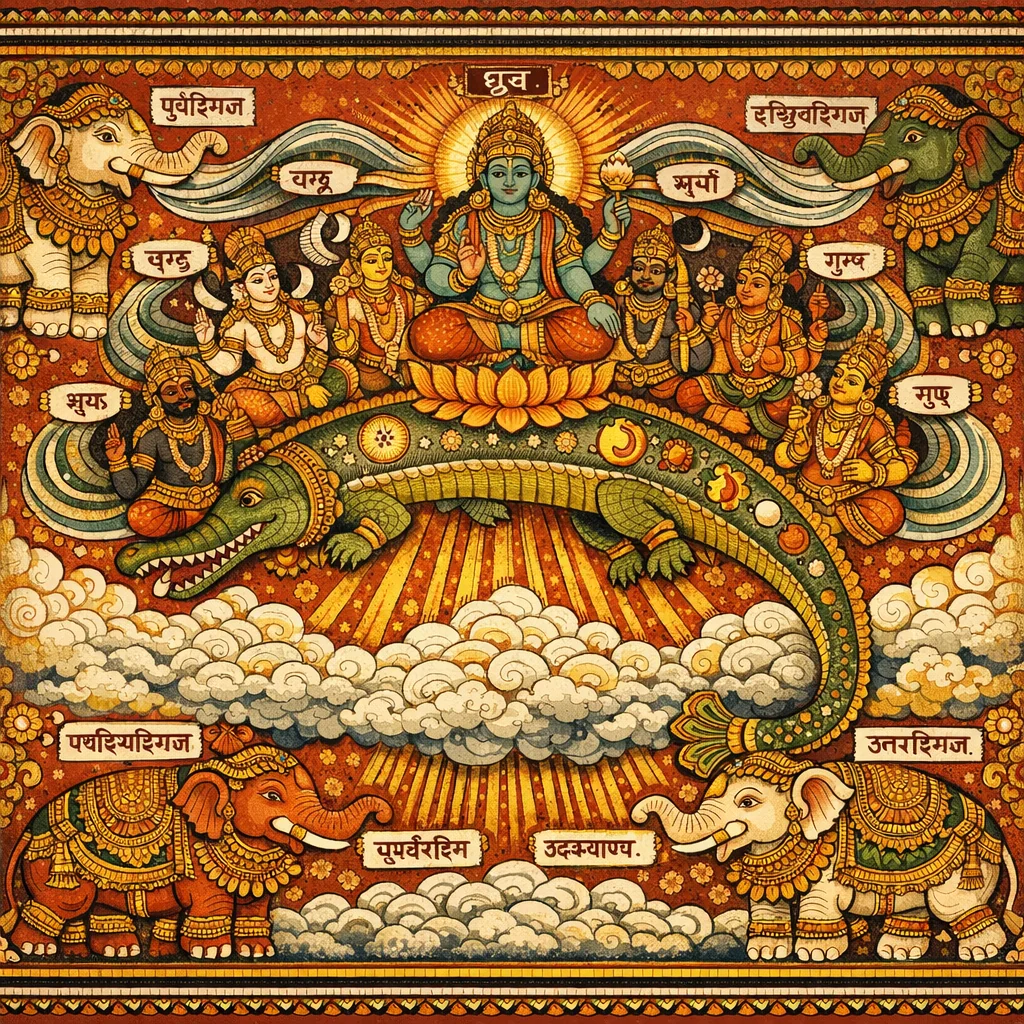
Adhyaya 125: Dhruva as Cosmic Pivot: Motions of Sun–Moon–Planets, Rain Formation, and the Sun’s Chariot
ध्रुवाधिष्ठितग्रहगति-वृष्टिसृष्टि-सूर्यरथवर्णनम्
Speaker: Ṛṣis, Lomaharṣaṇa (Sūta)
After hearing the prior divine account, the ṛṣis ask Sūta to explain celestial motions—why the luminaries do not collide and who impels them. Sūta replies that Dhruva, perceived as the Śiśumāra stationed among the nakṣatras, is the fixed cosmic pivot. Wind-formed bonds link Sun, Moon, and planets to Dhruva, yielding orderly revolutions and enabling time-reckoning (yogas, risings and settings, omens) through uttarāyaṇa and dakṣiṇāyana. The teaching then turns to rain: waters are drawn upward by the Sun’s rays with the aid of wind, become clouds, and fall as rain; mythic agencies—Puṣkarāvartaka clouds, Indra’s cutting of mountain wings, and the diggajas stirring Tripathā (the heavenly Gaṅgā)—frame this cosmic meteorology. The chapter culminates in a technical yet symbolic description of the Sun’s chariot—wheel, spokes, hubs, measures, reins held by Dhruva, and seven horses identified with Vedic metres—showing solar motion as both mechanism and sacred structure of time.
Key Concepts
Shlokas in Adhyaya 125
Verse 1
एवं श्रुत्वा कथां दिव्याम् अब्रुवंल्लौमहर्षणिम् सूर्याचन्द्रमसोश् चारं ग्रहाणां चैव सर्वशः //
Thus, having heard the divine account, they then spoke to Lomaharṣaṇa, asking in full about the courses (motions) of the Sun and the Moon, and likewise about all the planets in every respect.
Verse 2
*ऋषय ऊचुः भ्रमन्ति कथमेतानि ज्योतींषि रविमण्डले अव्यूहेनैव सर्वाणि तथा चासंकरेण वा //
The sages said: “How do these luminaries move within the solar sphere—each abiding in its own course, without disorder, and without mutual intermingling or collision?”
Verse 3
कश्च भ्रामयते तानि भ्रमन्ति यदि वा स्वयम् एतद्वेदितुम् इच्छामस् ततो निगद सत्तम //
“Who sets them in motion—or do they move of themselves? We wish to know this. Therefore, O best among the good, please declare it.”
Verse 4
*सूत उवाच भूतसंमोहनं ह्येतद् ब्रुवतो मे निबोधत प्रत्यक्षमपि दृश्यं तत् संमोहयति वै प्रजाः //
Sūta said: “Listen carefully to what I say. This indeed is a bewitchment of living beings: even what is directly visible to the senses can still delude the people.”
Verse 5
यो ऽसौ चतुर्दशर्क्षेषु शिशुमारो व्यवस्थितः उत्तानपादपुत्रो ऽसौ मेढीभूतो ध्रुवो दिवि //
That celestial Śiśumāra (the cosmic dolphin-form) stationed amid the fourteen nakṣatras is Dhruva, the son of Uttānapāda, fixed in the heavens as the pivot-post—the cosmic axle about which all revolves.
Verse 6
सैष भ्रमन्भ्रामयते चन्द्रादित्यौ ग्रहैः सह भ्रमन्तमनुसर्पन्ति नक्षत्राणि च चक्रवत् //
This itself (cosmic power/time), while revolving, causes the Moon and the Sun—together with the planets—to revolve; and as it moves, the nakṣatras also follow it, circling like a wheel.
Verse 7
ध्रुवस्य मनसा यो वै भ्रमते ज्योतिषां गणः वातानीकमयैर् बन्धैर् ध्रुवे बद्धः प्रसर्पति //
The host of luminous bodies indeed revolves in accord with Dhruva’s will; bound to Dhruva by cords made of the moving wind-hosts, it proceeds in its course.
Verse 8
तेषां भेदश्च योगश्च तथा कालस्य निश्चयः अस्तोदयास्तथोत्पाता अयने दक्षिणोत्तरे //
Their classifications, the (astronomical) yogas, and the determination of time are to be explained, as well as settings and risings, and likewise portents—within the Sun’s two courses, the southern (dakṣiṇāyana) and the northern (uttarāyaṇa).
Verse 9
विषुवद्ग्रहवर्णश्च सर्वमेतद्ध्रुवेरितम् जीमूता नाम ते मेघा यदेभ्यो जीवसम्भवः //
Their colours at the equinoxes and in relation to the planets—all of this is said to be governed by Dhruva. Those clouds are called jīmūtas, and from them living beings come into existence.
Verse 10
द्वितीय आवहन्वायुर् मेघास्ते त्वभिसंश्रिताः इतो योजनमात्राच्च अध्यर्धविकृता अपि //
The second is the ‘āvahana’ wind: those clouds are borne and pressed onward by it. Even from a distance of only a yojana from here, they appear distorted—by a measure of one-and-a-half in their form.
Verse 11
वृष्टिसर्गस्तथा तेषां धारासारः प्रकीर्तितः पुष्करावर्तका नाम ये मेघाः पक्षसम्भवाः //
Likewise, their particular mode of sending forth rain—its continuous downpour and essence—has been described. Those clouds, born of the rainy season, are known as the Puṣkarāvartaka clouds.
Verse 12
शक्रेण पक्षाश्छिन्ना वै पर्वतानां महौजसा कामगानां समृद्धानां भूतानां नाशमिच्छताम् //
Indeed, mighty Śakra (Indra) cut off the wings of the mountains—those powerful, prosperous beings that moved at will—because they sought the destruction of living creatures.
Verse 13
पुष्करा नाम ते पक्षा बृहन्तस्तोयधारिणः पुष्करावर्तका नाम कारणेनेह शब्दिताः //
Those wings are called Puṣkara—vast, water-bearing masses; and for this very reason they are also spoken of here as Puṣkarāvartakas.
Verse 14
नानारूपधराश्चैव महाघोरस्वराश्च ते कल्पान्तवृष्टिकर्तारः कल्पान्ताग्नेर् नियामकाः //
Assuming many forms and uttering exceedingly dreadful sounds, they become the makers of the end-of-aeon rains and the regulators of the end-of-aeon fire.
Verse 15
वाय्वाधारा वहन्ते वै सामृताः कल्पसाधकाः यान्यस्याण्डस्य भिन्नस्य प्राकृतान्यभवंस्तदा //
Supported by the Wind, they indeed move—endowed with a nectar-like sustaining power, accomplishing the ordering of an aeon (kalpa). At that time, from the splitting of this cosmic Egg, those primordial (prākṛta) constituents came into manifestation.
Verse 16
यस्मिन् ब्रह्मा समुत्पन्नश् चतुर्वक्त्रः स्वयं प्रभुः तान्येवाण्डकपालानि सर्वे मेघाः प्रकीर्तिताः //
That cosmic Egg in which Brahmā—the self-born Lord with four faces—arose: those very “shell-fragments of the egg” are proclaimed to be all the clouds.
Verse 17
तेषामाप्यायनं धूमः सर्वेषाम् अविशेषतः तेषां श्रेष्ठश्च पर्जन्यश् चत्वारश्चैव दिग्गजाः //
For all of them alike, “smoke” (dhūma) is said to be the common means of nourishment and increase; among them Parjanya, the rain-bearing power, is held to be the foremost—and there are also the four great elephants of the quarters (diggajas).
Verse 18
गजानां पर्वतानां च मेघानां भोगिभिः सह कुलमेकं द्विधा भूतं योनिरेका जलं स्मृतम् //
Elephants, mountains, and clouds—together with serpentine beings—are said to belong to a single lineage that has become twofold; yet their one common source (yoni) is remembered to be water.
Verse 19
पर्जन्यो दिग्गजाश्चैव हेमन्ते शीतसम्भवम् तुषारवर्षं वर्षन्ति वृद्धा ह्यन्नविवृद्धये //
In the season of Hemanta (early winter), Parjanya and the elephants of the quarters, having grown strong, send down showers of frost (tuṣāra) born of cold, so that the growth and abundance of grain may increase.
Verse 20
षष्ठः परिवहो नाम वायुस्तेषां परायणः यौ ऽसौ बिभर्ति भगवान् गङ्गामाकाशगोचराम् //
The sixth wind is called Parivaha, the ultimate support among them; it is that divine one which upholds the heavenly Gaṅgā as she moves through the sky.
Verse 21
दिव्यामृतजलां पुण्यां त्रिपथामिति विश्रुताम् तस्या विस्पन्दितं तोयं दिग्गजाः पृथुभिः करैः //
That sacred river—renowned as Tripathā, whose waters are divine and nectar-like—has her water set into motion and stirred by the direction-elephants with their broad trunks.
Verse 22
शीकरान् सम्प्रमुञ्चन्ति नीहार इति स स्मृतः दक्षिणेन गिरिर्यो ऽसौ हेमकूट इति स्मृतः //
That which releases fine sprays of water is called “nīhāra” (mist). And to the south, the mountain there is known as Hemakūṭa.
Verse 23
उदग्धिमवतः शैलस्य्-ओत्तरे चैव दक्षिणे पुण्ड्रं नाम समाख्यातं सम्यग्वृष्टिविवृद्धये //
To the north and also to the south of the mountain called Udagdhimavat lies the region known as Puṇḍra, famed for promoting the proper increase of rainfall.
Verse 24
तस्मिन्प्रवर्तते वर्षं तत्तुषारसमुद्भवम् ततो हिमवतो वायुर् हिमं तत्र समुद्भवम् //
In that region, rainfall arises, born of dew and frost; and from there, the wind of the Himavat gives rise to snow in that very place.
Verse 25
आनयत्यात्मवेगेन सिञ्चयानो महागिरिम् हिमवन्तमतिक्रम्य वृष्टिशेषं ततः परम् //
Driven by its own tremendous force, the floodwaters surged on, drenching the great mountain; crossing beyond the Himalaya, they then carried the remaining downpour still further onward.
Verse 26
इभास्ये च ततः पश्चाद् इदं भूतविवृद्धये वर्षद्वयं समाख्यातं सम्यग्वृष्टिविवृद्धये //
And thereafter, in the (type called) ‘Elephant-faced’, this two-year period is prescribed for the increase of living beings—indeed, for the proper increase of rainfall.
Verse 27
मेघाश्चाप्यायनं चैव सर्वमेतत्प्रकीर्तितम् सूर्य एव तु वृष्टीनां स्रष्टा समुपदिश्यते //
Thus the clouds and the process of replenishment have been fully described. Yet it is the Sun alone who is taught to be the true creator and producer of rains.
Verse 28
वर्षं घर्मं हिमं रात्रिं संध्ये चैव दिनं तथा शुभाशुभफलानीह ध्रुवात्सर्वं प्रवर्तते //
Rainy season, summer heat, winter cold, night, twilight, and day—as well as the auspicious and inauspicious results of deeds in this world—all proceed under the governance of Dhruva (the Pole Star).
Verse 29
ध्रुवेणाधिष्ठिताश्चापः सूर्यो वै गृह्य तिष्ठति सर्वभूतशरीरेषु त्व् आपो ह्यनुश्रिताश्च याः //
The Waters are upheld by Dhruva; and the Sun, having taken hold of that support, remains stationed. Indeed, the very Waters—those on which all embodied beings depend—are interwoven through the bodies of all creatures.
Verse 30
दह्यमानेषु तेष्वेव जङ्गमस्थावरेषु च धूमभूतास्तु ता ह्यापो निष्क्रामन्तीह सर्वशः //
As those very beings—both moving and unmoving—are being scorched, the waters within them, having turned into smoke, stream forth everywhere from all sides.
Verse 31
तेन चाभ्राणि जायन्ते स्थानमभ्रमयं स्मृतम् तेजोभिः सर्वलोकेभ्य आदत्ते रश्मिभिर्जलम् //
From that process clouds come into being; that region is remembered as the ‘cloud-realm’. With its fiery radiance, it draws up water by its rays from all the worlds.
Verse 32
समुद्राद्वायुसंयोगाद् वहन्त्यापो गभस्तयः ततस्त्वृतुवशात्काले परिवर्तन्दिवाकरः //
From the ocean, through association with the wind, the Sun’s rays lift and bear the waters upward; thereafter, in due time, under the governance of the seasons, the Sun (Divākara) turns and shifts his course.
Verse 33
नियच्छत्यापो मेघेभ्यः शुक्लाः शुक्लैस्तु रश्मिभिः अभ्रस्थाः प्रपतन्त्यापो वायुना समुदीरिताः //
With their bright, pale rays, the radiant solar beams draw the waters up from the clouds; and the waters, driven by the wind, then fall down from the mass of clouds.
Verse 34
ततो वर्षति षण्मासान् सर्वभूतविवृद्धये वायुभिः स्तनितं चैव विद्युतस्त्वग्निजाः स्मृताः //
Thereafter it rains for six months, for the growth and flourishing of all beings. Thunder is caused by the winds, and lightning is remembered to be born of fire.
Verse 35
मेहनाच्च मिहेर् धातोर् मेघत्वं व्यञ्जयन्ति च न भ्रश्यन्ते ततो ह्यापस् तस्मादभ्रस्य वै स्थितिः स्रष्टासौ वृष्टिसर्गस्य ध्रुवेणाधिष्ठितो रविः //
And from the verbal root miha, meaning “to pour forth, to shed moisture,” they also indicate the condition of being a cloud (megha-hood). Therefore the waters do not fall down at once; hence the cloud indeed remains suspended. The Sun (Ravi), established and supported by Dhruva, the Fixed Point, is the producer of the creation of rainfall.
Verse 36
ध्रुवेणाधिष्ठितो वायुर् वृष्टिं संहरते पुनः ग्रहन्निवृत्त्या सूर्यात्तु चरते ऋक्षमण्डलम् //
The Wind, governed by Dhruva (the Pole Star), again withdraws the rains; and when the planets’ “grasping” ceases (that is, when their obstructive influence ends), the circle of the lunar mansions (ṛkṣamaṇḍala, the nakṣatras) proceeds in relation to the Sun.
Verse 37
चारस्यान्ते विशत्यर्कं ध्रुवेण समधिष्ठितम् अतः सूर्यरथस्यापि संनिवेशं प्रचक्षते //
At the end of its circuit, the Sun enters the region aligned with the Pole Star, firmly governed by Dhruva; therefore the sages, on this basis, describe the very arrangement and placement of the Sun’s chariot.
Verse 38
स्थितेन त्वेकचक्रेण पञ्चारेण त्रिणाभिना हिरण्मयेनाणुना वै अष्टचक्रैकनेमिना चक्रेण भास्वता सूर्यः स्यन्दनेन प्रसर्पिणा //
But the radiant Sun moves onward in his swiftly coursing chariot by means of a fixed single wheel—golden and subtle, with five spokes and three hubs—together with a shining wheel that forms one rim for eight wheels.
Verse 39
शतयोजनसाहस्रो विस्तारायाम उच्यते द्विगुणा च रथोपस्थाद् ईषादण्डः प्रमाणतः //
The breadth and length are stated to be a thousand (units) of a hundred yojanas; and, by the prescribed standard, the pole-shaft (īṣā-daṇḍa) is twice the measure of the chariot-platform (rathopastha).
Verse 40
स तस्य ब्रह्मणा सृष्टो रथो ह्यर्थवशेन तु असङ्गः काञ्चनो दिव्यो युक्तः पवनगैर्हयैः //
For him, Brahmā—moved by the necessity of the moment—created a chariot: unhindered and unattached, golden and divine, yoked to horses swift as the wind.
Verse 41
छन्दोभिर्वाजिरूपैस्तैर् यथाचक्रं समास्थितैः वारुणस्य रथस्येह लक्षणैः सदृशश्च सः //
With those horse-forms fashioned according to the Vedic metres (Chandas), arranged in due order around the wheels, this chariot is, in its defining characteristics, similar to Varuṇa’s chariot.
Verse 42
तेनासौ चरति व्योम्नि भास्वाननुदिनं दिवि अथाङ्गानि तु सूर्यस्य प्रत्यङ्गानि रथस्य च संवत्सरस्यावयवैः कल्पितानि यथाक्रमम् //
By that arrangement, the radiant Sun moves through the sky each day in the heavenly realm. Now the limbs of the Sun, and likewise the subsidiary parts of his chariot, are conceived in proper sequence as fashioned from the constituent divisions of the year.
Verse 43
अहर्नाभिस्तु सूर्यस्य एकचक्रस्य वै स्मृतः अराः संवत्सरास्तस्य नेम्यः षडृतवः स्मृताः //
In the Sun’s single wheel, the day is remembered as the hub; its spokes are the years, and its rim is known to be the six seasons.
Verse 44
रात्रिर्वरूथो धर्मश्च ध्वज ऊर्ध्वं व्यवस्थितः अक्षकोट्योर्युगान्यस्य आर्तवाहाः कलाः स्मृताः //
Night is its protecting rampart; Dharma is its standard, set upright above. Between the two ends of its axle are its yugas; and its time-units (kalās) are remembered as the courses that carry the seasons onward.
Verse 45
तस्य काष्ठा स्मृता घोणा दन्तपङ्क्तिः क्षणास्तु वै निमेषश्चानुकर्षो ऽस्य ईषा चास्य कला स्मृता //
Of that measure of time, the unit called kāṣṭhā is said to be “ghoṇā”; the “row of teeth” is indeed called kṣaṇa. The nimeṣa is called anukarṣa, and its īṣā is remembered as kalā.
Verse 46
युगाक्षकोटी ते तस्य अर्थकामावुभौ स्मृतौ सप्ताश्वरूपाश्छन्दांसि वहन्ते वायुरंहसा //
The “yuga” and the “akṣa” are spoken of as his pair of wheels; and Artha and Kāma are remembered as his two ends (aims). The Vedic metres, taking the form of seven horses, carry him forward with the swiftness of the wind.
Verse 47
गायत्री चैव त्रिष्टुप्च जगत्यनुष्टुप्तथैव च पङ्क्तिश्च बृहती चैव उष्णिगेव तु सप्तमम् //
(The metres are:) Gāyatrī, Triṣṭubh, Jagatī, and likewise Anuṣṭubh; also Paṅkti and Bṛhatī—these, with Uṣṇik as the seventh.
Verse 48
चक्रमक्षे निबद्धं तु ध्रुवे चाक्षः समर्पितः सहचक्रो भ्रमत्यक्षः सहाक्षो भ्रमति ध्रुवः //
When the wheel is fastened to the axle, and the axle is set upon the pivot (the fixed point), the axle turns along with the wheel; and the pivot, in that coupled motion, also turns together with the axle.
Verse 49
अक्षः सहैव चक्रेण भ्रमते ऽसौ ध्रुवेरितः एवमर्थवशात्तस्य संनिवेशो रथस्य तु //
Driven by the fixed pivot, the axle turns together with the wheel; thus, according to the requirement of its function, the arrangement of the chariot is made in that manner.
Verse 50
तथा संयोगभागेन सिद्धो वै भास्करो रथः तेनासौ तरणिर्देवो नभसः सर्पते दिवम् //
Thus, by the proper measure of conjunction (and arrangement), the radiant Sun’s chariot is duly accomplished; and by that, the god Taraṇi (the Sun) glides through the sky and traverses the heavens.
Verse 51
युगाक्षकोटी ते तस्य दक्षिणे स्यन्दनस्य तु भ्रमतो भ्रमतो रश्मी तौ चक्रयुगयोस्तु वै //
On the right side of that chariot, at the end of the yoke-axle (yuga–akṣa), as it turns and turns, two reins (guiding cords) are fixed—indeed, they belong to the paired yokes of the wheels.
Verse 52
मण्डलानि भ्रमन्ते ऽस्य खेचरस्य रथस्य तु कुलालचक्रभ्रमवन् मण्डलं सर्वतोदिशम् //
The maṇḍalas (spheres or orbits) of this sky-moving chariot revolve; its circle turns in every direction, like the spinning wheel of a potter.
Verse 53
युगाक्षकोटी ते तस्य वातोर्मी स्यन्दनस्य तु संक्रमेते ध्रुवमहो मण्डले सर्वतोदिशम् //
At the rim of that cosmic axle of the yugas, the wind-waves that drive the celestial chariot course onward; and indeed, around the fixed Pole, Dhruva, they move through the great circle in every direction.
Verse 54
भ्रमतस्तस्य रश्मी ते मण्डले तूत्तरायणे वर्धेते दक्षिणेष्वत्र भ्रमतो मण्डलानि तु //
As the Sun moves in his circuit, those rays increase in the solar orb during the northward course (uttarāyaṇa); and here, during the southward course (dakṣiṇāyana), the maṇḍalas—as he revolves—are traversed differently.
Verse 55
युगाक्षकोटीसम्बद्धौ द्वौ रश्मी स्यन्दनस्य तु ध्रुवेण प्रगृहीतौ तौ रथौ यौ वनतो रविम् //
Two reins of the Sun’s chariot, fastened at the ends of the yoke and the yuga-axle, are held by Dhruva; by these the chariot is guided, directing the Sun along his course.
Verse 56
आकृष्येते यदा ते तु ध्रुवेण समधिष्ठिते तदा सो ऽभ्यन्तरे सूर्यो भ्रमते मण्डलानि तु //
When those maṇḍalas are drawn in and held firmly by Dhruva as their support, then within that system the Sun moves, revolving through its circular courses.
Verse 57
अशीतिमण्डलशतं काष्ठयोरुभयोश्चरन् ध्रुवेण मुच्यमानेन पुना रश्मियुगेन च //
Moving through one hundred and eighty circular courses along both solstitial paths, it is set in motion by Dhruva, and again by the paired yoke of rays.
Verse 58
तथैव बाह्यतः सूर्यो भ्रमते मण्डलानि तु उद्वेष्टयन्वै वेगेन मण्डलानि तु गच्छति //
In the same manner, the Sun moves in the outer region, revolving through the celestial circles; indeed, swiftly winding around them, he proceeds along those orbits.
Frequently Asked Questions
The chapter teaches that cosmic order—celestial motion, seasons, time-units, and rainfall—operates under a governing axis identified as Dhruva. The Sun’s movement is not random; it is described as mechanically and symbolically bound to Dhruva, with the Sun’s chariot mapped onto the structure of time (day, seasons, years) and propelled by Vedic metres as horses.
This adhyāya is primarily Sṛṣṭi/Cosmology and Jyotiṣa-style astronomy (Sun–Moon–planetary motion, nakṣatras, ayanas, yogas, omens) plus Puranic natural philosophy (clouds, winds, rain cycle, pralaya-rains). It is not a Vāstu-śāstra or Rājadharma chapter, and it contains no primary genealogical catalogue beyond identifying Dhruva as Uttānapāda’s son.
It attributes orderly, non-intermingling motion to Dhruva’s governance: luminaries are “bound” to Dhruva by cords formed of wind-hosts and revolve according to his stabilizing will, like a wheel turning around a fixed pivot.
The Sun rides a golden, divine chariot whose parts correspond to time: the wheel’s hub is the day, the rim is the six seasons, and the spokes are years; night is a protective enclosure and Dharma is the standard. Seven horses—Gāyatrī, Triṣṭubh, Jagatī, Anuṣṭubh, Paṅkti, Bṛhatī, and Uṣṇik—draw the chariot, linking Vedic metre, ritual time, and solar motion.