Adhyaya 14
Bhīṣma-nipāta-saṃvāda — Sañjaya’s Report of Bhīṣma’s Fall (भीष्मनिपातसंवादः)
Upa-parva: Bhīṣma-śaratalpa-vṛttānta (Report of Bhīṣma on the bed of arrows)
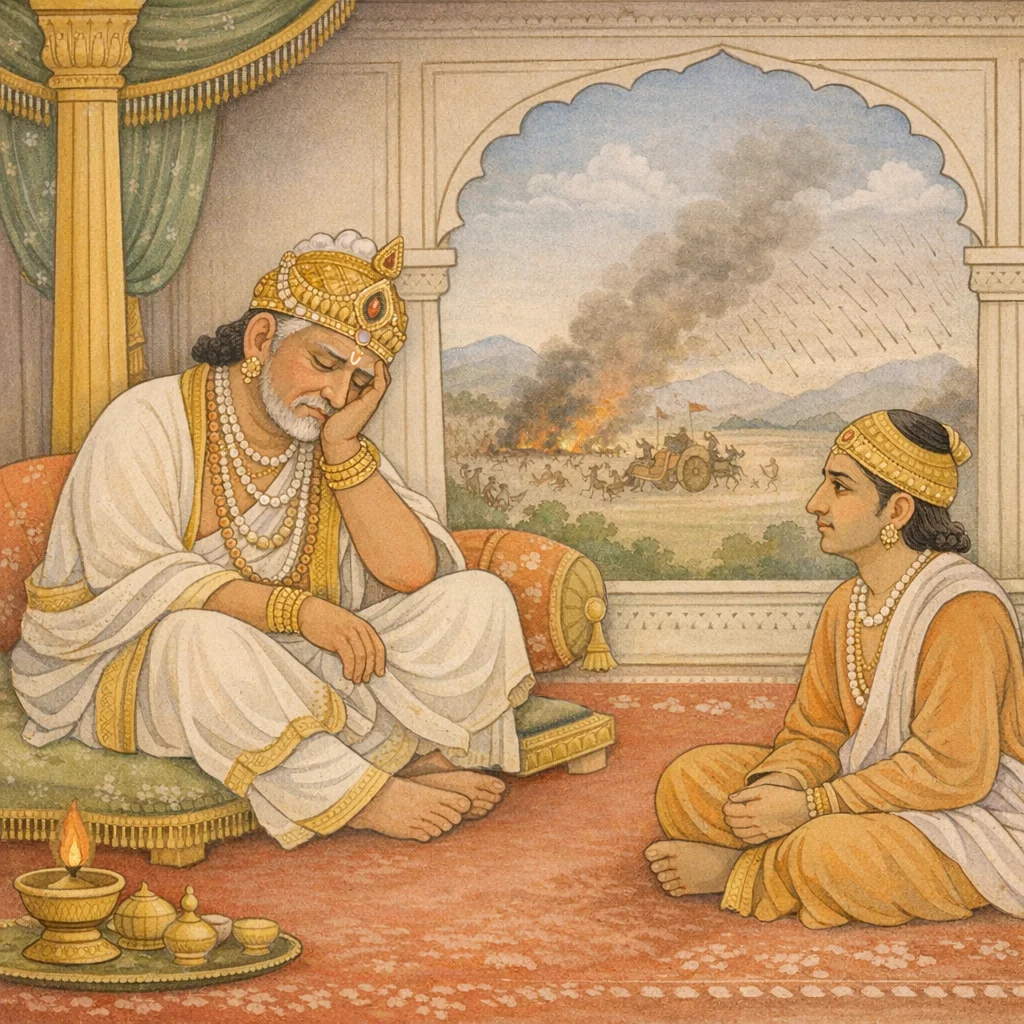
Vaiśaṃpāyana introduces Sañjaya’s return from the battlefield as an eyewitness reporter who approaches Dhṛtarāṣṭra in grief and announces Bhīṣma’s incapacitation. Sañjaya identifies himself, offers formal address, and delivers a compressed evaluative portrait of Bhīṣma: the foremost support of warriors and archers, now lying upon a bed of arrows. The report attributes Bhīṣma’s fall to Śikhaṇḍin (with the broader implication of Pāñcāla involvement), underscoring the irony that Bhīṣma, undefeated by Paraśurāma, is brought down through a specific tactical-ethical configuration. Sañjaya amplifies Bhīṣma’s qualities through similes (Indra-like valor, Himālaya-like steadiness, ocean-like depth, earth-like forbearance) and recalls his protective role over the Kuru forces for ten nights. The chapter closes with a pointed moral inference: the fallen protector is presented as a consequence of Dhṛtarāṣṭra’s “durmantrita” (mis-counsel/ill-advised policy), linking battlefield outcome to governance ethics.
Chapter Arc: भीष्म के गिरने का समाचार सुनकर धृतराष्ट्र का हृदय काँप उठता है; वह विलाप करते हुए संजय से आग्रह करता है कि ‘गुरु-कार्य के लिए ब्रह्मचर्य-व्रती, देवतुल्य बलवान भीष्म’ कैसे मारे गए। → धृतराष्ट्र प्रश्नों पर प्रश्न रखता है—भीष्म के पराक्रम, उनके ‘अश्मसार’ समान अडिग हृदय, देवताओं द्वारा उन्हें सहायक चाहने की पुरानी कीर्ति, और परशुराम-जैसे महावीर को अम्बा-प्रसंग में पराजित करने वाली कथा—इन सबको स्मरण कर वह मान ही नहीं पाता कि ऐसा पुरुषव्याघ्र रण में गिर सकता है। → वह निर्णायक बिंदु पर आकर पूछता है कि ‘महाबुद्धि भीष्म’ आज शिखण्डी के कारण कैसे ‘हत’ कहे गए—क्या यह वास्तव में वध था या किसी धर्म-संकट/रणनीति का परिणाम; और संजय से उसी क्षण का विस्तार मांगता है। → संजय के वर्णन की भूमिका बनती है: धृतराष्ट्र के प्रश्नों के माध्यम से भीष्म के जीवन-व्रत, अतुल युद्ध-भार, और उनके पतन की असाधारणता स्थापित होती है; साथ ही राजा यह भी जानना चाहता है कि भीष्म के अतिरिक्त किस-किस की हार-जीत हुई। → धृतराष्ट्र की अंतिम उत्कंठा—‘भीष्म के सिवा और कौन हारे, कौन जीते; सब बताओ’—अगले वर्णन के लिए द्वार खोल देती है।
Shlokas
Verse 1
अत--#कत चतुर्दशो 5 ध्याय: धृतराष्ट्रका विलाप करते हुए भीष्मजीके मारे जानेकी घटनाको विस्तारपूर्वक जाननेके लिये संजयसे प्रश्न करना धृतराष्ट उवाच कथं कुरूणामृषभो हतो भीष्म: शिखण्डिना । कथं रथात् स न्यपतत् पिता मे वासवोपम:,धृतराष्ट्र बोले--संजय! कुरुकुलके श्रेष्ठतम पुरुष मेरे पितृतुल्य भीष्म शिखण्डीके हाथसे कैसे मारे गये? वे इन्द्रके समान पराक्रमी थे, वे रथसे कैसे गिरे?
Dhṛtarāṣṭra said: “Sañjaya, how was Bhīṣma—bull among the Kurus—slain through Śikhaṇḍin? And how did that one, my father-like elder, equal to Vāsava (Indra) in prowess, fall from his chariot?”
Verse 2
कथमाचक्ष्व मे योधा हीना भीष्मेण संजय । बलिना देवकल्पेन गुर्वर्थे ब्रह्मचारिणा,संजय! जिन्होंने अपने पिताके संतोषके लिये आजीवन ब्रह्मचर्यका पालन किया और जो देवताओंके समान बलवान थे, उन्हीं भीष्मसे रहित होकर आज हमारे सैनिकोंकी कैसी अवस्था हुई है? यह बताओ
Dhṛtarāṣṭra said: “Tell me, Sañjaya—how are my warriors faring now, deprived of Bhīṣma: that mighty one, godlike in strength, who for the sake of his father and his teacher’s cause lived as a lifelong celibate? What has become of our army without him?”
Verse 3
तस्मिन् हते महाप्राज्ञे महेचासे महाबले । महासत्त्वे नरव्याप्रे किमु आसीन्मनस्तव,महाज्ञानी, महाधनुर्धर, महाबली और महान् धैर्यशाली नरश्रेष्ठ भीष्मजीके मारे जानेपर तुम्हारे मनकी कैसी अवस्था हुई?
Dhṛtarāṣṭra said: “When that great sage of counsel—mighty, a master of the great bow, a man of immense courage and heroic exertion—was slain, what state did your mind fall into?”
Verse 4
आर्ति परामाविशति मन: शंससि मे हतम् । कुरूणामृषभं वीरमकम्पं पुरुषर्षभम्,संजय! तुम कहते हो, अकम्प्य वीर पुरुषसिंह, कुरुकुलशिरोमणि भीष्मजी मारे गये-- इसे सुनकर मेरे हृदयमें बड़ी पीड़ा हो रही है
Dhṛtarāṣṭra said: “A deep anguish overwhelms my mind. You tell me that Bhīṣma—unyielding, heroic, the bull among the Kurus, the foremost of men—has been slain, O Saṃjaya.”
Verse 5
के तं यान्तमनुप्राप्ता: के वास्यासन् पुरोगमा: । के5तिष्ठन् के न्यवर्तन्त के<न्ववर्तन्त संजय,संजय! जिस समय वे युद्धके लिये अग्रसर हुए थे, उस समय इनके पीछे कौन गये थे अथवा उनके आगे कौन-कौन वीर थे? कौन उनके साथ युद्धमें डटे रहे? कौन युद्ध छोड़कर भाग गये? और किन लोगोंने सर्वधा उनका अनुसरण किया था?
Dhṛtarāṣṭra said: “Sañjaya, when they advanced toward battle, who followed behind him, and who were his vanguard? Who stood firm with him in the fight, who turned back and fled, and who, on the contrary, kept following him unwaveringly?”
Verse 6
के शूरा रथशार्दूलमद्धुतं क्षत्रियर्षभम् । तथानीकं गाहमानं सहसा पृष्ठतो<न्वयु:,किन शूरवीरोंने शत्रुसेनामें प्रवेश करते समय रथियोंमें सिंहके समान अद्भुत पराक्रमी, क्षत्रियशिरोमणि भीष्मजीके पास सहसा पहुँचकर सदा उनके पृष्ठभागका अनुसरण किया?
Dhṛtarāṣṭra asked: “As Bhīṣma—the lion among chariot-warriors, wondrous in prowess, the bull among kṣatriyas—plunged into the enemy host, which valiant heroes rushed to him at once and followed close behind, guarding his rear?”
Verse 7
यस्तमो<र्क इवापोहन् परसैन्यममित्रहा । सहस्नरश्मिप्रतिम: परेषां भयमादधत्,जैसे सूर्य अन्धकारको नष्ट कर देता है, उसी प्रकार शत्रुसूदन भीष्म शत्रुसेनाका नाश करते थे। जिनका तेज सहस्र किरणोंवाले सूर्यके समान था, जिन्होंने शत्रुओंको भयभीत कर रखा था
Dhṛtarāṣṭra said: “As the sun dispels darkness, so the slayer of foes was driving back and destroying the enemy host. Radiant like the thousand-rayed sun, he was striking fear into the hearts of the opposing warriors.”
Verse 8
अकरोद् दुष्करं कर्म रणे पाण्डुसुतेषु यः । ग्रसमानमनीकानि य एन॑ पर्यवारयन्,जिन्होंने युद्धमें पाण्डवोंपर दुष्कर पराक्रम किया था तथा जो उनकी सेनाका निरन्तर संहार कर रहे थे, उन अस्त्रविद्याके ज्ञाता दुर्जय वीर भीष्मजीको जिन्होंने रोका है, वे कौन हैं? संजय! तुम तो उनके पास ही थे, पाण्डवोंने युद्धमें शान्तनुनन्दन भीष्मको किस प्रकार आगे बढ़नेसे रोका?
Dhṛtarāṣṭra said: “Who were those that checked Bhīṣma—he who performed deeds hard to accomplish against the sons of Pāṇḍu in battle, and who, as he advanced, was continually consuming the opposing battle-formations? Sañjaya, you were there near him; tell me how the Pāṇḍavas restrained Śāntanu’s son Bhīṣma from pressing forward.”
Verse 9
कृतिन त॑ दुराधर्ष संजयास्य त्वमन्तिके । कथं शान्तनवं युद्धे पाण्डवा: प्रत्यवारयन्,जिन्होंने युद्धमें पाण्डवोंपर दुष्कर पराक्रम किया था तथा जो उनकी सेनाका निरन्तर संहार कर रहे थे, उन अस्त्रविद्याके ज्ञाता दुर्जय वीर भीष्मजीको जिन्होंने रोका है, वे कौन हैं? संजय! तुम तो उनके पास ही थे, पाण्डवोंने युद्धमें शान्तनुनन्दन भीष्मको किस प्रकार आगे बढ़नेसे रोका?
Dhṛtarāṣṭra said: “Sañjaya, you were close to him—tell me. How did the Pāṇḍavas check Śāntanu’s descendant Bhīṣma in battle—Bhīṣma, the accomplished and unassailable hero, master of weapons, who was performing deeds of near-impossible valor and relentlessly destroying their forces? By whom, and in what manner, was he held back from advancing?”
Verse 10
निकृन्तन्तमनीकानि शरदंष्टं मनस्विनम् । चापव्यात्ताननं घोरमसिजिह्ठलं दुरासदम्
Dhṛtarāṣṭra said: “(I beheld him) hewing down the battle-formations—like a fierce beast with autumnal fangs—high-spirited and resolute; dreadful to look upon, his mouth gaping with bow drawn, his sword flashing like a tongue of flame, and utterly hard to approach.”
Verse 11
अनर् पुरुषव्याप्रं ढवीमनतमपराजितम् । पातयामास कौन्न्तेय: कथं तमजितं युधि
Dhṛtarāṣṭra said: “How did the son of Kuntī bring down in battle that tiger among men—wise and undefeated—one who seemed unconquerable?”
Verse 12
जो शत्रुपक्षकी सेनाओंका निरन्तर उच्छेद करते थे, बाण ही जिनकी दाढ़ें थीं, धनुष ही खुला हुआ मुख था, तलवार ही जिनकी जिह्ला थी, उन भयंकर एवं दुर्धर्ष पुरुषसिंह भीष्मको कुन्तीनन्दन अर्जुनने युद्धमें कैसे मार गिराया? मनस्वी भीष्म इस प्रकार पराजयके योग्य नहीं थे। वे ललज्जाशील और पराजय-शून्य थे ।। उग्रधन्वानमुग्रेषुं वर्तमानं रथोत्तमे । परेषामुत्तमाड्नि प्रचिन्वन्तमथेषुभि:,जो उत्तम रथपर बैठकर भयंकर धनुष और भयानक बाण लिये शत्रुओंके मस्तकोंको सायकोंद्वारा काट-काटकर उनके ढेर लगा रहे थे
Dhṛtarāṣṭra said: “How did Kuntī’s son Arjuna bring down in battle that dreadful, unconquerable lion among men—Bhīṣma—who was ceaselessly destroying the enemy’s armies, whose arrows were like fangs, whose bow was his gaping mouth, and whose sword was his tongue? The high-minded Bhīṣma was not one fit to be defeated in such a way; he was modest in conduct and had never known defeat. He stood upon an excellent chariot, bearing a fearsome bow and terrible arrows, and with his shafts he was hewing down the foes’ heads, piling them up.”
Verse 13
इस प्रकार श्रीमहाभारत भीष्मपर्वके अन्तर्गत श्रीमद्भगवद्गीतापर्वमें भीष्मयत्युश्रवणविषयक तेरहवाँ अध्याय पूरा हुआ,पाण्डवानां महत् सैन्यं यं दृष्टवोद्यतमाहवे । कालाग्निमिव दुर्धर्ष समचेष्टत नित्यश: पाण्डवोंकी विशाल सेना दुर्धर्ष कालाग्निके समान जिन्हें युद्धके लिये उद्यत देख सदा काँपने लगती थी
Sañjaya said: Seeing the vast army of the Pāṇḍavas standing ready for battle—formidable like the fire of Time itself—(the opposing host) would continually be shaken and thrown into anxious commotion.
Verse 14
परिकृष्य स सेनां तु दशरात्रमनीकहा । जगामास्तमिवादित्य: कृत्वा कर्म सुदुष्करम्,वे ही शत्रुसूदन भीष्म दस दिनोंतक शत्रुओंकी सेनाका संहार करते हुए अत्यन्त दुष्कर पराक्रम दिखाकर सूर्यकी भाँति अस्त हो गये इति श्रीमहा भारते भीष्मपर्वणि श्रीमद्भगवद्गीतापर्वणि धृतराष्ट्रप्रश्ने चतुर्दशो 5 ध्याय: इस प्रकार श्रीमह्याभारत भीष्मपर्वके अन्तर्गत श्रीमद्भगवद्गीतापर्वनें धृतराष्ट्रका प्रश्रविषयक चौदहवाँ अध्याय पूरा हुआ
Dhṛtarāṣṭra said: Having drawn the army into close engagement, that mighty commander for ten nights wrought destruction upon the enemy host. After performing deeds exceedingly difficult to accomplish, Bhīṣma went down like the setting sun—his valor spent in relentless battle.
Verse 15
यः स शक्र इवाक्षय्यं वर्ष शरमयं क्षिपन् जघान युधि योधानामर्बुदं दशभिर्दिनै:,जिन्होंने इन्द्रके समान युद्धमें दस दिनोंतक अक्षय बाणोंकी वर्षा करके दस करोड़ विपक्षी सेनाओंका संहार कर डाला, वे ही भरतवंशी वीर भीष्म मेरी कुमन्त्रणाके कारण आँधीसे उखाड़े गये वृक्षकी भाँति युद्धमें मारे जाकर पृथ्वीपर शयन कर रहे हैं, वे कदापि इसके योग्य नहीं थे
Dhṛtarāṣṭra said: He who, like Indra, showered an inexhaustible rain of arrows and in battle destroyed a vast host of warriors within ten days— that very Bhīṣma, the heroic scion of the Bharata line, lies slain upon the earth, like a tree torn up by a storm, because of my evil counsel. He was never fit to meet such an end.
Verse 16
स शेते निहतो भूमौ वातभग्न इव द्रुम: । मम दुर्मन्त्रितेनाजी यथा नाहति भारत,जिन्होंने इन्द्रके समान युद्धमें दस दिनोंतक अक्षय बाणोंकी वर्षा करके दस करोड़ विपक्षी सेनाओंका संहार कर डाला, वे ही भरतवंशी वीर भीष्म मेरी कुमन्त्रणाके कारण आँधीसे उखाड़े गये वृक्षकी भाँति युद्धमें मारे जाकर पृथ्वीपर शयन कर रहे हैं, वे कदापि इसके योग्य नहीं थे
Dhṛtarāṣṭra said: “He lies slain upon the earth, like a tree broken by the wind. O Bhārata, it is as though he was struck down in battle because of my ill counsel.”
Verse 17
कथं शान्तनवं दृष्टवा पाण्डवानामनीकिनी । प्रहर्तुमशकत् तत्र भीष्म॑ भीमपराक्रमम्,शान्तनुनन्दन भीष्म तो बड़े भयंकर पराक्रमी थे, उन्हें सामने देखकर पाण्डवसेना उनपर प्रहार कैसे कर सकी?
Dhṛtarāṣṭra said: “How, upon seeing Bhīṣma—the son of Śāntanu, of dreadful and irresistible prowess—was the Pāṇḍavas’ army able to strike him there? How could they bring themselves to attack such a formidable elder on the battlefield?”
Verse 18
कथं भीष्मेण संग्रामं प्राकुर्वन् पाण्डुनन्दना: । कथं च नाजयद् भीष्मो द्रोणे जीवति संजय,संजय! पाण्डवोंने भीष्मके साथ संग्राम कैसे किया? द्रोणाचार्यके जीते-जी भीष्म विजयी कैसे नहीं हो सके?
Dhṛtarāṣṭra said: “How did the sons of Pāṇḍu undertake battle against Bhīṣma? And, Sañjaya, while Droṇa was still alive, how did Bhīṣma fail to secure victory?”
Verse 19
कृपे संनिहिते तत्र भरद्वाजात्मजे तथा । भीष्म: प्रहरतां श्रेष्ठ; कथं स निधनं गत:,उस युद्धमें कृपाचार्य तथा भरद्वाजपुत्र द्रोणाचार्य दोनों ही उनके निकट थे, तो भी योद्धाओंमें श्रेष्ठ भीष्म कैसे मारे गये?
Dhṛtarāṣṭra said: “When Kṛpa and Droṇa, the son of Bharadvāja, were both present there close by, how did Bhīṣma—foremost among those who strike in battle—come to meet his end? Even with such protectors at hand, by what course of fate and conduct was he brought down?”
Verse 20
कथं चातिरथस्तेन पाञज्चाल्येन शिखण्डिना । भीष्मो विनिहतो युद्धे देवेरपि दुरासद:,भीष्म तो युद्धमें देवताओंके लिये भी दुर्जय एवं अतिरथी थे, फिर पांचालराजकुमार शिखण्डीके हाथसे वे किस प्रकार मारे गये?
Dhṛtarāṣṭra said: “How was Bhīṣma—an atiratha, formidable in battle and difficult to overcome even for the gods—slain in war by that Pāñcāla prince Śikhaṇḍin? (Tell me the manner and cause by which such an invincible warrior fell.)”
Verse 21
यः स्पर्धते रणे नित्यं जामदग्न्यं महाबलम् | अजितं जामदग्न्येन शक्रतुल्यपराक्रमम्,जो रणभूमिमें महाबली जमदग्निनन्दन परशुरामसे भी टक्कर लेनेकी सदा इच्छा रखते थे, जिनका पराक्रम इन्द्रके समान था और परशुरामजी भी जिन्हें पराजित न कर सके थे; संजय! महारथियोंके कुलमें प्रकट हुए वे महावीर भीष्म समरभूमिमें किस प्रकार मारे गये, यह मुझे बताओ; क्योंकि मुझे शान्ति नहीं मिल रही है
Dhṛtarāṣṭra said: “Sañjaya, tell me how that great hero Bhīṣma—born in the line of mighty chariot-warriors—could be slain on the battlefield: he who ever longed to contend in war even with the immensely powerful Jāmadagnya (Paraśurāma), whose prowess was like Indra’s, and whom even Paraśurāma could not defeat. Explain this to me, for my mind finds no peace.”
Verse 22
त॑ हतं समरे भीष्म॑ं महारथकुलोदितम् | संजयाचक्ष्व मे वीरं येन शर्म न विद्यहे,जो रणभूमिमें महाबली जमदग्निनन्दन परशुरामसे भी टक्कर लेनेकी सदा इच्छा रखते थे, जिनका पराक्रम इन्द्रके समान था और परशुरामजी भी जिन्हें पराजित न कर सके थे; संजय! महारथियोंके कुलमें प्रकट हुए वे महावीर भीष्म समरभूमिमें किस प्रकार मारे गये, यह मुझे बताओ; क्योंकि मुझे शान्ति नहीं मिल रही है
Dhṛtarāṣṭra said: “Tell me, Sañjaya, how that hero Bhīṣma—sprung from the line of great chariot-warriors—was slain in battle. I find no peace; therefore recount to me the fall of that mighty one, whose valor was like Indra’s and who longed to measure himself even against Paraśurāma, the son of Jamadagni—one whom even Paraśurāma could not overcome.”
Verse 23
मामका: के महेष्वासा नाजहु: संजयाच्युतम् । दुर्योधनसमादिष्टा: के वीरा: पर्यवारयन्,संजय! कभी युद्धसे पीछे न हटनेवाले भीष्मजीका मेरे पक्षके किन महाधनुर्धरोंने साथ नहीं छोड़ा? दुर्योधनकी आज्ञा पाकर किन-किन वीरोंने उन्हें सब ओरसे घेर रखा था?
Dhṛtarāṣṭra said: “Sañjaya, which great bowmen on my side did not abandon Bhīṣma—unyielding in battle? And, acting under Duryodhana’s command, which heroes surrounded and protected him on every side?”
Verse 24
यच्छिखण्डिमुखा: सर्वे पाण्डवा भीष्ममभ्ययु: । कच्चित् ते कुरव: सर्वे नाजहु: संजयाच्युतम्,संजय! जब शिखण्डी आदि समस्त पाण्डव वीरोंने भीष्मपर आक्रमण किया, उस समय समस्त कौरवोंने कहीं अच्युत भीष्मका साथ छोड़ तो नहीं दिया था?
Dhṛtarāṣṭra asked: “When all the Pāṇḍava warriors, led by Śikhaṇḍin, advanced to attack Bhīṣma, did all those Kurus truly not abandon the unshakable Bhīṣma at that moment, O Sañjaya?”
Verse 25
अश्मसारमयं नून॑ हृदयं सुदृढं मम । यच्छुत्वा पुरुषव्याप्रं हतं भीष्म न दीर्यते,अवश्य ही मेरा यह हृदय लोहेके समान सुदृढ़ है, तभी तो पुरुषसिंह भीष्मको मारा गया सुनकर विदीर्ण नहीं होता है!
Dhṛtarāṣṭra said: “Surely my heart must be made of stone and hardened like iron; for even after hearing that Bhīṣma—the tiger among men—has been struck down, it does not split apart.”
Verse 26
यस्मिन् सत्यं च मेधा च नीतिश्न भरतर्षभे । अप्रमेयाणि दुर्धर्षे कथं स निहतो युधि,जिन दुर्जय वीर भरतभूषण भीष्ममें सत्य, मेधा और नीति--ये तीन अप्रमेय शक्तियाँ थीं, वे युद्धमें कैसे मारे गये?
Dhṛtarāṣṭra said: “O bull among the Bharatas, in Bhīṣma there were truthfulness, keen intelligence, and mastery of righteous policy—powers beyond measure and hard to overcome. How, then, was he struck down in battle?”
Verse 27
मौर्वीघोषस्तनयित्नु: पृषत्कपृषतो महान् । धनुर्ह्ाादमहाशब्दो महामेघ इवोजन्नत:,वे युद्धमें महान् मेघके समान ऊँचे उठे हुए थे। धनुषकी टंकार ही उनकी गर्जना थी बाण ही उनके लिये वर्षाकी बूँदें थीं और धनुषका महान् शब्द ही बिजलीकी गड़गड़ाहटका भयंकर शब्द था
His bowstring’s roar was like thunder; his arrows were like raindrops; and the mighty sound of his bow was like the dreadful crash of lightning. On the battlefield he rose aloft like a great cloud swelling in the sky.
Verse 28
यो<भ्यवर्षत कौन्तेयान् सपाज्चालान् ससृंजयान् । निघ्नन् पररथान् वीरो दानवानिव वज्रभूत्,वीरवर भीष्मने शत्रुपक्षके रथियों--कुन्तीकुमारों, पांचालों तथा सूंजयोंको मारते हुए उनके ऊपर उसी प्रकार बाणोंकी बौछार की, जैसे वज्रधारी इन्द्र दानवोंपर बाणवर्षा करते हैं
Dhṛtarāṣṭra said: “That heroic warrior showered arrows upon the sons of Kuntī—along with the Pāñcālas and the Sṛñjayas—striking down the warriors on the opposing chariots, just as Indra, wielder of the thunderbolt, rains destruction upon the Dānavas.”
Verse 29
इष्वस्त्रसागरं घोरं बाणग्राहं दुरासदम् । कार्मुकोर्मिणमक्षय्यमद्वीपं चलमप्लवम्,उनका धनुष-बाण आदि अस्त्रसमूह भयंकर एवं दुर्गम समुद्रके समान था, बाण ही उसमें ग्राह थे, धनुष लहरोंके समान जान पड़ता था, वह अक्षय, द्वीपरहित, चंचल तथा नौका आदि तैरनेके साधनोंसे शून्य था
Dhṛtarāṣṭra said: “That dreadful mass of arrows and weapons was like a fearsome, hard-to-cross ocean: arrows were its crocodiles, bows seemed like its surging waves. It appeared inexhaustible—without any island of refuge, restless and without any boat or means of crossing.”
Verse 30
गदासिमकरावासं हयावर्त गजाकुलम् | पदातिमत्स्यकलिलं शड्खदुन्दुभिनि:स्वनम्,गदा और खड़्ग आदि ही उसमें मगरके समान थे। वह अश्वरूपी भँवरोंसे भयावह प्रतीत होता था, उसमें हाथी जलहस्तीके समान प्रतीत होते थे, पैदल सेना उसमें भरे हुए मत्स्योंके समान जान पड़ती थी तथा शंख और दुन्दुभियोंकी ध्वनि ही उस समुद्रकी गर्जना थी
Dhṛtarāṣṭra said: “That battlefield looked like an ocean inhabited by crocodiles in the form of maces and swords. It was terrifying with whirlpools of horses; it teemed with elephants like mighty water-elephants, and the foot-soldiers seemed like dense shoals of fish. The blare of conches and the booming of kettledrums were its roaring sound.”
Verse 31
हयान् गजपदातींश्व रथांश्न तरसा बहून् निमज्जयन्तं समरे परवीरापहारिणम्,भीष्मजी उस समुद्रमें शत्रुपक्षके हाथियों, घोड़ों, पैदलों तथा बहुसंख्यक रथोंको वेगपूर्वक डुबो रहे थे। वे समरभूमिमें शत्रुवीरोंके प्राणोंका अपहरण करनेवाले थे
Dhṛtarāṣṭra said: “On the battlefield I see Bhīṣma, with irresistible speed, overwhelming and ‘submerging’ vast numbers of the enemy’s horses, elephants, infantry, and chariots—one who, in war, becomes a taker of the lives of opposing heroes.”
Verse 32
विदह्[मानं कोपेन तेजसा च परंतपम् । वेलेव मकरावासं के वीरा: पर्यवारयन्,अपने क्रोध और तेजसे दग्ध एवं प्रज्वलित-से होते हुए शत्रुसंतापी भीष्मको जैसे तट समुद्रको रोक देता है उसी प्रकार किन वीरोंने आगे बढ़नेसे रोका था
Dhṛtarāṣṭra said: “As Bhīṣma—scorching with wrath and blazing with fiery energy, a tormentor of foes—advanced, which heroes held him back, just as a shoreline holds back the ocean, the abode of crocodiles?”
Verse 33
भीष्मो यदकरोत् कर्म समरे संजयारिहा । दुर्योधनहितार्थाय के तस्यास्य पुरो$भवन्,शत्रुहन्ता भीष्मने दुर्योधनके हितके लिये समरभूमिमें जो पराक्रम किया था, वह अनुपम है। उस समय कौन-कौनसे योद्धा उनके आगे थे? किन-किन वीरोंने अमिततेजस्वी भीष्मके रथके दाहिने पहियेकी रक्षा की थी? किन लोगोंने दृढ़तापूर्वक व्रतका पालन करते हुए उनके पीछेकी ओर रहकर शत्रुपक्षके वीरोंको आगे बढ़नेसे रोका था?
Dhṛtarāṣṭra said: “O Sañjaya, slayer of foes, the deed Bhīṣma performed in the battle for Duryodhana’s benefit was extraordinary. Who were the warriors positioned in front of him then?”
Verse 34
के<रक्षन् दक्षिण चक्र भीष्मस्यामिततेजस: । पृष्ठतः के परान् वीरानपासेधन् यतव्रता:,शत्रुहन्ता भीष्मने दुर्योधनके हितके लिये समरभूमिमें जो पराक्रम किया था, वह अनुपम है। उस समय कौन-कौनसे योद्धा उनके आगे थे? किन-किन वीरोंने अमिततेजस्वी भीष्मके रथके दाहिने पहियेकी रक्षा की थी? किन लोगोंने दृढ़तापूर्वक व्रतका पालन करते हुए उनके पीछेकी ओर रहकर शत्रुपक्षके वीरोंको आगे बढ़नेसे रोका था?
Dhṛtarāṣṭra said: “Who guarded the right wheel of Bhīṣma of immeasurable splendor? And who, stationed behind him—men of firm vows—held back the enemy’s heroes from pressing forward?”
Verse 35
के पुरस्तादवर्तन्त रक्षन्तो भीष्ममन्तिके । के<रक्षन्नुत्तरं चक्रं वीरा वीरस्य युध्यत:,कौन-कौनसे वीर निकटसे भीष्मकी रक्षा करते हुए उनके आगे खड़े थे? और किन वीरोंने युद्धमें लगे हुए शूरशिरोमणि भीष्मके बायें पहियेकी रक्षा की थी?
Dhṛtarāṣṭra said: “Which heroes stood in front, guarding Bhīṣma at close quarters? And which heroes protected the left (northern) wheel of the hero’s chariot as he fought?”
Verse 36
वामे चक्रे वर्तमाना: के5घ्नन् संजय सूंजयान् । अग्रतो5ग्र्यमनीकेषु के भ्यरक्षन् दुरासदम्,संजय! उनके बायें चक्रकी रक्षामें तत्पर होकर किन-किन योद्धाओंने सूंजयवंशियोंका विनाश किया था? तथा किन्होंने आगे रहकर सेनाके अग्रणी दुर्जय वीर भीष्मकी सब ओरसे रक्षा की थी?
Dhṛtarāṣṭra said: “Sañjaya, who were the warriors stationed on the left wing, intent on its protection, that struck down the Sūñjayas? And who, standing in front among the foremost divisions, guarded on every side the hard-to-assail Bhīṣma?”
Verse 37
पार्श्व॑तः के भ्यरक्षन्त गच्छन्तो दुर्गमां गतिम् समूहे के परान् वीरानू् प्रत्ययुध्यन्त संजय,संजय! किन लोगोंने दुर्गम संग्राममें आगे बढ़ते हुए उनके पार्श्रभागका संरक्षण किया था? और किन्होंने उस सैन्यसमूहमें आगे रहकर वीरतापूर्वक शत्रुयोद्धाओंका डटकर सामना किया था?
Dhṛtarāṣṭra said: “O Saṃjaya, as they advanced along that hard-to-pass course of battle, who guarded their flanks? And within that massed host, who stood in the forefront and fought back the enemy heroes face to face?”
Verse 38
रक्ष्ममाण: कथं वीरैगोप्यमानाश्न तेन ते । दुर्जयानामनीकानि नाजयंस्तरसा युधि,जब मेरे पक्षके बहुत-से वीर उनकी रक्षा करते थे और वे भी उन वीरोंकी रक्षामें दत्तचित्त थे, तब भी उन सब लोगोंने मिलकर शत्रुपक्षकी दुर्जय सेनाओंको कैसे वेगपूर्वक परास्त नहीं कर दिया?
“When many heroes on my side were guarding them, and they too were intent on protecting those heroes, how was it that, even together, they did not swiftly overthrow in battle the enemy’s hard-to-conquer armies?”
Verse 39
सर्वलोकेश्वरस्येव परमेष्ठिप्रजापते: । कथं प्रहर्तुमपि ते शेकु: संजय पाण्डवा:,संजय! भीष्मजी सम्पूर्ण लोकोंके स्वामी परमेष्ठी प्रजापति ब्रह्माजीके समान अजेय थे; फिर पाण्डव उनके ऊपर कैसे प्रहार कर सके?
Dhṛtarāṣṭra said: “Sañjaya, Bhīṣma was as invincible as the Creator Brahmā—Parameṣṭhin, the Lord of progeny, the sovereign of all worlds. How, then, could the Pāṇḍavas even bring themselves to strike him?”
Verse 40
यस्मिन् द्वीपे समाश्वस्य युध्यन्ते कुरव: परै: । त॑ निमग्नं नरव्याप्र॑ भीष्मं शंससि संजय,संजय! जिन द्वीपस्वरूप भीष्मजीके आश्रयमें निर्भय एवं निश्चिन्त होकर समस्त कौरव शत्रुओंके साथ युद्ध करते थे, उन्हीं नरश्रेष्ठ भीष्मको तुम मारा गया बता रहे हो, यह कितने दुःखकी बात है?
Dhṛtarāṣṭra said: “Sañjaya, it was under the shelter of Bhīṣma—like an island amid the flood—that the Kauravas fought the enemy with confidence and without fear. And yet you report that this tiger among men, Bhīṣma, has been struck down. How grievous this is!”
Verse 41
यस्य वीर्य समाश्रित्य मम पुत्रो बृहद्धल: । न पाण्डवानगणयत् कथं स निहतः परै:,जिनके पराक्रमका आश्रय लेकर विशाल सेनाओंसे सम्पन्न मेरा पुत्र पाण्डवोंको कुछ नहीं गिनता था, वे शत्रुओंद्वारा किस प्रकार मारे गये?
Dhṛtarāṣṭra said: “Relying on whose prowess did my son—mighty in strength and backed by vast forces—treat the Pāṇḍavas as insignificant? How, then, was he slain by others (his enemies)?”
Verse 42
यः पुरा विबुधै: सर्वे: सहाये युद्धदुर्मद: । काडुक्षितो दानवान् घ्नद्धिः पिता मम महाव्रत:
Dhṛtarāṣṭra said: “He who in former times—proud and intoxicated with battle—stood allied with all the gods, and who, consecrated for a grim rite, struck down the Dānavas: that great-vowed one is my father.”
Verse 43
यस्मिज्जाते महावीरयें शान्तनुलोकविश्रुत: । शोकं दैन्यं च दुःखं च प्राजहात् पुत्रलक्ष्मणि
Dhṛtarāṣṭra said: “When that mighty hero—renowned throughout the world as the son of Śāntanu—was born, I cast off grief, dejection, and sorrow, for he appeared as a splendid blessing in the form of a son.”
Verse 44
प्रोक्ते परायणं प्राज्ञं स्वधर्मनिरतं शुचिम् । वेदवेदाज्भतत्त्वज्ञं कथं शंससि मे हतम्
Dhṛtarāṣṭra said: “When you have just described him as a wise man, steadfast in the highest course, devoted to his own dharma, and pure—one who knows the true purport of the Vedas—how can you now report to me that he has been slain?”
Verse 45
पहलेकी बात है, दानवोंका संहार करनेवाले सम्पूर्ण देवताओंने जिन मेरे महान् व्रतधारी पिता रणदुर्मद भीष्मजीको अपना सहायक बनानेकी अभिलाषा की थी, जिन महापराक्रमी पुत्र॒रत्नके जन्म लेनेपर लोकविख्यात महाराज शान्तनुने शोक, दीनता और दुःखका सदाके लिये त्याग कर दिया था, जो सबके आश्रयदाता, बुद्धिमान्, स्वधर्मपरायण, पवित्र और वेदवेदांगोंके तत्त्वज्ञ बताये गये हैं, उन्हीं भीष्मको तुम मारा गया कैसे बता रहे हो? ।। सर्वस्त्रिविनयोपेतं शान्तं दान्तं मनस्विनम् । हतं शान्तनवं श्रुत्वा मन्ये शेषं हतं बलम्,जो सम्पूर्ण अस्त्र-शस्त्रोंकी शिक्षासे सम्पन्न, शान्त, जितेन्द्रिय और मनस्वी थे, उन शान्तनुनन्दन भीष्मको मारा गया सुनकर मुझे यह विश्वास हो गया कि अब हमारी सारी सेना मार दी गयी
Dhṛtarāṣṭra said: “In former days my father—Bhīṣma, the great-vowed, slayer of the Dānavas, whom all the gods longed to have as their ally in war—was that jewel of a son; at his birth, Śāntanu, famed throughout the world, cast off grief, abasement, and sorrow forever. He is praised as the refuge of all, wise, devoted to his own dharma, pure, and knower of the essence of the Vedas and their limbs—how can you say that Bhīṣma has been slain? And hearing that Bhīṣma, Śāntanu’s son—fully trained in the discipline of every weapon, serene, self-controlled, and high-minded—has fallen, I am convinced that whatever strength remains to us is already as good as destroyed.”
Verse 46
धर्मादरर्मो बलवान् सम्प्राप्त इति मे मति: । यत्र वृद्ध गुरुं हत्वा राज्यमिच्छन्ति पाण्डवा:,आज मुझे निश्चितरूपसे ज्ञात हुआ कि धर्मसे अधर्म ही बलवान् है; क्योंकि पाण्डव अपने वृद्ध गुरुजनकी हत्या करके राज्य लेना चाहते हैं
Dhṛtarāṣṭra said: “It has now become my settled conviction that unrighteousness has gained strength over righteousness; for the Pāṇḍavas, in their desire for the kingdom, are prepared to slay even their aged elders and teachers.”
Verse 47
जामदग्न्य: पुरा राम: सर्वस्त्रिविदनुत्तम: | अम्बार्थमुद्यत: संख्ये भीष्मेण युधि निर्जित:,पूर्वकालमें अम्बाके लिये उद्यत होकर सम्पूर्ण अस्त्रवेत्ताओंमें श्रेष्ठ जमदग्निनन्दन परशुराम युद्ध करनेके लिये आये थे, परंतु भीष्मने उन्हें परास्त कर दिया, उन्हीं इन्द्रके समान पराक्रमी तथा सम्पूर्ण धनुर्धरोंमें श्रेष्ठ भीष्मको तुम मारा गया कह रहे हो, इससे बढ़कर दुःखकी बात और क्या हो सकती है?
Dhṛtarāṣṭra said: “In former times, Rāma Jāmadagnya (Paraśurāma)—unsurpassed among all who know the science of weapons—came to battle, taking up arms for Ambā’s sake; yet in that fight he was defeated by Bhīṣma. And now you say that Bhīṣma—Indra-like in valor and foremost among all archers—has been slain. What grief could be greater than this?”
Verse 48
तमिन्द्रसमकर्माणं ककुदं सर्वधन्विनाम् । हतं शंससि मे भीष्म कि नु दुःखमत: परम्,पूर्वकालमें अम्बाके लिये उद्यत होकर सम्पूर्ण अस्त्रवेत्ताओंमें श्रेष्ठ जमदग्निनन्दन परशुराम युद्ध करनेके लिये आये थे, परंतु भीष्मने उन्हें परास्त कर दिया, उन्हीं इन्द्रके समान पराक्रमी तथा सम्पूर्ण धनुर्धरोंमें श्रेष्ठ भीष्मको तुम मारा गया कह रहे हो, इससे बढ़कर दुःखकी बात और क्या हो सकती है?
You tell me that Bhīṣma—whose deeds were equal to Indra’s, the very crest and foremost of all bowmen—has been slain. What sorrow could be greater than this? He who once, for Ambā’s sake, faced Paraśurāma, the son of Jamadagni and master of all weapons, and yet overcame him—how can such a hero be said to have fallen?
Verse 49
असकृत् क्षत्रियव्राता: संख्ये येन विनिर्जिता: । जामदग्न्येन वीरेण परवीरनिघातिना
Dhṛtarāṣṭra said: “By that heroic scion of Jamadagni—Rāma—slayer of enemy champions, whole multitudes of kṣatriyas were repeatedly defeated in battle.”
Verse 50
तस्मान्नूनं महावीर्याद्धार्गवाद युद्धदुर्मदात्
Therefore, it must be that this outcome has arisen from the mighty Dhārgava, intoxicated with the arrogance of battle.
Verse 51
तेजोवीर्यबलैर्भूयान् शिखण्डी द्रुपदात्मज: । यः शूरं कृतिनं युद्धे सर्वशास्त्रविशारदम्
Dhṛtarāṣṭra said: “Śikhaṇḍī, the son of Drupada, is superior in splendor, valor, and strength—he who, in battle, confronts a heroic and accomplished warrior, fully versed in every weapon-lore and martial discipline.”
Verse 52
परमास्त्रविदं वीर॑ जघान भरतर्षभम् | इससे जान पड़ता है कि महापराक्रमी युद्धदुर्मद परशुरामजीकी अपेक्षा भी तेज, पराक्रम और बलनमें ट्रपदकुमार शिखण्डी निश्चय ही बहुत बढ़ा-चढ़ा है, जिसने सम्पूर्ण शास्त्रोंके ज्ञानमें निपुण, परमास्त्रवेत्ता और शूरवीर विद्वान् भरतकुलभूषण भीष्मजीका वध कर डाला है ।। के वीरास्तममित्रघ्नमन्वयु: शस्त्रसंसदि,उस समय युद्धमें शत्रुहन्ता भीष्मजीके साथ कौन-कौनसे वीर थे? संजय! पाण्डवोंके साथ भीष्मका किस प्रकार युद्ध हुआ? यह मुझे बताओ। उन वीर सेनापतिके मारे जानेपर मेरे पुत्रकी सेना विधवा स्त्रीके समान असहाय हो गयी है
Dhṛtarāṣṭra said: “That heroic master of the highest weapons has struck down the bull among the Bharatas. Tell me, Sañjaya—who were the warriors accompanying Bhīṣma, the slayer of foes, in that assembly of arms? And how did Bhīṣma fight against the Pāṇḍavas? Explain this to me. Now that that commander of heroes has been felled, my son’s army has become helpless, like a widowed woman.”
Verse 53
शंस मे तद् तथा चासीद् युद्ध भीष्मस्य पाण्डवै: । योषेव हतवीरा मे सेना पुत्रस्य संजय,उस समय युद्धमें शत्रुहन्ता भीष्मजीके साथ कौन-कौनसे वीर थे? संजय! पाण्डवोंके साथ भीष्मका किस प्रकार युद्ध हुआ? यह मुझे बताओ। उन वीर सेनापतिके मारे जानेपर मेरे पुत्रकी सेना विधवा स्त्रीके समान असहाय हो गयी है
Dhṛtarāṣṭra said: “Tell me exactly how the battle unfolded between Bhīṣma and the Pāṇḍavas. Sañjaya, which heroes stood with Bhīṣma in that fight? For with that warrior-commander struck down, my son’s army has become helpless—like a widow bereft of her protector.”
Verse 54
अगोपमिव चोद श्रान्तं गोकुलं तद् बल॑ मम । पौरुष॑ सर्वलोकस्य परं यस्मिन् महाहवे
Dhṛtarāṣṭra said: “My army there, exhausted and driven on, looked like a cowherd’s cattle-pen—confused and pressed together. Yet in that great battle the very summit of human valor, renowned throughout the world, was displayed.”
Verse 55
परासक्ते च वस्तस्मिन् कथमासीन्मनस्तदा । जैसे ग्वालेके बिना गौओंका समुदाय इधर-उधर भटकता फिरता है, उसी प्रकार अब मेरी सेना उदभ्रान्त हो रही होगी। महान् युद्धके समय जिनमें सम्पूर्ण जगत्का परम पुरुषार्थ प्रकट दिखायी देता था, वे ही भीष्म जब परलोकके पथिक हो गये? उस समय तुम लोगोंके मनकी अवस्था कैसी हुई थी || ५४ ह ।। जीविते>प्यद्य सामर्थ्य किमिवास्मासु संजय,संजय! आज जीवित रहनेपर भी हमलोगोंमें क्या सामर्थ्य है? जगत्के विख्यात धर्मात्मा महापराक्रमी पिता भीष्मको युद्धमें मरवाकर हम उसी प्रकार शोकमें डूब गये हैं, जैसे पार जानेकी इच्छावाले पथिक नावको अगाध जलनमें डूबी हुई देखकर दुःखी होते हैं
Dhṛtarāṣṭra said: “Sañjaya, even though we are still alive today, what strength is left in us? Having caused the death in battle of our father Bhīṣma—renowned in the world as righteous and of mighty valor—we have sunk into grief, like travelers longing to cross who are stricken with sorrow on seeing their boat submerged in deep, unfathomable waters.”
Verse 56
घातयित्वा महावीर्य पितरं लोकधार्मिकम् | अगाधे सलिले मग्नां नावं दृष्टवेव पारगा:,संजय! आज जीवित रहनेपर भी हमलोगोंमें क्या सामर्थ्य है? जगत्के विख्यात धर्मात्मा महापराक्रमी पिता भीष्मको युद्धमें मरवाकर हम उसी प्रकार शोकमें डूब गये हैं, जैसे पार जानेकी इच्छावाले पथिक नावको अगाध जलनमें डूबी हुई देखकर दुःखी होते हैं
Dhṛtarāṣṭra said: “Having caused the death of our mighty father—righteous and upheld by the whole world—we are plunged into grief, Sañjaya. Even if we still live, what strength is left in us? After making Bhīṣma, renowned in the world as a dharmic and supremely valiant elder, fall in battle, we have sunk into sorrow, like travelers longing to cross who, seeing their boat submerged in deep waters, are overcome with despair.”
Verse 57
भीष्मे हते भृशं दुःखान्मन्ये शोचन्ति पुत्रका: । अद्विसारमयं नूनं हृदयं मम संजय
Dhṛtarāṣṭra said: “With Bhīṣma slain, I think my sons are grieving in intense anguish. Surely my heart, Saṃjaya, is made of something without firmness or strength.”
Verse 58
यच्छुत्वा पुरुषव्याप्र॑ हतं भीष्म न दीर्यते । मैं समझता हूँ कि भीष्मजीके मारे जानेपर मेरे बेटे दुःखके कारण अत्यन्त शोकमग्न हो गये होंगे। संजय! मेरा हृदय निश्चय ही लोहेका बना हुआ है, जो पुरुषसिंह भीष्मको मारा गया सुनकर भी विदीर्ण नहीं हो रहा है ।। यस्मिन्नस्त्राणि मेधा च नीतिश्व पुरुषर्षभे
Dhṛtarāṣṭra said: “O tiger among men! Hearing that Bhīṣma has been slain, my heart does not break apart. I think my sons must have been plunged into extreme grief when Bhīṣma fell. Sañjaya, surely my heart is made of iron, since even on hearing that the bull among men, Bhīṣma, has been killed, it is not torn asunder.”
Verse 59
अप्रमेयाणि दुर्धर्षे कथं स निहतो युधि । जिन पुरुषरत्न तथा दुर्धर्ष वीरशिरोमणिमें अस्त्र, बुद्धि और नीति तीन अप्रमेय शक्तियाँ थीं, वे युद्धमें कैसे मारे गये? ।। ५८ है ।। न चास्त्रेण न शौर्येण तपसा मेधया न च
Dhṛtarāṣṭra said: “O invincible one, how was he slain in battle? That jewel among men, that hero so hard to assail, possessed three immeasurable powers—arms, intellect, and statecraft. How then did he fall in war? Not by weapons, not by valor, not by austerity, and not by intellect—by none of these could he be overcome.”
Verse 60
न धृत्या न पुनस्त्यागान्मृत्यो: कश्चिद् विमुच्यते | जान पड़ता है कि अस्त्रसे, शौर्यसे, तपस्यासे, बुद्धिसे, धैर्यसे तथा त्यागके द्वारा भी कोई मृत्युसे छूट नहीं सकता है || ५९ ह ।। कालो नून॑ महावीर्य: सर्वलोकदुरत्यय:
Dhṛtarāṣṭra said: “No one is released from death—neither by steadfast endurance nor by renunciation. Surely Time (Kāla) is of mighty power, and it is insurmountable for all worlds.”
Verse 61
यत्र शान्तनवं भीष्म हतं शंससि संजय । संजय! निश्चय ही कालकी शक्ति बहुत बड़ी है, सम्पूर्ण जगत्के लिये वह दुर्लड्घय है, जिसके अधीन होनेके कारण तुम शान्तनुनन्दन भीष्मको मारा गया बता रहे हो ।। ६० है ।। पुत्रशोकाभिसंतप्तो महद् दुःखमचिन्तयम्
Dhṛtarāṣṭra said: “Sañjaya, in what place, and under what circumstances, do you report that Bhīṣma, the son of Śāntanu, has been slain? Tormented by grief for my sons, I am overwhelmed, and my mind dwells upon a vast sorrow.”
Verse 62
आशंंसे5हं परं त्राणं भीष्माच्छान्तनुनन्दनात् । मुझे शान्तनुनन्दन भीष्मसे अपने पक्षके परित्राणकी बड़ी आशा थी। इस समय अपने पुत्रके शोकसे संतप्त होकर मैं महान् दुःखसे चिन्तित हो उठा हूँ ।। ६१ हू ।। यदा55दित्यमिवापश्यत् पतितं भुवि संजय
Dhṛtarāṣṭra said: “I had placed my highest hope of protection in Bhīṣma, the beloved son of Śāntanu. Yet now, scorched by grief for my son, I am overwhelmed—my mind weighed down by great sorrow and anxious thought.”
Verse 63
दुर्योधन: शान्तनवं किं तदा प्रत्यपद्यत | संजय! जब दुर्योधनने शान्तनुनन्दन भीष्मको अस्ताचलगामी सूर्यकी भाँति पृथ्वीपर पड़ा देखा, तब उसने क्या सोचा? ।। ६२ है || नाहं स्वेषां परेषां वा बुद्धथा संजय चिन्तयन्
Dhṛtarāṣṭra said: “Sañjaya, when Duryodhana saw Bhīṣma—the son of Śāntanu—fallen upon the earth like the sun sinking toward the western mountain, what did he then think? For I, Sañjaya, cannot discern with my own understanding what was in the mind of either my sons or their foes.”
Verse 64
शेषं किंचित् प्रपश्यामि प्रत्यनीके महीक्षिताम् । संजय! जब मैं अपनी बुद्धिसे विचार करके देखता हूँ तो अपने अथवा शशत्रुपक्षके राजाओंमेंसे किसीका भी जीवन इस युद्धमें शेष रहता नहीं दिखायी देता है | ६३ है ।। दारुण: क्षत्रधर्मोडयमृषिभि: सम्प्रदर्शित:
Dhṛtarāṣṭra said: “I see scarcely anything left among the opposing ranks of kings. Sañjaya, when I reflect with my own understanding, I do not perceive that the life of any king—whether on my side or the enemy’s—will remain after this war. Such is this terrible kṣatriya-duty, as the seers have set it forth.”
Verse 65
यत्र शान्तनवं हत्वा राज्यमिच्छन्ति पाण्डवा: । ऋषियोंने क्षत्रियोंका यह धर्म अत्यन्त कठोर निश्चित किया है, जिसमें रहते हुए पाण्डव शान्तनुनन्दन भीष्मको मारकर राज्य लेना चाहते हैं ।। ६४ हे ।। वयं वा राज्यमिच्छामो घातयित्वा महाव्रतम्
Dhṛtarāṣṭra said: “In this war, the Pāṇḍavas seek the kingdom by slaying Śāntanava (Bhīṣma), and we too desire the kingdom by causing the death of that great vow-bound elder. Such is the harsh, uncompromising kṣatriya code that the seers have laid down—where sovereignty is pursued even at the cost of killing the most revered.”
Verse 66
क्षत्रधर्मे स्थिता: पार्था नापराध्यन्ति पुत्रका: । एतदार्येण कर्तव्यं कृच्छास्वापत्सु संजय
Dhṛtarāṣṭra said: “The sons of Pāṇḍu, standing firm in the kṣatriya’s duty, are not at fault, my son. In such harsh crises and calamities, Sañjaya, this is what a noble person must do.”
Verse 67
पराक्रम: परं शक््त्या तत् तु तस्मिन् प्रतिष्ठितम् । अथवा हम भी तो उन महारथी भीष्मको मरवाकर ही राज्य लेना चाहते हैं। क्षत्रियधर्ममें स्थित हुए मेरे बच्चे कुन्तीकुमारोंका कोई अपराध नहीं है। संजय! दुस्तर आपफत्तिके समय श्रेष्ठ पुरुषको यही करना चाहिये, जो भीष्मजीने किया है, कि वह शक्तिके अनुसार अधिक-से-अधिक पराक्रम करे। यह गुण भीष्मजीमें पूर्णरूपसे प्रतिष्ठित था || ६५-६६ ह || अनीकानि विनिष्नन्तं हीमनन््तमपराजितम्,भीष्मजी किसीसे पराजित न होनेवाले और लज्जाशील थे। विपक्षी सेनाओंका संहार करते हुए उन मेरे ताऊ भीष्मजीको पाण्डवोंने कैसे रोका? उन महामनस्वी वीरोंने किस प्रकार सेनाएँ संगठित कीं और किस प्रकार युद्ध किया?
Dhṛtarāṣṭra said: “Valour reaches its highest measure according to one’s strength; and that excellence was firmly established in him. As he was crushing the battle-formations—unyielding, unwearied, and unconquered—how did the Pāṇḍavas check my elder Bhīṣma? How did those high-souled heroes marshal their forces, and in what manner did they fight?”
Verse 68
कथं शान्तनवं तात॑ पाण्डुपुत्रा नयवारयन् । कथं युक्तान्यनीकानि कथं युद्ध महात्मभि:,भीष्मजी किसीसे पराजित न होनेवाले और लज्जाशील थे। विपक्षी सेनाओंका संहार करते हुए उन मेरे ताऊ भीष्मजीको पाण्डवोंने कैसे रोका? उन महामनस्वी वीरोंने किस प्रकार सेनाएँ संगठित कीं और किस प्रकार युद्ध किया?
Dhṛtarāṣṭra said: “Tell me, dear one—how did the sons of Pāṇḍu restrain Śāntanu’s descendant (Bhīṣma), who was directing the battle with strategic skill? How were the battle-formations properly arrayed, and how did those great-souled warriors conduct the war?”
Verse 69
कथं वा निहतो भीष्म: पिता संजय मे परै: । दुर्योधनश्व कर्णश्न शकुनिश्चापि सौबल:
Dhṛtarāṣṭra said: “How, O Sañjaya, was Bhīṣma—my revered elder and father-figure—slain by the opposing side? And what became of Duryodhana, Karṇa, and Śakuni, the son of Subala as well?”
Verse 70
दुःशासनश्नल कितवो हते भीष्मे किमब्रुवन् । संजय! शत्रुओंने मेरे आदरणीय पिता भीष्मका किस प्रकार वध किया? दुर्योधन, कर्ण, दुःशासन तथा सुबलपुत्र जुआरी शकुनिने भीष्मजीके मारे जानेपर क्या-क्या बातें कहीं? || ६९ हू || यच्छरीरैरुपास्तीर्णा नरवारणवाजिनाम्
Dhṛtarāṣṭra said: “Sañjaya, when Bhīṣma had been slain, what did Duḥśāsana and that gambler say? How, indeed, did my revered elder—Bhīṣma—come to be killed by the enemy? And after Bhīṣma’s fall, what words were spoken by Duryodhana, Karṇa, Duḥśāsana, and Śakuni, the gambler, son of Subala?”
Verse 71
शरशक्तिमहाखड्गतोमराक्षां महाभयाम् | प्राविशन् कितवा मन्दा: सभां युद्धदुरासदाम्
Dhṛtarāṣṭra said: “Those foolish gamblers entered that great hall—made terrifying with arrows, spears, huge swords, javelins, and bears—hard to assail in battle.”
Verse 72
प्राणद्यूत्े प्रतिभये के5दीव्यन्त नरर्षभा: | संजय! जहाँ मनुष्य, हाथी और घोड़ोंके शरीर बिछे हुए थे, जहाँ बाण, शक्ति, महान् खड्ग और तोमररूपी पासे फेंके जाते थे, जो युद्धके कारण दुर्गम एवं महान् भय देनेवाली थी, उस रणक्षेत्ररूपी द्यूतसभामें किन-किन मन्दबुद्धि जुआरियोंने प्रवेश किया था? जहाँ प्राणोंकी बाजी लगायी जाती थी, वह भयंकर जूएका खेल किन-किन नरश्रेष्ठ वीरोंने खेला था? || ७०-७१ $ |। के जीयन्ते जितास्तत्र कृतलक्ष्या निपातिता:
Dhṛtarāṣṭra said: “Sañjaya, in that dreadful game of dice where life itself is staked—on that battlefield where the bodies of men, elephants, and horses lie strewn, and where arrows, spears, great swords, and tomaras are cast like dice—made hard to traverse by war and terrifying in its vastness: which deluded gamblers entered that gambling-hall in the form of the battlefield? Which best of men, which heroes, played that terrible game where the wager is one’s very breath? Who there are victorious, who are defeated, and who—having been aimed at—have fallen?”
Verse 73
न हि मे शान्तिरस्तीह श्रुत्वा देवव्रतं हतम्,त्वं हि मे सर्पिषेवाग्निमुद्दीपपसि संजय । युद्धभूमिमें शोभा पानेवाले भयंकर पराक्रमी अपने ताऊ देवव्रत भीष्मको मारा गया सुनकर मेरे हृदयमें शान्ति नहीं रह गयी है। उनके मारे जानेसे मेरे पुत्रोंकी जो हानि होनेवाली है, उसके कारण मेरे मनमें भारी व्यथा जाग उठी है। संजय! तुम अपने वचनरूपी घृतकी आहुति डालकर मेरी उस चिन्ता एवं व्यथारूपी अग्निको और भी उद्दीप्त कर रहे हो
Dhṛtarāṣṭra said: “I find no peace here after hearing that Devavrata (Bhīṣma) has been slain. Saṃjaya, you are fanning my fire as though pouring ghee upon it. The fall of that terrible, battle-adorning hero has shattered my composure; and the thought of the losses that will now befall my sons stirs a deep anguish within me. By your words you only kindle further my blaze of worry and grief.”
Verse 74
पितरं भीमकर्माणं भीष्ममाहवशोभिनम् । आर्ति मे हृदये रूढां महतीं पुत्रहानिजाम्
Dhṛtarāṣṭra said: “My heart is weighed down by a great anguish born of my sons’ destruction. I think of Bhīṣma—my revered elder, a man of terrible deeds in battle, resplendent on the field of war.”
Verse 75
महान्तं भारमुद्यम्य विश्रुतं सार्वलीकिकम्,जिन्होंने सम्पूर्ण जगत्में विख्यात इस युद्धके महान् भारको अपनी भुजाओंपर उठा रखा था, उन्हीं भीष्मजीको मारा गया देख मेरे पुत्र भारी शोकमें पड़ गये होंगे, ऐसा मेरा विश्वास है। मैं दुर्योधनके द्वारा प्रकट किये हुए उन दु:खोंको सुनूँगा
Dhṛtarāṣṭra said: “He who had taken upon himself the immense, world-renowned burden of this war—famed throughout all the earth—Bhīṣma, bearing it on the strength of his own arms: seeing him slain, my sons must have fallen into deep grief; of this I am certain. I wish to hear the sorrows that Duryodhana has voiced.”
Verse 76
दृष्टवा विनिहतं भीष्म मन्ये शोचन्ति पुत्रका: । श्रोष्यामि तानि दुःखानि दुर्योधनकृतान्यहम्,जिन्होंने सम्पूर्ण जगत्में विख्यात इस युद्धके महान् भारको अपनी भुजाओंपर उठा रखा था, उन्हीं भीष्मजीको मारा गया देख मेरे पुत्र भारी शोकमें पड़ गये होंगे, ऐसा मेरा विश्वास है। मैं दुर्योधनके द्वारा प्रकट किये हुए उन दु:खोंको सुनूँगा
Dhṛtarāṣṭra said: “Seeing Bhīṣma slain, I believe my sons are grieving. I shall now hear of those sorrows—brought about by Duryodhana’s own doing.”
Verse 77
तस्मान्मे सर्वमाचक्ष्व यद् वृत्तं तत्र संजय | यद् वृत्तं तत्र संग्रामे मन्दस्याबुद्धिसम्भवम्,अपनीतं सुनीतं यत् तनन््ममाचक्ष्व संजय । इसलिये संजय! मुझसे वहाँका सारा वृत्तान्त कहो। मूर्ख दुर्योधनके अज्ञानके कारण उस युद्धमें अन्याय और न्यायकी जो-जो बातें संघटित हुई हों, उन सबका वर्णन करो
Therefore, Sañjaya, tell me everything that happened there. Tell me what occurred in that battle—what arose from the dull-witted Duryodhana’s lack of understanding, and what was set aside or upheld as wrong and right. Relate all of it to me, Sañjaya.
Verse 78
|| यत् कृतं तत्र संग्रामे भीष्मेण जयमिच्छता
Dhṛtarāṣṭra said: “Tell me what was done there in that battle by Bhīṣma, who was intent on securing victory.”
Verse 79
तेजोयुक्त कृतास्त्रेण शंस तच्चाप्यशेषत: । विजयकी इच्छा रखनेवाले अस्त्रवेत्ता भीष्मजीने उस युद्धमें अपनी तेजस्विताके अनुरूप जो-जो कार्य किया हो, वह सभी पूर्णरूपसे मुझे बताओ || ७८ ई ।। तथा तदभवद् युद्ध कुरुपाण्डवसेनयो:,कौरवों और पाण्डवोंकी सेनाओंका वह युद्ध जिस समय, जिस क्रमसे और जिस रूपमें हुआ था, वह सब कहो
Dhṛtarāṣṭra said: “Tell me fully, without leaving anything out, what Bhīṣma—master of weapons, intent on victory, and armed with blazing power—did in that battle in a manner befitting his own splendor. And also relate how that war between the armies of the Kurus and the Pāṇḍavas unfolded—when it happened, in what sequence, and in what form—tell me all of it.”
Verse 80
क्रमेण येन यस्मिंश्ष॒ काले यच्च यथाभवत्,कौरवों और पाण्डवोंकी सेनाओंका वह युद्ध जिस समय, जिस क्रमसे और जिस रूपमें हुआ था, वह सब कहो
Dhṛtarāṣṭra said: Tell me everything—when it happened, in what sequence, and in what manner—the battle that took place between the armies of the Kauravas and the Pāṇḍavas. Describe it fully, exactly as it occurred.
Verse 496
न हतो यो महाबुद्धि: स हतो5द्य शिखण्डिना । शत्रुवीरोंका संहार करनेवाले जिन वीरवर परशुरामजीने अनेक बार समस्त क्षत्रियोंको युद्धमें परास्त किया था, उनसे भी जो मारे न जा सके, वे ही परम बुद्धिमान् उनसे भीष्म आज शिखण्डीके हाथसे मार दिये गये!
Dhṛtarāṣṭra said: “He who, though supremely wise, could not be slain—he has been slain today by Śikhaṇḍin. That foremost hero, Bhīṣma, the destroyer of enemy champions, whom even Paraśurāma—who repeatedly defeated all the kṣatriyas in battle—could not kill, has now fallen by Śikhaṇḍin’s hand.”
Verse 726
अन्ये भीष्माच्छान्तनवात् तन्ममाचक्ष्व संजय । संजय! शान्तनुनन्दन भीष्मके सिवा, उस युद्धमें कौन-कौन-से हार रहे थे, किन-किन लोगोंकी पराजय हुई तथा कौन-कौन वीर बाणोंके लक्ष्य बनकर मार गिराये गये? यह सब मुझे बताओ
Dhṛtarāṣṭra said: “Sañjaya, tell me in detail about the others as well—apart from Bhīṣma, the son of Śāntanu. In that battle, who were being worsted, who suffered defeat, and which heroes became the targets of arrows and were struck down? Relate all this to me.”
Verse 746
त्वं हि मे सर्पिषेवाग्निमुद्दीपपसि संजय । युद्धभूमिमें शोभा पानेवाले भयंकर पराक्रमी अपने ताऊ देवव्रत भीष्मको मारा गया सुनकर मेरे हृदयमें शान्ति नहीं रह गयी है। उनके मारे जानेसे मेरे पुत्रोंकी जो हानि होनेवाली है, उसके कारण मेरे मनमें भारी व्यथा जाग उठी है। संजय! तुम अपने वचनरूपी घृतकी आहुति डालकर मेरी उस चिन्ता एवं व्यथारूपी अग्निको और भी उद्दीप्त कर रहे हो
Dhṛtarāṣṭra said: “Sañjaya, you are fanning my fire as ghee feeds a flame. Hearing that my formidable uncle Devavrata Bhīṣma—glorious on the battlefield—has been struck down, peace no longer remains in my heart. The thought of the loss that will now befall my sons because he has fallen has awakened a heavy anguish within me. Sañjaya, by pouring oblations of your words like clarified butter, you are only kindling still further this fire of my worry and grief.”
Frequently Asked Questions
The dilemma is the reliance on personal power and vow-bound guardianship to sustain a political course that is ethically compromised; the chapter frames the collapse of protection as a consequence of flawed counsel and attachment-driven decisions.
The implied instruction is that governance and strategy are ethically causal: policy choices generate outcomes beyond immediate tactics, and even exceptional strength cannot indefinitely shield a regime from the results of mis-judgment.
No explicit phalaśruti is stated here; the meta-commentary operates implicitly through Sañjaya’s evaluative language—especially the attribution of the event to “durmantrita”—positioning the chapter as a moral diagnostic within the war narrative.