Adhyaya 50
Āhnika-Dharma: Dawn Purification, Sandhyā-Upāsanā, Tarpana, Pañca-Mahāyajñas, and Aśauca Rules
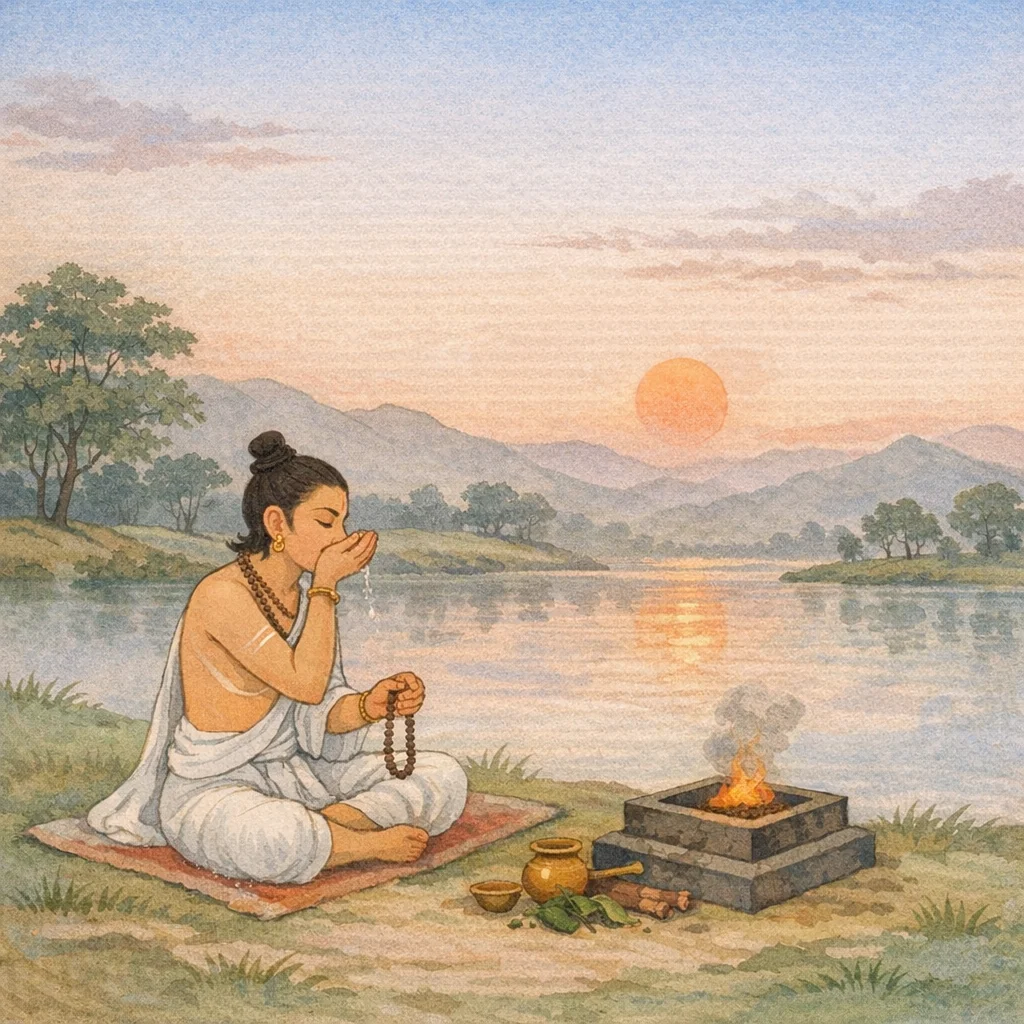
Brahmā sets forth a complete daily dharma-cycle beginning at Brāhma-muhūrta: reflection on dharma and artha, inward meditation on Hari, and strict śauca through dawn-bathing as the gatekeeper of all auspicious rites. He gives substitute purifications for those unable to bathe fully and defines a sixfold bathing system, culminating in mental and yogic purification. He then teaches Sandhyā practice—ācamana, mantra-cleansing with kuśa and water, Gāyatrī-japa, prāṇāyāma, and Sūrya-upāsanā with Vedic solar hymns—declaring that Sandhyā preserves ritual eligibility and spiritual ascent. After the morning rites he integrates household duties: agnihotra/homa, service to the guru, svādhyāya, midday bathing rules, and detailed water-rites (Aghamarṣaṇa, Āpo hi ṣṭhā, mārjana). The chapter culminates in tarpana protocols (sacred-thread positions), deity worship with Puruṣa-sūkta and “tad viṣṇoḥ,” and the pañca-mahāyajñas (Vaiśvadeva, bhūta-bali, honoring guests, feeding beings, daily śrāddha). It closes by introducing aśauca durations by varṇa and life-stage, preparing for further discussions of purity law.
Shlokas
Verse 1
नामैकोनपञ्चाशत्तमोध्यायः ब्रह्मोवाच / अहन्यहनि यः कुर्यात्क्रियां स ज्ञानमाप्नुयात् / ब्राह्मे मुहूर्ते चोत्थाय धर्ममर्थं च चिन्तयेत्
Brahmā said: Whoever, day after day, performs the prescribed daily observances attains true knowledge. Rising in the Brāhma-muhūrta, one should reflect upon dharma and also upon artha (right livelihood and purpose).
Verse 2
चिन्तयेद्धृदि पद्मस्थमानन्दमजरं हरिम् / उषः काले तु संप्राप्ते कृत्वा चावश्यकं बुधः
At dawn, the wise—having first attended to what is necessary—should meditate within the heart on Hari, who abides in the lotus of the heart, who is bliss itself and undecaying.
Verse 3
स्त्रायान्नदीषु शुद्धासु शौचं कृत्वा यथाविधि / प्रतः स्नानेन पूयन्ते ये ऽपि पापकृतो जनाः
Having performed purification (śauca) in the prescribed manner in pure rivers, even those who have committed sins are cleansed by the morning bath.
Verse 4
तस्मात्सर्वप्रयत्नेन प्रातः स्नानं समाचरेत् / प्रातः स्नानं प्रशंसन्ति दृष्टादृष्टष्टकरं हि तत्
Therefore, with every effort one should practice bathing in the early morning. The sages praise the morning bath, for it brings benefits both seen in this world and unseen as spiritual merit beyond it.
Verse 5
सुखात्सुप्तस्य सततं लालाद्याः संस्त्रवन्ति हि / अतो नैवाचरेत्कर्माण्यकृत्वा स्नानमादितः
For one who has slept comfortably, saliva and other bodily secretions continually flow; therefore, one should not perform any rite or duty without first bathing at the outset.
Verse 6
अलक्ष्मीः कालकर्णो च दुः स्वप्नं दुर्विचिन्तितम् / प्रतः स्नानेन पापानि धूयन्ते नात्र संशयः
Misfortune (Alakṣmī), the inauspicious spirit Kālakarṇa, bad dreams, and harmful thoughts—by bathing at dawn one’s sins are washed away; of this there is no doubt.
Verse 7
न च स्नानं विना पुंसां प्राशस्त्यं कर्म संस्मृतम् / होमे जप्ये विशेषेण तस्मात्स्नानं समाचरेत्
Without bathing, no auspicious rite performed by a person is regarded as truly commendable; especially in the case of fire-offerings and mantra-recitation. Therefore, one should duly practice bathing.
Verse 8
अशक्तावशिरस्कं तु स्नानमस्य विधीयते / आर्द्रेण वाससा वापि मार्जनं कायिकं स्मृतम्
For one who is incapable of performing a full bath, a headless (i.e., partial) bathing rite is prescribed. Alternatively, wiping the body with a wet cloth is also regarded as bodily purification.
Verse 9
ब्राह्ममाग्नेयमुद्दिष्टं वायव्यं दिव्यमेव च / वारुणं यौगिकं तद्वत्षडङ्गं स्नानमाचरेत्
One should perform the sixfold purificatory bath as prescribed: the Brāhma bath, the Āgneya (fire) bath, the Vāyavya (wind) bath, the Divya (celestial) bath, the Vāruṇa (water) bath, and likewise the Yaugika (yogic) bath.
Verse 10
ब्राह्मं तु मार्जनं मन्त्रैः कुशैः सोदकबिन्दुभिः / आग्रेयं भस्मनाऽपादमस्तकाद्देहधूननम्
The Brahma-type purification is a cleansing performed with mantras, with kuśa grass, and with drops of water. The Agni-type purification is the shaking/cleansing of the body by applying sacred ash, from the feet up to the head.
Verse 11
गवां हि रजसा प्रोक्तं वायव्यं स्नानमुत्तमम् / यत्तु सातपवर्षेण स्नानं तद्दिव्यमुच्यते
Bathing with the dust raised by cows is declared to be the supreme Vāyavya bath (purifying by the air); and bathing by exposure to sun and rain is called the Divine (Divya) bath.
Verse 12
वारुणं चावगाहं च मानर्स त्वात्मवेदनम् / यौगिकं स्नानमाख्यातं योगेन हरिचिन्तनम्
Immersion in water is called the Varuṇa bath; the mental bath is self-knowledge. The yogic bath is declared to be contemplation of Hari through yoga.
Verse 13
आत्मतीर्थमिति ख्यातं सेवितं ब्रह्मवादिभिः / क्षीरवृक्षसमुद्भूतं मालतीसम्भवं शुभम्
It is renowned as “Ātma-tīrtha” and is resorted to by expounders of Brahman. Auspicious by nature, it arises from the milky tree and is born of the mālatī (jasmine creeper).
Verse 14
अपामार्गं च विल्वं च करवीरं च धावने / उदङ्मुखः प्राङ्मुखो वा भक्षयेद्दन्तधावनम्
For cleansing the teeth, one may use apāmārga, bilva, or karavīra twigs; facing north or facing east, one should perform the tooth-cleaning.
Verse 15
प्रक्षाल्य भुक्त्वा तज्जह्याच्छुचौ देशे समाहितः / स्नात्वा सन्तर्पयेद्देवानृषीन्पितृगणांस्तथा
After eating, having rinsed and cleansed, one should properly dispose of the remnants in a clean place with a collected mind. Then, having bathed, one should offer santarpaṇa (oblations of satisfaction) to the Devas, the Ṛṣis, and likewise to the hosts of Pitṛs (ancestors).
Verse 16
आचम्य विधिवन्नित्यं पुनराचम्य वाग्यतः / संमार्ज्य मन्त्रै रात्मानं कुशैः सोदकबिन्दुभैः
Having performed daily ācamana (sipping of water) in the prescribed manner, and again performing ācamana with speech restrained, one should purify oneself with mantras, using kuśa grass together with drops of water.
Verse 17
आपोहिष्ठाव्याहृतिभिः सावित्र्या वारुणैः शुभैः / ओङ्कारव्याहृतियुतां गायत्त्रीं वेदमातरम्
With the sacred utterances beginning “Āpo hi ṣṭhā…”, with Savitrī (Gāyatrī) and the auspicious Varuṇa-mantras, and with Oṁ together with the vyāhṛtis, one should recite Gāyatrī—the Mother of the Vedas.
Verse 18
जप्त्वा जलाञ्जलिं दद्याद्भारस्करं प्रति तन्मनाः / प्राक्कूलेषु ततः स्थित्वा दर्भेषु सुसमाहितः
Having recited the prescribed mantra, one should offer a handful of water as an oblation, with the mind intent upon the Sun (Bhāskara). Then, standing on the eastern bank, one should sit upon darbha grass, fully composed and concentrated.
Verse 19
प्राणायामं ततः कृत्वा ध्यायेत्सन्ध्यामिति श्रुतिः / या सन्ध्या सा जगत्सूतिर्मायातीता हि निष्कला
Having then performed prāṇāyāma, one should meditate upon Sandhyā—so declares the Śruti. That Sandhyā is the very source of the universe, beyond māyā, and truly partless (without divisions).
Verse 20
ऐश्वरी केवला शक्तिस्तत्त्वत्रयसमुद्भवा / ध्यात्वा रक्तां सितां कृष्णां गायत्त्रीं वै जपेद्वुधः
Gāyatrī is the sovereign, absolute Power, arising from the triad of principles (the three tattvas). Having meditated on Gāyatrī in her red, white, and black forms, the wise person should indeed repeat her mantra in japa.
Verse 21
प्राङ्मुखः सततं विप्रः सन्ध्योपासनमाचरेत् / सन्ध्याहीनो ऽशुचिर्नित्यमनर्हः सर्वकर्मसु
Facing east, the twice-born should always perform the worship of Sandhyā. Devoid of Sandhyā, one remains ever impure and is unfit for all rites and duties.
Verse 22
यदन्यत्कुरुते किञ्चिन्न तस्य फलभाग्भवेत् / अनन्यचेतसः सन्तो ब्राह्मणा वेदपारगाः
Whatever else one may do, one does not become a sharer in its fruit; only those saintly Brahmins—single-pointed in mind and who have crossed to the far shore of the Vedas—are fit to receive and partake of the result.
Verse 23
उपास्य विधिवत्सन्ध्यां प्राप्ताः पूर्वपरां गतिम् / यो ऽन्यत्र कुरुते यत्नं धर्म कार्ये द्विजोत्तमः
Having duly performed the Sandhyā rites according to rule, they attain the highest course (the supreme state). But the best of the twice-born who strives elsewhere, apart from dharma, fails to reach that goal.
Verse 24
विहाय सन्ध्याप्रणतिं स याति नरकायुतम् / तस्मात्सर्वप्रयत्नेन सन्ध्योपासनमाचरेत्
One who abandons the reverential worship of Sandhyā goes to innumerable hells; therefore, with every effort one should practice the worship of Sandhyā.
Verse 25
उपासितो भवेत्तेन देवो योगतनुः परः / सहस्रपरमां नित्यां शतमध्यां दशावराम्
By that discipline of worship and japa, the supreme Deity—whose very form is Yoga—is duly propitiated. This practice should be kept as a constant observance: a thousand as the highest count, a hundred as the middle, and ten as the minimum.
Verse 26
गायत्त्रीं वै जपेद्विद्वान्प्राङ्मुखः प्रयतः शुचिः / अथोपतिष्ठेदादित्यमुदयस्थं समाहितः
A learned person, disciplined and pure, should recite the Gāyatrī while facing east; then, with a collected mind, he should worship Āditya, the Sun, at the time of sunrise.
Verse 27
मन्त्रैस्तु विविधैः सौरैः ऋग्यजुःसामसंज्ञितैः / उपस्थाय महायोगं देवदेवं दिवाकरम्
Then, with various solar mantras—known as those of the Ṛg, Yajus, and Sāma—having duly worshipped Divākara, the great yogin, the God of gods, the Sun.
Verse 28
कुर्वीत प्रणतिं भूमौ मूर्धानमभिमन्त्रितः / ॐ खखोल्काय शान्ताय कारणत्रयहेतवे
Having first consecrated the head with the mantra, one should bow down upon the ground, uttering: “Oṁ—salutations to Khakholka, the Peaceful One, the cause behind the three causes.”
Verse 29
निवेदयामि चात्मानं नमस्ते ज्ञानरूपिणे / त्वमेव ब्रह्म परममापो ज्योती रसो ऽमृतम्
I offer myself to You; salutations to You, whose very form is pure knowledge. You alone are the supreme Brahman—you are the waters, the light, the essence (rasa), and the nectar of immortality.
Verse 30
भूर्भुवः स्वस्त्वमोङ्कारः सर्वो रुद्रः सनातनः / एतद्वै सूर्यहृदयं जप्त्वा स्तवनमुत्तमम्
“Bhūr, Bhuvaḥ, Svaḥ; and the syllable Oṁ—He is all, Rudra, the Eternal.” Having recited this indeed as the Sūrya-hṛdaya (the Sun’s “heart” mantra), one attains the highest hymn of praise.
Verse 31
प्रातः काले च मध्याह्ने नमस्कुर्याद्दिवाकरम् / अथागम्य गृहं विप्रः (पश्चात्) समाचम्य यथाविधि
In the morning and again at midday, one should bow in reverence to the Sun (Divākara). Then, having returned home, the brāhmaṇa should afterward perform ācamana in the prescribed manner.
Verse 32
प्रज्वाल्य वह्निं विधिवज्जुहुयाज्जातवेदसम् / ऋत्विक् पुत्रो ऽथ पत्नी वा शिष्यो वापि सहोदरः
Having kindled the sacred fire, one should duly offer oblations to Jātavedas (Agni). The officiating priest, or the son, or the wife, or the disciple, or even a brother may perform this rite.
Verse 33
प्राप्यानुज्ञां विशेषेण जुहुयाद्वा यथाविधि / विना म (त) न्त्रेण यत्कर्म नामुत्रेह फलप्रदम्
Having duly obtained permission in the proper manner, one should perform the fire-offering according to rule; for any rite done without the mantra yields no fruit—neither in this world nor in the next.
Verse 34
दैवतानि नमस्कुर्यादुपहारान्निवेदयेत् / गुरुं चैवाप्युपासीत हितं चास्य समाचरेत्
One should bow to the deities and present them respectful offerings; one should also serve the guru and act in ways that are beneficial to him.
Verse 35
वेदाभ्यासं ततः कुर्यात्प्रयत्नाच्छक्तितो द्विजः / जपेद्वाध्यापयेच्छिष्यान्धारयेद्वै विचारयेत्
Then, with diligent effort and according to his capacity, the twice-born should engage in Vedic study; he should perform japa by reciting the mantras or teach the students; he should commit the teachings to memory and also reflect upon them.
Verse 36
अवेक्षेत च शास्त्राणि धर्मादीनि द्विजोत्तमः / वैदिकांश्चैव निगमान्वेदाङ्गानि च सर्वशः
The foremost among the twice-born should diligently examine the śāstras on Dharma and allied disciplines, and likewise study the Vedic scriptures (nigamas) and, in every way, all the Vedāṅgas, the auxiliary limbs of the Veda.
Verse 37
उपयादीश्वरं चैव योगक्षेमप्रासिद्धये / साधयेद्विविधानर्थान्कुटुम्बार्थं ततो द्विजः
For the attainment and assured maintenance of yoga and kṣema—prosperity and security—the twice-born should duly worship the Lord (Īśvara); thereafter, he should pursue various means of livelihood to support his family.
Verse 38
ततो मध्याह्नसमये स्नानार्थं मृदमाहरेत् / पुष्पाक्षतांस्तिलकुशान् गोमयं शुद्धमेव च
Then, at midday, one should bring clean earth for bathing, along with flowers, akṣata (unbroken grains of rice), sesame, kuśa grass, and also only pure cow-dung.
Verse 39
नदीषु देवखातेषु तडागेषु सरः सु च / स्नानं समाचरेन्नैव परकीये कदाचन
One should bathe in rivers, in sacred waterworks as though fashioned by the gods, in ponds and in lakes; but never, at any time, should one bathe in water that belongs to another without right or permission.
Verse 40
पञ्च पिण्डाननुद्धृत्य स्नानं दुष्यन्ति नित्यशः / मृदैकया शिरः क्षाल्यं द्वाभ्यां नाभेस्तथोपरि
If one bathes without first removing the five lumps of impurity, the bath becomes defiled each time. With one portion of cleansing earth one should wash the head; with two portions, the region from the navel upward.
Verse 41
अधश्च तिसृभिः क्षाल्यं पादौ षट्भिस्तथैव च / मृत्तिका च समुद्दिष्टा वृद्धामलकमात्निका
Below the body, one should wash the lower part with three handfuls of water, and likewise the feet with six. The cleansing earth (mṛttikā) to be used is also prescribed—namely the kind known as vṛddhāmalaka-mātnikā.
Verse 42
गोमयस्य प्रमाणं तु तेनाङ्गं लेपयेत्ततः / प्रक्षाल्याचम्य विधिवत्ततः स्नायात्समाहितः
Having taken the proper measure of cow-dung, one should smear the body with it; thereafter, having washed it off and performed ācamana according to rule, one should bathe with a collected and attentive mind.
Verse 43
लेपयित्वा तु तीरस्थस्तल्लिङ्गैरेव मन्त्रतः / अभिमन्त्र्य जलं मन्त्रैरालिङ्गैर्वारुणैः शुभैः
Standing on the riverbank, one should apply the sacred substance while reciting the appropriate mantras in accord with its signs; then, having consecrated the water with auspicious Varuṇa-mantras connected with those same signs, one should proceed with the rite.
Verse 44
त्नानकाले स्मरेद्विष्णमापो नारायणो यतः / प्रेक्ष्य ओङ्कारमादित्यं त्रिर्निमज्जेज्जलाशये
At the time of bathing, one should remember Lord Viṣṇu, for the waters are of Nārāyaṇa. Gazing upon the Sun as the sacred Oṁ, one should immerse oneself three times in the water-reservoir.
Verse 45
आचान्तः पुनराचामेन्मन्त्रेणानेन मन्त्रवित् / अन्तश्चरसि भूतेषु गुहायां विश्वतोमुखः
Having performed ācamana, the knower of mantras should sip water again with this mantra: “You move within all beings, dwelling in the heart-cave, O All-faced One.”
Verse 46
त्वं यज्ञस्त्वं वषट्कार आपो ज्योती रसो ऽमृतम् / द्रुपदां वा त्रिरभ्यस्येव्द्याहृतिप्रणवान्विताम्
You are the yajña, and You are the vaṣaṭ-call; You are the waters, the light, the essence, and amṛta, the nectar of immortality. One should remember You by reciting three times the sacred verses endowed with the vyāhṛtis and the praṇava “Oṁ”.
Verse 47
सावित्रीं वा जपे द्विद्वांस्तथा चैवाघमर्षणम् / ततः संमार्जनं कुर्यादापोहिष्ठामयोभुवः
A learned dvija should recite the Sāvitrī (Gāyatrī) and also the Aghamarṣaṇa, the hymn that removes sin. Thereafter he should perform purification by sprinkling/cleansing, reciting the water-mantras “Āpo hi ṣṭhā…” and “A mayo bhuvaḥ”.
Verse 48
इदमापः प्रवहतव्याहृतिभिस्तथैव च / ततो ऽभिमन्त्रितं तोपमापो हिष्ठादिमन्त्रकैः
These waters should be poured out while reciting the sacred vyāhṛtis. Thereafter the water should be ritually consecrated by mantra-recitation, beginning with “Āpo hi ṣṭhā…” and the related water-mantras.
Verse 49
अन्तर्जलमवाङ्मग्नो जपेत्त्रिरघमर्षणम् / द्रुपदां वाथ सावित्ररिं तद्विष्णोः परमं पदम्
Submerged in water, with the face turned downward, one should repeat the Aghamarṣaṇa three times. Or else one may recite the Drupadā or the Sāvitrī (Gāyatrī), and also the mantra beginning “tad viṣṇoḥ paramaṃ padam,” the supreme abode of Viṣṇu.
Verse 50
आवर्तयेद्वा प्रणवं देवदेवं रमरेद्धरिम् / अपः पाणौ समादाय जप्त्वा वै मार्जने कृते
Alternatively, one should repeatedly recite the praṇava “Oṁ”, worshipping Hari, the God of gods. Taking water in the hand and reciting the mantra, one should then perform mārjana, the purificatory sprinkling.
Verse 51
विन्यस्य मूर्ध्नि तत्तोयं मुच्यते सर्वपातकैः / सन्ध्यामुपास्य चाचम्य संस्मरेन्नित्यमीश्वरम्
Placing that water upon the crown of the head, one is released from all sins. Having performed Sandhyā worship and purified oneself by ācamana, one should ever remember the Lord.
Verse 52
अथोपतिष्ठेदादित्यमूर्ध्वपुष्पान्विताञ्जलिम् / प्रक्षिप्यालोकयेद्देवमुदयन्तं न शक्यते
Then one should stand reverently before Āditya, the Sun, with palms joined and flowers raised aloft. Having offered them, one may behold the deity as he rises—yet one should not attempt to gaze directly at him at the moment of rising.
Verse 53
उदुत्यं चित्रमित्येवं तच्चक्षुरिति मन्त्रतः / हंसः शुचिषदेतेन सावित्र्या च विशेषतः
By reciting the mantras beginning with “Udutyaṃ citram” and “Tac-cakṣur,” and most especially the Sāvitrī (Gāyatrī), the Haṃsa—abiding in purity—is realized and duly propitiated through this practice.
Verse 54
अन्यैः सौरैर्वैदिकैश्च गायत्त्रीं च ततो जपेत् / मन्त्रांश्च विविधान्पश्चात्प्राक्कूले च कशासने
Then one should repeat the Gāyatrī, along with other solar and Vedic mantras. Thereafter, one should recite various additional mantras, seated upon a kuśa-grass seat with its tip oriented toward the east.
Verse 55
तिष्ठंश्च वीक्ष्यमाणोर्ऽकं जपं कुर्यात्समाहितः / स्फटिकाब्जाक्षरुद्राक्षैः पुत्रजीवसमुद्भवैः
Standing with steady concentration, while beholding the Sun, one should perform japa (repetition of the mantra), using a rosary made of crystal, lotus-seeds, rudrākṣa, or the seeds of putrajīva.
Verse 56
कर्तव्या त्वक्षाला स्यादन्तरा तत्र सा स्मृता / यदि स्यात्क्लिन्नवासा वै वारिमध्यगतश्चरेत्
In that interval, one should indeed perform a cleansing of the body (bathing/purification)—this is the rule. And if one’s garments have become wet, one should walk while remaining in the midst of the water.
Verse 57
अन्यथा च शुचौ भूम्यां दर्भेषु च समाहितः / प्रदक्षिणं समावृत्य नमस्कृत्य ततः क्षितौ
Otherwise, seated with a collected mind on pure ground upon sacred darbha grass, one should perform the auspicious pradakṣiṇa (clockwise circumambulation); then, having offered reverent obeisance, one should bow down upon the earth.
Verse 58
आचम्य च यथाशास्त्रं शक्त्या स्वाध्यायमाचरेत् / ततः सन्तर्पयेद्देवानृषीन्पितृगणांस्तथा
Having performed ācamana in accordance with the scriptures, one should undertake svādhyāya (sacred self-study/recitation) to the best of one’s ability; thereafter, one should offer tarpana to satisfy the Devas, the Ṛṣis, and likewise the hosts of Pitṛs (ancestors).
Verse 59
आदावोङ्कारमुच्चार्य नमो ऽन्ते तर्पयामि च / देवान्ब्रह्मऋषींश्चैव तर्पयेदक्षतोदकैः
After first uttering the syllable Oṁ, and ending with the salutation “namo,” one should say, “I offer tarpana,” and then satisfy the Devas and the Brahmarṣis with water mixed with akṣata (unbroken grains).
Verse 60
पितॄन्देवान्मुनीन् भक्त्या स्वसूत्रोक्तविधानतः
With devotion, one should worship the Pitṛs (ancestors), the Devas, and the sages, strictly according to the procedures prescribed in one’s own gṛhya-sūtras.
Verse 61
देवर्षोंस्तर्पयेद्धीमानुदकाञ्जलिभिः पितॄत् / यज्ञोपवीती देवानां निवीती ऋषितर्पणे
A wise person should satisfy the Pitṛs (ancestors) by offering handfuls of water. When making offerings to the Devas, one should wear the sacred thread in the upavīta manner; and when making offerings to the Ṛṣis, one should wear it in the nivīta manner.
Verse 62
प्राचीनावीती पित्र्ये तु तेन तीर्थेन भारत / निष्पीड्य स्नानवस्त्रं वै समाचम्य च वाग्यतः
O Bhārata, for rites meant for the Pitṛs one should wear the sacred thread in the prācīnāvītī manner. Then, at that tīrtha, after wringing out the bathing cloth, one should perform ācamana and remain restrained in speech.
Verse 63
स्वैर्मन्त्रैरर्चयेद्देवान्पुष्पैः पत्रैस्तथाम्बुभिः / ब्रह्माणं शङ्करं सूर्यं तथैव मधुसूदनम्
With one’s own prescribed mantras, one should worship the gods with flowers, leaves, and also with water—worshipping Brahmā, Śaṅkara, Sūrya, and likewise Madhusūdana (Viṣṇu).
Verse 64
अन्यांश्चाभिमतान्देवान् भक्त्या चाक्रोधनो हर ! / प्रदद्याद्वाथ पुष्पादि सूक्तेन पुरुषेण तु
And, O Hara, being free from anger and with devotion, one should also make offerings to other chosen deities. Then one should present flowers and the like, accompanied by the Puruṣa-sūkta.
Verse 65
आपो वा देवताः सर्वास्तेन सम्यक् समर्चिताः / ध्यात्वा प्रणवपूर्वं वै देवं वारिसमाहितः
Water itself is to be regarded as all the deities; thus, through it, they are duly worshipped. Having meditated with the sacred syllable Oṁ as the prelude, with the mind focused upon the water, one should contemplate the Divine.
Verse 66
नमस्कारेण पुषापाणि विन्यसेद्वै पृथक्पृथक् / नर्ते ह्याराधनात्पुण्यं विद्यते कर्म वैदिकम्
With reverent salutations, one should place the flowers separately, one by one; for apart from worshipful adoration, no merit is obtained from Vedic ritual action.
Verse 67
तस्मात्तत्रादिमध्यान्ते चेतसा धारयेद्धरिम् / तद्विष्णोरिति मन्त्रेण सूक्तेन पुरुषेण तु
Therefore, there (in that rite), at the beginning, in the middle, and at the end, one should mentally hold Lord Hari in one’s consciousness—by means of the mantra “tad viṣṇoḥ” and by the Puruṣa Sūkta hymn.
Verse 68
निवेदयेच्च आत्मानं विष्णवे ऽमलतेजसे / तदाध्यात्ममनाः शान्तस्तद्विष्णोरिति मन्त्रतः
Let one offer (surrender) one’s very self to Vishnu of stainless radiance; becoming inwardly spiritual-minded and tranquil, one should do so through the mantra, “That is of Vishnu.”
Verse 69
अप्रेते सशिरा वेतियजेत्वा पुष्पके हरिम् / देवयज्ञं पितृयज्ञं तथैव च / मानुषं ब्रह्मयज्ञं च पञ्च यज्ञान्समाचरेत्
Before one becomes a preta (a restless departed spirit), one should worship Hari—envisioned as seated upon Garuḍa—and should duly perform the five great sacrifices: deva-yajña, pitṛ-yajña (to the ancestors), manuṣya-yajña (service to human beings), and brahma-yajña (svādhyāya: study/recitation of sacred knowledge).
Verse 70
यदि स्यात्तर्पणादर्वाग्ब्रयज्ञं कुतो भवेत् / कृत्वा मनुष्ययज्ञं वै ततः स्वाध्यायमाचरेत्
If the tarpaṇa (oblations of water) were to be done before it, how could the brahma-yajña (study/recitation of sacred knowledge) take place? Having first performed the manuṣya-yajña (service to human beings/guests), one should then engage in svādhyāya (self-study of the Veda and śāstra).
Verse 71
वैश्वदेवस्तु कर्तव्यो देवयज्ञः स तु स्मृतः / भूतयज्ञःऋ स वै ज्ञेयो भूतेभ्यो यस्त्वयं बलिः
One should perform the Vaiśvadeva offering; it is remembered as the deva-yajña, the sacrifice to the Devas. And the bali—this offering given to living beings—is to be understood as the bhūta-yajña, the sacrifice for all creatures.
Verse 72
श्वभ्यश्च श्वपचेभ्यश्च पतितादिभ्य एव च / दद्याद्भूमौ बहिस्त्वन्नं पक्षिभ्यश्च द्विजोत्तमः
The best of the twice-born should place food outside upon the ground and give it to dogs, to outcastes (the so-called dog-cookers), to the fallen and the like—and also to birds.
Verse 73
एकं तु भोजयेद्विप्रं पितॄनुद्दिश्य सत्तमाः / नित्यश्राद्धं तदुद्दिश्य पितृयज्ञो गतिप्रदः
The best among the virtuous should feed even a single brāhmaṇa, dedicating it to the Pitṛs. Performed as a daily śrāddha for their sake, that act is the Pitṛ-yajña, and it grants the ancestors a благотворный onward course.
Verse 74
उद्धृत्य वा यथाशक्ति किञ्चिदन्नं समाहितः / वेदतत्त्वार्थविदुषे द्विजायैवोपपादयेत्
With a collected mind, one should set aside—according to one’s capacity—some portion of food and offer it to a twice-born brāhmaṇa who knows the true purport and principles of the Veda.
Verse 75
पूजयेदतिथिं नित्यं नमस्येदर्चयोद्द्विजम् / मनोवाक्कर्मभिः शान्तं स्वागतैः स्वगृहं ततः
One should always honor a guest, and bow to and worship a learned twice-born. With peaceful mind, speech, and deeds, one should then welcome him properly into one’s own home.
Verse 76
भिक्षामाहुर्ग्रासमात्रमन्नं तत्स्याच्चतुर्गुणम् / पुष्कलं हन्तकारं तु तच्चतुर्गुणमुच्यते
They say that “bhikṣā” (a begged offering) is food equal to a single mouthful; the measured allowance is four times that. But a lavish excess is called “hantakāra” (ruinous), and that too is spoken of by a fourfold measure.
Verse 77
गोदोहमात्रकालं वै प्रतीक्ष्यो ह्यतिथिः स्वयम् / अभ्यागतान्यथाशक्ति पूजयेदतिथिं तथा
One should personally wait for a guest for the time it takes to milk a cow; and when guests arrive, one should honor and receive them according to one’s ability.
Verse 78
भिक्षां वै भिक्षवे दद्याद्विधिवद्ब्रह्यचारिणे / दद्यादन्नं यथाशक्ति अर्थिभ्यो लोभवर्जितः
One should duly give alms (bhikṣā) to a mendicant and, according to proper rule, to a brahmacārin. Free from greed, one should also give food to supplicants, as much as one is able.
Verse 79
भुञ्जति बन्धुभिः सार्धं वाग्यतो ऽन्नमकुत्सयन् / अकृत्वा तु द्विजः पञ्च महायज्ञान् द्विजोत्तमः
Even a distinguished twice-born man, if he eats together with relatives while restraining his speech and without disparaging the food, yet fails to perform the five great sacrifices (pañca mahāyajña), remains blameworthy despite his status.
Verse 80
भुञ्जते चेत्स मूढात्मा तिर्यग्योनिं च गच्छति / वेदाभ्यासो ऽन्वहं शक्त्या महायज्ञक्रियाक्षमाः
If a deluded person indulges in such forbidden enjoyment, he goes to an animal womb. Therefore, according to one’s capacity, one should practise the daily study of the Veda and be competent in the ritual acts of the great sacrifices.
Verse 81
नाशयन्त्याशु पापानि देवानामर्चनं तथा / यो मोहादथ वालस्यादकृत्वा देवतार्चनम्
Worship of the Devas swiftly destroys sins. But one who, through delusion or even through laziness, does not perform the adoration of the deities, incurs the opposite result.
Verse 82
भुङ्क्ते स याति नरकान्त्सूंकरेष्वेव जायते / अशौचं संप्रवक्ष्यामि अशुचिः पातकी सदा
He who partakes of forbidden or impure food goes to the hells and is indeed reborn among pigs. Now I shall explain aśauca (ritual impurity): the impure person is ever sinful.
Verse 83
अशौचं चैव संसर्गाच्छुद्धिः संसर्गवर्जनात् / दशाहं प्राहुराशौचं सर्वेविप्रा विपश्चितः
Aśauca (impurity) arises through contact with the impure, and purification comes from avoiding such contact. All wise Brahmin sages declare that the period of impurity lasts ten days.
Verse 84
मृतेषु वाथ जातेषु ब्राह्मणानां द्विजोत्तम / आदन्तजननात् सद्य आचूडादेकरात्रकम्
O best of the twice-born, in the case of deaths or births among Brahmanas, aśauca arises immediately and lasts for one night—from the time the child’s teeth appear until the tonsure rite (cūḍā).
Verse 85
त्रिरात्रमौपनयनाद्दशरात्रमतः परम् / क्षत्त्रियो द्वादशहेन दशभिः पञ्चभिर्विशः
After the upanayana (sacred-thread initiation), the observance lasts three nights; beyond that, it extends to ten nights. For a Kṣatriya it is twelve days; for a Vaiśya, ten days, or five days (according to the rule followed).
Verse 86
शुध्येन्मासेन वै शूद्रो यतीनां नास्ति पातकम् / रात्रिभिर्मासतुल्याभिर्गर्भस्त्रावेषु शौचकम्
A Śūdra is purified after a month; for the yatīs (renunciants) there is no impurity. In the case of miscarriage, the purification is to be observed for as many nights as equal a month.
Frequently Asked Questions
The chapter states a graded discipline for the constant observance: a thousand as the highest count, a hundred as the middle, and ten as the minimum, in the context of propitiating the supreme deity through the practice.
It explicitly names the water-hymn “Āpo hi ṣṭhā…”, the phrase “A mayo bhuvaḥ…”, and the Aghamarṣaṇa for sin-removal; it also permits Sāvitrī (Gāyatrī), the Drupadā hymn, and ‘tad viṣṇoḥ paramaṃ padam’ as alternatives, alongside repeated praṇava (Oṁ).
Offerings to Devas are done with the thread in upavīta; offerings to Ṛṣis with nivīta; and rites for Pitṛs with prācīnāvītī, followed by ācamana and restraint of speech at the tīrtha.
The chapter gives a general ten-day framework, then specifies: for Brāhmaṇas, a short immediate impurity in early childhood contexts and later three nights after upanayana, extending to ten; for Kṣatriyas twelve days; for Vaiśyas ten (or five by some rule); for Śūdras one month; for renunciants none; and for miscarriage, as many nights as correspond to the month-count of gestation.