Adhyaya 9
Dhruva’s Darśana, Transformative Prayers, and the Boon of the Dhruva-loka (Pole Star)
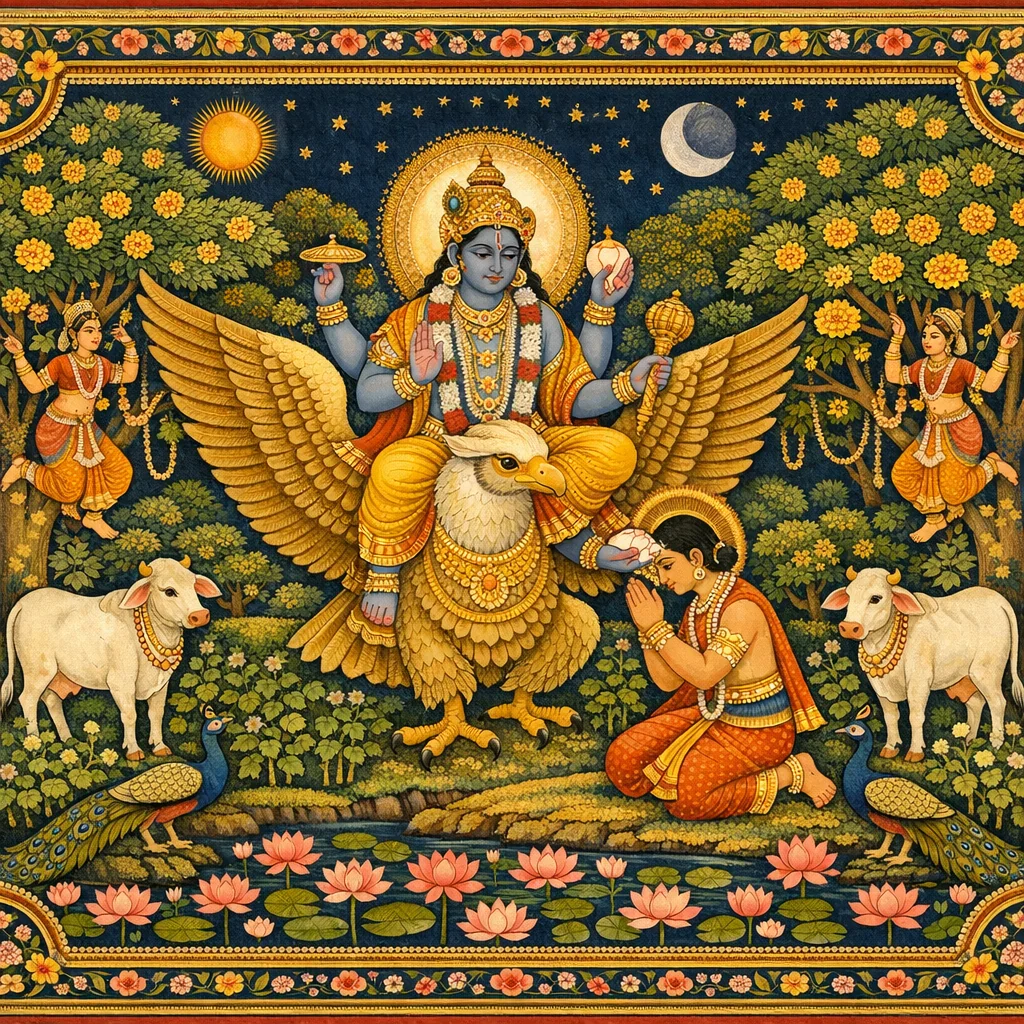
After reassuring the demigods, Lord Viṣṇu rides Garuḍa to Madhuvana to meet Dhruva. Dhruva’s meditation reaches its climax when his inner vision suddenly stops and the Lord appears before him. Overwhelmed, Dhruva is first speechless, but when the Lord touches his forehead with the conchshell, firm Vedic realization awakens and he offers powerful prayers. He glorifies the Lord’s energies, His presence as Paramātmā, and His cosmic functions, then reproaches his own material ambition, exalting bhakti above brahmānanda and even svarga. Above all he begs for sādhu-saṅga, knowing devotion alone carries one across saṁsāra. The Lord grants him the imperishable Dhruva-loka (the polestar) and foretells his future—rule, sacrifices, family tragedies, and final ascent to the Lord’s abode. After the Lord departs, Dhruva returns home ashamed of his earlier aims. Vidura asks why he is not pleased; Maitreya explains Dhruva’s remorse as the bhakta’s purification. The chapter then moves into Dhruva’s royal reception and Uttānapāda’s enthronement of him, preparing the next phase of righteous governance born of realized devotion and the elder king’s eventual renunciation.
Shlokas
Verse 1
मैत्रेय उवाच त एवमुत्सन्नभया उरुक्रमे कृतावनामा: प्रययुस्त्रिविष्टपम् । सहस्रशीर्षापि ततो गरुत्मता मधोर्वनं भृत्यदिदृक्षया गत: ॥ १ ॥
Maitreya said: Thus reassured by Urukrama, the demigods were freed from fear; offering obeisances, they returned to their heavenly abodes. Then the Lord, nondifferent from the Sahasraśīrṣā incarnation, mounted Garuḍa and went to the Madhuvana Forest to behold His servant and devotee, Dhruva.
Verse 2
स वै धिया योगविपाकतीव्रया हृत्पद्मकोशे स्फुरितं तडित्प्रभम् । तिरोहितं सहसैवोपलक्ष्य बहि:स्थितं तदवस्थं ददर्श ॥ २ ॥
By the full ripening of his yoga, Dhruva Mahārāja beheld within the lotus of his heart the Lord’s form, flashing like lightning; suddenly it vanished. Disturbed, his meditation broke, yet the moment he opened his eyes he saw the Supreme Personality of Godhead standing before him—just as he had seen the Lord within.
Verse 3
तद्दर्शनेनागतसाध्वस: क्षिता- ववन्दताङ्गं विनमय्य दण्डवत् । दृग्भ्यां प्रपश्यन् प्रपिबन्निवार्भक- श्चुम्बन्निवास्येन भुजैरिवाश्लिषन् ॥ ३ ॥
Seeing his Lord directly before him, Dhruva Mahārāja trembled with devotion and fell to the ground in daṇḍavat obeisance. In ecstatic love he gazed as though drinking the Lord with his eyes, kissing the Lord’s lotus feet with his mouth, and embracing Him with his arms.
Verse 4
स तं विवक्षन्तमतद्विदं हरि- र्ज्ञात्वास्य सर्वस्य च हृद्यवस्थित: । कृताञ्जलिं ब्रह्ममयेन कम्बुना पस्पर्श बालं कृपया कपोले ॥ ४ ॥
Though Dhruva Mahārāja was only a boy, he longed to pray to the Supreme Lord in fitting words, yet from inexperience he could not at once speak. Hari, dwelling in the heart of all, understood his plight; and out of causeless mercy He touched the child’s forehead/cheek with His spiritual conchshell as Dhruva stood with folded hands.
Verse 5
स वै तदैव प्रतिपादितां गिरं दैवीं परिज्ञातपरात्मनिर्णय: । तं भक्तिभावोऽभ्यगृणादसत्वरं परिश्रुतोरुश्रवसं ध्रुवक्षिति: ॥ ५ ॥
At that very moment Dhruva Mahārāja was endowed with divine speech and fully grasped the Vedic conclusion, realizing the Paramātmā and the Absolute Truth. Following the path of bhakti to Śrī Hari, whose fame is heard everywhere, Dhruva—destined to attain the imperishable Dhruvaloka even at dissolution—offered calm, deliberate, and conclusive prayers.
Verse 6
ध्रुव उवाच योऽन्त: प्रविश्य मम वाचमिमां प्रसुप्तां सञ्जीवयत्यखिलशक्तिधर: स्वधाम्ना । अन्यांश्च हस्तचरणश्रवणत्वगादीन् प्राणान्नमो भगवते पुरुषाय तुभ्यम् ॥ ६ ॥
Dhruva Mahārāja said: O my Lord, You are all-powerful. Entering within me, You awaken my sleeping power of speech and enliven my hands, feet, hearing, touch, all the senses, and the very life-air by the splendor of Your own abode. I offer my obeisances unto You, O Bhagavān, Supreme Person.
Verse 7
एकस्त्वमेव भगवन्निदमात्मशक्त्या मायाख्ययोरुगुणया महदाद्यशेषम् । सृष्ट्वानुविश्य पुरुषस्तदसद्गुणेषु नानेव दारुषु विभावसुवद्विभासि ॥ ७ ॥
O Bhagavān, You alone are the Supreme One. By Your own śakti—Your māyā, rich with vast modes—you create the mahat-tattva and all that follows. Having created, You enter within as the Puruṣa, the indwelling Paramātmā, and through nature’s temporary guṇas You shine forth in many forms, as fire entering woods of different shapes blazes in diverse ways.
Verse 8
त्वद्दत्तया वयुनयेदमचष्ट विश्वं सुप्तप्रबुद्ध इव नाथ भवत्प्रपन्न: । तस्यापवर्ग्यशरणं तव पादमूलं विस्मर्यते कृतविदा कथमार्तबन्धो ॥ ८ ॥
O Nātha, by the knowledge You bestowed, Brahmā—surrendered to You—beholds this whole universe as one awakened from sleep sees his immediate duty. The root of Your lotus feet is the sole shelter for those who seek liberation, and You are the friend of the distressed; how could a learned soul of perfect knowledge ever forget You?
Verse 9
नूनं विमुष्टमतयस्तव मायया ते ये त्वां भवाप्ययविमोक्षणमन्यहेतो: । अर्चन्ति कल्पकतरुं कुणपोपभोग्य- मिच्छन्ति यत्स्पर्शजं निरयेऽपि नृणाम् ॥ ९ ॥
Those who worship You only for the pleasure of this “bag of skin” are surely robbed of discernment by Your māyā. Though You are like a wish-fulfilling tree and the very cause of release from birth and death, fools (like me) still beg from You boons for sense enjoyment—pleasures available even to those in hellish states.
Verse 10
या निर्वृतिस्तनुभृतां तव पादपद्म ध्यानाद्भवज्जनकथाश्रवणेन वा स्यात् । सा ब्रह्मणि स्वमहिमन्यपि नाथ मा भूत् किं त्वन्तकासिलुलितात्पततां विमानात् ॥ १० ॥
O Nātha, the bliss embodied beings gain by meditating on Your lotus feet, or by hearing Your glories from pure devotees, is limitless—far beyond brahmānanda, the joy of imagining oneself merged into impersonal Brahman. If brahmānanda is itself defeated by the ecstasy of bhakti, what then of the fleeting happiness of heaven, cut down by time’s sword, ending in a fall as from a vimāna?
Verse 11
भक्तिं मुहु: प्रवहतां त्वयि मे प्रसङ्गो भूयादनन्त महताममलाशयानाम् । येनाञ्जसोल्बणमुरुव्यसनं भवाब्धिं नेष्ये भवद्गुणकथामृतपानमत्त: ॥ ११ ॥
Dhruva Mahārāja said: O limitless Lord Ananta, bless me with the company of great devotees, pure in heart, whose loving bhakti to You flows unceasingly like the waves of a river. By that path of devotion I shall surely cross the ocean of material existence, filled with blazing, firelike dangers, for I am becoming intoxicated by drinking the nectar of narrations of Your eternal qualities and līlās.
Verse 12
ते न स्मरन्त्यतितरां प्रियमीश मर्त्यं ये चान्वद: सुतसुहृद्गृहवित्तदारा: । ये त्वब्जनाभ भवदीयपदारविन्द सौगन्ध्यलुब्धहृदयेषु कृतप्रसङ्गा: ॥ १२ ॥
O Lord of the lotus navel, one who associates with a devotee whose heart is greedy for the fragrance of Your lotus feet never becomes attached to the material body, nor to bodily relations—children, friends, home, wealth, and wife—so dear to the worldly; indeed, he cares nothing for them.
Verse 13
तिर्यङ्नगद्विजसरीसृपदेवदैत्य मर्त्यादिभि: परिचितं सदसद्विशेषम् । रूपं स्थविष्ठमज ते महदाद्यनेकं नात: परं परम वेद्मि न यत्र वाद: ॥ १३ ॥
My dear Lord, O Supreme Unborn, I know that the many kinds of beings—animals, trees, birds, reptiles, demigods, daityas, and humans—pervade the universe born of the total material energy, sometimes manifest and sometimes unmanifest; yet never before have I experienced the supreme form I behold in You now. Here all speculation comes to rest.
Verse 14
कल्पान्त एतदखिलं जठरेण गृह्णन् शेते पुमान्स्वदृगनन्तसखस्तदङ्के । यन्नाभिसिन्धुरुहकाञ्चनलोकपद्म- गर्भे द्युमान्भगवते प्रणतोऽस्मि तस्मै ॥ १४ ॥
My Lord, at the end of each kalpa Garbhodakaśāyī Viṣṇu draws all that is manifest in the universe into His belly and lies upon the lap of Ananta Śeṣa. From His navel springs a golden lotus on a stalk, and upon that lotus Brahmā is born. I understand that You are that same Supreme Godhead; therefore I offer You my respectful obeisances.
Verse 15
त्वं नित्यमुक्तपरिशुद्धविबुद्ध आत्मा कूटस्थ आदिपुरुषो भगवांस्त्र्यधीश: । यद्बुद्ध्यवस्थितिमखण्डितया स्वदृष्टया द्रष्टा स्थितावधिमखो व्यतिरिक्त आस्से ॥ १५ ॥
My Lord, You are the eternally liberated, perfectly pure and fully awakened Self—unchanging Paramātmā, the original Puruṣa, Bhagavān endowed with six opulences, and the everlasting master of the three guṇas. By Your unbroken transcendental glance You are the supreme witness of every stage of intellect. As Viṣṇu You sustain the affairs of the universe, yet remain aloof, enjoying the fruits of all sacrifices.
Verse 16
यस्मिन्विरुद्धगतयो ह्यनिशं पतन्ति विद्यादयो विविधशक्तय आनुपूर्व्यात् । तद्ब्रह्म विश्वभवमेकमनन्तमाद्य- मानन्दमात्रमविकारमहं प्रपद्ये ॥ १६ ॥
My dear Lord, within Your impersonal manifestation as Brahman there ever appear two opposing currents—knowledge and ignorance—and Your many energies continually unfold. Yet that Brahman, one and undivided, original, changeless, unlimited, and made only of bliss, is the cause of the world’s manifestation. Because You are that very Brahman, I take shelter of You and offer my respectful obeisances.
Verse 17
सत्याशिषो हि भगवंस्तव पादपद्म- माशीस्तथानुभजत: पुरुषार्थमूर्ते: । अप्येवमर्य भगवान्परिपाति दीनान् वाश्रेव वत्सकमनुग्रहकातरोऽस्मान् ॥ १७ ॥
My Lord Bhagavān, You are the very embodiment of true benediction, the personified form of all human goals. For one who serves You in devotion with no other desire, worship of Your lotus feet is a greater blessing than kingship and dominion. To ignorant devotees like me, You are the causelessly merciful maintainer—like a cow that nourishes and protects her newborn calf with milk.
Verse 18
मैत्रेय उवाच अथाभिष्टुत एवं वै सत्सङ्कल्पेन धीमता । भृत्यानुरक्तो भगवान् प्रतिनन्द्येदमब्रवीत् ॥ १८ ॥
Maitreya said: O Vidura, when Dhruva Mahārāja, whose heart held noble resolve and whose mind was wise, finished his prayer, Bhagavān—affectionate to His devotees and servants—praised him and spoke as follows.
Verse 19
श्रीभगवानुवाच वेदाहं ते व्यवसितं हृदि राजन्यबालक । तत्प्रयच्छामि भद्रं ते दुरापमपि सुव्रत ॥ १९ ॥
Bhagavān said: Dear Dhruva, O prince, I know the resolve and desire within your heart. All auspiciousness to you, steadfast in noble vows. Though it is difficult to attain, I shall grant you its fulfillment.
Verse 20
नान्यैरधिष्ठितं भद्र यद्भ्राजिष्णु ध्रुवक्षिति । यत्र ग्रहर्क्षताराणां ज्योतिषां चक्रमाहितम् ॥ २० ॥ मेढ्यां गोचक्रवत्स्थास्नु परस्तात्कल्पवासिनाम् । धर्मोऽग्नि: कश्यप: शुक्रो मुनयो ये वनौकस: । चरन्ति दक्षिणीकृत्य भ्रमन्तो यत्सतारका: ॥ २१ ॥
The Lord continued: O Dhruva, I shall grant you the radiant realm known as Dhruvaloka, the polestar, which will endure even after the dissolution at the end of a kalpa. None has ever ruled it; around it is set the wheel of planets, constellations, and stars. All the luminaries in the sky circle it, as bulls tread around a central post to thresh grain. Keeping Dhruvaloka to their right, the stars inhabited by great sages such as Dharma, Agni, Kaśyapa, and Śukra also circumambulate it without cease.
Verse 21
नान्यैरधिष्ठितं भद्र यद्भ्राजिष्णु ध्रुवक्षिति । यत्र ग्रहर्क्षताराणां ज्योतिषां चक्रमाहितम् ॥ २० ॥ मेढ्यां गोचक्रवत्स्थास्नु परस्तात्कल्पवासिनाम् । धर्मोऽग्नि: कश्यप: शुक्रो मुनयो ये वनौकस: । चरन्ति दक्षिणीकृत्य भ्रमन्तो यत्सतारका: ॥ २१ ॥
The Lord continued: O Dhruva, I shall grant you the radiant realm known as Dhruvaloka, the polestar, which will endure even after the dissolution at the end of a kalpa. None has ever ruled it; around it is set the wheel of planets, constellations, and stars. All the luminaries in the sky circle it, as bulls tread around a central post to thresh grain. Keeping Dhruvaloka to their right, the stars inhabited by great sages such as Dharma, Agni, Kaśyapa, and Śukra also circumambulate it without cease.
Verse 22
प्रस्थिते तु वनं पित्रा दत्त्वा गां धर्मसंश्रय: । षट्-त्रिंशद्वर्षसाहस्रं रक्षिताव्याहतेन्द्रिय: ॥ २२ ॥
When your father departs for the forest and entrusts you with the kingdom, you, sheltered in dharma, will rule the whole world unbrokenly for thirty-six thousand years. Your senses will remain as strong as they are now, and old age will not touch you.
Verse 23
त्वद्भ्रातर्युत्तमे नष्टे मृगयायां तु तन्मना: । अन्वेषन्ती वनं माता दावाग्निं सा प्रवेक्ष्यति ॥ २३ ॥
In time to come your brother Uttama will go hunting in the forest, and, his mind absorbed in the chase, he will be slain. Your stepmother Suruci, maddened by grief at her son’s death, will search for him in the woods, but will be consumed by a forest fire.
Verse 24
इष्ट्वा मां यज्ञहृदयं यज्ञै: पुष्कलदक्षिणै: । भुक्त्वा चेहाशिष: सत्या अन्ते मां संस्मरिष्यसि ॥ २४ ॥
I am the heart of all sacrifices. You will worship Me by performing many great yajñas, rich with gifts and charity. Thus you will enjoy true blessings in this life, and at the time of death you will be able to remember Me.
Verse 25
ततो गन्तासि मत्स्थानं सर्वलोकनमस्कृतम् । उपरिष्टादृषिभ्यस्त्वं यतो नावर्तते गत: ॥ २५ ॥
Then, when your life in this body is finished, you will go to My abode, ever worshiped by the residents of all worlds. It lies above the planets of the seven ṛṣis, and having reached it you will never return again to this material realm.
Verse 26
मैत्रेय उवाच इत्यर्चित: स भगवानतिदिश्यात्मन: पदम् । बालस्य पश्यतो धाम स्वमगाद्गरुडध्वज: ॥ २६ ॥
Maitreya said: Thus worshiped and honored by the boy Dhruva, and having bestowed upon him His own abode, Lord Viṣṇu—bearing the banner of Garuḍa—returned to His dhāma as Dhruva looked on.
Verse 27
सोऽपि सङ्कल्पजं विष्णो: पादसेवोपसादितम् । प्राप्य सङ्कल्पनिर्वाणं नातिप्रीतोऽभ्यगात्पुरम् ॥ २७ ॥
Though by serving Lord Viṣṇu’s lotus feet he attained the fruit born of his resolve, Dhruva Mahārāja was not greatly pleased; thus he returned to his own city.
Verse 28
विदुर उवाच सुदुर्लभं यत्परमं पदं हरे- र्मायाविनस्तच्चरणार्चनार्जितम् । लब्ध्वाप्यसिद्धार्थमिवैकजन्मना कथं स्वमात्मानममन्यतार्थवित् ॥ २८ ॥
Vidura inquired: O brāhmaṇa, the supreme abode of Hari is exceedingly hard to attain, won only by pure bhakti—worship of His feet. Dhruva gained it in a single life and was wise; why then was he not greatly pleased?
Verse 29
मैत्रेय उवाच मातु: सपत्न्या वाग्बाणैर्हृदि विद्धस्तु तान् स्मरन् । नैच्छन्मुक्तिपतेर्मुक्तिं तस्मात्तापमुपेयिवान् ॥ २९ ॥
Maitreya replied: Dhruva’s heart, pierced by the arrows of his stepmother’s harsh words, remembered that hurt; thus he did not even ask the Lord of liberation for liberation. When Bhagavān finally appeared before him, he felt only shame for the material demands he had cherished within.
Verse 30
ध्रुव उवाच समाधिना नैकभवेन यत्पदं विदु: सनन्दादय ऊर्ध्वरेतस: । मासैरहं षड्भिरमुष्य पादयो- श्छायामुपेत्यापगत: पृथङ्मति: ॥ ३० ॥
Dhruva reflected: To dwell in the shade of the Lord’s lotus feet is no ordinary attainment; even the great brahmacārīs headed by Sanandana reach that shelter only after many births in samādhi. I gained it in six months, yet by thinking apart from the Lord I fell from my station.
Verse 31
अहो बत ममानात्म्यं मन्दभाग्यस्य पश्यत । भवच्छिद: पादमूलं गत्वायाचे यदन्तवत् ॥ ३१ ॥
Alas—behold my folly and ill fortune! I approached the lotus feet of the Supreme Lord, who can at once sever the chain of birth and death, yet in my delusion I prayed for things that perish.
Verse 32
मतिर्विदूषिता देवै: पतद्भिरसहिष्णुभि: । यो नारदवचस्तथ्यं नाग्राहिषमसत्तम: ॥ ३२ ॥
Even the demigods of the higher worlds must fall again; therefore they envy my being raised to Vaikuṇṭha by bhakti. Those intolerant devas clouded my intelligence, and for that reason alone I could not accept the true boon of Sage Nārada’s truthful instruction.
Verse 33
दैवीं मायामुपाश्रित्य प्रसुप्त इव भिन्नदृक् । तप्ये द्वितीयेऽप्यसति भ्रातृभ्रातृव्यहृद्रुजा ॥ ३३ ॥
I was under the sway of the Lord’s illusory energy; not knowing the truth, I lay as if asleep upon her lap. Seeing through duality, I took my own brother for an enemy and, falsely thinking, “They are my foes,” I burned with grief within my heart.
Verse 34
मयैतत्प्रार्थितं व्यर्थं चिकित्सेव गतायुषि । प्रसाद्य जगदात्मानं तपसा दुष्प्रसादनम् । भवच्छिदमयाचेऽहं भवं भाग्यविवर्जित: ॥ ३४ ॥
What I prayed for was worthless—like medicine given to one already dead. Though by austerity I pleased the Soul of the universe, so hard to satisfy, I am most unfortunate: even after meeting the Lord who can sever the bond of birth and death, I begged again for the same worldly condition.
Verse 35
वाराज्यं यच्छतो मौढ्यान्मानो मे भिक्षितो बत । ईश्वरात्क्षीणपुण्येन फलीकारानिवाधन: ॥ ३५ ॥
In my utter folly and with scant piety, though the Lord offered me His own personal service, I begged for mere name, fame, and worldly prosperity. I am like a poor man who, having pleased a mighty emperor ready to grant anything, asks in ignorance only a few broken grains of husked rice.
Verse 36
मैत्रेय उवाच न वै मुकुन्दस्य पदारविन्दयोरजोजुषस्तात भवादृशा जना: । वाञ्छन्ति तद्दास्यमृतेऽर्थमात्मनोयदृच्छया लब्धमन:समृद्धय: ॥ ३६ ॥
The great sage Maitreya continued: Dear Vidura, devotees like you—purely devoted to Mukunda’s lotus feet and ever attached to the honey of those feet—are satisfied simply by serving the Lord’s feet. In any condition of life they remain content, and therefore they never ask the Lord for material prosperity.
Verse 37
आकर्ण्यात्मजमायान्तं सम्परेत्य यथागतम् । राजा न श्रद्दधे भद्रमभद्रस्य कुतो मम ॥ ३७ ॥
Hearing that his son Dhruva was returning—like one restored to life after death—King Uttānapāda could not at once believe the message. Thinking himself most wretched, he doubted that such auspicious fortune could ever come to him.
Verse 38
श्रद्धाय वाक्यं देवर्षेर्हर्षवेगेन धर्षित: । वार्ताहर्तुरतिप्रीतो हारं प्रादान्महाधनम् ॥ ३८ ॥
Though he could not fully trust the messenger’s words, he had complete faith in the utterance of the devarṣi Nārada. Swept up by a surge of joy at the auspicious news, he at once, in great satisfaction, bestowed upon the bearer of tidings a necklace of immense value.
Verse 39
सदश्वं रथमारुह्य कार्तस्वरपरिष्कृतम् । ब्राह्मणै: कुलवृद्धैश्च पर्यस्तोऽमात्यबन्धुभि: ॥ ३९ ॥ शङ्खदुन्दुभिनादेन ब्रह्मघोषेण वेणुभि: । निश्चक्राम पुरात्तूर्णमात्मजाभीक्षणोत्सुक: ॥ ४० ॥
Then King Uttānapāda mounted a chariot drawn by excellent horses and adorned with golden workmanship. Surrounded by learned brāhmaṇas, the elders of his dynasty, his officers, ministers, and close friends, he hurried out of the city. Conchshells, kettledrums, flutes, and the auspicious chanting of Vedic mantras resounded as he went, eager to behold his son again.
Verse 40
सदश्वं रथमारुह्य कार्तस्वरपरिष्कृतम् । ब्राह्मणै: कुलवृद्धैश्च पर्यस्तोऽमात्यबन्धुभि: ॥ ३९ ॥ शङ्खदुन्दुभिनादेन ब्रह्मघोषेण वेणुभि: । निश्चक्राम पुरात्तूर्णमात्मजाभीक्षणोत्सुक: ॥ ४० ॥
Then King Uttānapāda mounted a chariot drawn by excellent horses and adorned with golden workmanship. Surrounded by learned brāhmaṇas, the elders of his dynasty, his officers, ministers, and close friends, he hurried out of the city. Conchshells, kettledrums, flutes, and the auspicious chanting of Vedic mantras resounded as he went, eager to behold his son again.
Verse 41
सुनीति: सुरुचिश्चास्य महिष्यौ रुक्मभूषिते । आरुह्य शिबिकां सार्धमुत्तमेनाभिजग्मतु: ॥ ४१ ॥
The king’s two queens, Sunīti and Suruci, adorned with golden ornaments, also joined the procession, seated upon a palanquin together with his other son, Uttama.
Verse 42
तं दृष्ट्वोपवनाभ्याश आयान्तं तरसा रथात् । अवरुह्य नृपस्तूर्णमासाद्य प्रेमविह्वल: ॥ ४२ ॥ परिरेभेऽङ्गजं दोर्भ्यां दीर्घोत्कण्ठमना: श्वसन् । विष्वक्सेनाङ्घ्रिसंस्पर्शहताशेषाघबन्धनम् ॥ ४३ ॥
Seeing Dhruva Mahārāja swiftly approaching the nearby grove, King Uttānapāda hurriedly descended from his chariot. Long tormented by yearning, he rushed forward in overflowing affection and, breathing heavily, embraced his long-lost son with both arms. Yet Dhruva was no longer as before: by the touch of the lotus feet of the Supreme Lord, Viśvaksena, all bonds of sin had been destroyed and he was wholly sanctified.
Verse 43
तं दृष्ट्वोपवनाभ्याश आयान्तं तरसा रथात् । अवरुह्य नृपस्तूर्णमासाद्य प्रेमविह्वल: ॥ ४२ ॥ परिरेभेऽङ्गजं दोर्भ्यां दीर्घोत्कण्ठमना: श्वसन् । विष्वक्सेनाङ्घ्रिसंस्पर्शहताशेषाघबन्धनम् ॥ ४३ ॥
Seeing Dhruva, King Uttānapāda, overwhelmed with love, stepped down from his chariot and at once went forward. In the joy of long yearning he embraced his son with both arms, breathing hard. But Dhruva was no longer the same: having touched the lotus feet of Bhagavān Viśvaksena, all bonds of sin were destroyed, and by spiritual advancement he was fully purified.
Verse 44
अथाजिघ्रन्मुहुर्मूर्ध्नि शीतैर्नयनवारिभि: । स्नापयामास तनयं जातोद्दाममनोरथ: ॥ ४४ ॥
Reunion with Dhruva Mahārāja fulfilled King Uttānapāda’s long-cherished desire. Again and again he smelled Dhruva’s head and bathed his son in torrents of very cold tears flowing from his eyes.
Verse 45
अभिवन्द्य पितु: पादावाशीर्भिश्चाभिमन्त्रित: । ननाम मातरौ शीर्ष्णा सत्कृत: सज्जनाग्रणी: ॥ ४५ ॥
Then Dhruva Mahārāja, foremost among the noble, first bowed at his father’s feet and received his blessings. Honored by his father, he then lowered his head and offered obeisances at the feet of his two mothers as well.
Verse 46
सुरुचिस्तं समुत्थाप्य पादावनतमर्भकम् । परिष्वज्याह जीवेति बाष्पगद्गदया गिरा ॥ ४६ ॥
Suruci, Dhruva Mahārāja’s younger mother, seeing the innocent boy fallen at her feet, at once lifted him up and embraced him with both hands. With her voice choked by tears of feeling, she blessed him: “My dear child, may you live long!”
Verse 47
यस्य प्रसन्नो भगवान् गुणैर्मैत्र्यादिभिर्हरि: । तस्मै नमन्ति भूतानि निम्नमाप इव स्वयम् ॥ ४७ ॥
To one with whom Bhagavān Hari is pleased by virtues such as friendliness, all living beings naturally offer honor—just as water, by its own nature, flows downward.
Verse 48
उत्तमश्च ध्रुवश्चोभावन्योन्यं प्रेमविह्वलौ । अङ्गसङ्गादुत्पुलकावस्रौघं मुहुरूहतु: ॥ ४८ ॥
Uttama and Dhruva, the two brothers, were overwhelmed by love for one another. As they embraced, their bodies thrilled with goosebumps, and again and again they shed streams of tears.
Verse 49
सुनीतिरस्य जननी प्राणेभ्योऽपि प्रियं सुतम् । उपगुह्य जहावाधिं तदङ्गस्पर्शनिर्वृता ॥ ४९ ॥
Sunīti, the true mother of Dhruva Mahārāja, embraced her son, dearer to her than life itself. Delighted by the touch of his body, she forgot all material sorrow.
Verse 50
पय: स्तनाभ्यां सुस्राव नेत्रजै: सलिलै: शिवै: । तदाभिषिच्यमानाभ्यां वीर वीरसुवो मुहु: ॥ ५० ॥
My dear Vidura, Sunīti, the mother of a great hero, shed auspicious tears from her eyes as milk flowed from her breasts. Again and again, both drenched the entire body of Dhruva Mahārāja—an eminently favorable sign.
Verse 51
तां शशंसुर्जना राज्ञीं दिष्टया ते पुत्र आर्तिहा । प्रतिलब्धश्चिरं नष्टो रक्षिता मण्डलं भुव: ॥ ५१ ॥
The palace residents praised the Queen: “Blessed are you, O Queen—your son is a remover of distress. Long lost, he has now returned; thus it seems he will protect you for a long time and bring your worldly pains to an end.”
Verse 52
अभ्यर्चितस्त्वया नूनं भगवान्प्रणतार्तिहा । यदनुध्यायिनो धीरा मृत्युं जिग्यु: सुदुर्जयम् ॥ ५२ ॥
O Queen, surely you have worshiped Bhagavān, the Reliever of the distress of those who bow to Him; the steadfast who constantly meditate upon Him conquer even death, so hard to overcome, and pass beyond birth and death—this perfection is rare indeed.
Verse 53
लाल्यमानं जनैरेवं ध्रुवं सभ्रातरं नृप: । आरोप्य करिणीं हृष्ट: स्तूयमानोऽविशत्पुरम् ॥ ५३ ॥
As the people thus affectionately praised Dhruva along with his brother, the King rejoiced; seating them upon the back of a she-elephant, he entered his capital amid the acclaim of all.
Verse 54
तत्र तत्रोपसंक्लृप्तैर्लसन्मकरतोरणै: । सवृन्दै: कदलीस्तम्भै: पूगपोतैश्च तद्विधै: ॥ ५४ ॥
Throughout the city, shining gateways fashioned in the form of makaras were set up here and there; pillars of banana trees with their clusters, and areca (betel-nut) trees with leaves and branches, adorned the streets.
Verse 55
चूतपल्लववास:स्रङ्मुक्तादामविलम्बिभि: । उपस्कृतं प्रतिद्वारमपां कुम्भै: सदीपकै: ॥ ५५ ॥
At every gate burned lamps beside great waterpots; each entrance was adorned with many-colored cloth, garlands of flowers, strings of pearls, and hanging mango leaves.
Verse 56
प्राकारैर्गोपुरागारै: शातकुम्भपरिच्छदै: । सर्वतोऽलड़्क़ृतं श्रीमद्विमानशिखरद्युभि: ॥ ५६ ॥
The capital’s walls, gates, and palaces—already most beautiful—were on this occasion adorned on every side with golden ornaments. The domes of the palaces glittered, and so did the peaks of the celestial vimānas hovering above the city.
Verse 57
मृष्टचत्वररथ्याट्टमार्गं चन्दनचर्चितम् । लाजाक्षतै: पुष्पफलैस्तण्डुलैर्बलिभिर्युतम् ॥ ५७ ॥
The city’s squares, lanes, streets, and raised platforms at the crossings were thoroughly cleansed and sprinkled with sandal-scented water; and auspicious grains, flowers, fruits, and many sacred offerings were strewn throughout the city.
Verse 58
ध्रुवाय पथि दृष्टाय तत्र तत्र पुरस्त्रिय: । सिद्धार्थाक्षतदध्यम्बुदूर्वापुष्पफलानि च ॥ ५८ ॥ उपजह्रु: प्रयुञ्जाना वात्सल्यादाशिष: सती: । शृण्वंस्तद्वल्गुगीतानि प्राविशद्भवनं पितु: ॥ ५९ ॥
As Dhruva Mahārāja proceeded along the road, gentle ladies of the neighborhood gathered from every side to behold him, and with motherly affection they blessed him, showering white mustard seed, barley, curd, water, fresh dūrvā grass, fruits, and flowers. Hearing their sweet songs, Dhruva entered his father’s palace.
Verse 59
ध्रुवाय पथि दृष्टाय तत्र तत्र पुरस्त्रिय: । सिद्धार्थाक्षतदध्यम्बुदूर्वापुष्पफलानि च ॥ ५८ ॥ उपजह्रु: प्रयुञ्जाना वात्सल्यादाशिष: सती: । शृण्वंस्तद्वल्गुगीतानि प्राविशद्भवनं पितु: ॥ ५९ ॥
As Dhruva Mahārāja proceeded along the road, gentle ladies of the neighborhood gathered from every side to behold him, and with motherly affection they blessed him, showering white mustard seed, barley, curd, water, fresh dūrvā grass, fruits, and flowers. Hearing their sweet songs, Dhruva entered his father’s palace.
Verse 60
महामणिव्रातमये स तस्मिन्भवनोत्तमे । लालितो नितरां पित्रा न्यवसद्दिवि देववत् ॥ ६० ॥
Thereafter Dhruva Mahārāja dwelt in his father’s most splendid palace, adorned with clusters of priceless jewels. His affectionate father cared for him with special attention, and Dhruva lived there like the demigods in their celestial abodes.
Verse 61
पय:फेननिभा: शय्या दान्ता रुक्मपरिच्छदा: । आसनानि महार्हाणि यत्र रौक्मा उपस्करा: ॥ ६१ ॥
In that palace the bedding was white like the foam of milk and exceedingly soft. The bedsteads were fashioned of ivory and adorned with gold, and the chairs, benches, and all other furnishings were of precious gold.
Verse 62
यत्र स्फटिककुड्येषु महामारकतेषु च । मणिप्रदीपा आभान्ति ललनारत्नसंयुता: ॥ ६२ ॥
There, upon walls of crystal and great emerald, precious jewels were carved in splendid designs; figures of lovely women, adorned with gems, shone while holding jeweled lamps—thus the king’s palace blazed with sacred grandeur.
Verse 63
उद्यानानि च रम्याणि विचित्रैरमरद्रुमै: । कूजद्विहङ्गमिथुनैर्गायन्मत्तमधुव्रतै: ॥ ६३ ॥
Around the king’s residence lay delightful gardens, graced with wondrous trees brought from the heavenly realms; there, pairs of birds warbled sweetly, and bumblebees, intoxicated by nectar, hummed a most relishable song.
Verse 64
वाप्यो वैदूर्यसोपाना: पद्मोत्पलकुमुद्वती: । हंसकारण्डवकुलैर्जुष्टाश्चक्राह्वसारसै: ॥ ६४ ॥
There were lakes approached by stairways of vaidūrya; they were filled with lotuses, utpalas, and kumudas, and within them were seen swans, kāraṇḍavas, cakravākas, sārasa cranes, and other precious birds.
Verse 65
उत्तानपादो राजर्षि: प्रभावं तनयस्य तम् । श्रुत्वा दृष्ट्वाद्भुततमं प्रपेदे विस्मयं परम् ॥ ६५ ॥
The saintly King Uttānapāda, hearing of the glorious deeds of Dhruva Mahārāja and seeing with his own eyes his wondrous greatness and influence, was filled with the highest amazement and deep inner satisfaction.
Verse 66
वीक्ष्योढवयसं तं च प्रकृतीनां च सम्मतम् । अनुरक्तप्रजं राजा ध्रुवं चक्रे भुव: पतिम् ॥ ६६ ॥
When King Uttānapāda saw that Dhruva Mahārāja was mature to bear the burden of rule, that the ministers approved, and that the citizens were devoted to him, he enthroned Dhruva as the sovereign of this earth.
Verse 67
आत्मानं च प्रवयसमाकलय्य विशाम्पति: । वनं विरक्त: प्रातिष्ठद्विमृशन्नात्मनो गतिम् ॥ ६७ ॥
Considering his advanced age and reflecting on the welfare of his own soul, King Uttānapāda, detached from worldly affairs, departed for the forest.
Frequently Asked Questions
The conchshell touch signifies divine empowerment (anugraha) whereby the Lord removes incapacity and grants siddhi of expression aligned with siddhānta. Dhruva, though a child, becomes able to offer conclusive prayers because the Lord, as antaryāmī (indwelling Supersoul), activates his speech and reveals Vedic conclusion—illustrating that bhakti is not dependent on age or scholarship but on mercy.
Dhruva’s dissatisfaction is the symptom of purification: upon seeing the Supreme Lord, he recognizes the smallness of his earlier motive (revenge and prestige) compared to the Lord’s gift—service and liberation from saṁsāra. His remorse reflects the bhakta’s dawning vairāgya: material boons, even extraordinary ones like Dhruva-loka, appear insignificant beside unalloyed devotion and the Lord’s personal service.
Dhruva explicitly ranks the bliss of hearing and meditating on the Lord’s lotus feet above brahmānanda (impersonal absorption) and far above svarga, which ends under kāla (time). The teaching is that devotional bliss is unlimited because it is relationship-based (sevā and prema) with Bhagavān, whereas impersonal and heavenly attainments remain finite or reversible.
The chapter states that luminaries and star systems, including those associated with great sages (e.g., Dharma, Agni, Kaśyapa, Śukra), circumambulate the polestar, keeping it to their right. This depicts Dhruva-loka as a stable cosmic pivot and also symbolizes the devotee’s fixedness: Dhruva becomes a cosmic reference point due to steadfast devotion.