Adhyaya 163
Śrāddha-kalpa-kathana (Exposition of the Śrāddha Procedure)
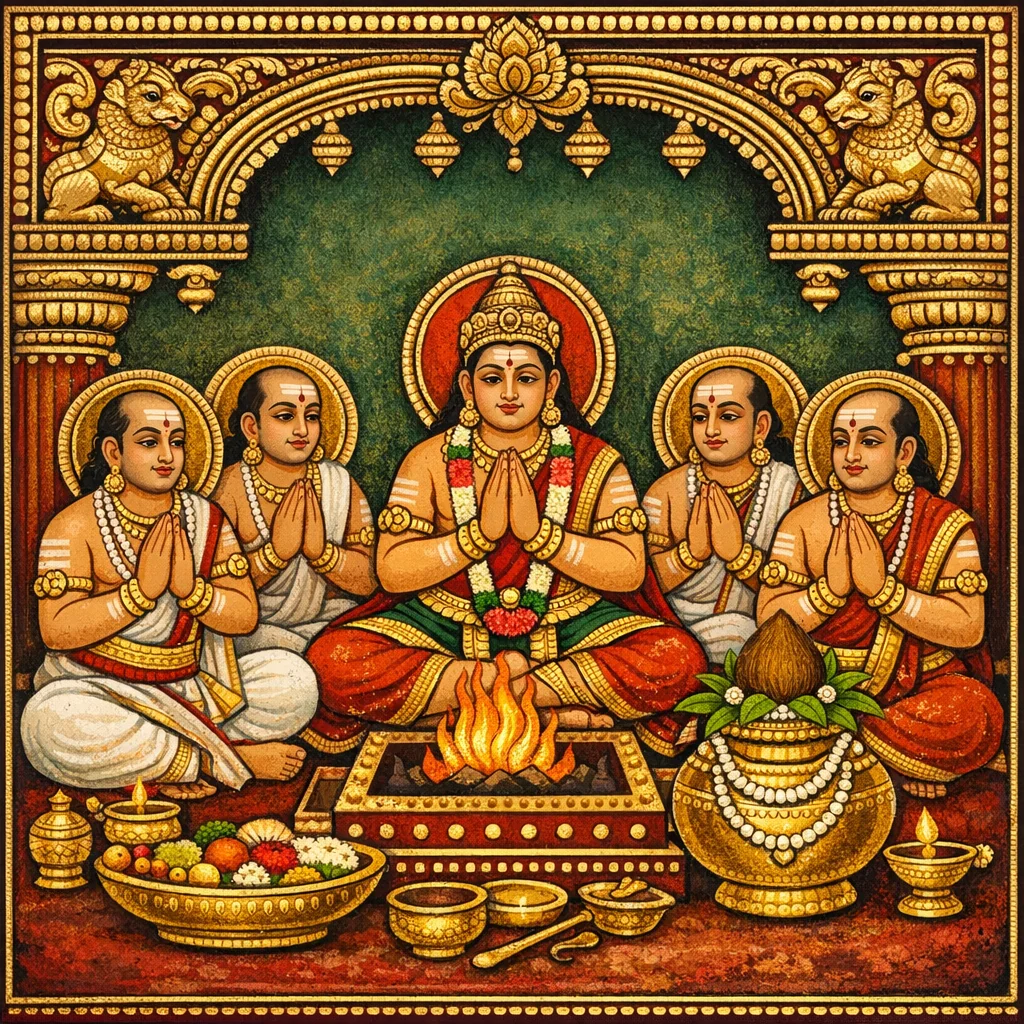
This chapter sets out a procedural dharma-map for śrāddha, praised as a rite granting both bhukti (well-being and prosperity) and mukti (liberative merit). Puṣkara gives the sequence from inviting brāhmaṇas the previous day and receiving them in the afternoon, to the seating rules (east-facing; even numbers for deva-kārya and odd for pitṛ-kārya), extended likewise to maternal ancestors. It then details mantra-governed stages: invoking the Viśve-devas, using pavitra-equipped vessels, scattering grains, adding milk and barley/sesame, offering arghya, and shifting to apasavya orientation for pitṛ-circumambulation. A pitṛyajña-style fire offering precedes distribution of hutaśeṣa; vessels are consecrated and food sanctified by recitation and thumb-contact. The conclusion covers leftovers and water offerings, south-facing piṇḍa-dāna, svasti and akṣayya-udaka, dakṣiṇā with svadhā formulas, formal visarjana, and post-feeding observances. The chapter also distinguishes ekoddiṣṭa and sapiṇḍīkaraṇa, prescribes death-day, monthly, and annual śrāddha cycles, lists foods and gifts with their results, highlights Gayā and auspicious times, and ends by affirming the pitṛs as śrāddha-devatās who bestow longevity, wealth, learning, heaven, and liberation.
Shlokas
Verse 1
इत्य् आग्नेये महापुराणे धर्मशास्त्रं नाम द्विषष्ट्यधिकशततमो ऽध्यायः अथ त्रिषष्ठ्यधिकशततमो ऽध्यायः श्राद्धकल्पकथनं पुष्कर उवाच श्राद्धकल्पं प्रवक्ष्यामि भुक्तिमुक्तिप्रदं शृणु निमन्त्र्य विप्रान् पूर्वेद्युः स्वागतेनापराह्णतः
Thus, in the Agni Mahāpurāṇa, the chapter called “Dharmaśāstra,” the one-hundred-and-sixty-second (162nd) chapter, concludes. Now begins the one-hundred-and-sixty-third (163rd) chapter: “The exposition of the Śrāddha procedure.” Puṣkara said: “I shall explain the rite-procedure for Śrāddha, which bestows both worldly enjoyment and liberation—listen. Having invited the brāhmaṇas on the previous day, one should receive and honor them with a proper welcome in the afternoon.”
Verse 2
प्राच्योपवेशयेत् पीठे युग्मान्दैवे ऽथ पित्रके अयुग्मान् प्राङ्मुखान्दैवे त्रीन् पैत्रे चैकमेव वा
One should seat the invited brāhmaṇas on seats arranged to the east: for the rite meant for the Devas (daiva), in even numbers; and for the rite meant for the Pitṛs (pitṛ), in odd numbers. In the Deva-offering they should face east; in the Pitṛ-offering one may seat three brāhmaṇas, or else only one.
Verse 3
मातामहानामप्येवन्तन्त्रं वा वैश्यदेविकं प्राणिप्रक्षालनं दत्त्वा विष्टरार्थं कुशानपि
Likewise, for the maternal grandfathers (mātāmahā) too, one should perform this same rite—namely the Vaiśvadeva procedure—having given the offering called prāṇi-prakṣālana, and also having placed kuśa-grass for preparing the seat (viṣṭara).
Verse 4
आवाहयेदनुज्ञातो विश्वे देवास इत्य् ऋचा यवैरन्ववकीर्याथ भाजने सपवित्रके
Having obtained permission, he should invoke (the deities) with the Ṛg-vedic verse beginning “Viśve devāsaḥ…”. Then, in a vessel furnished with a pavitra (a kuśa-ring/ritual purifier), he should sprinkle or scatter barley grains all around as prescribed in the rite.
Verse 5
शन्नोदेव्या पयः क्षिप्त्वा यवोसीति यवांस् तथा यादिव्या इतिमन्त्रेण हस्ते ह्य् अर्घं विनिक्षिपेत्
Reciting the mantra “śanno devyā”, he should pour milk into the offering; reciting “yavo’si”, he should likewise add barley. Then, with the mantra “yā divyā”, he should place the arghya-offering into the hand.
Verse 6
दत्वोदकं गन्धमाल्यं धूपदानं प्रदीपकं अपसव्यं ततः कृत्वा पितॄणामप्रदक्षिणं
Having offered water, fragrance and garlands, incense, and a lamp, he should then wear the sacred thread in the reverse position (apasavya) and perform the circumambulation for the Pitṛs in the non-rightward manner, keeping them on his left.
Verse 7
द्विगुणांस्तु कुशान् कृत्वा ह्य् उशन्तस्त्वेत्यृचा पितॄन् आवाह्य तदनुज्ञातो जपेदायान्तु नस्ततः
Having made the kuśa-grass bundles double (in number or length), he should invoke the Pitṛs with the Ṛk beginning “uśantas tvā…”. Then, having obtained their assent, he should recite: “May they come to us from there.”
Verse 8
यवार्थास्तु तिलैः कार्याः कुर्यादर्घ्यादि पूर्ववत् दत्त्वार्घ्यं संश्रवान् शेषान् पात्रे कृत्वा विधानतः
But the offerings that are to be made with barley should instead be prepared with sesame; and the arghya and related rites should be performed exactly as previously prescribed. Having offered the arghya, the remaining portions, together with the sanctified runoff (saṃśrava), should be collected in a vessel in accordance with the rule.
Verse 9
पितृभ्यः स्थानमसीति न्युब्जं पात्रं करोत्यधः अग्नौ करिष्य आदाय पृच्छत्यन्नं घृतप्लुतं
Saying, “You are the seat for the Fathers (pitṛs),” he places the vessel upside down upon the ground. Then, intending to offer into the fire, he takes up and presents the food—moistened with ghee—ritually asking for permission/acceptance.
Verse 10
कुरुष्वेति ह्य् अनुज्ञातो हुत्वाग्नौ पितृयज्ञवत् हुतशेषं प्रदद्यात्तु भाजनेषु समाहितः
When granted permission with the words “Do it,” having offered into the fire in the manner of the ancestral rite (pitṛyajña), he should then, with a collected mind, distribute the remaining oblation (hutaśeṣa) into the vessels.
Verse 11
यथालाभोपपन्नेषु रौप्येषु तु विशेषतः दत्वान्नं पृथिवीपात्रमिति पात्राभिमन्त्रणं
In vessels obtained according to one’s means—especially in silver ones—having placed the food as an offering, one should consecrate the vessel by reciting: “This is an earthen (earth-born) vessel”; this is the invocatory consecration of the vessel.
Verse 12
कृत्वेदं विष्णुरित्यन्ने द्विजाङ्गुष्ठं निवेशयेत् सव्याहृतिकां गायत्रीं मधुवाता इति त्यचं
Having recited over the food, “This indeed is Viṣṇu,” one should place the dvija’s (brahmin’s) thumb upon the food. Then one should recite the Gāyatrī together with the vyāhṛtis, and also the Ṛg-verse beginning with “madhu-vātāḥ …,” as the consecrating formula.
Verse 13
जप्त्वा यथासुखं वाच्यं भुञ्जीरंस्ते ऽपि वाग्यताः अन्नमिष्टं हविष्यञ्च दद्याज्जप्त्वा पवित्रकं
Having completed the japa, one may speak as is comfortable; they too may partake of food while maintaining restraint of speech. Having again performed japa, one should give the desired food and the oblation-worthy offering (havis), along with the pavitraka, the sanctifying ring/grass.
Verse 14
अन्नमादाय तृप्ताः स्थ शेषं चैवान्नमस्य च तदन्नं विकिरेद् भूमौ दद्याच्चापः सकृत् सकृत्
Having taken food and become satisfied, one should also set aside the remaining portion of that food; that leftover food should be scattered on the ground, and water should be offered repeatedly (again and again).
Verse 15
सर्वमन्नमुपादाय सतिलं दक्षिणामुखः उच्छिष्टसन्निधौ पिण्डान् प्रदद्यात् पितृयज्ञवत्
Taking all the prepared food together with sesame, and facing south, one should offer the rice-balls (piṇḍas) near the remains (of the meal), in the manner prescribed for the ancestral sacrifice (pitṛ-yajña).
Verse 16
मातामहानामप्येवं दद्यादाचमनं ततः स्वस्ति वाच्यं ततः कुर्यादक्षय्योदकमेव च
In the same manner, one should also offer the sipping-water (ācamana) for the maternal grandfathers; then one should recite an auspicious benediction (svasti). Thereafter, one should perform the offering known as ‘akṣayya-udaka’—the inexhaustible water-oblation.
Verse 17
दत्वा तु दक्षिणां शक्त्या स्वधाकारमुदाहरेत् वाच्यतामित्यनुज्ञातः स्वपितृभ्यः स्वधोच्यतां
After giving the priestly fee (dakṣiṇā) according to one’s capacity, one should utter the Svadhā-formula. When permission is granted—“Let it be recited”—one should then pronounce “Svadhā” addressed to one’s own Pitṛs (ancestors).
Verse 18
मातामहानामित्यादिः, स्वपितृभ्यः स्वधोच्यतामित्यन्तः पाठः झ पुस्तके नास्ति कुर्युरस्तु स्वधेत्युक्ते भूमौ सिञ्चेत्ततो जलं प्रीयन्तामिति वा दैवं विश्वे देवा जलं ददेत्
“Beginning with ‘(to) the maternal grandfathers …’”: the reading that ends with “let ‘svadhā’ be uttered for one’s own forefathers” is not found in the Jha manuscript. When it is said, “Let them do so—‘svadhā’,” one should then pour water upon the ground. Or one may say, “May they be satisfied.” Alternatively, as a divine offering, one should give water to the Viśve-devas.
Verse 19
दातारो नो ऽभिवर्धन्तां वेदाः सन्ततिरेव च श्रद्धा च नो माव्यगमद्बहुदेयं च नो स्त्विति
May our benefactors increase; may the Vedas—sacred learning—and our progeny likewise flourish. May faith never depart from us, and may there always be much for us to give—thus should one pray.
Verse 20
इत्युक्त्वा तु प्रिया वाचः प्रणिपत्य विसर्जयेत् वाजे वाज इति प्रीतपितृपूर्वं विसर्जनं
Having spoken these pleasing words, one should bow down and then perform the formal dismissal. The dismissal is to be carried out first for the satisfied Pitṛs (ancestors), with the mantra “vāje vāja”.
Verse 21
यस्मिंस्तु संश्रवाः पूर्वमर्घपात्रे निपातिताः पितृपात्रं तदुत्तानं कृत्वा विप्रान् विसर्जयेत्
When the saṃśravāḥ (remnants/overflow of the offerings) have first been poured into the arghya-vessel, then, having set the vessel meant for the Pitṛs upright in its proper concluding position, one should formally dismiss the brāhmaṇas.
Verse 22
प्रदक्षिणमनुब्रज्य भक्त्वा तु पितृसेवितं ब्रह्मचारी भवेत्तान्तु रजनीं ब्राह्मणैः सह
Having followed them in reverential pradakṣiṇā (rightward circumambulation), and having eaten what was offered in service to the Pitṛs, he should remain a brahmacārī, observing celibacy; and that night he should stay together with the brāhmaṇas.
Verse 23
एवं प्रदक्षिणं कृत्वा वृद्धौ नान्दीमुखान् पितॄन् यजेत दधिकर्कन्धुमिश्रान् पिण्डान् यवैः क्रिया
Thus, having performed the pradakṣiṇā, in the rite for elders one should worship the Nandīmukha Pitṛs, offering piṇḍa-balls mixed with curd and jujube (karkandhu); the ritual act is to be carried out with barley (yava).
Verse 24
एकोद्दिष्टं दैवहीनमेकार्घैकपवित्रकं आवाहनाग्नौकरणरहितं ह्य् अपसव्यवत्
The ekoddiṣṭa (śrāddha for a single departed person) is performed without offerings to the gods; it has one arghya and one pavitra (a kuśa ritual ring), is done without the āvāhana-agni rite (invoking the fire), and is to be carried out in the apasavya manner (with the sacred thread worn to the right).
Verse 25
उपतिष्ठतामित्यक्षय्यस्थाने पितृविसर्जने अभिरम्यतामिति वदेद् ब्रूयुस्ते ऽभिरताः स्म ह
At the dismissal of the Pitṛs, at the akṣayya-sthāna (“imperishable place”), one should say, “Upatiṣṭhatām—rise/withdraw now.” Then one should say, “Abhiramyatām—delight in your own abode.” They, being pleased, indeed respond accordingly.
Verse 26
गन्धोदकतिलैर् युक्तं कुर्यात् पात्रचतुष्टयं अर्घार्थपितृपात्रेषु प्रेतपात्रं प्रसेचयेत्
One should prepare a set of four ritual vessels, furnished with scented water (gandhodaka) and sesame seeds (tila); and one should pour a portion from the preta-vessel (preta-pātra) into the vessels meant for arghya and for the Pitṛs.
Verse 27
ये समाना इति द्वाभ्यां शेषं पूर्ववदाचरेत् एतत् सपिण्डीकरणमेकोद्दिष्टं स्तिया सह
With the two verses beginning “ye samānāḥ…”, one should perform the remaining procedures exactly as stated earlier. This is the sapiṇḍīkaraṇa rite—namely, the ekoddiṣṭa (single-offering śrāddha for the newly departed)—to be carried out together with the wife.
Verse 28
अर्वाक्सपिण्डीकरणं यस्य संवत्सराद् भवेत् पितृपूर्वं विसर्जयेदिति ख , छ , झ च स्त्र्या अपीति ख , छ च तस्याप्यन्नं सोदकुम्भं दद्यात् संवत्सरं द्विजे
For one whose sapiṇḍīkaraṇa (the rite of joining the departed to the ancestral line) is performed before the completion of a year, one should first perform the visarjana (dismissal) of the Pitṛs—so state the recensions Kha, Cha, and Jha. Even in the case of a woman—so state Kha and Cha—one should, for that person as well, give food together with an udaka-kumbha (water-pot) to a Brahmin for the period of a year.
Verse 29
मृताहनि च कर्तव्यं प्रतिमासन्तु वत्सरं प्रतिसंवत्सरं कार्यं श्राद्धं वै मासिकान्नवत्
On the very day of death the rite is to be performed; thereafter, for one year, it is to be performed each month; and then, year by year, śrāddha is to be performed, the annual rite being carried out in the same manner as the monthly offering of food.
Verse 30
हविष्यान्नेन वै मासं पायसेन तु वत्सरं मात्स्यहारिणकौरभ्रशाकुनच्छागपार्षतैः
With haviṣyānna one should observe this regimen for a month; with milk-rice (pāyasa), for a year; and likewise—according to the stated rule—with fish, deer, boar, ram, bird, goat, and hare as permitted food.
Verse 31
ऐणरौरववाराहशाशैर् मांसैर् यथाक्रमं मासवृद्ध्याभितृप्यन्ति दत्तैर् एव पितामहाः
By meats—of antelope (ena), of the ruru-deer, of boar, and of hare—offered in due order, the pitāmahas (ancestral grandfathers) become fully satisfied, and that satisfaction increases month by month, precisely through those offerings.
Verse 32
खड्गामिषं महाशल्कं मधुयुक्तान्नमेव च लोहामिषं कालशाकं मांसं वार्धीनसस्य च
Rhinoceros-meat; the great scaly fish; rice or other food preparations mixed with honey; the meat of a red-fleshed animal (rohita-type); the dark leafy green called kāla-śāka; and also the meat of the aquatic creature called vārdhīnasa—these are enumerated here as specific dietary items.
Verse 33
यद्ददाति गयास्थञ्च सर्वमानन्त्यमुच्यते तथा वर्षात्रयोदश्यां मघासु च न संशयः
Whatever one gives while staying at Gayā is declared to yield inexhaustible merit in every respect; likewise, a gift made on the thirteenth lunar day in the rainy season, and a gift made when the Moon is in Maghā, bears unfailing fruit—of this there is no doubt.
Verse 34
कन्यां प्रजां वन्दिनश् च पशून् मुख्यान् सुतानपि घृतं कृषिं च वाणिज्यं द्विशफैकशफं तथा
These are spoken of as gifts/boons: a maiden; dependents (subjects); bards who recite praises; excellent cattle; even sons; also ghee (clarified butter), agriculture, and trade; likewise animals with cloven hooves and with single hooves.
Verse 35
ब्रह्मवर्चस्विनः पुत्रान् स्वर्णरूप्ये सकुप्यके ज्ञातिश्रैष्ठ्यं सर्वकामानाप्नोति श्राद्धदः सदा
By offering in the Śrāddha gold, silver, and also base metals, the giver of the Śrāddha ever attains sons endowed with sacred radiance, pre-eminence among kinsmen, and the fulfillment of all desires.
Verse 36
प्रतिपत्प्रभृतिष्वेतान्वर्जयित्वा चतुर्दशीं शस्त्रेण तु हता ये वै तेषां तत्र प्रदीयते
For these rites/offerings, from the lunar first day onward—excluding the fourteenth tithi—whatever is offered there is assigned to those who indeed have been slain by weapons.
Verse 37
स्वर्गं ह्य् अपत्यमोजश् च शौर्यं क्षेत्रं बलं तथा पुत्रश्रैष्ठ्यं ससौभाग्यमपत्यं मुख्यतां सुतान्
Indeed, progeny is a cause of heaven; it is vigor and valor, a “field” for the continuity of lineage, and strength as well. The excellence of sons together with good fortune—progeny, namely one’s sons, is declared the foremost among possessions.
Verse 38
मात्स्याविहारिणौरभ्रशाकुनच्छागपार्षतैर् इति छ दत्तैर् इहेति घ , ङ , ञ च मधुमुद्गान्नमेव वेति ङ सर्वमानन्त्यमश्नुते इति घ , ङ च स्वर्णमिति ख , छ च प्रवृत्तचक्रतां पुत्रान् वाणिज्यं प्रसुतां तथा अरोगित्वं यशो वीतशोकतां परमाङ्गतिं
By giving as offerings/charity foods such as fish, meat, birds, goat, and other suitable items, one gains prosperity here in this world. By giving honey, mung-beans, and cooked food, one attains inexhaustible abundance in every respect. By giving gold, one gains thriving enterprise (the wheel of activity set in motion), sons, success in trade, offspring, freedom from disease, fame, a sorrowless condition, and the supreme state.
Verse 39
घनं विद्यां भिषकसिद्धिं रूप्यं गाश्चाप्यजाविकं अश्वानायुश् च विधिवत् यः श्राद्धं सम्प्रयच्छति
He who, according to the prescribed rite, offers a Śrāddha (ancestral oblation) thereby gains solid wealth, learning, success in the healing art, silver, cows, likewise goats and sheep, horses, and longevity.
Verse 40
कृत्तिकादिभरण्यन्ते स कामानाप्नुयादिमान् वसुरुद्रादितिसुताः पितरः श्राद्धदेवताः
From Kṛttikā to Bharaṇī—whoever performs the rite in this order attains these desired boons. The Vasus, Rudras, and Ādityas, together with the Pitṛs, are the presiding deities of the Śrāddha.
Verse 41
प्रीणयन्ति मनुष्याणां पितॄन् श्राद्धेन तर्पिताः आयुः प्रजां धनं विद्यां स्वर्गं मोक्षं सुखानि च
When the Pitṛs (ancestors) of human beings are satisfied and nourished through Śrāddha, they rejoice and in return bestow longevity, offspring, wealth, learning, heaven, liberation (mokṣa), and happiness.
Verse 42
प्रयच्छन्ति तथा राज्यं प्रीता नॄणां पितामहाः
Likewise, when satisfied, the forefathers of men bestow sovereignty—royal dominion.
Frequently Asked Questions
Invitation and reception of brāhmaṇas, regulated seating (deva vs pitṛ), mantra-led invocations, arghya and related offerings with pavitra-equipped vessels, apasavya pitṛ-circumambulation, pitṛyajña-style fire offering, distribution of remnants, piṇḍa-dāna facing south, svasti and akṣayya-udaka, dakṣiṇā with svadhā, and formal visarjana/dismissal.
It defines ekoddiṣṭa as deva-hīna (without offerings to gods), with a single arghya and single pavitra, performed without āvāhana-agni, and carried out in apasavya mode—marking it as a focused rite for a single departed person.
It is the rite that integrates the newly departed into the ancestral line, described here as an ekoddiṣṭa-related procedure performed with specific mantras (“ye samānāḥ…”), and stated to be done together with the wife; it also notes variant readings about early performance before one year.
The Vasus, Rudras, and Ādityas, together with the Pitṛs, are declared the presiding deities of śrāddha.
It explicitly frames śrāddha as bhukti-mukti-prada and concludes that satisfied pitṛs grant both worldly goods (āyuḥ, prajā, dhana, vidyā, rājya) and transcendent ends (svarga, mokṣa, sukha).