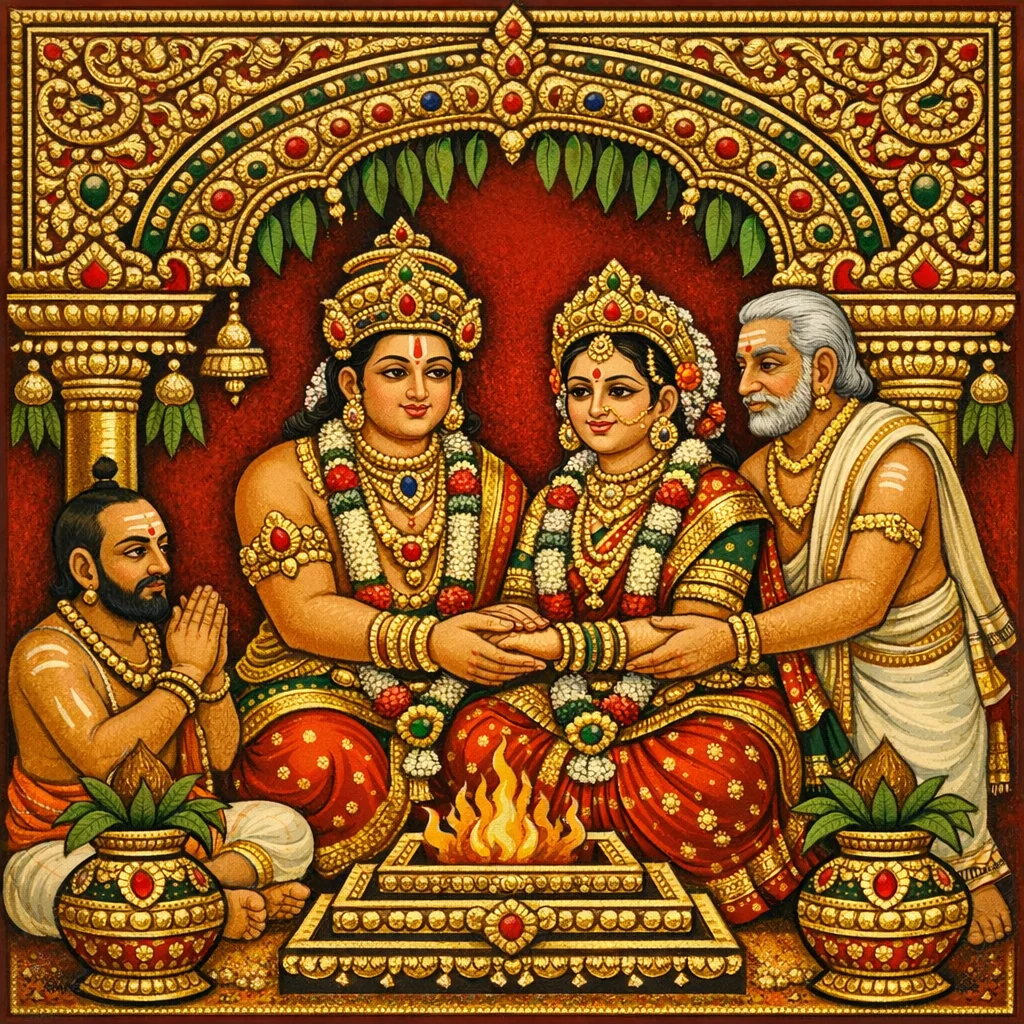
Adhyaya 154
Chapter 154: विवाहः (Vivāha — Marriage)
The chapter shifts from brahmacarya to the gṛhastha stage, presenting marriage as a dharma-governed institution. It sets varṇa-based norms: the permitted number of wives by social class and the rule that dharma-kāryas (ritual duties) should not be performed with an asavarṇā spouse, affirming endogamy as a ritual-legal principle. It then gives transactional and protective rules—bride-price expectations in certain cases, the prohibition on giving a maiden more than once, and penalties for abduction. The text lists recognized marriage forms (Brāhma, Ārṣa, Prājāpatya, Āsura, Gāndharva, Rākṣasa, Paiśāca), distinguishing dharmic gifting from purchase, mutual choice, force, or deception. It also notes exceptional permissions for remarriage in calamities, including a levirate-like provision with the deceased husband’s younger brother. The latter portion treats vivāha-muhūrta: auspicious and inauspicious months, weekdays, tithis, nakṣatras, and planetary conditions (avoiding Viṣṇu’s “sleep,” certain months, an afflicted Moon, set benefics, and vyatīpāta), concluding with guidance on household conduct regarding conjugal approach and calendrical restraints.
Shlokas
Verse 1
१७च्द् नैष्ठिको ब्रह्मचारी वा देहान्तं निवसेद्गुरौ अप्_१५३ इत्य् आग्नेये महापुराणे ब्रह्मचर्याश्रमो नाम त्रिपञ्चाशदधिकशततमो ऽध्यायः अथ चतुःपञ्चाशदधिकशततमो ऽध्यायः विवाहः पुष्कर उवाच विप्रश् चतस्रो विन्देत भार्यास्तिस्रस्तु भूमिपः द्वे च वैश्यो यथाकामं भार्यैकामपि चान्त्यजः
A lifelong (naiṣṭhika) brahmacārin should reside with his teacher until the end of his life. Thus ends, in the Agni Mahāpurāṇa, the one-hundred-and-fifty-third chapter called “The Brahmacarya Āśrama.” Now begins the one-hundred-and-fifty-fourth chapter: “Marriage.” Puṣkara said: “A brāhmaṇa may obtain four wives; a king (kṣatriya) three; a vaiśya two, according to desire; and an antyaja even one wife.”
Verse 2
धर्मकार्याणि सर्वाणि न कार्याण्यसवर्णया पाणिर्ग्राह्यः सवर्णासु गृह्णीयात् क्सत्रिया शरं
All rites and duties prescribed by dharma are not to be performed with a woman of a different varṇa. One should take the hand (in marriage) among women of the same varṇa; a Kṣatriya should take up the arrow, that is, follow the warrior’s calling.
Verse 3
वैश्या प्रतीदमादद्याद्दशां वै चान्त्यजा तथा सकृत् कन्या प्रदातव्या हरंस्तां चौरदण्डभाक्
A Vaiśyā woman should accept this as the proper bride-price; likewise an Antyajā woman should accept ten (units). A maiden is to be given in marriage only once; whoever carries her off is liable to the punishment prescribed for a thief.
Verse 4
अपत्यविक्रयासक्ते निष्कृतिर् न विधीयते कन्यादानं शचीयोगो विवाहो ऽथ चतुर्थिका
For one who is addicted to the selling of offspring, no expiation (niṣkṛti) is prescribed. (Now are stated) the giving of a maiden (kanyā-dāna), the Śacī-yoga, the proper marriage rite, and then the ‘caturthikā’ observance.
Verse 5
सतीयोग इति ख , छ च विवाहमेतत् कथितं नामकर्मचतुष्टयं नष्टे मृते प्रव्रजिते क्लीवे च पतिते पतौ
This form of marriage is described as “satīyoga” (according to the kha and cha readings). The fourfold rite concerning name and ritual acts is to be applied when the husband is missing, dead, has renounced the world (pravrajita), is impotent, or has fallen from dharma.
Verse 6
पञ्चस्वापत्सु नारीणां पतिरन्यो विधीयते मृते तु देवरे देयात् तदभावे यथेच्छया
In five kinds of calamity, a woman is permitted to take another husband. If her husband has died, she should be given in marriage to the younger brother of the deceased; if he is not available, then she may be given according to her own choice.
Verse 7
पूर्वात्रितयमाग्नेयं वायव्यं चोत्तरात्रयं रोहिणौ चेति चरणे भगणः शस्यते सदा
The three ‘eastern’ quarters (pada/caraṇa) are of the Agni (fire) type, and the three ‘northern’ quarters are of the Vāyu (wind) type; and so too in Rohiṇī—thus, with respect to the quarter (caraṇa/pada), the bhagaṇa-classification is always prescribed.
Verse 8
नैकगोत्रान्तु वरयेन्नैकार्षेयाञ्च भार्गव पितृतः सप्तमादूर्ध्वं मातृतः पञ्चमात्तथा
But, O Bhārgava, one should not choose a bride from the same gotra, nor one of the same ṛṣi-lineage (pravara). Marriage is permitted only beyond the seventh generation on the father’s side and beyond the fifth generation on the mother’s side as well.
Verse 9
आहूय दानं ब्राह्मः स्यात् कुलशीलयुताय तु पुरुषांस्तारयेत्तज्जो नित्यं कन्यप्रदानतः
When the groom is formally invited and the maiden is given in marriage, that is the Brāhma form—given to one endowed with good family and conduct. The offspring born of that union continually deliver their male ancestors, by virtue of the gift of a daughter.
Verse 10
तथा गोमिथुनादानाद्विवाहस्त्वार्ष उच्यते प्रार्थिता दीयते यस्य प्राजापत्यः स धर्मकृत्
Likewise, when a pair of cattle is given (to the bride’s father), that marriage is called the Ārṣa type. That marriage in which the maiden, when requested, is given in marriage is the Prājāpatya type; such a man is a doer of dharma.
Verse 11
शुल्केन चासुरो मन्दो गान्धर्वो वरणान्मिथः राक्षसो युद्धहरणात् पैशाचः कन्यकाच्छलात्
When a marriage is effected by a bride-price (śulka), it is the Āsura type; when it arises from mutual choice (varaṇa) between the two, it is the Gāndharva type; when the girl is carried off by force amid fighting, it is the Rākṣasa type; and when a maiden is obtained through deception, it is the Paiśāca type.
Verse 12
वैवाहिके ऽह्नि कुर्वीत कुम्भकारमृदा शुचीं जलाशये तु तां पूज्य वाद्याद्यैः स्त्रीं गृहत्रयेत्
On the wedding day, one should fashion a pure and auspicious female figure from potter’s clay; then, at a water-reservoir, having worshipped her with musical instruments and the like, one should lead the woman into the house.
Verse 13
प्रशुप्ते केशवे नैव विवाहः कार्य एव हि पोषे चैत्रे कुजदिने रिक्ताविष्टितथो न च
When Keśava (Viṣṇu) is in the state called ‘sleep’ (praśupta), marriage should certainly not be performed. Nor should it be done in the month of Pauṣa, in the month of Caitra, on a Tuesday (Kujavāra), or during the tithis known as Riktā and Āviṣṭi.
Verse 14
न शुक्रजीवे ऽस्तमिते न शशाङ्के ग्रहार्दिते अर्कार्कभौमयुक्ते भे व्यतीपातहते न हि
Not when Venus and Jupiter are set (invisible); not when the Moon is afflicted by planets; not when the lunar mansion is conjoined with the Sun, another Sun-like malefic, and Mars; and certainly not when it is struck by Vyatīpāta—these are not fit times for rites.
Verse 15
सोम्यं पित्र्यञ्च वायव्यं सावित्रं रोहिणी तथा वैवाहिकेब्दे इति घ , ङ , ञ , ट च वाद्यौघैर् इति ग , घ , ञ च उत्तरात्रितयं मूलं मैत्रं पौष्णं विवाहभं
For marriage, the auspicious lunar mansions (nakṣatras) are Somya, Pitrya, Vāyavya, Sāvitra, and also Rohiṇī; likewise those designated in the marriage-section by the syllables gha, ṅa, ña, and ṭa. Also, as indicated in the passage ‘with masses of musical instruments’, those marked by ga, gha, and ña. Further, the three Uttarās, Mūla, Maitra, and Pauṣṇa are declared to be marriage-nakṣatras, suitable for weddings.
Verse 16
मानुषाख्यस् तथा लग्नो मानुषाख्यांशकः शुभः तृतीये च तथा षष्ठे दशमैकादशे ऽष्टमे
Likewise, the ascendant (lagna) is termed “human” (mānuṣa); and the “human” divisional portion (aṃśaka) is auspicious—especially in the 3rd, 6th, 10th, 11th, and 8th houses/places.
Verse 17
अर्कार्किचन्दतनयाः प्रशस्ता न कुजो ऽष्टमः सप्तान्त्याष्टमवर्गेषु शेषाः शस्ता ग्रहोत्तमाः
The Sun, Saturn, and the Moon’s son (Mercury) are regarded as auspicious (in these placements); Mars is not auspicious when in the eighth. In the seventh, the last (twelfth), and the eighth divisions/houses, the remaining excellent planets are held to be favorable.
Verse 18
तेषामपि तथा मध्यात् षष्ठः शुक्रो न शस्यते वैवाहिके भे कर्तव्या तथैव च चतुर्थिका
Even among those (otherwise acceptable times), the sixth tithi when it falls on a Friday is not recommended. For marriage, the rite should likewise be performed when the Moon is in an auspicious nakṣatra; and the fourth tithi too should be treated in the same manner (i.e., avoided/regulated as stated).
Verse 19
न दातव्या ग्रहास्तत्र चतुराद्यास्तथैकगाः पर्ववर्जं स्त्रियं गच्छेत् सत्या दत्ता सदा रतिः
In that context, the inauspicious tithis beginning with the fourth, as well as the “single” (odd/solitary) ones, are not to be assigned for conjugal approach. Excluding festival or sacred days, one should approach one’s wife; when she is given in marriage with truthfulness and proper vows, conjugal union is always regarded as legitimate and meritorious.
Frequently Asked Questions
It stresses savarṇa marriage for dharma-kārya performance and prohibits choosing a bride from the same gotra or the same ṛṣi-lineage (pravara), permitting marriage only beyond the 7th paternal and 5th maternal generations.
Brāhma, Ārṣa, and Prājāpatya are presented as normative dharmic forms, contrasted with Āsura (bride-price), Gāndharva (mutual choice), Rākṣasa (force), and Paiśāca (deception) as progressively more problematic modes.
It forbids marriage during Viṣṇu’s ‘sleep’, certain months and weekdays, in Riktā/Āviṣṭi tithis, when Venus/Jupiter are set, when the Moon is afflicted, under specific malefic conjunctions, and when struck by Vyatīpāta; it also lists auspicious nakṣatras for vivāha.
By treating marriage as a saṃskāra governed by lineage rules, ritual competence, ethical protections for the maiden, and precise calendrical/astrological constraints—making gṛhastha life a disciplined vehicle for dharma and ancestral continuity.