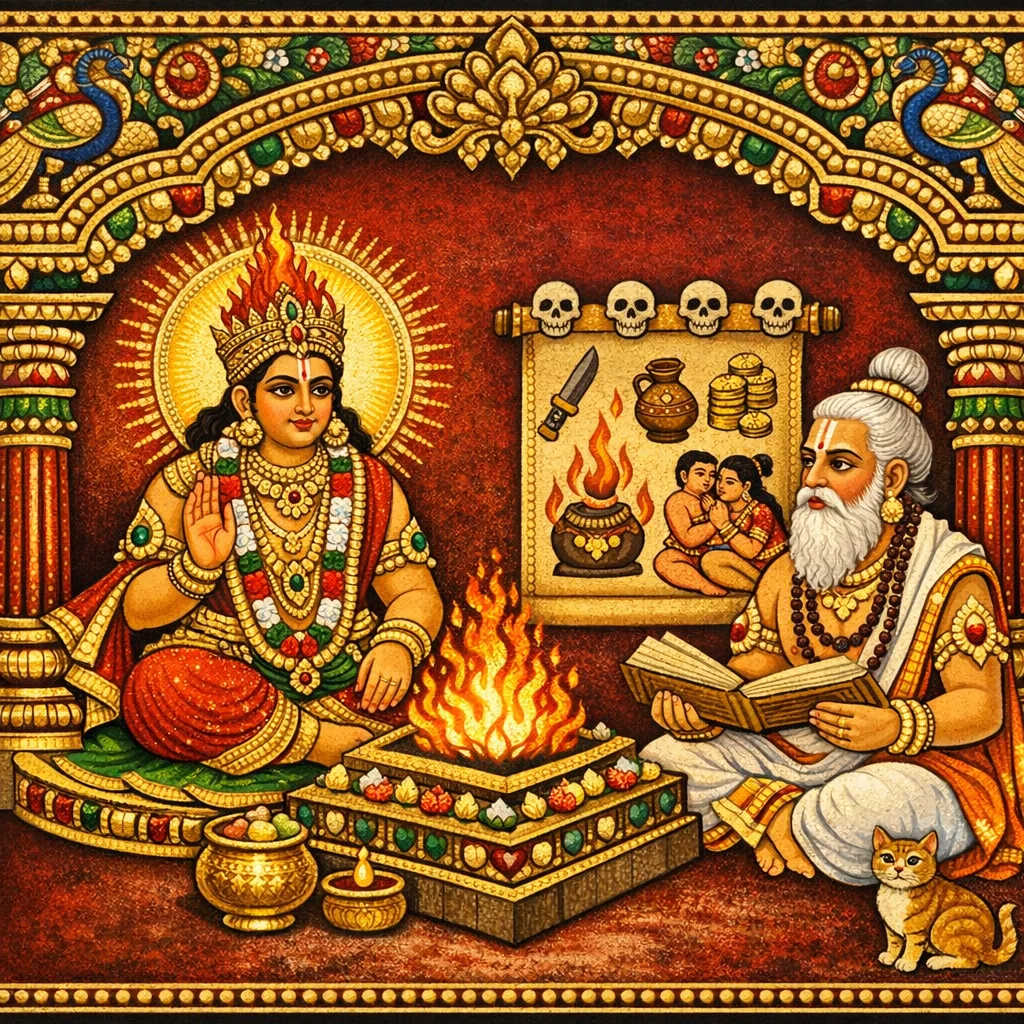
Adhyaya 169
Mahāpātaka-ādi-kathana (Account of the Great Sins) — concluding note incl. ‘Mārjāra-vadha’ (killing of a cat)
This chapter concludes a Dharma-śāstra unit that classifies grave transgressions (mahāpātaka) and related faults, ending with a colophon-like transition that explicitly notes mārjāra-vadha (killing of a cat). In the Agneya teaching flow, sin-taxonomy is not mere moral labeling but the necessary map for prescribing proportionate remedies. The conclusion serves as a hinge, signaling a move from identifying pāpa (wrongdoing/defilement) to the applied purification discipline of prāyaścitta. In the Agni Purāṇa’s encyclopedic method—like other practical vidyās such as Vāstu or Rāja-dharma—categories and measures are defined first, then procedures are given, integrating social order and inner purification under Dharma.
Shlokas
Verse 1
इत्य् आग्नेये महापुराणे महापातकादिकथनं नामाष्टषष्ट्यधिकशततमो ऽध्यायः मार्जारस्यैव मारणमिति ङ अथैकोनसप्तत्यधिकशततमो ऽध्यायः प्रायश्चित्तानि पुष्कर उवाच एतत्प्रभृतिपापानां प्रायश्चित्तं वदामि ते ब्रह्महा द्वादशाब्दानि कुटीङ्कृत्वा वने वसेत्
Thus, in the Agni Mahāpurāṇa, the one-hundred-and-sixty-ninth chapter, called “The Account of the Great Sins,” concludes (including the topic “the killing of a cat”). Now begins the one-hundred-and-seventieth chapter on “Expiations (prāyaścitta).” Puṣkara said: “I shall tell you the expiations for sins beginning with these. A slayer of a brāhmaṇa should, for twelve years, build a hut and dwell in the forest.”
Verse 2
भिक्षेतात्मविशुद्ध्यर्थं कृत्वा शवशिरोध्वजं प्रास्येदात्मानमग्नौ वा समिद्धे त्रिरवाक्शिराः
For the sake of self-purification, he should live by begging; having made a banner topped with a corpse’s head, he should cast himself into a well-kindled fire—thrice, with his head bent downward.
Verse 3
यजेत वाश्वमेधेन स्वर्जिता गोसवेन वा जपन्वान्यतमं वेदं योजनानां शतं ब्रजेत्
One should perform sacrifice by means of the Aśvamedha; or, to gain heaven, by the Gosava rite; or, while reciting any one of the Vedas, one should travel a hundred yojanas.
Verse 4
सर्वस्वं वा वेदविदे ब्राह्मणायोपपादयेत् व्रतैर् एतैर् व्यपोहन्ति महापातकिनो मलं
Or else, one should bestow one’s entire wealth upon a Veda-knowing Brāhmaṇa. By these vows, even those guilty of the great sins remove their defilement.
Verse 5
उपपातकसंयुक्तो गोघ्नो मासं यवान् पिवेत् कृतवापो वसेद्गोष्ठे चर्मणा तेन संवृतः
A cow-killer, if additionally tainted with a minor sin (upapātaka), should for one month subsist on barley-water; having had his head shaved, he should dwell in a cowshed, covered with that hide.
Verse 6
चतुर्थकालमश्रीयादक्षारलवणं मितं गोमूत्रेण चरेत् स्नानं द्वौ मासौ नियतेन्द्रियः
Let him take food only at the fourth mealtime, consuming measured alkali and salt; and let him bathe using cow’s urine for two months, with his senses restrained.
Verse 7
दिवानुगच्छेद्गाश् चैव तिष्ठन्नूर्ध्वं रजः पिवेत् वृषभैकादशा गास्तु दद्याद्विचारितव्रतः
Observing the vow with due deliberation, he should follow the cows by day; and, standing, he should drink the dust raised upward. Thereafter, the vow-observer should give in charity eleven cows together with a bull.
Verse 8
अविद्यमाने सर्वस्वं वेदविद्भ्यो निवेदयेत् पादमेकञ्चरेद्रोधे द्वौ पादौ बन्धने चरेत्
When there is no other means of restitution, one should surrender one’s entire property to the knowers of the Veda. For obstructing another’s movement or activity, the penalty is one quarter; for detention or imprisonment, the penalty is two quarters, that is, one half.
Verse 9
दद्यात् सुचरितव्रत इति ङ योजने पादहीनं स्याच्चरेत् सर्वं निपातने कान्तारेष्वथ दुर्गेषु विषमेषु भयेषु च
In the construction (yojana) “dadyāt sucaritavrata”, adding the affix ṅa causes a pāda-deficiency (a metrical shortfall). In cases of nipātana (accepted irregular or exceptional usage), however, all such forms are to be allowed—as in expressions like “in wildernesses, and in difficult places, in uneven terrain, and in dangers”, where fixed exceptional forms are admitted.
Verse 10
यदि तत्र विपत्तिः स्यादेकपादो विधीयते घण्टाभरणदोषेण तथैवर्धं विनिर्दिशत्
If, in that case, a mishap occurs, a single pāda (one share) is prescribed as the expiatory measure; likewise, for the defect of the bell-ornament, he has specified the penalty as half.
Verse 11
दमने दमने रोधे शकटस्य नियोजने स्तम्भशृङ्खलपाशेषु मृते पादोनमाचरेत्
In cases of taming and subduing, in confinement, in pressing a cart into service, and in punishments involving a post, chains, or a noose—if death results, one should impose a penalty reduced by one quarter.
Verse 12
शृङ्गभङ्गे ऽस्थिभङ्गे च लाङ्गूलच्छेदने तथा यावकन्तु पिवेत्तावद्यावत् सुस्था तु गौर्भवेत्
In cases of a broken horn, a fractured bone, and likewise when the tail has been cut, the cow should be made to drink yavaka-gruel for as long as needed—until the cow becomes well again.
Verse 13
गोमतीञ्च जपेद्विद्यां गोस्तुतिं गोमतीं स्मरेत् एका चेद्बहुभिर्दैवाद् यत्र व्यापादिता भवेत्
One should recite the Gomatī-vidyā and remember (or chant) the Gomatī hymn in praise of the cow. If, by fate, a single cow is killed at a place by many persons, this recitation is prescribed as the expiation.
Verse 14
पादं पादन्तु हत्यायाश् चरेयुस्ते पृथक् पृथक् उपकारे क्रियमाणे विपत्तौ नास्ति पातकं
They should each perform, separately, one-quarter of the expiation prescribed for homicide. When an act is done as a helpful intervention in a calamity, there is no sin incurred.
Verse 15
एतदेव व्रतं कुर्युरुपपातकिनस् तथा अवकीर्णवर्जं शुद्ध्यर्थञ्चान्द्रायणमथापि वा
Those guilty of minor sins should indeed perform this very vow; and, for the sake of purification, they may also undertake the Cāndrāyaṇa observance—excluding the case of the ‘avakīrṇa’ offender.
Verse 16
अवकीर्णी तु कालेन गर्धभेन चतुष्पथे पाकयज्ञविधानेन यजेत निरृतिं निशि
But an avakīrṇī (a woman who has transgressed chastity) should, at the prescribed time, at a crossroads, at night, perform an offering to Nirṛti using the procedure of a pākayajña, with a donkey as the ritual animal/means.
Verse 17
कृत्वाग्निं विधिवद्धीमानन्ततस्तु समित्तृचा चन्द्रेन्द्रगुरुवह्नीनां जुहुयात् सर्पिषाहुतिं
Having duly prepared the sacred fire according to rule, the wise practitioner should then—using the kindling-verse (samit-ṛcā)—offer oblations of ghee into the fire, addressed to the Moon, Indra, the Guru (Bṛhaspati), and Agni.
Verse 18
अथवा गार्धभञ्चर्म वसित्वाब्दञ्चरेन्महीं हत्वा गर्भमविज्ञातं ब्रह्महत्याव्रतं चरेत्
Alternatively, having worn a donkey-hide for a year and wandered over the earth, if one has destroyed an unrecognized pregnancy, one should undertake the vow prescribed for the expiation of brahmahatyā (brahma-slaughter).
Verse 19
जुहुयात्सर्पिषाहुतीरिति ख , ङ , ज च सरां पीत्वा द्विजो मोहादग्निवर्णां सुरां पिवेत् गोमूत्रमग्निवर्णं वा पिवेदुदकमेव वा
He should offer oblations of ghee into the fire while reciting the syllables ‘kha’, ‘ṅa’, and ‘ja’. If a twice-born man, through delusion, has drunk sarā (a fermented drink), he should drink liquor that is fire-coloured; or else cow’s urine that is fire-coloured; or he should drink only water.
Verse 20
सुवर्णस्तेयकृद्विप्रो राजानमभिगम्य तु स्वकर्म ख्यापयन् व्रूयान्मां भवाननुशास्त्विति
A Brahmin who has committed the theft of gold should approach the king and, disclosing his own deed, should say: “May you instruct me (that is, punish and discipline me).”
Verse 21
गृहीत्वा मुशलं राजा सकृद्धन्यात् स्वयङ्गतं बधेन शुद्ध्यते स्तेयो ब्राह्मणस्तपसैव वा
Taking a pestle (club) in hand, the king should strike once the thief who has come of his own accord; by such corporal punishment the thief is purified. But a Brāhmaṇa (guilty of theft) is purified only by austerity (tapas), that is, by penance alone.
Verse 22
गुरुतल्पो निकृत्यैव शिश्नञ्च वृषणं स्वयं निधाय चाञ्चलौ गच्छेदानिपाताच्च नैरृतिं
One who has violated the teacher’s bed (i.e., committed adultery with the guru’s wife), having cut off his own penis and testicles and placing them in his hands, should proceed toward the south-west, the direction of Nirṛti, until he falls down (dead).
Verse 23
चान्द्रायणान् वा त्रीन्मासानभ्यसेन्नियतेन्द्रियः जातिभ्रंशकरं कर्म कृत्वान्यतममिच्छया
Or, with the senses restrained, he should undertake Cāndrāyaṇa penances for three months, if he has willfully performed any act that causes loss of caste-status.
Verse 24
चरेच्छान्तपनं कृच्छ्रं प्राजापत्यमनिच्छया सङ्करीपात्रकृत्यासु मासं शोधनमैन्दवं
If one has unwillingly (without intent) committed acts involving a mixed/impure vessel (saṅkarī-pātra) and the associated prohibited dealings, one should undertake the Śāntapana Kṛcchra and the Prājāpatya (penance); the prescribed purification is the Aindava purification for a month.
Verse 25
मलिनीकरणीयेषु तप्तं स्याद्यावकं त्र्यहं तुरीयो ब्रह्महत्यायाः क्षत्रियस्य बधे स्मृतः
In cases that cause defilement (mālinīkaraṇa), one should drink heated yāvaka-gruel for three days; this is taught as the fourth-grade expiation (turīya) of the brahmahatyā-penance when a Kṣatriya has been slain.
Verse 26
वैश्ये ऽष्टमांशे वृत्तस्थे शूद्रे ज्ञेयस्तु षोडशः मार्जरनकुलौ हत्वा चासं मण्डूकमेव च
For a Vaiśya, the expiation is understood to be one-eighth (of the standard measure); for a Śūdra, it is to be known as one-sixteenth—this applies when one has killed a cat and a mongoose, and likewise a frog.
Verse 27
श्वगोधोलूककाकांश् च शूद्रहत्याव्रतं चरेत् चतुर्णामपि वर्णानां नारीं हत्वानवस्थितां
For killing a dog, an iguana (godhā), an owl (ulūka), or a crow (kāka), one should undertake the expiatory vow prescribed for the killing of a Śūdra. Likewise, having killed an unprotected woman (without a guardian) of any of the four varṇas, one should perform the appropriate expiation.
Verse 28
अमत्यैव प्रमाप्य स्त्रीं शूद्रहत्याव्रतं चरेत् सर्पादीनां बधे नक्तमनस्थ्नां वायुसंयमः
If one has caused a woman’s death unintentionally, one should undertake the expiatory vow prescribed for killing a Śūdra. For killing serpents and the like, one should eat only at night; for killing boneless creatures, one should practice restraint of the breath (prāṇāyāma).
Verse 29
द्रव्याणामल्पसाराणां स्तेयं कृत्वान्यवेश्मतः चरेच्छान्तपनं कृच्छं व्रतं निर्वाप्य सिद्ध्यति
Having stolen articles of little value from another’s house, one should perform the Śāntapana Kṛcchra expiatory vow; having duly completed that observance, one becomes purified—the expiation is accomplished.
Verse 30
भक्षभोज्यापहरणे यानशय्यासनस्य च पुष्पमूलफलानाञ्च पञ्चगव्यं विशोधनं
For the taking away (theft/appropriation) of edible items and cooked foods, and also of a conveyance, a bed, or a seat, as well as of flowers, roots, and fruits, purification is to be done by pañcagavya.
Verse 31
तृणकाष्ठद्रुमाणान्तु शुष्कान्नस्य गुडस्य च चेलचर्मामिषाणान्तु त्रिरात्रं स्यादभोजनं
In cases involving grass, sticks, and trees, as well as dried food and jaggery, and likewise cloth, leather, and meat, the prescribed expiation is abstention from eating for three nights.
Verse 32
मणिमुक्ताप्रवालानां ताम्रस्य रजतस्य च अयःकांस्योपलानाञ्च द्वादशाहं कणान्नभुक्
For the impurity incurred by consuming gems, pearls, coral, copper and silver—and likewise iron, kāṃsya (bell-metal), and stones—one should observe a twelve-day expiation, subsisting on kaṇānna, a simple diet of grains.
Verse 33
कार्पासकीटजीर्णानां द्विशफैकशफस्य च पक्षिगन्धौषधीनान्तु रज्वा चैव त्र्यहम्पयः
For disorders arising from cotton-worm infestation (or its ingestion), and for ailments connected with two-hoofed and one-hoofed animals, as well as those caused by birds and foul-smelling medicinal substances, milk kept (infused) with a rope for three days is prescribed.
Verse 34
गुरुतल्पव्रतं कुर्याद्रेतः सिक्त्वा स्वयोनिषु सख्युः पुत्रस्य च स्त्रीषु कुमारोष्वन्त्यजासु च
Having discharged semen into women of one’s own prohibited kin-group, or into the wives of a friend or of one’s son, or into unmarried girls, or into women of the lowest/outcaste communities, one should undertake the penance known as the gurutalpa-vrata.
Verse 35
पितृस्वस्रेयीं भगिनीं स्वस्रीयां मातुरेव च मातुश् च भ्रातुराप्तस्य गत्वा चान्द्रायणञ्चरेत्
If one has gone to (i.e., has had illicit sexual intercourse with) a paternal-aunt’s daughter, a sister, a maternal-aunt’s daughter, one’s mother, or a brother’s wife, one should perform the Cāndrāyaṇa (lunar) expiatory vow.
Verse 36
अमानुषीषु पुरुष उदक्यायामयोनिषु रेतः सिक्त्वा जले चैव कृच्छ्रं शान्तपनञ्चरेत्
If a man has discharged semen into non-human females, or into a menstruating woman, or into an improper/forbidden womb, and also in water, he should undertake the Kṛcchra penance and the Śāntapana expiation.
Verse 37
मैथुनन्तु समासेव्य पुंसि योषिति वा द्विजः गोयाने ऽप्सु दिवा चैव सवासाः स्नानमाचरेत्
After sexual intercourse—whether with a man or with a woman—a twice-born person (dvija) should perform the prescribed ritual bath in water during the daytime, still wearing garments, (standing) in a place associated with cattle, such as a cow-pen or cowshed.
Verse 38
चण्डालान्त्यस्त्रियो गत्वा भुक्त्वा च प्रतिगृह्य च पतत्यज्ञानतो विप्रो ज्ञानात् साम्यन्तु गच्छति
If a brāhmaṇa goes to women of the Caṇḍāla and other outcaste groups, eats there, and accepts their gifts or food, he falls when it is done in ignorance; but when done knowingly, he attains their very condition, becoming equal to them in status.
Verse 39
विप्रदुष्टां स्त्रियं भर्ता निरुन्ध्यादेकवेश्मनि यत् पुंसः परदारेषु तदेनाञ्चारयेद्व्रतं
A husband should confine in a single dwelling a woman who has been corrupted by a brāhmaṇa, and he should make her observe the same expiatory vow (vrata) that is prescribed for a man who has relations with another man’s wife.
Verse 40
साचेत्पुनः प्रदुष्येत सदृशेनोपमन्त्रिता कृच्छ्रञ्चाद्रायणञ्चैव तदस्याः पावनं स्मृतं
If she becomes defiled again—having been enticed or solicited by a man of similar status—then the Kṛcchra penance and the Cāndrāyaṇa observance are declared to be her means of purification.
Verse 41
वेणुचर्मामिषाणाञ्चेति झ यत् करोत्येकरात्रेण वृषलीसेवनं द्विजः तद्भैक्ष्यभुक् जपेन्नित्यं त्रिभिर्वषैर् व्यपोहति
Whatever a twice-born man commits in a single night by consorting with a śūdra woman—a fault likened to involvement with bamboo, hides/leather, and meat—he removes it by living on alms and by daily japa (recitation); within three years it is expiated.
Frequently Asked Questions
It serves as a topical marker within the mahāpātaka/related-sins catalogue and signals the closure of the sin-identification section before the text begins systematic prāyaścitta prescriptions.
By diagnosing wrongdoing in graded categories (mahāpātaka and upapātaka), it prepares the ground for disciplined correction; accurate moral taxonomy enables proportionate penance, restoring dharmic order and supporting purification-oriented practice.