Adhyaya 152
The Livelihood of the Householder (गृहस्थवृत्तिः) — Agni Purana, Chapter 152
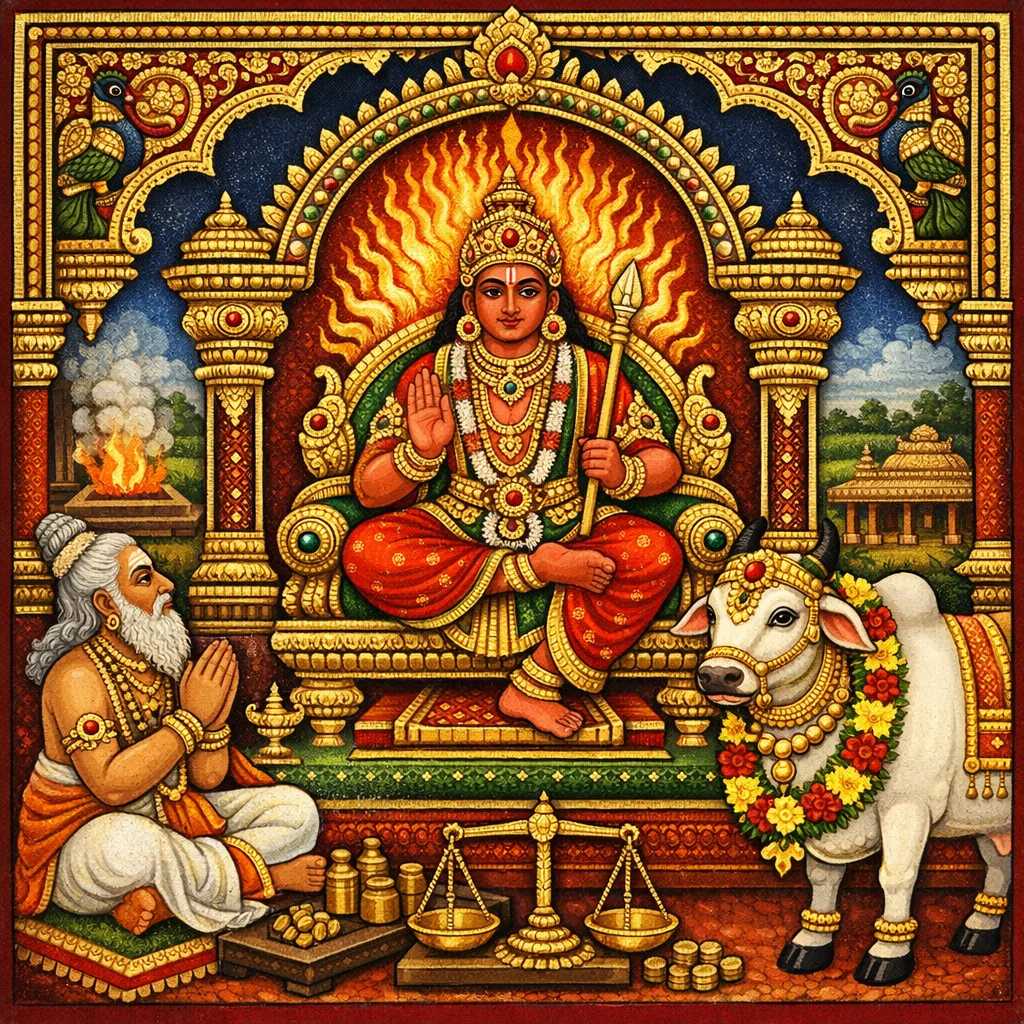
Spoken by Puṣkara, this chapter shifts from varṇāntara-dharma to a Dharma-shastra exposition on gṛhastha-vṛtti, the householder’s livelihood. It upholds the brāhmaṇa’s self-support through prescribed duties, allowing—only under necessity—recourse to kṣatriya, vaiśya, or even śūdra-type work, while warning against servile dependence on a śūdra or adopting a śūdra-born primary livelihood. It lists permitted occupations for the twice-born—agriculture, trade, cattle-protection, and money-lending—together with abstentions that set ethical limits on consumption and commerce. Acknowledging the moral harm inherent in farming (injury to earth, plants, and insects), it prescribes purification through yajña and deva-pūjā, integrating economic life with ritual expiation. It introduces graded penalties (measured in cows) concerning the plough, calibrating necessity, cruelty, and dharma-injury. The chapter ends with a hierarchy of livelihood modes—ṛta, amṛta, mṛta, pramṛta—permitting even mixed truth and untruth in extremis, yet rejecting base and improper livelihood as never acceptable.
Shlokas
Verse 1
इत्य् आग्नेये महापुराणे वर्णान्तरधर्मा नामैकपञ्चाशदधिकशततमो ऽध्यायः अथ द्विपञ्चाशदधिकशततमो ऽध्यायः गृहस्थवृत्तिः पुष्कर उवाच आजीवंस्तु यथोक्तेन ब्राह्मणः स्वेन कर्मणा क्षत्रविट्शूद्रधर्मेण जीवेन्नैव तु शूद्रजात्
Thus, in the Agni Mahāpurāṇa, the one-hundred-and-fifty-first chapter, entitled “Varṇāntara-dharma (Duties concerning transition between social classes),” concludes. Now begins the one-hundred-and-fifty-second chapter, “Gṛhastha-vṛtti (The livelihood of the householder).” Puṣkara said: “A Brāhmaṇa should maintain himself by his own prescribed duties, as stated in the śāstras. If need be, he may live by the duties of a kṣatriya, a vaiśya, or a śūdra; but he should not live by a livelihood derived from a śūdra—namely, servile dependence upon a śūdra or taking a śūdra-born occupation as one’s principal means.”
Verse 2
कृषिबाणिज्यगोरक्ष्यं कुशीदञ्च द्विजश् चरेत् गोरसं गुडलवणलाक्षामांसानि वर्जयेत्
A twice-born (Brāhmaṇa) may engage in agriculture, trade, the protection of cattle, and even lending money at interest; however, he should abstain from cow-products, jaggery, salt, lac, and meat.
Verse 3
श्रीजीवनञ्च तत्र स्यात् प्रोक्तमिति ग , घ , ङ , ञ च भूमिं भित्वौषधीश्छित्वा हुत्वा कोटपिपीलिकान् पुनन्ति खलु यज्ञेन कर्षका देवपूजनात्
And there it is said that a prosperous livelihood arises (so read the variants ga, gha, ṅa, ña). Though farmers split the earth, cut down plants, and in the course of cultivation consign countless ants to the fire, they are indeed purified through sacrifice (yajña) and through the worship of the gods.
Verse 4
हलमष्टगवं धर्म्यं षड्गवं जीवितार्थिनां चर्तुर्गवं नृशंसानां द्विगवं धर्मघातिनां
The fine for taking or using a plough is eight cows for one who acts in accordance with dharma; six cows for one seeking livelihood; four cows for the cruel; and two cows for one who strikes at or undermines dharma.
Verse 5
ऋतामृताभ्यां जीवेत मृतेन प्रमृतेन वा सत्यानृताभ्यामपिवा न स्ववृत्त्या कदा च न
One should sustain life by ṛta and amṛta, or by mṛta and pramṛta; even by truth mixed with untruth—yet never, at any time, by one’s own base livelihood that violates proper conduct.
Frequently Asked Questions
A Dharma-shastra taxonomy of livelihood (ṛta/amṛta/mṛta/pramṛta), a regulated list of permissible economic activities (agriculture, trade, cattle-protection, money-lending), abstentions, and a graded penalty structure (in cows) associated with the plough—calibrated by intent and dharma-injury.
It sacralizes economic life by subordinating livelihood to dharma: necessity-based occupational flexibility is bounded by purity norms, and the harms of livelihood (e.g., farming) are ritually counterbalanced through yajña and deva-pūjā, turning household prosperity into a disciplined path of purification.