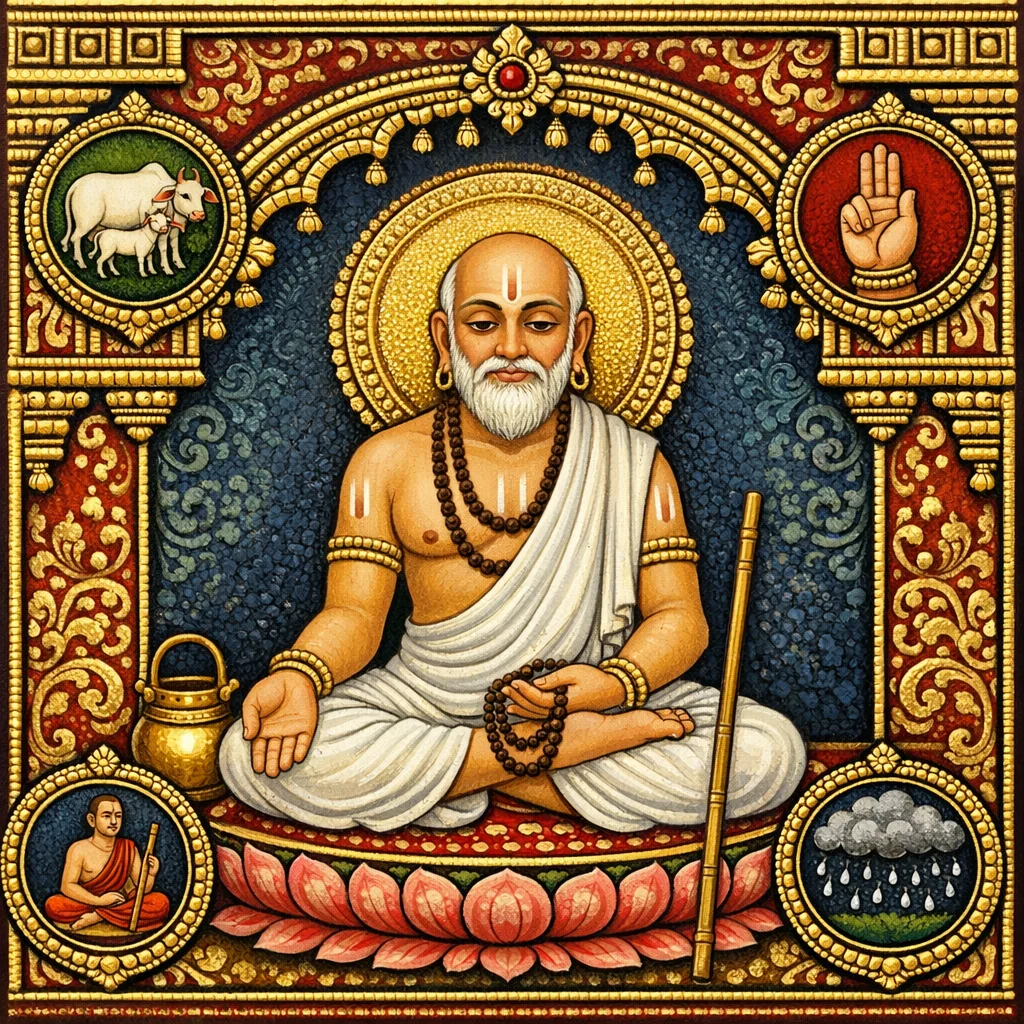
Adhyaya 161
Yati-dharma (The Dharma of the Renunciate Ascetic)
This chapter codifies yati-dharma as a disciplined passage from social attachment to liberating knowledge. The aspirant should renounce the moment dispassion (virāga) arises, after arranging a prājāpatya iṣṭi and internalizing the sacred fires, marking a shift from outer ritual to inner tapas. The yati’s life stresses solitude, non-accumulation, minimal subsistence, careful non-harming, and speech and conduct purified by truth. Detailed alms rules define ethical dependence on society without burdening householders, and a fourfold typology (kuṭīraka → bahūdaka → haṃsa → paramahaṃsa) maps progressive interiorization. Ascetic conduct is then aligned with yoga: yama-niyama, āsana, prāṇāyāma (garbha/agarbha; pūraka-kumbhaka-recaka with mātrā measures), pratyāhāra, dhāraṇā, dhyāna, and samādhi. It culminates in mahāvākya-like non-dual affirmations identifying the Self with Brahman/Vāsudeva/Hari, presenting renunciation as ethical rigor and direct jñāna leading to moksha, including expiations (six prāṇāyāmas) and seasonal vows (cāturmāsya).
Shlokas
Verse 1
इत्य् आग्नेये महापुराणे वानप्रस्थाश्रमो नाम षष्ट्यधिकशततमो ऽध्यायः अथैकषष्ट्यधिकशततमो ऽध्यायः यतिधर्मः पुष्कर उवाच यतिर्धर्मं प्रवक्ष्यामि ज्ञानमोक्षादिदर्शकं चतुर्धमायुषो भागं प्राप्य सङ्गात् परिवर्जयेत्
Thus, in the Agni Mahāpurāṇa ends the one-hundred-and-sixtieth chapter called “The Vānaprastha (forest-dweller) stage.” Now begins the one-hundred-and-sixty-first chapter: “The Dharma of the Yati (renunciate).” Puṣkara said: “I shall expound the dharma of the yati, which reveals knowledge and liberation (mokṣa) and the like. Having attained one quarter of one’s lifespan, one should abandon attachment and worldly association.”},{
Verse 2
यदह्नि विरजेद्धीरस्तदह्नि च परिव्रजेत् प्रजापत्यां निरूप्येष्टिं सर्वदेवसदक्षिणां
On the very day the steadfast man becomes free from passion and attachment, on that very day he should depart as a wandering renunciate; having arranged a Prājāpatya iṣṭi (an offering related to Prajāpati), with dakṣiṇā (sacrificial fees) given in the name of all the gods.
Verse 3
आत्मन्यग्नीन् समारोप्य प्रव्रजेद्ब्राह्मणो गृहात् दृष्ट्वावश्यमिति ङ तपश्चोग्रं वने चरेदिति ङ भजेद्दिशमजिम्हग इति ङ सङ्गान् परित्यजेदिति ङ विरजेद्वापि तदह्नि इति ङ एक एव चरेन्नित्यं ग्रासमन्नाथमाश्रयेत्
Having established the sacred fires within himself (as the inner fire), a brāhmaṇa should leave the house and enter the homeless state (renunciation). Seeing what is inevitable (death and impermanence), he should practise intense austerity and dwell in the forest. He should take a straight direction, without crookedness; abandon all attachments and associations; and become free from passion and impurity—indeed, from that very day. He should always wander alone, subsisting on a single mouthful of food, relying only on food obtained without any sense of ownership.
Verse 4
उपेक्षको ऽसिञ्चयिको मुनिर्ज्ञानसमन्वितः कपालं वृक्षमूलञ्च कुचेलमसहायाता
Indifferent to worldly concerns, non-accumulating, a sage endowed with true knowledge—bearing a skull-bowl, dwelling at the foot of a tree, wearing tattered rags, and moving about without assistance or dependence.
Verse 5
समता चैव सर्वस्मिन्नेतन्मुक्तस्य लक्षणं नाभिनन्देन मरणं नाभिनन्देत जीवनं
Equanimity toward everything—this is the mark of one who is liberated: he neither rejoices in death nor rejoices in life.
Verse 6
कालमेव प्रतीक्षेत निदेशं भृतको यथा दृष्टिपूतं न्यसेत्पादं वस्त्रपूतं जलं पिवेत्
One should wait for the proper time alone, like a hired servant awaiting instruction; one should place the foot only after inspecting the spot (thus ‘purified by sight’), and one should drink water that has been strained through cloth.
Verse 7
सत्यपूतां वदेद्वाचं मनःपूतं समाचरेत् अलावुदारुपत्राणि मृण्मयं वैष्णवं यतेः
Let the ascetic speak words purified by truth, and let him act with a mind made pure. For the Vaiṣṇava renunciant, the proper utensils are those made from gourd, wood, and leaves, and also those made of clay.
Verse 8
विधूमे न्यस्तमुषले व्यङ्गारे भुक्तवज्जने वृत्ते शरावसम्पाते भिक्षां नित्यं यतिश् चरेत्
A renunciant should daily go for alms only when the household is without smoke (cooking finished), the pestle has been set down, the embers are cold, the people have eaten, and the clatter of dishes has ceased.
Verse 9
मधूकरमसङ्क्लिप्तं प्राक्प्रणीतमयाचितं तात्कालिकञ्चोपपन्नं भैक्षं पञ्चविधं स्मृतं
Alms (bhaikṣa) is remembered as fivefold: (1) “like a bee” (madhūkara), (2) untainted and unhoarded (asaṅklipta), (3) previously set aside (prākpraṇīta), (4) unsolicited (ayācita), and (5) obtained at the proper time and in a fitting manner (tātkālika, upapanna).
Verse 10
पाणिपात्री भवेद्वापि पात्रे पात्रात् समाचरेत् अवेक्षेत गतिं नॄणां कर्मदोषसमुद्भवां
Even if one must use the hand itself as a begging-bowl, one should still behave with propriety toward a worthy recipient. One should reflect upon the destinies of people as arising from the faults of their own actions (karma).
Verse 11
शुद्धभावश् चरेद्भर्मं यत्र तत्राश्रमे रतः समः सर्वेषु भूतेषु न लिङ्गं धर्मकारणं
With a purified disposition, one should practice dharma; dwelling wherever one may be, one should remain devoted to one’s āśrama-discipline. Being even-minded toward all beings, one should know that mere external insignia are not the cause of dharma.
Verse 12
फलं कतकवृक्षस्य यद्यप्यम्बुप्रसादकं न नामग्रहणादेव तस्य वारि प्रसीदति
Although the fruit of the kaṭaka tree is indeed a clarifier of water, the water does not become clear merely by uttering its name.
Verse 13
वृक्षमूलानि ख , घ , छ , झ च वृक्षमूलादि इति ट एतच्छुद्धस्येति ङ जीवितमिति ख , घ , ङ , छ , ज च अजिह्मः पण्डकः पङ्गुरन्धो बधिर एव च सद्भिश् च मुच्यते मद्भिरज्ञानात् संसृतो द्विजः
“‘Tree-roots…’—so read the recensions (kha, gha, cha, jha); ‘tree-roots and the like’—so reads (ṭa); ‘of one purified by this’—so reads (ṅa); and ‘for livelihood’—so read (kha, gha, ṅa, cha, ja). A twice-born person (dvija) who, through ignorance, has become entangled in saṃsāra—even if not crooked, or even if a paṇḍaka (sexually/ritually atypical person), lame, blind, or deaf—is released from sin/defilement by the good (sadbhiḥ), through their company and guidance in purification.
Verse 14
अह्नि रात्र्याञ्च यान् जन्तून् हिनस्त्यज्ञानतो यतिः तेषां स्नात्वा विशुद्ध्यर्थं प्राणायामान् षडाचरेत्
Whatever living beings an ascetic (yati) unknowingly harms by day or by night—having bathed, for purification from that fault, he should perform six prāṇāyāmas (breath-regulations).
Verse 15
अस्थिस्थूणं स्नायुयुतं मांसशोणितलेपनं चर्मावनद्धं दुर्गन्धं पूर्णं मूत्रपुरीषयोः
A body is a pillar of bones, bound with sinews, smeared with flesh and blood, wrapped in skin, foul-smelling, and filled with urine and feces.
Verse 16
जराशोकसमाविष्टं रोगायतनमातुरं रजस्वलमनित्यञ्च भूतावासमिमन्त्यजेत्
One should abandon this body, permeated by old age and sorrow, a seat of disease, afflicted, subject to menstrual impurity, impermanent, and a dwelling-place of living beings.
Verse 17
धृतिः क्षमा दमो ऽस्तेयं शौचमिन्द्रियनिग्रहः ह्रीर्विद्या सत्यमक्रोधो दशकं धर्मलक्षणं
Steadfastness, forbearance, self-control, non-stealing, purity, restraint of the senses, modesty, true knowledge, truthfulness, and freedom from anger—these ten are the defining marks of dharma (righteous conduct).
Verse 18
चतुर्विधं भैक्षवस्तु कुटीरकवहूदके हंसः परमहंसश् च यो यः पश्चात् स उत्तमः
The mendicant’s way of living (bhikṣā-life) is fourfold: the kuṭīraka, the bahūdaka, the haṃsa, and the paramahaṃsa. Of these, whichever comes later in this sequence is considered superior.
Verse 19
एकदण्डी त्रिदण्डी वा योगी मुच्यते बन्धनात् अहिंसा सत्यमस्तेयं ब्रह्मचर्यापरिग्रहौ
Whether bearing a single staff (ekadaṇḍa) or the triple staff (tridaṇḍa), the yogin is freed from bondage by practicing ahiṃsā (non-violence), satya (truthfulness), asteya (non-stealing), brahmacarya (celibate conduct), and aparigraha (non-possessiveness).
Verse 20
यमाः पञ्चाथ नियमाः शौचं सन्तोषणन्तपः स्वाध्यायेश्वरपूजा च पद्मकाद्यासनं यतेः
The five yamas, and then the niyamas—śauca (purity), santoṣa (contentment), tapaḥ (austerity), svādhyāya (self-study/recitation of scripture), and īśvara-pūjā (worship of the Lord)—together with postures such as padmaka (the lotus-seat) and others, are to be observed by the ascetic.
Verse 21
प्राणायामस्तु द्विविधः स गर्भो ऽगर्भ एव च जपध्यानयुतो गर्भो विपरीतस्त्वगर्भकः
Prāṇāyāma is of two kinds: “with seed” (garbha) and “seedless” (agarbha). That which is accompanied by japa (mantra-recitation) and dhyāna (meditation) is “with seed”; its opposite is “seedless”.
Verse 22
प्रत्येकं त्रिविधं सोपि पूरकुम्भकरेचकैः पूरणात् पूरको वायोर् निश् चलत्वाच्च कुम्भकः
Each practice is itself threefold: pūraka (inhalation), kumbhaka (retention), and recaka (exhalation). Because it “fills” (the body with breath) it is called pūraka; and because the breath becomes motionless it is called kumbhaka.
Verse 23
समाचरेदिति ख , छ च दयास्तेयमिति ङ त्रिदण्डी चेति ङ पद्मकाद्यासनं महत् इति ट रेचनाद्रेचकः प्रोक्तो मात्राभेदेन च त्रिधा द्वादशात्तु चतुर्विंशः षट्त्रिंशन्मात्रिको ऽपरः
“One should practice (these),” as indicated by the kha/cha readings; “dayā (compassion) and asteya (non-stealing),” according to the ṅa reading; and “the ascetic bearing the triple staff (tridaṇḍin),” also according to the ṅa reading; and “the great posture beginning with padmaka (the lotus-seat),” according to the ṭa reading. From recana (“expulsion”) the term recaka (exhalation) is defined. By difference in mātrā (time-units), it is of three kinds: of twelve mātrās, of twenty-four mātrās, and another of thirty-six mātrās.
Verse 24
तालो लघ्वक्षरो मात्रा प्रणवादि चरेच्छनैः प्रत्याहारो जापकानां ध्यानमीश्वरचिन्तनं
Tāla (regulated timing), the short syllable, and mātrā (a unit of prosodic/temporal measure)—beginning with the praṇava (Oṃ)—should be practiced gradually. For those engaged in japa, pratyāhāra is the withdrawal of the senses, and dhyāna is contemplation of the Lord.
Verse 25
मनोधृतिर्धारणा स्यात् समाधिर्ब्रह्मणि स्थितिः अयमात्मा परं ब्रह्म सत्यं ज्ञानमनन्तकं
Steadiness of the mind is called dhāraṇā (concentration); samādhi is abiding in Brahman. This Self is the supreme Brahman—Truth, Knowledge, and the Infinite.
Verse 26
विज्ञानमानन्दं ब्रह्म तत्त्वमस्यअहमस्मि तत् परम् ब्रह्म ज्योतिरात्मा वासुदेवो विमुक्त ॐ
Brahman is consciousness and bliss. “That thou art”; “I am That.” That is the supreme Brahman—the Self whose nature is light; that is Vāsudeva. (One who realizes this is) liberated. Oṃ.
Verse 27
देहेन्द्रियमनोबुद्धिप्राणाहङ्कारवर्जितं जाग्रत्स्वप्नसुसुप्त्यादिमुक्तं ब्रह्म तुरोयकं
Brahman is that which is devoid of body, senses, mind, intellect, vital-breath, and ego; free from the limitations of waking, dream, and deep sleep and the like—(that) is the Turīya (the “fourth” state).
Verse 28
नित्यशुद्धबुद्धयुक्तसत्यमानन्दमद्वयं अहं ब्रह्म परं ज्योतिरक्षरं सर्वगं हरिः
I am Brahman—eternally pure, endowed with consciousness, real, blissful, and non-dual; the supreme Light, the imperishable, all-pervading Hari.
Verse 29
सो ऽसावादित्यपुरुषः सो ऽसावहमखण्ड ॐ सर्वारम्भपरित्यागी समदुःखसुखं क्षमी
He indeed is the Solar Puruṣa; He indeed am I—undivided, Oṃ. (He/I am) one who abandons all new undertakings, remains the same in sorrow and happiness, and is forbearing.
Verse 30
भावशुद्धश् च ब्रह्माण्डं भित्त्वा ब्रह्म भवेन्नरः आषढ्यां पौर्णमास्याञ्च चातुर्मास्यं व्रतञ्चरेत्
With purified inner disposition, a man—piercing (i.e., transcending) the cosmic egg (brahmāṇḍa)—becomes one with Brahman. On the full-moon day of Āṣāḍha he should undertake the Cāturmāsya vow.
Verse 31
ततो ज्रजेत् नवम्यादौ ह्य् ऋतुसन्धिषु वापयेत् प्रायश्चित्तं यतीनाञ्च ध्यानं वायुयमस् तथा
Thereafter, one should undertake the prescribed discipline beginning on the ninth lunar day; and at the junctions of the seasons one should likewise perform it. This is the expiatory observance (prāyaścitta) for ascetics (yatis), together with meditative practice—also (the contemplations of) Vāyu and Yama.
Frequently Asked Questions
Equanimity toward all, non-accumulation, solitary wandering, truth-purified speech and mind, careful non-harming, and indifference to life and death—paired with yogic discipline culminating in Brahman-realization.
It prescribes alms only after the household has finished cooking and eating (no smoke, pestle set down, embers cold), and defines five ethical modes of alms (madhūkara, asaṅklipta, prākpraṇīta, ayācita, tātkālika/upapanna) to prevent coercion, hoarding, and social disruption.
Yama-niyama and āsana support prāṇāyāma (garbha/agarbha; pūraka-kumbhaka-recaka with mātrā timing), leading to pratyāhāra, dhāraṇā, dhyāna (Īśvara-cintana), and samādhi as abiding in Brahman.
It presents non-dual identification statements—Self as Brahman (truth, knowledge, infinite; consciousness-bliss), Brahman as Turīya beyond waking/dream/deep sleep, and the realized Self as Vāsudeva/Hari—framing moksha as direct knowledge.