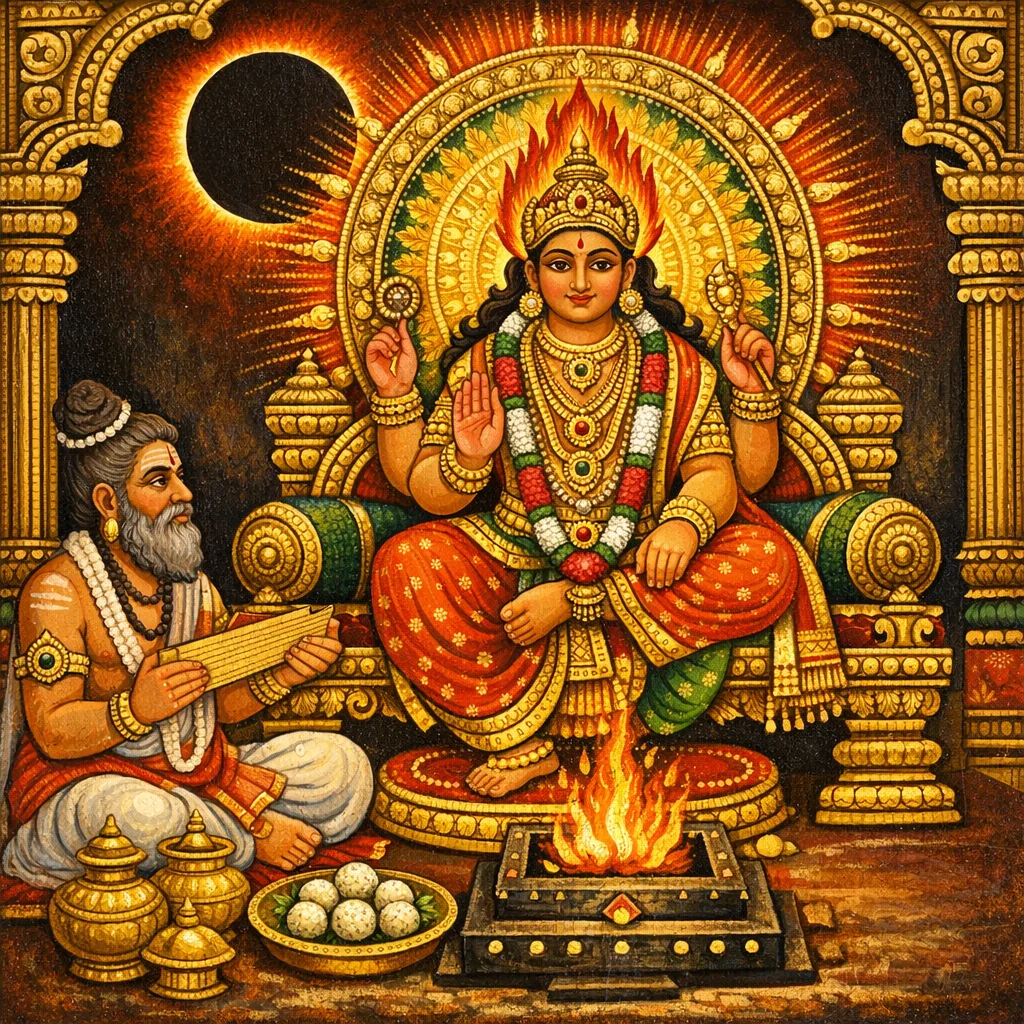
Adhyaya 165
Adhyaya 165 — नानाधर्माः (Various Dharmas)
Continuing the Agni–Vasiṣṭha transmission, this chapter frames dharma contemplatively: meditate on the Lord within the heart, with mind, intellect, memory, and senses made one-pointed. From this inner discipline Agni turns to applied Dharma-śāstra—śrāddha offerings and food restrictions; the special power of eclipse-junctions for gifts and ancestral rites; and the proper Vaiśvadeva procedure when fire is absent. It then sets social purity debates—especially concerning women, coercion, and impurity—beside a non-dual corrective: for one who perceives no “second” beyond the Self, conventional oppositions loosen. A sustained yoga section defines the highest yoga as cessation of mental modifications and the merging of the kṣetrajña into Paramātman/Brahman; prāṇāyāma and the Sāvitrī (Gāyatrī) are praised as supreme purifiers. The latter portion states limits of expiation and karmic consequences (degraded rebirths and long durations), concluding that yoga alone is the unsurpassed remover of sin, integrating ritual dharma with inner realization.
Shlokas
Verse 1
इत्य् आग्नेये महापुराणे नवग्रहहोमो नाम चतुःषष्ट्यधिकशततमो ऽध्यायः अथ पञ्चषष्त्यधिकशततमो ऽध्यायः नानाधर्माः अग्निर् उवाच ध्येय आत्मा स्थितो यो ऽसौ हृदये दीपवत् प्रभुः अनन्यविषयं कृत्वा मनो बुद्धिस्मृतीन्द्रियं
Thus, in the Agni Mahāpurāṇa, ends the one-hundred-and-sixty-fourth chapter called “Navagraha-homa” (the oblation-rite to the nine planets). Now begins the one-hundred-and-sixty-fifth chapter, “Various Dharmas.” Agni said: “The Self (Ātman), the Lord, who abides in the heart like a lamp, is to be meditated upon—having made the mind, intellect, memory, and the senses single-pointed, without any other object.”
Verse 2
श्राद्धन्तु ध्यायिने देयं गव्यं दधि घृतं पयः प्रियङ्गवो मसूराश् च वार्ताकुः कोद्रवो न हि
In a Śrāddha rite, one should give (offer) to the meditative recipient: cow-products—curd (dadhi), ghee (ghṛta), and milk—as well as priyaṅgu grain and masūra lentils; but vārtāku (brinjal/eggplant) and kodrava (a coarse millet) are not to be used.
Verse 3
सैंहिकयो यदा सूर्यं ग्रसते पर्वसन्धिषु हस्तिच्छाया तु सा ज्ञेया श्राद्धदानादिके ऽक्ष्या
When Rāhu, the son of Siṃhikā, eclipses the Sun at the junctions of the lunar fortnight (parvan-sandhi), that time is to be understood as the “elephant-shadow”; it is an imperishable, highly efficacious occasion for rites such as śrāddha and charitable gifts.
Verse 4
सदा दुःस्थ इति ख , छ च मनुष्याणामिति ङ व्यापिने देयमिति ङ पित्रे चैव यदा सोमो हंसे चैव करे स्थिते तिथिर्वैवस्वतो नाम सा छाया कुञ्जरस्य तु
In the relevant code-letter notations it is stated: “ever afflicted” (kha; and also cha), “of human beings” (ṅa), and “it should be given to the All-pervading, Viṣṇu” (ṅa). Further, when the Moon is placed in the constellation Haṃsa and also in Kara, that tithi is called Vaivasvata; its associated shadow-form is that of an elephant.
Verse 5
अग्नौकरणशेषन्तु न दद्याद्वैश्वदेविके अग्न्यभावे तु विप्रस्य हस्ते दद्यात्तु दक्षिणे
In the Vaiśvadeva rite one should not offer the remnant left over from what has already been offered into the fire. But if fire is unavailable, one should place it in the right hand of a brāhmaṇa as dakṣiṇā.
Verse 6
न स्त्री दुष्यति जारेण न विप्रो वेदकर्मणा बलात्कारोपभुक्ता चेद्वैरिहस्तगतापि वा
A woman is not rendered impure by sexual contact with a paramour; nor is a brāhmaṇa rendered impure by performing Vedic rites. Likewise, if she has been violated by force—or even if she has fallen into the hands of an enemy—she is not thereby tainted.
Verse 7
सन्त्यजेद् दूषितान्नारीमृतुकाले न शुद्ध्यति य आत्मत्र्यतिरेकेण द्वितीयं नात्र पश्यति
One should abandon a woman who has become defiled; during her menstrual period she is not considered purified. Yet for one who, apart from the Self (Ātman), perceives no ‘second’ here, this rule does not apply in the same manner.
Verse 8
ब्रह्मभूतः स एवेह योगी चात्मरतो ऽमलः विषयेन्द्रियसंयोगात् केचिद् योगं वदन्ति वै
Here, that very person is a yogin—one who has become Brahman, who delights in the Self (Ātman), and is stainless. Yet some indeed call “yoga” the conjunction of the senses with their objects.
Verse 9
अधर्मो धर्मबुद्ध्या तु गृहीतस्तैर् अपण्डितैः आत्मनो मनसश् चैव संयोगञ्च तथा परे
But the unlearned seize upon unrighteousness, taking it to be righteousness; and they also misconstrue the true relation of the Self (Ātman) and the mind (manas)—and likewise other principles besides.
Verse 10
वृत्तिहीनं मनः कृत्वा क्षेत्रज्ञं परमात्मनि एकीकृत्य विमुच्येत बन्धाद्योगो ऽयमुत्तमः
Having made the mind free from all vṛtti (mental modifications), and having unified the knower of the field (kṣetrajña) in the Supreme Self (Paramātman), one is released from bondage—this is the highest Yoga.
Verse 11
कुटुम्बैः पञ्चभिर्यामः षष्ठस्तत्र महत्तरः देवासुरमनुष्यैर् वा स जेतुं नैव शक्यते
With five supporting groups (kula/retinues) one advances; but the sixth there is greater—whether by gods, asuras, or humans, he cannot be conquered.
Verse 12
वहिर्मुखानि सर्वाणि कृत्वा चाभिमुखानि वै मनस्येवेन्द्रियग्रामं मनश्चात्मनि योजयेत्
Having made all the outward-turned sense-currents inward-facing, one should merge the entire aggregate of senses into the mind (manas), and then yoke the mind into the Self (Ātman).
Verse 13
सर्वभावविनिर्मुक्तं क्षेत्रज्ञं ब्रह्मणि न्यसेत् एतज्ज्ञानञ्च ध्यानञ्च शेषो ऽन्यो ग्रन्थविस्तरः
Let one place (absorb) the Knower of the Field (kṣetrajña), freed from all mental states and conditioned dispositions, into Brahman. This indeed is knowledge and meditation; all else is merely the extended elaboration of texts.
Verse 14
चौरहस्तगतापि वेति ख , घ , ञ च द्वितीयं नानुपश्यतीति घ , ट च स जेतुं न च शक्यत इति ग , ङ च शेषा ये ग्रन्थविस्तरा इति ङ यन्नास्ति सर्वलोकस्य तदस्तीति विरुध्यते कथ्यमानं तथान्यस्य हृदये नावतिष्ठते
Even if a statement has been seized by a thief’s hand (stolen or misappropriated), it is still recognized as such. Not perceiving the “second” (the true corroboration), one errs; such a person cannot be conquered. The remaining readings are merely expansions within the textual tradition. What is not accepted by all people yet is asserted to exist becomes self-contradictory; and when stated so, it does not take root in another’s heart.
Verse 15
असंवेद्यं हि तद् ब्रह्म कुमारी स्त्रीमुखं यथा अयोगी नैव जानाति जात्यन्धो हि घटं यथा
Indeed, that Brahman is not an object of sensory apprehension—just as a maiden does not fully know the experience of a woman’s state (married life); likewise, one not established in Yoga does not know Brahman, just as one blind from birth does not know a pot.
Verse 16
सत्र्यसन्तं द्विजं दृष्ट्वा स्थानाच्चलति भास्करः एष मे मण्डलं भित्त्वा परं ब्रह्माधिगच्छति
Seeing the twice-born (brāhmaṇa) steadfast in the sacrificial vow (satra), the Sun-god moves from his station: “This one, breaking through my solar orb, proceeds to the Supreme Brahman.”
Verse 17
उपवासव्रतञ्चैव स्नानन्तीर्थं फलन्तपः द्विजसम्पादनञ्चैव सम्पन्नन्तस्य तत् फलं
Fasting and religious vows, bathing at a sacred ford (tīrtha), the fruit of austerity (tapas), and the gaining of a brāhmaṇa’s support or favor—these are the merits that accrue to one who has duly accomplished the prescribed observance.
Verse 18
एकाक्षरं परं ब्रह्म प्राणायामः परन्तपः सावित्र्यास्तु परं नास्ति पावनं परमं स्मृतः
The single syllable (Om) is the Supreme Brahman; and prāṇāyāma, O subduer of foes, is itself the highest austerity. Nothing surpasses the Sāvitrī (Gāyatrī) mantra—she is remembered as the supreme purifier.
Verse 19
पूर्वं स्त्रियः सुरैर् भुक्ताः सोमगन्धर्ववह्निभिः भुञ्जते मानुषाः पश्चान्नैता दुष्यन्ति केनचित्
Formerly women were enjoyed by the gods—by Soma, the Gandharvas, and Agni; afterward men enjoy them. By this, they are not defiled by anyone at all.
Verse 20
असवर्णेन यो गर्भः स्त्रीणां योनौ निषिच्यते अशुद्धा तु भवेन्नारी यावत्छल्यं न मुञ्चति
If a conception is sown in a woman’s womb by one of a different varṇa, then the woman becomes impure so long as she does not expel that “foreign body” (śalya).
Verse 21
निःसृते तु ततः शल्ये रजसा शुद्ध्यते ततः ध्यानेन सदृशन्नास्ति शोधनं पापकर्मणां
When that “foreign body” (śalya) has been extracted, one is purified thereafter by rajas (dust/earth). Yet for cleansing sinful actions, there is no purification comparable to meditation (dhyāna).
Verse 22
श्वपाकेष्वपि भुञ्जानो ध्यानेन हि विशुद्ध्यति आत्मा ध्याता मनो ध्यानं ध्येयो विष्णुः फलं हरिः
Even if one eats among the śvapākas (dog-cookers, outcastes), one is indeed purified by meditation. The Self is the meditator; the mind is the meditation; Viṣṇu is the object to be meditated upon; and Hari is the fruit attained.
Verse 23
अक्षयाय यतिः श्राद्धे पङ्क्तिपावनपावनः आरूढो नैष्ठिकन्धर्मं यस्तु प्रच्यवते द्विजः
In a Śrāddha, a yati (renunciant) yields akṣaya (imperishable) merit and purifies the line of those who dine. But a dvija (twice-born) who, having undertaken naiṣṭhika-dharma (steadfast discipline), falls away from it—is not so.
Verse 24
स्वसंवेद्यं हि तद् ब्रह्म इति ग , ङ च सुसंवेद्यं हि तद् ब्रह्म इति ज , ट च स्वयं वेद्यं हि तद् ब्रह्म इति घ , ञ च प्रायश्चित्तं न पश्यामि येन शुद्ध्येत्स आत्महा ये च प्रव्रजिताः पत्न्यां या चैषां वीजसन्ततिः
“Indeed that Brahman is self-apprehended (svasaṃvedya)”—so read the ga and ṅa recensions; “indeed that Brahman is well-apprehended (susaṃvedya)”—so read the ja and ṭa recensions; “indeed that Brahman is to be known by oneself (svayaṃ vedya)”—so read the gha and ña recensions. (On expiation:) I see no prāyaścitta by which a self-slayer would be purified—nor for those who renounce while still bound to a wife, nor for the progeny that arises from their seed.
Verse 25
विदुरा नाम चण्डाला जायन्ते नात्र संशयः शतिको म्रियते गृध्रः श्वासौ द्वादशिकस् तथा
Women known as Vidurā are born as Caṇḍālī outcastes—of this there is no doubt. The one called Śatika dies and is reborn as a vulture; likewise, Śvāsa becomes a Dvādaśika.
Verse 26
भासो विंशतिवर्षाणि सूकरो दशभिस् तथा अपुष्पो विफलो वृक्षो जायते कण्टकावृतः
A bhāsa (kite) lives for twenty years, and likewise a boar for ten. A tree that is covered with thorns is born flowerless and fruitless.
Verse 27
ततो दावाग्निदग्धस्तु स्थाणुर्भवति सानुगः ततो वर्षशतान्यष्टौ द्वे तिष्ठत्यचेतनः
Then, scorched by a forest-fire, he becomes a motionless tree-stump together with its offshoots. Thereafter, for eight hundred and two years, he remains standing, insentient.
Verse 28
पूर्णे वर्षसहस्रे तु जायते ब्रह्मराक्षसः प्लवेन लभते मोक्षं कुलस्योत्सादनेन वा
When a full thousand years are completed, one becomes a brahmarākṣasa. He attains liberation either by means of a ‘plava’—a purificatory rite of crossing that carries one over—or else by the destruction of his own lineage.
Verse 29
योगमेव निषेवेतेत नान्यं मन्त्रमघापहं
One should practice Yoga alone; there is no other mantra that removes sin so effectively.
Frequently Asked Questions
It recommends cow-products (curd, ghee, milk) along with priyaṅgu grain and masūra lentils, while excluding vārtāku (brinjal/eggplant) and kodrava (a coarse millet).
The chapter treats the eclipse at parvan-sandhi as an ‘elephant-shadow’ period with imperishable efficacy (akṣaya) for śrāddha and dāna.
By making the mind free of modifications (vṛtti-śūnya) and unifying the kṣetrajña (knower of the field) in the Supreme Self/Brahman, resulting in release from bondage.
The Sāvitrī (Gāyatrī) mantra is praised as unsurpassed in purification, and prāṇāyāma is called the highest tapas.