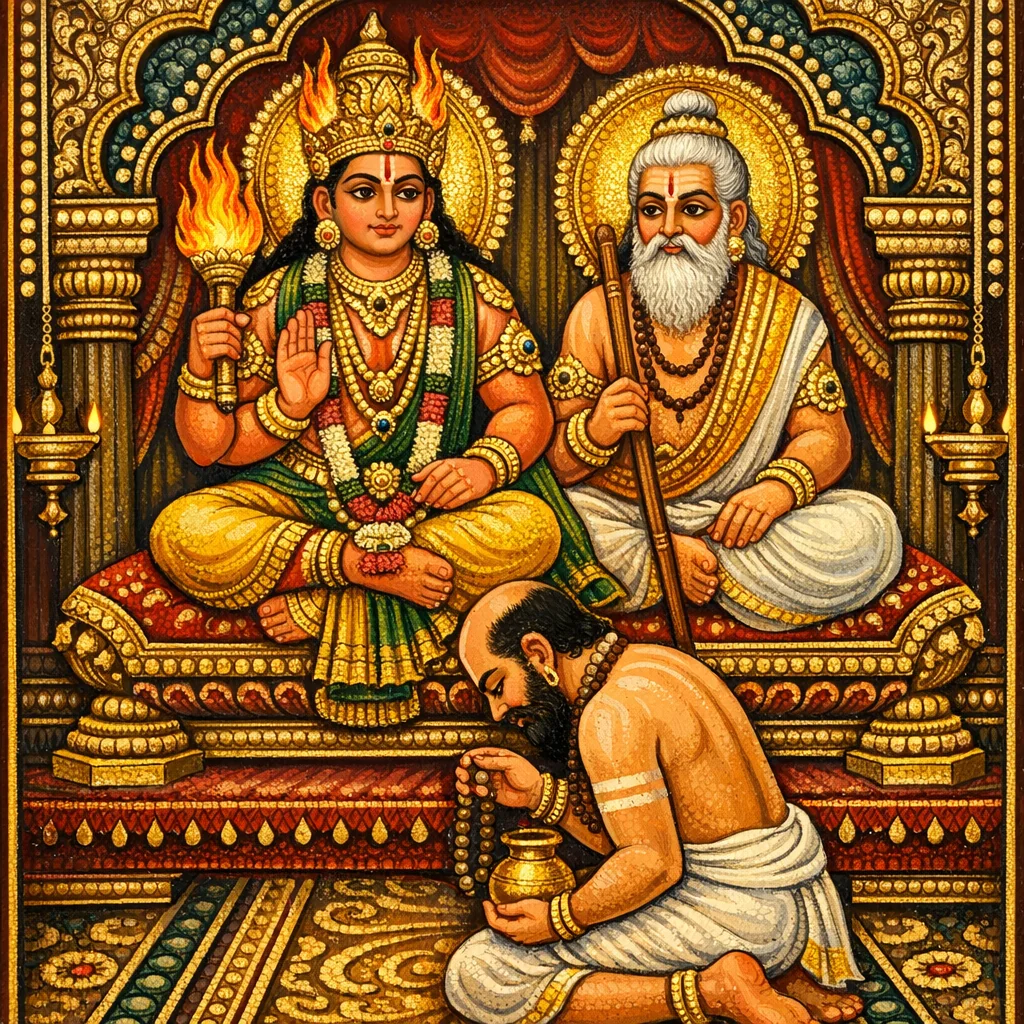
Adhyaya 173
Prāyaścitta — Definitions of Killing, Brahmahatyā, and Graded Expiations
Lord Agni opens a Dharma-śāstra teaching on prāyaścitta (expiation), tracing the system to Brahmā and defining “killing” as any act that ends in the separation of prāṇa (death). Guilt extends beyond the direct slayer to the instigator, group participants in a joint armed act, and indirect causation—including suicides driven by abuse or coercive circumstances—thus grounding grave sin, especially brahmahatyā (brahmin-slaying). The chapter sets principles for assessing penance by place, time, capacity, and the offense’s nature, then lists major expiations for brahmin-killing: self-sacrifice, long-term ascetic marks with alms-living, and conduct-based mitigations. It gives a graded scale by victim’s varṇa and vulnerability (aged, women, children, sick) and by specific harms (cow-killing, injuries, accidental deaths by implements). It proceeds through purity rules and food contamination, intoxicants and restricted consumption, theft with restitution and royal-penalty logic, and sexual transgressions under gurutalpa, prescribing death-penances or demanding multi-month Cāndrāyaṇas. Throughout, Agni presents prāyaścitta as juridical calibration and spiritual medicine—restoring dharma outwardly while purifying intention and conduct within.
Shlokas
Verse 1
इत्य् आग्नेये महापुराणे सर्वपापप्रायश्चित्ते पापनाशनस्तोत्रं नाम द्विसप्तत्यधिकशततमो ऽध्यायः अथ त्रिसप्तत्यधिकशततमो ऽध्यायः प्रायश्चित्तं अग्निर् उवाच प्रायश्चित्तं ब्रह्णोक्तं वक्ष्ये पापोपशान्तिदं स्यात् प्राणवियोगफलो व्यापारो हननं स्मृतं
Thus, in the Agni Mahāpurāṇa, the one-hundred-and-seventy-second chapter, called “The Hymn that Destroys Sin,” within the section on expiations for all sins, concludes. Now begins the one-hundred-and-seventy-third chapter on expiation (prāyaścitta). Agni said: “I shall teach the expiation declared by Brahmā, which brings the pacification of sin. An act whose result is the separation of the life-breath (prāṇa)—that is, death—is remembered as ‘killing’ (hanana).”
Verse 2
रागाद् द्वेषात् प्रमादाच्च स्वतः परत एव वा ब्राह्मणं घातयेद्यस्तु स भवेद्ब्रह्मघातकः
Whoever causes a brāhmaṇa to be killed—out of passion (rāga), hatred (dveṣa), or negligence—whether by his own hand or through another, becomes a slayer of a brāhmaṇa (brahma-ghātaka).
Verse 3
बहूनामेककार्याणां सर्वेषां शस्त्रधारिणां यद्येको घातकस्तत्र सर्वे ते घातकाः स्मृताः
When many armed men are engaged in a single joint undertaking, if even one among them becomes the slayer there, then all of them are regarded as slayers.
Verse 4
आक्रोशितस्ताडितो वा धनैव्वा परिपीडितः ततः कर्माणीति ख , ग , घ , छ च यमुद्दिश्य त्यजेत् प्राणांस्तमाहुर्ब्रह्मघातकं
Even if a person has been abused, beaten, or oppressed by the power of wealth, if—because of those acts (as stated in the preceding items ka, kha, ga, gha, and cha)—he takes his own life, then, with regard to the person whose death he has thus occasioned, they declare him to be a slayer of a brāhmaṇa (brahma-ghātaka).
Verse 5
औषधाद्युपकारे तु न पापं स्यात् कृते मृते पुत्रं शिष्यन्तथा भार्यां शासते न मृते ह्य् अघं
When an act is done as beneficial aid, such as administering medicine, there is no sin even if death results. Likewise, in disciplining one’s son, student, or wife, there is no fault if death occurs unintentionally in the course of such chastisement.
Verse 6
देशं कालञ्च यः शक्तिं पापञ्चावेक्ष्य यत्नतः प्रायश्चित्तं प्रकल्प्यं स्याद्यत्र चोक्ता ब निष्कृतिः
After carefully considering the place, the time, one’s capacity, and the nature of the sin, one should prescribe an expiation (prāyaścitta)—that very form of atonement stated in the teaching as the proper release from the fault.
Verse 7
गवार्थे ब्राह्मणार्थे वा सद्यः प्राणान् परित्यजेत् प्रास्येदात्मानमग्नौ वा मुच्यते ब्रह्महत्यया
For the sake of a cow, or for the sake of a Brāhmaṇa, one should immediately give up one’s life; or else cast oneself into fire—by such self-sacrifice one is released from the sin of brahmin-slaying (brahmahatyā).
Verse 8
शिरःकपाली ध्वजवान् भैक्षाशी कर्म वेदयन् ब्रह्महा द्वादशाब्दानि मितभुक् शुद्धिमाप्नुयात्
A slayer of a brāhmaṇa should bear a skull as a mark of expiation, carry a banner, live on alms, and openly declare his deed; subsisting on measured food for twelve years, he thereby attains purification.
Verse 9
षड्भिर्वर्षैः शुद्धचारी ब्रह्महा पूयते नरः विहितं यदकामा मां कामात्तु द्विगुणं स्मृतं
A man who has slain a brāhmaṇa becomes purified in six years if he maintains pure conduct. What is prescribed when done without desire—if done out of desire—is remembered as requiring a penance twice as great.
Verse 10
प्रायश्चित्तं प्रवृत्तस्य बधे स्यात्तु त्रिवार्षिकं ब्रह्मघ्नि क्षत्रे द्विगुणं विट्च्छूद्रे द्विगुणं त्रिधा
For one who has proceeded to commit a killing, the expiation is prescribed as a three-year observance; for the slaying of a Brāhmaṇa it is doubled; for a Kṣatriya it is doubled; and for a Vaiśya and a Śūdra it is doubled threefold (i.e., multiplied according to the stated gradation).
Verse 11
अन्यत्र विप्रे सकलं पादोनं क्षत्रिये मतं वैश्ये ऽर्धपादं क्षत्रे स्याद्वृद्धस्त्रीबालरोगिषु
In other cases, the full measure of expiation/penalty is prescribed for a brāhmaṇa; for a kṣatriya it is held to be one quarter less; for a vaiśya it is reduced by half; and for śūdras—as also for the aged, women, children, and the sick—it should be further moderated as appropriate.
Verse 12
तुरीयो ब्रह्महत्यायाः क्षत्रियस्य बधे स्मृतं वैश्ये ऽष्टमांशो वृत्तस्थे शूद्रे ज्ञेयस्तु षोडशः
For the killing of a kṣatriya, the sin is remembered as one-fourth of the sin of brahmin-slaying; for a vaiśya it is one-eighth; and for a śūdra living by his proper livelihood, it should be understood as one-sixteenth.
Verse 13
अप्रदुष्टां स्त्रियं हत्वा शूद्रहत्याव्रतं चरेत् पञ्चगव्यं पिवेद्गोघ्नो मासमासीत संयतः
Having slain an untainted (innocent) woman, one should undertake the expiatory observance prescribed for killing a śūdra. But a killer of a cow should drink pañcagavya and, self-restrained, remain in penance for a month.
Verse 14
गोष्ठे शयो गो ऽनुगामी गोप्रदानेन शुद्ध्यति कृच्छ्रञ्चैवातिकृच्छ्रं वा पादह्रासो नृपादिषु
One who sleeps in the cowshed, or who follows (or intrudes upon) the cow, becomes purified by gifting a cow. But in matters involving the king and the like, the prescribed penance is the Kṛcchra or the Atikṛcchra, and there is also loss of one’s standing (pāda-hrāsa).
Verse 15
अतिवृद्धामतिकृशामतिबालाञ्च रोगिणीं न संस्कृतिरिति छ बधे ऽस्य तु इति छ हत्वा पूर्वविधानेन चरेदर्धव्रतं द्विजः
For one who is extremely aged, extremely emaciated, very young, or diseased, it is said that there is no full saṃskāra-rite; but if a twice-born man (dvija) kills such a person, then—according to the rule stated earlier—he should undertake a half-vow (ardha-vrata) as expiation.
Verse 16
ब्राह्मणान् भोजयेच्छक्त्या दद्याद्धेमतिलदिकं मुष्टिचपेटकीलेन तथा शृङ्गादिमोटने
According to one’s ability, one should feed the Brāhmaṇas; and one should give gold, sesame, and the like—as expiation for injuries caused by a fist, a slap, or a nail/peg, and likewise for the breaking of horns and the like.
Verse 17
लगुडादिप्रहारेण गोबधं तत्र निर्दिशेत् दमेन दामने चैव शकटादौ च योजने
There (in legal adjudication), striking with a club and the like is to be treated as ‘killing of a cow’; and the same rule applies in the case of the fine called dama, in the act of binding (the cow), and also in yoking it to a cart and the like.
Verse 18
स्तम्भशृङ्खलपाशैर् वा मृते पादोनमाचरेत् काष्ठे शान्तपनं कुर्यात् प्राजापत्यन्तु लोष्ठके
If (a living being) dies due to a pillar, chain, or noose, one should perform an expiation reduced by a quarter. If (death is caused) by a piece of wood, one should perform the Śāntapana penance; but if it is caused by a loṣṭa (clod/brickbat), one should perform the Prājāpatya penance.
Verse 19
तप्तकृच्छ्रन्तु पाषाणे शस्त्रे चाप्यतिकृच्छ्रकं मार्जारगोधानकुलमण्डूकश्वपतत्रिणः
For the killing of a cat, a godhā (iguana/monitor lizard), a nakula (mongoose), a frog, a dog, or a bird: one should perform the Tapta-kṛcchra penance if it is caused by stone, and the Ati-kṛcchra penance if it is done with a weapon.
Verse 20
हत्वा त्र्यहं पिवेत् क्षीरं कृच्छ्रं चान्द्रायणं चरेत् व्रतं रहस्ये रहसि प्रकाशे ऽपि प्रकाशकं
Having slain (a person), one should drink milk for three days; and one should undertake the Kṛcchra penance and the Cāndrāyaṇa observance—an atoning vow that purifies secret faults in secret and even those made manifest in public.
Verse 21
प्राणायामशतं कार्यं सर्वपापापनुत्तये पानकं द्राक्षमधुकं खार्जरन्तालमैक्षवं
One should perform a hundred regulated breath-controls (prāṇāyāmas) for the removal of all sins. Then one should take a sweet drink (pānaka) prepared from grapes, madhūka, dates, tāla-fruit, and sugarcane-juice.
Verse 22
मध्वीकं टङ्कमाध्वीकं मैरेयं नारिकेलजं न मद्यान्यपि मद्यानि पैष्टी मुख्या सुरा स्मृता
Madhvīka, ṭaṅka-mādhvīka, maireya, and that prepared from coconut—these and other intoxicating drinks are indeed alcoholic; yet the principal surā is regarded as the grain-based (paiṣṭī) liquor.
Verse 23
त्रैवर्णस्य निषिद्धानि पीत्वा तप्त्वाप्यपः शुचिः कणान् वा भक्षयेदब्दं पिण्याकं वा सकृन्निशि
If a member of the three twice-born social orders drinks what is prohibited, then—having drunk heated water—he becomes purified; alternatively, he should eat only grains for a year, or else take oil-cake once at night.
Verse 24
सुरापाणापनुत्यर्थं बालवामा जटी ध्वजी अज्ञानात् प्राश्य विण्मूत्रं सुरासंस्पृष्टमेव च
For the removal of the sin of drinking liquor, one should undertake the expiatory vow as a childlike ascetic, with the prescribed leftward orientation (vāma), wearing matted hair (jaṭā) and carrying a banner; and this applies even if, through ignorance, one has consumed feces or urine that has come into contact with liquor.
Verse 25
पुनः संस्कारमर्हन्ति त्रयो वर्णा द्विजातयः मद्यमाण्डस्थिता आपः पीत्वा सप्तदिनं व्रती
The three twice-born social orders are fit to undergo re-consecration (saṃskāra) again. Having drunk water in which the māṇḍa—the dregs or ferment of liquor—has been present, the person should observe a vow (vrata) for seven days.
Verse 26
चाण्डालस्य तु पानीयं पीत्वा स्यात् षड्दिनं व्रती चण्डालकूपभाण्डेषु पीत्वा शान्तपनं चरेत्
If one drinks the drinking-water belonging to a Caṇḍāla, one should observe a vow for six days. If one drinks water from a Caṇḍāla’s well or from vessels used by a Caṇḍāla, one should perform the Śāntapana expiatory observance.
Verse 27
पञ्चगव्यं त्रिरान्ते पीत्वा चान्त्यजलं द्विजः मत्स्यकण्टकशम्बूकशङ्खशुक्तिकपर्दकान्
A twice-born man (dvija), having drunk pañcagavya three times at the close (of the prescribed period) and also water associated with an antyaja, thereby atones for the fault of consuming or handling fish-bones, snails, conch-shell, oyster-shell, and cowries.
Verse 28
पीत्वा नवोदकं चैव पञ्चगव्येन शुद्ध्यति शवकूपोदकं पीत्वा त्रिरात्रेण विशुद्ध्यति
Having drunk fresh water (navodaka), one becomes purified by taking pañcagavya. Having drunk water from a corpse-contaminated well, one becomes completely purified after three nights.
Verse 29
अन्त्यावसायिनामन्नं भुक्त्वा चान्द्रायणं चरेत् आपत्काले शूद्रगृहे मनस्तापेन शुद्ध्यति
Having eaten the food of those deemed antyāvasāyin (outside the settled social order), one should perform the Cāndrāyaṇa expiation. But in a time of emergency, if one eats in a Śūdra’s house, one becomes purified through mental remorse alone.
Verse 30
शूद्रभाजनभुक् विप्रः पञ्चगव्यादुपोषितः कन्दुपक्वं स्नेहपक्वं स्नेहं च दधिशक्तवः
A brāhmaṇa (vipra) who has eaten from a Śūdra’s vessel should undertake a fast sustained on pañcagavya; as permitted fare, he may take tubers boiled (in water), food cooked with ghee, ghee itself, and barley-gruel mixed with curd.
Verse 31
शूद्रादनिन्द्यान्येतानि गुडक्षीररसादिकं अस्नातभुक् चोपवासी दिनान्ते तु जपाच्छुचिः
From a Śūdra, it is not blameworthy to accept such items as jaggery, milk, fruit-juice, and the like. One who eats without bathing should observe a fast (upavāsa), and at day’s end become purified through recitation (japa).
Verse 32
मूत्रोच्चार्यशुचिर्भुक्त्वा त्रिरात्रेण विशुद्ध्यति केशकीटावपन्नं च पादस्पृष्टञ्च कामतः
If, after urinating, one eats without having purified oneself, one becomes purified after three nights. The same (rule of purification) applies to food tainted by hair or insects, and to food deliberately touched by the foot.
Verse 33
भ्रूणघ्नावेक्षित्तं चैव सस्पृष्टं वाप्युदक्यया काकाद्यैर् अवलीढं च शुनासंस्पृष्टमेव च
Food (or a prepared offering) that has been looked upon by a slayer of a foetus, or touched by a menstruating woman, or licked by crows and the like, or even contacted by a dog—all such food is to be regarded as defiled.
Verse 34
गवाद्यैर् अन्नमाघ्रातं भुक्त्वा त्र्यहमुपावसेत् रेतोविण्मूत्रभक्षी तु प्राजापत्यं समाचरेत्
Having eaten food that has been smelled by cows and the like, one should fast for three days. But if one has consumed semen, feces, or urine, then one should perform the Prājāpatya expiation.
Verse 35
चान्द्रायण नवश्राद्धे पराको मासिके मतः पक्षत्रये ऽतिकृच्छ्रं स्यात् षण्मासे कृच्छ्रमेव च
For the fault connected with the ninefold śrāddha (nava-śrāddha), the expiation is held to be the Cāndrāyaṇa vow; for a fault connected with a monthly rite, the Parāka penance is prescribed. If the lapse continues for three fortnights, it should be atoned for by the Atikṛcchra; if for six months, then the ordinary Kṛcchra alone.
Verse 36
आब्दिके पादकृच्छ्रं स्यादेकाहः पुनराव्दिके पूर्वेद्युर्वार्षिकं श्राद्धं परेद्युः पुनराव्दिकं
For the annual (ābdika) śrāddha, the ‘half-kṛcchra’ penance is prescribed; for the repeated annual observance (punar-ābdika), a one-day (ekāha) fast/observance is prescribed. On the preceding day one should perform the yearly (vārṣika) śrāddha, and on the following day again the (punar-)ābdika śrāddha.
Verse 37
निषिद्धभक्षणे भुक्ते प्रायश्चित्तमुपोषणं भूस्तृणं लशुनं भुक्त्वा शिशुकं कृच्छ्रमाचरेत्
If one has eaten what is prohibited, the expiation is fasting. Having eaten earth, grass, or garlic, one should perform the ‘Śiśuka’ form of the kṛcchra penance.
Verse 38
लशुनं गृञ्जनं भुक्त्वेति ङ शिशुकृच्छ्रं समाचरेदिति ख अभोज्यानान्तु भुक्त्वान्नं स्त्रीशूद्रोच्छिष्टमेव च जग्ध्वा मांसमभक्ष्यञ्च सप्तरात्रं पयः पिवेत्
Having eaten garlic or onions, one should undertake the ‘Śiśu-kṛcchra’ (a minor austerity). But if one has eaten food that is forbidden to eat, or has eaten the leftovers of a woman or of a Śūdra, or has eaten meat that is not permissible, then one should drink only milk for seven nights.
Verse 39
मधु मांसञ्च यो ऽश्नीयाच्छावं सूतकमेव वा प्राजापत्यं चरेत् कृच्छ्रं ब्रह्मचारी यतिर्व्रती
Whoever eats honey and meat, or partakes of food during impurity caused by a death (śāva) or by childbirth (sūtaka), should perform the Prājāpatya kṛcchra expiation—living as a celibate, an ascetic, observing vows.
Verse 40
अन्ययेन परस्वापहरणं स्तेयमुच्यते मुसलेन हतो राज्ञा स्वर्णस्तेयी विशुद्ध्यति
The unlawful taking away of another’s property is called theft. A stealer of gold, when put to death by the king with a club (musala), becomes purified from that sin.
Verse 41
अधःशायी जटाधारी पर्णमूलफलाशनः एककालं समश्नानो द्वादशाब्दे विशुद्ध्यति
Sleeping upon the bare ground, bearing matted locks (jaṭā), subsisting on leaves, roots, and fruits, and eating only once a day in measured quantity—by such a discipline one becomes purified in twelve years.
Verse 42
रुक्मस्तेयी सुरापश् च ब्रह्महा गुरुतल्पगः स्तेयं कृत्वा सुरां पीत्वा कृच्छ्रञ्चाब्दं चरेन्नरः
A stealer of gold, a drinker of intoxicating liquor, a slayer of a brāhmaṇa, and one who violates the teacher’s bed—having committed theft and having drunk liquor, a man should undertake the Kṛcchra penance for one year.
Verse 43
मणिमुक्ताप्रवालानां ताम्रस्य रजतस्य च अयस्कांस्योपलानाञ्च द्वादशाहं कणान्नभुक्
For expiation concerning gems, pearls, corals, copper, silver, iron, bell-metal, and stones, one should for twelve days subsist on kaṇānna—a simple diet of grains.
Verse 44
मनुष्याणान्तु हरणे स्त्रीणां क्षेत्रगृहस्य च वापीकूपतडागानां शुद्धिश्चान्द्रायणं स्मृतं
For the theft or abduction of human beings, of women, and of a field or a house, and also of wells, stepwells, and ponds or tanks, the prescribed purification is said to be the Cāndrāyaṇa penance.
Verse 45
भक्ष्यभोज्यापहरणे यानशय्यासनस्य च पुष्पमूलफलानाञ्च पञ्चगव्यं विशोधनं
When edible foods and prepared meals are taken away (or defiled), and likewise when a vehicle, bed, or seat is thus affected, and also in the case of flowers, roots, and fruits—purification is to be done by means of pañcagavya, the five cow-products.
Verse 47
तृणकाष्ठद्रुमाणाञ्च शुष्कान्नस्य गुडस्य च चेलचर्मामिषाणाञ्च त्रिरात्रं स्यादभोजनं
If one has partaken of, or been defiled by, grass, wood, trees (and similar improper or impure substances), as well as dry food and jaggery (guda), and also cloth, leather, and meat, then one should observe non-eating (a fast) for three nights.
Verse 48
पितुः पत्नीञ्च भगिनीमाचार्यतनयान्तथा आचार्याणीं सुतां स्वाञ्च गच्छंश् च गुरुतल्पगः
He who has sexual intercourse with his father’s wife, his sister, the teacher’s daughter, the teacher’s wife, his own daughter, or his own mother is called a violator of the guru’s bed (gurutalpaga).
Verse 49
गुरुतल्पे ऽभिभाष्यैनस्तप्ते पच्यादयोमये शूमीं ज्वलन्तीञ्चाश्लिष्य मृतुना स विशुद्ध्यति
For the sin of violating the teacher’s bed, he should be made to burn (be cooked) on red-hot iron; and, embracing a blazing iron effigy (of a woman), he becomes purified by death.
Verse 50
चान्द्रायणान् वा त्रीन्मासानभ्यस्य गुरुतल्पगः एवमेव विधिं कुर्याद् योषित्सु पतितास्वपि
Or, having performed three Cāndrāyaṇa vows over three months, a man guilty of violating the guru’s bed should follow this very same prescribed expiatory procedure—even in the case of women who have fallen from proper conduct.
Verse 51
यत् पुंसः परदारेषु तच्चैनां कारयेद्व्रतं रेतः सिक्त्वा कुमारीषु चाण्डालीषु सुतासु च
Whatever penance is prescribed for a man in the case of intercourse with another man’s wife—let that same vow be enjoined for her as well, when she has caused semen to be deposited in maidens, in Caṇḍāla women, and in her own daughters.
Verse 52
सपिण्डापत्यदारेषु प्राणत्यागो विधीयते यत् करोत्येकरात्रेण वृषलीसेवनं द्विजः
For illicit intercourse with a sapinda woman, with one’s son’s wife, or with a daughter-in-law, the expiation enjoined is the surrender of one’s life; for a twice-born man (dvija), by consorting with a vṛṣalī even for a single night, incurs a sin of comparable gravity.
Verse 53
तद्भैक्ष्यभुग् जपन्नित्यं त्रिभिर्वर्षैर् व्यपोहति पितृव्यदारगमने भ्रातृभार्यागमे तथा
Living on alms and reciting a mantra daily, he removes (the sin) within three years—the sin incurred by approaching his paternal uncle’s wife, and likewise by approaching his brother’s wife.
Verse 54
चाण्डालीं पुक्कसीं वापि स्नुषाञ्च भगिनीं सखीं मातुः पितुः स्वसारञ्च निक्षिप्तां शरणागतां
Whether a Caṇḍāla woman or a Pukkasī, or one’s daughter-in-law, sister, female friend, or the sister of one’s mother or father—any woman who has been cast off and has come seeking refuge (śaraṇāgata) should be received and protected.
Verse 55
मातुलानीं स्वसारञ्च सगोत्रामन्यमिच्छतीं शिष्यभार्यां गुरोर्भार्यां गत्वा चान्द्रायणञ्चरेत्
Having had sexual intercourse with one’s maternal uncle’s wife, one’s own sister, another woman of the same gotra, a disciple’s wife, or the guru’s wife, one should perform the Cāndrāyaṇa expiatory observance.
Frequently Asked Questions
It defines killing as any act whose result is prāṇa-viyoga—separation of the life-breath—emphasizing outcome-based culpability alongside agency (direct or indirect).
The expiation should be prescribed after assessing deśa (place), kāla (time), śakti (capacity), and the specific nature/weight of the sin, selecting the stated niṣkṛti appropriate to that case.
The chapter repeatedly deploys Kṛcchra/Ati-kṛcchra/Tapta-kṛcchra, Prājāpatya, Parāka, and Cāndrāyaṇa, along with pañcagavya, fasting, japa, and prāṇāyāma as modular tools.