Adhyaya 174
Chapter 174 — प्रायश्चित्तानि (Expiations)
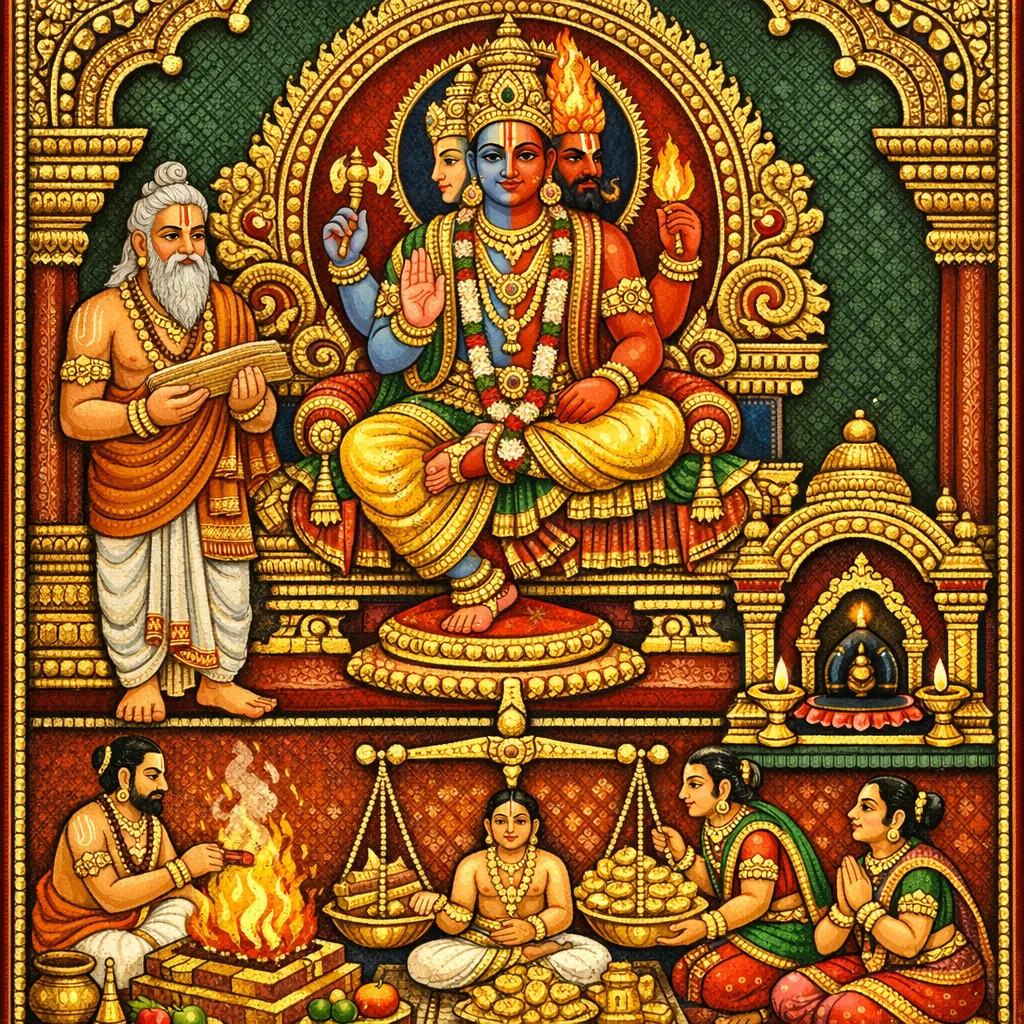
Agni lays down a Dharma-śāstric protocol to restore ritual integrity when worship, āśrama duties, or homa is missed or disturbed. It opens with expiations for omitted pūjā—especially eight-hundredfold japa and doubled worship—and for impurity-contact affecting the deity, remedied through pañcopaniṣad mantras, homa, and feeding brāhmaṇas. Practical rules follow: for contaminated homa materials, damaged offerings, or mantra/dravya mix-ups, discard only the affected portion, sprinkle for purification, and repeat root-mantra japa. For grave mishaps such as a fallen, broken, or lost image, fasting and a hundred oblations are prescribed. The chapter then widens from procedure to soteriology: true remorse culminates in the supreme atonement, Hari-smaraṇa (remembrance of Hari). Traditional penances (Cāndrāyaṇa, Parāka, Prājāpatya), japa systems (Gāyatrī, Praṇava-stotra, Sūrya/Īśa/Śakti/Śrīśa mantras), tīrtha power, dāna including mahā-dānas, and non-dual contemplation—“I am Brahman, the Supreme Light”—are taught as sin-destroyers. Concluding verses reaffirm the Agni Purāṇa’s encyclopedic scope, placing all vidyās and śāstras in Hari as the ultimate source and purifier.
Shlokas
Verse 1
इत्य् आग्नेये महापुराणे प्रायश्चित्तानि नाम त्रिसप्तत्यधिकशततमो ऽध्यायः हविष्यभुगिति ग ,ट च मातृजायागमे इति ग , छ , ट च अथ चतुःसप्तत्यधिकशततमो ऽध्यायः प्रायश्चित्तानि अग्निर् उवाच देवाश्रमार्चनादीनां प्रायश्चित्तन्तु लोपतः पूजालोपे चाष्टशतं जपेद्द्विगुणपूजनं
Thus, in the Agni Mahāpurāṇa, the preceding chapter—one hundred and seventy-three—was entitled “Expiations” (Prāyaścitta). (Variant readings: “Haviṣyabhuk” in some manuscripts; “Mātṛjāyāgame” in others.) Now begins the one hundred and seventy-fourth chapter, “Expiations.” Agni said: “For omissions in the worship of the gods, the rites of the āśramas, and the like, expiation is prescribed in accordance with that lapse. And when a pūjā (formal worship) has been omitted, one should repeat the mantra eight hundred times and perform the worship twice over.”}]}
Verse 2
पञ्चोपनिषदैर् मन्त्रैर् हुत्वा ब्राह्मणभोजनं सूतिकान्त्यजकोदक्यास्पृष्टे देवे शतं जपेत्
Having offered oblations with the mantras of the five Upaniṣads and having fed the Brāhmaṇas, if the deity has been touched by water connected with a woman in childbirth, a menstruating woman, a goat, or impure water, one should recite the mantra one hundred times.
Verse 3
पञ्चोपनिषदैः पूजां द्विगुणं स्नानमेव च विप्रभोज्यं होमलोपे होमस्नानं तथार्चनं
With the pañcopaniṣad (the five subsidiary offerings) one should perform the worship; one should also bathe twice and feed a Brāhmaṇa. If the homa (fire-offering) has been omitted, then one should perform a homa and a bath, and likewise renewed worship (arcana).
Verse 4
होमद्रव्ये मूषिकाद्यैर् भक्षिते कीटसंयुते तावन्मात्रं परित्यज्य प्रोक्ष्य देवादि पूजयेत्
If the materials intended for the homa have been eaten by rats and the like, or have become infested with insects, one should discard only that much of the contaminated portion; then, after sprinkling (prokṣaṇa) the remainder with purifying water, one should proceed with worship of the deity and the rest of the rite.
Verse 5
अङ्कुरार्पणमात्रन्तु छिन्नं भिन्नं परित्यजेत् अस्पृश्यैश् चैव संस्पृष्टे अन्यपात्रे तदर्पणं
In the case of offerings consisting only of sprouts, one should discard them if they are cut or broken. And if they have been touched by an untouchable (aspr̥śya, an impure person), then that offering should be placed in a different vessel.
Verse 6
देवमानुषविघ्नघ्नं पूजाकाले तथैव च मन्त्रद्रव्यादिव्यत्यासे मूलं जप्त्वा पुनर्जपेत्
At the time of worship, and likewise when there is a mix-up or interchange regarding the mantra, the offering-substances, and the like, one should first recite the root-mantra (mūla-mantra); then one should repeat the japa properly.
Verse 7
कुम्भेनाष्टशतजपो देवे तु पतिते करात् भिन्ने नष्टे चोपवासः शतहोमाच्छुभं भवेत्
If the matter concerns the kumbha (the consecrated water-pot), an eight-hundredfold japa (mantra-repetition) is prescribed. But if the deity’s image falls from the hand, or is broken or lost, then fasting (upavāsa) is enjoined; and by performing a hundred oblations in homa, auspiciousness is attained.
Verse 8
शतं शहुनेदिति ख , छ च शतहोमाच्छुचिर्भवेदिति ख , घ , ञ च कृते पापे ऽनुतापो वै यस्य पुंसः प्रजायते प्रायश्चित्तन्तु तस्यैकं हरिसंस्मरणं परं
“(Some recensions say), ‘He should recite the Śāhuna-formula one hundred times,’ and (others say), ‘By a hundred oblations he becomes pure.’ Yet for a man who, after committing sin, truly feels remorse (anutāpa), there is one supreme atonement: the remembrance of Hari (Viṣṇu).”
Verse 9
चान्द्रायणं पराको वा प्राजापत्यमघौघनुत् सूर्येशशक्तिश्रीशदिमन्त्रजप्यमघौघनुत्
The Cāndrāyaṇa vow, or the Parāka fast, or the Prājāpatya penance destroys heaps of sin. Likewise, the japa (mantra-repetition) of mantras beginning with Sūrya, Īśa, Śakti, and Śrīśa also destroys heaps of sin.
Verse 10
गायत्रीप्रणवस्तोत्रमन्त्रजप्यमघान्तकं काद्यैर् आवीजसंयुक्तैर् आद्यैर् आद्यैस्तदन्तकैः
The japa of the Gāyatrī and the Praṇava-stotra—this mantra that destroys sin—is to be performed with syllables beginning from “ka”, joined with the bīja-syllable “āvī”, and with the initial vowels (a, ā, etc.), such that it also ends with those same initial vowels as its final.
Verse 11
सूर्येशशक्तिश्रीशादिमन्त्राः कोट्यधिकाः पृथक् ओंह्रीमाद्याश् चतुर्थ्यन्ता नमोन्ताः सर्वकामदाः
Distinct mantras beginning with (the names of) Sūrya, Īśa, Śakti, and Śrīśa are said, each separately, to number more than a koṭi (a crore). Those that begin with “Oṃ” and “Hrīm”, that end with a dative (fourth-case) ending, and that conclude with “namaḥ” are declared to bestow all desired aims.
Verse 12
नृसिंहद्वादशाष्टार्णमालामन्त्राद्यघौघनुत् आग्नेयस्य पुराणस्य पठनं श्रवणादिकं
The garland of Nṛsiṁha-mantras—beginning with the twelve- and eight-syllabled formulas—removes torrents of sin; likewise do the recitation of the Agni Purāṇa and practices such as listening to it.
Verse 13
द्विविद्यारूपको विष्णुरग्निरूपस्तु गीयते परमात्मा देवमुखं सर्ववेदेषु गीयते
Viṣṇu is celebrated as having the form of the twofold sacred knowledge, and he is also praised as being of the form of Agni. As the Supreme Self, he is proclaimed to be the “mouth of the gods”—thus he is sung of throughout all the Vedas.
Verse 14
प्रवृत्तौ तु निवृत्तौ तु इज्यते भुक्तिमुक्तिदः अग्निरूपस्य विष्णोर्हि हवनं ध्यानमर्चनं
Whether in the path of worldly engagement (pravṛtti) or in the path of renunciation (nivṛtti), one should worship Him—the giver of both enjoyment and liberation. For Viṣṇu in the form of Agni, the worship consists of fire-offering (havana), meditation (dhyāna), and ritual adoration (arcana).
Verse 15
जप्यं स्तुतिश् च प्रणतिः शारीराशेषाघौघनुत् दशस्वर्णानि दानानि धान्यद्वादशमेव च
Repetition (japa), praise (stuti), and prostration (praṇati) remove the entire flood of bodily sins; likewise, gifts of ten pieces of gold, and also twelve (measures of) grain.
Verse 16
तुलापुरुषमुख्यानि महादानानि षोडश अन्नदानानि मुख्यानि सर्वाण्यघहराणि हि
The sixteen great gifts (mahādāna)—foremost among them the Tulāpuruṣa—are prescribed; yet, among all gifts, gifts of food are the foremost, for indeed all of them remove sin.
Verse 18
तिथिवारर्क्षसङ्क्रान्तियोगमन्वादिकालके ब्रतादि सूर्येशशक्तिश्रीशादेरघघातनं
When vows (vrata) and related rites are performed at times determined by the lunar day (tithi), weekday (vāra), lunar mansion (nakṣatra), solar ingress (saṅkrānti), and auspicious combinations (yoga)—and also on sacred occasions such as Manvādi—they become destroyers of sin, especially through the worship of Sūrya, Īśa (Śiva), Śakti, Śrīśa (Viṣṇu), and the like.
Verse 19
गङ्गा गया प्रयागश् च काश्ययोध्या ह्य् अवम्तिका प्रवृत्तैस्तु निवृत्तैस्तु इज्यते भुक्तिमुक्तिद इति घ , ङ , झ , ञ च अघनाशनमिति ग कुरुक्षेत्रं पुष्करञ्च नैमिषं पुरुषोत्तमः
The Gaṅgā, Gayā, Prayāga, Kāśī, Ayodhyā, and indeed Avantikā are worshipped by both those engaged in worldly activity and those who have renounced it; they are said to bestow both bhukti (enjoyment) and mukti (liberation). (These are designated by the syllables) gha, ṅa, jha, and ña; and the group called “Aghanāśana” is denoted by ga. Likewise are Kurukṣetra, Puṣkara, Naimiṣa, and Puruṣottama.
Verse 20
शालग्रामप्रभासाद्यं तीर्थञ्चघोघघातकं अहं ब्रह्म परं ज्योतिरिति ध्यानमघौघनुत्
Śālagrāma, Prabhāsa, and the other sacred fords (tīrthas) are destroyers of masses of sin; likewise, the meditation (dhyāna), “I am Brahman, the Supreme Light,” removes multitudes of sins.
Verse 21
पुराणं ब्रह्म चाग्नेयं ब्रह्मा विष्णुर्महेश्वरः अवताराः सर्वपूजाः प्रतिष्ठाप्रतिमादिकं
Herein are set forth the Purāṇa and the sacred Agneya lore: (accounts of) Brahmā, Viṣṇu, and Maheśvara; the divine descents (avatāras); all modes of worship; and procedures such as consecration (pratiṣṭhā) and the installation of images, and related matters.
Verse 22
ज्योतिःशास्त्रपुराणानि स्मृतयस्तु तपोव्रतं अर्थशास्त्रञ्च सर्गाद्या आयुर्वेदो धनुर्मतिः
Jyotiḥśāstra (astrology) and the Purāṇas; the Smṛtis and the disciplines of austerity and religious vows (tapas and vrata); Arthaśāstra (statecraft) and the accounts beginning with creation (sarga) and related topics; Ayurveda (the science of life) and Dhanurveda (the doctrine of archery and warfare)—these are the teachings to be known.
Verse 23
शिक्षा छन्दो व्याकरणं निरुक्तञ्चाभिधानकं कल्पो न्यायश् च मीमांसा ह्य् अन्यत् सर्वं हरिः प्रभुः
Phonetics (Śikṣā), prosody (Chandas), grammar (Vyākaraṇa), etymology (Nirukta), and lexicography (Abhidhānaka), as well as ritual procedure (Kalpa), logic (Nyāya), and exegesis (Mīmāṃsā)—indeed, everything else: Hari alone is the sovereign Lord, the source and master of all knowledge.
Verse 24
एके द्वयोर्यतो यस्मिन् यः सर्वमिति वेद यः तं दृष्ट्वान्यस्य पापानि विनश्यन्ति हरिश् च सः
He is the One whom some describe as the source of the two (the duality of manifest principles); He is that in whom all abides; He is the one who knows, “All this is He alone.” Having beheld Him, the sins of another are destroyed—and He indeed is Hari.
Verse 25
विद्याष्टादशरूपश् च सूक्ष्मः स्थूलो ऽपरो हरिः ज्योतिः सदक्षरं ब्रह्म परं विष्णुश् च निर्मलः
Hari is also of the form of the eighteen branches of knowledge (vidyā); He is subtle and gross, and yet transcendent. He is Light; He is the imperishable Brahman (akṣara) endowed with the sacred syllable(s); He is the supreme, stainless Viṣṇu.
Frequently Asked Questions
Agni states that when formal worship (pūjā) is omitted, one should perform eight hundred repetitions (japa) and then perform the worship twice over (a doubled worship sequence).
It gives precise corrective rites (japa, homa, fasting, feeding brāhmaṇas, dāna, tīrtha) for defined ritual faults, yet declares that for one who genuinely repents after sin, the supreme single atonement is Hari-smaraṇa (remembrance of Viṣṇu), integrating moral interiority with ritual repair.