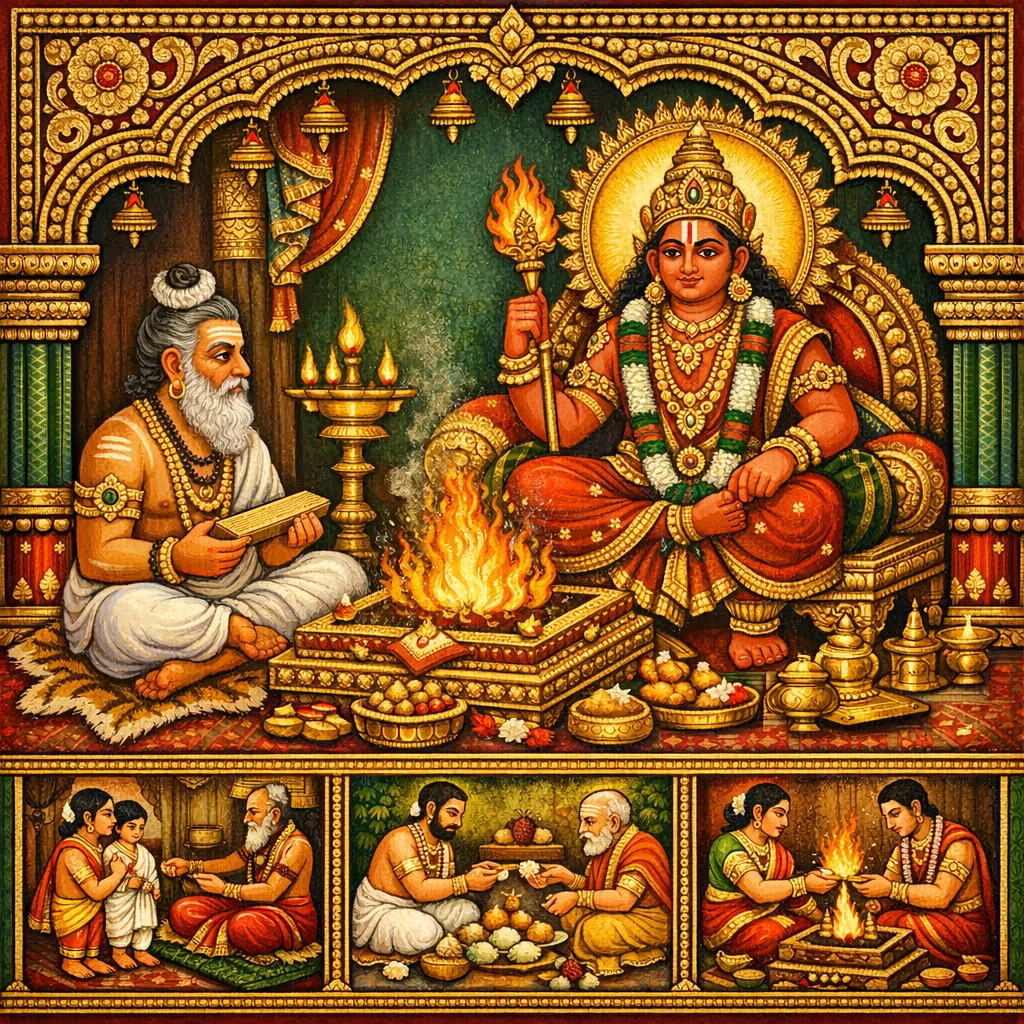
Adhyaya 166
Chapter 166: वर्णधर्मादिकथनं (Exposition of Varṇa-Dharma and Related Topics)
This chapter defines dharma as Veda–Smṛti based and “fivefold,” teaching that adhikāra (eligibility for practices) follows one’s varṇa, while āśrama-duties are the specific observances of each life-stage. It then classifies naimittika procedures—especially prāyaścitta (expiation)—as applicable across the four āśramas (brahmacārin, gṛhastha, vānaprastha, yati), and frames action by aims: adṛṣṭārtha (unseen fruits) such as mantra and yajña, dṛṣṭārtha (practical ends), and mixed aims in vyavahāra (legal procedure) and daṇḍa (punishment/discipline). Hermeneutically it harmonizes śruti and smṛti, explaining anuvāda as restatement for application, including guṇārtha and pari-saṅkhyārtha types, and introducing arthavāda as commendatory/explanatory discourse. The chapter catalogs saṃskāras (notably the “forty-eight”), outlines pañca-yajña and the pākayajña/haviryajña and soma-sacrifice taxonomies, and concludes with ethical qualities, daily conduct rules (speech, bathing, eating discipline), funeral/daśāha eligibility even for non-kin, mitigations for paṅkti-doṣa (dining-row contamination), and the five prāṇāhutis.
Shlokas
Verse 1
इत्य् आग्नेये महापुराणे नानाधमा नाम पञ्चषष्ट्यधिकशततमो ऽध्यायः अथ षट्षष्ट्यधिकशततमो ऽध्यायः वर्णधर्मादिकथनं पुष्कर उवाच वेदस्मार्तं प्रवक्ष्यामि धर्मं वै पञ्चधा स्मृतं वर्णत्वमेकमाश्रित्य यो ऽधिकारः प्रवर्तते
Thus, in the Agni Mahāpurāṇa, the one-hundred-and-sixty-fifth chapter called “Nānādhama” ends. Now begins the one-hundred-and-sixty-sixth chapter: “The exposition of the duties of the varṇas and related topics.” Puṣkara said: “I shall set forth dharma as taught in the Veda and the Smṛtis—remembered as fivefold—namely, that sphere of entitlement and practice (adhikāra) which proceeds on the basis of one’s single defining status as a varṇa.”
Verse 2
धर्मं वै परमामृतमिति ख , छ च वर्णधर्ंअः स विज्ञ्येयो यथोपनयनन्त्रिषु यस्त्वाश्रमं समाश्रित्य पदार्थः संविधीयते
“Dharma is indeed the supreme nectar”—so it is taught. Varṇa-dharma is to be understood as set forth in the treatises on upanayana (initiation and its disciplines). And whatever prescribed observance is laid down for one who has taken refuge in a particular āśrama (life-stage), that is his āśrama-duty, to be duly performed.
Verse 3
उक्त आश्रमधर्मस्तु भिन्नपिण्डादिको यथा उभयेन निमित्तेन यो विधिः सम्प्रवर्तते
The duties of the āśramas have been stated; likewise, the rites beginning with the separate piṇḍa-offering (bhinnapiṇḍa) are to be understood—namely, that procedure which is set in motion on account of both kinds of causes (nimittas).
Verse 4
नैमित्तिकः स विज्ञेयः प्रायश्चित्तविधिर्यथा ब्रह्मचारी गृही चापि वानप्रस्थो यतिर् नृप
O king, this expiatory procedure (prāyaścitta) is to be understood as “naimittika” (occasional, contingent upon a cause), as prescribed—whether for a celibate student (brahmacārin), a householder (gṛhastha), a forest-dweller (vānaprastha), or a renunciant (yati).
Verse 5
उक्त आश्रमधर्मस्तु धर्मः स्यात् पञ्चधा परः षाड्गुण्यस्याभिधाने यो दृष्टार्थः स उदाहृतः
The dharma of the āśramas that has been stated is indeed the higher dharma in fivefold form. In the exposition of the sixfold policy (ṣāḍguṇya), what has been set forth is that which has a directly practical aim (dṛṣṭārtha).
Verse 6
स त्रेधा मन्त्रयागाद्यदृष्टार्थ इति मानवाः उभयार्थो व्यवहारस्तु दण्डधारणमेव च
That human pursuit is threefold: (i) mantra-recitation, (ii) sacrificial worship (yajña) and the like—these, men say, are for an unseen result (adṛṣṭa). Legal procedure (vyavahāra), however, serves both aims (seen and unseen), and so does the very upholding of punishment (daṇḍa).
Verse 7
तुल्यार्थानां विकल्पः स्याद् यागमूलः प्रकीर्तितः वेदे तु विहितो धर्मः स्मृतौ तादृश एव च
When alternative procedures have the same intended meaning (and effect), an optional choice (vikalpa) is permitted; this is declared to be rooted in sacrifice (yajña). Moreover, the dharma enjoined in the Veda is of the very same kind as that found in the Smṛti.
Verse 8
अनुवादं स्मृतिः सूते कार्यार्थमिति मानवाः गुणार्थः परिसङ्ख्यार्थो वानुवादो विशेषतः
Smṛti declares that anuvāda is a restatement made for the sake of practical application. In particular, anuvāda is of two kinds: (i) for expressing a quality (guṇārtha) and (ii) for restrictive enumeration (parisaṅkhyārtha).
Verse 9
विशेषदृष्ट एवासौ फलार्थ इति मानवाः स्यादष्टचत्वारिंशद्भिः संस्कारैर् ब्रह्मलोकगः
That result is indeed a specially revealed fruit, ascertained by scripture; thus, O humans, by means of the forty-eight saṃskāras (purificatory rites), one becomes a goer to the world of Brahmā (Brahmaloka).
Verse 10
गर्भाधानं पुंसवनं सीमन्तोन्नयनः ततः जातकर्म नामकृतिरन्नप्राशनचूडकं
They are: Garbhādhāna (the rite for conception), Puṃsavana (the rite for begetting/ensuring a male child), then Sīmantonnayana (the hair-parting rite for the pregnant woman); thereafter Jātakarma (the birth rite), Nāmakṛti (name-giving), Annaprāśana (first feeding of solid food), and Cūḍākarma (the first tonsure).
Verse 11
संस्कारश्चोपनयनं वेदव्रतचतुष्टयं स्नानं स्वधर्मचारिण्या योगः स्याद्यज्ञपञ्चकं
The purificatory rites include the upanayana (initiation); the four Vedic vows; bathing as a rite of purification by one who adheres to one’s own dharma (svadharma); the discipline of yoga; and the fivefold sacrificial acts (pañca-yajña).
Verse 12
धर्म एष सनातन इति ङ अर्थवादं स्मृतिः सूत इति ख , छ च वार्थवादो विशेषत इति ख , छ च देवयज्ञः पितृयज्ञो मनुष्यभूतयज्ञकौ ब्रह्मयज्ञः सप्तपाकयज्ञसंस्थाः पुरो ऽष्टकाः
“This is the eternal Dharma”—so says the text. O Sūta, the Smṛti is also termed an arthavāda (a eulogistic/explanatory passage); and the arthavāda, in particular, is of a special commendatory kind. The sacrifices are: deva-yajña, pitṛ-yajña, manuṣya-yajña and bhūta-yajña, and brahma-yajña. The pākayajña-institutions are seven; and the rites called puro-’ṣṭakā(s) also occur.
Verse 13
पार्वणश्राद्धं श्रावण्याग्रहायणी च चैत्र्यपि आश्वयुजी सप्तहविर्यज्ञसंस्थास्ततः स्मृताः
The Pārvaṇa-śrāddha, the Śrāvaṇī, the Āgrahāyaṇī, the Caitrī, and the Āśvayujī—these are remembered as the seven established forms of the havis-offering sacrifices (haviryajñas).
Verse 14
अग्न्याधेयमग्निहोत्रं दर्शः स्यात् पशुबन्धकः चातुर्मास्याग्रहायेष्टिर्निरूढः पशुबन्धकः
Agnyādhāna and Agnihotra are rites of the sacred fire. The Darśa rite is said to be a form of paśubandha (animal-offering sacrifice). The Cāturmāsya rites, the Āgrahāyaṇeṣṭi, and the Nirūḍha (paśubandha) are likewise classified as paśubandha sacrifices.
Verse 15
सौत्रामणिसप्तसोमसंस्थाग्निष्टोम आदितः अत्यग्निष्टोम उक्थश् च षोडशी वाजपेयकः
Beginning with the Agniṣṭoma, the Soma-sacrifices are arranged in the seven Soma-saṃsthās; and their forms include the Sautrāmaṇi, the Atyagniṣṭoma, the Ukthya, the Ṣoḍaśin, and the Vājapeya.
Verse 16
अतिरात्रास् तथा स्तोम अष्टौ चात्मगुणास्ततः दया क्षमानसूया च अनायासो ऽथ मङ्गलं
Likewise, the Atirātra rites and the Stoma-sacrifices are enumerated; and thereafter, the eight qualities of the self are: compassion, forgiveness, freedom from malice and envy, effortless ease (anāyāsa), and auspiciousness (maṅgala).
Verse 17
अकार्पण्यास्पृहाशौचं यस्यैते स परं व्रजेत् प्रचारे मैथुने चैव प्रस्रावे दन्तधावने
One in whom these qualities are present—freedom from miserliness, absence of craving, and purity—attains the supreme goal. (These rules are to be observed) in matters of going about, sexual intercourse, urination, and the cleaning of the teeth.
Verse 18
स्नानभोजनकाले च पट्सु मौनं समाचरेत् पुनर्दानं पृथक्पानमाज्येन यपसा निशि
At the time of bathing and at the time of eating, and while wearing the prescribed cloths, one should observe mauna (sacred silence). One should also make an additional gift; and one should drink separately—at night—with ghee, together with the observance called yapas.
Verse 19
दन्तच्छेदनमुष्णं च सप्त शक्तुषु वर्जयेत् स्नात्वा पुष्पं न गृह्णीयाद् देवायोग्यन्तदीरितं
During the seven śaktu observances, one should avoid tooth-cutting/cleaning and the use of hot (water or food). After bathing, one should not pluck flowers; it is declared unfit for offering to the deity.
Verse 20
अन्यगोत्रोप्यसम्बद्धः प्रेतस्याग्निन्ददाति यः पिण्डञ्चोदकदानञ्च स दशाहं समापयेत्
Even one of another gotra (lineage), though unrelated, who provides the funeral fire for the deceased and also offers the piṇḍa (rice-ball oblation) and the libation of water, may duly complete the ten-day (daśāha) rites.
Verse 21
उदकञ्च तृणं भस्म द्वारम्पन्थास्तथैव च अग्न्याधानमग्निहोत्रमिति ख , छ च अन्यगोत्रो ऽन्यसम्बन्ध इति ख , घ , ञ च एभिरन्तरितं कृत्वा पङ्क्तिदोषो न विद्यते
If the diners in a row are separated by placing in between water, grass, ash, a doorway, or a pathway—and likewise by the intervening establishment of the sacred fires (agnyādhāna) and the Agnihotra—then the defect called paṅkti-doṣa (contamination of a dining row) does not arise. Similarly, when persons are of a different gotra or of a different connection, if such intervening separations are made, no paṅkti-doṣa exists.
Verse 22
पञ्च प्राणाहुतीर्दद्यादनामाङ्गुष्ठयोगतः
One should offer the five āhuti oblations to the prāṇa, the vital breaths, by the prescribed joining of the ring finger and the thumb.
Frequently Asked Questions
It frames dharma as Veda–Smṛti taught and fivefold, with adhikāra grounded in varṇa identity, while āśrama-dharma is the set of prescribed observances tied to one’s chosen life-stage.
Mantra and yajña are classified as adṛṣṭārtha (aimed at unseen results), while vyavahāra and daṇḍa are treated as ubhayārtha (serving both seen and unseen ends), integrating social order with spiritual merit.
They function as interpretive tools: anuvāda restates rules for application (including guṇārtha and restrictive enumeration), while arthavāda provides commendation/explanation that reinforces practice and motivation within śruti-smṛti reasoning.
It enumerates saṃskāras (including early life rites and upanayana), pañca-yajña, pākayajña/haviryajña groupings, and major soma-sacrifice forms—mapping domestic and śrauta ritual systems in a compact schema.