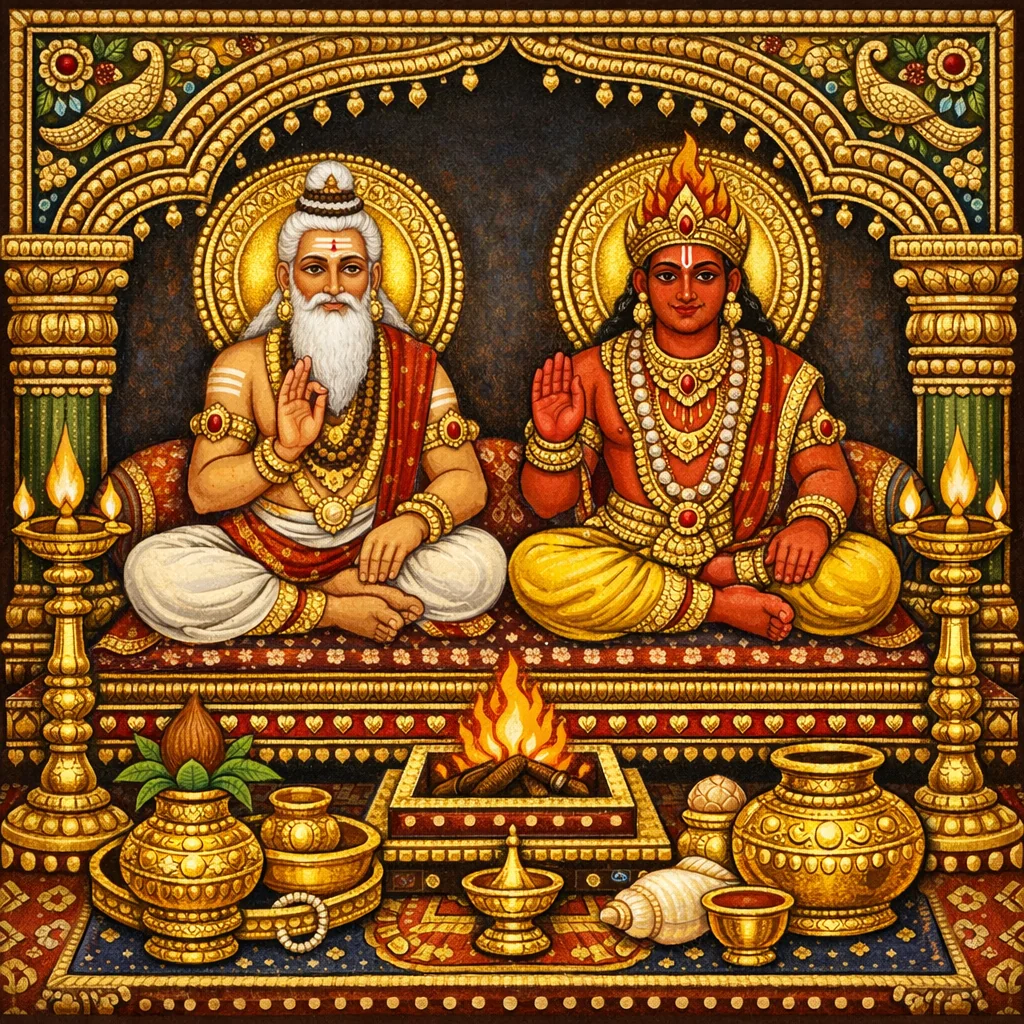
Adhyaya 156
Chapter 156 — द्रव्यशुद्धिः (Dravya-śuddhi) / Purification of Substances
This chapter, following the close of the Ācāra section, teaches dravya-śuddhi—how defiled materials regain ritual fitness. Puṣkara sets out substance-wise rules, forming a dharmaśāstra taxonomy of contamination and remedy: earthenware is purified by re-firing; metals by appropriate cleansers (acidulated water for copper, alkaline solutions for bronze and iron); gems such as pearls by washing. The scope includes utensils, stone objects, water-born produce, vegetables, ropes, roots, fruits, and bamboo/reed items, showing purity as a practical discipline for household and yajña. In yajña, vessels are purified by wiping and proper handling; greasy items by hot water; domestic spaces by sweeping. Cloth is cleansed with clay and water, multiple garments by sprinkling, wood by planing, compacted items by sprinkling, and liquids by overflow. It also notes purity conventions for animals’ mouths, observances after eating, sneezing, sleep, drinking, and bathing, ācamana after entering public ways, and menstrual purity periods. Finally it prescribes clay counts for post-excretion cleansing, special rules for ascetics, and cleansers for silk, linen, and deer-hair, concluding that flowers and fruits are purified by water-sprinkling, linking outward cleanliness to ritual eligibility and dharmic order.
Shlokas
Verse 1
इत्य् आग्नेये महापुराणे आचाराध्यायो नाम पञ्चपञ्चाशदधिकशततमो ऽध्यायः अथ षट्पञ्चाशदधिकशततमो ऽध्यायः द्रव्यचुद्धिः पुष्कर उवाच द्रव्यशुद्धिं प्रवक्ष्यामि पुनःपाकेन मृण्मयं शुद्ध्येन् मूत्रपुरीषाद्यैः स्पृष्टाम्रं सुवर्णकं
Thus, in the Agni Mahāpurāṇa ends the chapter called “Ācāra,” the one-hundred-and-fifty-fifth. Now begins the one-hundred-and-fifty-sixth chapter, “Purification of substances.” Puṣkara said: “I shall explain the purification of materials. Earthenware is purified by re-firing; copper and gold that have been touched by urine, feces, and the like are to be purified according to the prescribed rites.”
Verse 2
आवर्तितञ्चान्यथा तु वारिणाम्ल्लेन ताम्रकं क्षारेण कांस्यलोहानां मुक्तादेः क्षालनेन तु
Copper is purified with sour water (an acidulated liquid); bronze and iron with an alkaline solution; and pearls and similar gems by washing.
Verse 3
अब्जानां चैव भाण्डानां सर्वस्याश्ममयस्य च शाकरज्जुमूलफलवैदलानां तथैव च
Likewise, this rule applies to water-born produce, to vessels and utensils, to everything made of stone, and also to vegetables, ropes, roots, fruits, and articles made of bamboo or reed.
Verse 4
मार्जनाद्यज्ञपात्राणां पाणिना यज्ञकर्मणि उष्णाम्बुना सस्नेहानां शुद्धिः सम्मार्जनाद्गृहे
In the course of sacrificial rites (yajña), ritual vessels are purified by wiping and by the hand. Greasy items are purified with hot water; and in the home, purity is maintained by thorough sweeping and cleaning.
Verse 5
दुष्टानामिति ट शोधनान्म्रक्षणाद्वस्त्रे मृत्तिकाद्भिर्विशोधनं बहुवस्त्रे प्रोक्षणाच्च दारवाणाञ्च तक्षणात्
Defiled articles are purified by cleansing and wiping. Cloth is purified with earth (clay) and water; many garments by sprinkling; and wooden objects by planing or scraping.
Verse 6
प्रोक्षणात् संहतानान्तु द्रवाणाञ्च तथोत्प्लवात् शयनासनयानानां शूर्पस्य शकटस्य च
For substances that are compacted or aggregated, purification is by sprinkling consecrated water; for liquids likewise, by causing the water to overflow and cover them. The same purificatory procedure applies to beds, seats, vehicles, winnowing-baskets, and carts.
Verse 7
शुद्धिः सम्प्रोक्षणाज् ज्ञेया पलालेन्धनयोस् तथा शुद्धार्थकानाङ्कल्केन शृङ्गदन्तमयस्य च
Purification should be understood as being accomplished by sprinkling consecrated water; likewise in the case of straw/chaff and firewood. And for objects made of horn or tooth (ivory), purification is done by rubbing with the sediment (kalkā) of substances intended for cleansing.
Verse 8
गोबालैः पलपात्राणामस्थ्नां स्याच्छृङ्गवत्तथा निर्यासानां गुडानाञ्च लवणानां च शोषणात्
By using cow-hair as a binding cord, vessels measured according to the pala unit may be made from bone; likewise, they may be fashioned in a horn-like form. By drying, solid forms are obtained of exudates (resins), jaggery, and salts.
Verse 9
कुशुम्भकुसुमानाञ्च ऊर्णाकार्पासयोस् तथा शुद्धन्नदीगतं तोयं पुण्यन्तद्वत् प्रसारितं
Likewise, the flowers of kuśumbha (safflower), and wool and cotton, and also pure water drawn from a river—when spread out for use—are regarded as purifying (pavitrīkara) in the same manner.
Verse 10
मुखवर्जञ्च गौः शुद्धा शुद्धमश्वाजयोर्मुखं नारीणाञ्चैव वत्सानां शकुनीनां शुनो मुखं
A cow is deemed pure, except for its mouth. The mouth of a horse or an elephant is also regarded as pure; likewise, the mouth of women, calves, birds, and dogs is regarded as pure.
Verse 11
मुखैः प्रस्रवणे वृत्ते मृगयायां सदा शुचि भुक्त्वा क्षुत्वा तथा सुप्त्वा पीत्वा चाम्भो विगाह्य च
When excretions flow from the body’s orifices, and during hunting, one should always remain pure; likewise after eating, after sneezing, after sleeping, after drinking, and after immersing in water.
Verse 12
रथ्यामाक्रम्य चाचामेद्वासो विपरिधाय च मार्जारश् चङ्क्रमाच्छुद्धश् चतुर्य्थे ऽह्नि रजस्वला
Having stepped onto the street (a public way), she should perform ācamana and put on fresh, clean clothing; likewise, when a cat has walked over something, it is regarded as purified. A menstruating woman becomes pure on the fourth day.
Verse 13
स्नाता स्त्री पञ्चमे योग्या दैवे पित्र्ये च कर्मणि पञ्चापाने दशैकस्मिन्नुभयोः सप्त मृत्तिकाः
A woman, after bathing, becomes fit (for observances) on the fifth day. She is eligible for both divine rites and ancestral rites. For cleansing after excretion: use five portions of clay after passing stool, ten after passing urine; when both occur together, use seven portions of clay.
Verse 14
एकां लिङ्गे मृदं दद्यात् करयोस्त्रिद्विमृत्तिकाः ब्रह्मचारिवनस्थानां यतीनाञ्च चतुर्गुणं
One should apply one portion of cleansing earth to the genital organ; to the two hands, three and two portions (respectively). For brahmacārins, forest-dwellers (vānaprasthas), and renunciants (yatins), the quantity is fourfold.
Verse 15
श्रीफलैर् अंशुपट्टानां क्षौमाणाङ्गौरसर्षपैः शोधनाभ्युक्षणाद्वस्त्रे इति घ , ङ च शुद्धिः पर्युक्ष्य तोयेन मृगलोम्नां प्रकीर्तिता
Silk cloths (aṃśupaṭṭa) are purified with śrīphala (coconut); linen garments (kṣauma) are purified with pale mustard seeds (gaura-sarṣapa) by cleansing and by sprinkling (consecrated) water. Likewise, for deer-hair articles (mṛga-loma), purification is declared to be accomplished by sprinkling with water.
Verse 16
पुष्पाणाञ्च फलानाञ्च प्रोक्षणाज्जलतो ऽखिलं
For flowers and for fruits as well, everything is ritually purified by the sprinkling of water.
Frequently Asked Questions
It specifies substance-by-substance purification methods (re-firing earthenware; acidulated water for copper; alkali for bronze/iron; washing for pearls; hot water for greasy items; planing for wood; sprinkling for compacted items; overflow for liquids) and gives numeric clay counts for post-excretion cleansing, including increased quantities for brahmacārins, vānaprasthas, and renunciants.
By codifying śauca as actionable discipline in both yajña and household life, it protects ritual efficacy and ethical order; external purification (materials, spaces, bodies) is presented as a prerequisite for eligibility in divine and ancestral rites and as a support for inner restraint and dharmic living.