Adhyaya 155
Ācāra (Right Conduct)
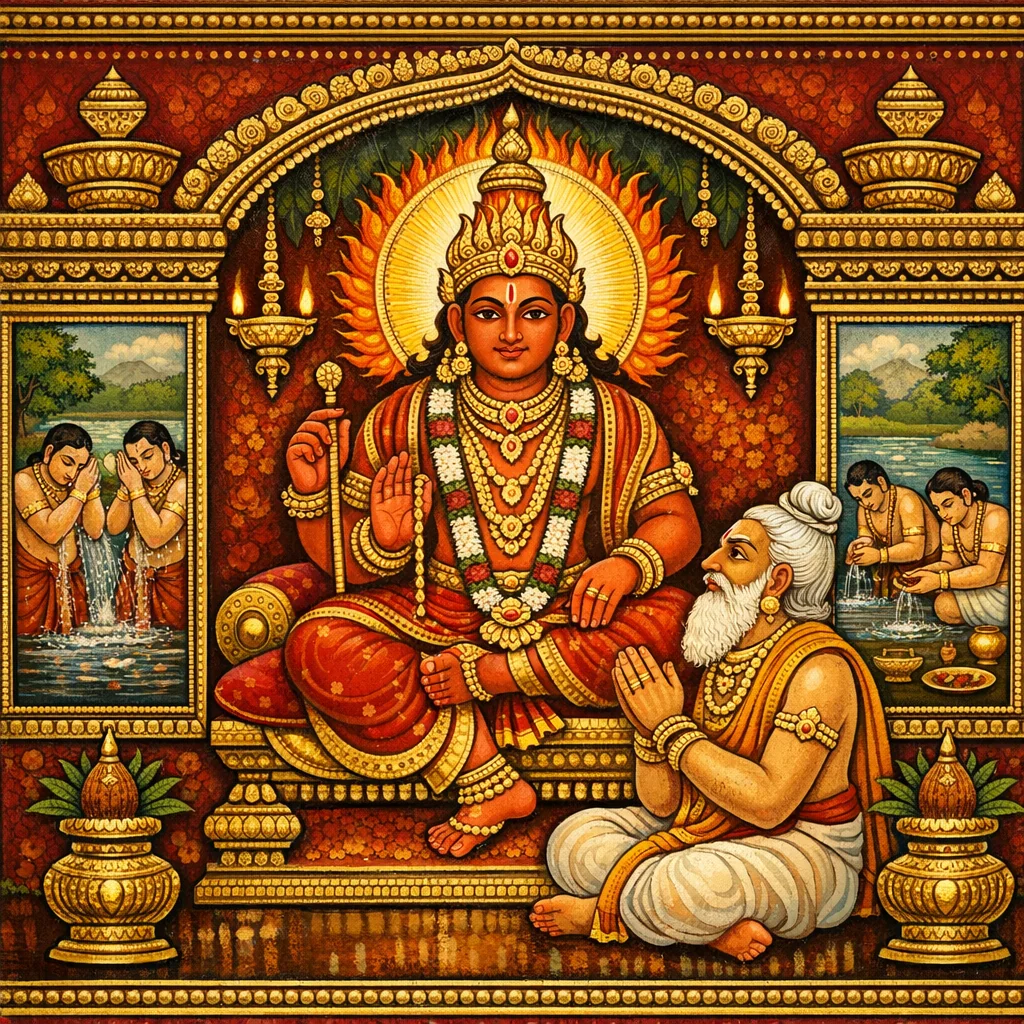
This chapter serves as a compact Dharma-śāstra guide to daily right conduct. Puṣkara outlines the day’s ritual and ethical rhythm: rising at brāhma-muhūrta with deva-smaraṇa, observing direction in bodily functions (by day to the north, by night to the south), and avoiding improper places for elimination. It then orders śauca through ācamana using earth, dantadhāvana, and above all snāna—declaring ritual acts done unbathed to be fruitless. A hierarchy of purifying waters is listed: ground water, drawn water, springs, lakes, tīrtha-water, and Gaṅgā as supreme. Bathing is liturgically framed by Vedic mantras (Hiraṇyavarṇāḥ, Śanno devī, Āpo hi ṣṭhā, Idam āpaḥ), underwater japa, and optional recitations (Aghamarṣaṇa, Drupadā, Yuñjate manaḥ, Pauruṣa sūkta), followed by tarpaṇa, homa, and dāna. The latter half expands into social-ethical restraints: non-harm, yielding to the burdened and pregnant, guarded gaze and speech, avoidance of inauspicious acts, public decorum, water hygiene, boundaries of sexual and social purity, reverence for Veda, deities, kings, and sages, and calendrical cautions (avoiding oil-massage on certain tithis). Manuscript variants are noted, reflecting a living transmission while preserving the core aim: purity, restraint, and welfare (yoga-kṣema) through disciplined ācāra.
Shlokas
Verse 1
इत्य् आग्नेये महापुराणे विवाहो नाम सतुःपञ्चाशदधिकशततमो ऽध्यायः अथ पञ्चपञ्चाशदधिकशततमो ऽध्यायः आचारः पुष्कर उवाच ब्राह्मे मुहूर्ते चोत्थाय विष्ण्वादीन् दैवतान् स्मरेत् उभे मूत्रपुरीषे तु दिवा कुर्यादुदङ्मुखः
Thus, in the Agni Mahāpurāṇa, the one-hundred-and-fifty-fourth chapter called “Marriage” (Vivāha) concludes. Now begins the one-hundred-and-fifty-fifth chapter: “Right Conduct” (Ācāra). Puṣkara said: “Rising at the brāhma-muhūrta (the auspicious pre-dawn period), one should remember the deities beginning with Viṣṇu. During the daytime, one should discharge both urine and feces while facing north.”
Verse 2
रातौ च दक्षिणे कुर्यादुभे सन्ध्ये यथा दिवा न मार्गादौ जले वीप्यां सतृणायां सदाचरेत्
At night one should perform both twilight rites (sandhyā) facing south, just as by day. One should never perform them at the beginning of a road, in water, on a ploughed strip of ground, or on grassy ground; one should always conduct oneself with proper decorum.
Verse 3
शौचं कृत्वा मृदाचम्य भक्षयेद्दन्तधावनं नित्यं नैमित्तिकं काम्यं क्रियाङ्गं मलकर्षणं
Having performed purification (śauca) and, with earth (clay), done ācamana (ritual sipping for cleansing), one should regularly undertake tooth-cleaning. It is classed as daily, occasional, and desire-motivated, and is an auxiliary limb of rites, serving to scrape away impurities.
Verse 4
क्रियास्नानं तथा षष्ठं षोढास्नानं प्रकीर्तितं अस्नातस्याफलं कर्म प्रातःस्नानं चरेत्ततः
Thus, the sixth is declared to be the ‘kriyā-snāna’ (ritual bath), and the ‘ṣoḍhā-snāna’ (bathing in sixteen modes) is also taught. For one who has not bathed, ritual action yields no result; therefore one should perform the morning bath.
Verse 5
भूमिष्ठमुद्धृतात् पुण्यं ततः प्रस्रवणोदकं ततो ऽपि सारसं पुण्यं तस्मान्नादेयमुच्यते
Water that has remained on the ground is more meritorious than water drawn up (from a well, etc.). More meritorious than that is water from a natural spring; and even more meritorious is lake-water. Therefore it is said that such water is not to be rejected as unfit.
Verse 6
तीर्थतोयं ततः पुण्यं गाङ्गं पुण्यन्तु सर्वतः संशोधितमलः पूर्वं निमग्नश् च जलाशये
Therefore the water of a tīrtha (sacred ford) is meritorious; and the water of the Gaṅgā is purifying from every side. Having first cleansed away impurity, one should immerse oneself in a reservoir of water.
Verse 7
उपस्पृश्य ततः कुर्यादम्भसः परिमार्जनं हिरण्यवर्णास्तिसृभिः शन्नो देवीति चाप्यथ
After performing ācamana (sipping water for purification), one should cleanse oneself with water by wiping or sprinkling, using the three verses beginning with “hiraṇyavarṇāḥ” and also the mantra “śanno devī”.
Verse 8
आपोहिष्ठेति तिसृभिरिदमापस्तथैव च ततो जलाशये मग्नः कुर्यादन्तर्जलं जपं
With the three verses beginning “Āpo hi ṣṭhā…”, and likewise with the mantra “Idam āpaḥ…”, he should then immerse himself in a body of water and perform japa (sacred repetition) beneath the water.
Verse 9
तत्राघमर्षणं सूक्तं द्रुपदां वा तथा जपेत् युञ्जते मन इत्य् एवं सूक्तं सूक्तं वाप्यथ पौरुषं
There one should recite the Aghamarṣaṇa Sūkta, or likewise the Drupadā hymn, and also the hymn beginning “yuñjate manaḥ…”. Thus one may recite a sūkta—or even repeat a sūkta—and thereafter the Pauruṣa (Puruṣa Sūkta).
Verse 10
गायत्रीं तु विशेषेण अघमर्षणसूक्तके देवता भाववृत्तस्तु ऋषिश् चैवाघमर्षणः
In the Aghamarṣaṇa-sūkta, the metre is specifically Gāyatrī; the presiding deity is Bhāva-vṛtta, and the seer (ṛṣi) is indeed Aghamarṣaṇa.
Verse 11
छन्दश्चानुष्टुभं तस्य भाववृत्तो हरिः स्मृतः आपीडमानः शाटीं तु देवतापितृतर्पणं
Its metre is Anuṣṭubh; its bhāva-vṛtti (dominant emotive-aesthetic mode) is remembered as Hari (Viṣṇu). The ritual/poetic application called āpīḍamāna is “śāṭī”, and it is for tarpaṇa (satiatory offering) to the deities and the ancestors.
Verse 12
पौरुषेण तु सूक्तेन ददेच्चैवोदकाञ्जलिं ततो ऽग्निहवनं कुर्याद्दानं दत्वा तु शक्तितः
With the Pauruṣa hymn, one should offer a cupped handful of water as a libation; thereafter one should perform the fire-offering (homa), and then—according to one’s capacity—give gifts (dāna).
Verse 13
तत्राघमर्षणमित्यादिः देवतापितृतर्पणमित्यन्तः पाठः झ पुस्तके नास्ति ततो ऽग्निहरणमिति ङ , छ च दीपं दत्वेति झ ततः समभिगच्छेत योगाक्षेमार्थमीश्वरं आसनं शयनं यानं जायापत्यङ्कमण्डलुः
Here, the reading beginning with “aghamaṛṣaṇa (the sin-dispelling rite)” and ending with “tarpana to the deities and the ancestors” is not found in the Jha manuscript. After that, the variant reading “then the removal/transfer of the (sacred) fire” occurs in the Ṅa and Cha manuscripts; in the Jha manuscript, (instead) it reads “having given a lamp.” Thereafter, for the sake of welfare and security (yoga and kṣema), one should duly approach the Lord, offering (appropriate gifts such as) a seat, a bed, a conveyance, one’s wife, one’s children, a couch/bedstead, and a water-pot (kamaṇḍalu).
Verse 14
आत्मनः शुचिरेतानि परेषां न शुचिर्भवेत् भाराक्रान्तस्य गुर्विण्याः पन्था देयो गुरुष्वपि
These practices are for one’s own cleanliness; they should not become a cause of impurity or inconvenience to others. Even a teacher should yield the way to one who is burdened (with a load) and to a pregnant woman.
Verse 15
न पश्येच्चार्कमुद्यन्तन्नास्तं यान्तं न चाम्भसि नेक्षेन्नग्नां स्त्रियं कूपं शूनास्थानमघौघिनं
One should not look at the sun while it is rising, nor while it is setting, nor look at it reflected in water. One should also not gaze upon a naked woman, a well, a deserted place, or a mass of sin/evil.
Verse 16
कार्पासाथि तया भस्म नाक्रामेद् यच्च कुत्सितं अन्तःपुरं वित्तिगृहं परदौत्यं ब्रजेन्न हि
One should not step over cotton and ashes, nor anything deemed impure; indeed, one should not go into the inner women’s quarters, into a house of wealth/treasury, nor undertake another’s messenger-service (as an agent in others’ affairs).
Verse 17
नारोहेद्विषमान्नावन्न वृक्षं न च पर्वतं अर्थायतनशास्त्रेषु तथैव स्यात् कुतूहली
One should not board an unsafe boat, nor climb a tree or a mountain. Likewise, in the śāstras on wealth and statecraft, one should be inquisitive and carefully discerning.
Verse 18
लोष्टमर्दो तृणच्छेदी नखखादी विनश्यति मुखादिवादनं नेहेद् विना दीपं न रात्रिगः
One who crushes clods, cuts grass, or bites his nails comes to ruin. Likewise, one should not make music with the mouth and the like here; and without a lamp one should not go about at night.
Verse 19
नाद्वारेण विशेद्वेश्म न च वक्त्रं विरागयेत् कथाभङ्गं न कुर्वीत न च वासोविपर्ययं
One should not enter a house by a side or back entrance, nor display a face of contempt or displeasure. One should not break the flow of conversation, and one should not wear garments reversed or improperly.
Verse 20
भद्रं भद्रमिति ब्रूयान्नानिष्टं कीर्तयेत् क्वचित् पालाशमासनं वर्ज्यं देवादिच्छायया व्रजेत्
One should speak only auspicious words, saying “bhadra, bhadra” (“may it be auspicious”), and never mention what is inauspicious. One should avoid a seat made of palāśa wood, and should not pass through the shadow of a deity and the like.
Verse 21
न मध्ये पूज्ययोर्यायात् नोच्छिष्टस्तारकादिदृक् नद्यान्नान्यां नदीं ब्रूयान्न कण्डूयेद् द्विहस्तकं
One should not pass between two venerable persons. While in the state of having eaten (and thus ritually impure), one should not look at stars and the like. Having reached a river, one should not speak of another river; and one should not scratch oneself with both hands.
Verse 22
असन्तर्प्य पितॄन् देवान्नदीपारञ्च न व्रजेत् मलादिप्रक्षिपेन्नाप्सु न नग्नः स्नानमाचरेत्
Without first satisfying the ancestors (Pitṛs) and the gods with offerings, one should not go to the far bank of a river. One should not cast filth and the like into the water; and one should not bathe while naked.
Verse 23
परभृतो भवेन्न हि इति झ लोष्टमद्दीत्यादिः, न रात्रिग इत्य् अन्तः पाठः, गपुस्तके नास्ति देवाद्रिच्छाययेति ख , छ , ग च मलादिक्षेपयेन्नाप्सु इति ख , ट च ततः समभिगच्छेत योगक्षेमार्थमीश्वरं स्रजन्नात्मनाप्पनयेत् खरादिकरजस्त्यजेत्
As the reading “parabhṛto bhavenna hi” indicates, one should not become dependent upon others. Variant readings mention “loṣṭa-mad” and related terms; another internal reading is “na rātrigaḥ”, and in one manuscript it is absent. Some recensions read “devādri-cchāyāyā” (“in the shade of the divine mountain”); others read “malādi kṣepayen nāpsu” (“one should not throw filth and the like into water”). Then, for the sake of yoga-kṣema (welfare and security), one should approach the Lord; and, having placed a garland upon oneself as part of worship, one should remove it and cast off dust and grime—such as that from a donkey and the like—thus discarding impurity.
Verse 24
हीनान्नावहसेत् गच्छेन्नादेशे नियसेच्च तैः वैद्यराजनदीहीने म्लेच्छस्त्रीबहुनायके
One should not travel by a low or unsafe boat; one should not go to an improper land, nor reside among such people. One should avoid a region devoid of physicians, kings, and rivers—and a place dominated by mlecchas, by women, or by many rulers.
Verse 25
रजस्वलादिपतितैर् न भाषेत केशवं स्मरेत् नासंवृतमुखः कुर्याद्धासं जृम्भां तथा क्षुतं
One should not converse with a menstruating woman and the like (persons in states of impurity or fallen conduct). One should remember Keśava (Viṣṇu). And one should not laugh, yawn, or sneeze with the mouth uncovered.
Verse 26
प्रभोरप्यवमनं खद्गोपयेद्वचनं बुधः इन्द्रियाणां नानुकूली वेदरोधं न कारयेत्
Even if a lord speaks with contempt, the wise person should conceal it, as one would sheath a sword. One should not, for the sake of pleasing the senses (indriyas), cause any obstruction to the Veda—its duty and authority.
Verse 27
नोपेक्षितव्यो व्याधिः स्याद्रिपुरल्पो ऽपि भार्गव रथ्यातिगः सदाचामेत् विभृयान्नाग्निवारिणी
O Bhārgava, a disease should never be neglected, just as even a small enemy must not be ignored. One who travels along the public road should always perform ācamana (ritual rinsing) and should carry fire and water as protective means.
Verse 28
न हुङ्कुर्याच्छिवं पूज्यं पादं पादेन नाक्रमेत् प्रत्यक्षं वा परोक्षं वा कस्य चिन्नाप्रियं वदेत्
One should not utter the contemptuous “huṅ” toward Śiva, who is worthy of worship; one should not step over another’s foot with one’s own; and one should not speak what is displeasing to anyone, whether to their face or behind their back.
Verse 29
वेदशास्त्रनरेन्द्रर्षिदेवनिन्दां विवर्जयेत् स्त्रीणामीर्षा न कर्तव्या त्रिश्वासन्तासु वर्जयेत्
One should wholly avoid reviling the Veda and the śāstras, the king, the sages (ṛṣis), and the gods. One should not harbor jealousy toward women, and one should avoid association or intercourse with women in the state called “three-breathing” (triśvāsa), i.e., during menses.
Verse 30
धर्मश्रुतिं देवरतिं कुर्याद्धर्मादि नित्यशः सोमस्य पूजां जन्मर्क्षे विप्रदेवादिपूजनं
One should constantly engage in hearing teachings on dharma and in devotion to the gods, performing daily the duties that begin with dharma and the like. On one’s birth-star (janma-nakṣatra), one should worship Soma and also honor Brahmins and the gods (and other venerable beings).
Verse 31
पुर्वत्सोपि इति ङ समाचामेदिति छ स्त्रीणामिच्छेति क देवनतिमिति ग , घ , ङ , ञ , ट च वेदनतिमिति ख ,छ च भद्रं भद्रमिति ब्रूयादित्यादिः, कुर्याद्धर्मादि नित्यश इत्य् अन्तः पाठः झ पुस्तके नास्ति षष्ठीचतुर्दश्यष्टम्यामभ्यङ्गं वर्जयेत्तथा दूराद्गृहान् मूत्रविष्ठे नोत्तमैवैरमाचरेत्
Variant readings are noted across manuscripts (e.g., “purvatsopi,” “samācāmet,” “strīṇām icchā,” “deva-nati / veda-nati,” and “bhadraṃ bhadram iti brūyāt”); moreover, the internal reading “kuryād dharmādi nityaśaḥ” is absent in the Jha manuscript. The prescriptive rule is: one should avoid oil-massage (abhyaṅga) on the sixth, fourteenth, and eighth lunar days; likewise, one should keep houses at a distance from urine and excrement, and one should not engage in quarrels with virtuous/excellent people.
Frequently Asked Questions
Brahma-muhūrta rising with deva-smaraṇa → śauca and ācamana (with earth) → dantadhāvana → morning snāna (with mantra-recitation and japa) → tarpaṇa → homa → dāna, followed by sustained ethical restraints in speech, gaze, and conduct.
The chapter cites Hiraṇyavarṇāḥ (three verses), Śanno devī, Āpo hi ṣṭhā (three verses), Idam āpaḥ, plus optional recitations: Aghamarṣaṇa-sūkta, Drupadā hymn, Yuñjate manaḥ hymn, and the Pauruṣa (Puruṣa) sūkta for udakāñjali/tarpaṇa.
It sacralizes bodily and civic discipline by linking purity acts to mantra, japa, tarpaṇa, homa, and dāna, making self-regulation and social non-harm instruments of dharma that protect yoga-kṣema and purify intention toward Mukti.