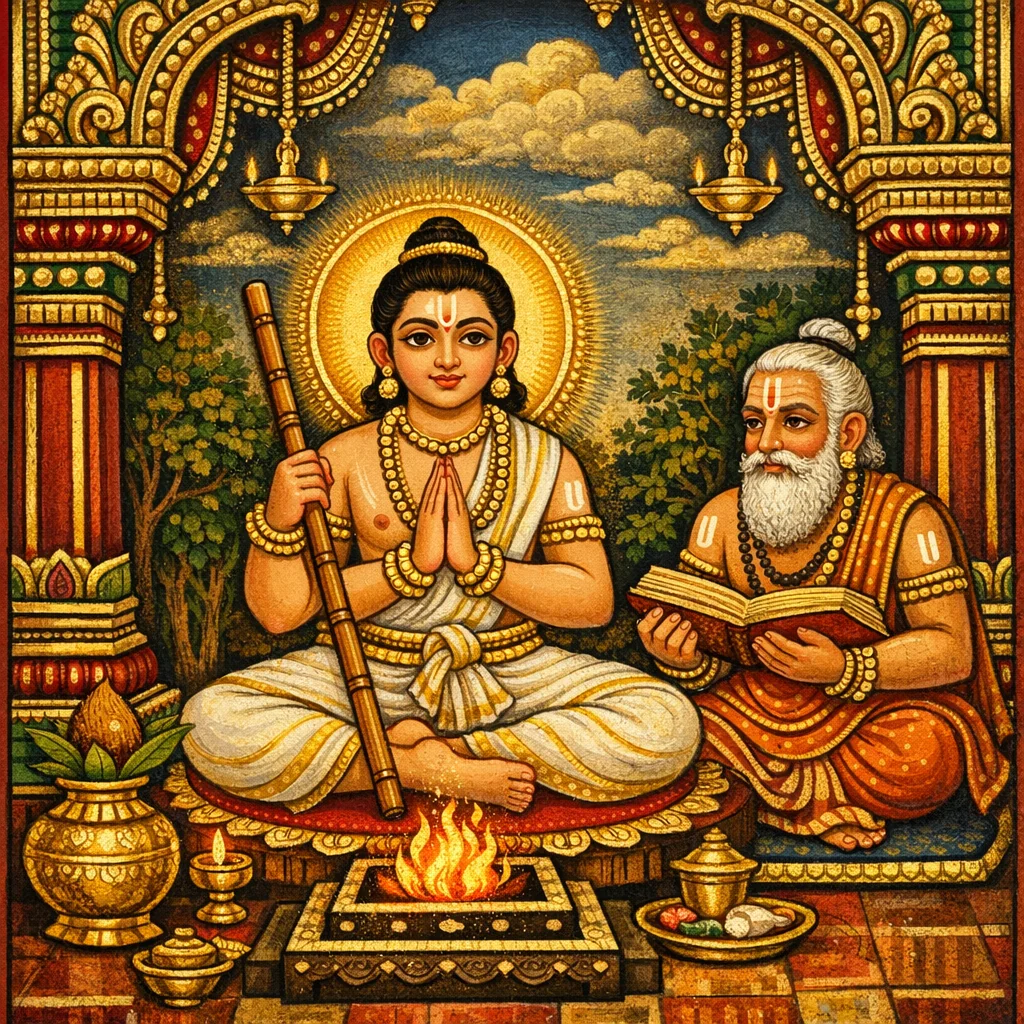
Adhyaya 153
Chapter 153 — Brahmacarya-āśrama-dharma (The Dharma of the Student Stage)
This chapter shifts from household observances to brahmacarya-āśrama-dharma, portraying dharma as a life-cycle curriculum that preserves social continuity and supports spiritual ascent. It opens with norms for procreative timing (ṛtu-nights) and rites connected with conception and pregnancy, then details birth-related saṃskāras—sīmanta, jātakarma, and nāmakarma—along with varṇa-based naming conventions. It proceeds to early-life rites such as cūḍā-karman and sets upanayana timing by varṇa with age limits, followed by the student’s prescribed equipment—girdle, skins, staff, garment, and upavīta—stressing fitness and order. The teacher’s duties include training in cleanliness, conduct, fire-rites, and sandhyā worship. Practical discipline covers eating-direction symbolism, daily agnihotra-like offerings, and prohibitions on indulgent pleasures, violence, slander, and obscenity. The chapter concludes with vedāsvīkaraṇa, dakṣiṇā, and the completion bath, framing brahmacarya as a regulated knowledge-vow harmonizing śāstric study with ethical restraint.
Shlokas
Verse 1
इत्य् आग्नेये महापुराणे गृहस्थवृत्तयो नाम व्रिपञ्चाशदधिकशततमो ऽध्यायः अथ त्रिपञ्चाशदधिकशततमो ऽध्यायः ब्रह्मचर्याश्रमधर्मः पुष्कर उवाच धर्ममाश्रमिणां वक्ष्ये भुक्तिमुक्तिप्रदं शृणु षोडशर्तुनिशा स्त्रीणामाद्यस्तिस्रस्तु गर्हिताः
Thus, in the Agni Mahāpurāṇa, the chapter titled “The Observances of Householders” ends. Now begins the one-hundred-and-fifty-third chapter, “The Dharma of the Brahmacarya-āśrama.” Puṣkara said: “I shall declare the duties of those established in the āśramas—listen—duties that bestow both worldly enjoyment and liberation. For women there are sixteen ‘seasonal nights’ (fertile nights); however, the first three are censured.”
Verse 2
व्रजेद्युग्मासु पुत्रार्थी कर्माधानिकमिष्यते गर्भस्य स्पष्टताज्ञाने सवनं स्पन्दनात् पुरा
A man desiring a son should approach (his wife) on the even nights/days of the fertile period; for him the rite connected with conception (garbhādhāna/ādhāna-karman) is prescribed. To determine the clear manifestation of the embryo, the ‘savana’ (the prescribed observance/rite) is to be performed before the stage when foetal movement (spandana) is felt.
Verse 3
षष्ठे ऽष्टमे वा सीमन्तं पुत्रीयं नामभं शुभं अच्छिन्ननाड्यां कर्तव्यं जातकर्म विचक्षणैः
In the sixth—or else the eighth—month, the sīmanta rite should be performed; thereafter an auspicious name, conducive to progeny, should be bestowed. The learned should perform jātakarma while the umbilical cord is still uncut.
Verse 4
अशौचे तु व्यतिक्रान्ते नामकर्म विधीयते शर्मान्तं ब्राह्मस्योक्तं वर्मान्तं क्षत्रियस्य तु
When the period of aśauca (ritual impurity) has passed, the nāmakarma (name-giving rite) should be performed. For a Brāhmaṇa, a name ending in “-śarman” is prescribed; for a Kṣatriya, one ending in “-varman” is prescribed.
Verse 5
गुप्तदासात्मकं नाम प्रशस्तं वैश्यशूद्रयोः शर्मान्तं ब्रह्मणस्योक्तं वर्मान्तं क्षत्रियस्य च
For Vaiśyas and Śūdras, names ending with the elements “-gupta” or “-dāsa” are commended. For a Brāhmaṇa it is prescribed that the name end in “-śarman,” and for a Kṣatriya that it end in “-varman.”
Verse 6
गुप्तदासात्मकं नाम प्रशस्तं वैश्यशूद्रयोः बालं निवेदयेद्भर्त्रे तव पुत्रो ऽयमित्युत
For Vaiśyas and Śūdras, a name of the type ending in “-gupta” or “-dāsa” is commended. One should present the child to the husband, saying, “This is your son,” indeed.
Verse 7
यथाकुलन्तु चूडाकृद् ब्राह्मणस्योपनायनं गर्भाष्टमे ऽष्टमे वाब्दे गर्भादेकादशे नृपे
According to family custom, the cūḍā-karman (tonsure) should be performed; and for a Brāhmaṇa, the upanayana (initiation with the sacred thread) should be done in the eighth year counted from conception—or else in the eighth year counted from birth—or in the eleventh year counted from conception, O king.
Verse 8
गर्भात्तु द्वादशे वैश्ये षोडशाब्दादितो न हि मुञ्जानां वल्कलानान्तु क्रमान्मौज्ज्याः प्रकीर्तिताः
For a Vaiśya, the upanayana should be performed in the twelfth year counted from conception; it should not be undertaken from the sixteenth year onward (beyond that limit). And, in due order, the sacred girdles (maujī) are declared to be made from muñja-grass and from bark-fibres.
Verse 9
मार्गवैयाध्रवास्तानि चर्माणि व्रतचारिणां पर्णपिप्पलविल्वानां क्रमाद्दण्डाः प्रकीर्तिताः
For those who practice religious observances (vrata), the prescribed skins are those of the antelope and the tiger; and, in due order, the staffs (daṇḍa) are declared to be made from the woods of palāśa (parṇa), pippala (aśvattha), and bilva.
Verse 10
केशदेशललाटास्यतुल्याः प्रोक्ताः क्रमेण तु अवक्राः सत्वचः सर्वे नाविप्लुष्टास्तु दण्डकाः
They are said to be, in due order, equal in measure to the regions of the hairline, the forehead, and the face. All should be straight, with sound bark, and the rods (daṇḍaka) should not be blistered or burnt.
Verse 11
वासोपवीते कार्पासक्षौमोर्णानां यथाक्रमं आदिमध्यावसानेषु भवच्छब्दोपलक्षितं
Regarding the garment and the sacred thread (upavīta): cotton, linen, and wool are to be used respectively in due order; and the proper form of respectful address is indicated by the word “bhavat” at the beginning, in the middle, and at the end of one’s speech.
Verse 12
प्रथमं तत्र भ्हिक्षेत यत्र भिक्षा ध्रुवं भवेत् स्त्रीणाममन्त्रतस्तानि विवाहस्तु समन्त्रकः
First, one should seek alms only in a place where alms are assured. For women, those rites are to be performed without Vedic mantras; but marriage is to be performed with mantras.
Verse 13
उपनीय गुरुः शिष्यं सिक्षयेच्छौचमादितः आचारमग्निकार्यं च सन्ध्योपासनमेव च
Having initiated the student (upanayana), the teacher should first instruct him in purity and rules of cleanliness, proper conduct (ācāra), the duties connected with the sacred fire (agni-kārya), and the Sandhyā worship at the junctions of dawn and dusk.
Verse 14
आयुष्यं प्राङ्मुखो भुङ्क्ते यशस्यं दक्षिणामुखः श्रियं प्रत्यङ्मुखी भुङ्क्ते ऋतं भुङ्क्ते उदङ्मुखः
Facing east while eating yields longevity; facing south yields fame; facing west yields prosperity; and facing north one partakes of ṛta—right order and truth, alignment with dharma and auspiciousness.
Verse 15
सायं प्रातश् च जुहुयान् नामेध्यं व्यस्तहस्तकं मधु मांस जनैः सार्धं गीतं नृत्यञ्च वै त्यजेत्
One should perform the fire-offering (homa) in the evening and in the morning; and one should avoid impurity, improper acts done with disorderly hands (contrary to rite), honey and meat, socializing for indulgence, and also singing and dancing.
Verse 16
नृत्यञ्च वर्जयेदिति ख , ग , घ , ङ , छ , ञ , ट च सायं प्रातश्चेत्यादिः, नृत्यञ्च वै त्यजेदित्यन्तः पाठः ज पुस्तके नास्ति हिंसाम्परापवादं च अश्लीलं च विशेषतः दण्डादि धारयेन्नष्टमप्सु क्षिप्त्वान्यधारणं
“One should avoid dancing”—so read the manuscripts Kha, Ga, Gha, Ṅa, Cha, Ña, and Ṭa, continuing with “in the evening and in the morning …”; the closing reading “and indeed one should give up dancing” is not found in the Ja manuscript. One should especially avoid violence, slander of others, and obscenity. One may carry a staff (daṇḍa) and similar implements; if such an item is lost, having cast it into water, one should take up another as a replacement.
Verse 17
वेदस्वीकरणं कृत्वा स्रायाद्वै दत्तदक्षिणः
Having formally undertaken the Veda (veda-svīkaraṇa) and duly given the prescribed teacher’s fee (dakṣiṇā), he should then bathe as the concluding rite.
Frequently Asked Questions
It specifies saṃskāra sequencing and technical constraints—timing for sīmanta and upanayana, varṇa-linked naming suffixes, and standardized materials and quality-controls for the student’s girdle, skins, and staff.
By treating disciplined study, purity, sandhyā worship, and restraint as a single vow-structure: regulated conduct stabilizes the senses, supports Vedic learning, and aligns daily life with ṛta/dharma, thereby serving both social duty and liberation.