Adhyaya 164
Chapter 164: नवग्रहहोमः (Navagraha Fire-Offering)
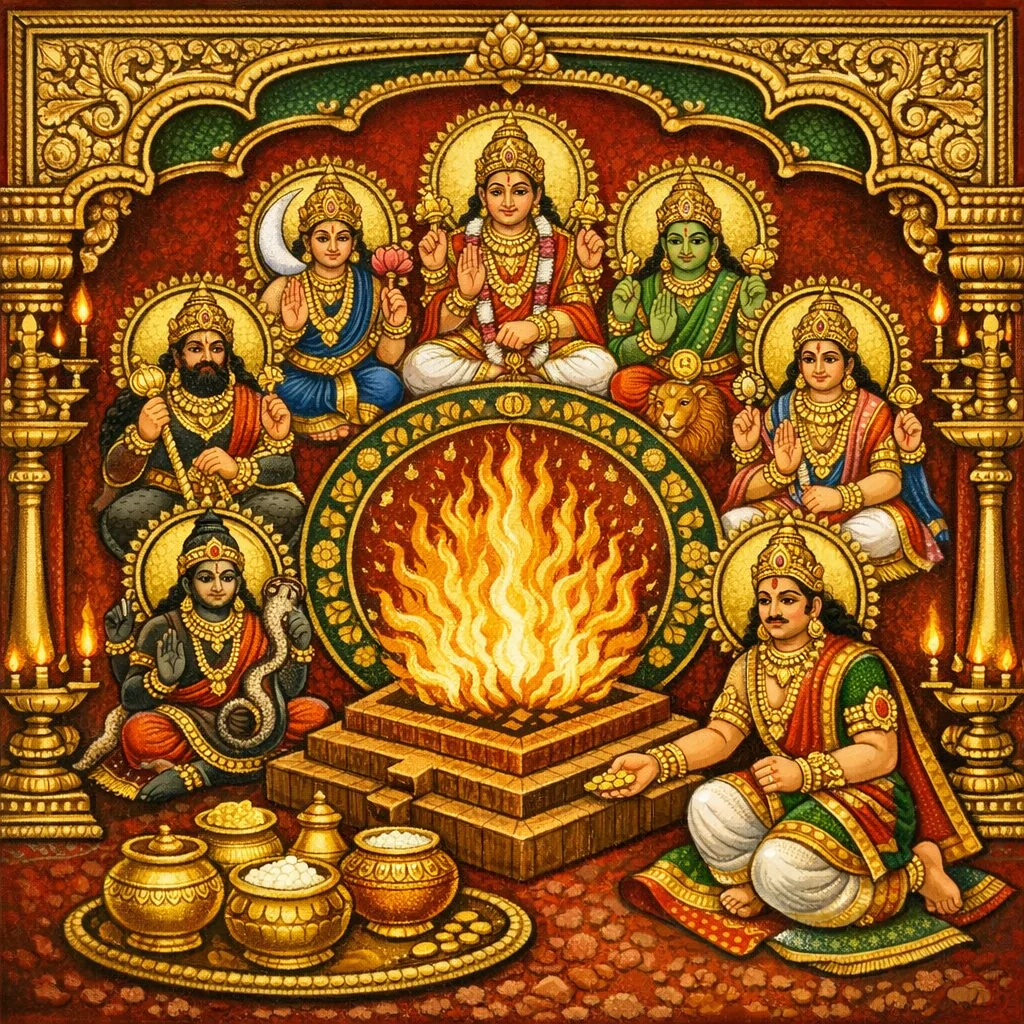
This chapter gives a Dharma-śāstric, ritual-technical manual for Navagraha Homa, taught by Puṣkara as a remedial and augmenting rite for prosperity, pacification of afflictions, rainfall, longevity, nourishment, and even abhicāra (forceful/hostile aims). It lists the nine planetary deities (Sūrya through Ketu) and prescribes making their images in order from specific materials: copper, crystal, red sandalwood, gold, arka-wood for a paired set, silver, iron, and lead. It stresses correct diagrammatic inscription (gold writing or scented maṇḍalas), color-matched garments and flowers, perfumes, bracelets, and guggulu incense. Vedic ṛks/mantras are assigned for recitation in sequence, along with the samidh (kindling) order and oblation counts for each deity (128 or 28) using honey, ghee, and curd. Food-offerings and the protocol for feeding dvijas in planetary order are given, followed by an ordered schedule of dakṣiṇās (cow, conch, bull, gold, garment, horse, and other gifts). It concludes that planetary forces govern the rise and fall of kings and worldly conditions; therefore the grahas are supremely worthy of worship.
Shlokas
Verse 1
इत्य् आग्नेये महापुराणे श्राद्धकल्पो नाम त्रिषष्ट्यधिकशततमो ऽध्यायः अथ चतुःषष्ट्यधिकशततमो ऽध्यायः नवग्रहहोमः पुष्कर उवाच श्रीकामः शान्तिकामो वा ग्रहयज्ञं समारभेत् वृष्ट्यायुःपुष्टिकामो वा तथैवाभिचरन् पुनः
Thus, in the Agni Mahāpurāṇa ends the one-hundred-and-sixty-third chapter, called “The Procedure for Śrāddha.” Now begins the one-hundred-and-sixty-fourth chapter: “The Navagraha Fire-Offering.” Puṣkara said: “One who desires prosperity, or who seeks pacification of afflictions, should undertake a planetary sacrifice (graha-yajña). Likewise, one who desires rain, longevity, and nourishment may do so; and again, even one engaged in abhicāra—rites of coercive or hostile intent—may undertake it.”
Verse 2
मनुष्यादीनिति ख , छ च आयुः प्रज्ञाधनमिति ज आयुः प्रजां बलमिति घ प्रीताः पितृपितामहा इति ङ सूर्यः सोमो मङ्गलश् च बुधश्चाथ बृहस्पतिः शुक्रः शनैश् चरो राहुः केतुश्चेति ग्रहाः स्मृताः
“(They bestow) humans and the like”—thus it is said for Kha and Cha; “life, intelligence, and wealth”—thus for Ja; “life, progeny, and strength”—thus for Gha; “the Pitṛs and Pitāmahas are pleased”—thus for Ṅa. The Grahas are remembered as: Sūrya, Soma, Maṅgala, Budha, Bṛhaspati, Śukra, Śanaiścara, Rāhu, and Ketu.
Verse 3
ताम्रकात् स्फटिकाद्रक्तचन्दनात् स्वर्णर्कादुभौ रजतादयसः शीशात् ग्रहाः कार्याः क्रमादिमे
These planetary images should be made in proper sequence from the following materials: from copper, from crystal (sphaṭika), from red sandalwood, from gold, from arka-wood—for both (of the pair), then from silver, from iron, and from lead.
Verse 4
सुवर्णैर् वायजेल्लिख्य गन्धमण्डलकेषु वा यथावर्णं प्रदेयानि वासांसि कुसुमानि च
Having inscribed (the forms/letters) with gold—or else within scented maṇḍalas—one should offer, in accordance with the prescribed colors, garments and flowers as offerings.
Verse 5
गन्धाश् च वलयश् चैव धूपो देयस्तु गुग्गुलुः कर्तव्या मन्त्रयन्तश् च चरवः प्रतिदैवतं
One should offer perfumes and also bracelets (ornamental bands); and as incense, guggulu (fragrant resin) is to be offered. While reciting the appropriate mantras, one should prepare and offer the ritual oblations (caru) separately for each deity.
Verse 6
आकृष्णेन इमं देवा अग्निर्मूर्धा दिवः ककुत् उद्बुद्ध्यस्वेति च ऋचो यथासङ्ख्यं प्रकीर्तिताः
The Ṛgvedic verses beginning with “Ākṛṣṇena…”, “Imaṃ devā…”, “Agnir mūrdhā divaḥ kakut…”, and “Udbuddhyasva…” are thus recited (or enumerated) in their proper numerical order.
Verse 7
वृहस्पते अतियदर्यस्तथैवाल्पात् परिश्रुतः शन्नो देवीस् तथा काण्डात् केतुं कृन्वन्निमास् तथा
O Bṛhaspati, may the noble one, widely renowned—whether from a great or a small source—be auspicious to us. May the goddesses be auspicious to us; and from calamity (kāṇḍa), by making these prayers a banner/sign (ketu) of protection, may we be safeguarded.
Verse 8
अर्कः पालाशः खदिरो ह्य् अपामार्गोथ पिप्पलः उदुम्बरः शमी दुर्वा कुशाश् च समिधः क्रमात्
In due order, the prescribed kindling-sticks (samidh) are: arka, palāśa, khadira, apāmārga, pippala, udumbara, śamī, and also durvā grass and kuśa grass.
Verse 9
एकैकस्यात्राष्टशतमष्टाविंशतिरेव वा होतव्या मधुसर्पिर्भ्यां दध्ना चैव समन्विताः
Here, for each (mantra/deity), one should offer either one hundred and twenty-eight oblations, or else twenty-eight, each oblation being accompanied with honey, ghee, and curd.
Verse 10
गुडौदनं पायसं च हविष्यं क्षीरयष्टिकं दध्योदनं हविः पूपान् मांसं चित्रान्नमेव च
Sweetened rice with jaggery, rice-pudding (pāyasa), sacrificial oblation-food (havis), milk-preparations, rice mixed with curds, clarified-butter (ghee) oblations, cakes (pūpa), meat, and also assorted prepared dishes—these are to be offered.
Verse 11
दद्याद्ग्रहक्रमदेतद्द्विजेभ्यो भोजनं बुधः शक्तितो वा यथालाभं सत्कृत्य विधिपूर्वकं
A wise man should offer this food to the twice-born (dvija) in the proper order of distribution, either according to his capacity or as resources permit, honoring them and doing so in accordance with prescribed procedure.
Verse 12
धेनुः शङ्खस् तथानड्वान् हेम वासो हयस् तथा खदिरस्त्वपामार्गो ऽथेति ग , घ , ञ च कृष्णा गौरायसश्छाग एता वै दक्षिणाः क्रमात्
As the ordered dakṣiṇās (ritual honoraria), one should give in sequence: a milch-cow, a sacred conch (śaṅkha), a bull, gold, a garment, and a horse; also khadira-wood and apāmārga. Likewise, for the groups denoted by ga, gha, and ña, one should give: a black cow, a pale/tawny (white) cow, an iron implement, and a goat—these indeed are the dakṣiṇās in due order.
Verse 13
यश् च यस्य यदा दूष्यः स तं यत्नेन पूजयेत् ब्रह्मणैषां वरो दत्तः पूजिताः पूजितस्य च
Whoever, at any time, becomes able to harm another should, with deliberate effort, honor that person. For Brahmā has granted this boon concerning such persons: when they are honored, the one who honors them is honored in return.
Verse 14
ग्रहाधीना नरेन्द्राणा मुछ्रयाः पतनानि च भावभावो च जगतस्तस्मात् पूज्यतमा ग्रहाः
The rise and the fall of kings depend upon the planets; and the world’s very becoming and non-becoming (prosperity and decline) also depend upon them. Therefore, the planets are most worthy of worship.
Frequently Asked Questions
It is prescribed for prosperity and pacification, and also for specific aims such as rainfall, longevity, nourishment; the text additionally acknowledges its use even within abhicāra-oriented contexts.
Sūrya, Soma, Maṅgala, Budha, Bṛhaspati, Śukra, Śanaiścara, Rāhu, and Ketu.
Correct ordering: (1) graha list, (2) image materials, (3) color-matched offerings, (4) mantra recitation, (5) samidh sequence, (6) fixed oblation counts with honey-ghee-curd, (7) dvija-feeding, and (8) ordered dakṣiṇā.
It explicitly states that the rise and fall of kings depend on the planets, making planetary worship a dhārmic act with direct implications for governance and worldly stability.