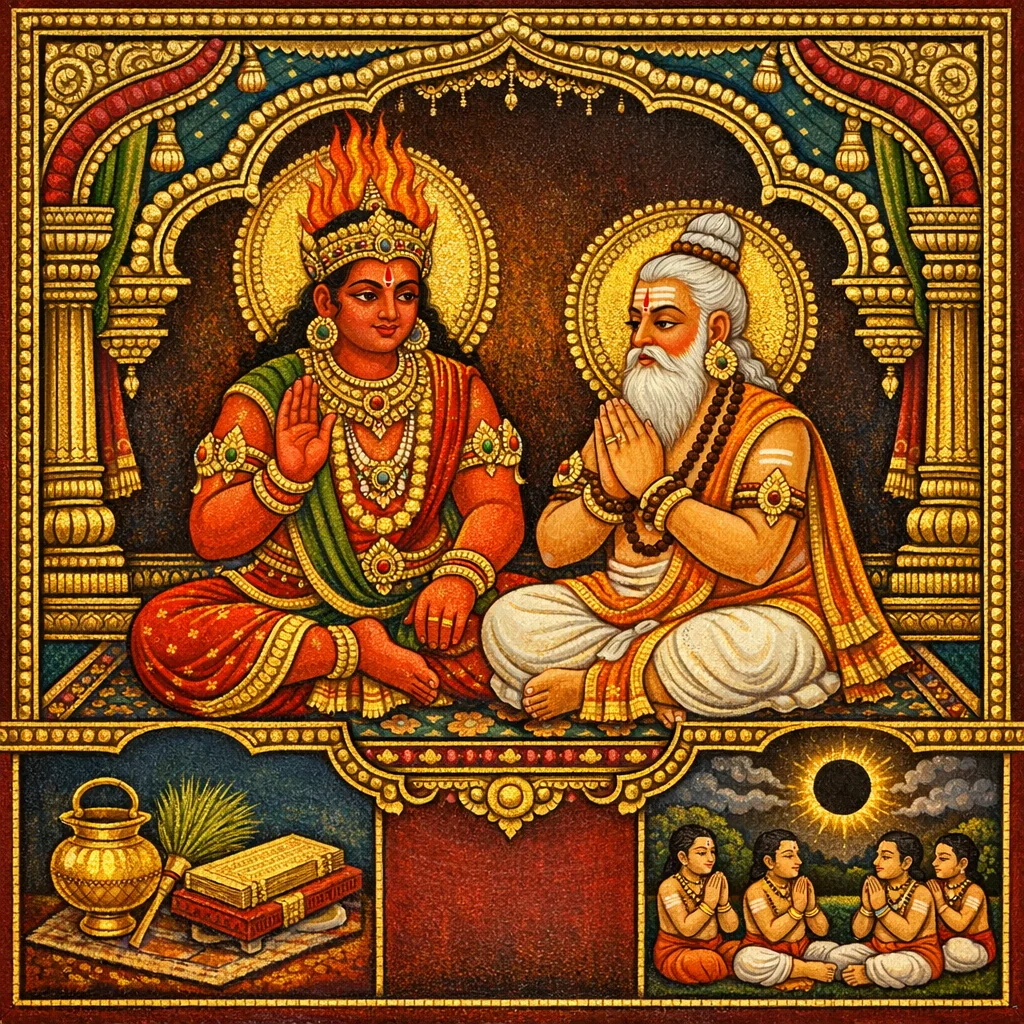
Adhyaya 162
अध्याय १६२ — धर्मशास्त्रकथनम् (Dharmaśāstra Exposition: Authorities, Pravṛtti–Nivṛtti, Upākarman, and Anadhyāya Rules)
This chapter grounds Dharma in a recognized lineage of smṛti authorities (from Manu through Parāśara, with others such as Āpastamba, Vyāsa, and Bṛhaspati), establishing an ethical and juridical canon. It defines Vedic karma as twofold—pravṛtti (engaged action driven by desire) and nivṛtti (withdrawal based on knowledge)—and extols tapas, svādhyāya, sense-restraint, ahiṃsā, and guru-sevā as disciplines culminating in ātma-jñāna, the highest means to niḥśreyasa and immortality. The chapter then turns to applied dharma, prescribing calendrical and situational rules for Vedic recitation, including the upākarman and utsarga rites, and a detailed list of anadhyāya (temporary suspension) occasions: death-impurity periods, eclipses, specific lunar days, atmospheric disturbances (thunder, meteors, earthquakes), contact with impure contexts (corpse, cremation-ground, outcaste), ominous sounds, and practical disruptions—collectively counted as thirty-seven anadhyāya instances. Thus the Agni Purāṇa links metaphysical telos (self-knowledge) with precise observance that disciplines daily life.
Shlokas
Verse 1
आग्रत्स्वप्नसुसुप्त्यान्तमुक्तमिति ङ , छ , ञ च इत्य् आग्नेये अशौचनिर्णय इत्य् आदिः, सत्यमानन्दमद्वयमित्यन्तः पाठो ग पुस्तके नास्ति अथ द्विषष्ट्यधिकशततमो ऽध्यायः धर्मशास्त्रकथनं पुष्कर उवाच मनुर्विष्णुर्याज्ञवल्को हारीतो ऽत्रिर्यमो ऽङिगिराः वसिष्ठदक्षसंवर्तशातातपपराशराः
“‘…ending with the words: waking, dream, and deep sleep—thus declared’—so read the recensions (ṅ, cha, and ña). In the Āgneya (Agni Purāṇa) it begins with ‘the determination of impurity (aśauca)’; the concluding reading ‘(He is) Truth, Bliss, non-dual’ is not found in the ‘ga’ manuscript. Now begins the one-hundred-and-sixty-second chapter, ‘The exposition of Dharmaśāstra.’ Puṣkara said: Manu, Viṣṇu, Yājñavalkya, Hārīta, Atri, Yama, Aṅgiras, Vasiṣṭha, Dakṣa, Saṃvarta, Śātātapa, and Parāśara (are the authorities).”
Verse 2
आपस्तम्बोशनोव्यासाः कात्ययनबृहस्पती गोतमः शङ्खलिखितौ धर्ममेते यथाब्रुवन्
Āpastamba, Uśanas, Vyāsa, Kātyāyana, Bṛhaspati, Gautama, and Śaṅkha and Likhita—these authorities have declared Dharma as they expounded it.
Verse 3
तथा वक्ष्ये समासेन भुक्तिमुक्तिप्रदं शृणु प्रवृत्तञ्च निवृत्तञ्च द्विविधङ्कर्म वैदिकं
Thus I shall explain it in brief—listen—what bestows both worldly enjoyment and liberation: Vedic action (karma) is of two kinds, the path of engagement (pravṛtti) and the path of withdrawal (nivṛtti).
Verse 4
काम्यं कर्म प्रवृत्तं स्यान्निवृत्तं ज्ञानपूर्वकं वेदाभ्यासस्तपो ज्ञानमिन्दियाणाञ्च संयमः
Desire-motivated action is to be understood as the path of engagement (pravṛtti), whereas the path of withdrawal (nivṛtti) is grounded in knowledge. Vedic study, austerity (tapas), true knowledge, and restraint of the senses—these are its means.
Verse 5
अहिंसा गुरुसेवा च निःश्रेयसकरं परं सर्वेषामपि चैतेषामत्मज्ञानं परं स्मृतं
Non-violence (ahiṃsā) and service to the guru (guru-sevā) are supreme means that bring about the highest good (niḥśreyasa). Yet among all these, Self-knowledge (ātma-jñāna) is remembered as the highest.
Verse 6
तच्चग्र्यं सर्वविद्यानां प्राप्यते ह्य् अमृतं ततः सर्वभूतेषु चात्मानं सर्वभूतानि चात्मनि
That knowledge is the foremost of all sciences; by attaining it, immortality (amṛta) is indeed gained. One then realizes the Self in all beings, and all beings within the Self.
Verse 7
समम्पश्यन्नात्मयाजी स्वाराज्यमधिगच्छति आत्मज्ञाने समे च स्याद्वेदाभ्यासे च यत्नवान्
One who sees all with equal vision, performing worship as an inward sacrifice, attains svārājya—inner sovereignty. He should abide in Self-knowledge and equanimity, and be diligent in the disciplined study of the Veda.
Verse 8
एतद्द्विजन्मसामर्थ्यं ब्राह्मणस्य विशेषतः एतद्द्विजन्मसाग्र्यमिति ख , ङ , झ , ञ , ट च एतद्द्विजन्मसामग्रीति घ वेदशास्त्रार्थतत्त्वज्ञो यत्र तत्राश्रमे वसन्
This is the distinctive power of the twice-born (dvija), and especially of the Brāhmaṇa. (Some recensions read “the pre-eminence of the twice-born,” while another reads “the full equipment/completeness of the twice-born.”) One who knows the true purport and principles of the Vedas and the śāstras, dwelling in whatever āśrama (stage of life) he may be in, possesses that capability.
Verse 9
इहैव लोके तिष्ठन् हि ब्रह्मभूयाय कल्प्यते स्वाध्यायानामुपाकर्म श्रावण्यां श्रावणेन तु
Indeed, while remaining in this very world, one becomes fit for attaining the state of Brahman; for the Upākarman—the rite of recommencing Vedic self-recitation (svādhyāya)—is to be performed on the Śrāvaṇī, the full-moon day in the month of Śrāvaṇa.
Verse 10
हस्ते चौषधिवारे च पञ्चम्यां श्रावणस्य वा पौषमासस्य रोहिण्यामष्टकायामथापि वा
Also: when the lunar mansion (nakṣatra) is Hasta; on Auṣadhivāra, the “day of medicines”; on the fifth lunar day in the month of Śrāvaṇa; on the day when Rohiṇī falls in the month of Pauṣa; or likewise on an Aṣṭakā day—these are prescribed as auspicious times.
Verse 11
जलान्ते छन्दसाङ्कुर्यादुत्सर्गं विधिवद्वहिः त्र्यहं प्रेतेष्वनध्यायः शिष्यर्त्विग्गुरुबन्धुषु
At the water’s edge one should, according to rule, perform the Utsarga (utsarga), the prescribed “release/cessation” of Vedic recitation. When a death has occurred, there is an anadhyāya—suspension of Vedic study—for three days in the case of one’s disciple, officiating priest (ṛtvij), teacher (guru), and kinsmen.
Verse 12
उपाकर्मणि चोत्सर्गं स्वशाखाश्रोत्रिये तथा सन्ध्यागर्जितनिर्घाते भूकम्पोल्कानिपातने
At the rite of Upākarman, and also at the (Veda-)Utsarga; likewise when one is to instruct a śrotriya of one’s own Vedic branch (śākhā); and during the thunderous crash of lightning at twilight, at an earthquake, or when a meteor falls—these are occasions governed by the stated rule of suspension/exception regarding study and recitation.
Verse 13
समाप्य वेदं ह्य् अनिशमारण्यकमधीत्य च पञ्चदश्यां चतुर्दश्यामष्टम्यां राहुसूतके
Having completed the Veda, one should also continually study the Āraṇyaka; yet on the fifteenth lunar day, the fourteenth, the eighth, and during an eclipse (the “birth-time of Rāhu”), Vedic study is to be avoided.
Verse 14
ऋतुसन्धिषु भुक्त्वा वा श्राद्विकं प्रतिगृह्य च पशुमण्डूकनकुलश्वाहिमार्जारशूकरैः
Having eaten at the junctions of the seasons, or having accepted an offering connected with a śrāddha; and through defilement arising from contact with cattle, frogs, mongooses, dogs, snakes, cats, and pigs—one becomes impure and subject to restriction.
Verse 15
कृतेन्तरे त्वहोरात्रं शक्रपाते तथोच्छ्रिये श्वक्रोष्टुगर्धभोलूकमासवाणर्तुनिस्वने
During the interval when death is impending, throughout day and night—when there is Indra’s rain and also an abnormal upheaval—if inauspicious sounds arise, such as the howling of dogs, the cry of jackals, the braying of donkeys, the hooting of owls, and untimely noises of the months, winds, and seasons, these are to be known as ominous portents.
Verse 16
अमेध्यशवशूद्रान्त्यश्मशानपतितान्तिके अशुभासु च तारासु विद्युत्स्तनितसम्प्लवे
Near impure substances, a corpse, a Śūdra, an outcaste, a cremation-ground, or a fallen person; and also when the stars are inauspicious, during lightning and thunder, and amid a tumultuous downpour—one should avoid undertaking the rite.
Verse 17
भुत्क्वार्द्रपाणिरम्भोन्तरर्धरात्रे ऽतिमारुते पांशुवर्षे दिशान्दाहे सन्ध्यानीहारभीतिषु
Having eaten, with the hand still wet—while in water; at midnight; during violent winds; during a rain of dust; when the quarters seem ablaze; and during twilight fogs and moments of fear—one should avoid or be on guard against improper acts.
Verse 18
धावतः प्राणिबाधे च विशिष्टे गृहमागते ब्रह्मचर्याय कल्प्यते इति ङ स्वशाखाश्रोत्रिये मृते इति घ , झ , ञ , ट च शशमार्जारशूकरैर् इति ङ खरोष्ट्रयानहस्त्यश्वनौकावृक्षादिरोहणे
When one has been running in haste, when injury has been caused to a living being, and when a distinguished guest arrives at one’s house—in such circumstances it is prescribed that one observe brahmacarya (continence). The same rule applies when a learned śrotriya of one’s own Vedic branch has died. It also applies in matters involving (contact-impurity connected with) hare, cat, and boar; and in mounting a donkey or camel, riding in a vehicle, mounting an elephant or horse, embarking on a boat, or climbing trees and the like.
Verse 19
सप्तत्रिंशदनध्यायानेतांस्तात्कालिकान्विदुः
These are known as the thirty-seven anadhyāya days—periods during which Vedic study should be temporarily suspended.
Frequently Asked Questions
It ranks disciplines such as svādhyāya, tapas, indriya-saṃyama, ahiṃsā, and guru-sevā as means toward niḥśreyasa, while declaring ātma-jñāna (Self-knowledge) the supreme attainment that yields immortality and equal vision.
The chapter emphasizes procedural and situational regulation of Vedic study—upākarman/utsarga rites and a consolidated list of thirty-seven anadhyāya occasions when recitation should be suspended due to impurity, time markers, omens, or disruptive conditions.