Adhyaya 167
Ayuta–Lakṣa–Koṭi Fire-offerings (अयुतलक्षकोटिहोमाः) — Graha-yajña Vidhi
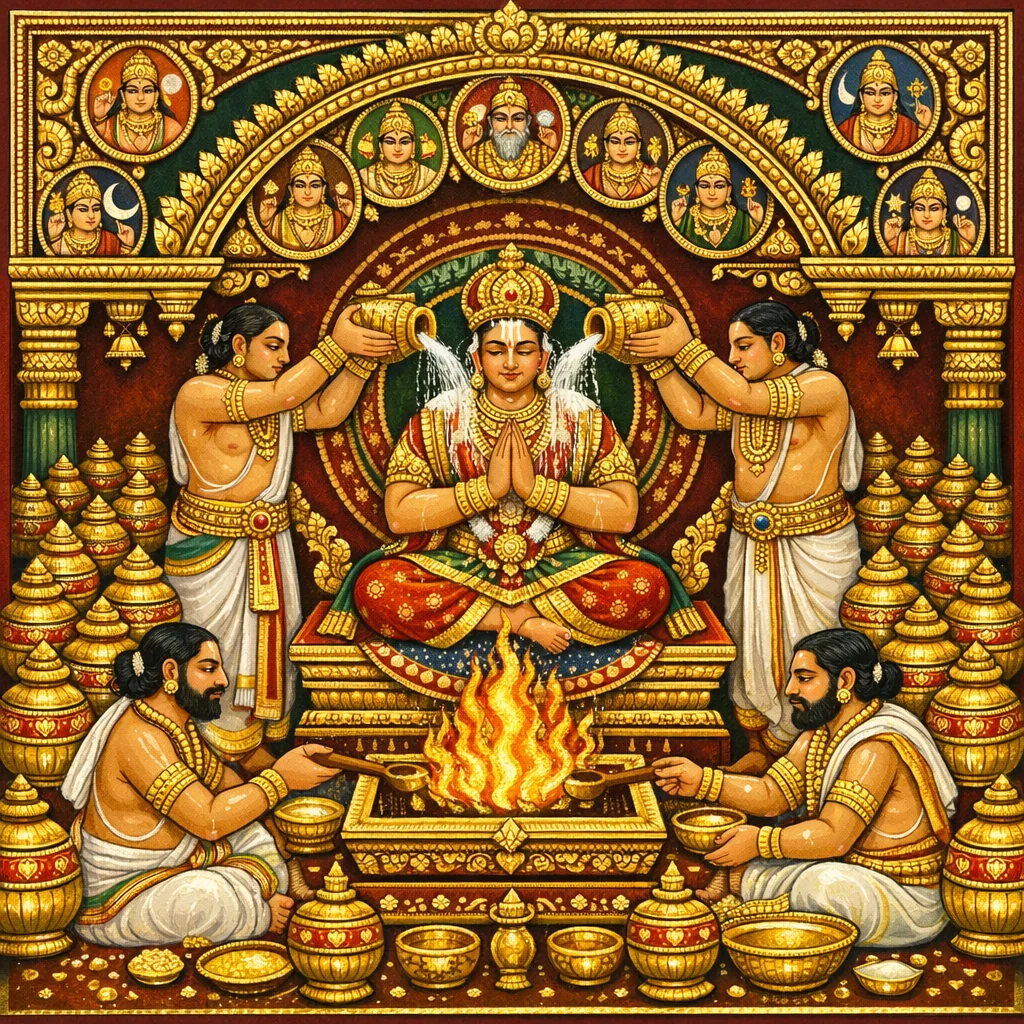
Lord Agni continues teaching graha-yajña as a Dharma-śāstra ritual technology for prosperity, pacification, and victory. He defines three graded homa scales—ayuta (10,000), lakṣa (100,000), and koṭi (10,000,000)—and explains the ritual maṇḍala: the planets (navagrahas) are invoked from the agni-kuṇḍa and installed in prescribed sectors, with the Sun at the center. The chapter enlarges the ritual cosmos through lists of adhidevatās and praty-adhidevatās, prescribes materials (woods, samidh, oblation-mixtures) and counts (108 offerings, 108 kumbhas), and culminates in pūrṇāhuti, vasordhārā, dakṣiṇā, and abhiṣeka mantras invoking major deities, the navagrahas, and protective powers. It links efficacy to dāna—gold, cows, land, gems, garments, bed—and situates the rites for battle-victory, marriage, festivals, and consecrations. Advanced forms specify lakṣa- and koṭi-homa requirements (kuṇḍa measurements, priest numbers, mantra options) and a distinct abhicāra/vidveṣaṇa procedure using a triangular kuṇḍa and effigy-operations, showing the Purāṇa’s integration of practical rites with cosmic-ethical order.
Shlokas
Verse 1
इत्य् आग्नेये महापुराणे वर्णधर्मादिर्नाम षट्षष्ट्यधिकशततमो ऽध्यायः अथ सप्तषष्ट्यधिकशततमो ऽध्यायः अयुतलक्षकोटिहोमाः अग्निर् उवाच श्रीशान्तिविजयाद्यर्थं ग्रहयज्ञं पुनर्वदे ग्रहयज्ञो ऽयुतहोमलक्षकोट्यात्मकस्त्रिधा
Thus, in the Agni Mahāpurāṇa ends the one-hundred-and-sixty-sixth chapter titled “Varṇa-dharma and related duties.” Now begins the one-hundred-and-sixty-seventh chapter, “Ayuta–Lakṣa–Koṭi Fire-offerings.” Agni said: “For prosperity, pacification, victory, and the like, I shall again expound the planetary sacrifice (graha-yajña). The graha-yajña is threefold, consisting of measures of homa: ayuta (ten thousand), lakṣa (one hundred thousand), and koṭi (ten million).”
Verse 2
वेदेरैशे ह्य् अग्निकुण्डाद् ग्रहानावाह्य मण्डले सौम्ये गुरुर्बुधश् चैशे शुक्रः पूर्वदले शशी
With Vedic mantras one should invoke the planets from the agni-kuṇḍa (fire-pit) and establish them in the ritual maṇḍala: in the auspicious (saumya) sector are Guru (Jupiter) and Budha (Mercury); in the eastern petal are Śukra (Venus) and Śaśī (the Moon).
Verse 3
आग्नेये दक्षिणे भौमो मध्ये स्याद्भास्करस् तथा शनिराप्ये ऽथ नैरृत्ये राहुः केतुश् च वायवे
Mars (Bhauma) is placed in the south-east and the south; the Sun (Bhāskara) is to be in the center; Saturn (Śani) in the west; then Rāhu in the south-west (nairṛtya), and Ketu in the north-west (vāyavya).
Verse 4
ईशश्चोमा गुहो विष्णुर्ब्रह्मेन्द्रौ यमकालकौ चित्रगुप्तश्चाधिदेवा अग्निरापः क्षितिर्हरिः
Īśa (Śiva) and Umā, Guha (Skanda), Viṣṇu, Brahmā and Indra, Yama and Kāla, and Citragupta are to be remembered as the presiding deities (adhidevas); likewise Agni (Fire), Āpas (Waters), Kṣiti (Earth), and Hari.
Verse 5
इन्द्र ऐन्द्री देवता च प्रजेशो ऽहिर्विधिः क्रमात् एते प्रत्यधिदेवाश् च गणेशो दुर्गयानिलः
Indra, the goddess Aindrī, Prajēśa (Brahmā), Ahi (the serpent-power), and Vidhi (the Ordainer—Brahmā) are mentioned in due order; these are the corresponding praty-adhidevatās (secondary presiding deities), along with Gaṇeśa, Durgā, and Anila (Vāyu).
Verse 6
खमश्विनौ च सम्पूज्य यजेद्वीजैश् च वेदजैः अर्कः पलाशः खदिरो ह्य् अपामार्गश् च पिप्पलः
Having duly worshipped Kha and the Aśvins, one should perform the sacrifice with dvija (“twice-born”) priests trained in Vedic rites. The prescribed ritual woods/plants are: arka, palāśa, khadira, apāmārga, and pippala.
Verse 7
उदुम्बरः शमी दुर्वा कुशाश् च समिधः क्रमात् मध्वाज्यदधिसंमिश्रा होतव्याश्चाष्टधा शतम्
In proper sequence, the fuel-sticks (samidh) should be of udumbara, śamī, durvā, and kuśa; and one should offer one hundred and eight oblations, mixed with honey, ghee, and curd.
Verse 8
एकाष्टशतुरः कुम्भान् पूर्य पूर्णाहुतिन्तथा वसोर्धारान्ततो दद्याद्दक्षिणाञ्च ततो ददेत्
Having filled one hundred and eight pots (kumbhas) to fullness, one should then perform the concluding complete oblation (pūrṇāhuti); after finishing the vasordhārā offering, one should thereafter give the priestly fee (dakṣiṇā).
Verse 9
यजमानं चतुर्भिस्तैर् अभिषिञ्चेत् समन्त्रकैः सुरास्त्वामभिषिञ्चन्तु ब्रह्मविष्णुमहेश्वराः
With those four (consecratory waters/vessels), accompanied by mantras, one should anoint the sacrificer (yajamāna): “May the gods anoint you—Brahmā, Viṣṇu, and Maheśvara.”
Verse 10
वासुदेवो जगन्नाथस् तथा सङ्कर्षणः प्रभुः प्रद्युम्नश्चानिरुद्धश् च भवन्तु विजयाय ते
May Vāsudeva, the Lord of the universe (Jagannātha); likewise Saṅkarṣaṇa, the sovereign; and Pradyumna and Aniruddha too—be for your victory.
Verse 11
आखण्डलो ऽग्निर्भगवान् यमो वै नैरृतस् तथा वरुणः पवनश् चैव धनाध्यक्षस् तथा शिवः
Akhāṇḍala (Indra), the venerable Lord Agni, Yama indeed, and likewise Nairṛta; Varuṇa, and also Pavana (Vāyu); Dhanādhyakṣa (Kubera), and also Śiva.
Verse 12
ब्रह्मणा सहितः शेषो दिक्पालाः पान्तु वः सदा कीर्तिर्लक्ष्मीर्धृतिर्मेधा पुष्टिः श्रद्धा क्रिया मतिः
May Śeṣa, together with Brahmā and the Guardians of the Directions, always protect you; and may Fame, Prosperity (Lakṣmī), Fortitude, Intelligence, Nourishment, Faith, Right Action, and Sound Judgement likewise abide with you.
Verse 13
बुद्धिर् लज्जा वपुः शान्तिस्तुष्टिः कान्तिश् च मातरः एतास्त्वामभिषिञ्चन्तु धर्मपत्न्याः समागताः
May these Mother-powers—Intelligence, Modesty, Bodily Well-being, Peace, Contentment, and Splendor—assembled here as the righteous consorts of Dharma, consecrate you with abhiṣeka.
Verse 14
आदित्यश् चन्द्रमा भौमो बुधजीवशितार्कजाः ग्रहास्त्वामभिषिञ्चन्तु राहुः केतुश् च तर्पिताः
May the planets—Sun, Moon, Mars, Mercury, Jupiter, Venus, and Saturn—consecrate you with abhiṣeka; and may Rāhu and Ketu also, duly satisfied through offerings, bestow their favor.
Verse 15
देवदानवगन्धर्वा यक्षराक्षसपन्नगाः ऋषयो मनवो गावो देवमातर एव च
The gods, the Dānavas, and the Gandharvas; the Yakṣas, the Rākṣasas, and the serpent-beings (Pannagas); the Ṛṣis, the Manus, the cows—and also the divine Mothers (Mātṛkās).
Verse 16
देवपत्न्यो द्रुमा नागा दैत्याश्चाप्सरसाङ्गणाः अस्त्राणि सर्वशास्त्राणि राजानो वाहनानि च
The wives of the gods, trees, Nāgas, Daityas, and the companies of Apsarases; weapons, all śāstras (treatises and sciences), kings, and also vehicles or mounts (vāhanas)—all these are to be understood as included here.
Verse 17
औषधानि च रत्नानि कालस्यावयवाश् च ये सरितः सागराः शैलास्तीर्थानि जलदा नदाः
Medicinal herbs and gems, and all the divisions (constituent parts) of time; rivers, oceans, mountains, sacred tīrthas (holy fords), rain-bearing clouds, and streams—these are to be understood as the world’s enumerated constituents.
Verse 18
एते त्वामभिषिञ्चन्तु सर्वकामार्थसिद्धये अलङ्कृतस्ततो दद्याद्धेमगोन्नभुवादिकं
“May these consecrate you by abhiṣeka, for the fulfillment of all desired aims and objects.” Then, duly adorned, one should give gifts—gold, cows, food-grain, land, and the like.
Verse 19
कपिले सर्वदेवानां पूजनीयासि रोहिणि तीर्थदेवमयी यस्मादतःशान्तिं प्रयच्छ मे
O Kapilā, O Rohiṇī—worthy of worship by all the gods—since you embody the divinity of a sacred tīrtha, therefore grant me peace.
Verse 20
पुण्यस्त्वं शङ्ख पुण्यानां मङ्गलानाञ्च मङ्गलं विष्णुना विधृतो नित्यमतः शान्तिं प्रयच्छ मे
O Conch, you are holy among holy things, and the very auspiciousness among auspicious things. Ever borne by Viṣṇu—therefore, grant me peace.
Verse 21
धर्म त्वं वृषरूपेण जगदानन्दकारकः अष्टमूर्तेरधिष्टानमतः शान्तिं प्रयच्छ मे
O Dharma—who, in the form of the Bull, brings joy to the world—you are the sustaining foundation of the Aṣṭamūrti (Śiva’s Eightfold Form); therefore, grant me peace.
Verse 22
हिरण्यगर्भगर्भस्थं हेमवीजं विभावसोः अनन्तपुण्यफलदमतः शान्तिं प्रयच्छ मे
O Radiant Agni, you who abide within the Golden Womb (Hiraṇyagarbha) and whose seed is golden—therefore, as the bestower of endless meritorious fruits, grant me peace.
Verse 23
पीतवस्त्रयुगं यस्माद्वासुदेवस्य वल्लभं प्रदानात्तस्य वै विष्णुरतः शान्तिं प्रयच्छ मे
Since a pair of yellow garments—dear to Vāsudeva—has been offered, may that Viṣṇu, who delights in such devotion, grant me peace.
Verse 24
विष्णुस्त्वं मत्स्यरूपेण यस्मादमृतसम्भवः चन्द्रार्कवाहनो नित्यमतः शान्तिं प्रयच्छ मे
You are Viṣṇu in the form of the Fish (Matsya), from whom the arising of amṛta, the source of immortality, is brought about. You who are ever borne by the Moon and the Sun—therefore, grant me peace.
Verse 25
यस्मात्त्वं पृथिवी सर्वा धेनुः केशवसन्निभा सर्वपापहरा नित्यमतः शान्तिं प्रयच्छ मे
Since you are the entire Earth—like a cow, resembling Keśava (Viṣṇu)—and you ever remove all sins, therefore grant me peace.
Verse 26
यस्मादायसकर्माणि तवाधीनानि सर्वदा लाङ्गलाद्यायुधादीनि अतः शान्तिं प्रयच्छ मे
Since all works in iron are always under your control—ploughs and other weapons and implements as well—therefore grant me pacification and safety.
Verse 27
यस्मात्त्वं स्सर्वयज्ञानामङ्गत्वेन व्यवस्थितः योनिर्विभावसोर्नित्यमतः शान्तिं प्रयच्छ मे
Since you are established as an integral limb of all sacrifices, and are ever the source of Vibhāvas (the Fire), therefore grant me peace.
Verse 28
गवामङ्गेषु तिष्ठन्ति भुवनानि चतुर्दश यस्मात्तस्माच्छिवं मे स्यादिह लोके परत्र च
Because the fourteen worlds abide in the limbs of cows, therefore may auspiciousness be mine—here in this world and also in the world beyond.
Verse 29
धर्मकामार्थसिद्धये इति ख यस्मादशून्यं शयनं केशवस्य शिवस्य च शय्या ममाप्यशून्यास्तु दत्ता जन्मनि जन्मनि
“For the accomplishment of dharma, desire (kāma), and prosperity (artha)”—thus one should say. Since the couch of Keśava and of Śiva is never empty, may my own bed also never be empty, having been given in charity, in birth after birth.
Verse 30
यथा रत्नेषु सर्वेषु सर्वे देवाः प्रतिष्ठिताः तथा शान्तिं प्रयच्छन्तु रत्नदानेन मे सुराः
Just as all the gods are established in all gems, so may the deities grant me peace through my gifting of gems.
Verse 31
यथा भूमिप्रदानस्य कलां नार्हन्ति षोडशीं दानान्यन्यानि मे शान्तिर्भूमिदानाद्भवत्विह
Just as other gifts do not merit even a sixteenth part of the fruit of gifting land, so may peace come to me here through the donation of land.
Verse 32
ग्रहयज्ञो ऽयुतहोमो दक्षिणाभी रणे जितिः विवाहोत्सवयज्ञेषु प्रतिष्ठादिषु कर्मषु
The Graha-sacrifice (Graha-yajña), the ayuta-homa of ten thousand oblations, and the bestowal of dakṣiṇā (priestly fees) bring victory in battle; and they are to be employed in rites such as marriage-sacraments, festive sacrifices, consecrations (pratiṣṭhā), and related ceremonial acts.
Verse 33
सर्वकामाप्तये लक्षकोटिहोमद्वयं मतं गृहदेशे मण्डपे ऽथ अयुते हस्तमात्रकं
For the attainment of all desired aims, a twofold performance of homa—reckoned in lakṣa and koṭi of oblations—is prescribed. In one’s residential area, within a maṇḍapa, for an ayuta rite of ten thousand oblations, the kuṇḍa (fire-pit/altar) should be of one hasta (hand) in measure.
Verse 34
मेखलायोनिसंयुक्तं कुण्डञ्चत्वार ऋत्विजः स्वयमेको ऽपि वा लक्षे सर्वं दशगुणं हि तत्
A kuṇḍa (fire-pit) furnished with the prescribed mekhalā and yoni, and served by four ṛtvij (officiating priests)—or even when one performs the lakṣa rite by oneself—should be understood to yield the entire ritual fruit tenfold.
Verse 35
चतुर्हस्तं द्विहस्तं वा तार्क्षञ्चात्राधिकं यजेत् सामध्वनिशीरस्त्वं वाहनं पमेष्ठिनः
Here one should worship Tārkṣya (Garuḍa) either in a four-armed form, or in a two-armed form, or else in an even more exalted, augmented form. You, whose head is adorned with the resonance of Sāman-chants, are the vehicle of Pameṣṭhin (Brahmā).
Verse 36
विषयापहरो नित्यमतः शान्तिं प्रयच्छ मे पूर्ववत् कुण्डमामन्त्र्य लक्षहोमं समाचरेत्
“O ever-present remover of harmful influences, grant me peace.” Then, as before, having ritually invoked the kuṇḍa (fire-pit), one should duly perform the lakṣa-homa of one hundred thousand oblations.
Verse 37
वसोर्धारां ततो दद्याच्छय्याभूषादिकं ददेत् तत्रापि दश चाष्टौ च लक्षहोमे तथर्त्विजः
Thereafter one should offer the vasordhārā oblation, and also donate a bed, ornaments, and the like. In that same rite, for the lakṣa-homa (one hundred thousand oblations), ten and eight—i.e., eighteen—officiating priests are likewise prescribed.
Verse 38
पुत्रान्नराज्यविजयभुक्तिमुक्त्यादि चाप्नुयात् दक्षिणाभिः फलेनास्माच्छत्रुघ्नः कोटिहोमकः
From this rite, the performer—who completes a koṭi-homa (a crore of fire-offerings) in the enemy-destroying Shatrughna homa—attains sons, food, sovereignty, victory, enjoyment, liberation, and other benefits, in accordance with the dakṣiṇā gifts and the intended result.
Verse 39
तथा जन्मनि जन्मनीति ङ गृहादौ मण्डपे वाथेति ख गृहादौ मण्डपे चैवमिति ञ पुत्रार्थराज्यविजयभुक्तिमुक्त्यादीति ख , ङ च चतुर्हस्तं चाष्टहस्तं कुण्डन्द्वादश च द्विजाः पञ्चविंशं षोडशं वा पटे द्वारे चतुष्टयं
Likewise, these rules apply from birth to birth. In a house and also in a maṇḍapa (ritual pavilion) it is so stated. For aims such as obtaining a son, sovereignty, victory in kingship, worldly enjoyment, and liberation, the same prescriptions are taught. O twice-born ones, the kuṇḍa (fire-pit) should be four cubits or eight cubits; and the measurements for the paṭa (cloth-screen) and for the doorway are given in sets of four, with dimensions such as twelve, sixteen, or twenty-five (units) as applicable.
Verse 40
कोटिहोमी सर्वकामी विष्णुलोकं स गच्छति होमस्तु ग्रहमन्त्रैर् वा गायत्र्या वैष्णवैर् अपि
One who performs a koṭi-homa (a million/a koṭi of oblations), fulfilling all desired aims, goes to Viṣṇu’s world. Such a homa may be performed either with the mantras of the planetary deities (graha), or with the Gāyatrī, or also with Vaiṣṇava mantras.
Verse 41
जातवेदोमुखैः शैवैः वैदिकैः प्रथितैर् अपि तिलैर् यवैर् घृतैर् अश्वमेधफलादिभाक्
He should make offerings with mantras beginning with “Jātavedas”, with Śaiva mantras, and also with renowned Vedic mantras. Using sesame, barley (yava), and ghee (ghṛta) as oblations, he becomes a recipient of the fruits of the Aśvamedha and other great sacrifices.
Verse 42
विद्वेषणाभिचारेषु त्रिकोणं कुण्डमिष्यते समिधो वामहस्तेन श्येनास्थ्यनलसंयुताः
In rites of enmity and in hostile abhicāra operations, a triangular fire-pit is prescribed. The kindling sticks (samidh), taken with the left hand, should be used together with materials such as a hawk’s bone and fire.
Verse 43
रक्तभूषैर् मुक्तकेशैर् ध्यायद्भिरशिवं रिपोः दुर्मित्रियास्तस्मै सन्तु यो द्वेष्टि हुं फडिति च
May those who hate him—uttering “huṃ” and “phaṭ”—become evil allies to that enemy, as they meditate upon the foe’s misfortune, adorned in red and with loosened hair.
Verse 44
छिन्द्यात् क्षुरेण प्रतिमां पिष्टरूपं रिपुं हनेत् यजेदेकं पीडकं वा यः स कृत्वा दिवं व्रजेत्
One should cut the effigy with a razor; thereby he strikes down the enemy fashioned in the form of dough. Whoever performs the worship of the single targeted rite, or even of a pīḍaka (a pressing/afflicting rite), having done so, attains heaven.
Frequently Asked Questions
It emphasizes calibrated homa-scales (ayuta, lakṣa, koṭi), precise navagraha placement within a ritual maṇḍala, fixed counts like 108 oblations and 108 kumbhas, kuṇḍa measurements for different homa magnitudes, and role-allocation (including increased ṛtvij counts for larger rites).
It frames ritual mastery as dharmic discipline: planetary pacification and victory-oriented rites are bound to mantra, purity, and generosity (dakṣiṇā/dāna), thereby converting worldly aims (bhukti) into ethically regulated action that supports protection, order, and ultimately auspicious destiny and higher spiritual attainment (including Vaiṣṇava-oriented outcomes such as Viṣṇuloka).
The abhiṣeka invokes Brahmā–Viṣṇu–Maheśvara, the four Vyūhas (Vāsudeva, Saṅkarṣaṇa, Pradyumna, Aniruddha), dikpālas and major deities (e.g., Indra, Agni, Yama, Varuṇa, Vāyu, Kubera, Śiva), protective qualities (kīrti, lakṣmī, dhṛti, medhā, puṣṭi, śraddhā, kriyā, mati), mother-powers, and the navagrahas including Rāhu and Ketu.