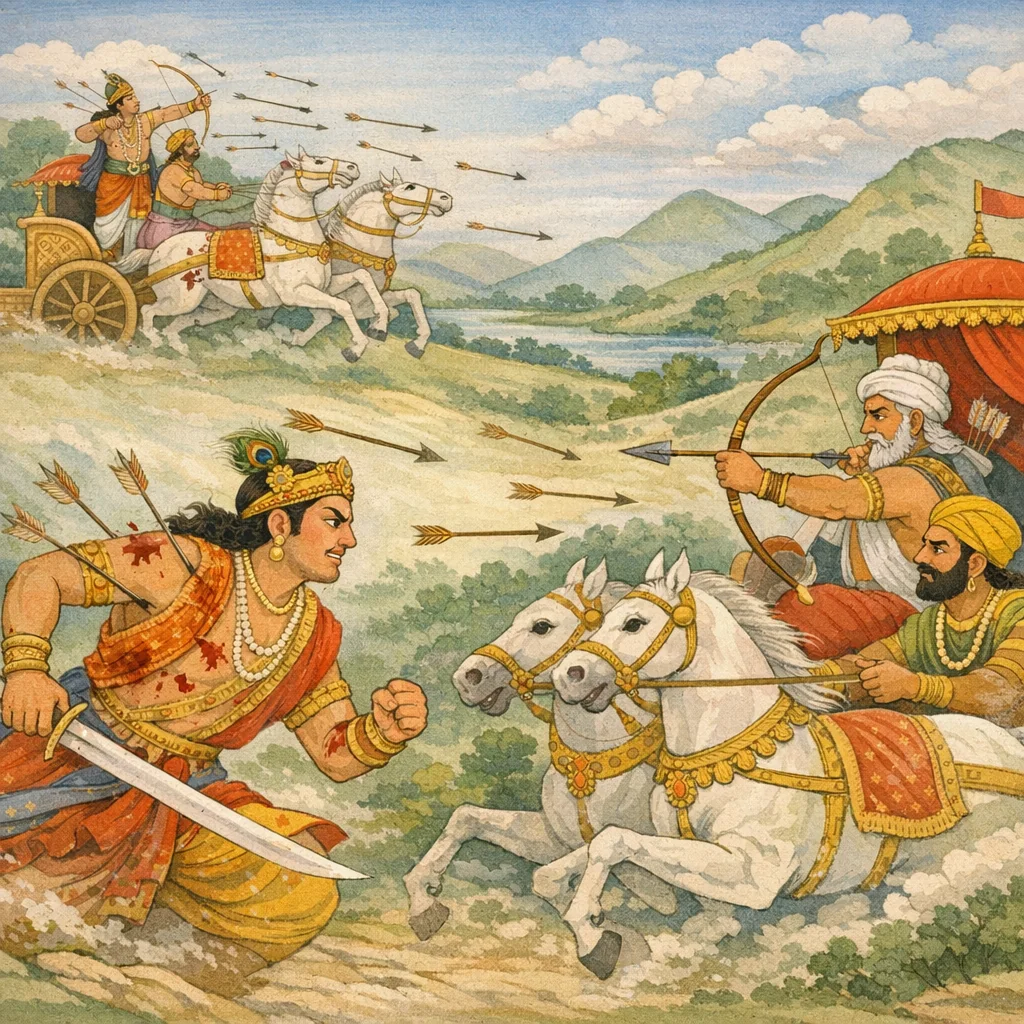
Adhyaya 172
द्रोणपुत्रस्याग्नेयास्त्रप्रयोगः — अर्जुनस्य ब्राह्मास्त्रप्रतिघातः — व्यासोपदेशः (Aśvatthāmā’s Agneyāstra, Arjuna’s Brāhmāstra Counter, and Vyāsa’s Instruction)
Upa-parva: Aśvatthāmāstra–Brāhmāstra Pratighāta (Episode: Drauṇi’s Agneyāstra and Arjuna’s Countermeasure)
Sañjaya reports that Arjuna, seeking to check the routed forces and intent on confronting Droṇa’s son, attempts to stabilize the field alongside Kṛṣṇa. Arjuna addresses Aśvatthāmā with severe, provocative speech, challenging him to display his full prowess and to face both Arjuna and the formidable Pāñcāla (Dṛṣṭadyumna), identified as Droṇa’s slayer. Dhṛtarāṣṭra queries the uncharacteristic harshness; Sañjaya attributes it to cumulative losses, internal strain, and the psychological weight of setbacks. Enraged, Aśvatthāmā performs ritual preparation and releases the Agneyāstra, generating a catastrophic barrage: darkness, unnatural winds, fear-signs, and widespread burning across beings and formations. The Kauravas exult, believing Kṛṣṇa and Arjuna destroyed. Arjuna then releases the Brāhmāstra as an all-astra counter, after which the darkness subsides and Kṛṣṇa–Arjuna reappear unharmed, reversing morale. Aśvatthāmā, distressed and doubting the efficacy of his weapon, withdraws and encounters Vyāsa near Sarasvatī. He asks why Kṛṣṇa and Arjuna could not be slain. Vyāsa explains a doctrinal frame: Kṛṣṇa is Nārāyaṇa, ancient and invincible by ordinary means; Arjuna is Nara, his counterpart. The discourse expands into Nārāyaṇa’s tapas and vision of Rudra, Rudra’s boons, and the theological rationale for their exceptional protection. Aśvatthāmā reveres Rudra and re-evaluates Kṛṣṇa’s stature; subsequently, both armies disengage amid exhaustion and the larger war context marked by Droṇa’s fall after days of intense fighting.
Chapter Arc: संजय धृतराष्ट्र को बताता है कि घोर संग्राम के बीच धृष्टद्युम्न द्रोणाचार्य के रथ पर सीधी चढ़ाई करता है—मानो प्रतिज्ञा को आज ही रक्त से लिख देना हो। → धृष्टद्युम्न बार-बार धनुष की ज्यां खींचकर बाणों का संधान करता है; उसके पीछे पांचाल और पाण्डव-सेना भी द्रोण-वध की आकांक्षा से उमड़ती है। द्रोण भीषण प्रतिरोध करते हैं, धृष्टद्युम्न को घायल करते हैं; धृष्टद्युम्न क्रोध में दाँत भींचकर धनुष छोड़ता है और दूसरा धनुष उठा कर फिर टूट पड़ता है। समानांतर मोर्चे पर सात्यकि कौरव-वीरों से घिरकर बाण-वृष्टि सहता है; कर्ण उसके शरीर को विविध तीक्ष्ण शरों से क्षत-विक्षत करता है। कौरव पक्ष में यह धारणा उभरती है कि यदि सात्यकि और धृष्टद्युम्न गिरें तो विजय ध्रुव हो जाएगी। → द्रोण और धृष्टद्युम्न का आमने-सामने का उग्र क्षण—धृष्टद्युम्न घायल होकर भी क्रोधरक्त नेत्रों से दूसरा धनुष लेकर द्रोण के रथ पर धावा बोलता है; उसी समय कौरव-रणनीति का तीखा आदेश गूंजता है: ‘कृष्ण-अर्जुन सहित पाण्डवों का वध करो’—युद्ध का लक्ष्य व्यक्तिगत द्वंद्व से बढ़कर सर्वनाशकारी संकल्प बन जाता है। → सात्यकि को अनेक कौरवों में उलझा देख सव्यसाची अर्जुन द्रोण के सम्मुख अग्रसर होता है—धृष्टद्युम्न के प्रयास को सहारा देने और द्रोण-व्यूह को तोड़ने हेतु। अध्याय का अंत निर्णायक वध पर नहीं, बल्कि नए टकराव की ओर बढ़ती गति पर टिकता है। → अर्जुन के सामने आते ही प्रश्न लटकता है—क्या द्रोण का अभेद्य प्रतिरोध टूटेगा, या धृष्टद्युम्न की प्रतिज्ञा फिर रक्त में डूबकर भी अधूरी रह जाएगी?
Shlokas
Verse 1
संजय कहते हैं--महाराज! जिस समय वह भयंकर घमासान युद्ध चल रहा था, उसी समय धृष्टट्युम्नने द्रोणाचार्यपर चढ़ाई की
Sanjaya said: “O King, while that dreadful, all-consuming battle was raging, at that very moment Dhrishtadyumna launched an assault against Acharya Drona.”
Verse 2
संदधानो धनुःश्रेष्ठ ज्यां विकर्षन् पुनः पुनः । अभ्यद्रवत द्रोणस्य रथं रुक्मविभूषितम्,उन्होंने अपने श्रेष्ठ धनुषपर बाणोंका संधान करके बारंबार उसकी प्रत्यंचा खींचते हुए द्रोणाचार्यके स्वर्णभूषित रथपर आक्रमण किया
Sañjaya said: Fitting arrows to his excellent bow and drawing its bowstring again and again, he charged straight at Droṇa’s chariot, splendidly adorned with gold—an act that displays the relentless momentum of battle and the warrior’s resolve to confront a formidable teacher on the field of dharma-war.
Verse 3
धृष्टद्युम्नम थायान्तं द्रोणस्थान्तचिकीर्षया । परिवत्रुर्महाराज पञ्चाला: पाण्डवै: सह,महाराज! द्रोणाचार्यका अन्त करनेकी इच्छासे आते हुए धृष्टद्युम्नको पाण्डवोंसहित पांचालोंने घेरकर अपने बीचमें कर लिया
Sañjaya said: O great king, as Dhṛṣṭadyumna advanced with the intent to bring about Droṇa’s end, the Pāñcālas—together with the Pāṇḍavas—surrounded him and kept him in their midst, shielding their chosen slayer while pressing the war’s grim necessity forward.
Verse 4
तथा परिवृतं दृष्टवा द्रोणमाचार्यसत्तमम् | पुत्रास्ते सर्वतो यत्ता ररक्षुद्रोणमाहवे,धृष्टद्युम्मको इस प्रकार रक्षकोंसे घिरा हुआ देख आपके पुत्र भी सावधान हो युद्धस्थलमें सब ओरसे आचार्यप्रवर टद्रोणकी रक्षा करने लगे
Sañjaya said: Seeing Droṇa—the foremost of teachers—thus surrounded (by protectors), your sons too became fully alert and, exerting themselves on every side, began to guard Droṇa on the battlefield. The scene underscores a wartime ethic of loyalty to one’s commander and the strategic duty of protecting the preceptor who anchors the army’s morale and order.
Verse 5
बलार्णवी ततस्तौ तु समेयातां निशामुखे । वातोद्धूतौ क्षुब्धसत्त्वी भैरवी सागराविव,जैसे वायुके वेगसे उद्वेलित तथा विक्षुब्ध जल-जन्तुओंसे भरे हुए दो भयंकर समुद्र एक-दूसरेसे मिल रहे हों, उसी प्रकार उस रात्रिके समय वे सागर-सदृश दोनों सेनाएँ एक- दूसरेसे भिड़ गयीं
Verse 6
ततो द्रोणं महाराज पाञज्चाल्य: पठ्चभि: शरै: । विव्याध हृदये तूर्ण सिंहनादं ननाद च,महाराज! उस समय धृष्टद्युम्नने द्रोणाचार्यकी छातीमें तुरंत ही पाँच बाण मारे और सिंहके समान गर्जना की
Sañjaya said: Then, O King, the Pāñcāla prince (Dhṛṣṭadyumna) swiftly pierced Droṇa in the region of the heart with five arrows, and he roared aloud like a lion—an act of martial challenge meant to shake the enemy’s resolve amid the righteous yet terrible duties of war.
Verse 7
त॑ द्रोणग: पञ्चविंशत्या विद्ध्वा भारत संयुगे । चिच्छेदान्येन भल्लेन धनुरस्य महास्वनम्,भरतनन्दन! तब द्रोणाचार्यने युद्धस्थलमें धृष्टद्युम्मको पचीस बाणोंसे घायल करके एक-दूसरे भल्लके द्वारा उनके घोर टंकार करनेवाले धनुषको काट दिया
Sañjaya said: Then Droṇa, O descendant of Bharata, struck him with twenty-five arrows in the thick of battle; and with another broad-headed shaft he cut down his great, thunder-sounding bow—thus disabling his power to fight and turning skill into restraint through superior mastery of arms.
Verse 8
धष्टय्युम्नस्तु निर्विद्धो द्रोणेन भरतर्षभ । उत्ससर्ज धनुस्तूर्ण संदश्य दशनच्छदम्,भरतश्रेष्ठ! द्रोणाचार्यके द्वारा घायल किये हुए धृष्टद्युम्नने रोषपूर्वक अपने ओठको दाँतोंसे दबा लिया और उस टूटे हुए धनुषको तुरंत फेंक दिया
Sañjaya said: O bull among the Bharatas, Dhrishtadyumna, pierced by Droṇa’s weapon, in a surge of wrath clenched his lips between his teeth and at once cast away his bow. The moment underscores how, amid the pressures of righteous war, even a disciplined warrior’s resolve is tested by pain and anger, yet the narrative keeps attention on steadfastness and the consequences of passion on the battlefield.
Verse 9
ततः क्रुद्धो महाराज धृष्टद्युम्न: प्रतापवान् | आददे>न्यद् धनुःश्रेष्ठ द्रोणस्पान्तचिकीर्षया,महाराज! तदनन्तर क्रोधसे भरे हुए प्रतापी धृष्टद्युम्नने द्रोणाचार्यका विनाश करनेकी इच्छासे दूसरा श्रेष्ठ धनुष हाथमें ले लिया
Sañjaya said: Then, O King, the valiant and mighty Dhṛṣṭadyumna—angered—took up another excellent bow, intent on bringing about Droṇa’s end. In the moral tension of the war, his resolve shows how personal wrath and strategic necessity converge, as he fixes his will on eliminating a formidable teacher-warrior who stands as a pillar of the opposing army.
Verse 10
विकृष्य च धनुश्चित्रमाकर्णात् परवीरहा । द्रोणस्यान्तकरं घोरं व्यसूजत् सायकं ततः,फिर शत्रुवीरोंका संहार करनेवाले उस पांचाल वीरने उस विचित्र धनुषको कानोंतक खींचकर उसके द्वारा द्रोणाचार्यका अन्त करनेमें समर्थ एक भयंकर बाण छोड़ा
Sañjaya said: Then that slayer of enemy-heroes drew his wondrous bow back to the ear and released a dreadful arrow—one capable of bringing about Droṇa’s end. In the grim logic of war, the act is presented as a decisive strike against a formidable teacher-warrior, raising the ethical tension between battlefield necessity and the tragic fall of a revered elder.
Verse 11
स विसृष्टो बलवता शरो घोरो महामृथे । भासयामास तत् सैन्यं दिवाकर इवोदित:,उस महासमरमें बलवान् वीरके द्वारा छोड़ा हुआ वह घोर बाण उदित हुए सूर्यके समान उस सेनाको प्रकाशित करने लगा
Sañjaya said: In that great clash of arms, the dreadful arrow, released with mighty force by the hero, blazed forth and lit up the army like the sun newly risen. The image underscores how, in war, a single act of martial power can suddenly dominate the field—magnificent in appearance, yet inseparable from the destructive purpose it serves.
Verse 12
तं तु दृष्टवा शरं घोरं देवगन्धर्वमानवा: । स्वस्त्यस्तु समरे राजन द्रोणायेत्यब्रुवन् वच:,राजन! समरभूमिमें उस भयंकर बाणको देखकर देवता, गन्धर्व और मनुष्य सभी कहने लगे कि “द्रोणाचार्यका कल्याण हो”
Sañjaya said: Seeing that dreadful arrow on the battlefield, the gods, Gandharvas, and men all voiced a benediction, O King: “May Droṇa be safe and victorious in this combat.” The moment underscores how awe at martial power can draw even diverse beings into a single, reverent acclamation—revealing the war’s moral tension, where admiration for prowess coexists with the tragedy of violence.
Verse 13
त॑ तु सायकमायान्तमाचार्यस्य रथं प्रति । कर्णो द्वादशधा राजंश्रिच्छेद कृतहस्तवत्,नरेश्वर! आचार्यके रथकी ओर आते हुए उस बाणके कर्णने सिद्धहस्त योद्धाकी भाँति बारह टुकड़े कर डाले
Sañjaya said: “But that arrow, as it sped toward the Teacher’s chariot, was cut by Karṇa into twelve pieces, O King—like a warrior of consummate skill.” The moment underscores how, amid the moral chaos of war, mastery of arms becomes a decisive force that can protect a revered elder even when the larger conflict has already strained the bonds of dharma.
Verse 14
स च्छिन्नो बहुधा राजन् सूतपुत्रेण धन्विना । निपपात शरस्तूर्ण निर्विषो भुजगो यथा,राजन! धनुर्धर सूतपुत्रके द्वारा अनेक टुकड़ोंमें कटा हुआ वह बाण विषहीन भुजंगके समान तुरंत पृथ्वीपर गिर पड़ा
Sañjaya said: O King, that arrow—cut into many pieces by the bowman, the Sūta’s son—fell at once to the ground, like a serpent whose poison has been removed. The image underscores how martial skill can render even a deadly weapon suddenly powerless, turning imminent harm into harmless collapse.
Verse 15
धृष्टद्युम्नं ततः कर्णो विव्याध दशभि: शरै: | पज्चभिद्रॉणपुत्रस्तु स्वयं द्रोणस्तु सप्तभि:,तदनन्तर धृष्टद्युम्मनको कर्णने दस, अभश्वत्थामाने पाँच और स्वयं द्रोणने सात बाण मारे
Sañjaya said: Then Karṇa struck Dhṛṣṭadyumna with ten arrows. Droṇa’s son (Aśvatthāman) pierced him with five, and Droṇa himself with seven. The passage underscores the relentless, coordinated violence of the battlefield, where prowess and loyalty to one’s side drive repeated assaults, even as the ethical weight of war accumulates through such acts.
Verse 16
शल्यश्न दशभिबणिस्त्रिभिर्द:शासनस्तथा । दुर्योधनस्तु विंशत्या शकुनिश्चापि पठचभि:,फिर शल्यने दस, दुःशासनने तीन, दुर्योधनने बीस और शकुनिने पाँच बाणोंसे उन्हें घायल कर दिया
Sañjaya said: Śalya struck him with ten arrows; Duḥśāsana likewise with three. Duryodhana then pierced him with twenty, and Śakuni too with five—each adding to the relentless wounding that marks this phase of the war, where prowess and fury eclipse restraint and compassion.
Verse 17
पाज्चाल्यं त्वरयाविध्यन् सर्व एव महारथा: । स विद्ध: सप्तभिवर्वरिद्रोणस्यार्थे महाहवे,राजन्! इस प्रकार सभी महारथियोंने बड़ी उतावलीके साथ पांचालराजकुमारपर अपने-अपने बाणोंका प्रहार किया। उस महासमरमें द्रोणाचार्यकी रक्षाके लिये सात वीरोंद्वारा घायल किये जानेपर भी धूृष्टद्युम्नने बिना किसी घबराहटके उन सबको तीन-तीन बाणोंसे बींध डाला। फिर द्रोणाचार्य, अश्वत्थामा, कर्ण तथा आपके पुत्र दुर्योधनको भी घायल कर दिया
Sañjaya said: All the great chariot-warriors, in urgent haste, shot at the Pāñcāla prince. Though struck by seven heroes in that great battle for the sake of protecting Droṇa, O King, Dhṛṣṭadyumna—undaunted—pierced them all with three arrows each, and then wounded Droṇācārya, Aśvatthāmā, Karṇa, and your son Duryodhana as well. The passage highlights the fierce momentum of war, where loyalty to one’s commander and the drive to fulfill a vowed objective collide with the ethical weight of violence against revered elders and kin.
Verse 18
सर्वानसम्भ्रमाद् राजन प्रत्यविद्धयत् त्रिभिस्त्रिभि: । द्रोणं द्रौ्णिं च कर्ण च विव्याध च तवात्मजम्,राजन्! इस प्रकार सभी महारथियोंने बड़ी उतावलीके साथ पांचालराजकुमारपर अपने-अपने बाणोंका प्रहार किया। उस महासमरमें द्रोणाचार्यकी रक्षाके लिये सात वीरोंद्वारा घायल किये जानेपर भी धूृष्टद्युम्नने बिना किसी घबराहटके उन सबको तीन-तीन बाणोंसे बींध डाला। फिर द्रोणाचार्य, अश्वत्थामा, कर्ण तथा आपके पुत्र दुर्योधनको भी घायल कर दिया
Sañjaya said: O King, without losing composure, he struck them all back—each with three arrows. He then pierced Droṇa, Droṇa’s son Aśvatthāmā, and Karṇa, and also wounded your own son. The scene underscores the fierce reciprocity of battle: even when assailed by many for the sake of protecting Droṇa, Dhṛṣṭadyumna remains steady and answers violence with measured, skillful counterforce rather than panic.
Verse 19
ते भिन्ना धन्विना तेन धृष्टट्युम्नं पुनर्मधे । विव्यधु: पञ्चभिस्तूर्णमेकैको रथिनां वर:,उन थधनुर्धर वीर धृष्टद्युम्नके बाणोंसे क्षत-विक्षत हो उन सभी योद्धाओंने युद्धस्थलमें पुनः उन्हें पाँच-पाँच बाणोंसे शीघ्र ही बींध डाला। प्रत्येक महारथीने उनपर प्रहार किया था
Verse 20
ट्रुमसेनस्तु संक्रुद्धो राजन विव्याध पत्रिणा । त्रिभिक्षान्यै:शरैस्तूर्ण तिष्ठ तिछेति चाब्रवीत्,राजन्! उस समय द्रुमसेनने अत्यन्त कुपित होकर एक बाणसे धृष्टद्युम्नको बींध डाला। फिर तुरंत ही अन्य तीन बाणोंसे उन्हें घायल करके कहा--'अरे! खड़ा रह, खड़ा रह”
Sañjaya said: O King, Drumaseṇa, inflamed with anger, pierced Dhṛṣṭadyumna with a feathered arrow. Then, swiftly striking him with three more shafts, he cried out, “Stand! Stand!”—a taunt meant to halt his advance and assert dominance amid the chaos of battle.
Verse 21
सतुतंप्रतिविव्याध त्रिभिस्तीक्ष्णैरजिद्ागै: । स्वर्णपुड्खै: शिलाधौतै: प्राणान्तकरणैर्युधि,तब धृष्टद्युम्नने रणभूमिमें सोनेके पंखवाले, शिलापर स्वच्छ किये हुए, तीन तीखे एवं प्राणान्तकारी बाणोंद्वारा द्रमसेनको घायल कर दिया
Sañjaya said: Then, in the midst of battle, he pierced Tuta with three sharp arrows that flew straight, their shafts polished on stone and fitted with golden feathers—missiles capable of taking life. The narration underscores the grim precision of war, where skill and lethal intent eclipse ordinary moral restraints, even as the larger struggle is framed by competing claims of duty.
Verse 22
भल््लेनान्येन तु पुनः सुवर्णोज्ज्वलकुण्डलम् । निचकर्त शिर: कायाद् ट्रुमसेनस्थ वीर्यवान्,फिर दूसरे भल्लद्वारा उन पराक्रमी वीरने द्रुमसेनके सुवर्णनिर्मित कान्तिमान् कुण्डलोंद्वारा मण्डित मस्तकको धड़से काट गिराया
Sañjaya said: Then again, with another sharp arrow, the mighty warrior severed from the body the head of Drumāsena—adorned with brilliantly shining golden earrings—casting it down. The scene underscores the grim finality of battlefield karma: valor and ornament alike are rendered powerless before the impartial stroke of war.
Verse 23
तच्छिरो न््यपतद् भूमौ संदष्टौष्ठपुर्ट रणे । महावातसमुद्धूतं पकक्वं तालफलं यथा,रणभूमिमें उस मस्तकने अपने ओठको दाँतोंसे दबा रखा था। वह आँधीके द्वारा गिराये हुए पके ताल-फलके समान पृथ्वीपर गिर पड़ा
Sañjaya said: In the midst of the battle, that severed head fell to the earth, the lips clenched tight against the teeth—like a ripe palmyra fruit knocked down by a mighty gale. The image underscores the brutal inevitability of death in war: even the proud and resolute are brought down by forces larger than themselves, and the battlefield reduces human will to a momentary gesture before collapse.
Verse 24
तान् स विद्ध्वा पुनर्योधान् वीर: सुनिशितै: शरैः । राधेयस्याच्छिनद् भल्लै: कार्मुकं चित्रयोधिन:
Sañjaya said: Having struck those warriors again with keenly sharpened arrows, the valiant fighter then, with broad-headed shafts, cut down the bow of Rādheya (Karna), that master of varied combat. In the relentless ethics of battlefield duty, disabling an opponent’s weapon becomes a decisive act—aimed not at cruelty for its own sake, but at turning the tide through skill and resolve.
Verse 25
तत्पश्चात् वीर धृष्टद्युम्नने अत्यन्त तीखे बाणोंद्वारा उन सभी योद्धाओंको पुनः घायल करके विचित्र युद्ध करनेवाले राधापुत्र कर्णके धनुषको भल्लोंसे काट डाला ।। न तु तन्ममृषे कर्णो धनुषश्छेदनं तथा । निकर्तनमिवात्युग्रं लाड्गूलस्य महाहरि:,जैसे सिंहकी पूँछ काट लेना अत्यन्त भयंकर कर्म है, उसे कोई महान् सिंह नहीं सह सकता, उसी प्रकार कर्ण अपने धनुषका काटा जाना सहन न कर सका
Sañjaya said: Thereafter the valiant Dhṛṣṭadyumna, striking all those warriors again with exceedingly sharp arrows and wounding them anew, cut down with broad-headed shafts the bow of Karṇa, the son of Rādhā, famed for his wondrous manner of fighting. Karṇa could not endure that severing of his bow; for just as the cutting off of a lion’s tail is a most dreadful deed that no great lion can tolerate, so too Karṇa could not bear the humiliation and peril of having his bow cut.
Verse 26
सोअन्यद् धनु: समादाय क्रोधरक्तेक्षण:श्वसन् । अभ्यद्रवच्छरौचैस्तं धृष्टद्युम्नं महाबलम्,क्रोधसे उसकी आँखें लाल हो रही थीं। वह दूसरा धनुष हाथमें लेकर लंबी साँस खींचता हुआ महाबली धृष्टद्युम्मकी ओर दौड़ा और उनपर बाण-समूहोंकी वर्षा करने लगा
Sañjaya said: With eyes reddened by anger and breathing hard, he seized another bow and rushed at the mighty Dhṛṣṭadyumna, showering him with volleys of arrows. The scene underscores how wrath, once it takes hold, drives a warrior from measured judgment into relentless escalation on the battlefield.
Verse 27
दृष्टवा कर्ण तु संरब्धं ते वीरा: षड़थर्षभा: । पाज्चाल्यपुत्र त्वरिता: परिवत्रुर्जिघांसया,कर्णको क्रोधमें भरा हुआ देख उन छहों- श्रेष्ठ रथी वीरोंने पांचालराजकुमार धृष्टद्युम्नको मार डालनेकी इच्छासे तुरंत ही घेर लिया
Sañjaya said: Seeing Karṇa inflamed with wrath, those six heroic bull-like chariot-warriors swiftly surrounded the son of the Pāñcāla king, Dhṛṣṭadyumna, with the intent to slay him. In the press of battle, anger hardens into collective resolve, and the warriors’ choice to encircle a single foe reveals how vengeance and tactical necessity can converge—often at the cost of restraint and dharmic balance.
Verse 28
षण्णां योधप्रवीराणां तावकानां पुरस्कृतम् | मृत्योरास्यमनुप्राप्तं धृष्टद्युम्नममंस्महि,आपकी सेनाके इन छ: प्रमुख वीर योद्धाओंके सामने खड़े हुए धृष्टद्युम्मको हमलोग मृत्युके मुखमें पड़ा हुआ ही मानने लगे
Sanjaya said: “When Dhrishtadyumna stood facing those six foremost warrior-champions of your army, we judged him to have already entered the very mouth of Death.”
Verse 29
एतस्मिन्नेव काले तु दाशाहों विकिरन् शरान् । धृष्टय्युम्नं पराक्रान्तं सात्यकि: प्रत्यपद्यत,इसी समय दशा्हकुलभूषण सात्यकि बाणोंकी वर्षा करते हुए वहाँ पराक्रमी धृष्टद्युम्नके पास आ पहुँचे
Sañjaya said: At that very moment, Sātyaki—scion of the Dāśārhas—showering arrows, came up to the valiant Dhṛṣṭadyumna. The scene underscores the warrior’s duty in battle: timely support of an ally amid the press of combat, where resolve and loyalty are tested alongside skill.
Verse 30
तमायान्तं महेष्वासं सात्यकिं युद्धदुर्मदम् । राधेयो दशभिर्बाणै: प्रत्यविध्यदजिद्वागैः
Sañjaya said: As the great archer Sātyaki advanced—fierce with the intoxication of battle—Rādheya (Karna) struck him in return with ten arrows, swift and unerring in their flight. The scene underscores how, in the heat of war, prowess and retaliation escalate, testing restraint and the warrior’s duty amid surging wrath.
Verse 31
वहाँ आते हुए महाधनुर्धर युद्धदुर्मद सात्यकिको राधापुत्र कर्णने सीधे जानेवाले दस बाणोंसे बींध डाला ।। त॑ सात्यकिर्महाराज विव्याध दशभि: शरै: | पश्यतां सर्ववीराणां मा गास्तिछेति चाब्रवीत्,महाराज! तब सात्यकिने भी समस्त वीरोंके देखते-देखते कर्णको दस बाणोंसे घायल कर दिया और कहा--'खड़े रहो, भाग न जाना”
Sañjaya said: O King, Sātyaki struck Karṇa, the son of Rādhā, with ten straight-flying arrows as all the warriors looked on. Having wounded him, Sātyaki called out, “Stand your ground—do not flee!” The moment underscores the kṣatriya ethic of steadfastness in battle: courage is demanded not only of oneself but also challenged in one’s opponent, and public valor becomes a moral test witnessed by the assembled heroes.
Verse 32
स सात्यकेस्तु बलिन: कर्णस्य च महात्मन: । आसीत् समागमो राजन् बलिवासवयोरिव,राजन्! उस समय बलवान् सात्यकि और महामनस्वी कर्णका वह संग्राम राजा बलि और इन्द्रके युद्ध-सा प्रतीत होता था
Sañjaya said: O King, the clash between the mighty Sātyaki and the great-souled Karṇa then appeared like the legendary combat of King Bali and Vāsava (Indra)—a meeting of equals whose power made the battlefield seem charged with cosmic consequence.
Verse 33
त्रासयन् रथघोषेण क्षत्रियान क्षत्रियर्षभ: । राजीवलोचनं कर्ण सात्यकि: प्रत्यविध्यत,अपने रथकी घर्घराहटसे क्षत्रियोंकों भयभीत करते हुए क्षत्रियशिरोमणि सात्यकिने कमललोचन कर्णको अच्छी तरह घायल कर दिया
Sañjaya said: With the thunder of his chariot, Sātyaki—bull among warriors—struck fear into the kṣatriyas and then powerfully pierced Karṇa, the lotus-eyed hero. The verse underscores how martial prowess and psychological force (the roar of arms and vehicles) shape the battlefield, where even renowned champions are wounded amid the relentless demands of kṣatriya-duty.
Verse 34
कम्पयन्निव घोषेण धनुषो वसुधां बली । सूतपुत्रो महाराज सात्यकिं प्रत्ययोधयत्,महाराज! बलवान सूतपुत्र कर्ण भी अपने धनुषकी टंकारसे पृथ्वीको कम्पित करता हुआ-सा सात्यकिके साथ युद्ध करने लगा
Sañjaya said: O King, the mighty son of a charioteer—Karna—seemed to make the earth tremble with the thunderous twang of his bow as he advanced to engage Sātyaki in battle. The verse underscores the awe-inspiring force of martial prowess on the battlefield, where personal valor and duty to one’s side drive warriors into direct confrontation.
Verse 35
विपाठकर्णिनाराचैरवत्सदन्तै: क्षुरैरपपि । कर्ण: शरशतैश्नापि शैनेयं प्रत्यविध्यत
Sañjaya said: With broad-headed arrows, with razor-edged shafts, and even with barbed missiles, Karṇa struck Śaineya again and again, showering him with hundreds of arrows. The scene underscores the relentless escalation of violence in battle—where prowess and resolve are displayed through ever more lethal means, even as the moral cost of such ferocity continues to mount.
Verse 36
कर्णने शिनिषौत्र सात्यकिको विपाठ, कर्णी, नाराच, वत्सदन्त, क्षुर तथा सैकड़ों बाणोंसे क्षत-विक्षत कर दिया ।। तथैव युद्ध्यमानो5पि वृष्णीनां प्रवरो युधि । अभ्यवर्षच्छरै: कर्ण तद् युद्धमभवत् समम्
Sañjaya said: Even while being fought at close quarters, Sātyaki—the foremost of the Vṛṣṇis—poured down a rain of arrows upon Karṇa. Thus, between Karṇa and Sātyaki the battle became evenly matched, each meeting the other with equal prowess and resolve amid the relentless violence of war.
Verse 37
इसी प्रकार रणभूमिमें वृष्णिवंशके श्रेष्ठ वीर सात्यकि भी युद्ध-तत्पर हो कर्णपर बाणोंकी वर्षा करने लगे। उन दोनोंका वह युद्ध समानरूपसे चलने लगा ।। तावकाश्न महाराज कर्णपुत्रश्न दंशित: । सात्यकिं विव्यधुस्तूर्ण समन्तान्निशितै: शरै:,महाराज! आपके अन्य योद्धा तथा कर्णका पुत्र कवचधारी वृषसेन--ये सब-के-सब चारों ओरसे तीखे बाणोंद्वारा सात्यकिको बींधने लगे
Sañjaya said: O King, your warriors as well as the armored sons of Karṇa, all enraged, swiftly pierced Sātyaki from every side with sharp arrows. Thus, amid the press of battle, Sātyaki found himself surrounded and struck from all directions—an image of how war’s momentum often turns into collective assault rather than single combat, testing endurance and resolve more than mere prowess.
Verse 38
अस्त्रैरस्त्राणि संवार्य तेषां कर्णस्य वा विभो । अविद्ध्यत् सात्यकि: क्रुद्धो वृषसेनं स्तनान्तरे,प्रभो! इससे कुपित हुए सात्यकिने उन सब योद्धाओं तथा कर्णके अस्त्रोंका अस्त्रोंद्वारा निवारण करके वृषसेनकी छातीमें गहरी चोट पहुँचायी
Sañjaya said: O mighty one, Sātyaki, enraged, countered the missiles of those warriors—and even of Karṇa—by means of his own weapons; then he struck Vṛṣasena in the chest, dealing him a deep, telling wound. The verse highlights the grim ethic of battlefield skill: mastery is shown not only in attack, but in disciplined defense and decisive action amid righteous fury.
Verse 39
तेन बाणेन निर्विद्धो वृषसेनो विशाम्पते । न्यपतत् स रथे मूढो धनुरुत्सृज्य वीर्यवान्,प्रजानाथ! सात्यकिके बाणसे घायल हो बलवान वृषसेन धनुष छोड़कर मूर्च्छित हो रथपर गिर पड़ा
Struck through by that arrow, O lord of the people, the valiant Vṛṣasena—bewildered and overcome—dropped his bow and collapsed upon his chariot. In the grim ethics of battle, this moment marks how even a powerful warrior can be suddenly rendered helpless by a single well-aimed missile, shifting the tide without warning.
Verse 40
ततः कर्णो हतं मत्वा वृषसेनं महारथम् । पुत्रशोकाभिसंतप्त: सात्यकिं प्रत्यपीडयत्,तब महारथी वृषसेनको मारा गया मानकर कर्ण पुत्रशोकसे संतप्त हो सात्यकिको पीड़ा देने लगा
Sañjaya said: Then Karṇa, believing the great chariot-warrior Vṛṣasena to have been slain, was scorched by grief for his son; driven by that sorrow, he pressed his attack against Sātyaki, seeking to afflict him in battle. The scene underscores how personal loss, even in a dharma-yuddha setting, can intensify wrath and harden resolve, turning grief into immediate violence on the field.
Verse 41
पीड्यमानस्तु कर्णेन युयुधानो महारथ: । विव्याध बहुभि: कर्ण त्वरमाण: पुन: पुन:,कर्णसे पीड़ित होते हुए महारथी युयुधान बड़ी उतावलीके साथ कर्णको अपने बहुसंख्यक बाणोंद्वारा बारंबार बींधने लगे
Sañjaya said: Though being hard-pressed by Karṇa, the great chariot-warrior Yuyudhāna, in swift urgency, repeatedly pierced Karṇa with a multitude of arrows. The verse highlights the relentless momentum of battle: even under severe pressure, a warrior’s resolve and duty to his side drive him to answer force with force.
Verse 42
स कर्ण दशभिर्विद्ध्वा वृषसेनं च सप्तभि: । स हस्तावापधनुषी तयोश्रिच्छेद सात्वत:,सात्वतवंशी सात्यकिने कर्णको दस और वृषसेनको सात बाणोंसे घायल करके उन दोनोंके दस्ताने और धनुष काट दिये
Sañjaya said: Sātyaki, the Sātvata hero, struck Karṇa with ten arrows and Vṛṣasena with seven. Then, in a display of battlefield mastery, he cut off the hand-guards and the bows of both, disabling their capacity to fight without directly taking their lives—an act that emphasizes tactical restraint amid the ferocity of war.
Verse 43
तावन्ये धनुषी सज्ये कृत्वा शत्रुभयंकरे । युयुधानमविध्येतां समन्तान्निशितै: शरै:,तब उन दोनोंने दूसरे शत्रु-भयंकर धनुषोंपर प्रत्यंचा चढ़्ाकर सब ओरसे तीखे बाणोंद्वारा युयुधानको बींधना आरम्भ किया
Sañjaya said: Then those two, taking up other bows—made ready with the bowstrings and fearsome to their foes—began to pierce Yuyudhāna from every side with sharp arrows. The scene underscores the ruthless momentum of battle, where coordinated force seeks to overwhelm even a renowned warrior, testing resolve and the limits of righteous conduct amid war’s chaos.
Verse 44
वर्तमाने तु संग्रामे तस्मिन् वीरवरक्षये । अतीव शुश्रुवे राजन् गाण्डीवस्य महास्वन:
Sañjaya said: O King, while that battle was in progress—when the foremost heroes were being cut down—the mighty, far-reaching roar of Gāṇḍīva was heard with overwhelming intensity. The sound signals Arjuna’s relentless engagement in the war’s grim duty, where valor and destruction move together, and where the king must face the moral weight of what his cause has unleashed.
Verse 45
राजन! जब बड़े-बड़े वीरोंका विनाश करनेवाला वह संग्राम चल रहा था, उसी समय वहाँ गाण्डीव धनुषकी गम्भीर टंकार-ध्वनि बड़े जोर-जोरसे सुनायी देने लगी ।। श्र॒त्वा तु रथनिर्घोषं गाण्डीवस्य च नि:स्वनम् । सूतपुत्रो5ब्रवीद् राजन् दुर्योधनमिदं वच:,नरेश्वर! अर्जुनके रथका गम्भीर घोष और गाण्डीव धनुषकी टंकार सुनकर सूतपुत्र कर्णने दुर्योधनसे इस प्रकार कहा--
Sañjaya said: O King, hearing the deep rumble of Arjuna’s chariot and the resounding twang of the Gāṇḍīva bow, Karṇa—the son of a charioteer—addressed Duryodhana with these words. In the midst of a battle that was consuming even the greatest heroes, that sound rose like a portent, signaling the approach of a formidable moral and martial challenge.
Verse 46
एष सर्वा चमूं हत्वा मुख्यांश्वैव नरर्षभान् । पौरवांश्व महेष्वासो विक्षिपन्नुत्तमं धनु:,“राजन! ये महाधनुर्धर कुन्तीकुमार अर्जुन हमारी सारी सेनाका संहार और मुख्य-मुख्य कुरुवंशी श्रेष्ठ पुरुषोंका वध करके अपने उत्तम धनुषकी टंकार करते हुए विजयी हो रहे हैं। उधर गाण्डीव धनुषका महान् घोष तथा गरजते हुए मेघके समान पार्थके रथकी घोर घर्घराहट सुनायी दे रही है
Sañjaya said: “O King, that mighty archer (Arjuna) has cut down our entire host and slain the foremost bull-like heroes among the Pauravas. Now, brandishing and twanging his excellent bow, he advances in triumph.”
Verse 47
पार्थो विजयते तत्र गाण्डीवनिनदो महान् । श्रूयते रथघोषश्न वासवस्येव नर्दत:,“राजन! ये महाधनुर्धर कुन्तीकुमार अर्जुन हमारी सारी सेनाका संहार और मुख्य-मुख्य कुरुवंशी श्रेष्ठ पुरुषोंका वध करके अपने उत्तम धनुषकी टंकार करते हुए विजयी हो रहे हैं। उधर गाण्डीव धनुषका महान् घोष तथा गरजते हुए मेघके समान पार्थके रथकी घोर घर्घराहट सुनायी दे रही है
Sañjaya said: There, Pārtha (Arjuna) is prevailing in victory, and the mighty reverberation of the Gāṇḍīva is heard. The thunderous roar of his chariot also resounds—like the bellowing of Vāsava (Indra). In the ethical frame of the war, the verse underscores how Arjuna’s prowess becomes an audible sign of momentum and morale on the battlefield, intensifying fear in opponents and resolve among allies.
Verse 48
करोति पाण्डवो व्यक्त कर्मौपयिकमात्मन: । एषा विदार्यते राजन् बहुधा भारती चमू:,“इससे स्पष्ट जान पड़ता है कि अर्जुन वहाँ अपने अनुरूप पुरुषार्थ कर रहे हैं। राजन! भरतवंशियोंकी इस सेनाको वे अनेक भागोंमें विदीर्ण (विभक्त) किये देते हैं
Sañjaya said: “It is plainly evident that the son of Pāṇḍu is exerting himself with purposeful, fitting action, in accordance with his own capacity and resolve. O King, this Bhārata host is being torn apart into many divisions by him.”
Verse 49
विप्रकीर्णान्यनेकानि न हि तिष्ठन्ति कर्हिचित् | वातेनेव समुद्धूतमभ्रजालं विदीर्यते
Sañjaya said: “When scattered in many directions, they do not hold their ground at any time. Like a mass of clouds driven up by the wind, they are torn apart and dispersed.”
Verse 50
द्रवतां योधमुख्यानां गाण्डीवप्रेषितै: शरै:,विद्धानां शतशो राजन् श्रूयते निःस्वनो महान् । “राजन! गाण्डीव धनुषसे छूटे हुए बाणोंद्वारा बिद्ध होकर भागते हुए सैकड़ों मुख्य- मुख्य योद्धाओंका वह महान् आर्तनाद सुनायी पड़ता है
Sañjaya said: “O King, as hundreds of foremost warriors flee after being pierced by arrows shot from the Gāṇḍīva, a great, dreadful cry is heard.”
Verse 51
शृणु दुन्दुभिनिर्घोषमर्जुनस्य रथं प्रति
Sañjaya said: “Listen to the thunderous sound of the war-drum, directed toward Arjuna’s chariot.”
Verse 52
हाहाकाररवांश्वैव सिंहनादां श्व पुष्ललान्
Sañjaya said: “There arose tumultuous cries of lamentation and, along with them, many mighty lion-like roars—an overwhelming din that marked the fierce escalation of the battle.”
Verse 53
शृणु शब्दान् बहुविधानर्जुनस्य रथं प्रति । 'अर्जुनके रथके आसपास जो भाँति-भाँतिके हाहाकार, बारंबार सिंहनाद तथा अनेक प्रकारके और भी बहुत-से शब्द हो रहे हैं, उनको भी श्रवण करो ।। अयं मध्ये स्थितो<स्माकं सात्यकि: सात्वतां वर:
Sañjaya said: “Hear also the many kinds of sounds rising around Arjuna’s chariot—cries of tumult, repeated lion-roars, and numerous other clamors. And there, stationed in our midst, stands Sātyaki, the finest among the Sātvatas.”
Verse 54
इह चेल्लभ्यते लक्ष्यं कृत्स्नान् जेष्यामहे परान् | 'ये सात्वतशिरोमणि सात्यकि इस समय हमलोगोंके बीचमें खड़े हैं। यदि यहाँ इन्हें हम अपने बाणोंका निशाना बना सकें तो निश्चय ही सम्पूर्ण शत्रुओंपर विजय पा सकेंगे ।। ५३ ३ || एष पाउ्चालराजस्य पुत्रो द्रोणेन संगत:
Sañjaya said: “If, here and now, the target can be secured—if we can bring him within the range of our arrows—then we shall surely conquer the enemies in their entirety. Here stands the son of the king of the Pāñcālas, now engaged in combat with Droṇa.”
Verse 55
सात्यकिं यदि हन्याम धृष्टद्युम्नं च पार्षतम्
Sañjaya said: “If we were to slay Sātyaki, and also Dhṛṣṭadyumna, the son of Pārṣata (Drupada)…” The line conveys a conditional, strategic reflection amid the moral pressure of fratricidal war—measuring victory not only by battlefield success but by the grave ethical weight of killing renowned, dharma-aligned warriors.
Verse 56
सौभद्रवदिमौ वीरौ परिवार्य महारथी
Sañjaya said: Those two heroes, mighty chariot-warriors, surrounded Saubhadra and pressed in upon him—an image of valor tested by overwhelming force amid the harsh ethics of battlefield duty.
Verse 57
प्रयतामो महाराज निहन्तुं वृष्णिपार्षतौ । 'राजेन्द्र! अत: हमलोग सुभद्राकुमार अभिमन्युके समान वृष्णिवंश तथा पार्षतकुलके इन दोनों महारथी वीरोंको सब ओरसे घेरकर मार डालनेका प्रयत्न करें ।। सव्यसाची पुरो<भ्येति द्रोणानीकाय भारत
Sañjaya said: “O great king, let us strive to slay those two heroes of the Vṛṣṇis and the Pārṣatas. The ambidextrous Arjuna now advances to the fore against Droṇa’s battle-array, O Bhārata.”
Verse 58
तत्र गच्छन्तु बहव: प्रवरा रथसत्तमा:,“अतः बहुत-से श्रेष्ठ महारथी वहाँ उनका सामना करनेके लिये जायँँ। जबतक अर्जुन यह नहीं जानते कि सात्यकि बहुसंख्यक योद्धाओंसे घिर गये हैं, तभीतक तुम सभी शूरवीर बाणोंका प्रहार करनेमें अधिकाधिक शीघ्रता करो
Sanjaya said: “Let many of the foremost chariot-warriors go there. Send numerous excellent mahārathas to confront him. Until Arjuna comes to know that Sātyaki has been surrounded by a great multitude of fighters, all you heroes should strike with arrows with the utmost speed.”
Verse 59
यावत् पार्थो न जानाति सात्यकिं बहुभिव॒तम् | ते त्वरध्वं तथा शूरा: शराणां मोक्षणे भूशम्,“अतः बहुत-से श्रेष्ठ महारथी वहाँ उनका सामना करनेके लिये जायँँ। जबतक अर्जुन यह नहीं जानते कि सात्यकि बहुसंख्यक योद्धाओंसे घिर गये हैं, तभीतक तुम सभी शूरवीर बाणोंका प्रहार करनेमें अधिकाधिक शीघ्रता करो
Sañjaya said: “So long as Pārtha (Arjuna) does not come to know that Sātyaki has been surrounded by many warriors, you heroes must press on with utmost speed in the discharge of arrows. Let many excellent mahārathas go there to confront him.”
Verse 60
यथा ल्विह व्रजत्येष परलोकाय माधव: । तथा कुरु महाराज सुनीत्या सुप्रयुक्तया,“महाराज! जिस उपायसे भी यहाँ ये मधुवंशी सात्यकि परलोकगामी हो जाये, अच्छी तरह प्रयोगमें लायी हुई सुन्दर नीतिके द्वारा वैसा ही प्रयत्न करो”
Sañjaya said: “O Mādhava (Kṛṣṇa), just as this man here is now going toward the other world (death), so too, O King, act accordingly—by means of sound policy, well applied. Use a well-directed, noble strategy to bring about that end.”
Verse 61
कर्णस्य मतमास्थाय पुत्रस्ते प्राह सौबलम् | यथेन्द्र: समरे राजनू् _प्राह विष्णुं यशस्विनम्,राजन! जैसे इन्द्र समरांगणमें परम यशस्वी भगवान् विष्णुसे कोई बात कहते हैं, उसी प्रकार आपके पुत्र दुर्योधनने कर्णकी सलाह मानकर सुबलपुत्र शकुनिसे इस प्रकार कहा --
Sañjaya said: Accepting Karṇa’s counsel, your son (Duryodhana) addressed Saubala (Śakuni). O King, just as Indra, on the battlefield, speaks to the illustrious Viṣṇu, so did Duryodhana speak—placing his reliance on Śakuni’s guidance in the midst of war. The verse underscores how, in crisis, a ruler’s moral and strategic direction is shaped by the advisers he chooses to heed.
Verse 62
वृतः सहस्रैर्दशभिर्गजानामनिवर्तिनाम् | रथैश्व दशसाहसैस्तूर्ण याहि धनंजयम्,“मामा! तुम युद्धसे पीछे न हटनेवाले दस हजार हाथियों और उतने ही रथोंके साथ तुरंत ही अर्जुनका सामना करनेके लिये जाओ
Sañjaya said: “Surrounded by ten thousand steadfast elephants, and by ten thousand chariots as well, go at once and confront Dhanañjaya (Arjuna).” The command underscores the war’s relentless escalation—valor and duty are invoked to press an immediate attack, regardless of the peril involved.
Verse 63
दुःशासनो दुर्विषह: सुबाहुर्दुष्प्रधर्षण: । एते त्वामनुयास्यन्ति पत्तिभिर्बहुभिववृता:,“दुःशासन, दुर्विषह, सुबाहु और दुष्प्रधर्षण--ये (महारथी) बहुत-से पैदल सैनिकोंको साथ लेकर तुम्हारे पीछे-पीछे जायँगे
Sañjaya said: “Duḥśāsana, Durviṣaha, Subāhu, and Duṣpradharṣaṇa—these warriors, surrounded by many foot-soldiers, will follow close behind you.”
Verse 64
जहि कृष्णौ महाबाहो धर्मराजं च मातुल । नकुलं सहदेवं च भीमसेनं तथैव च,“मेरे महाबाहु मामा! तुम श्रीकृष्ण, अर्जुन, धर्मराज युधिष्ठिर, नकुल, सहदेव तथा भीमसेनको भी मार डालो
Sañjaya said: “O mighty-armed uncle, slay both Kṛṣṇa and (Arjuna) Kṛṣṇa, and also Dharmarāja (Yudhiṣṭhira); slay Nakula and Sahadeva, and Bhīmasena as well.” The utterance reflects the war’s ruthless escalation, where kinship terms like ‘uncle’ are invoked even while urging the annihilation of the principal upholders of dharma on the Pāṇḍava side.
Verse 65
देवानामिव देवेन्द्रे जयाशा त्वयि मे स्थिता । जहि मातुल कौन्तेयानसुरानिव पावकि:,“मामा! जैसे देवताओंकी आशा देवराज इन्द्रपर लगी रहती है, उसी प्रकार मेरी विजयकी आशा तुमपर अवलम्बित है। जैसे अग्निकुमार स्कन्दने असुरोंका संहार किया था, उसी प्रकार तुम भी कुन्तीकुमारोंका वध करो”
Sanjaya said: “As the gods’ hope rests upon Indra, the lord of the gods, so too my hope of victory rests upon you. Therefore, O maternal uncle, slay the sons of Kunti—just as Pāvaki (Skanda, son of Agni) once destroyed the Asuras.”
Verse 66
एवमुक्तो ययौ पार्थान् पुत्रेण तव सौबल: । महत्या सेनया सार्ध सह पुत्रैश्न ते विभो,प्रभो! आपके पुत्र दुर्योधनके ऐसा कहनेपर शकुनि विशाल सेना और आपके अन्य पुत्रोंके साथ कुन्तीकुमारोंका सामना करनेके लिये गया
Sañjaya said: Thus addressed by your son, Śakuni of the Saubala line set out to confront the Pāṇḍavas, accompanied by a vast army and also by your sons, O mighty lord. The verse underscores how counsel and command in war swiftly translate into mobilization, drawing kin and forces into escalating conflict.
Verse 67
प्रियार्थ तव पुत्राणां दिधक्षु: पाण्डुनन्दनान् । ततः प्रववृते युद्धं तावकानां परै: सह,वह आपके पुत्रोंका प्रिय करनेके लिये पाण्डवोंको भस्म कर देना चाहता था। फिर तो आपके योद्धाओंका शत्रुओंके साथ घोर युद्ध आरम्भ हो गया
Sañjaya said: Seeking to do what was pleasing for your sons, he wished to burn the sons of Pāṇḍu to ashes. Thereupon a fierce battle commenced between your warriors and their foes—driven not by restraint, but by the desire to secure advantage for one’s own side.
Verse 68
प्रयाते सौबले राजन् पाण्डवानामनीकिनीम् । बलेन महता युक्त: सूतपुत्रस्तु सात्वतम्,राजन्! जब शकुनि पाण्डव-सेनाकी ओर चला गया, तब विशाल सेनाके साथ सूतपुत्र कर्णने युद्धस्थलमें कई सौ बाणोंकी वर्षा करते हुए तुरंत ही सात्यकिपर आक्रमण किया। इसी प्रकार अन्य सब राजाओंने भी सात्यकिको घेर लिया
Sañjaya said: O King, when the son of Subala (Śakuni) advanced toward the Pāṇḍavas’ army, the charioteer’s son Karṇa—supported by a vast force—at once fell upon Sātyaki, showering him with hundreds of arrows on the battlefield. In the same manner, the other kings too surrounded Sātyaki, turning the fight into a concentrated assault against a single champion.
Verse 69
अभ्ययात् त्वरितो युद्धे किरन् शरशतान् बहून् तथैव पार्थिवा: सर्वे सात्यकिं पर्यवारयन्,राजन्! जब शकुनि पाण्डव-सेनाकी ओर चला गया, तब विशाल सेनाके साथ सूतपुत्र कर्णने युद्धस्थलमें कई सौ बाणोंकी वर्षा करते हुए तुरंत ही सात्यकिपर आक्रमण किया। इसी प्रकार अन्य सब राजाओंने भी सात्यकिको घेर लिया
Sañjaya said: Hastening into the battle, he advanced while scattering many hundreds of arrows. In the same way, O King, all the other rulers too surrounded Sātyaki. The scene underscores the war’s relentless momentum: a single warrior becomes the focus of a coordinated encirclement, where prowess and strategy eclipse any space for restraint.
Verse 70
भारद्वाजस्ततो गत्वा धृष्टद्युम्नरथं प्रति । महद् युद्ध तदा55सीत् तु द्रोणस्य निशि भारत । धृष्टुम्नेन वीरेण पञ्चालैश्व सहाद्भुतम्,भारत! तदनन्तर द्रोणाचार्यने धृष्टद्युम्मनके रथपर आक्रमण किया। उस रात्रिके समय वीर धृष्टद्युम्न और पांचालोंके साथ द्रोणाचार्यका महान् एवं अद्भुत युद्ध हुआ
Sañjaya said: Then Bhāradvāja (Droṇa) advanced toward the chariot of Dhṛṣṭadyumna. O Bhārata, that night there arose a great battle for Droṇa—marvellous and intense—against the valiant Dhṛṣṭadyumna together with the Pāñcālas. The episode underscores the grim ethical tension of war: personal enmities and vows are pursued even in darkness, while duty to one’s side compels relentless combat.
Verse 170
इति श्रीमहाभारते द्रोणपर्वणि घटोत्कचवधपर्वणि रात्रियुद्धे संकुलयुद्धे सप्तत्यधिकशततमो<ध्याय:
Thus, in the Śrī Mahābhārata, within the Droṇa Parva—specifically in the section on the slaying of Ghaṭotkaca—this concludes the one-hundred-and-seventieth chapter, describing the night-battle and the confused, densely entangled fighting. The colophon signals a moral and narrative turning point: warfare has crossed into darkness and disorder, where discernment and restraint are strained and the cost of victory grows heavier.
Verse 493
सव्यसाचिनमासाद्य भिन्ना नौरिव सागरे | “उनके द्वारा तितर-बितर किये हुए हमारे बहुत-से सैन्यदल कहीं भी ठहर नहीं पाते हैं। जैसे हवा घिरे हुए बादलोंको छिलन्न-भिन्न कर देती है, उसी प्रकार अर्जुनके सामने पड़कर अपनी सारी सेना अनेक टुकड़ियोंमें बँ.कर भागने लगी है। उसकी अवस्था समुद्रमें फटी हुई नौकाके समान हो रही है
Sañjaya said: Having come up against Arjuna, the ambidextrous archer, our forces can find no footing anywhere. Scattered and broken into fragments, they flee in many directions—like clouds torn apart by the wind. Before Arjuna, the army’s condition is like a boat split open in the midst of the sea, helpless and sinking amid the turmoil of war.
Verse 516
निशीथे राजशार्दूल स्तनयित्नोरिवाम्बरे | “नृपश्रेष्ठी इस रात्रिके समय आकाशमें मेघकी गर्जनाके समान जो अर्जुनके रथके समीप नगाड़ोंकी ध्वनि हो रही है, उसे सुनो
Sañjaya said: “O tiger among kings, in the depth of night—like thunder in the sky—listen to that booming sound of the war-drums rising near Arjuna’s chariot.”
Verse 543
सर्वतः संवृतो योधै: शूरैश्वन रथसत्तमै: । 'ये पांचालराज ट्रुपदके पुत्र धृष्टद्युम्म, जो आचार्य द्रोणके साथ जूझ रहे हैं, हमारे रथियोंमें श्रेष्ठठम शूरवीर योद्धाओंद्वारा चारों ओरसे घिर गये हैं
Sañjaya said: On every side he was hemmed in by warriors—valiant men, and indeed by the finest of chariot-fighters. That Dhṛṣṭadyumna, son of Drupada, king of the Pāñcālas, who was engaged in combat with the preceptor Droṇa, was surrounded from all directions by our most excellent heroic rathas, as the battle tightened around him and the struggle for advantage grew ruthless.
Verse 556
असंशयं महाराज ध्रुवो नो विजयो भवेत् । “महाराज! यदि हम सात्यकि तथा द्रुपदकुमार धृष्टद्युम्नको मार डालें तो हमारी स्थायी विजय होगी, इसमें संदेह नहीं है
Sañjaya said: “O King, there is no doubt—our victory would become certain.” In the surrounding context of the war-counsel, this confidence is tied to the strategic (and morally fraught) idea that eliminating key opponents would secure a lasting advantage, revealing how calculations of success can eclipse ethical restraint in the heat of conflict.
Verse 573
संसक्तं सात्यकिं ज्ञात्वा बहुभि: कुरुपुड्भवै: । “भारत! सात्यकिको बहुत-से प्रधान कौरववीरोंक साथ उलझा हुआ जानकर सव्यसाची अर्जुन सामनेसे द्रोणाचार्यकी सेनाकी ओर आ रहे हैं
Sañjaya said: Knowing that Sātyaki was closely engaged—entangled in combat—with many of the foremost heroes among the Kurus, Arjuna (the ambidextrous archer) advanced from the front toward Droṇācārya’s army. The moment underscores a warrior’s duty to protect an ally and to act decisively amid the moral pressure of a fratricidal war.
Frequently Asked Questions
The chapter juxtaposes justified martial response with the risks of anger-driven, wide-impact weaponry, raising the question of proportionality and responsibility when deploying astras that affect combatants and environment alike.
Vyāsa reframes apparent battlefield anomaly through theology: Kṛṣṇa as Nārāyaṇa and Arjuna as Nara represent a protected, archetypal pairing whose agency operates within a higher cosmic order.
Rather than a formal phalaśruti, the chapter provides interpretive closure: it instructs the listener to read extraordinary war events through dharma, kāla, and divine identity, integrating tactical narrative with metaphysical explanation.