Adhyaya 23
Kālayavana’s Rise, Dvārakā’s Founding, and Muchukunda’s Awakening (Śaraṇāgati & Brahman-Stuti)
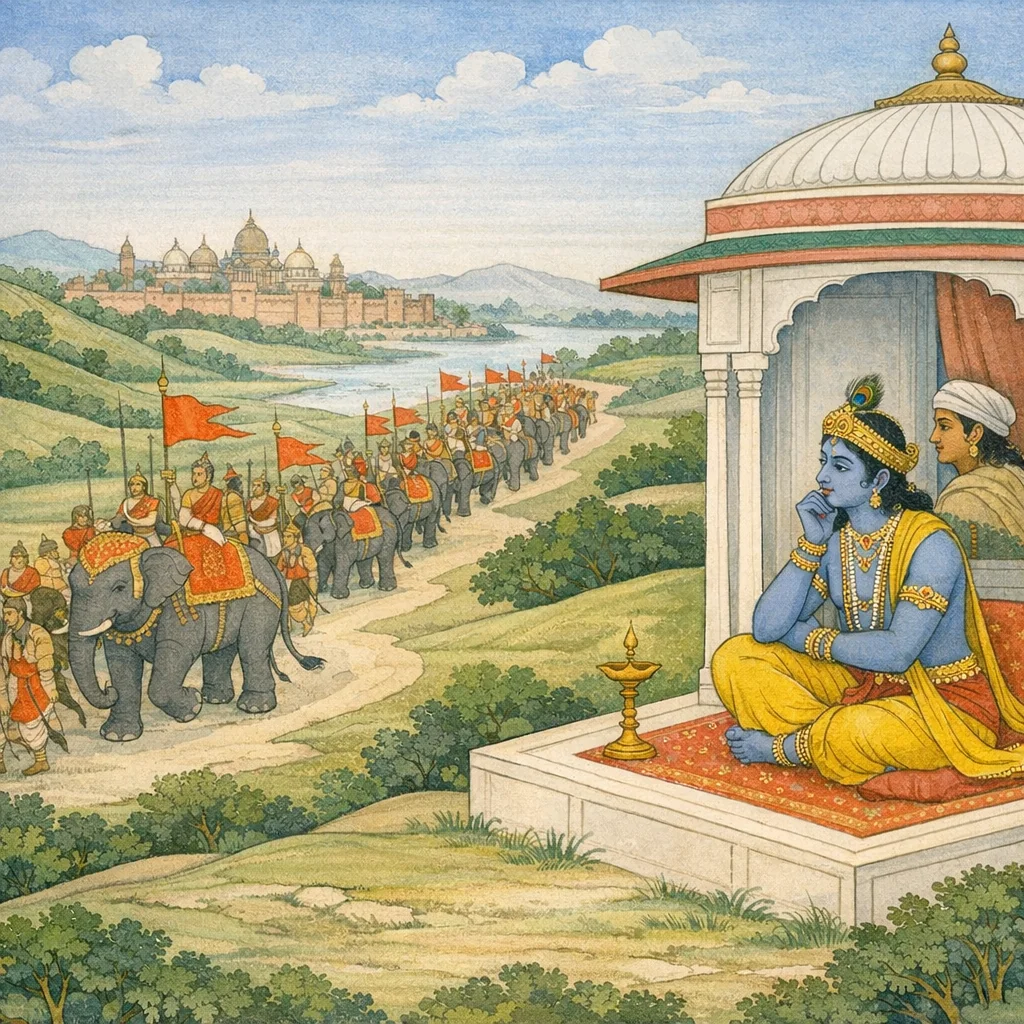
Parāśara tells Maitreya how the brāhmaṇa Gārgya, stung by insult, performs fierce tapas in the south; Mahādeva grants him a boon, and through Yavana association a son, Kālayavana, is born and enthroned. Proud of his might, Kālayavana gathers vast mleccha hosts and advances on Mathurā. Śrī Kṛṣṇa weighs the situation: the Yādava forces are weary, and the Yavana menace can also draw Jarāsandha of Magadha within reach; so He resolves to raise an unconquerable stronghold. Govinda petitions the ocean for twelve yojanas of land, founds Dvārakā, and moves Mathurā’s people to safety. Kṛṣṇa then returns unarmed, lures the Yavana-lord into a cave where King Muchukunda sleeps by divine boon—whoever wakes him is burned by his fiery glance. Kālayavana strikes the sleeper and is instantly reduced to ashes. Muchukunda beholds Kṛṣṇa, recognizes Him as an aṃśa of Viṣṇu per Garga’s prophecy, and offers a long stuti: Hari as the all-pervading Brahman, the sole refuge from saṃsāra, māyā, karma, and naraka—unfolding śaraṇāgati and Viṣṇu as the ground of all beings.
Shlokas
Verse 1
गार्ग्यं गोष्ठ्यां द्विजं श्यालः षण्ड इत्य् उक्तवान् द्विज यदूनां संनिधौ सर्वे जहसुर् यादवास् ततः
In the cattle-yard, a relative by marriage mocked the Brahmin Gārgya, calling him “Ṣaṇḍa”; and, in the very presence of the Yādavas, they all burst into laughter.
Verse 2
ततः कोपसमाविष्टो दक्षिणापथम् एत्य सः सुतम् इच्छंस् तपस् तेपे यदुचक्रभयावहम्
Then, seized by wrath, he went to the southern region; longing for a son, he performed a fierce austerity, so dreadful that to all who opposed his resolve it was like the fearsome Yadu-disc.
Verse 3
आराधयन् महादेवं सो ऽयश्चूर्णम् अभक्षयत् ददौ वरं च तुष्टो ऽस्मै वर्षे द्वादशमे हरः
Worshipping Mahādeva with steadfast austerity, he sustained himself on iron filings; and in the twelfth year, Hara, pleased with him, granted him a boon.
Verse 4
सभाजयाम् आस च तं यवनेशो ह्य् अनात्मजः तद्योषित्संगमाच् चास्य पुत्रो ऽभूद् अलिसंनिभः
And the lord of the Yavanas—though not of his own lineage—received him with due honor. From union with that woman, a son was born to him, dark and lustrous like a black bee.
Verse 5
तं कालयवनं नाम राज्ये स्वे यवनेश्वरः अभिषिच्य वनं यातो वज्राग्रकठिनोरसम्
Having anointed to his own throne the one named Kālayavana, the lord of the Yavanas withdrew to the forest—his chest firm and unyielding, hard as the point of a thunderbolt.
Verse 6
स तु वीर्यमदोन्मत्तः पृथिव्यां बलिनो नृपान् पप्रच्छ नारदस् तस्मै कथयाम् आस यादवान्
But he, intoxicated by pride in his own prowess, questioned the mighty kings upon the earth. Then Nārada, in reply, began to recount to him the lineage of the Yādavas.
Verse 7
म्लेच्छकोटिसहस्राणां सहस्रैः सो ऽभिसंवृतः गजाश्वरथसंपन्नैश् चकार परमोद्यमम्
Though hemmed in by thousands upon thousands of mleccha hosts, furnished with elephants, horses, and chariots, he still set forth a supreme and unrelenting effort for battle.
Verse 8
प्रययौ चाव्यवच्छिन्नं छिन्नयानो दिने दिने यादवान् प्रति सामर्षो मैत्रेय मथुरां पुरीम्
And so, O Maitreya, day after day he pressed on without pause, his march unbroken; burning with wrath against the Yādavas, he advanced toward the city of Mathurā.
Verse 9
कृष्णो ऽपि चिन्तयाम् आस क्षपितं यादवं बलम् यवनेन रणे गम्यं मागधस्य भविष्यति
Kṛṣṇa too reflected: “The Yādava host has been worn down; and in battle, through the Yavana, the Magadhan will be brought within my reach—so that I may meet and overcome him.”
Verse 10
मागधेन बलं क्षीणं स कालयवनो बली हन्ता तद् इदम् आयातं यदूनां व्यसनं द्विधा
Magadha’s power has waned, and the mighty Kālayavana—the slayer—has arrived. Thus the Yadus’ calamity has come upon them in a double form.
Verse 11
तस्माद् दुर्गं करिष्यामि यदूनाम् अरिदुर्जयम् स्त्रियो ऽपि यत्र युध्येयुः किं पुनर् वृष्णिपुंगवाः
Therefore I shall raise a fortress for the Yadus, one no enemy can overcome; a stronghold where even the women could fight—how much more, then, the foremost heroes of the Vṛṣṇis.
Verse 12
मयि मत्ते प्रमत्ते वा सुप्ते प्रवसिते तथा यादवाभिभवं दुष्टा मा कुर्वंस् त्व् अरयो ऽधिकाः
Whether I am intoxicated, heedless, asleep, or even away from the city—let not the wicked and overbold enemies dare to disgrace and overthrow the Yādavas.
Verse 13
इति संचिन्त्य गोविन्दो योजनानि महोदधिम् ययाचे द्वादश पुरीं द्वारकां तत्र निर्ममे
Thus reflecting, Govinda petitioned the great ocean for twelve yojanas of space; and upon that granted expanse he established the city of Dvārakā.
Verse 14
महोद्यानां महावप्रां तडागशतशोभिताम् प्राकारगृहसंबाधाम् इन्द्रस्येवामरावतीम्
It was a city of vast pleasure-gardens and lofty ramparts, beautified by hundreds of lotus-ponds; dense with mansions and encircling walls—like Amarāvatī itself, Indra’s celestial capital.
Verse 15
मथुरावासिनो लोकांस् तत्रानीय जनार्दनः आसन्ने कालयवने मथुरां च स्वयं ययौ
Janārdana brought the people of Mathurā to a place of safety; and as Kālayavana drew near, he himself went to Mathurā, taking the peril upon his own person to protect his devotees.
Verse 16
बहिर् आवसिते सैन्ये मथुराया निरायुधः निर्जगाम स गोविन्दो ददृशे यवनेश्वरम्
When the army had encamped outside, Govinda—unarmed—went forth from Mathurā and beheld the Yavana-lord.
Verse 17
स ज्ञात्वा वासुदेवं तं बाहुप्रहरणो नृपः अनुयातो महायोगिचेतोभिः प्राप्यते न यः
Recognizing Him as Vāsudeva, King Bāhu—famed for the might of his arms—followed after Him: that Lord whom even the concentrated minds of great yogins cannot attain.
Verse 18
तेनानुयातः कृष्णो ऽपि प्रविवेश महागुहाम् यत्र शेते महावीर्यो मुचुकुन्दो नरेश्वरः
Pursued by him, Krishna too entered a vast cavern—where the mighty king Muchukunda, lord among men, lay asleep.
Verse 19
सो ऽपि प्रविष्टो यवनो दृष्ट्वा शय्यागतं नरम् पादेन ताडयाम् आस मत्वा कृष्णं सुदुर्मतिः
That Yavana too entered within; and seeing a man lying upon a couch, the wicked-minded one—mistaking him for Krishna—began to strike him with his foot.
Verse 20
दृष्टमात्रश् च तेनासौ जज्वाल यवनो ऽग्निना तत्क्रोधजेन मैत्रेय भस्मीभूतश् च तत्क्षणात्
The moment he was merely looked upon by him, that Yavana blazed up in fire—born of the king’s wrath; and, O Maitreya, in that very instant he was reduced to ashes.
Verse 21
स हि देवासुरे युद्धे गतो जित्वा महासुरान् निद्रार्तः सुमहत् कालं निद्रां वव्रे वरं सुरान्
For he went forth to the war of gods and demons; and having conquered the mighty Asuras, wearied by sleep, he chose from the Devas as a boon the gift of slumber for a very long span of time.
Verse 22
प्रोक्तश् च देवैः संसुप्तं यस् त्वाम् उत्थापयिष्यति देहजेनाग्निना सद्यः स तु भस्मीभविष्यति
Thus have the gods declared: while you lie in deep slumber, whoever seeks to awaken you will at once be reduced to ashes by the fire that springs from your own body.
Verse 23
एवं दग्ध्वा स तं पापं दृष्ट्वा च मधुसूदनम् कस् त्वम् इत्य् आह सो ऽप्य् आह जातो ऽहं शशिनः कुले वसुदेवस्य तनयो यदोर् वंशसमुद्भवः
Having thus burned that wicked one to ashes, the onlooker beheld Madhusūdana and asked, “Who are you?” He replied, “I am born in the lunar race—son of Vasudeva, arisen from the lineage of Yadu.”
Verse 24
मुचुकुन्दो ऽपि तत्रासौ वृद्धगर्गवचो ऽस्मरत्
There, Muchukunda too—right in that moment—remembered the words once spoken by the aged sage Garga.
Verse 25
संस्मृत्य प्रणिपत्यैनं सर्वं सर्वेश्वरं हरिम् प्राह ज्ञातो भवान् विष्णोर् अंशस् त्वं परमेश्वर
Recollecting and bowing down to that Hari—who is all, the Lord of all—he said: “You are now known to me; you are indeed a portion of Viṣṇu, O Supreme Lord.”
Verse 26
पुरा गर्गेण कथितम् अष्टाविंशतिमे युगे द्वापरान्ते हरेर् जन्म यदोर् वंशे भविष्यति
Long ago, Garga foretold that in the twenty-eighth age-cycle—at the close of the Dvāpara—Hari Himself would take birth within the lineage of Yadu.
Verse 27
स त्वं प्राप्तो न संदेहो मर्त्यानाम् उपकारकृत्
Truly you have arrived—there is no doubt; you are the benefactor of mortals, bringing them help and welfare.
Verse 28
तथा हि सुमहत् तेजो नालं सोढुम् अहं तव तथा हि सजलाम्भोदनादधीरतरं तव वाक्यं नमति चैवोर्वी युष्मत्पादप्रपीडिता
Indeed, your radiance is so vast that I cannot endure it. Your utterance is graver and more overpowering than a rain-laden thundercloud; even the Earth bows, pressed beneath your feet.
Verse 29
देवासुरमहायुद्धे दैत्यसैन्यमहाभटाः न सेहुर् मम तेजस् ते त्वत्तेजो न सहाम्य् अहम्
In the mighty war between Devas and Asuras, the great champions of the Daitya host could not endure my splendor. Yet I too cannot bear the radiance that is yours; your power surpasses mine.
Verse 30
संसारपतितस्यैको जन्तोस् त्वं शरणं परम् स प्रसीद प्रपन्नार्तिहन्तर् हर ममाशुभम्
For a creature fallen into the whirl of saṃsāra, you alone are the highest refuge. Be gracious, O Hari, remover of the anguish of those who surrender; take away my evil and inauspiciousness.
Verse 31
त्वं पयोनिधयः शैलाः सरितस् त्वं वनानि च मेदिनी गगनं वायुर् आपो ऽग्निस् त्वं तथा मनः
You are the oceans and the mountain ranges; you are the rivers and the forests. You are the earth, the sky, the wind; you are the waters and the fire—and you are the mind itself.
Verse 32
बुद्धिर् अव्याकृतं प्राणाः प्राणेशस् त्वं तथा पुमान् पुंसः परतरं यच् च व्याप्य् अजन्मविकल्पवत्
You are buddhi itself; You are the Unmanifest (avyākṛta); You are the prāṇas and the Lord of prāṇa. You are the Purusha—and also That which is beyond the purusha. Pervading all, You abide unborn, free from every conceptual division and limiting alternative.
Verse 33
शब्दादिहीनम् अजरम् अमेयं क्षयवर्जितम् अवृद्धिनाशं तद् ब्रह्म त्वम् आद्यन्तविवर्जितम्
You are that Brahman—beyond sound and every limiting designation; unborn, immeasurable, and free from decay; untouched by growth or destruction; without beginning or end.
Verse 34
त्वत्तो ऽमराः सपितरो यक्षगन्धर्वकिंनराः सिद्धाश् चाप्सरसस् त्वत्तो मनुष्याः पशवः खगाः
From You arise the immortals and the Pitṛs; from You come the Yakṣas, Gandharvas, and Kiṃnaras. From You are born the Siddhas and the Apsarases; and from You, too, spring humankind, the beasts, and the birds.
Verse 36
अमूर्तं मूर्तम् अथवा स्थूलं सूक्ष्मतरं स्थितम् तत् सर्वं त्वं जगत्कर्तर् नास्ति किंचित् त्वया विना
Whether as the formless or as the formed; whether abiding as the gross or established as the subtlest—O Maker of the world, all of that is You. Nothing whatsoever exists apart from You.
Verse 37
मया संसारचक्रे ऽस्मिन् भ्रमता भगवन् सदा तापत्रयाभिभूतेन न प्राप्ता निर्वृतिः क्वचित्
O Blessed Lord, as I have wandered ceaselessly within this revolving wheel of saṃsāra, crushed by the threefold afflictions, I have never—at any time—found nirvṛti, true peace and release.
Verse 38
दुःखान्य् एव सुखानीति मृगतृष्णाजलाशया मया नाथ गृहीतानि तानि तापाय चाभवन्
O Lord, mistaking suffering itself for happiness—like one who hopes for water in a mirage—I pursued and seized those pleasures; and they only became fuel for my burning anguish.
Verse 39
राज्यम् उर्वी बलं कोशो मित्रपक्षस् तथात्मजाः भार्या भृत्यजनो ये च शब्दाद्या विषयाः प्रभो
Sovereignty and land, armed strength and treasury; allies and one’s sons; wife and dependents—and even the sense-objects beginning with sound: all these, O Lord, gather around power and fortune, and are counted among the outward possessions of embodied life.
Verse 40
सुखबुद्ध्या मया सर्वं गृहीतम् इदम् अव्यय परिणामे तद् एवेश तापात्मकम् अभून् मम
Thinking it would bring happiness, I took hold of all this as though it were lasting and secure. Yet, O Lord, when its consequences unfolded, that very same thing became, for me, nothing but burning sorrow.
Verse 41
देवलोकगतिं प्राप्तो नाथ देवगणो ऽपि हि मत्तः साहाय्यकामो ऽभूच् शाश्वती कुत्र निर्वृतिः
O Lord—though the host of gods attained the path to heaven, even they came to seek help from me. Where, then, is everlasting peace to be found in any realm of the world?
Verse 42
त्वाम् अनाराध्य जगतां सर्वेषां प्रभवास्पदम् शाश्वती प्राप्यते केन परमेश्वर निर्वृतिः
O Parameśvara—foundation and source from which all worlds arise—without worshipping You, by whom could everlasting peace and final contentment ever be attained?
Verse 43
त्वन्मायामूढमनसो जन्ममृत्युजरादिकम् अवाप्य तापान् पश्यन्ति प्रेतराजाननं नराः
O Lord, men whose minds are deluded by Your māyā fall into the torments of birth, death, old age, and the like; and after enduring those burning pains, they behold the dreadful face of Yama, the king of the departed.
Verse 44
ततो निजक्रियासूतिनरकेष्व् अतिदारुणम् प्राप्नुवन्ति नरा दुःखम् अस्वरूपविदस् तव
Thereafter, O you who do not know your true nature, men are born into the hells fashioned by their own deeds, and there they undergo sufferings of the most dreadful kind.
Verse 45
अहम् अत्यन्तविषयी मोहितस् तव मायया ममत्वगर्वगर्तान्तर् भ्रमामि परमेश्वर
O Supreme Lord, I am utterly bound to sense-objects; deluded by Your māyā, I wander within the pit of possessiveness and pride.
Verse 46
सो ऽहं त्वां शरणम् अपारम् ईशम् ईड्यं संप्राप्तः परमपदं यतो न किंचित् संसारश्रमपरितापतप्तचेता निर्वाणे परिणतधाम्नि साभिलाषः
Therefore I, my heart scorched by the toil and burning afflictions of samsāra, have come to You for refuge—You, the boundless Lord, worthy of praise. I long for that highest state beyond which there is nothing: the abode matured into nirvāṇa, where all becoming is stilled.
Frequently Asked Questions
The text presents Dvārakā as a strategic dharmic fortress to protect the Yādavas and civilians from compounded threats, while allowing Kṛṣṇa to carry the danger personally and reorder political conditions.
It identifies Hari as the source of all beings and elements, beyond conceptual limitation, and as the only ultimate refuge for the saṃsāra-bound—linking devotion (bhakti/śaraṇāgati) with Brahman-metaphysics.