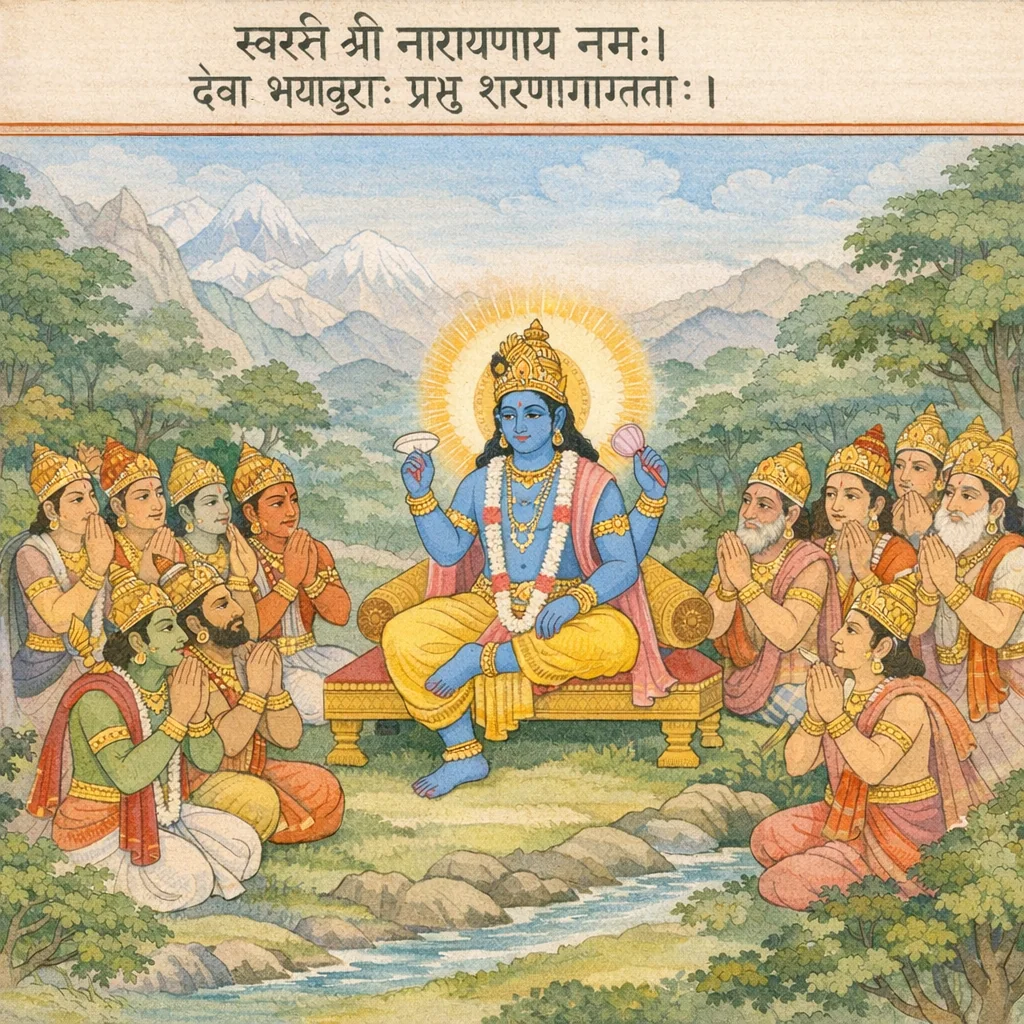
Adhyaya 2
इक्ष्वाकुवंश-प्रसङ्गः, पुरंजय-दैवसाहाय्य-कथा, युवनाश्व-मांधातृ-उत्पत्तिः, सौभरि-वैराग्योपदेशः
Parāśara continues the Solar/Ikṣvāku genealogies, tracing successions such as Nābhāga → Ambarīṣa → Virūpa, and noting descendants who, though Kṣatriya by birth, are remembered as Aṅgirasa-rathītaras. The Vikukṣi episode teaches ritual impurity and śrāddha norms: he eats a hare from meat set aside for offering, so Vasiṣṭha rejects the tainted oblation. In Tretā-yuga, devas defeated by asuras worship Viṣṇu; Nārāyaṇa promises to enter Purāñjaya as an aṃśa to destroy the demons, and Purāñjaya fights mounted on Indra’s shoulders. The narrative proceeds to Yuvanāśva and the wondrous birth of Māndhātṛ through mantra-purified water, followed by his vast sovereignty and progeny. Saubhari’s story becomes the chief instruction: seeing the joy of a fish family, his samādhi collapses through saṅga and he longs for household life; the text then shows the endless multiplication of desires, the sorrow of parigraha, and the need for niḥsaṅgatā. It culminates in renewed bhakti and śaraṇāgati to Viṣṇu as the supreme Guru and final refuge.
Shlokas
Verse 5
नभगस्यात्मजो नाभागसंज्ञो ऽभवत् । तस्य अम्बरीषः । अम्बरीषस्यापि विरूपो ऽभवत् ॥
Nabhāga had a son who became known as Nābhāga. From Nābhāga was born Ambarīṣa; and from Ambarīṣa, in turn, was born Virūpa.
Verse 7
एते क्षत्रप्रसूता वै पुनश् चाङ्गिरसाः स्मृताः । रथीतराणां प्रवराः क्षत्रोपेता द्विजातयः ॥
These, though born from the Kṣatriya line, are again remembered as Aṅgirasas; foremost among the Rathītaras, they are ‘twice-born’ men, invested with the rank and authority of Kṣatriyas.
Verse 9
तस्य पुत्रशतप्रवरा विकुक्षिनिमिदण्डाख्यास् त्रयः पुत्रा । शकुनिप्रमुखाः पञ्चाशत् पुत्राः उत्तरापथरक्षितारो बभूवुः । चत्वारिंशद् अष्टौ च दक्षिणापथभूपालाः ॥
Among his hundred eminent sons, three were especially renowned by the names Vikukṣi, Nimidaṇḍa, and others of that line. Of his sons, fifty—led by Śakuni—became guardians of the Northern region (Uttarāpatha); and forty-eight became kings who ruled the Southern region (Dakṣiṇāpatha).
Verse 10
स चेक्ष्वाकुर् अष्टकायाम् उत्पाद्य श्राद्धार्हं मांसम् आनयेति विकुक्षिम् आज्ञापयाम् आस । स तथेति गृहीताज्ञो वनम् अभ्येत्यानेकान् मृगान् हत्वातिश्रान्तो ऽतिक्षुत्परीतो विकुक्षिर् एकं शशम् अभक्षयत् । शेषं च मांसम् आनीय पित्रे निवेदयाम् आस ॥
When Aṣṭakā was to be honored, Ikṣvāku commanded Vikukṣi: “Bring meat fit to be offered in the śrāddha.” Accepting his father’s order, Vikukṣi went into the forest and, after killing many deer, became utterly exhausted and tormented by hunger. Overcome by that craving, he ate one hare himself; then he brought back the remaining meat and presented it to his father.
Verse 11
इक्ष्वाकुकुलाचार्यस् तत्प्रोक्षणाय वसिष्ठश् चोदितः प्राह । अलम् अनेनामेध्येनामिषेण दुरात्मनानेन ते पुत्रेणैतन् मांसम् उपहतं यतो ऽनेन शशो भक्षितः ॥
When the preceptor of Ikṣvāku’s line urged Vasiṣṭha to consecrate (the offering), the sage spoke: “Enough of this impure flesh! This meat has been tainted by your wicked son—for it was he who ate the hare.”
Verse 15
इदं चान्यत् पुरा हि त्रेतायां देवासुरम् अतीव भीषणं युद्धम् आसीत् । तत्र चातिबलिभिर् असुरैर् अमराः पराजिता भगवन्तं विष्णुम् आराधयां चक्रुः ॥
And this, too, is another ancient account: in the Tretā-yuga there arose a most dreadful war between the Devas and the Asuras. There, the immortals—overpowered and defeated by Asuras of immense strength—turned in worshipful supplication to Bhagavān Viṣṇu.
Verse 16
प्रसन्नश् च देवानाम् अनादिनिधनः सकलजगत्परायणो नारायणः प्राह । ज्ञातम् एव मया युष्माभिर् यद् अभिलषितं तदर्थम् इदं श्रूयताम् । पुरंजयो नाम शशादस्य च राजर्षेस् तनयः क्षत्रियवर्यस् तच्छरीरे ऽहम् अंशेन स्वयम् एवावतीर्य तान् अशेषान् असुरान् निहनिष्यामि तद् भवद्भिः पुरंजयो ऽसुरवधार्थाय कार्योद्योगः कार्य इति एतच् च श्रुत्वा प्रणम्य भगवन्तं विष्णुम् अमराः पुरंजयसकाशम् आजग्मुः ॥
Pleased with the gods, Nārāyaṇa—beginningless and endless, the supreme refuge toward whom the whole universe tends—spoke: “I already know what you have desired. Therefore hear what is to be done for that very purpose. There is a prince named Purāñjaya, the son of the royal sage Śaśāda, a foremost among kṣatriyas. Entering his body Myself as a portion of My power, I shall personally destroy all those asuras without remainder. Therefore, let Purāñjaya be set in motion by you for the task of slaying the demons.” Having heard this, the immortals bowed to Lord Viṣṇu and went to Purāñjaya’s presence.
Verse 17
ऊचुश् चैनं । भो भोः क्षत्रियवर्यास्माभिर् अभ्यर्थितेन भवतास्माकम् अरातिवधोद्यतानां साहाय्यं कृतम् इच्छामः । तद् भवतास्माकम् अभ्यागतानां प्रणयभङ्गो न कार्यः । इत्य् उक्तः पुरंजयः प्राह । सकलत्रैलोक्यनाथो यो ऽयं युष्माकम् इन्द्रः शतक्रतुर् अस्य यद्य् अहं स्कन्धारूढो युष्मदरातिभिः सह योत्स्ये तदाहं भवतां सहायः । इत्य् आकर्ण्य समस्तदेवैर् इन्द्रेण च बाढम् इत्य् एवं समन्विच्छितम् ॥
They said to him: “O best of kṣatriyas, since you have been entreated by us, we desire that you render aid to us who are poised to slay our foes. Therefore, for us who have come to you in trust, do not break the bond of friendship.” Thus addressed, Puraṁjaya replied: “Indra—your Śatakratu—is the lord of all the three worlds. If I, mounted upon his shoulders, should fight together with you against your enemies, then indeed I shall be your ally.” Hearing this, all the gods, and Indra as well, consented, saying, “So be it”—and thus the agreement was settled.
Verse 24
दृढाश्वाद् धर्यश्वस् तस्मान् निकुम्भो निकुम्भात् संहिताश्वः । ततश् च कृशाश्वस् । तस्माच् च प्रसेनजित् ततो युवनाश्वो ऽभवत् ॥
From Dṛḍhāśva was born Dharyaśva; from him came Nikumbha; from Nikumbha arose Saṃhitāśva. Thereafter came Kṛśāśva; from him was born Prasenajit; and then Yuvanāśva came to be.
Verse 25
तस्य चापुत्रस्यातिनिर्वेदान् मुनीनाम् आश्रममण्डले निवसतः कृपालुभिस् तैर् मुनिभिर् अपत्योत्पादनाय इष्टिः कृता । तस्यां च मध्यरात्रिनिवृत्तायां मन्त्रपूतजलपूर्णं कलशं वेदिमध्ये निवेश्य ते मुनयः सुषुपुः ॥
Seeing the profound despondency of that sonless man who dwelt within the precincts of the sages’ hermitage, those compassionate munis performed an iṣṭi sacrifice to bring forth offspring. When the middle of the night had passed, they set in the very center of the altar a jar filled with water—purified and empowered by mantra—and then the sages lay down to rest.
Verse 27
सुप्तांश् च तान् ऋषीन् नैवोत्थापयाम् आस । तच् च कलशजलम् अपरिमेयमाहात्म्यं मन्त्रपूतं पपौ ॥
He did not awaken the sages who slept; instead, he drank the water kept in that vessel—of immeasurable sanctity, purified by sacred mantras.
Verse 34
ततो मांधाता नामतो ऽभवत् । वक्त्रे चास्य प्रदेशिनी देवराजेन न्यस्ता तां पपौ । तां चामृतस्राविणीम् आस्वाद्याह्नैव स व्यवर्धत ॥
Thereafter he came to be known as Māndhātṛ. When the Lord of the gods placed his index finger into the child’s mouth, the child drank from it; tasting that essence which streamed like nectar, he grew to full strength within a single day.
Verse 36
भवति चात्र श्लोकः । यावत् सूर्य उदेति स्म यावच् च प्रतितिष्ठति । सर्वं तद् यौवनाश्वस्य मांधातुः क्षेत्रम् उच्यते ॥
And here a verse is recited: “As far as the sun rises, and as far as it comes to rest—everything within that span is proclaimed to be the realm of Māndhātṛ, son of Yuvanāśva.”
Verse 37
मांधाता शशबिन्दोर् दुहितरं बिन्दुमतीम् उपयेमे । पुरुकुत्सम् अम्बरीषं च मुचकुन्दं च तस्यां पुत्रत्रयम् उत्पादयाम् आस ॥
Māndhātṛ took to wife Bindumatī, the daughter of Śaśabindu; and through her he begot three sons—Purukutsa, Ambarīṣa, and Mucukunda—by whom the royal line was carried forward in due order.
Verse 40
तत्र चान्तर्जले संमदो नामातिबहुप्रजो ऽतिप्रमाणो मीनाधिपतिर् आसीत् । तस्य च पुत्रपौत्रदौहित्राः पार्श्वतः पृष्ठतो ऽग्रतो वक्षःपुच्छशिरसां चोपरि भ्रमन्तस् तेनैव सहाहर्निशम् अतिनिर्वृता रेमिरे ॥
There, within the waters, there was a lord of fishes named Sammada—of immense size and exceedingly prolific. His sons, grandsons, and grandsons through daughters swarmed around him... Moving in ceaseless circles about him, they sported with him day and night, utterly content.
Verse 42
अथान्तर्जलावस्थितः स सौभरिर् एकाग्रतासमाधानम् अपहायानुदिनं तत् तस्य मत्स्यस्यात्मजपौत्रदौहित्रादिभिः सहातिरमणीयं ललितम् अवेक्ष्याचिन्तयत् । अहो धन्यो ऽयम् ईदृशम् अप्य् अनभिमतं योन्यन्तरम् अवाप्यैभिर् आत्मजपौत्रादिभिः सह रममाणो ऽतीवास्माकं स्पृहाम् उत्पादयति । वयम् अप्य् एवं पुत्रादिभिः सह रमिष्यामः । इत्य् एवम् अभिसमीक्ष्य स तस्माद् अन्तर्जलान् निष्क्रम्य निर्वेष्टुकामः कन्यार्थं मांधातारं राजानम् अगच्छत् ॥
Then Saubhari, remaining beneath the waters... let go of the gathered steadiness of one-pointed samādhi. Watching the exceedingly delightful play of that fish... he began to reflect... "I too shall rejoice in the same way, together with sons and family." Having thus considered, he emerged from the waters; and... went to King Māndhātṛ to seek daughters in marriage.
Verse 44
निर्वेष्टुकामो ऽस्मि नरेन्द्र कन्यां प्रयच्छ मे मा प्रणयं विभाङ्क्षीः न ह्य् अर्थिनः कार्यवशाभ्युपेताः ककुत्स्थगोत्रे विमुखाः प्रयान्ति
O king, I desire to be joined in marriage—grant me your daughter. Do not frustrate my purpose by withholding your consent; for those who come as petitioners... do not depart turned away when they have approached the illustrious house of Kakutstha.
Verse 45
अन्ये ऽपि सन्त्य् एव नृपाः पृथिव्यां क्ष्मापाल येषांतनयाः प्रसूताः किंत्व् अर्थिनाम् अर्थितदानदीक्षा कृतव्रतं श्लाघ्यम् इदं कुलं ते
Other kings too indeed exist upon the earth... Yet this is the praiseworthy distinction of your family: it has taken up as a solemn vow the consecrated discipline of granting to supplicants exactly what they seek.
Verse 46
शतार्धसंख्यास् तव सन्ति कन्यास् तासां ममैकां नृपते प्रयच्छ यत् प्रार्थनाभङ्गभयाद् बिभेमि तस्माद् अहं राजवरातिदुःखात्
“You have daughters numbering a hundred and fifty, O king; grant me just one of them. I ask because I fear the disgrace of a refused request—and because, O best of kings, I am sorely distressed.”
Verse 48
नरेन्द्र कस्मात् समुपैषि चिन्ताम् अशक्यम् उक्तं न मयात्र किंचित् यावश्यदेया तनया तयैव कृतार्थता नो यदि किं न लब्धम्
O king, why do you give yourself over to anxiety? I have spoken nothing here that is impossible. So long as the daughter who must be bestowed is given to him, our purpose is fulfilled—what, then, is there that has not been obtained?
Verse 50
अहो ऽयम् अन्यो ऽस्मत्प्रत्याख्यानोपायो वृद्धो ऽयम् अनभिमतः स्त्रीणां किम् उत कन्यानाम् इत्य् अमुना संचिन्त्यैवम् अभिहितम् । एवम् अस्तु तथा करिष्यामीति संचिन्त्य मांधातारम् उवाच ॥
“Ah! Here is another way to refuse me,” she thought. “He is old—unwelcome to women, how much more to an unmarried maiden.” Having reflected thus, she spoke in this manner. Then, resolving, “So be it; I shall do exactly so,” she addressed King Māndhātṛ.
Verse 51
यद्य् एवं तदादिश्यताम् अस्माकं प्रवेशाय कन्यान्तःपुरवर्षवरः । यदि कन्यैव काचिन् माम् अभिलषति तदाहं दारसंग्रहं करिष्यामीत्य् अन्यथा चेत् तद् अलम् अस्माकम् एतेनातीतकालारम्भेनेत्य् उक्त्वा विरराम ॥
"If that is so, then let the foremost of the palace-attendants of the maidens be instructed to admit us within. If some maiden herself desires me, then indeed I shall accept a wife; but if not, then enough of this—enough for us of this beginning of a time already gone by." Saying thus, he fell silent.
Verse 56
अलं भगिन्यो ऽहम् इमं वृणोमि वृतो मया नैष तवानुरूपः ममैव भर्ता विधिनैष सृष्टः सृष्टाहम् अस्योपशमं प्रयाहि
“Enough, sisters—this is the one I choose; I have chosen him. He is not, in truth, a match for you. By the ordinance of destiny he has been fashioned to be my husband, and I too have been fashioned for him. Therefore, set aside this agitation and go in peace.”
Verse 57
वृतो मयायं प्रथमं मयायं गृहं विशन्न् एव विहन्यसे किम् मया मयेति क्षितिपात्मजानां तदर्थम् अत्यर्थकलिर् बभूव
I chose him first; I was the first to accept him. Why, then, do you strike him even as he enters the house? “He is mine—mine!”—for that very claim of possession, a fierce and ruinous quarrel arose among the king’s sons.
Verse 58
यदा तु सर्वाभिर् अतीव हार्दाद् वृतः स कन्याभिर् अनिन्द्यकीर्तिः तदा स कन्याधिकृतो नृपाय यथावद् आचष्ट विनम्रमूर्तिः
But when that man of blameless fame was warmly surrounded by all the maidens, the officer appointed over the maidens—humble in bearing—reported the matter to the king exactly as it had occurred.
Verse 78
मनोरथानां न समाप्तिर् अस्ति वर्षायुतेनापि तथाब्दलक्षैः पूर्णेषु पूर्णेषु पुनर् नवानाम् उत्पत्तयः सन्ति मनोरथानाम्
There is no end to the mind’s longings—not even with a life of ten thousand years, nor even when hundreds of thousands of years are fully spent. Again and again, as each desire is fulfilled, new desires are born.
Verse 79
पद्भ्यां गता यौवनिनश् च जाता दारैश् च संयोगम् इताः प्रसूताः दृष्टाः सुतास् तत्तनयप्रसूतिं द्रष्टुं पुनर् वाञ्छति मे ऽन्तरात्मा
I have watched my children grow—first learning to walk, then entering youth; I have seen them joined in marriage and become parents. Yet even after beholding my sons, my inmost self still longs to see the birth of their children as well—ever reaching onward, never satisfied.
Verse 80
द्रक्ष्यामि तेषाम् अपि चेत् प्रसूतिं मनोरथो मे भविता ततो ऽन्यः पूर्णे ऽपि तत्राप्य् अपरस्य जन्म निवार्यते केन मनोरथस्य
Even if I were to behold the birth of their progeny, another desire would arise in me after that. For even when one wish is fulfilled, who can prevent the mind from giving birth to yet another longing?
Verse 81
आमृत्युतो नैव मनोरथानाम् अन्तो ऽस्ति विज्ञातम् इदं मयाद्य मनोरथासक्तिपरस्य चित्तं न जायते वै परमार्थसङ्गि
Today I have understood this with certainty: until death there is truly no end to the mind’s cravings. For one whose heart clings to mere wishes and fantasies, the mind never becomes a companion of the Highest Good (paramārtha).
Verse 82
स मे समाधिर् जलवासमित्र मत्स्यस्य सङ्गात् सहसैव नष्टः परिग्रहः सङ्गकृतो ममायं परिग्रहोत्था च महाविधित्सा
O friend who dwells in the waters! By association with the fish, my samādhi was suddenly destroyed. This grasping sense of possession was fashioned by attachment itself, and from it arose a great craving to secure and control.
Verse 83
दुःखं यदैवैकशरीरजन्म शतार्धसंख्यं यद् इदं प्रसूतम् परिग्रहेण क्षितिपात्मजानां सुतैर् अनेकैर् बहुलीकृतं तत्
That sorrow which is born along with a single embodied life—already brought forth in countless measures—becomes multiplied still more through attachment and possession, and through the many sons of kings’ daughters and their proliferating lineages.
Verse 84
सुतात्मजैस् तत्तनयैश् च भूयो भूयश् च तेषां स्वपरिग्रहेण विस्तारम् एष्यत्य् अतिदुःखहेतुः परिग्रहो वै ममतानिधानम्
Through sons and grandsons—and again through their descendants—one’s own sense of possession keeps spreading further and further. This expansion becomes a cause of exceedingly great sorrow, for grasping accumulation is truly the storehouse of “mine-ness.”
Verse 85
चीर्णं तपो यत् तु जलाश्रयेण तस्यर्द्धिर् एषा तपसो ऽन्तरायः मत्स्यस्य सङ्गाद् अभवच् च यो मे सुतादिरागो मुषितो ऽस्मि तेन
The austerity I performed while dwelling in the waters—this very attainment has become an obstacle to that tapas. For through my association with the fish, attachment arose in me, beginning with the longing for a “son”; and by that I have been robbed of my former detachment.
Verse 86
निःसङ्गता मुक्तिपदं यतीनां सङ्गाद् अशेषाः प्रभवन्ति दोषाः आरूढयोगो ऽपि निपात्यते ऽधः सङ्गेन योगी किम् उताल्पसिद्धिः
For renunciants, non-attachment is itself the gateway to liberation; from company, all faults arise without remainder. Even one ascended in yoga is cast down by association—how much more a yogin of slight attainment?
Verse 87
अहं चरिष्यामि तथात्मनो ऽर्थे परिग्रहग्राहगृहीतबुद्धिः यथा हि भूयः परिहीनदोषो जनस्य दुःखैर् भविता न दुःखी
Thus will I live for my own true good—my mind no longer seized by the urge to grasp and hoard possessions—so that, once more free from fault, I may not become one who suffers when the people suffer.
Verse 88
सर्वस्य धातारम् अचिन्त्यरूपम् अणोर् अणीयांसम् अतिप्रमाणम् सितासितं चेश्वरम् ईश्वराणाम् आराधयिष्ये तपसैव विष्णुम्
I shall worship Vishnu through austerity alone—Vishnu, the sustainer of all, whose form is beyond thought; subtler than the subtlest atom, yet immeasurable beyond all measure; the Lord both fair and dark, the Sovereign over all sovereigns.
Verse 89
तस्मिन्न् अशेषौजसि सर्वरूपिण्य् अव्यक्तविस्पष्टतनाव् अनन्ते ममाचलं चित्तम् अपेतदोषं सदास्तु विष्णाव् अभवाय भूयः
May my mind—steady and freed from fault—rest forever, again and again, in Vishnu: in that endless One of inexhaustible splendour, who bears all forms, whose body is at once unmanifest and yet clearly revealed, the Supreme beyond decay and becoming.
Verse 90
समस्तभूताद् अमलाद् अनन्तात् सर्वेश्वराद् अन्यद् अनादिमध्यात् यस्मान् न किंचित् तम् अहं गुरूणां परं गुरुं संश्रयम् एमि विष्णुम्
I take refuge in Vishnu—the supreme Guru of all teachers—who is stainless, infinite, Lord of all, beyond the totality of beings; without beginning or middle; and apart from whom nothing whatsoever exists.
Frequently Asked Questions
It illustrates that offerings intended for ancestral rites must remain ritually untainted; personal consumption (especially of the designated portion) renders the meat impure for consecration. Vasiṣṭha’s refusal underscores dharma as precision in ritual conduct, not merely intent.
Viṣṇu does not merely grant external aid; He declares entry into Purāñjaya ‘as a portion’ (aṃśa) to accomplish asura-vadha. This models divine immanence operating through a righteous kṣatriya instrument while maintaining Viṣṇu’s supremacy as the ultimate agent.
Saṅga (association/attachment) destabilizes even advanced yogic collectedness; parigraha (grasping) multiplies duḥkha through expanding ‘mine-ness’ across descendants and possessions. The teaching culminates in niḥsaṅgatā as the gateway to mokṣa and in devotion/refuge in Viṣṇu as the supreme support of purified mind.