Adhyaya 7
लोकसंस्थानम्, ग्रहदूरी-प्रमाणम्, ब्रह्माण्डावरणानि, विष्णोः जगत्कारणत्वम्
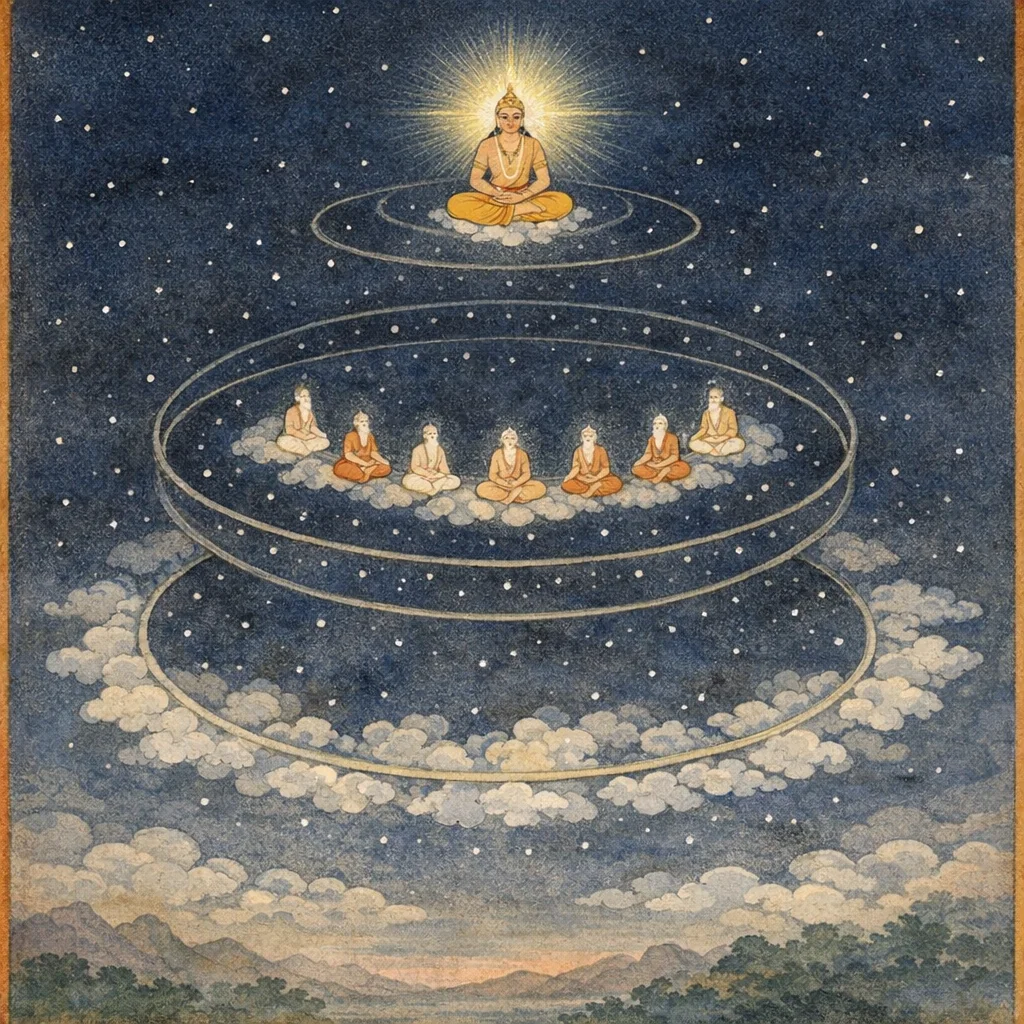
Maitreyā asks Parāśara to explain the order of the lokas from Bhuvarloka upward and the arrangement and measured distances of the grahas. Parāśara defines Earth’s extent as far as the Sun’s and Moon’s rays reach, then gives the successive distances above: Sun, Moon, the nakṣatra-maṇḍala, Budha, Śukra, Maṅgala, Bṛhaspati, Śani, the Saptarṣi-maṇḍala, and Dhruva as the cosmic pivot. He describes the higher lokas above Dhruva—Maharloka, Janaloka, Tapoloka, Satyaloka/Brahmaloka—and sets spatial intervals for Bhūrloka, Bhuvarloka, and Svarga. He distinguishes kṛtaka (made) from akṛtaka (unmade) realms, placing Maharloka between them. The teaching then turns to the brahmāṇḍa shell and the seven tenfold envelopes—water→fire→wind→space→bhūtādi→mahat→pradhāna—and to countless universes. Finally, he grounds cosmology in Vedāntic devotion: Puruṣa within Pradhāna, both upheld by Viṣṇu-śakti; creation proceeds without diminishing its cause; and Hari is the Supreme Brahman—sacrifice, its instruments, and its fruits being non-different from Him.
Shlokas
Verse 1
कथितं भवता ब्रह्मन् ममैतद् अखिलं त्वया भुवर्लोकादिकांल् लोकाञ् श्रोतुम् इच्छाम्य् अहं मुने
O Brahman, you have explained all of this to me in full. Now, O sage, I wish to hear about the worlds beginning with Bhuvarloka—about their order and nature.
Verse 2
तथैव ग्रहसंस्थानं प्रमाणानि यथातथम् समाचक्ष्व महाभाग मह्यं त्वं परिपृच्छते
In the same way, O greatly fortunate one, describe to me—exactly as it truly is—the arrangement of the planets and their respective measures, for I am asking you.
Verse 3
रविचन्द्रमसोर् यावन् मयूखैर् अवभास्यते ससमुद्रसरिच्छैला तावती पृथिवी स्मृता
As far as the rays of the Sun and the Moon spread their illumination, so far is the Earth understood to extend—together with its oceans, its rivers, and its mountains.
Verse 4
यावत्प्रमाणा पृथिवी विस्तारपरिमण्डलात् नभस् तावत्प्रमाणं वै व्यासमण्डलतो द्विज
O twice-born one, the vault of heaven is of the same measure as the Earth—equal in extent by its spread and circumference, and equal also by its diameter and spherical sweep.
Verse 5
भूमेर् योजनलक्षे तु सौरं मैत्रेय मण्डलम् लक्षे दिवाकरस्यापि मण्डलं शशिनः स्थितम्
O Maitreya, at a distance of one hundred thousand yojanas from the Earth lies the solar sphere; and at the same measure from the Sun is situated the sphere of the Moon, each moving in its ordained course.
Verse 6
पूर्णे शतसहस्रे तु योजनानां निशाकरात् नक्षत्रमण्डलं कृत्स्नम् उपरिष्टात् प्रकाशते
At a distance of a full hundred thousand yojanas above the Moon, the entire sphere of the nakṣatras—the whole host of stars—shines forth in the higher expanse.
Verse 7
द्वे लक्षे चोत्तरे ब्रह्मन् बुधो नक्षत्रमण्डलात् तावत्प्रमाणभागे तु बुधस्याप्य् उशना स्थितः
O Brāhmaṇa, Mercury (Budha) is situated two lakṣas and more beyond the sphere of the nakṣatras; and within that same measured interval, beyond Mercury, Venus (Uśanā/Śukra) is also placed.
Verse 8
अङ्गारको ऽपि शुक्रस्य तत्प्रमाणे व्यवस्थितः लक्षद्वये तु भौमस्य स्थितो देवपुरोहितः
Mars (Aṅgāraka) too is set according to the same measure as Venus (Śukra); and at a distance of two lakṣas from Mars abides the divine priest, Bṛhaspati, in his ordained station.
Verse 9
सौरिर् बृहस्पतेश् चोर्ध्वं द्विलक्षे समवस्थितः सप्तर्षिमण्डलं तस्माल् लक्षम् एकं द्विजोत्तम
O best of the twice-born, Śauri (Saturn) abides two lakṣas above Bṛhaspati (Jupiter); and above him, at a distance of one lakṣa, is the great circle of the Saptarṣi-maṇḍala, the Seven Sages.
Verse 10
ऋषिभ्यस् तु सहस्राणां शताद् ऊर्ध्वं व्यवस्थितः मेढीभूतः समस्तस्य ज्योतिश्चक्रस्य वै ध्रुवः
Above the realm of the sages—by a hundred thousand (yojanas)—stands Dhruva, fixed in his station; having become the cosmic pivot, he is indeed the axle-pin for the entire revolving wheel of the lights (stars and planets).
Verse 11
त्रैलोक्यम् एतत् कथितम् उत्सेधेन महामुने इज्याफलस्य भूर् एषा इज्या चात्र प्रतिष्ठिता
Thus, O great sage, the vertical extent of this threefold universe has been declared. This earth is the very ground of the fruit of sacrifice; and sacrifice itself stands established here.
Verse 12
ध्रुवाद् ऊर्ध्वं महर्लोको यत्र ते कल्पवासिनः एकयोजनकोटी तु महर्लोको ऽभिधीयते
Above Dhruva lies Maharloka—where dwell the kalpa-abiding sages. Maharloka is said to extend for a span of one crore (one koṭi) yojanas.
Verse 13
द्वे कोटी तु जनो लोको यत्र ते ब्रह्मणः सुताः सनन्दनाद्याः कथिता मैत्रेयामलचेतसः
The Jana-loka extends for two koṭis; and there dwell the stainless sons of Brahmā—Sanandana and the others—of whom I have spoken, O Maitreya, whose mind is pure.
Verse 14
चतुर्गुणोत्तरे चोर्ध्वं जनलोकात् तपः स्मृतः वैराजा यत्र ते देवाः स्थिता दाहविवर्जिताः
Fourfold above Janaloka is said to be Tapoloka. There dwell the gods called the Vairājas, abiding free from burning heat, pain, and all consuming afflictions.
Verse 15
षड्गुणेन तपोलोकात् सत्यलोको विराजते अपुनर्मारका यत्र ब्रह्मलोको हि स स्मृतः
Beyond Tapoloka, shining with sixfold excellence, stands Satyaloka. There death does not return again; therefore that realm is remembered as Brahmaloka.
Verse 16
पादगम्यं तु यत् किंचिद् वस्त्व् अस्ति पृथिवीमयम् स भूर्लोकः समाख्यातो विस्तरो ऽस्य मयोदितः
Whatever may be traversed on foot—every tangible expanse constituted of the element of earth—is declared to be Bhūrloka, the terrestrial world. Its extent has thus been stated by me.
Verse 17
भूमिसूर्यान्तरं यत् तु सिद्धादिमुनिसेवितम् भुवर्लोकस् तु सो ऽप्य् उक्तो द्वितीयो मुनिसत्तम
That region between the earth and the sun, frequented by the Siddhas and the primordial sages, is also declared to be Bhuvarloka, the second world, O best of sages.
Verse 18
ध्रुवसूर्यान्तरं यत् तु नियुतानि चतुर्दश स्वर्लोकः सो ऽपि गदितो लोकसंस्थानचिन्तकैः
The interval between Dhruva (the Pole Star) and the Sun is said to be fourteen niyutas; and that region is declared to be Svarloka (heaven) by those who contemplate the ordered structure of the cosmos.
Verse 19
त्रैलोक्यम् एतत् कृतकं मैत्रेय परिपठ्यते जनस् तपस् तथा सत्यम् इति चाकृतकं त्रयम्
O Maitreya, this entire threefold world is recited as kṛtaka—fashioned and compounded; yet three realms are declared akṛtaka: Janas, Tapas, and Satya, not constructed like the created cosmos.
Verse 20
कृतकाकृतयोर् मध्ये महर्लोक इति स्मृतः शून्यो भवति कल्पान्ते यो ऽत्यन्तं न विनश्यति
Between the kṛtaka and the akṛtaka is the region remembered as Maharloka; at the end of a kalpa it becomes empty, yet it is not utterly destroyed.
Verse 21
एते सप्त मया लोका मैत्रेय कथितास् तव पातालानि च सप्तैव ब्रह्माण्डस्यैष विस्तरः
Thus, O Maitreya, I have declared to you the seven worlds—and likewise the seven nether realms. This is the full ordered extent of the Brahmāṇḍa, the Cosmic Egg.
Verse 22
एतद् अण्डकटाहेन तिर्यक् चोर्ध्वम् अधस् तथा कपित्थस्य यथा बीजं सर्वतो वै समावृतम्
All this is enclosed by the shell of the Cosmic Egg—sideways, above, and below—on every side, as the seed of the kapittha is wrapped within its fruit.
Verse 23
दशोत्तरेण पयसा मैत्रेयाण्डं च तद् वृतम् सर्वो ऽम्बुपरिधानो ऽसौ वह्निना वेष्टितो बहिः
O Maitreya, that Cosmic Egg is enclosed by water tenfold in measure; and that entire watery sheath, in turn, is surrounded from without by fire.
Verse 24
वह्निश् च वायुना वायुर् मैत्रेय नभसा वृतः भूतादिना नभः सो ऽपि महता परिवेष्टितः दशोत्तराण्य् अशेषाणि मैत्रेयैतानि सप्त वै
Fire is enclosed by wind; and wind, O Maitreya, is enclosed by space. Space is encompassed by bhūtādi, the primal source of the elements; and even that is wrapped about by Mahat, the Great Principle. These are the seven envelopes, each tenfold greater than the one before.
Verse 25
महान्तं च समावृत्य प्रधानं समवस्थितम् अनन्तस्य न तस्यान्तः संख्यानं वापि विद्यते
Pradhāna, the primordial unmanifest, abides—enfolding even Mahat. But of the Infinite, Ananta, there is no limit; neither His measure nor any counting of Him can ever be known.
Verse 26
तद् अनन्तम् असंख्यातप्रमाणं चापि वै यतः हेतुभूतम् अशेषस्य प्रकृतिः सा परा मुने
That Supreme Principle is endless, and its measure is beyond calculation; for it is the causal ground of all, without remainder. That is the higher Prakṛti, O sage.
Verse 27
अण्डानां तु सहस्राणां सहस्राण्य् अयुतानि च ईदृशानां तथा तत्र कोटिकोटिशतानि च
Of such cosmic eggs (brahmāṇḍas) there are thousands upon thousands, tens of thousands besides; indeed, in that immeasurable expanse exist hundreds of crores of crores of universes of the same kind.
Verse 28
दारुण्य् अग्निर् यथा तैलं तिले तद्वत् पुमान् अपि प्रधाने ऽवस्थितो व्यापी चेतनात्मात्मवेदनः
As fire lies hidden in wood and oil abides within the sesame seed, so too does the Puruṣa dwell within Pradhāna: all-pervading, the conscious Self, self-luminous, and knowing itself.
Verse 29
प्रधानं च पुमांश् चैव सर्वभूतात्मभूतया विष्णुशक्त्या महाबुद्धे वृतौ संश्रयधर्मिणौ
O great-minded one, by the Śakti of Viṣṇu—who has become the very Self within all beings—both Pradhāna and Puruṣa are encompassed; thus they abide by nature as dependent realities, taking refuge in Him.
Verse 30
तयोः सैव पृथग्भावकारणं संश्रयस्य च क्षोभकारणभूता च सर्गकाले महामते
O great-minded one, of those two (Prakṛti and Puruṣa), she alone—Prakṛti—becomes the cause of their differentiation and of their conjunction in dependence; and at the time of creation she is also the cause of agitation (kṣobha).
Verse 31
यथा सक्तं जले वातो बिभर्ति कणिकाशतम् शक्तिः सापि तथा विष्णोः प्रधानपुरुषात्मकम्
As wind moving through water bears along hundreds of tiny particles, so too the Śakti of Viṣṇu sustains and carries forth the dual principle of Pradhāna and Puruṣa.
Verse 32
यथा च पादपो मूलस्कन्धशाखादिसंयुतः आदिबीजात् प्रभवति बीजान्य् अन्यानि वै ततः
Just as a tree—endowed with root, trunk, branches, and the rest—arises from an original seed, so too from that (tree) other seeds surely come forth again.
Verse 33
प्रभवन्ति ततस् तेभ्यः संभवन्त्य् अपरे द्रुमाः ते ऽपि तल्लक्षणद्रव्यकारणानुगता मुने
From those arise other trees in turn, and from them yet other trees come into being. Even these, O sage, proceed according to the same defining marks—following their material substance (dravyā) and its causal origin.
Verse 34
एवम् अव्याकृतात् पूर्वं जायन्ते महदादयः विशेषान्तास् ततस् तेभ्यः संभवन्ति सुरादयः तेभ्यश् च पुत्रास् तेषां च पुत्राणाम् अपरे सुताः
Thus, from the Unmanifest (avyākṛta) first arise the principles beginning with Mahat, culminating in the particularized elements (viśeṣas). From these, in due order, come forth the gods and other classes of beings; from them are born sons, and from those sons again are born further descendants—line upon line of progeny.
Verse 35
बीजाद् वृक्षप्ररोहेण यथा नापचयस् तरोः भूतानां भूतसर्गेण नैवास्त्य् अपचयस् तथा
Just as a tree suffers no loss when a sprout arises from a seed, so too there is no diminution when beings bring forth beings in the process of creation.
Verse 36
संनिधानाद् यथाकाशकालाद्याः कारणं तरोः तथैवापरिणामेन विश्वस्य भगवान् हरिः
Just as, by mere proximity, space, time, and the like become the occasioning causes for a tree, so too—without undergoing any transformation—Bhagavān Hari stands as the cause of the universe.
Verse 37
व्रीहिबीजे यथा मूलं नालं पत्राङ्कुरौ तथा काण्डकोषस् तथा पुष्पं क्षीरं तद्वच् च तण्डुलाः
Just as, within a grain-seed of rice, there abides the root, the stalk, and the sprouting leaf; so too there lie within it the sheath of the stem and the flower, and even the milky essence—likewise, in potential, the very rice-grains themselves are already contained.
Verse 38
तुषाः कणाश् च सन्तो वै यान्त्य् आविर्भावम् आत्मनः प्ररोहहेतुसामग्रीम् आसाद्य मुनिसत्तम
Even husks and tiny particles, though seemingly insignificant, come into the full display of their own nature when they obtain the complete set of causes that produces their sprouting—O best of sages.
Verse 39
तथा कर्मस्व् अनेकेषु देवाद्याः समवस्थिताः विष्णुशक्तिं समासाद्य प्ररोहम् उपयान्ति वै
So too, amid the countless modes of action, the gods and other beings stand established; and, attaining the śakti of Viṣṇu, they surely rise onward—growing and advancing in their respective functions.
Verse 40
स च विष्णुः परं ब्रह्म यतः सर्वम् इदं जगत् जगच् च यो यत्र चेदं यस्मिंश् च लयम् एष्यति
And that very Viṣṇu is the Supreme Brahman—from whom this entire universe arises; who is Himself this universe; in whom it abides; and into whom it finally passes at dissolution.
Verse 41
तद् ब्रह्म तत् परं धाम सदसत्परमं पदम् यस्य सर्वम् अभेदेन जगद् एतच् चराचरम्
That is Brahman; that is the supreme abode—the highest station beyond both the manifest and the unmanifest. In Him, without any division, this entire universe—moving and unmoving—exists as one.
Verse 42
स एव मूलप्रकृतिर् व्यक्तरूपी जगच् च सः तस्मिन्न् एव लयं सर्वं याति तत्र च तिष्ठति
He alone is the root Nature (mūla-prakṛti); He alone is the universe in its manifest form. Into Him, indeed, all things pass at dissolution, and in Him they remain established.
Verse 43
कर्ता क्रियाणां स च इज्यते क्रतुः स एव तत्कर्मफलं च तस्य यत् स्रुगादि यत् साधनम् अप्य् अशेषतो हरेर् न किंचिद् व्यतिरिक्तम् अस्ति वै
He is the doer of all actions; and He Himself is the sacrifice that is worshipped. He alone is the fruit of that rite and of that action. Even the ladle and every other instrument—every means, without remainder—are nothing apart from Hari; truly, nothing exists that is separate from Him.
Frequently Asked Questions
Parāśara lists an ordered ascent: Earth → Sun → Moon → nakṣatra-maṇḍala → Budha (Mercury) → Śukra (Venus) → Maṅgala (Mars) → Bṛhaspati (Jupiter) → Śani (Saturn) → Saptarṣi-maṇḍala → Dhruva, then higher lokas (Maharloka to Satyaloka).
The brahmāṇḍa is enclosed successively by water, fire, wind, space, bhūtādi (the elemental source/ahaṃkāra complex), mahat, and pradhāna—each layer described as tenfold greater than the preceding.
After mapping worlds and measures, Parāśara concludes that Hari is Supreme Brahman: the universe arises from Him, is identical with His pervasion, and dissolves into Him; even yajña, its instruments (sruva etc.), and its fruits are declared non-different from Hari.