Adhyaya 20
प्रह्लादस्य विष्णुमयता, विष्णोः दर्शनं, वरदानं, तथा चरितश्रवण-फलम्
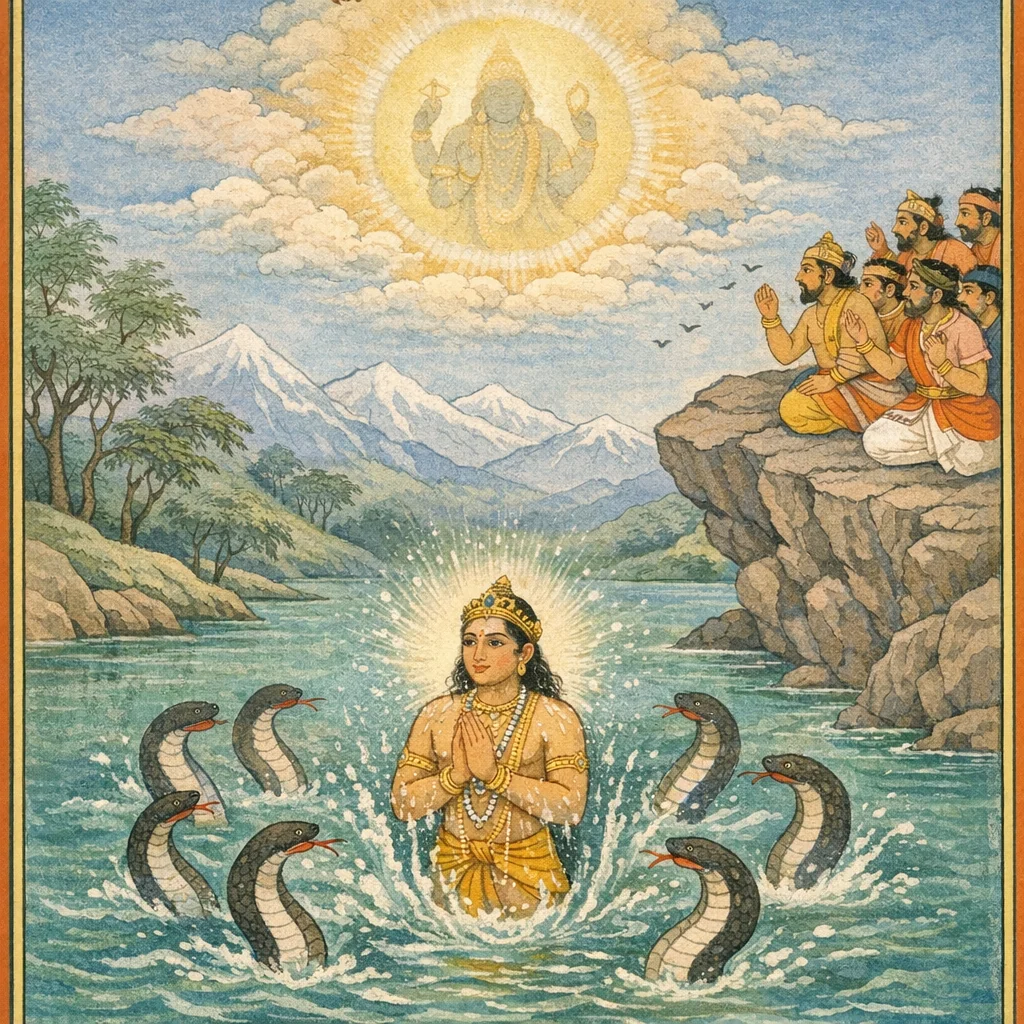
Parāśara explains to Maitreya the inner secret of Prahlāda’s deliverance: ceaseless contemplation of Viṣṇu in non-difference (abheda-bhāvanā) washes away sin, clarifies the antaḥkaraṇa, and establishes Acyuta as knowledge itself within the heart. As Prahlāda becomes “Viṣṇu-maya,” the serpent-bonds snap and ocean and earth tremble; he regains ordinary self-recognition yet remains one-pointed in bhakti. He offers a refined stuti portraying Viṣṇu as gross and subtle, kṣara and akṣara, manifest and unmanifest, nirguṇa yet the support of guṇas, one and many, and the cause beyond the universe. Hari, clad in pītāmbara, appears and grants boons; Prahlāda chiefly asks for unwavering devotion across births and also seeks his father’s release from sin born of hatred toward a devotee. Viṣṇu affirms enduring bhakti and promises supreme nirvāṇa by grace. The chapter ends with a phala-śruti: hearing or reciting Prahlāda’s carita destroys sins and yields great merit (like the fruit of go-pradāna), extolling bhakti-kathā as a purifying sādhanā within the guru–śiṣya setting.
Shlokas
Verse 1
एवं संचिन्तयन् विष्णुम् अभेदेनात्मनो द्विज तन्मयत्वम् अवापाग्र्यं मेने चात्मानम् अच्युतम्
O twice-born, thus by ceaselessly contemplating Vishnu as non-different from his own Self, he attained the supreme state of complete absorption in Him, and came to regard his very self as Acyuta, the Imperishable.
Verse 2
विसस्मार तथात्मानं नान्यत् किंचिद् अजानत अहम् एवाव्ययो ऽनन्तः परमात्मेत्य् अचिन्तयत्
Thus he forgot even his former sense of self and knew nothing else at all; he contemplated, “I alone am the imperishable, the infinite—indeed, the Supreme Self.”
Verse 3
तस्य तद्भावनायोगात् क्षीणपापस्य वै क्रमात् शुद्धे ऽन्तःकरणे विष्णुस् तस्थौ ज्ञानमयो ऽच्युतः
By the discipline of sustained contemplation upon That Supreme, his sins were gradually worn away; and when the inner instrument was purified, Vishnu—the unfailing Acyuta, of the very nature of knowledge—became firmly present within it.
Verse 4
योगप्रभावात् प्रह्लादे जाते विष्णुमये ऽसुरे चलत्य् उरगबन्धैस् तैर् मैत्रेय त्रुटितं क्षणात्
O Maitreya, by the sheer potency of yogic power, when Prahlada—though born among the Asuras—became wholly permeated by Vishnu, the serpent-bonds that bound him writhed and snapped apart in an instant.
Verse 5
भ्रान्तग्राहगणः सोर्मिर् ययौ क्षोभं महार्णवः चचाल च मही सर्वा सशैलवनकानना
The great ocean heaved with surging waves, its hosts of crocodiles thrown into bewildered motion, and rose in violent agitation; and the whole earth trembled as well—mountains, forests, and every wilderness quivering in that universal upheaval.
Verse 6
स च तं शैलसंघातं दैत्यैर् न्यस्तम् अथोपरि प्रक्षिप्य तस्मात् सलिलान् निश्चक्राम महामतिः
Prahlāda, of mighty understanding, cast away the mass of rock the Daityas had laid upon him, and emerged forth from those waters.
Verse 7
दृष्ट्वा च स जगद् भूयो गगनाद्युपलक्षणम् प्रह्लादो ऽस्मीति सस्मार पुनर् आत्मानम् आत्मना
Seeing the world once more—marked by the sky and all the rest—he recognized himself within and remembered: “I am Prahlāda.”
Verse 8
तुष्टाव च पुनर् धीमान् अनादिं पुरुषोत्तमम् एकाग्रमतिर् अव्यग्रो यतवाक्कायमानसः
Then the wise one again praised the Primeval Supreme Person, Purushottama—his mind one-pointed, undistracted, and his speech, body, and thought held in disciplined restraint.
Verse 9
ॐ नमः परमार्थार्थ स्थूलसूक्ष्म क्षराक्षर व्यक्ताव्यक्त कलातीत सकलेश निरञ्जन
Om—salutations to You, the very purport of the highest truth: the gross and the subtle; the perishing and the imperishable; the manifest and the unmanifest; beyond time and its divisions; Lord of all; stainless and untouched by taint.
Verse 10
गुणाञ्जन गुणाधार निर्गुणात्मन् गुणस्थित मूर्तामूर्त महामूर्ते सूक्ष्ममूर्ते स्फुटास्फुट
O You who are the unguent of the guṇas and the ground where the guṇas rest—though Your essence is beyond all qualities, You yet uphold the qualities. You are with form and without form; the vastest and the subtlest; clearly manifest and yet unmanifest.
Verse 11
करालसौम्यरूपात्मन् विद्याविद्यामयाच्युत सदसद्रूपसद्भाव सदसद्भावभावन
O Acyuta, whose very Self appears as both the terrible and the gentle, You are the essence of knowledge and of ignorance. You are the reality abiding as being and non-being, and You are the One who brings forth and governs the very notions of being and non-being.
Verse 12
नित्यानित्य प्रपञ्चात्मन् निष्प्रपञ्चामलाश्रय एकानेक नमस् तुभ्यं वासुदेवादिकारण
Salutations to You, O Vāsudeva—the primal Cause—who are the very Self of the world of the eternal and the transient, yet whose stainless refuge stands beyond all manifestation; You who are at once the One and also the many.
Verse 13
यः स्थूलसूक्ष्मः प्रकटप्रकाशो यः सर्वभूतो न च सर्वभूतः विश्वं यतश् चैतद् अविश्वहेतोर् नमो ऽस्तु तस्मै पुरुषोत्तमाय
Salutations to that Supreme Person: He is both the gross and the subtle; His light is manifest and self-revealing. He pervades all beings, yet is not confined to any being; from Him this entire universe proceeds, though He Himself is the cause beyond the universe.
Verse 14
तस्य तच्चेतसो देवः स्तुतिम् इत्थं प्रकुर्वतः आविर्बभूव भगवान् पीताम्बरधरो हरिः
As he—his mind wholly absorbed—thus offered his hymn of praise, the blessed Lord Hari, the God who wears the yellow garment, manifested before him.
Verse 15
ससंभ्रमस् तम् आलोक्य समुत्थायाकुलाक्षरम् नमो ऽस्तु विष्णवैत्य् एतद् व्याजहारासकृद् द्विज
Seeing Him, he was seized with reverent agitation; rising at once, his voice broken and his syllables confused, he repeatedly uttered, “Homage to Viṣṇu!” O twice-born one.
Verse 16
देव प्रपन्नार्तिहर प्रसादं कुरु केशव अवलोकनदानेन भूयो मां पावयाव्यय
O God, remover of the distress of those who surrender, O Keśava, grant me Your grace. By the gift of Your glance, purify me again and again, O Imperishable One.
Verse 17
कुर्वतस् ते प्रसन्नो ऽहं भक्तिम् अव्यभिचारिणीम् यथाभिलषितो मत्तः प्रह्लाद व्रियतां वरः
Because you have practiced unwavering, undivided devotion, I am pleased with you. Therefore, Prahlāda, choose from Me the boon you desire, according to your heart’s wish.
Verse 18
नाथ योनिसहस्रेषु येषु येषु व्रजाम्य् अहम् तेषु तेष्व् अच्युता भक्तिर् अच्युतास्तु सदा त्वयि
O Lord, through whatever thousands of wombs I may pass—wherever I am born again and again—may my devotion remain unwavering, O Acyuta; and may You, the Unfailing One, ever abide as the constant refuge within my heart.
Verse 19
या प्रीतिर् अविवेकानां विषयेष्व् अनपायिनी त्वाम् अनुस्मरतः सा मे हृदयान् मापसर्पतु
May that very love which, in the undiscerning, clings unceasingly to sense-objects—become mine as I continually remember You; may it never depart from my heart.
Verse 20
मयि भक्तिस् तवास्त्य् एव भूयो ऽप्य् एवं भविष्यति वरश् च मत्तः प्रह्लाद व्रियतां यस् तवेप्सितः
Your devotion to Me is indeed present—and it shall be so again and again in times to come. And now, Prahlāda, choose from Me a boon, whatever you desire.
Verse 21
मयि द्वेषानुबन्धो ऽभूत् संस्तुताव् उद्यते तव मत्पितुस् तत्कृतं पापं देव तस्य प्रणश्यतु
When I set about praising You, O Lord, a lingering thread of hatred arose within my father. May the sin committed through that be destroyed, O Deva.
Verse 22
शस्त्राणि पातितान्य् अङ्गे क्षिप्तो यच् चाग्निसंहतौ दंशितश् चोरगैर् दत्तं यद् विषं मम भोजने
Weapons have been hurled upon my limbs; I have been cast into a blazing fire; I have been bitten by serpents; and poison has been mixed into my food.
Verse 23
बद्ध्वा समुद्रे यत् क्षिप्तो यच् चितो ऽस्मि शिलोच्चयैः अन्यानि चाप्य् असाधूनि यानि पित्रा कृतानि मे
That I was bound and hurled into the ocean, and that I was heaped over with piles of stones—these and other unrighteous deeds that my father committed against me…
Verse 24
त्वयि भक्तिमतो द्वेषाद् अघं तत्संभवं च यत् त्वत्प्रसादात् प्रभो सद्यस् तेन मुच्येत मे पिता
Whatever sin has been incurred—together with all consequences born of it—through hatred toward Your devotee: by Your grace, O Lord, may my father be freed from that at once.
Verse 25
प्रह्लाद सर्वम् एतत् ते मत्प्रसादाद् भविष्यति अन्यं च ते वरं दद्मि व्रियताम् असुरात्मज
Prahlada, all this shall indeed come to pass for you by My grace. And I grant you yet another boon—choose it, O son of the Asuras.
Verse 26
कृतकृत्यो ऽस्मि भगवन् वरेणानेन यत् त्वयि भवित्री त्वत्प्रसादेन भक्तिर् अव्यभिचारिणी
O Bhagavān, by this boon I am fulfilled: by Your gracious favor, may unwavering, never-straying bhakti arise in me toward You.
Verse 27
धर्मार्थकामैः किं तस्य मुक्तिस् तस्य करे स्थिता समस्तजगतां मूले यस्य भक्तिः स्थिरा त्वयि
What need has he of dharma, artha, or kāma? Liberation itself rests in his palm—he whose devotion is steadfast in You, the root of all worlds.
Verse 28
यथा ते निश्चलं चेतो मयि भक्तिसमन्वितम् तथा त्वं मत्प्रसादेन निर्वाणं परम् आप्स्यसि
As your mind remains unwavering, filled with devotion toward Me, so by My grace you shall attain the supreme nirvāṇa, the highest release.
Verse 29
इत्य् उक्त्वान्तर्दधे विष्णुस् तस्य मैत्रेय पश्यतः स चापि पुनर् आगम्य ववन्दे चरणौ पितुः
Having spoken thus, Lord Viṣṇu vanished from sight—O Maitreya—while he looked on. Returning, he bowed in reverence and touched his father’s feet.
Verse 30
तं पिता मूर्ध्न्य् उपाघ्राय परिष्वज्य च पीडितम् जीवसीत्य् आह वत्सेति बाष्पार्द्रनयनो द्विज
O brāhmaṇa, the father—his eyes wet with tears—smelled his son’s head and clasped him close; seeing him worn by suffering, he cried, “You live! My child, you live!”
Verse 31
प्रीतिमांश् चाभवत् तस्मिन्न् अनुतापी महासुरः गुरुपित्रोश् चकारैवं शुश्रूषां सो ऽपि धर्मवित्
Thus that great asura, his heart softened by remorse, became filled with affection toward him; and, knowing dharma, he rendered devoted service in this manner to both his teacher and his father.
Verse 32
पितर्य् उपरतिं नीते नरसिंहस्वरूपिणा विष्णुना सो ऽपि दैत्यानां मैत्रेयाभूत् पतिस् ततः
When his father had been brought to his end by Viṣṇu, who assumed the form of Narasiṃha, then he too, O Maitreya, became thereafter the lord of the Daityas.
Verse 33
तद्राज्यभूतिं संप्राप्य कर्मशुद्धिकरीं द्विज पुत्रपौत्रांश् च सुबहून् अवाप्यैश्वर्यम् एव च
Having attained that royal prosperity—O twice-born—whose very exercise purifies one’s deeds, he also obtained many sons and grandsons, and indeed the full measure of sovereign fortune.
Verse 34
क्षीणाधिकारः स यदा पुण्यपापविवर्जितः तदासौ भगवद्ध्यानात् परं निर्वाणम् आप्तवान्
When his karmic entitlement to further embodied experience had been exhausted, and he stood free from both merit and demerit, then—through steadfast meditation on the Blessed Lord—he attained the supreme Nirvāṇa.
Verse 35
एवंप्रभावो दैत्यो ऽसौ मैत्रेयासीन् महामतिः प्रह्लादो भगवद्भक्तो यं त्वं माम् अनुपृच्छसि
Such, O Maitreya, was the greatness of that Daitya: the high-souled Prahlāda—of vast intelligence and a devotee of the Blessed Lord—about whom you now question me.
Verse 36
यस् त्व् एतच् चरितं तस्य प्रह्लादस्य महात्मनः शृणोति तस्य पापानि सद्यो गच्छन्ति संक्षयम्
Whoever listens to this sacred account of the great-souled Prahlāda—his sins, without delay, hasten toward complete destruction.
Verse 37
अहोरात्रकृतं पापं प्रह्लादचरितं नरः शृण्वन् पठंश् च मैत्रेय व्यपोहति न संशयः
O Maitreya, there is no doubt: one who listens to or recites the sacred account of Prahlāda drives away the sins accumulated through day and night.
Verse 38
पौर्णमास्याम् अमावास्याम् अष्टम्याम् अथ वा पठन् द्वादश्यां वा तद् आप्नोति गोप्रदानफलं द्विज
O brāhmaṇa, one who recites this on the full-moon day, the new-moon day, the eighth lunar day, or the twelfth attains the very merit gained by gifting a cow.
Verse 39
प्रह्लादं सकलापत्सु यथा रक्षितवान् हरिः तथा रक्षति यस् तस्य शृणोति चरितं सदा
Just as Hari preserved Prahlāda through every calamity, so too does He protect the one who continually listens to his sacred deeds.
Frequently Asked Questions
Sustained abheda-bhāvanā—contemplating Viṣṇu as non-different from the Self—leading to antaḥkaraṇa-śuddhi, Viṣṇu’s indwelling as jñāna-maya, and the maturation of unwavering bhakti under divine grace.
He prioritizes avyabhicāriṇī-bhakti across births, valuing devotion itself over worldly ends; the text frames bhakti as self-sufficient and as the direct conduit for prasāda and nirvāṇa.
The chapter’s phala-śruti states that śravaṇa/pāṭha of Prahlāda-carita swiftly diminishes sins and grants significant merit—explicitly likened to the fruit of go-pradāna when recited on auspicious lunar days.