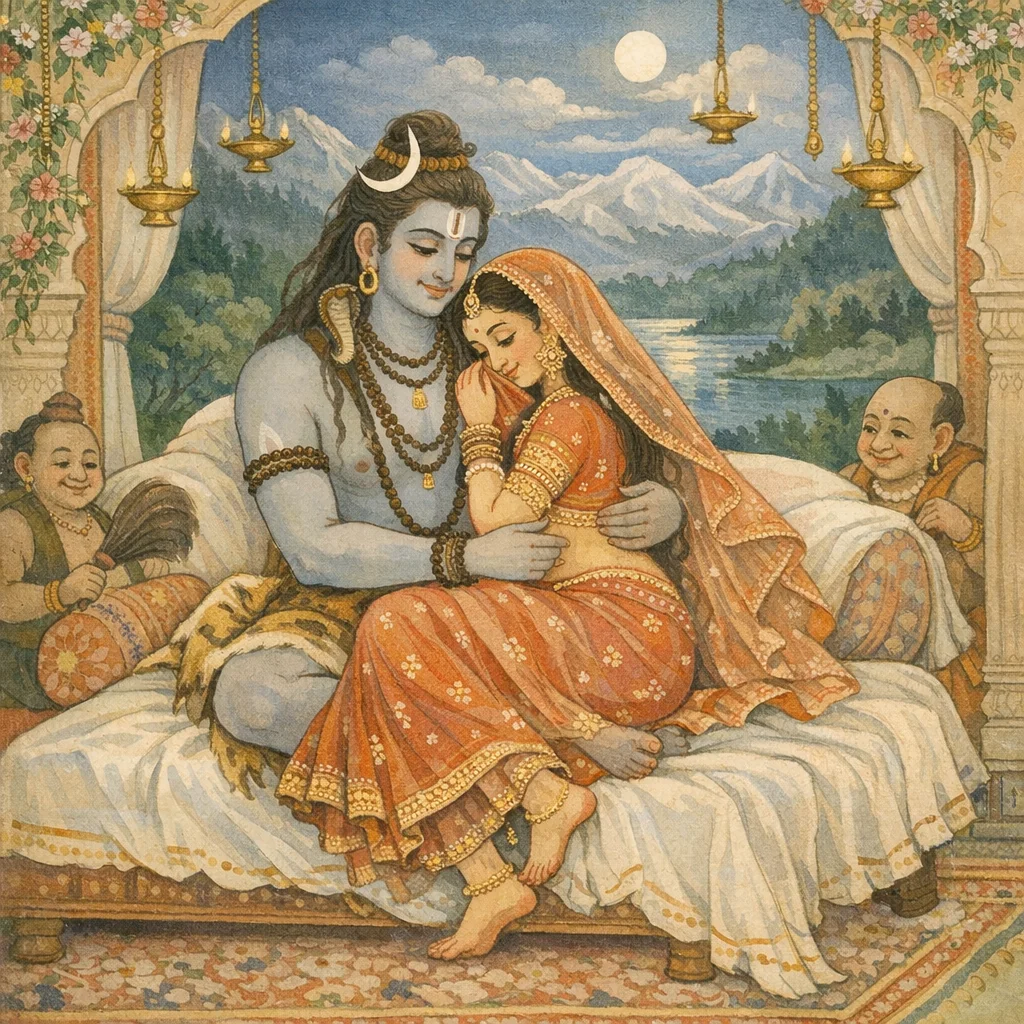
गौरीप्रवेशः—शिवसाक्षात्कारः (Gaurī’s Entry and the Vision of Śiva)
Adhyāya 27 begins with the ṛṣis asking Vāyu about the episode in which Devī, daughter of Himavat, assumes a fair, radiant form (gauraṃ vapus) and enters the richly adorned inner residence to meet her Lord. They also ask what the gaṇas stationed at the doorway did at her entry and how Śiva responded on seeing them. Vāyu portrays the moment as an ineffable “supreme rasa,” a devotional-aesthetic mood born of intimate love (praṇaya) that captivates even tender hearts. Devī enters with anticipation mixed with slight apprehension and beholds Śiva eagerly awaiting her. The gaṇas within greet and honor her with affectionate words; Devī bows to Tryambaka. Before she can rise, Śiva joyfully embraces her and tries to seat her on his lap; she sits on the couch instead, whereupon Śiva playfully lifts her onto his lap, smiling and gazing upon her face. Śiva then begins a gentle, teasing dialogue, recalling her former state and expressing how her nature has drawn his mind into concern, hinting at form, self-will, and reconciliation within divine intimacy.
Shlokas
Verse 1
ऋषय ऊचुः । कृत्वा गौरं वपुर्दिव्यं देवी गिरिवरात्मजा । कथं ददर्श भर्तारं प्रविष्टा मन्दितं सती
The sages said: “After assuming a radiant, divine, fair-hued form, how did Satī—the goddess, daughter of the great mountain—enter that adorned place and behold her Lord, her husband Śiva?”
Verse 2
प्रवेशसमये तस्या भवनद्वारगोचरैः । गणेशैः किं कृतं देवस्तान्दृष्ट्वा किन्तदा ऽकरोत्
At the moment of her entry, what did the Gaṇeśas stationed at the threshold of the palace gate do? And when the Lord beheld them, what did He do then?
Verse 3
वायुरुवाच । प्रवक्तुमंजसा ऽशक्यः तादृशः परमो रसः । येन प्रणयगर्भेण भावो भाववतां हृतः
Vāyu said: “That supreme relish (parama-rasa) is of such a nature that it cannot be plainly expressed. By that love-laden (praṇaya-garbha) experience, the very heart of those capable of devotional feeling is captivated.”
Verse 4
द्वास्थैस्ससंभ्रमैरेव देवो देव्यागमोत्सुकः । शंकमाना प्रविष्टान्तस्तञ्च सा समपश्यत
Eager for the Goddess’s arrival, the Lord—stirred by the attendants’ excited commotion at the doorway—entered the inner chambers. Then the Goddess, entering with gentle apprehension, beheld Him there.
Verse 5
तैस्तैः प्रणयभावैश्च भवनान्तरवर्तिभिः । गणेन्द्रैर्वन्दिता वाचा प्रणनाम त्रियम्बकम्
Honoured by the words of the foremost Gaṇas—who dwelt within the inner precincts and were filled with diverse moods of loving devotion—she bowed down in reverence to Tryambaka, Lord Śiva, the Three-Eyed One.
Verse 6
प्रणम्य नोत्थिता यावत्तावत्तां परमेश्वरः । प्रगृह्य दोर्भ्यामाश्लिष्य परितः परया मुदा
While she, having bowed down, had not yet risen, Parameśvara, the Supreme Lord, at once took her in both arms, embraced her, and held her close on every side with overflowing joy.
Verse 7
स्वांके धर्तुं प्रवृत्तो ऽपि सा पर्यंके न्यषीदत । पर्यंकतो बलाद्देवीं सोङ्कमारोप्य सुस्मिताम्
Though He moved to take her onto His lap, she instead sat upon the couch. Then, with gentle insistence, He lifted the smiling Goddess from the couch and placed her upon His lap.
Verse 8
सस्मितो विवृतैर्नेत्रैस्तद्वक्त्रं प्रपिबन्निव । तया संभाषणायेशः पूर्वभाषितमब्रवीत्
Smiling, with eyes wide open as though drinking in her face, the Lord—wishing to converse with her—spoke again the words He had said before.
Verse 9
देवदेव उवाच । सा दशा च व्यतीता किं तव सर्वांगसुन्दरि । यस्यामनुनयोपायः को ऽपि कोपान्न लभ्यते
Devadeva said: “O you whose every limb is beautiful—has that condition passed for you? In that state, no means of reconciliation can be found, for it arises from anger.”
Verse 10
स्वेच्छयापि न कालीति नान्यवर्णवतीति च । त्वत्स्वभावाहृतं चित्तं सुभ्रु चिंतावहं मम
“Even by my own choice I cannot think of You as Kālī, nor as one of any other complexion. O fair-browed one, my mind—carried away by Your very nature—has become within me a cause of anxious longing.”
Verse 11
विस्मृतः परमो भावः कथं स्वेच्छांगयोगतः । न सम्भवन्ति ये तत्र चित्तकालुष्यहेतवः
How could the supreme state be forgotten when one is united through the yoga of the limbs, pursued with one’s own steady resolve? In that condition, the causes that bring impurity to the mind do not arise at all.
Verse 12
पृथग्जनवदन्योन्यं विप्रियस्यापि कारणम् । आवयोरपि यद्यस्ति नास्त्येवैतच्चराचरम्
For ordinary people, mutual separateness becomes a cause of discord and displeasure. But if such a division were to exist between us, then this entire world of the moving and the unmoving would cease to be.
Verse 13
अहमग्निशिरोनिष्ठस्त्वं सोमशिरसि स्थिता । अग्नीषोमात्मकं विश्वमावाभ्यां समधिष्ठितम्
“I abide at the head of Agni, and you are established at the head of Soma. This entire universe, whose nature is Agni and Soma, is jointly presided over and sustained by us both.”
Verse 14
जगद्धिताय चरतोः स्वेच्छाधृतशरीरयोः । आवयोर्विप्रयोगे हि स्यान्निरालम्बनं जगत्
We two move about for the welfare of the world, assuming bodies by our own free will. Indeed, if there were separation between us, the universe would become supportless—bereft of its sustaining ground.
Verse 15
अस्ति हेत्वन्तरं चात्र शास्त्रयुक्तिविनिश्चितम् । वागर्थमिव मे वैतज्जगत्स्थावरजंगमम्
Here, indeed, there is another cause—ascertained through scriptural reasoning—by which this entire universe, the immovable and the moving, stands related, as speech is related to its meaning.
Verse 16
त्वं हि वागमृतं साक्षादहमर्थामृतं परम् । द्वयमप्यमृतं कस्माद्वियुक्तमुपपद्यते
You are, indeed, the very nectar of speech, and I am the supreme nectar of meaning. Since both are nectar, how can it be proper that the two should be separated?
Verse 17
विद्याप्रत्यायिका त्वं मे वेद्यो ऽहं प्रत्ययात्तव । विद्यावेद्यात्मनोरेव विश्लेषः कथमावयोः
You are the very Knowledge that makes realization arise in me; and I am the One to be known through your awakening insight. If knowledge and the knowable are truly of one essence, how could there be any separation between us?
Verse 18
न कर्मणा सृजामीदं जगत्प्रतिसृजामि च । सर्वस्याज्ञैकलभ्यत्वादाज्ञात्वं हि गरीयसी
“I do not create this universe by any binding action, nor do I recreate it by action. Since all things are attained only through My command, sovereignty as the Lord’s command is indeed supreme.”
Verse 19
आज्ञैकसारमैश्वर्यं यस्मात्स्वातंत्र्यलक्षणम् । आज्ञया विप्रयुक्तस्य चैश्वर्यं मम कीदृशम्
“Sovereignty has obedience to command as its very essence, for true lordship is defined by freedom. If I were separated from the power of command, what sort of sovereignty could possibly be Mine?”
Verse 20
न कदाचिदवस्थानमावयोर्विप्रयुक्तयोः । देवानां कार्यमुद्दिश्य लीलोक्तिं कृतवानहम्
There is never any real separation or interval of existence between us when we are (seemingly) apart. Keeping in view the task of the gods, I spoke those words only as a divine play (līlā).
Verse 21
त्वयाप्यविदितं नास्ति कथं कुपितवत्यसि । ततस्त्रिलोकरक्षार्थे कोपो मय्यपि ते कृतः
“There is nothing unknown to you—so how have you become angry? Therefore, for the protection of the three worlds, you have directed even that wrath toward me.”
Verse 22
यदनर्थाय भूतानां न तदस्ति खलु त्वयि । इति प्रियंवदे साक्षादीश्वरे परमेश्वरे
“O sweet-speaker, in You—who are manifest as the very Lord, the Supreme Īśvara—there truly exists nothing that could ever become the cause of harm or misfortune to living beings.”
Verse 23
शृंगारभावसाराणां जन्मभूमिरकृत्रिमा । स्वभर्त्रा ललितन्तथ्यमुक्तं मत्वा स्मितोत्तरम्
She—an uncontrived birthplace of the very essence of amorous sentiment—understood that her own lord had spoken a playful yet truthful remark, and she replied with a smile.
Verse 24
लज्जया न किमप्यूचे कौशिकी वर्णनात्परम् । तदेव वर्णयाम्यद्य शृणु देव्याश्च वर्णनम्
Out of modesty I spoke nothing beyond the description of Kauśikī. Yet today I shall describe that very same matter—listen to the account of the Goddess, Devī.
Verse 25
देव्युवाच । किं देवेन न सा दृष्टा या सृष्टा कौशिकी मया । तादृशी कन्यका लोके न भूता न भविष्यति
The Goddess said: “Has the Lord not seen her—Kauśikī—whom I myself have brought forth? Such a maiden has never existed in the world before, nor shall she ever exist again.”
Verse 26
तस्या वीर्यं बलं विन्ध्यनिलयं विजयं तथा । शुंभस्य च निशुंभस्य मारणे च रणे तयोः
Her valor and strength—her dwelling in the Vindhya mountains and her assured victory—were all for the slaying of Śumbha and Niśumbha, and for triumph over them in battle.
Verse 27
प्रत्यक्षफलदानं च लोकाय भजते सदा । लोकानां रक्षणं शश्वद्ब्रह्मा विज्ञापयिष्यति
He ever serves the welfare of the world by granting visible, immediate fruits; and Brahmā will continually proclaim the perpetual protection of all the worlds that comes from Him.
Verse 28
इति संभाषमाणाया देव्या एवाज्ञया तदा । व्याघ्रः सख्या समानीय पुरो ऽवस्थापितस्तदा
While the Goddess was thus speaking, then—by her very command—a tigress was brought by her companion and made to stand before her.
Verse 29
तं प्रेक्ष्याह पुनर्देवी देवानीतमुपायतम् । व्याघ्रं पश्य न चानेन सदृशो मदुपासकः
Seeing him again, the Goddess spoke, beholding that tiger who had been brought by the gods and had come near: “Look at this tiger—there is no devotee of mine equal to him.”
Verse 30
अनेन दुष्टसंघेभ्यो रक्षितं मत्तपोवनम् । अतीव मम भक्तश्च विश्रब्धश्च स्वरक्षणात्
“By him my grove of austerities has been protected from the bands of the wicked. And because of his vigilant self-guarding, he is exceedingly devoted to me and abides in fearless confidence.”
Verse 31
स्वदेशं च परित्यज्य प्रसादार्थं समागतः । यदि प्रीतिरभून्मत्तः परां प्रीतिं करोषि मे
“Abandoning even your own land, you have come seeking my grace. If you truly have affection for me, then show me the highest love—complete devotion.”
Verse 32
नित्यमन्तःपुरद्वारि नियोगान्नन्दिनः स्वयम् । रक्षिभिस्सह तच्चिह्नैर्वर्ततामयमीश्वर
By command, let Nandin himself remain always at the gate of the inner apartments, together with the guards who bear his insignia—thus shall this Lord’s household be protected and duly ordered.
Verse 33
वायुरुवाच । मधुरं प्रणयोदर्कं श्रुत्वा देव्याः शुभं वचः । प्रीतो ऽस्मीत्याह तं देवस्स चादृश्यत तत्क्षणात्
Vāyu said: Hearing the auspicious words of the Goddess—sweet and brimming with loving devotion—the Lord said, “I am pleased,” and in that very moment He vanished from sight.
Verse 34
बिभ्रद्वेत्रलतां हैमीं रत्नचित्रं च कंचुकम् । छुरिकामुरगप्रख्यां गणेशो रक्षवेषधृक्
Ganeśa, assuming the guise of a guard, bore a golden, creeper-like staff and a gem-adorned cuirass, and he carried a dagger gleaming like a serpent.
Verse 35
यस्मात्सोमो महादेवो नन्दी चानेन नन्दितः । सोमनन्दीति विख्यातस्तस्मादेष समाख्यया
Because Mahādeva is “Soma”—the auspicious Lord, nectar-like in grace—and because Nandī is gladdened by Him, he is renowned by the name “Somanandī”; therefore this is his well-established appellation.
Verse 36
इत्थं देव्याः प्रियं कृत्वा देवश्चर्धेन्दुभूषणः । भूषयामास तन्दिव्यैर्भूषणै रत्नभूषितैः
Thus, having fulfilled what was dear to the Goddess, the Lord—adorned with the crescent moon—then embellished Her with celestial ornaments, radiant and studded with jewels.
Verse 37
ततस्स गौरीं गिरिशो गिरीन्द्रजां सगौरवां सर्वमनोहरां हरः । पर्यंकमारोप्य वरांगभूषणैर्विभूषयामास शशांकभूषणः
Then Hara—Giriśa, Lord of the mountains—honouring Gaurī, daughter of the King of mountains and enchanting to every heart, seated her upon a couch and adorned her limbs with exquisite ornaments—He whose own ornament is the moon.
Frequently Asked Questions
Devī (Satī/Gaurī), having assumed a radiant fair form, enters Śiva’s inner residence; she is welcomed by the gaṇas, bows to Śiva, and Śiva embraces her and begins a personal dialogue recalling her earlier condition.
The chapter encodes ‘darśana’ as a liminal passage: the doorway, gaṇas, and inner chamber symbolize graded access to the divine, while ‘rasa’ and ‘praṇaya’ present emotion as a disciplined spiritual medium rather than mere sentiment.
Devī’s gaura (radiant) manifestation and Śiva as Tryambaka/Parameśvara/Devadeva; additionally, the gaṇas function as Śiva’s embodied retinue mediating sacred hospitality and threshold-guardianship.
Read Shiva Purana in the Vedapath app
Scan the QR code to open this directly in the app, with audio, word-by-word meanings, and more.