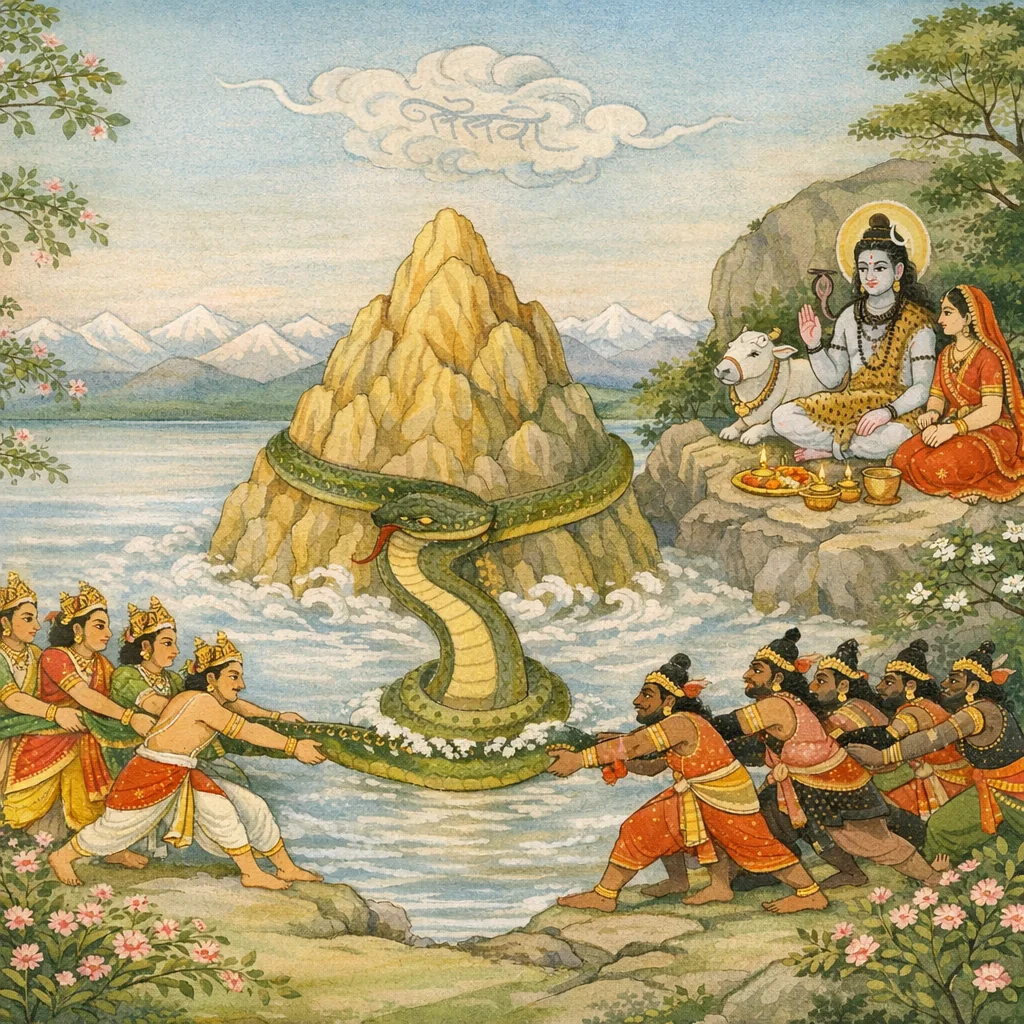
Vṛṣeśākhya-Śivāvatāra and the Initiation of the Kṣīrasāgara-Manthana (Churning of the Milk Ocean)
Adhyāya 22 begins with Nandīśvara addressing Brahmā’s son (a munīśvara) and introducing a Śiva-avatāra named Vṛṣeśa, a līlā-manifestation who removes Hari’s pride. The narrative then turns to a cosmic crisis: devas and asuras, fearing old age and death, ally to churn the supreme Milk Ocean (Kṣīrasāgara) for its treasures. Unsure of the means, they hear a thunderous disembodied celestial voice (nabho-vāṇī) declaring, by Īśvara’s command, that Mount Mandara is to be the churning staff and Vāsuki the rope, and that they must act together. They begin the undertaking by assembling Mandara, radiant like gold and richly adorned; after propitiating Girīśa (Śiva) and receiving his sanction, they attempt to uproot and carry the mountain to the ocean. The chapter’s inner teaching is that even shared cosmic works depend upon Śiva’s authorization, and divine instruction bridges mortal limitation and universal transformation.
Shlokas
Verse 1
नन्दीश्वर उवाच । शृणु ब्रह्मसुत प्राज्ञ वृषेशाख्यं मुनीश्वर । शिवावतारं सल्लीलं हरिगर्वहरं वरम्
Nandīśvara said: “Listen, O wise son of Brahmā—O great sage Vṛṣeśa. I shall tell you of a blessed incarnation of Śiva, full of divine līlā, the noble one who humbles the pride of Hari (Viṣṇu).”
Verse 2
पुरा देवासुराः सर्वे जरामृत्युभयार्दिताः । परस्परं च संधाय रत्नान्यादित्सवोऽभवन्
In ancient times, all the Devas and Asuras—afflicted by the fear of old age and death—entered into a mutual pact with one another, and a strong desire arose in them to obtain the divine treasures (ratnas).
Verse 3
ततः सुराऽसुराः सर्वे क्षीरोदं सागरोत्तमम् । उद्यता मथितुं तं च बभूवुर्मुनि नन्दन
Then all the Devas and Asuras, O beloved son of a sage, became ready to churn that excellent Ocean of Milk.
Verse 4
आसञ्छुचिस्मितास्सर्वे केनेदं मन्थनं भवेत् । स्वकार्यसिद्धये तस्य ब्रह्मन्निति सुरासुराः
All of them sat down with pure, gentle smiles and said: “O Brahmā, by whose agency will this churning take place? Tell us—so that his purpose may be fulfilled,” thus spoke the devas and the asuras.
Verse 5
तदा नभोगता वाणी मेघगम्भीरनिस्वना । उवाच देवान्दैत्यांश्च श्वासयन्तीश्वराज्ञया
Then a voice resounding in the sky—deep and thunderous like a cloud—spoke to both the Devas and the Daityas, calming and steadying them by the command of the Supreme Lord (Īśvara).
Verse 6
नभोवाण्युवाच । हे देवा असुराश्चैव मन्थध्वं क्षीरसागरम् । भवताम्बलबुद्धिर्हि भविष्यति न संशयः
The heavenly voice proclaimed: “O Devas and Asuras alike, churn the Ocean of Milk. From this, strength and clear resolve shall arise within you—of this there is no doubt.”
Verse 7
मन्दरं चैव मन्थानं रज्जुं कुरुत वासुकिम् । मिथस्सर्वे मिलित्वा तु मंथनं कुरुतादरात्
“Make Mandara the churning-rod, and make Vāsuki the rope. Then all of you, joining together in mutual cooperation, churn with reverent effort.”
Verse 8
नन्दीश्वर उवाच । नभोगता तदा वाणीं निशम्याथ सुरासुरः । उद्योगं चक्रिरे सर्वे तत्कर्तुं मुनिसत्तम
Nandīśvara said: “O best of sages, hearing then that voice resounding through the sky, all the devas and asuras together bestirred themselves and began preparing to accomplish what was enjoined.”
Verse 9
सुसन्धायाखिलास्ते वै मन्दरम्पर्वतोत्तमम् । कनकाभं च सरलं नानाशोभार्चितं ययुः
Having firmly resolved together, all of them set out for Mandara, the foremost of mountains—straight and well-formed, golden-hued, and adorned with manifold splendors.
Verse 10
सुप्रसाद्य गिरीशं तं तदाज्ञप्ताः सुरासुराः । बलादुत्पाटयामासुर्नेतुकामाः पयोऽर्णवम्
Having fully propitiated Girīśa (Lord Śiva), and acting under His command, the devas and asuras forcefully uprooted the mountain, desiring to carry it to the Ocean of Milk.
Verse 11
भुजैरुत्पाट्य ते सर्व्वे जग्मुः क्षीरार्णव पुरे । अशक्ता अभवंस्तत्र तमानेतुं हतौजसः
Tearing him away with their arms, all of them went to the city in the Ocean of Milk. Yet there they became powerless—their vigor shattered—and they were unable to bring him back.
Verse 12
तद्भुजैस्स परिभ्रष्टः पतितो मंदरो गिरिः । सहसातिगुरुस्सद्यो देवदैत्योपरि ध्रुवम्
Struck and dislodged by His arms, Mount Mandara slipped from its place and fell at once—its tremendous weight crashing down firmly upon the Devas and the Daityas.
Verse 13
एवम्भग्नोद्यमा भग्नाः सम्बभूवुस्सुरासुरा । चेतनाः प्राप्य च ततस्तुष्टुवुर्जगदीश्वरम्
Thus, the gods and the asuras—whose efforts had been shattered—became utterly broken. Then, regaining their consciousness, they praised Jagadīśvara, the Lord of the universe.
Verse 14
तदिच्छयोद्यतास्सर्वे पुनरुत्थाय तं गिरिम् । निचिक्षिपुर्जले नीत्वा क्षीरोदस्योत्तरे तटे
Moved by His will, they all rose up again, carried that mountain, and cast it into the waters—placing it upon the northern shore of the Ocean of Milk.
Verse 15
ततस्सुरासुरगणा रज्जुं कृत्वा च वासुकिम् । रत्नान्यादातुकामास्ते ममंथुः क्षीरसागरम्
Then the hosts of devas and asuras, making Vāsuki into a churning rope, churned the Ocean of Milk, desiring to obtain its precious treasures.
Verse 16
क्षीरोदे मथ्यमाने तु श्रीस्स्वर्लोकमहेश्वरी । समुद्भूता समुद्राच्च भृगुपुत्री हरिप्रिया
When the Ocean of Milk was churned, Śrī—the sovereign goddess of the heavenly realms—arose from the sea. From the ocean itself she emerged as Bhṛgu’s daughter, beloved of Hari.
Verse 17
धन्वन्तरिः शशांकश्च पारिजातो महाद्रुमः । उच्चैश्श्रवाश्च तुरगो गज ऐरावतस्तथा
Dhanvantari, the Moon, the Pārijāta—the great celestial tree—Uccaiḥśravas the horse, and likewise Airāvata the elephant: all these are counted among the divine manifestations spoken of here.
Verse 18
सुरा हरिधनु श्शङ्खो गावः कामदुघास्ततः । कौस्तुभाख्यो मणिश्चैव तथा पीयूषमेव च
Then appeared the divine wine (surā), the bow of Hari, the conch, the wish‑fulfilling cows, the jewel famed as Kaustubha, and also the nectar of immortality (pīyūṣa).
Verse 19
पुनश्च मथ्यमाने तु कालकूटं महाविषम् । युगान्तानलभ जातं सुरासुरभयावहम
Then, as the churning was continued again, the dreadful poison Kālakūṭa arose—an immense venom, blazing like the fire at the end of an age—bringing terror to both the gods and the demons.
Verse 20
पीयूषजन्मकाले तु बिन्दवो ये बहिर्गताः । तेभ्यः कान्ता समुद्भूता बह्वयो ह्यद्भुतदर्शनाः
At the time when the nectar (amṛta) came into being, the drops that flowed out—from those drops arose many radiant maidens, wondrous to behold.
Verse 21
शरत्पूर्णेन्दुवदनास्तडित्सूर्य्यानलप्रभाः । हारकेयूरकटकैर्दिव्यरत्नैरलङ्कृताः
Their faces were like the full moon of autumn, and their radiance shone like lightning, the sun, and blazing fire. They were adorned with celestial jewels—necklaces, armlets, and bracelets—resplendent in divine splendor.
Verse 22
इति श्रीशिवमहापुराणे तृतीयायां शतरुद्रसंहितायां विष्णूपद्रववृषावतारवर्णनं नाम द्वाविंशोऽध्यायः
Thus, in the Śrī Śiva Mahāpurāṇa, in the Third Book, within the Śatarudra Saṃhitā, ends the twenty-second chapter entitled “The Description of the Bull-Incarnation that quelled Viṣṇu’s disturbance.”
Verse 23
कोटिशस्तास्समुत्पन्नास्त्वमृतात्कामनिस्सृताः । ततोऽमृतं समुत्पन्नं जरामृत्युनिवारणम्
From that Amṛta, desires surged forth and arose in countless crores; and from those, again, Amṛta manifested—an elixir that wards off old age and death.
Verse 24
लक्ष्मीं शंखं कौस्तुभं च खड्गं जग्राह केशवः । जग्राहार्को हयं दिव्यमुच्चैःश्रवसमादरात्
Keśava (Viṣṇu) took Lakṣmī, the conch, the Kaustubha jewel, and the sword; and the Sun (Arka) reverently took the divine horse Uccaiḥśravas.
Verse 25
पारिजातं तरुवरमैरावतमिभेश्वरम् । शचीपतिश्च जग्राह निर्जरेशो महादरात
Then Indra, lord of the gods and consort of Śacī, with profound reverence took possession of the supreme Pārijāta tree and of Airāvata, king of elephants, honoring the divine order.
Verse 26
कालकूटं शशांकं च देवत्राणाय शंकरः । स्वकण्ठे धृतवाञ्छम्भुस्स्वेच्छया भक्तवत्सलः
To protect the gods, Śaṅkara—Śambhu, ever tender to His devotees—of His own free will held the deadly Kālakūṭa poison within His throat, and also bore the moon.
Verse 27
दैत्यास्सुराख्यां रमणीमीश्वराज्ञाविमोहिताः । जगृहुः सकला व्यास सर्वे धन्वन्तरिं जनाः
O Vyāsa, deluded by the Lord’s command through the maiden named Surā, all the Dāityas seized Dhanvantari; indeed, all of them together took hold of him.
Verse 28
जगृहुर्मुनयस्सर्वे कामधेनुम्मुनीश्वराः । सामान्यतस्त्रियस्ताश्च स्थिता आसन्विमोहिताः
Then all the sages—masters among ascetics—seized Kāmadhenū. Those women, however, stood there in an ordinary way, bewildered and deluded.
Verse 29
अमृतार्थं महायुद्धं संबभूव जयैषिणाम् । सुराणामसुराणां च मिथः संक्षुब्धचेतसाम्
For the sake of amṛta, a great war arose among those hungry for victory—between the Devas and the Asuras—whose minds were mutually agitated and inflamed.
Verse 30
हृतं सोमं च दैतेयैर्बलाद्देवान्विजित्य च । बलिप्रभृतिभिर्व्यास युगान्ताग्न्यर्कसुप्रभैः
O Vyāsa, the Daityas, having overpowered the gods by sheer force, carried off the Soma as well; and the mighty ones—beginning with Bali—shone with a dreadful splendor, like the fire at the end of the age and like the blazing sun.
Verse 31
देवाश्शंकरमापन्ना विह्वलाश्शिवमायया । सर्वे शक्रादयस्तात दैतेयैरर्दिता बलात्
O dear one, all the gods—Indra and the rest—bewildered by Śiva’s Māyā and hard-pressed by the Daityas’ force, went and took refuge in Śaṅkara.
Verse 32
ततस्तदमृतं यत्नात्स्त्रीस्वरूपेण मायया । शिवाज्ञया रमेशेन दैत्येभ्यश्च हृतम्मुने
Then, O sage, that nectar of immortality was carefully taken away from the demons by Rameśa (Viṣṇu), who—by Śiva’s command—assumed a womanly form through divine māyā.
Verse 33
अपाययत्सुरांस्तांश्च मोहिनीस्त्रीस्वरूपधृक् । मोहयित्वा सुरान्सर्वान्हरिर्मायाविनां वरः
Assuming the form of Mohinī, a woman of enchanting delusion, Hari made those gods drink; and after bewildering all the Devas, that Hari—foremost among wielders of māyā—accomplished his purpose.
Verse 34
गत्वा निकटमेतस्या ऊचिरे दैत्यपुंगवाः । पाययस्व सुधामेतां मा भूद्भेदोऽत्र पंक्तिषु
Approaching her closely, the foremost of the Daityas said: “Make everyone drink this sudhā, this nectar, so that no division or dispute arises here among the rows of those seated.”
Verse 35
एतदुक्त्वा ददुस्तस्मै विष्णवे छलरूपिणे । ते दैत्या दानवाः सर्वे शिवमायाविमोहिताः
Having said this, all those Daityas and Dānavas—bewildered by Śiva’s Māyā—handed (their offering/boon) to that Viṣṇu who had assumed a deceptive guise.
Verse 36
एतस्मिन्नन्तरे दृष्ट्वा स्त्रियो दानवपुंगवाः । अनयन्नमृतोद्भूता यथास्थानं यथासुखम्
Meanwhile, seeing the women, the foremost among the Dānavas—those who had arisen through the (churning for) nectar—led them away, each to her proper place, in accordance with comfort and propriety.
Verse 37
तासाम्पुराणि दिव्यानि स्वर्गाच्छगुणान्यपि । घोरैर्यन्त्रैस्सुगुप्तानि मयमायाकृतानि च
Their ancient abodes were divine, endowed with qualities surpassing even heaven; and they were securely concealed by dreadful protective devices—also fashioned through the wondrous māyā (artifice) of Maya.
Verse 38
सुरक्षितानि सर्वाणि कृत्वा युद्धाय निर्ययुः । अस्पृष्टवक्षसो दैत्याः कृत्वा समयमेव हि
Having secured everything, they marched out for battle. Indeed, the Daityas—keeping their chests untouched by wounds—set the agreement and the appointed time for combat accordingly.
Verse 39
न स्पृशामः स्त्रियश्चेमा यदि देवैर्विनिर्जिताः । इत्युक्त्वा ते महावीरा दैत्यास्सर्वे युयुत्सवः
“We shall not touch these women, if indeed they have been won over (or protected) by the Devas.” Having said this, all those mighty Daityas—eager for battle—made ready to fight.
Verse 40
सिंहनादन्ततश्चक्रुश्शंखान्दध्मुः पृथक्पृथक् । पूरयन्त इवाकाशं तर्पयन्तो बलाहकान्
Then they roared like lions and, each in his own way, blew their conches—filling the sky as though it were completely pervaded, and as if delighting the rain-bearing clouds themselves.
Verse 41
युद्धं बभूव देवानामसुरैस्सह भीकरम् । देवासुराख्यमतुलं प्रसिद्धं भुवनत्रये
A dreadful battle arose between the Devas and the Asuras—an incomparable conflict known as the “Deva–Asura war,” famous throughout the three worlds.
Verse 42
जयं प्रापुस्सुरास्सर्वे विष्णुना परिरक्षिताः । दैत्याः पलायितास्तत्र हताः सामरविष्णुना
Protected by Viṣṇu, all the Devas attained victory. There the Daityas fled in rout, and in that battle they were slain by Viṣṇu, the warrior in combat.
Verse 43
दैत्याः संमोहिता देवैर्विष्णुना च महात्मना । हतावशिष्टाः पातालं विविशुर्विवराणि च
Deluded by the gods—and also by the great-souled Viṣṇu—the Daityas who survived after the slaughter entered Pātāla, retreating into subterranean fissures and hidden caverns.
Verse 44
अनुवव्राज तान्विष्णुश्चक्रपाणिर्महाबलः । पातालं परमं गत्वा संस्थितान्भीतभीतवत्
Then mighty Viṣṇu, the bearer of the discus, pursued them; and having gone to the deepest Pātāla, he found them standing there, gripped by fear upon fear.
Verse 45
एतस्मिन्नन्तरे विष्णु ददर्शामृतसम्भवाः । कान्ताः पूर्णेन्दुवदना दिव्यलावण्यगर्विताः
Just then, Viṣṇu beheld the enchanting maidens born of amṛta—full-moon-faced, radiant, and proud of their divine beauty.
Verse 46
संमोहितः कामबाणैर्लेभे तत्रैव निर्वृतिम् । ताभिश्च वरनारीभिः क्रीडमानो बभूव ह
Bewildered by Kāma’s arrows, he found delight right there; and sporting with those excellent women, he indeed remained absorbed in play.
Verse 47
ताभ्य पुत्रानजनयद्विष्णुर्वरपराक्रमान् । महीं सर्वां कंपयतो नानायुद्धविशारदान्
From those women, Viṣṇu begot sons of excellent valor, skilled in many kinds of warfare, whose prowess made the whole earth tremble.
Verse 48
ततो वै हरिपुत्रास्ते महाबलपराक्रमाः । महोपद्रवमाचेरुस्स्वर्गे भुवि च दुःखदम्
Then those sons of Hari, endowed with immense strength and valor, unleashed a great calamity, bringing sorrow both in heaven and on earth.
Verse 49
लोकोपद्रवमालक्ष्य निर्जरा मुनयोऽथ वै । चक्रुर्निवेदनन्तेषां ब्रह्मणे प्रणिपत्य च
Seeing the affliction that had befallen the worlds, the deathless sages bowed to Brahmā and submitted a petition, reporting the plight of all beings.
Verse 50
तच्छ्रुत्वादाय तान्ब्रह्मा ययौ कैलासपर्वतम् । तत्र दृष्ट्वा शिवं देवैः प्रणनाम पुनः पुनः
Hearing this, Brahmā gathered them and went to Mount Kailāsa. There, beholding Lord Śiva, he—together with the gods—bowed down again and again.
Verse 51
तुष्टाव विविधैस्तोत्रैर्नत स्कन्धः कृताञ्जलिः । जय देव महादेव सर्वस्वामिन्निति ब्रुवन्
With shoulders bowed in humility and palms joined in reverence, he praised (Śiva) with many hymns, saying: “Victory to You, O God—O Mahādeva, the Lord who is my very all.”
Verse 52
ब्रह्मोवाच । देवदेव महादेव लोकान्रक्षाखिलान्प्रभो । उपद्रुतान्विष्णुपुत्रैः पातालस्थैर्विकारिभिः
Brahmā said: O God of gods, O Mahādeva, O Lord—protect all the worlds. They are being afflicted by the sons of Viṣṇu, who dwell in Pātāla and are prone to violent, distorted changes.
Verse 53
नारीष्वमृतभूतासु संसक्तात्मा हरिर्विभो । पाताले तिष्ठतीदानीं रमते हि विकारवान्
O all-pervading Lord, Hari—his mind is attached to women who are, as it were, the very embodiment of death. Now he remains in Pātāla and, being subject to change, takes delight there.
Verse 54
नन्दीश्वर उवाच । इत्थं बहुस्तुतः शम्भुर्ब्रह्मणा सर्षिनिर्जरैः । लोकसंरक्षणार्थाय विष्णोरानयनाय च
Nandīśvara said: Thus, when Śambhu had been greatly praised by Brahmā—together with the Ṛṣis and the deathless gods—the Lord acted for the protection of the worlds and also for bringing Viṣṇu back.
Verse 55
ततस्स भगवाञ्छम्भुः कृपासिंधुर्महेश्वरः । तदुपद्रवमाज्ञाय वृषरूपो बभूव ह
Then Bhagavān Śambhu—Maheśvara, the ocean of compassion—perceiving that calamity, truly assumed the form of a bull (Vṛṣa) to protect and uphold dharma.
Frequently Asked Questions
It frames the start of the Kṣīrasāgara-manthana: devas and asuras, fearing decay and death, seek treasures through churning, but the procedure becomes possible only after a celestial voice—acting under Īśvara’s command—provides the method (Mandara as staff, Vāsuki as rope).
Mandara and Vāsuki function as cosmological instruments: stability/axis (mountain) and dynamic binding force (serpent-rope). The nabho-vāṇī signifies supra-human revelation—knowledge required for transformation—while the insistence on Śiva’s sanction encodes the principle that cosmic ‘technique’ is ineffective without alignment to Īśvara-ājñā.
The chapter explicitly names Vṛṣeśa as a Śiva-avatāra, defined by līlā and the removal of Hari’s garva (pride). Śiva also appears by epithets (Īśvara, Girīśa) as the sovereign whose approval enables the devas–asuras undertaking.