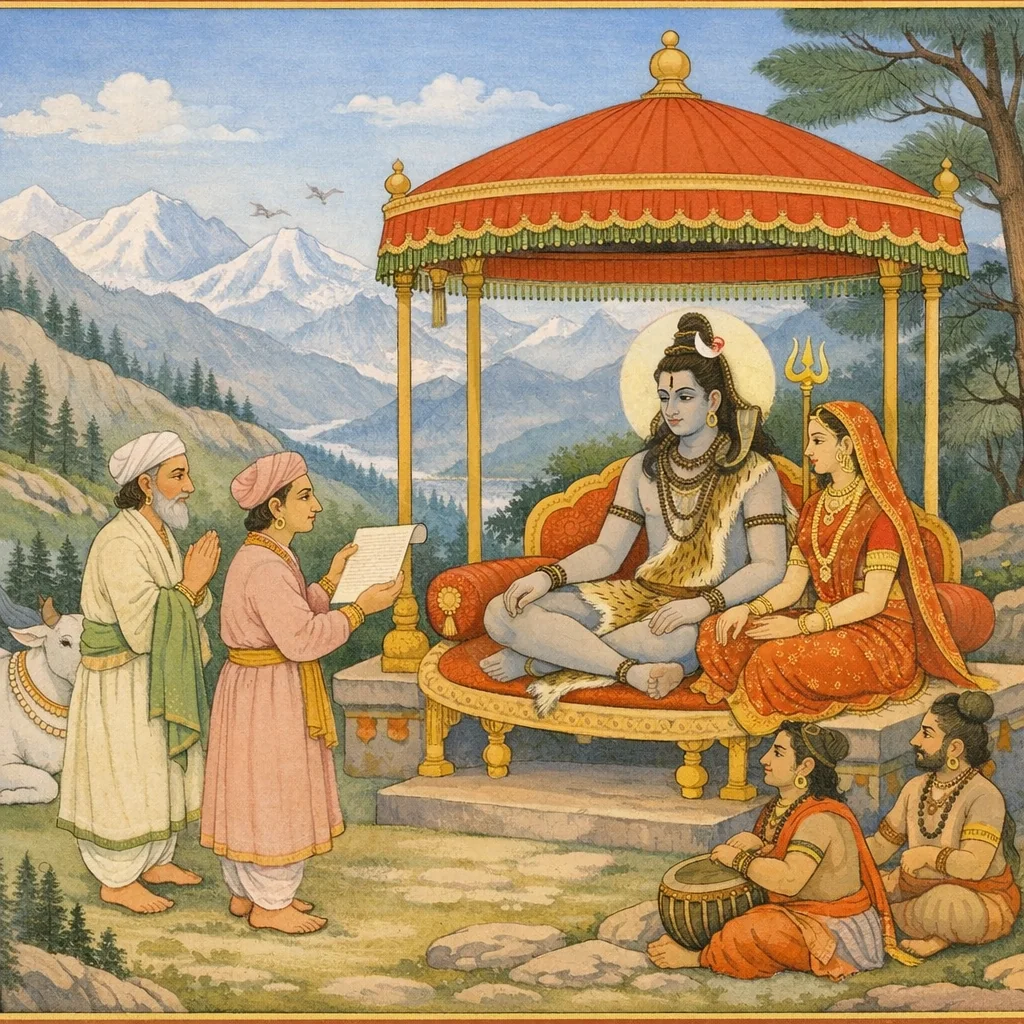
निमन्त्रण-पत्रिका-प्रेषणम् (Dispatch of the Invitation Letter) / Himālaya Sends the Wedding Invitation to Śiva
Adhyāya 37 continues the wedding preparations through a formal episode of letters and protocol. Nārada asks Brahmā what Himavān did after the Saptarṣis departed. Brahmā explains that Himavān, joyful and large-hearted, consults and summons his mountain-kin—Meru and other parvatas—showing a united familial mobilization. With affectionate intent and under proper guidance, Himavān has his purohita Garga compose a lagna-patrikā, a document fixing the auspicious time and serving as an invitation to Śiva. The letter is sent with attendants carrying various preparations and auspicious articles. The emissaries reach Kailāsa, approach Śiva, present the letter with tilaka and due courtesies, and receive special honor from the Lord. Their successful reception gladdens Himālaya, who then invites relatives and well-wishers from many regions, widening the social and ritual sphere of the coming divine wedding. The chapter highlights satkāra (honoring guests), lagna (auspicious timing), and the sacred logistics of invitation within dharmic ritual order.
Shlokas
Verse 1
नारद उवाच । तात प्राज्ञ वदेदानीं सप्तर्षिषु गतेषु च । किमकार्षीद्धिमगिरिस्तन्मे कृत्वा कृपां प्रभो
Narada said: “O revered and wise one, speak now—when the Seven Sages had departed, what did Himagiri do? O Lord, out of compassion, tell me that.”
Verse 2
ब्रह्मोवाच । गतेषु तेषु मुनिषु सप्तस्वपि मुनीश्वर । सारुन्धतीषु हिमवान् यदकार्षीद्ब्रवीमि ते
Brahmā said: “O lord among sages, when those seven sages had departed—together with their Arundhatīs—I shall tell you what Himavān, the Lord of the Himalayas, then did.”
Verse 3
करवीरस्तथैवापि महाविभव संयुतः । महेन्द्रः पर्वतश्रेष्ठ आजगाम हिमालयम्
Karavīra too, endowed with great prosperity, and Mahendra—the foremost of mountains—came to the Himalaya, the best of mountains.
Verse 4
तदाज्ञप्तस्ततः प्रीत्या हिमवान् लग्न पत्रिकाम् । लेखयामास सुप्रीत्या गर्गेण स्वपुरोधसा
Thus instructed, Himavān—filled with joy—had the marriage document written with great delight, through his own family priest, the sage Garga.
Verse 5
अथ प्रस्थापयामास तां शिवाय स पत्रिकाम् । नानाविधास्तु सामग्र्यः स्वजनैर्मुदितात्मभिः
Thereupon he sent that letter to Śiva. And many kinds of preparations were made by his own people, whose hearts were filled with joy.
Verse 6
ते जनास्तत्र गत्वा च कैलासे शिवसन्निधिम् । ददुश्शिवाय तत्पत्रं तिलकं सम्विधाय च
Those people went there to Kailāsa, into the immediate presence of Lord Śiva; and after duly preparing a tilaka-mark, they presented that sacred leaf to Śiva as an offering.
Verse 7
सन्मानिता विशेषेण प्रभुणा च यथोचितम् । सर्वे ते प्रीतिमनस आजग्मुश्शैलसन्निधिम्
Honoured with special regard by the Lord and duly treated as was fitting, all of them—joyful at heart—came to the presence of the mountain.
Verse 8
सन्मानितान्विशेषेण महेशेनागताञ्जनान् । दृष्ट्वा सुहर्षिताञ्च्छैलो मुमोदातीव चेतसि
Seeing the people who had arrived and were specially honored by Mahādeva (Maheśa), the Mountain Himālaya rejoiced exceedingly within his heart, filled with great joy.
Verse 9
ततो निमन्त्रणं चक्रे स्वबन्धूनां प्रमोदितः । नानादेशस्थितानाञ्च निखिलानां सुखास्पदम्
Then, greatly delighted, he sent out invitations to his own kinsmen and to all who dwelt in various lands, so that the occasion might become a source of joy and well-being for everyone.
Verse 10
ततस्स कारयामास स्वर्णसंग्रहमादरात् । नानाविधाश्च सामग्रीर्विवाहकरणोचिताः
Then he had gold carefully gathered with reverent care, and also assembled various materials befitting the solemn rites of the wedding.
Verse 11
तण्डुलानां बहूञ्छैलान् पृथुकानां तथैव च । गुडानां शर्कराणाञ्च लवणानां तथैव च
He should also provide many heaps of rice, as well as flattened rice; likewise jaggery, sugar, and salt.
Verse 12
क्षीराणां च घृतानाञ्च दध्नां वापीश्चकार सः । यवादिधान्यपिष्टानां लड्डुकानां तथैव च
He then caused wells (reservoirs) to be made—filled with milk, with ghee, and with curd—and likewise arranged sweet balls, laḍḍus, prepared from the flour of barley and other grains.
Verse 13
शष्कुलीनां स्वस्तिकानां शर्कराणां तथैव च । अमृतेक्षुरसानां च तत्र वापीश्चकार सः
There he caused wells to be made—filled with śaṣkulī cakes, svastika-shaped sweets, and sugar; and also with sugarcane juice, nectar-like as amṛta.
Verse 14
बह्वीर्हैयंगवानाञ्च ह्यासवानां तथैव च । नाना पक्वान्नसंघांश्च महास्वादुरसांस्तथा
And they offered many preparations of fresh butter and likewise many fermented drinks, along with heaps of assorted cooked foods—each endowed with exceedingly delicious tastes.
Verse 16
मणिरत्नप्रकाराणि सुवर्णरजतानि च । द्रव्याण्येतानि चान्यानि संगृह्य विधिपूर्वकम्
Having gathered—according to proper scriptural procedure—various kinds of gems and precious stones, gold and silver, and other such valuable substances, the devotee should proceed with the ordained worship.
Verse 17
मंगलं कर्तुमारेभे गिरिर्मंगलकृद्दिने । संस्कारं कारयामासुः पार्वत्याः पर्वतस्त्रियः
On an auspicious day, the Mountain-King Himālaya began the preparations for the consecratory rites; and the women of the mountains set about performing Pārvatī’s saṃskāras, preparing her outwardly and inwardly for the holy union with Lord Śiva.
Verse 18
ता मंगलं मुदा चक्रुर्भूषिता भूषणैः स्वयम् । पुरद्विजस्त्रियो दृष्ट्वा लोकाचारं प्रचक्रिरे
Adorning themselves with ornaments by their own hands, those women joyfully performed the auspicious rites. Seeing the wives of the city’s brāhmaṇas, they then followed and carried out the customary conduct of society.
Verse 19
नाना व्यञ्जनवस्तूनि गणदेवहितानि च । अमूल्यनानावस्त्राणि वह्निशौचानि यानि च
Various prepared delicacies and items beneficial to the Gaṇa-deities were arranged, along with many kinds of priceless garments, and those pure offerings made clean and consecrated by the ritual fire.
Verse 20
सर्वभावेन सुप्रीतो बन्धुवर्गागमोत्सुकः । एतस्मिन्नन्तरे तस्य बान्धवाश्च निमन्त्रिताः
He was delighted with his whole heart and eagerly awaited the arrival of his kinsmen. Meanwhile, in that very interval, his relatives too were invited.
Verse 21
आजग्मुस्सस्त्रियो हृष्टास्ससुतास्सपरिच्छदाः । तदैव शृणु देवर्षे गिर्य्यागमनमादृतः
Delighted, the women arrived at once—together with their children and with all their attendants and belongings. At that very moment, O divine sage, listen attentively to the reverent coming of the Mountain (Himālaya).
Verse 22
वर्णयामि समासेन शिवप्रीतिविवृद्धये । देवालय गिरिर्यो हि दिव्यरूपधरो महान्
For the increase of Śiva’s delight, I shall describe it briefly: that great mountain called Devālaya, bearing a divine form, indeed stands forth in glory.
Verse 23
नानारत्नपरिभ्राजत्समाजस्सपरिच्छदः । नानामणिमहारत्नसारमादाय यत्नतः
With all its attendants and equipment, the assembly shone with many kinds of jewels; and with great care they had gathered the choicest essence of diverse gems and precious great jewels.
Verse 24
सुवेषालंकृतः श्रीमान् जगाम स हिमालयम् । मन्दरस्सर्वशोभाढ्यस्सनारीतनयो गिरिः
Adorned in splendid attire and radiant with prosperity, he went to the Himalaya—to Mount Mandara, the mountain richly endowed with every beauty, the son of the lady Menā, that great lord among mountains.
Verse 25
सूपायनानि संगृह्य जगाम विविधानि च । अस्ताचलोपि दिव्यात्मा सोपायन उदारधीः
Having gathered various fitting offerings and gifts, that divine-souled, noble-minded one set out—indeed, he went even toward the western mountain, Asta—carrying those offerings with him.
Verse 26
बहुशोभासमायुक्त आजगाम मुदान्वितः । उदयाचल आदाय सद्रत्नानि मणीनपि
Adorned with great splendor, he arrived filled with joy, bringing from Udayācala, the eastern mountain, excellent jewels and precious gems as well.
Verse 27
अत्युत्कृष्टपरीवार आजगाम महासुखी । मलयो गिरिराजो हि सपरीवार आदृतः
Surrounded by an exceedingly splendid retinue, the great Mountain-King Malaya arrived, filled with great joy; he came with his attendants, duly honored and received with respect.
Verse 28
सुदिव्यरचनायुक्त आययौ बहुसद्बलः । सद्यो दर्दुरनामा च मुदितस्सकलत्रकः
Endowed with a splendid, divine array and supported by a great and noble force, Dardura by name arrived at once—joyful—together with all his attendants and retinue.
Verse 29
बहुशोभान्वितस्तातः ययौ हिमगिरेर्गृहम् । निषदोपि प्रहृष्टात्मा सपरिच्छद आययौ
Then the father, adorned with great splendor, proceeded to the dwelling of Himālaya. Even the Niṣāda (tribal attendant), joyful at heart, arrived there too, bearing the needed provisions and belongings.
Verse 30
ससुतस्त्रीगणः प्रीत्या ययौ हिमगिरेर्गृहम् । आजगाम महाभाग्यो भूधरो गन्धमादनः
Rejoicing, Himālaya went to his home together with his sons and the company of women; and then the most fortunate Gandhamādana—supporter of the earth—arrived there as well.
Verse 32
सगणस्ससुतस्त्रीको बहुशोभासमन्वितः । पारियात्रो हि हृष्टात्मा मणि रत्नाकरस्सयुत्
Accompanied by his attendants, together with his son and wife, adorned with many kinds of splendor, Pāriyātra—his heart filled with joy—came endowed with treasures, heaps and mines of gems and jewels.
Verse 33
सगणस्सपरीवार आययौ हिमभूधरम् । क्रौञ्चः पर्वतराजो हि महाबलपरिच्छदः । आजगाम गिरिश्रेष्ठस्स मुपायन आदृतः
Accompanied by his attendants and retinue, he arrived at the snowy mountain. And Krauncha, the king of mountains—mighty and splendidly endowed—came forward with respectful offerings to honor that foremost of mountains.
Verse 34
पुरुषोत्तमशैलोपि सपरिच्छद आदृतः । महोपायनमादायाजगाम हिमभूधरम्
Even Puruṣottamaśaila, duly honored and accompanied by his attendants, took a great offering and set out for the Himālaya mountain—Himabhūdhara.
Verse 35
नीलः सलीलस्स सुतस्सस्त्रीको द्रव्यसंयुतः । आजगाम हिमागस्य गृहमानन्दसंयुतः
Nīla, together with Salīla and his son, accompanied by his wife and furnished with gifts and provisions, came joyfully to the house of Himāga.
Verse 36
त्रिकूटश्चित्रकूटोपि वेंकटः श्रीगिरिस्तथा । गोकामुखी नारदश्च हिमगेहमुपागमत्
Trikūṭa, Citrakūṭa, Veṅkaṭa, and likewise Śrīgiri—and Gokāmukhī as well—together with Nārada, all approached the snowy abode of Himālaya.
Verse 37
विन्ध्यश्च पर्वतश्रेष्ठो नानासम्पत्समन्वितः । आजगाम प्रहृष्टात्मा सदारतनयश्शुभः
Then Vindhya—the foremost of mountains, endowed with many kinds of riches—arrived with a delighted heart, accompanied by his wife and son, auspicious in every way.
Verse 38
कालंजरो महाशैलो बहुहर्षसमन्वितः । बहुभस्सगणः प्रीत्याजगामहिमभूधरम्
The great mountain Kālañjara, filled with abundant joy, lovingly came—along with many attendants bearing bhasma, the sacred ash—to the Himālaya, lord of snowy peaks.
Verse 39
कैलासस्तु महाशैलो महाहर्षसमन्वितः । आजगाम कृपां कृत्वा सर्वोपरि लसत्प्रभुः
Then mighty Kailāsa—the great mountain, filled with supreme joy—came forth in compassion, shining above all as the radiant Lord’s own exalted abode.
Verse 40
अन्येपि भूभृतो ये हि द्वीपेष्वन्येष्वपि द्विज । इहापि येऽचलास्सर्वे आययुस्ते हिमालयम्
O brāhmaṇa, even those other mountain-lords who dwelt on other islands—and all the immovable mountains that were here as well—came and assembled at Himālaya.
Verse 41
निमन्त्रिता नगास्तत्र तेन पूर्वं मुदा मुने । आययुर्निखिलाः प्रीत्या विवाहश्शिवयोरिति
O sage, having been invited there beforehand by him with joy, all the mountain-lords came gladly, delighted at the marriage of Śiva and Pārvatī.
Verse 42
तदा सर्वे समायाताश्शोणभद्रादयः खलु । बहुशोभा महाप्रीत्या विवाहश्शिवयोरिति
Then indeed all of them—Śoṇabhadra and the others—arrived there. With great joy and splendid celebration, they came for the marriage of Śiva and Pārvatī.
Verse 43
नद्यस्सर्वास्समायाता नानालंकारसंयुताः । दिव्य रूपधराः प्रीत्या विवाहश्शिवयोरिति
All the rivers arrived there, adorned with many ornaments. Assuming radiant, divine forms, they came joyfully, celebrating the sacred marriage of Śiva and Pārvatī.
Verse 44
गोदावरी च यमुना ब्रह्मस्त्रीर्वेणिका तथा । आययौ हिमशैलम्वै विवाहश्शिवयोरिति
Godāvarī and Yamunā, along with the maidens of Brahmā and Veṇikā too, came to the Himālaya, for the wedding of Śiva and Pārvatī was to be held there.
Verse 45
गंगा तु सुमहाप्रीत्या नानालंकारसंयुता । दिव्यरूपा ययौ प्रीत्या विवाहश्शिवयोरिति
Then Gaṅgā, filled with great joy and adorned with many ornaments, assumed a divine form and went forth gladly for the wedding of Śiva and Pārvatī.
Verse 46
नर्मदा तु महामोदा रुद्रकन्या सरिद्वरा । महाप्रीत्या जगामाशु विवाहश्शिवयोरिति
Narmadā—greatly delighted, the daughter of Rudra and the most excellent of rivers—went swiftly with profound joy to witness the wedding of Śiva and Pārvatī.
Verse 47
आगतैस्तैस्ततः सर्वैस्सर्वतो हिमभूधरम् । संकुलासीत्पुरी दिव्या सर्वशोभासमन्विता
Then, as all of them arrived from every direction at the Himālaya mountain, the divine city grew densely crowded, adorned with every kind of splendor.
Verse 48
महोत्सवा लसत्केतुध्वजातोरणकाधिका । वितानविनिवृत्तार्का तथा नानालसत्प्रभा
It became a scene of great festivity—shining banners, flags, and ceremonial gateways; canopies were spread to soften the sun’s glare, and many radiant lights glittered all around.
Verse 49
हिमालयोपि सुप्रीत्यादरेण विविधेन च । तेषां चकार सन्मानं तासां चैव यथायथम्
Even Himālaya, filled with gladness and attentive reverence, bestowed upon them manifold honors—each in the manner fitting to them.
Verse 50
सर्वान्निवासयामास सुस्थानेषु पृथक् पृथक् । सामग्रीभिरनेकाभिस्तोषयामास कृत्स्नशः
He seated them all separately in well-appointed places, and with many kinds of offerings and provisions he satisfied every one of them completely.
Frequently Asked Questions
Himavān formally prepares and dispatches the lagna-patrikā (wedding/auspicious-time invitation) to Śiva at Kailāsa, and Śiva receives and honors the emissaries.
The chapter sacralizes ‘auspicious order’ (lagna, etiquette, satkāra) as a manifestation of cosmic harmony—showing that divine union is approached through disciplined, dharmic procedure.
Śiva appears as the ideal sovereign-host (proper honor to messengers), while Himavān embodies dharmic kingship/guardianship through organized invitation, priestly mediation (Garga), and communal coordination.