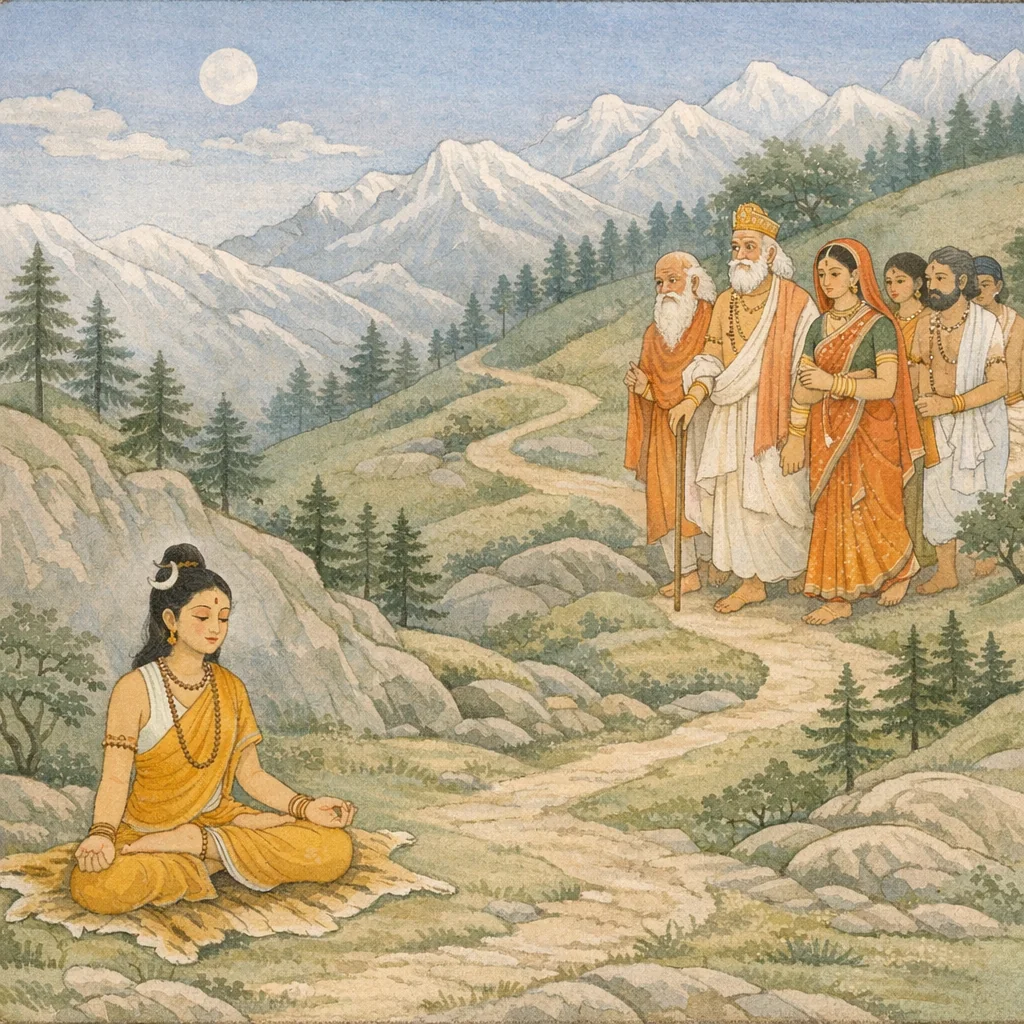
पार्वत्याः तपः—हिमालयादिभिः उपदेशः / Pārvatī’s Austerity and Counsel from Himālaya and Others
In this chapter Brahmā narrates Pārvatī’s long tapas undertaken to attain Śiva. Though time passes without Śiva’s visible appearance, Pārvatī, surrounded by her companions, intensifies her austerities with unwavering resolve fixed on the highest aim (paramārtha). Himālaya arrives with his household and urges her not to exhaust herself through severe asceticism, saying that Rudra is not seen and implying His aloofness. He warns of bodily frailty, advises her to return home, and cites Śiva’s burning of Kāma as a sign of His inaccessibility, using the analogy that Śiva is as ungraspable as the moon in the sky. Brahmā adds that Menā and many mountain-kings—Sahyādri, Meru, Mandara, Maināka, and others such as Kraunca—also try to dissuade Girijā with varied arguments. The chapter centers on the clash between worldly counsel and steadfast spiritual intention, setting the stage for a later divine response.
Shlokas
Verse 1
गतेषु तेषु सूर्येषु सखीभिः परिवारिता । तपस्तेपे तदधिकं परमार्थसुनिश्चया
When those days had passed, she—surrounded by her companions—performed austerities even more intensely, firmly resolved upon the supreme spiritual goal.
Verse 2
हिमालयस्तदागत्य पार्वतीं कृतनिश्चयाम् । सभार्यस्ससुतामात्य उवाच परमेश्वरीम्
Then Himālaya came to Pārvatī, whose resolve had become steadfast; accompanied by his wife, his daughter, and his ministers, he addressed the Supreme Goddess.
Verse 3
हिमालय उवाच । मा खिद्यतां महाभागे तपसानेन पार्वती । रुद्रो न दृश्यते बाले विरक्तो नात्र संशयः
Himālaya said: “O most fortunate Pārvatī, do not grieve over this austerity. O child, Rudra is not easily seen; of this there is no doubt—He is detached, not won by mere outward striving.”
Verse 4
त्वं तन्वी सुकुमारांगी तपसा च विमोहिता । भविष्यसि न संदेहस्सत्यं सत्यं वदामि ते
O slender one, O tender-limbed maiden—though you are wholly absorbed in austerity, you shall indeed attain the fulfillment destined for you; there is no doubt. I tell you the truth—truth itself.
Verse 5
तस्मादुत्तिष्ठ चैहि त्वं स्वगृहं वरवर्णिनि । किं तेन तव रुद्रेण येन दग्धः पुरा स्मरः
Therefore, rise and come—return to your own home, O fair-complexioned lady. What good is that Rudra to you, by whom Kāma (Smara) was once burned to ashes?
Verse 6
अतो हि निर्विकार त्वात्त्वामादातुं वरां हराः । नागमिष्यति देवेशि तं कथं प्रार्थयिष्यसि
Therefore, O Devī, because Lord Hara is changeless and without modification, He will not come to take you as His bride. How, then, will you be able to petition Him?
Verse 7
गगनस्थो यथा चंद्रो ग्रहीतुं न हि शक्यते । तथैव दुर्गमं शंभुं जानीहि त्वमिहानघे
Just as the moon abiding in the sky cannot be grasped, so too, O sinless one, know that Śambhu (Lord Śiva) is difficult to reach.
Verse 8
ब्रह्मोवाच । तथैव मेनया चोक्ता तथा सह्याद्रिणा सती । मेरुणा मंदरेणैव मैनाकेन तथैव सा
Brahmā said: In the same way, Satī was instructed by Menā; likewise by the Sahya mountain. So too she was counselled by Meru, by Mandara, and in the same manner by Maināka.
Verse 9
एवमन्यैः क्षितिभैश्च क्रौंचादिभिरनातुरा । तथैव गिरिजा प्रोक्ता नानावादविधायिभिः
In the same way, other kings of mountains too—Krauñca and the rest—free from distress, addressed Girijā (Pārvatī) with diverse arguments and many kinds of counsel.
Verse 10
ब्रह्मोवाच । एवं प्रोक्ता यदा तन्वी सा सर्वैस्तपसि स्थिता । उवाच प्रहसंत्येव हिमवंतं शुचिस्मिता
Brahmā said: Thus addressed, when that slender, radiant maiden remained steadfast in every form of austerity, she—smiling brightly—spoke to Himavān with a pure and gentle smile.
Verse 11
पार्वत्युवाच । पुरा प्रोक्तं मया तात मातः किं विस्मृतं त्वया । अधुनापि प्रतिज्ञां च शृणुध्वं मम बांधवाः
Pārvatī said: “O beloved Mother, have you forgotten what I spoke long ago? Even now, hear my vow, O my kinsfolk.”
Verse 12
विरक्तोसौ महादेवो येन दग्धा रुषा स्मरः । तं तोषयामि तपसा शंकरं भक्तवत्सलम्
He is that dispassionate Mahādeva by whose wrath Smara (Kāma) was burnt to ashes. By austerity I seek to please that Śaṅkara, the One who is tenderly gracious to His devotees.
Verse 13
सर्वे भवंतो गच्छंतु स्वं स्वं धाम प्रहर्षिताः । भविष्यत्येव तुष्टोऽसौ नात्र कार्य्या विचारणा
“May all of you depart joyfully to your own abodes. He will certainly be pleased—there is no need for any further deliberation in this matter.”
Verse 14
दग्धो हि मदनो येन येन दग्धं गिरेर्वनम् । तमानयिष्ये चात्रैव तपसा केव लेन हि
He by whom Kāma (the god of desire) was burned—by him this mountain-forest was also burned. Here itself, by austerity alone, I shall bring Him (Śiva) to me.
Verse 15
तपोबलेन महता सुसेव्यो हि सदाशिवः । जानीध्वं हि महाभागास्सत्यं सत्यं वदामि वः
By the great power of austerity (tapas), Sadāśiva is indeed to be worshipped with steadfast devotion. Know this, O noble ones—I speak to you the truth, the truth alone.
Verse 16
आभाष्य चैवं गिरिजा च मेनकां मैनाकबंधुं पितरं हिमालयम् । तूष्णीं बभूवाशु सुभाषिणी शिवा समंदरं पर्वतराजबालिका
Having spoken thus, Girijā addressed Menakā, her maternal uncle Maināka, and her father Himālaya. Then that well-spoken Śivā—the young daughter of the Lord of Mountains—at once became silent, composed and steady like the ocean.
Verse 17
जग्मुस्तथोक्ताः शिवया हि पर्वता यथागतेनापि विचक्षणास्ते । प्रशंसमाना गिरिजा मुहुर्मुहुस्सुविस्मिता हेमनगेश्वराद्याः
Thus instructed by Śivā, those discerning lords of the mountains departed, returning by the very path they had come. Again and again they praised Girijā (Pārvatī), greatly astonished—beginning with Hemanageśvara and the others.
Verse 19
तपसा महता तेन तप्तमासीच्चराचरम् । त्रैलोक्यं हि मुनिश्रेष्ठ सदेवासुरमानुषम्
By that immense tapas, O best of sages, all that moves and all that is still seemed as though scorched; indeed the three worlds—together with devas, asuras, and humans—were grievously afflicted by its heat.
Verse 20
तदा सुरासुराः सर्वे यक्षकिन्नरचारणाः । सिद्धास्साध्याश्च मुनयो विद्याधरमहोरगाः
Then all the Devas and Asuras—together with the Yakṣas, Kinnaras, and Cāraṇas; the Siddhas and Sādhyas; the sages, the Vidyādharas, and the great serpents—assembled there.
Verse 21
सप्रजापतयश्चैव गुह्यकाश्च तथापरे । कष्टात् कष्टतरं प्राप्ताः कारणं न विदुः स्म तत्
Even the Prajāpatis, the Guhyakas, and other beings too fell into an affliction worse than suffering itself; yet they did not understand the true cause of that calamity.
Verse 22
सर्वे मिलित्वा शक्राद्या गुरुमामंत्र्य विह्वलाः । सुमेरौ तप्तसर्वांगा विधिं मां शरणं ययुः
Then all the gods—led by Śakra (Indra)—gathered together. Distressed, they respectfully took leave of their Guru; and with their whole bodies scorched by austerity on Mount Sumeru, they went for refuge to me, Brahmā (Vidhī).
Verse 23
इति श्रीशिवमहापुराणे द्वितीयायां रुद्रसंहितायां तुतीये पार्वतीखंडे पार्वतीसांत्वनशिवदेवदर्शनवर्णनं नाम त्रयोविंशोऽध्यायः
Thus ends the twenty-third chapter, entitled “The Description of Consoling Pārvatī and the Vision of Lord Śiva,” in the Pārvatīkhaṇḍa (third section) of the Rudra-saṃhitā (second part) of the Śrī Śiva Mahāpurāṇa.
Verse 24
देवा ऊचुः । त्वया सृष्टमिदं सर्वं जगदेतच्चराचरम् । संतप्तमति कस्माद्वै न ज्ञातं कारणं विभो
The Devas said: “By You this entire universe—both the moving and the unmoving—has been created. Yet it burns with affliction. Why indeed is its cause not known, O all-pervading Lord?”
Verse 26
ब्रह्मोवाच । इत्याकर्ण्य वचस्तेषामहं स्मृत्वा शिवं हृदा । विचार्य मनसा सर्वं गिरिजायास्तपः फलम्
Brahmā said: Having thus heard their words, I remembered Lord Śiva within my heart; and, reflecting in my mind on everything, I considered the fruit of Girijā’s austerity.
Verse 27
दग्धं विश्वमिति ज्ञात्वा तैः सर्वैरिह सादरात् । हरये तत्कथयितुं क्षीराब्धिमगमं द्रुतम्
Realizing with reverence that the whole world had been burnt, they all hastened at once to the Ocean of Milk, in order to report that matter to Hari (Viṣṇu).
Verse 28
तत्र गत्वा हरिं दृष्ट्वा विलसंतं सुखासने । सुप्रणम्य सुसंस्तूय प्रावोचं सांजलिः सुरैः
Going there and seeing Hari (Viṣṇu) delighting as he sat upon a comfortable seat, I bowed down deeply, praised him well, and then—standing with folded hands in the presence of the gods—spoke.
Verse 29
त्राहि त्राहि महाविष्णो तप्तान्नश्शरणागतान् । तपसोग्रेण पार्वत्यास्तपत्याः परमेण हि
“Save us, save us, O Mahāviṣṇu—us who are scorched and have come seeking refuge. For indeed, by Pārvatī’s most supreme and fierce austerity, the heat of her tapas is blazing.”
Verse 30
इत्याकर्ण्य वचस्तेषामस्मदादि दिवौकसाम् । शेषासने समाविष्टोऽस्मानुवाच रमेश्वरः
Thus, having heard the words of those who dwell in heaven—beginning with us—Rameśvara, seated upon the throne of Śeṣa, addressed us in reply.
Verse 31
विष्णुरुवाच । ज्ञातं सर्वं निदानं मे पार्वती तपसोद्य वै । युष्माभिस्सहितस्त्वद्य व्रजामि परमेश्वरम्
Viṣṇu said: “Today I have understood the entire cause and purpose of Pārvatī’s austerities (tapas). Therefore, accompanied by all of you, I now go to the Supreme Lord, Parameśvara (Śiva).”
Verse 32
महादेवं प्रार्थयामो गिरिजाप्रापणाय तम् । पाणिग्रहार्थमधुना लोकानां स्वस्तयेऽमराः
We, the immortal Devas, now pray to Mahādeva, that Girijā (Pārvatī) may attain Him in marriage—so that He may accept her hand—for the welfare and auspiciousness of all the worlds.
Verse 34
तस्माद्वयं गमिष्यामो यत्र रुद्रो महाप्रभुः । तपसोग्रेण संयुक्तोऽद्यास्ते परममंगलः
Therefore, let us go to the place where Rudra, the great Lord, abides today—united with intense austerity—supremely auspicious in His very being.
Verse 35
ब्रह्मोवाच । विष्णोस्तद्वचनं श्रुत्वा सर्व ऊचुस्सुरादयः । महाभीता हठात् क्रुद्धाद्दग्धुकामात् लयंकरात्
Brahmā said: Having heard those words of Viṣṇu, all the gods and the others spoke up—greatly afraid of that one who, suddenly wrathful, longed to burn all things and stood as a fearsome agent of dissolution (pralaya).
Verse 36
देवा ऊचुः । महाभयंकरं क्रुद्धं कालानलसमप्रभम् । न यास्यामो वयं सर्वे विरूपाक्षं महाप्रभम्
The gods said: “He is exceedingly terrifying, wrathful, and radiant like the fire of Kāla (Time) that consumes all. We all will not go near Virūpākṣa, the Great Lord of mighty splendor.”
Verse 37
यथा दग्धः पुरा तेन मदनो दुरतिक्रमः । तथैव क्रोधयुक्तो नः स धक्ष्यति न संशयः
Just as in former times that formidable, irresistible Kāma was burned by him, so too—when united with wrath—he will burn us as well; of this there is no doubt.
Verse 38
ब्रह्मोवाच तदाकर्ण्य वचस्तेषां शक्रादीनां रमेश्वरः । सांत्वयंस्तान्सुरान्सर्वान्प्रोवाच स हरिर्मुने
Brahmā said: Hearing the words of Indra and the other gods, Hari—the Lord of Lakṣmī—comforted all the devas and then spoke, O sage.
Verse 39
हरिरुवाच । हे सुरा मद्वचः प्रीत्या शृणुतादरतोऽखिलाः । न वो धक्ष्यति स स्वामी देवानां भयनाशनः
Hari (Viṣṇu) said: “O Devas, all of you listen attentively to my words with goodwill. That Lord—who removes the fear of the gods—will not burn you.”
Verse 40
तस्माद्भवद्भिर्गंतव्यं मया सार्द्धं विचक्षणैः । शंभुं शुभकरं मत्वा शरणं तस्य सुप्रभो
Therefore, O wise ones, go together with me. Knowing Śambhu to be the bestower of auspiciousness, O radiant one, take refuge in Him.
Verse 41
शिवं पुराणं पुरुषमधीशं वरेण्यरूपं हि परं पुराणम् । तपोजुषाणां परमात्मरूपं परात्परं तं शरणं व्रजामः
We take refuge in that Supreme Śiva—ancient beyond all, the sovereign Lord, of the most excellent form; the very essence of the highest Purāṇa; the form of the Supreme Self for those who delight in tapas; the Transcendent who is beyond even the beyond.
Verse 42
ब्रह्मोवाच । एवमुक्तास्तदा देवा विष्णुना प्रभवि ष्णुना । जग्मुस्सर्वे तेन सह द्रष्टुकामाः पिनाकिनम्
Brahmā said: Thus addressed at that time by mighty Viṣṇu, all the gods went along with him, desiring to behold Pinākin—Lord Śiva, the bearer of the bow Pināka.
Verse 43
प्रथमं शैलपुत्र्यास्तत्तपो द्रष्टुं तदाश्रमम् । जग्मुर्मार्गवशात्सर्वे विष्ण्वाद्यस्सकुतूहलाः
First, wishing to behold the tapas being performed by Śailaputrī (Pārvatī), all the gods—led by Viṣṇu—set out; and, following the course of the path, they came to that hermitage, filled with curiosity.
Verse 44
पार्वत्यास्तु तपो दृष्ट्वा तेजसा व्यापृतास्तदा । प्रणेमुस्तां जगद्धात्रीं तेजोरूपां तपः स्थिताम्
Beholding Pārvatī’s austerity, they were pervaded by its tejas, its spiritual radiance. They bowed to that Mother who upholds the worlds—she who had become a very form of splendor, steadfastly established in tapas.
Verse 45
प्रशंसंतस्तपस्तस्यास्साक्षात्सिद्धितनोस्सुराः । जग्मुस्तत्र तदा ते च यत्रास्ते वृषभध्वजः
Praising her austerity, the gods—whose very bodies seemed embodiments of manifest siddhi—then went to the place where Vṛṣabhadhvaja, Lord Śiva bearing the bull as His emblem, was present.
Verse 46
तत्र गत्वा च ते देवास्त्वां मुने प्रैषयंस्तदा । पश्यतो दूरतस्तस्थुः कामभस्मकृतोहरात्
Having gone there, those gods then dispatched you, O sage. And while you watched, they stood at a distance—after Hara (Śiva) had reduced Kāma to ashes.
Verse 47
नारद त्वं शिवस्थानं तदा गत्वाऽभयस्सदा । शिवभक्तो विशेषेण प्रसन्नं दृष्टवान् प्रभुम्
O Nārada, at that time you went to Śiva’s sacred abode and remained ever fearless. As a devotee of Śiva in a special way, you beheld the Lord—Śiva—radiant with grace and fully pleased.
Verse 48
पुनरागत्य यत्नेन देवानाहूय तांस्ततः । निनाय शंकरस्थानं तदा विष्ण्वादिकान्मुने
Then, returning again and with due effort, he summoned the gods; and thereafter, O sage, he led them—Vishnu and the others—to the sacred abode of Śaṅkara (Lord Shiva).
Verse 49
अथ विष्ण्वादयस्सर्वे तत्र गत्वा शिवं प्रभुम् । ददृशुस्सुखमासीनं प्रसन्नं भक्तवत्सलम्
Then Vishnu and the other deities all went there and beheld Lord Shiva, the Supreme Master—seated at ease, serene and radiant with grace, ever tender toward His devotees.
Verse 50
योगपट्टस्थितं शंभुं गणैश्च परिवारितम् । तपोरूपं दधानं च परमेश्वररूपिणम्
They beheld Śambhu seated in the yogic posture with the yoga-strap, surrounded by His gaṇas—bearing the very form of tapas (austerity) and manifest as Parameśvara, the Supreme Lord.
Verse 51
ततो विष्णुर्मयान्ये च सुरसिद्धमुनीश्वराः । प्रणम्य तुष्टुवुस्सूक्तैर्वेदोपनिषदन्वितैः
Thereupon, Viṣṇu, I (Brahmā), and also the foremost lords among the gods, Siddhas, and great sages bowed down in reverence and praised (Śiva) with hymns enriched with the authority of the Vedas and the Upaniṣads.
Frequently Asked Questions
The discouraging counsel invokes Śiva’s burning of Smara (Kāma) to suggest Śiva’s detachment and difficulty of approach, using that mythic precedent to argue against Pārvatī’s marital aspiration.
It dramatizes the testing of resolve: the seeker’s paramārtha-suniścaya is refined through opposition, showing that authentic tapas is measured by steadiness under persuasive, emotionally charged counter-arguments.
Śiva is referenced as Haro (Hara), Rudra, and Śaṃbhu, emphasizing both his transcendent otherness (durgama, ‘hard to reach’) and his power over desire (the Smara-burning motif).