Vāmadeva-mata: Rahasya-upadeśa (The Esoteric Teaching of Vāmadeva’s Doctrine)
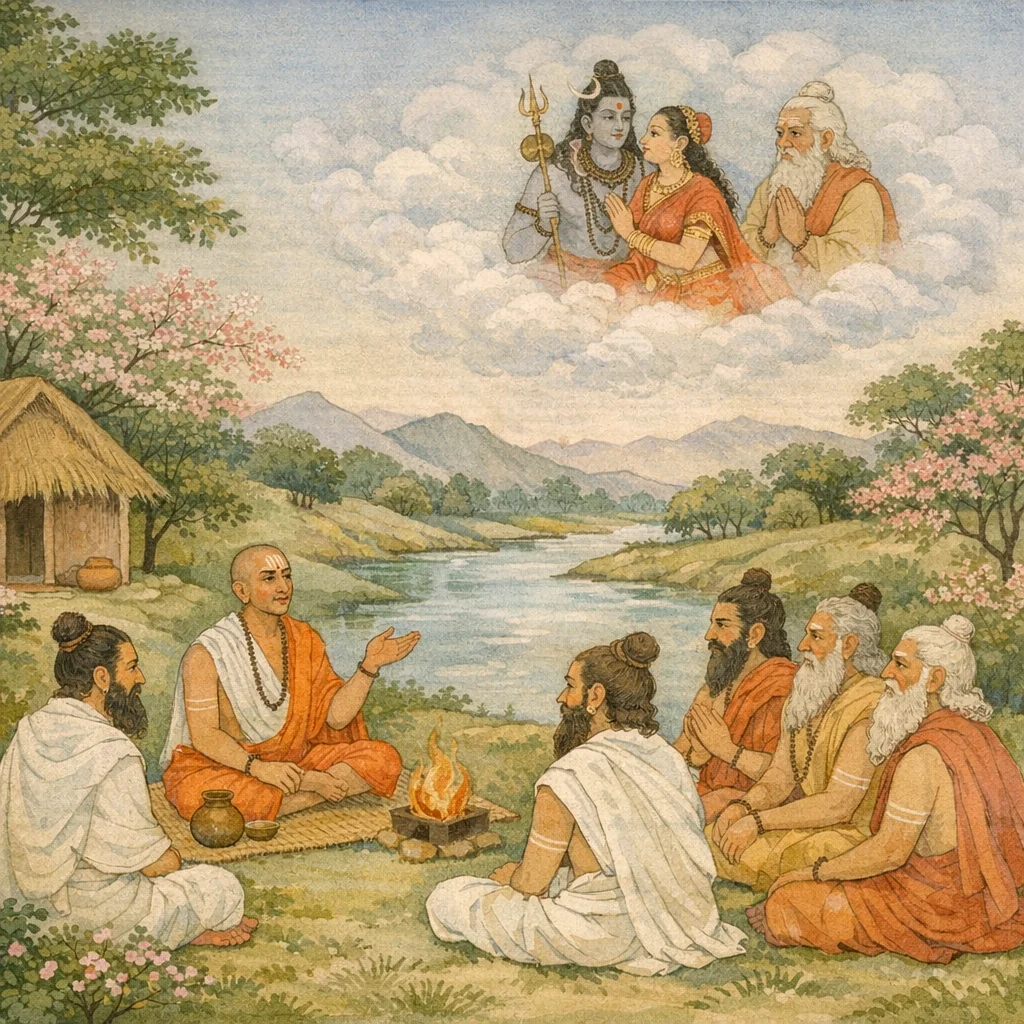
Adhyāya 11 begins with the ṛṣis addressing Sūta as their foremost teacher and explicitly invoking the ethics of transmitting sacred knowledge. As śraddhālu (faithful) disciples, they humbly request a fuller explanation of the Vāmadeva-mata—previously only hinted at—connected with the time of the Virajā-homa, seeking anugraha (grace). Sūta responds by authorizing his discourse ritually and intellectually: he bows to Mahādeva (the Guru beyond all gurus), Mahādevī (trijananī), and Vyāsa, and blesses the sages to remain steadfast Śiva-bhaktas. He notes the teaching is ‘vicitra’ and had earlier been withheld out of fear of exposing a secret (guhya), but now, seeing the listeners’ firm vow and devotion, he agrees to teach. The chapter then places the doctrine in history: in the Rathantara kalpa, Vāmadeva—a great muni and the foremost knower and teacher of Śiva-jñāna—is presented as the central authority. Thus the narrative establishes a controlled disclosure of esoteric Śaiva knowledge—its lineage, ritual context, and the qualifications for receiving it.
Shlokas
Verse 1
ऋषय ऊचुः । सूत सूत महाभागस्त्वमस्मद्गुरुरुत्तमः । अतस्त्वां परिपृच्छामो भवतोऽनुग्रहो यदि
The sages said: “O Sūta, O Sūta—most blessed one! You are our supreme teacher. Therefore we ask you, if your gracious favor rests upon us.”
Verse 2
श्रद्धालुषु च शिष्येषु त्वादृशा गुरवस्सदा । स्निग्धभावा इतीदं नो दर्शितम्भवताधुना
Toward disciples who are full of faith, teachers like you are ever affectionate. Indeed, you have now shown us this—your tender, gracious regard for us.
Verse 3
विरजाहोमसमये वामदेवमतम्पुरा । सूचितम्भवतास्माभिर्न श्रुतं विस्तरान्मुने
O sage, earlier—at the time of the Virajā-homa—you only indicated to us the doctrine of Vāmadeva; we did not hear it from you in full detail.
Verse 4
तदिदानीं श्रोतुकामाः श्रद्धया परमादरात् । वयं सर्व्वे कृपासिंधो प्रीत्या तद्वक्तुमर्हसि
Now we all long to hear it, with faith and the highest reverence. O ocean of compassion, out of gracious love you should indeed tell us that.
Verse 5
इति तेषां वचः श्रुत्वा सूतो हृष्टतनूरुहः । नमस्कृत्य महादेवं गुरोः परतरं गुरुम्
Thus, having heard their words, Sūta—his body thrilled with joy—bowed in reverence to Mahādeva, the Guru who is higher than all gurus.
Verse 6
महादेवीं त्रिजननीं गुरुं व्यासश्च भक्तितः । प्राह गम्भीरया वाचा मुनीनाह्लादयन्निदम्
With devotion, Vyāsa addressed the great Goddess—the threefold Mother and his revered spiritual guide. In a deep, steady voice, he spoke these words, delighting the assembled sages.
Verse 7
सूत उवाच । स्वस्त्यस्तु मुनयस्सर्वे सुखिन स्सन्तु सर्व्वदा । शिवभक्ता स्थिरात्मानश्शिवे भक्तिप्रवर्तकाः
Sūta said: “May auspiciousness be upon all the sages; may you ever remain happy. May you be devoted to Śiva, steadfast in spirit, and active promoters of devotion to Śiva.”
Verse 8
तदतीव विचित्रं हि श्रुतं गुरुमुखाम्बुजात् । इतः पूर्वम्मया नोक्तं गुह्यप्राकट्यशंकया
That indeed was exceedingly wondrous—heard from the lotus-mouth of my Guru. Earlier I did not speak of it, fearing that what is secret would become openly disclosed.
Verse 9
यूयं खलु महाभागाश्शिवभक्ता दृढव्रताः । इति निश्चित्य युष्माकं वक्ष्यामि श्रूयताम्मुदा
You are indeed most fortunate—devotees of Lord Śiva, steadfast in your vows. Knowing this with certainty, I shall speak for your sake; listen with joy.
Verse 10
पुरा रथन्तरे कल्पे वामदेवो महामुनिः । गर्भमुक्तश्शिवज्ञानविदां गुरुतमस्स्वयम्
In the ancient Rathantara Kalpa, there was the great sage Vāmadeva—himself liberated even while in the womb—who became, of his own accord, the foremost guru among the knowers of Śiva’s wisdom.
Verse 11
वेदागमपुराणादिसर्व्वशास्त्रार्थवत्त्ववित् । देवासुरमनुष्यादिजीवानां जन्मकर्म्मवित्
He is the knower of the true purport and inner reality of all scriptures—Vedas, Āgamas, Purāṇas, and the rest—and he understands the births and karmic courses of all beings, whether gods, demons, humans, and others.
Verse 12
भस्मावदातसर्व्वांगो जटामण्डललमंडितः । निराश्रयो निःस्पृहश्च निर्द्वन्द्वो निरहंकृतिः
His entire body shines with sacred ash (bhasma), and he is adorned with a halo-like crown of matted locks (jaṭā). He depends on nothing, is free from craving, untouched by the pairs of opposites, and devoid of ego—thus revealing the Lord’s serene, yogic majesty that grants liberation.
Verse 13
दिगंबरो महाज्ञानी महेश्वर इवापरः । शिष्यभूतैर्मुनीन्द्रैश्च तादृशैः परिवारितः
Sky-robed, clad in the directions (digambara), a great knower, he appeared like another Maheshvara Himself, surrounded by eminent sages of the same kind who had become his disciples.
Verse 14
पर्य्यटन्पृथिवीमेतां स्वपाद स्पर्शपुण्यतः । पवित्रयन्परे धाम्नि निमग्नहृदयोन्वहम्
Wandering over this earth, he sanctified it by the meritorious touch of his own feet; and day by day his heart remained immersed in the supreme abode, absorbed in the highest reality of Śiva.
Verse 15
कुमारशिखरम्मेरोर्द्दक्षिणं प्राविशन्मुदा । यत्रास्ते भगवानीशतन यश्शिखिवाहनः
With joy he entered Kumāra-śikhara, the southern peak of Mount Meru—where abides the Blessed One, the very embodiment of Lord Īśa (Śiva), the Peacock-rider, Kumāra/Skanda.
Verse 16
ज्ञानशक्तिधरो वीरस्सर्वासुरविमर्दनः । गजावल्लीसमायुक्तस्सर्व्वैर्देवैर्नमस्कृतः
He is the heroic bearer of the power of true knowledge, the crusher of all asuras. Adorned with a garland of elephants, he is bowed to by all the gods.
Verse 17
तत्र स्कन्दसरो नाम सरस्सागरसन्निभम् । शिशिरस्वादुपानीयं स्वच्छागाधबहूदकम्
There is a lake there called Skanda-saras, vast like the ocean. Its water is cool and sweet, fit to drink—clear, deep, and abundant.
Verse 18
सर्व्वाश्चर्य्यगुणोपेतं विद्यते स्वामिसन्निधौ । तत्र स्नात्वा वामदेवस्सहशिष्यैर्महामुनिः
Near the Lord’s holy presence there exists a sacred place endowed with every wondrous excellence. Bathing there, the great sage Vāmadeva—together with his disciples—performed the prescribed observances.
Verse 19
कुमारं शिखरासीनं मुनिवृन्दनिषेवितम् । उद्यदादित्यसंकाशं मयूरवरवाहनम्
They beheld Kumāra (Kārttikeya), seated upon a lofty peak and attended by multitudes of sages—radiant like the rising sun, and borne upon his excellent mount, the peacock.
Verse 20
चतुर्भुजमुदारांगं मुकुटादिविभूषितम् । शक्तिरत्नद्वयोपास्यं शक्तिकुक्कुटधारिणम्
He was four-armed, noble-limbed, and adorned with a crown and other ornaments—revered through the two sacred powers shining like radiant jewels, and bearing the śakti and the emblem of the cock—thus revealing a visible (saguṇa) form fit for devotion and contemplation.
Verse 21
वरदाभयहस्तञ्च दृष्ट्वा स्कन्दं मुनीश्वरः । सम्पूज्य परया भक्त्या स्तोतुं समुपचक्रमे
Seeing Skanda with hands that grant boons and bestow fearlessness, the foremost of sages worshipped him with supreme devotion and then began to sing hymns of praise.
Verse 22
वामदेव उवाच । ॐ नमः प्रणवार्थाय प्रणवार्थविधायिने । प्रणवाक्षरबीजाय प्रण वाय नमोनमः
Vāmadeva said: “Om—salutations to the Lord who is the very meaning of Praṇava (Oṁ), who ordains and reveals the meaning of Praṇava, who is the seed (bīja) of the syllables of Praṇava, and who is Himself Praṇava. Salutations again and again.”
Verse 23
वेदान्तार्थस्वरूपाय वेदान्तार्थविधायिने । वेदान्तार्थविदे नित्यं विदिताय नमोनमः
Salutations again and again to Him who is the very embodiment of the meaning of Vedānta; who establishes and reveals the meaning of Vedānta; who truly knows the meaning of Vedānta; and who is eternally known as the Supreme Lord.
Verse 24
नमो गुहाय भूतानां गुहासु निहिताय च । गुह्याय गुह्यरूपाय गुह्यागमविदे नमः
Salutations to Śiva, the indwelling Mystery of all beings, who abides hidden within the caves of the heart. Salutations to the Hidden One, whose very form is secrecy, and who knows the esoteric Śaiva revelations (guhyāgamas).
Verse 25
अणोरणीयसे तुभ्यं महतोपि महीयसे । नमः परावरज्ञाय परमात्मस्वरूपिणे
Salutations to You—subtler than the subtlest and yet greater than the greatest; obeisance to the Knower of both the higher and the lower, to the One whose very nature is the Supreme Self (Paramātman).
Verse 26
स्कन्दाय स्कन्दरूपाय मिहिरारुणेतेजसे । नमो मन्दारमालोद्यन्मुकुटादिभृते सदा
Salutations always to Skanda—He who is Skanda in form—whose splendor is like the sun’s crimson dawn, ever bearing a radiant crown and other ornaments, and adorned with a garland of mandāra blossoms.
Verse 27
शिवशिष्याय पुत्राय शिवस्य शिवदायिने । शिवप्रियाय शिवयोरानन्दनिधये नम
Salutations to the son who is Śiva’s disciple; to the giver of Śiva, the auspicious Lord, to devotees; to the beloved of Śiva; and to the treasure-house of bliss for the Divine Pair—Śiva and Śivā.
Verse 28
गांगेयाय नमस्तुभ्यं कार्तिकेयाय धीमते । उमापुत्राय महते शरकाननशायिने
Salutations to You, O Gāṅgeya—Kārtikeya of luminous intellect; the great son of Umā, who abides in the grove of reeds.
Verse 29
षडक्षरशरीराय षड्विधार्थविधायिने । षडध्वातीतरूपाय षण्मुखाय नमोनमः
Salutations again and again to the Lord whose very body is the six-syllabled mantra; who ordains the sixfold meanings of sacred teaching; whose true nature transcends the six paths (ṣaḍ-adhvan) of manifestation; and who is the Six-faced One.
Verse 30
द्वादशायतनेत्राय द्वादशोद्यतबाहवे । द्वादशायुधधाराय द्वादशात्मन्नमोस्तु ते
Salutations to You—the Lord whose eyes extend through the twelve abodes, whose twelve arms are uplifted in sovereign power, who bears twelve divine weapons, and who shines as the indwelling Self in twelvefold form.
Verse 31
चतुर्भुजाय शान्ताय शक्तिकुक्कुट धारिणे । वरदाय विहस्ताय नमोऽसुरविदारिणे
Salutations to Him who is four-armed and tranquil; who bears the śakti-spear and the emblem of the cock; who grants boons and stands ever-ready with uplifted hand—salutations to the One who rends the asuras, the forces of darkness.
Verse 32
गजावल्लीकुचालिप्तकुंकुमांकितवक्षसे । नमो गजाननानन्दमहि मानंदितात्मने
Salutations to Him whose chest is marked with kuṅkuma (saffron) smeared from the bosom of the Gajavallī creeper; salutations to that One whose very Self is gladdened by the great bliss of Gajānana (Gaṇeśa).
Verse 33
ब्रह्मादिदेवमुनिकिन्नरगीयमानगाथाविशेषशुचिचिंतितकीर्त्तिधाम्ने । वृन्दारकामलकिरीटविभूषणस्रक्पूज्याभिरामपदपंकज ते नमोस्तु
Salutations to You, whose abode is stainless glory—celebrated in choice hymns sung by Brahmā and the other gods, sages, and Kinnaras, and contemplated with pure minds. Salutations to Your beautiful lotus-feet, worthy of worship, adorned with the garlands and ornaments of the celestial ones, and crowned by their lotus-like diadems.
Verse 34
इति स्कन्दस्तवन्दिव्यं वामदेवेन भाषितम् । यः पठेच्छृणुयाद्वापि स याति परमां गतिम्
Thus ends the divine hymn in praise of Skanda, as spoken by Vāmadeva. Whoever recites it or even listens to it attains the supreme goal—liberation through the grace that flows from devotion to Śiva’s divine son.
Verse 35
महाप्रज्ञाकरं ह्येतच्छिवभक्तिविवर्द्धनम् । आयुरारोग्यधनकृत्सर्व्वकामप्रदं सदा
Indeed, this bestows great wisdom and ever increases devotion to Śiva. It grants longevity, health, and prosperity, and it continually fulfills all worthy desires.
Verse 36
इति स्तुत्वा वामदेवो देवं सेनापतिं प्रभुम् । प्रदक्षिणात्रयं कृत्वा प्रणम्य भुवि दण्डवत्
Having thus praised, Vāmadeva extolled the Lord—the divine Commander and sovereign. He then performed three pradakṣiṇā (circumambulations) and bowed upon the earth in daṇḍavat prostration, like a staff, in complete surrender.
Verse 37
साष्टांगं च पुनः कृत्वा प्रदक्षिणनमस्कृतम् । अभवत्पार्श्वतस्तस्य विनयावनतो द्विजाः
Then, performing full prostration once again and offering reverent circumambulation with salutations, the humble brāhmaṇas stood at his side, their bodies bent in respectful submission.
Verse 38
वामदेवकृतं स्तोत्रम्परमार्थविजृम्भितम् । श्रुत्वाभवत्प्रसन्नो हि महे श्वरसुतः प्रभुः
Hearing the hymn composed by Vāmadeva—unfolding the highest truth—the Lord, the mighty son of Maheśvara, became truly pleased.
Verse 39
तमुवाच महासेनः प्रीतोस्मि तव पूजया । भक्त्या स्तुत्या च भद्रन्ते किमद्यकरवाण्यहम्
Mahāsena said to him: “I am pleased by your worship—by your devotion and your hymn of praise, O blessed one. What shall I do for you today?”
Verse 40
मुने त्वं योगिनान्मुख्यः परिपूर्णश्च निस्पृहः । भवादृशां हि लोकेस्मिप्रार्थनीयं न विद्यते
O sage, among yogins you are foremost—complete in realization and free from desire. Indeed, in this world there is nothing that persons like you need to ask for.
Verse 41
तथापि धर्म्मरक्षायै लोकानुग्रहकांक्षया । त्वादृशा साधवस्सन्तो विचरन्ति महीतले
Even so, for the protection of dharma and out of the wish to bestow grace upon the worlds, holy sādhus and true devotees like you continue to wander upon the earth.
Verse 42
श्रोतव्यमस्ति चेद्ब्रह्मन्वक्तुमर्हसि साम्प्रतम् । तदिदानीमहं वक्ष्ये लोकानुग्रहहे तवे
O Brahman, revered sage, if you deem this worthy to be heard and fit to be spoken of now, then I shall speak this very moment—for the welfare and upliftment of the worlds, and for your benefit as well.
Verse 43
इति स्कन्दवचः श्रुत्वा वामदेवो महामुनिः । प्रश्रयावनतः प्राह मेघगम्भीरया गिरा
Having thus heard Skanda’s words, the great sage Vāmadeva—bowed in humble reverence—spoke in a voice deep as thunderclouds.
Verse 44
वामदेव उवाच । भगवन्परमेशस्त्वं परापरविभूतिदः । सर्व्वज्ञसर्वकर्त्ता च सर्व्वशक्तिधरः प्रभुः
Vāmadeva said: “O Blessed Lord, You are the Supreme Parameśvara, the bestower of both higher and lower vibhūti. You are all-knowing and the doer of all; the sovereign Lord who bears and wields every śakti.”
Verse 45
जीवा वयं तु ते वक्तुं सन्निधौ परमेशितुः । तथाप्यनुग्रहो यन्ते यत्त्वं वदसि मां प्रति
We are but finite jīva; in the very presence of the Supreme Lord, we are not truly fit to speak. Yet it is surely Your grace (anugraha) upon us that You address Your words to me.
Verse 46
कृतार्थोहं महाप्राज्ञ विज्ञानकणमात्रतः । प्रेरितः परिपृच्छामि क्षन्तव्योतिक्रमो मम
O greatly wise one, by even a mere particle of true knowledge I feel fulfilled, as though my aim were attained. Yet, impelled by devotion and earnest inquiry, I ask further—please forgive any impropriety on my part.
Verse 47
प्रणवो हि परः साक्षात्परमेश्वरवाचकः । वाच्यः पशुपतिर्देवः पशूनां पाशमोचकः
Verily, the supreme Praṇava (Oṁ) directly denotes the Supreme Lord. The One denoted by it is Deva Paśupati—the Lord of bound souls—who releases beings from the fetters (pāśas) that bind them.
Verse 48
वाचकेन समाहूतः पशून्मोचयते क्षणात् । तस्माद्वाचकतासिद्धिः प्रणवेन शिवम्प्रति
When He is invoked by His true indicator, He releases the bound souls in an instant. Therefore, the Praṇava (Oṁ) is established as the definitive signifier that points to Śiva.
Verse 49
ॐ मितीदं सर्वमिति श्रुतिराह सनातनी । ओमिति ब्रह्म सर्व्वं हि ब्रह्मेति च समब्रवीत्
The eternal Śruti declares, “Oṁ—this indeed is all.” It further proclaims, “Oṁ is Brahman; truly, all is Brahman,” and thus it affirms the supreme Reality.
Verse 50
देवसेनापते तुभ्यन्देवानाम्पतये नमः । नमो यतीनाम्पतये परिपूर्णाय ते नमः
Salutations to You, O Lord and commander of the divine hosts; salutations to the Sovereign of the gods. Salutations to You, the Lord of ascetics; salutations to You, the All-Complete (Pūrṇa) Supreme Master.
Verse 51
एवं स्थिते जगत्यस्मिञ्छिवादन्यन्न विद्यते । सर्व्वरूपधरः स्वामी शिवो व्यापी महेश्वरः
Thus, in this world as it truly stands, there is nothing apart from Śiva. The Lord Śiva—Mahādeva, the all-pervading Maheśvara—is the sovereign Master who assumes every form.
Verse 52
समष्टिव्यष्टिभावेन प्रणवार्थः श्रुतो मया । न जातुचिन्महासेन संप्राप्तस्त्वादृशो गुरुः
From you I have heard the meaning of the Praṇava (Oṁ) in both its universal and its individual aspects. O Mahāsena, never before have I obtained a Guru like you.
Verse 53
अतः कृत्वानुकंपां वै तमर्थं वक्तुमर्हसि । उपदेशविधानेन सदाचारक्रमेण च
Therefore, out of compassion, you should indeed explain that matter—by the proper method of spiritual instruction and in accordance with the orderly discipline of righteous conduct.
Verse 54
स्वाम्येकः सर्ब्वजन्तूनां पाशच्छेदकरो गुरुः । अतस्त्वत्कृपया सोऽर्थः श्रोतव्यो हि मया गुरो
You alone are the Lord of all beings, and you are the Guru who cuts the bonds (pāśas). Therefore, by your compassion, that truth must indeed be heard by me, O revered teacher.
Verse 55
इति स मुनिना पृष्टः स्कन्दः प्रणम्य सदाशिवं प्रणववपुषं साष्टत्रिंशत्कलावरलक्षितम् । सहितमुमया शश्वत्पार्श्वे मुनिप्रवरान्वितं गदितुमुपचक्राम श्रेयः श्रुतिष्वपि गोपितम्
Thus questioned by the sage, Skanda bowed to Sadāśiva—whose very form is the Pranava (Oṁ), marked by the thirty-six divine kalās—and, seeing Him ever accompanied by Umā at His side and attended by the foremost of sages, began to proclaim that highest good which is spoken of as secret even within the Śrutis.
Frequently Asked Questions
The chapter stages a theological justification for esoteric transmission: the sages request expansion of Vāmadeva-mata linked to the Virajā-homa, and Sūta agrees only after confirming their devotion and vows, then anchors the doctrine in the Rathantara kalpa with Vāmadeva as the authoritative source.
The ‘rahasya’ is primarily epistemic and initiatory: Virajā-homa functions as a ritual marker of purity/transition, while the repeated emphasis on guhyatā (secrecy) encodes the rule that Śiva-jñāna is not public information but a lineage-bound teaching disclosed to qualified Śiva-bhaktas.
Rather than a distinct iconographic avatāra, the chapter highlights Śiva as ‘guroḥ parataraḥ guruḥ’ (guru beyond gurus) and invokes Mahādevī as Trijananī, establishing the divine couple as the highest authority validating the forthcoming doctrine associated with Vāmadeva.