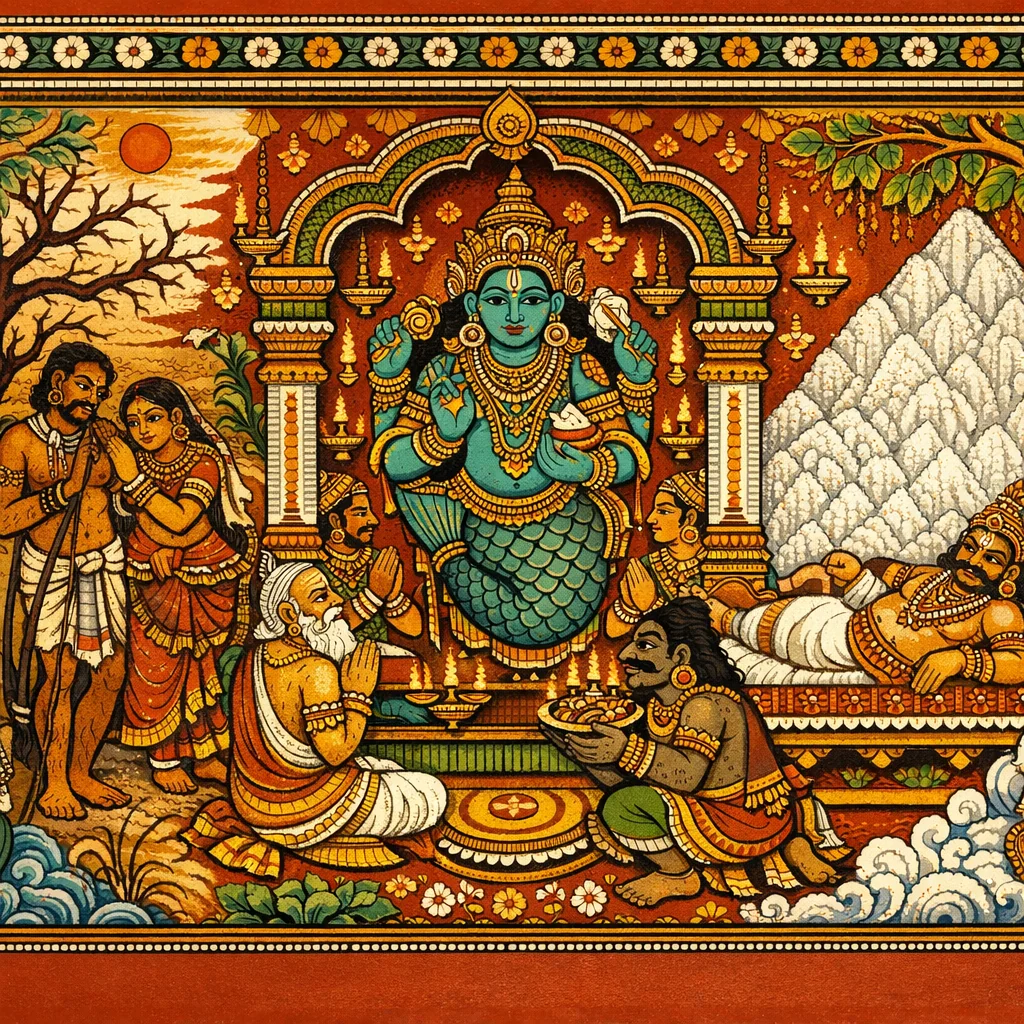
Adhyaya 100: The Greatness of the Vibhūti-Dvādaśī Vow: Pushkara, Lavaṇācala, and the Karmic Rise of King Puṣpavāhana
विभूतिद्वादशीव्रतमाहात्म्यं पुष्कर-लवणाचल-प्रसङ्गः
Speaker: Nandikeśvara (narrator), Nārada (listener/interlocutor), Sage Prācetasa (teacher within the story), King Puṣpavāhana (questioner within the story)
Nandikeśvara tells Nārada the story of King Puṣpavāhana, whose golden lotus—gifted by Brahmā—enables travel through celestial realms, and whose queen and lineage are likewise extraordinary. Wondering why such fortune has arisen and what dharma frees one from further rebirth, the king questions Prācetasa. Prācetasa reveals the king’s former life as a sinful hunter, his starvation during drought, and the decisive change of heart when he witnessed a Viṣṇu worship connected with the Vibhūti-Dvādaśī observance. The couple rejects wealth gained through harm and performs devotion, night-vigil, and charity at Lavaṇācala; that merit ripens into his present kingship and purification through Puṣkara. Prācetasa then instructs him to leave Puṣkara, take refuge at the Gaṅgā, and observe Vibhūti-Dvādaśī for assured nirvāṇa; he vanishes, and the king follows. The chapter ends with ritual guidance: worship on twelve Dvādaśīs with lotuses, give dakṣiṇā honestly, and hear or recite this account for purification and heavenly reward.
Key Concepts
Shlokas in Adhyaya 100
Verse 1
*नन्दिकेश्वर उवाच पुरा रथंतरे कल्पे राजासीत्पुष्पवाहनः नाम्ना लोकेषु विख्यातस् तेजसा सूर्यसंनिभः //
Nandikeśvara said: In ancient times, in the Rathaṃtara kalpa, there was a king named Puṣpavāhana, renowned throughout the worlds, whose splendor was like that of the Sun.
Verse 2
तपसा तस्य तुष्टेन चतुर्वक्त्रेण नारद कमलं काञ्चनं दत्तं यथाकामगमं मुने //
O Nārada, pleased by that asceticism, the four-faced (Brahmā) granted the sage a golden lotus, endowed with the power to travel wherever one wishes.
Verse 3
लोकैः समस्तैर् नगरवासिभिः सहितो नृपः द्वीपानि सुरलोकं च यथेष्टं व्यचरत्तदा //
Accompanied by all the people—the residents of the city—the king then wandered at will through the islands and even the celestial world (Suraloka).
Verse 4
कल्पादौ सप्तमं द्वीपं तस्य पुष्करवासिनः लोके च पूजितं यस्मात् पुष्करद्वीपमुच्यते //
At the beginning of the aeon (kalpa), the seventh continent came into being. Its inhabitants are the Puṣkaravāsins; and because it is revered in the world, it is called Puṣkara-dvīpa (the Continent of Puṣkara).
Verse 5
देवेन ब्रह्मणा दत्तं यानमस्य यतो ऽम्बुजम् पुष्पवाहनमित्याहुस् तस्मात्तं देवदानवाः //
Because the god Brahmā granted him the lotus as his conveyance, therefore the gods and the Dānavas call him “Puṣpavāhana”—the one whose vehicle is flowers.
Verse 6
नागम्यमस्यास्ति जगत्त्रये ऽपि ब्रह्माम्बुजस्थस्य तपो ऽनुभावात् पत्नी च तस्याप्रतिमा मुनीन्द्र नारीसहस्रैरभितो ऽभिनन्द्या नाम्ना च लावण्यवती बभूव सा पार्वतीवेष्टतमा भवस्य //
O best of sages, by the power born of the austerities of lotus-seated Brahmā, her beauty was unattainable even in the three worlds. And his wife too was incomparable—praised all around by thousands of women. She became known by the name Lāvaṇyavatī, and she was most dear to Bhava (Śiva), as Pārvatī is.
Verse 7
तस्यात्मजानामयुतं बभूव धर्मात्मनाम् अग्र्यधनुर्धराणाम् तदात्मनः सर्वमवेक्ष्य राजा मुहुर्मुहुर् विस्मयमाससाद सो ऽभ्यागतं वीक्ष्य मुनिप्रवीरं प्राचेतसं वाक्यमिदं बभाषे //
Of his sons there came to be ten thousand—righteous-souled and foremost among bowmen. Seeing all this as his own line, the king again and again fell into wonder. Then, beholding the eminent sage Prācetasa who had arrived, he spoke these words.
Verse 8
कस्माद्विभूतिर् अमलामरमर्त्यपूज्या जाता च सर्वविजितामरसुन्दरीणाम् भार्या ममाल्पतपसा परितोषितेन दत्तं ममाम्बुजगृहं च मुनीन्द्र धात्रा //
Why has Vibhūti—pure and worthy of worship by gods and mortals—become my wife, surpassing all the celestial maidens? And why, O best of sages, has the Creator Dhātṛ (Brahmā), pleased with my slight austerity, granted me also a lotus-like dwelling?
Verse 9
यस्मिन्प्रविष्टमपि कोटिशतं नृपाणां सामात्यकुञ्जररथौघजनावृतानाम् नो लक्ष्यते क्व गतमम्बरमध्य इन्दुस् तारागणैरिव गतः परितः स्फुरद्भिः //
Even when a hundred million kings—surrounded by their ministers, masses of elephants, streams of chariots, and crowds—had entered that place, it could not be discerned where the Moon in the middle of the sky had gone, as though he had vanished amid the hosts of stars flashing all around.
Verse 10
तस्मात्किमन्यजननीजठरोद्भवेन धर्मादिकं कृतमशेषफलाप्तिहेतुः भगवन्मयाथ तनयैर् अथवानयापि भद्रं यदेतदखिलं कथय प्रचेतः //
Therefore, what further need is there to be born again from another mother’s womb? O Blessed Lord—if the practice of dharma and related duties is the cause of attaining every fruit—then tell me fully, O Pracetas, what is truly auspicious, whether it should be done by me, by my sons, or even by her (my wife) as well.
Verse 11
मुनिरभ्यधादथ भवान्तरितं समीक्ष्य पृथ्वीपतेः प्रसभमद्भुतहेतुवृत्तम् जन्माभवत्तव तु लुब्धकुले ऽतिघोरे जातस्त्वमप्यनुदिनं किल पापकारी //
Then the sage spoke: “Having examined your intervening (past) existence, I have seen the forceful course of events—arising from a wondrous cause—connected with the king of the earth. Because of that, your birth occurred in a most terrible hunter clan; and you too, indeed, have been committing sinful deeds day after day.”
Verse 12
वपुरप्यभूत्तव पुनः पुरुषाङ्गसंधिर् दुर्गन्धिसत्त्वभुजगावरणं समन्तात् न च ते सुहृन् न सुतबन्धुजनो न तातस् त्व् आदृक्स्वसा न जननी च तदाभिशस्ता //
Your body, though restored again with human limbs and joints, was surrounded on all sides by foul-smelling creatures and serpents. And for you there was no friend, no son or kinsman, no father—nor a sister like you, nor even a mother—so utterly were you then cast out and condemned.
Verse 13
अभिसंगता परमभीष्टतमा विमुखी महीश तव योषिदियम् अभूदनावृष्टिरतीव रौद्रा कदाचिदाहारनिमित्तमस्मिन् क्षुत्पीडितेनाथ तदा न किंचिद् आसादितं धान्यफलामिषाद्यम् //
O King, this woman—once closely united with you and exceedingly dear—has turned away. A fearsome drought arose; and once, when she went in search of food, tormented by hunger, she found nothing at all—no grain, no fruit, no meat, nor anything of the kind.
Verse 14
अथाभिदृष्टं महदम्बुजाढ्यं सरोवरं पङ्कपरीतरोधः पद्मान्यथादाय ततो बहूनि गतः पुरं वैदिशनामधेयम् //
Then he beheld a vast lake rich with great lotuses, its banks encircled by mire; and, gathering many lotus-flowers from there, he went on to the city known by the name Vaidiśa (Vidishā).
Verse 15
तन्मौल्यलाभाय पुरं समस्तं भ्रान्तं त्वयाशेषम् अहस् तदासीत् क्रेता न कश्चित्कमलेषु जातः श्रान्तो भृशं क्षुत्परिपीडितश्च //
To obtain the price for it, you wandered through the entire city all day long; yet, O lotus-born one, there was no buyer at all. You became utterly exhausted, severely afflicted by hunger as well.
Verse 16
उपविष्टस्त्वमेकस्मिन् सभार्यो भवनाङ्गणे अथ मङ्गलशब्दश्च त्वया रात्रौ महाञ्श्रुतः //
While you were seated in one place, together with your wife, in the courtyard of your house, you then heard—at night—a great sound of auspiciousness.
Verse 17
सभार्यस्तत्र गतवान् यत्रासौ मङ्गलध्वनिः तत्र मण्डपमध्यस्था विष्णोरर्चावलोकिता //
Together with his wife, he went to the place where that auspicious sound was heard; there, standing in the middle of the pavilion, he beheld the worship-image of Lord Viṣṇu.
Verse 18
वेश्यानङ्गवती नाम विभूतिद्वादशीव्रतम् समाप्तौ माघमासस्य लवणाचलमुत्तमम् //
A courtesan named Naṅgavatī, having completed the Vibhūti-Dvādaśī vow at the close of the month of Māgha, attained the excellent holy place called Lavaṇācala.
Verse 19
निवेदयन्ती गुरवे शय्यां चोपस्करान्विताम् अलंकृत्य हृषीकेशं सौवर्णामरपादपम् //
She presented to the guru a bed furnished with the proper accessories; and, having adorned Hṛṣīkeśa (Viṣṇu), she offered a golden wish-fulfilling kalpa-tree as a sacred gift.
Verse 20
तां तु दृष्ट्वा ततस्ताभ्याम् इदं च परिचिन्तितम् किमेभिः कमलैः कार्यं वरं विष्णुरलंकृतः //
But on seeing that, the two of them reflected: “What use are these lotus-flowers? It is better that Lord Viṣṇu Himself be adorned.”
Verse 21
इति भक्तिस्तदा जाता दम्पत्योस्तु नराधिप तत्प्रसङ्गात्समभ्यर्च्य केशवं लवणाचलम् शय्या च पुष्पप्रकरैः पूजिता भूश्च सर्वतः //
Thus, O king, devotion arose in that husband and wife. In connection with that event, they duly worshipped Keśava at Lavaṇācala; the resting-place (śayyā) was adorned with clusters of flowers, and the ground all around was likewise reverently decorated and honoured.
Verse 22
अथानङ्गवती तुष्टा तयोर्धनशतत्रयम् दीयतामादिदेशाथ कलधौतशतत्रयम् //
Then Anaṅgavatī, being pleased, instructed that three hundred measures of wealth be given to them, and thereafter three hundred pieces of refined gold as well.
Verse 23
न गृहीतं ततस्ताभ्यां बहुसत्त्वावलम्बनात् अनङ्गवत्या च पुनस् तयोरन्नं चतुर्विधम् आनीय व्याहृतं चात्र भुज्यतामिति भूपते //
Therefore the two did not accept it, for it depended upon (the harm of) many living beings. Then Anaṅgavatī again brought four kinds of food for them and said, “O King, let it be eaten here.”
Verse 24
ताभ्यां तु तदपि त्यक्तं भोक्ष्यावो वै वरानने प्रसङ्गादुपवासेन तवाद्य सुखमावयोः //
But for those two reasons, even that was set aside. O fair-faced one, we shall indeed eat—today, by the occasion of your fasting, there will be happiness for both of us.
Verse 25
जन्मप्रभृति पापिष्ठौ कुकर्माणौ दृढव्रते तत्प्रसङ्गात्तयोर्मध्ये धर्मलेशस्तु ते ऽनघ //
From birth they were thoroughly wicked, steadfast in evil deeds; yet, O sinless one, through their very entanglement with one another, between those two there arose at least a tiny remnant of dharma.
Verse 26
इति जागरणं ताभ्यां तत्प्रसङ्गादनुष्ठितम् प्रभाते च तदा दत्ता शय्या सलवणाचला //
Thus, prompted by that very occasion, the two of them duly observed the night‑vigil (jāgaraṇa). And at dawn, a bed was then given in charity—complete with salt and provisions (the ‘salted mountain’ offering).
Verse 27
ग्रामाश्च गुरवे भक्त्या विप्रेषु द्वादशैव तु वस्त्रालंकारसंयुक्ता गावश्च करकान्विताः //
With devotion, one should donate villages to one’s teacher; and to the brāhmaṇas, twelve cows—adorned with cloth and ornaments, and fitted with (golden) metal fittings according to rite.
Verse 28
भोजनं च सुहृन्मित्रदीनान्धकृपणैः समम् तच्च लुब्धकदाम्पत्यं पूजयित्वा विसर्जितम् //
He should share his meal equally with well-wishers and friends, and also with the poor, the blind, and the destitute; and having duly honoured even the greedy hunter-couple, he should then respectfully send them on their way.
Verse 29
स भवांल् लुब्धको जातः सपत्नीको नृपेश्वरः पुष्करप्रकरात्तस्मात् केशवस्य न पूजनात् //
O lord of kings, because he did not worship Keśava, he fell away from the sacred precinct of Puṣkara and was born as a greedy hunter—together with his wife.
Verse 30
विनष्टाशेषपापस्य तव पुष्करमन्दिरम् तस्य सत्त्वस्य माहात्म्याद् अल्पेन तपसा नृप //
O King, by the greatness of that sacred presence, your Puṣkara shrine becomes the means by which all sins are utterly destroyed—even through only a little austerity (tapas).
Verse 31
यथाकामगमं जातं लोकनाथश्चतुर्मुखः संतुष्टस्तव राजेन्द्र ब्रह्मरूपी जनार्दनः //
As you desired, it has come to pass: the four-faced Lord of the worlds (Brahmā) is pleased with you, O king; for Janārdana himself—assuming the form of Brahmā—is satisfied.
Verse 32
साप्यनङ्गवती वेश्या कामदेवस्य साम्प्रतम् पत्नी सपत्नी संजाता रत्याः प्रीतिरिति श्रुता लोकेष्वानन्दजननी सकलामरपूजिता //
That very Anaṅgavatī—once known as a courtesan—has now become Kāma-deva’s wife, a co-wife alongside Rati. She is famed in the worlds as “Prīti” (Affection), the mother who gives rise to joy, and she is worshipped by all the gods.
Verse 33
तस्मादुत्सृज्य राजेन्द्र पुष्करं तन्महीतले गङ्गातटं समाश्रित्य विभूतिद्वादशीव्रतम् कुरु राजेन्द्र निर्वाणम् अवश्यं समवाप्स्यसि //
Therefore, O best of kings, set aside Puṣkara upon this earth and take refuge on the bank of the Gaṅgā. Perform the Vibhūti-Dvādaśī vow; O king, you will surely attain nirvāṇa (final liberation).
Verse 34
इत्युक्त्वा स मुनिर् ब्रह्मंस् तत्रैवान्तरधीयत राजा यथोक्तं च पुनर् अकरोत्पुष्पवाहनः //
Having spoken thus, that sage—O Brahman—vanished there itself; and the king, Puṣpavāhana, again carried out exactly as had been instructed.
Verse 35
इदमाचरतो ब्रह्मन्न् अखण्डव्रतम् आचरेत् यथाकथंचित् कमलैर् द्वादश द्वादशीर् मुने //
O Brahman, one who undertakes this observance should maintain the unbroken vow; and, O sage, on twelve Dvādaśī days he should worship (the Lord) with lotus flowers, in whatever way he is able.
Verse 36
कर्तव्याः शक्तितो देया विप्रेभ्यो दक्षिणानघ न वित्तशाठ्यं कुर्वीत भक्त्या तुष्यति केशवः //
O sinless one, one should duly offer priestly fees (dakṣiṇā) to the Brahmins according to one’s capacity; one should not practice deceit regarding wealth—for Keśava is pleased by sincere devotion.
Verse 37
इति कलुषत्रिदारणं जनानामपि पठतीह शृणोति चाथ भक्त्या / मतिमपि च ददाति देवलोके वसति स कोटिशतानि वत्सराणाम् //
Thus, whoever among people recites this here, or listens to it with devotion—this teaching that shatters the threefold impurity—receives right understanding as well, and dwells in the world of the gods for hundreds of crores of years.
Frequently Asked Questions
The chapter teaches that sincere devotion to Keśava, expressed through the Vibhūti-Dvādaśī vrata (with pūjā, jāgaraṇa, and ethical dāna), can destroy sins and end rebirth. Prācetasa explicitly advises Puṣpavāhana to take refuge on the Gaṅgā’s bank, perform Vibhūti-Dvādaśī, avoid deceit in offerings, and thereby attain nirvāṇa.
Adhyāya 100 is primarily Dharma and ritual practice (vrata, dāna, bhakti), with tīrtha-māhātmya (Puṣkara, Lavaṇācala, Gaṅgā) and karmic causality (past-life hunter birth explaining present royalty). It is not a Vāstu-śāstra or architectural-measurement chapter, though it references worship settings like a maṇḍapa (pavilion) and shrine context.
It is a Dvādaśī vow connected to Viṣṇu/Keśava worship (noted at Māgha’s close), featuring devotion, night-vigil (jāgaraṇa), worship with lotus flowers (specified across twelve Dvādaśīs), and charitable gifts (dakṣiṇā, śayyā-dāna, and support to brāhmaṇas/teacher) performed without financial deceit.
The hunter-couple declines the offered wealth because it is morally compromised—implying harm or exploitation of living beings. The chapter uses this to frame dāna and livelihood ethics: Keśava is pleased by sincere, non-deceptive devotion and pure means, not merely by material magnitude.
Puṣkara is praised as powerful for sin-destruction even with small austerity, explaining the king’s purification and rise. Yet Prācetasa gives a forward-looking sādhanā: leave earthly Puṣkara and undertake the Vibhūti-Dvādaśī discipline on Gaṅgā’s bank for assured nirvāṇa—linking tīrtha merit with a definitive liberation-focused vow.