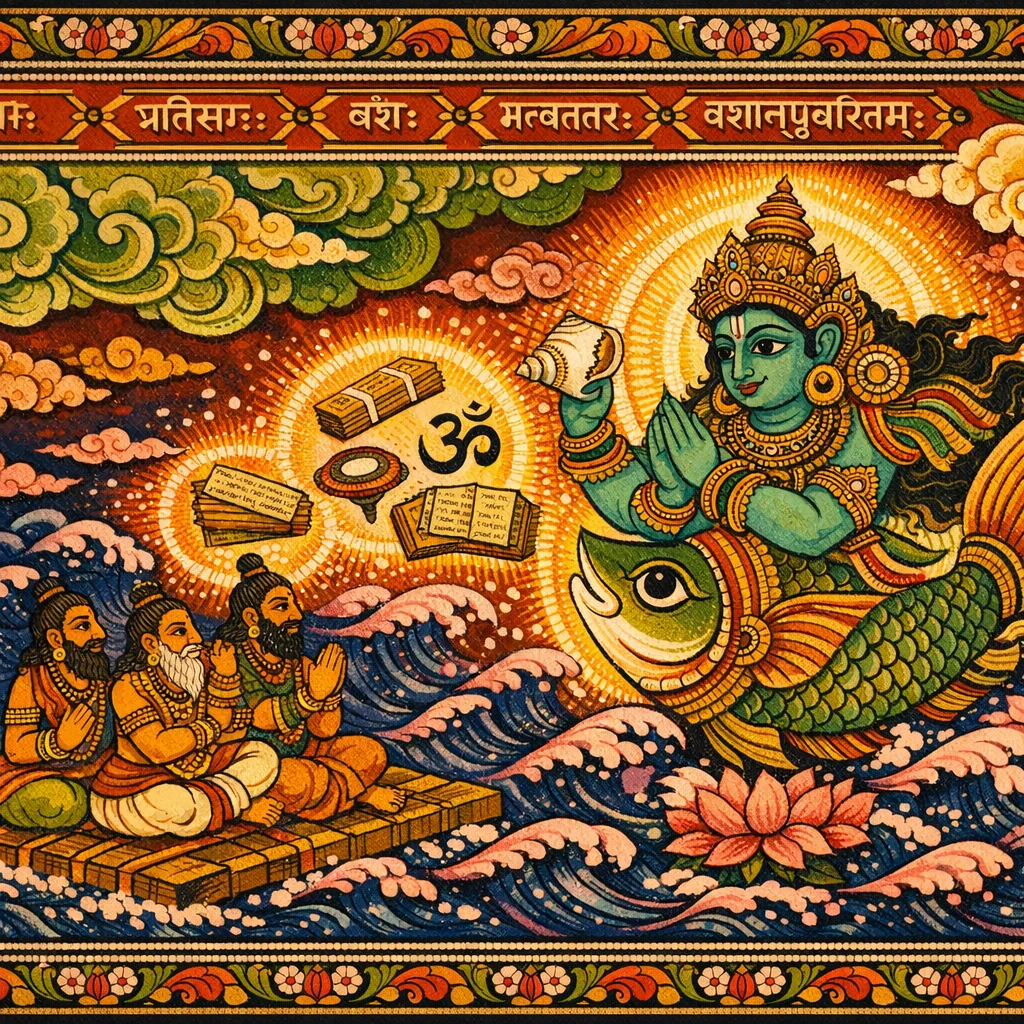
Adhyaya 53: Catalogue of the Eighteen Puranas, Their Measures, and the Dharma of Donating Sacred Texts
पुराणानुक्रमणिका-दानधर्म-वर्णनम्
Speaker: ऋषयः (Sages), सूत (Sūta), मत्स्य (Matsya / Janārdana in Fish form), ब्रह्मा (Brahmā), व्यास (Vyāsa form of the Lord, as stated)
The sages ask Sūta for a stepwise account of how the Purāṇas are numbered and classified, and for the proper sequence of dāna-dharma. Sūta replies that the teaching is ancient, first spoken by the Primeval Person to Manu, and then relates Matsya’s exposition: the Purāṇa’s supremacy among the śāstras, its immense original extent, and its preservation through pralaya by divine incarnational intervention. As right retention waned with time, the tradition was recompilated as Vyāsa and manifested in Bhūrloka in eighteen parts. Matsya then lists the major Purāṇas with their verse-measures and prescribes month- and tithi-based rites for donating manuscripts, with emblematic gifts and promised fruits—attainment of lokas, sāyujya, or residence for the span of a kalpa. The chapter ends by defining Purāṇas through the pañcalakṣaṇa, mapping guṇa-based categories, linking Vyāsa’s composition of the Mahābhārata and the vast Rāmāyaṇa tradition, and praising the auspicious merit of reciting and hearing the Purāṇa-anukrama.
Key Concepts
Shlokas in Adhyaya 53
Verse 1
*मुनय ऊचुः पुराणसंख्यामाचक्ष्व सूत विस्तरशः क्रमात् दानधर्ममशेषं तु यथावदनुपूर्वशः //
The sages said: “O Sūta, tell us—step by step and in full detail—the number (and classification) of the Purāṇas; and likewise explain completely the dharma of giving (dāna), properly and in the correct sequence.”
Verse 2
*सूत उवाच इदमेव पुराणेषु पुराणपुरुषस्तदा यदुक्तवान्स विश्वात्मा मनवे तन्निबोधत //
Sūta said: “This indeed is what, in the Purāṇas, the Primeval Person (Purāṇa-Puruṣa)—He who is the Soul of the universe (Viśvātman)—once spoke to Manu. Now understand that.”
Verse 3
*मत्स्य उवाच पुराणं सर्वशास्त्राणां प्रथमं ब्रह्मणा स्मृतम् अनन्तरं च वक्त्रेभ्यो वेदास्तस्य विनिर्गताः //
Matsya said: “Among all śāstras, the Purāṇa was first remembered (composed/retained) by Brahmā; thereafter, from his mouths the Vedas issued forth.”
Verse 4
पुराणमेकमेवासीत् तदा कल्पान्तरे ऽनघ त्रिवर्गसाधनं पुण्यं शतकोटिप्रविस्तरम् //
O sinless one, at the close of a former aeon there existed only a single Purāṇa—holy in nature, a means to accomplish the three aims of life (dharma, artha, and kāma), and vast in extent, spreading over a hundred koṭi (of verses).
Verse 5
निर्दग्धेषु च लोकेषु वाजिरूपेण वै मया अङ्गानि चतुरो वेदान् पुराणं न्यायविस्तरम् //
When the worlds were burnt up, I indeed—assuming the form of a horse—recovered and safeguarded the Vedāṅgas, the four Vedas, the Purāṇa, and the extensive teaching of Nyāya (right reasoning).
Verse 6
मीमांसां धर्मशास्त्रं च परिगृह्य मया कृतम् मत्स्यरूपेण च पुनः कल्पादावुदकार्णवे //
Having taken up and safeguarded the Mīmāṃsā and the Dharmaśāstra that were established by me, I again—assuming the form of Matsya—preserved them in the primeval ocean at the beginning of the kalpa.
Verse 7
अशेषम् एतत्कथितम् उदकान्तर्गतेन च श्रुत्वा जगाद च मुनीन् प्रति देवांश्चतुर्मुखः //
Having heard in full this entire account—narrated by the one who was within the waters—four-faced Brahmā then spoke to the sages and to the gods.
Verse 8
प्रवृत्तिः सर्वशास्त्राणां पुराणस्याभवत्ततः कालेनाग्रहणं दृष्ट्वा पुराणस्य ततो नृप //
From that Purāṇa arose the onward course of all the śāstras. Then, O King, seeing that in the passage of time the Purāṇa was no longer being properly retained (studied and preserved), the tradition-bearer acted accordingly.
Verse 9
व्यासरूपमहं कृत्वा संहरामि युगे युगे चतुर्लक्षप्रमाणेन द्वापरे द्वापरे सदा //
Assuming the form of Vyāsa, I gather and compile the Veda again and again in every age; and in each Dvāpara Yuga, unfailingly, I arrange it to the measure of four hundred thousand verses.
Verse 10
तथाष्टादशधा कृत्वा भूर्लोके ऽस्मिन्प्रकाश्यते अद्यापि देवलोके ऽस्मिञ् छतकोटिप्रविस्तरम् //
Thus, having been divided into eighteen parts, it is made manifest here in Bhūrloka, the world of mortals; and even now, in Devaloka, the world of the gods, it remains expanded to a vast extent—of a hundred koṭis in measure.
Verse 11
तदर्थो ऽत्र चतुर्लक्षं संक्षेपेण निवशितः पुराणानि दशाष्टौ च साम्प्रतं तदिहोच्यते //
Here, the purport of the Purāṇic teaching has been set forth in brief to the measure of four hundred thousand verses. Now, accordingly, the eighteen Purāṇas are stated here.
Verse 12
नामतस्तानि वक्ष्यामि शृणुध्वं मुनिसत्तमाः ब्रह्मणाभिहितं पूर्वं यावन्मात्रं मरीचये //
I shall now declare them by their names—listen, O best of sages—exactly as Brahmā formerly taught them, in due measure, to Marīci.
Verse 13
ब्राह्मं त्रिदशसाहस्रं पुराणं परिकीर्त्यते लिखित्वा तच्च यो दद्याज् जलधेनुसमन्वितम् वैशाखपूर्णिमायां च ब्रह्मलोके महीयते //
The Brahma Purāṇa is proclaimed to be thirty thousand verses in extent. Whoever has it written out and then donates that manuscript—together with a jaladhenu (“water-cow,” a ritual gift for the merit of providing water)—on the full-moon day of Vaiśākha is honored in Brahmaloka, the world of Brahmā.
Verse 14
एतदेव यदा पद्मम् अभूद्धैरण्मयं जगत् तद्वृत्तान्ताश्रयं तद्वत् पाद्ममित्युच्यते बुधैः पाद्मं तत्पञ्चपञ्चाशत्सहस्राणीह कथ्यते //
When this very world became a golden lotus, the narrative grounded in (and concerning) that event is therefore called the Padma (Purāṇa) by the wise. Here it is said that the Padma (Purāṇa) consists of fifty-five thousand verses.
Verse 15
तत्पुराणं च यो दद्यात् सुवर्णकमलान्वितम् ज्येष्ठे मासि तिलैर्युक्तम् अश्वमेधफलं लभेत् //
Whoever donates that Purāṇa—adorned with a golden lotus and accompanied by sesame seeds—in the month of Jyeṣṭha attains merit equal to that of performing the Aśvamedha sacrifice.
Verse 16
वाराहकल्पवृत्तान्तम् अधिकृत्य पराशरः यत्प्राह धर्मानखिलांस् तद्युक्तं वैष्णवं विदुः //
Taking the account of the Varāha-kalpa as his subject, Parāśara taught the entire body of dharma in full; know that this is properly aligned with the true Vaiṣṇava tradition.
Verse 17
तदाषाढे च यो दद्याद् घृतधेनुसमन्वितम् पौर्णमास्यां विपूतात्मा स पदं याति वारुणम् त्रयोविंशतिसाहस्रं तत्प्रमाणं विदुर्बुधाः //
In the month of Āṣāḍha, whoever, with a purified mind, gives on the full-moon day the ghee-cow offering (ghṛta-dhenu—a ritual gift of a cow accompanied by ghee) attains the realm of Varuṇa. The learned know its prescribed measure to be twenty-three thousand.
Verse 18
श्वेतकल्पप्रसङ्गेन धर्मान्वायुरिहाब्रवीत् यत्र तद्वायवीयं स्याद् रुद्रमाहात्म्यसंयुतम् चतुर्विंशसहस्राणि पुराणं तदिहोच्यते //
In connection with the Śveta-kalpa, Vāyu expounded here the principles of Dharma. That work is known as the Vāyavīya (Purāṇa), endowed with the greatness of Rudra; and it is said here to comprise twenty-four thousand verses.
Verse 19
श्रावण्यां श्रावणे मासि गुडधेनुसमन्वितम् यो दद्याद्वृषसंयुक्तं ब्राह्मणाय कुटुम्बिने शिवलोके स पूतात्मा कल्पमेकं वसेन्नरः //
Whoever, in the month of Śrāvaṇa, on the Śrāvaṇī observance, gives to a householder brāhmaṇa a cow accompanied by jaggery (the “gudadhenu” gift) and joined with a bull—he, purified in soul, dwells in Śiva’s world for one full kalpa.
Verse 20
यत्राधिकृत्य गायत्रीं वर्ण्यते धर्मविस्तरः वृत्रासुरवधोपेतं तद्भागवतमुच्यते //
That scripture in which, taking the Gāyatrī as the governing foundation, the full expanse of Dharma is set forth, and which also includes the account of the slaying of Vṛtrāsura, is called the Bhāgavata.
Verse 21
सारस्वतस्य कल्पस्य मध्ये ये स्युर्नरोत्तमाः तद्वृत्तान्तोद्भवं लोके तद्भागवतमुच्यते //
That sacred narrative which arises in the world from the accounts of the best among men who lived within the Sarasvata Kalpa—this is what is called the Bhāgavata.
Verse 22
लिखित्वा तच्च यो दद्याद् धेमसिंहसमन्वितम् पौर्णमास्यां प्रौष्ठपद्यां स याति परमां गतिम् अष्टादश सहस्राणि पुराणं तत्प्रचक्षते //
Whoever has that Purāṇa written out and then donates it, adorned with a golden lion-throne, on the full-moon day of the month of Prauṣṭhapada, attains the highest state. This Purāṇa is declared to consist of eighteen thousand verses.
Verse 23
यत्राह नारदो धर्मान् बृहत्कल्पाश्रयाणि च पञ्चविंशत्सहस्राणि नारदीयं तदुच्यते //
That work in which Nārada expounds the principles of dharma, together with matters grounded in the Great Kalpa, and which extends to twenty-five thousand verses, is called the Nāradīya Purāṇa.
Verse 24
आश्विने पञ्चदश्यां तु दद्याद्धेनुसमन्वितम् परमां सिद्धिमाप्नोति पुनरावृत्तिदुर्लभाम् //
On the fifteenth lunar day of the month of Āśvina, one should give a gift accompanied by a cow; by this, one attains the highest spiritual perfection, after which return to worldly rebirth is rare.
Verse 25
यत्राधिकृत्य शकुनीन् धर्माधर्मविचारणा व्याख्याता वै मुनिप्रश्ने मुनिभिर्धर्मचारिभिः //
There, with reference to omens (śakuna), the inquiry into what is dharma and what is adharma was indeed explained—when the sages asked—by sages devoted to dharma.
Verse 26
मार्कण्डेयेन कथितं तत्सर्वं विस्तरेण तु पुराणं नवसाहस्रं मार्कण्डेयम् इहोच्यते //
All that was expounded by Mārkaṇḍeya—indeed in full detail—is here spoken of as the “Mārkaṇḍeya Purāṇa”, a Purāṇa consisting of nine thousand verses.
Verse 27
प्रतिलिख्य च यो दद्यात् सौवर्णकरिसंयुतम् कार्त्तिक्यां पुण्डरीकस्य यज्ञस्य फलभाग्भवेत् //
Whoever, after having it copied, donates it together with a golden image of an elephant—especially in the month of Kārttika—becomes a sharer in the merit, the fruit, of the Puṇḍarīka sacrifice (yajña).
Verse 28
यत् तद् ईशानकं कल्पं वृत्तान्तमधिकृत्य च वसिष्ठायाग्निना प्रोक्तम् आग्नेयं तत्प्रचक्षते //
That account which concerns the Īśānaka Kalpa—spoken by Agni to Vasiṣṭha—is therefore declared to be the Agneya tradition, that which is related to Agni.
Verse 29
लिखित्वा तच्च यो दद्याद् धेमपद्मसमन्वितम् मार्गशीर्ष्यां विधानेन तिलधेनुसमन्वितम् //
Whoever has that sacred text written out and then donates it—adorned with a golden lotus, and in the month of Mārgaśīrṣa, according to the prescribed rite, accompanied by the sesame “cow” offering (tila-dhenu)—obtains the stated religious merit.
Verse 30
तच्च षोडशसाहस्रं सर्वक्रतुफलप्रदम् यः प्रदधन्नरः सो ऽथ स्वर्गलोके महीयते //
And that gift—amounting to sixteen thousand—bestows the fruit of all sacrifices. The man who gives it is then honored and exalted in the heavenly world.
Verse 31
यत्राधिकृत्य माहात्म्यम् आदित्यस्य चतुर्मुखः अघोरकल्पवृत्तान्तप्रसङ्गेन जगत्स्थितिम् मनवे कथयामास भूतग्रामस्य लक्षणम् //
There, having taken up the greatness of Āditya (the Sun), the Four-faced One (Brahmā), in the course of recounting the events of the Aghora-kalpa, explained to Manu the established order of the world and the defining characteristics of the multitude of beings.
Verse 32
चतुर्दश सहस्राणि तथा पञ्च शतानि च भविष्यचरितप्रायं भविष्यं तदिहोच्यते //
It consists of fourteen thousand, and additionally five hundred (verses); and here it is declared to be a Purāṇa largely concerned with accounts of what is yet to come (future events).
Verse 33
तत्पौषे मासि यो दद्यात् पौर्णमास्यां विमत्सरः गुडकुम्भसमायुक्तम् अग्निष्टोमफलं भवेत् //
Whoever, free from envy, gives (a gift) on the full-moon day in the month of Pauṣa—together with a pot filled with jaggery (guda)—obtains merit equivalent to the Agniṣṭoma sacrifice.
Verse 34
रथंतरस्य कल्पस्य वृत्तान्तमधिकृत्य च सावर्णिना नारदाय कृष्णमाहात्म्यमुत्तमम् //
And, taking up the account of the Rathaṃtara Kalpa, Sāvarṇi narrated to Nārada the unsurpassed greatness (māhātmya) of Śrī Kṛṣṇa.
Verse 35
यत्र ब्रह्मवराहस्य चोदन्तं वर्णितं मुहुः तदष्टादशसाहस्रं ब्रह्मवैवर्तमुच्यते //
That Purāṇa in which the account of Brahmā’s Varāha (the Boar incarnation) is repeatedly described—consisting of eighteen thousand verses—is called the Brahma-vaivarta (Purāṇa).
Verse 36
पुराणं ब्रह्मवैवर्तं यो दद्यान्माघमासि च पौर्णमास्यां शुभदिने ब्रह्मलोके महीयते //
Whoever gifts the Brahma-vaivarta Purāṇa in the month of Māgha, on the auspicious day of the full moon, is honored and exalted in Brahmaloka, the world of Brahmā.
Verse 37
यत्राग्निलिङ्गमध्यस्थः प्राह देवो महेश्वरः धर्मार्थकाममोक्षार्थम् आग्नेयमधिकृत्य च //
There, seated in the midst of the Agni-liṅga, the Lord Maheśvara spoke—taking up the Agneya (fire-related) doctrine or rite—so that it may lead to dharma, artha, kāma, and mokṣa.
Verse 38
कल्पान्ते लैङ्गमित्युक्तं पुराणं ब्रह्मणा स्वयम् तदेकादशसाहस्रं फाल्गुन्यां यः प्रयच्छति तिलधेनुसमायुक्तं स याति शिवसाम्यताम् //
At the close of a kalpa, Brahmā himself proclaimed the Purāṇa called the “Liṅga.” Whoever, in the month of Phālguna, donates that Purāṇa—consisting of eleven thousand verses—together with the tiladhenu (“sesame-cow” gift), attains equality with Śiva (Śiva-sāmyatā).
Verse 39
महावराहस्य पुनर् माहात्म्यमधिकृत्य च विष्णुनाभिहितं क्षोण्यै तद्वाराहम् इहोच्यते //
Now, taking up once again the greatness of the Great Boar (Mahāvarāha), this Vārāha teaching—spoken by Viṣṇu to the Earth—is here set forth.
Verse 40
मानवस्य प्रसङ्गेन कल्पस्य मुनिसत्तमाः चतुर्विंशत्सहस्राणि तत्पुराणमिहोच्यते //
O best of sages, in connection with Manu and this kalpa, this Purāṇa is here declared to consist of twenty-four thousand (verses).
Verse 41
काञ्चनं गरुडं कृत्वा तिलधेनुसमन्वितम् पौर्णमास्यां मधौ दद्याद् ब्राह्मणाय कुटुम्बिने वराहस्य प्रसादेन पदमाप्नोति वैष्णवम् //
Having fashioned a golden Garuḍa, together with a sesame-cow (tiladhenu), one should give it on the full-moon day in the month of Madhu to a householder Brāhmaṇa; by the grace of Varāha, one attains the Vaiṣṇava abode/state.
Verse 42
यत्र माहेश्वरान्धर्मान् अधिकृत्य च षण्मुखः कल्पे तत्पुरुषं वृत्तं चरितैरुपबृंहितम् //
There, taking up the sacred observances of Maheśvara (Śiva) as his theme, Ṣaṇmukha (Skanda) in that kalpa expounded the account of Tatpuruṣa, enriching it with (illustrative) deeds and episodes.
Verse 43
स्कान्दं नाम पुराणं च ह्य् एकाशीतिर्निगद्यते सहस्राणि शतं चैकम् इति मर्त्येषु गद्यते //
As for the Purāṇa called the Skanda (Skānda), it is declared to contain eighty-one thousand and one hundred verses—so it is said among mortals.
Verse 44
परिलिख्य च यो दद्याद् धेमशूलसमन्वितम् शैवं पदमवाप्नोति मीने चोपागते रवौ //
Whoever has it inscribed and then donates it—together with a golden trident—attains the Śaiva state, especially when the Sun has entered Pisces (Mīna).
Verse 45
त्रिविक्रमस्य माहात्म्यम् अधिकृत्य चतुर्मुखः त्रिवर्गमभ्यधात्तच्च वामनं परिकीर्तितम् //
Taking up the greatness of Trivikrama as his theme, the Four-faced Lord (Brahmā) expounded the three aims of life; and in that very context the incarnation of Vāmana was celebrated.
Verse 46
पुराणं दशसाहस्रं कूर्मकल्पानुगं शिवम् यः शरद्विषुवे दद्याद् वैष्णवं यात्यसौ पदम् //
Whoever, at the autumnal equinox, donates the auspicious Purāṇa consisting of ten thousand verses—aligned with the Kūrma-kalpa—attains the supreme Vaiṣṇava abode.
Verse 47
यत्र धर्मार्थकामानां मोक्षस्य च रसातले माहात्म्यं कथयामास कूर्मरूपी जनार्दनः //
There, in Rasātala (the nether region), Janārdana in the form of the Tortoise expounded the sacred greatness connected with dharma, artha, kāma, and also mokṣa.
Verse 48
इन्द्रद्युम्नप्रसङ्गेन ऋषिभ्यः शक्रसंनिधौ अष्टादश सहस्राणि लक्ष्मीकल्पानुषङ्गिकम् //
In connection with the episode of King Indradyumna, and in the very presence of Śakra (Indra), he related to the sages an ancillary account of the Lakṣmī-kalpa—eighteen thousand verses in extent.
Verse 49
यो दद्यादयने कूर्मं हेमकूर्मसमन्वितम् गोसहस्रप्रदानस्य फलं सम्प्राप्नुयान्नरः //
A man who, at the time of the ayana (solstice), gives a tortoise in gift together with a golden tortoise image attains merit equal to the donation of a thousand cows.
Verse 50
श्रुतीनां यत्र कल्पादौ प्रवृत्त्यर्थं जनार्दनः मत्स्यरूपेण मनवे नरसिंहोपवर्णनम् //
Here it is described how, at the beginning of a kalpa, Janārdana—assuming the form of the Fish (Matsya) to set the Śruti (the Vedas) in motion—expounded to Manu the account of the Narasiṃha manifestation.
Verse 51
अधिकृत्याब्रवीत्सप्तकल्पवृत्तं मुनीश्वराः तन्मात्स्यमिति जानीध्वं सहस्राणि चतुर्दश //
O foremost sages, having undertaken the narration of the course of the seven kalpas, he declared: “Know this as the Matsya (Purāṇa); it comprises fourteen thousand verses.”
Verse 52
विषुवे हेममत्स्येन धेन्वा चैव समन्वितम् यो दद्यात्पृथिवी तेन दत्ता भवति चाखिला //
Whoever, on the day of Viṣuva, gives in charity a symbolic ‘earth’ gift accompanied by a golden fish and a cow—by him the entire earth is deemed to have been given.
Verse 53
यदा च गारुडे कल्पे विश्वाण्डाद्गरुडोद्भवम् अधिकृत्याब्रवीत्कृष्णो गारुडं तदिहोच्यते //
And when, in the Gāruḍa Kalpa, Kṛṣṇa spoke with reference to Garuḍa’s arising from the cosmic egg, that teaching is here called the “Gāruḍa” account.
Verse 54
तद् अष्टादशकं चैकं सहस्राणीह पठ्यते सौवर्णहंससंयुक्तं यो ददाति पुमानिह स सिद्धिं लभते मुख्यां शिवलोके च संस्थितिम् //
Here it is recited as a single set of eighteen thousand. Whoever in this world donates it together with a golden haṃsa (swan) attains the highest siddhi and an abiding station in Śiva’s realm.
Verse 55
ब्रह्मा ब्रह्माण्डमाहात्म्यम् अधिकृत्याब्रवीत्पुनः तच्च द्वादशसाहस्रं ब्रह्माण्डं द्विशताधिकम् //
Brahmā, taking up again the topic of the glory of the Brahmāṇḍa (the cosmic egg), spoke further: “That Brahmāṇḍa is twelve thousand, with two hundred more added.”
Verse 56
भविष्याणां च कल्पानां श्रूयते यत्र विस्तरः तद्ब्रह्माण्डपुराणं च ब्रह्मणा समुदाहृतम् //
That Purāṇa in which an extensive account is heard concerning the future kalpas (aeons) is the Brahmāṇḍa Purāṇa, as proclaimed by Brahmā.
Verse 57
यो दद्यात्तद्व्यतीपाते पीतोर्णायुगसंयुतम् राजसूयसहस्रस्य फलमाप्नोति मानवः हेमधेन्वा युतं तच्च ब्रह्मलोकफलप्रदम् //
Whoever, on that Vyatīpāta, gives a pair of yellow woolen garments attains merit equal to a thousand Rājasūya sacrifices. And that gift—when accompanied by a golden cow—bestows the fruit of reaching Brahmaloka.
Verse 58
चतुर्लक्षमिदं प्रोक्तं व्यासेनाद्भुतकर्मणा मत्पितुर्मम पित्रा च मया तुभ्यं निवेदितम् //
This Purāṇa, consisting of four lakhs (four hundred thousand verses), was proclaimed by Vyāsa of wondrous deeds; it was conveyed by my father to my own father, and now I have presented it to you.
Verse 59
इह लोकहितार्थाय संक्षिप्तं परमर्षिणा इदमद्यापि देवेषु शतकोटिप्रविस्तरम् //
For the welfare of the world here, this Purāṇa was condensed by the supreme sage; yet even today, among the gods, it remains vast—extending to a hundred koṭi (crores) of verses.
Verse 60
उपभेदान्प्रवक्ष्यामि लोके ये सम्प्रतिष्ठिताः पाद्मे पुराणे यत्रोक्तं नरसिंहोपवर्णनम् तच्चाष्टादशसाहस्रं नारसिंहमिहोच्यते //
I shall now declare the subsidiary divisions (upabhedas) that are well established in the world. That account in the Padma Purāṇa where the description of Narasiṁha is taught—consisting of eighteen thousand verses—is here called the Nārasiṁha (Purāṇa).
Verse 61
नन्दाया यत्र माहात्म्यं कार्त्तिकेयेन वर्ण्यते नन्दीपुराणं तल्लोकैर् आख्यातमिति कीर्त्यते //
That text in which the greatness of Nandā is described by Kārttikeya is celebrated among people as the “Nandī Purāṇa”; thus it is proclaimed.
Verse 62
यत्र साम्बं पुरस्कृत्य भविष्यति कथानकम् प्रोच्यते तत्पुनर्लोके साम्बमेतन्मुनिव्रताः //
Wherever, placing Sāmba in the forefront, this forthcoming episode is recounted, there in the world again arise the fame and merit of this very “Sāmba”, O sages of holy vows.
Verse 63
पुरातनस्य कल्पस्य पुराणानि विदुर्बुधाः धन्यं यशस्यमायुष्यं पुराणानामनुक्रमम् एवमादित्यसंज्ञा च तत्रैव परिगद्यते //
The wise know the Purāṇas to belong to the ancient cosmic age (kalpa). The ordered listing of the Purāṇas is auspicious, fame-bestowing, and conducive to long life; and in that very context the designation “Āditya” is also stated.
Verse 64
अष्टादशभ्यस्तु पृथक् पुराणं यत्प्रदिश्यते विजानीध्वं द्विजश्रेष्ठास् तदेतेभ्यो विनिर्गतम् //
O best of the twice-born, know that the Purāṇa taught as distinct from the eighteen has nonetheless issued forth from them, from that very Purāṇic tradition.
Verse 65
पञ्चाङ्गानि पुराणेषु आख्यानकमिति स्मृतम् सर्गश्च प्रतिसर्गश्च वंशो मन्वन्तराणि च वंश्यानुचरितं चैव पुराणं पञ्चलक्षणम् //
It is taught that the Purāṇas have five limbs: ākhyāna (narrative), sarga (creation), pratisarga (re-creation), vaṃśa (genealogies), manvantara (the cycles of Manus), and vaṃśyānucarita (the histories of dynasties and their successors). Thus a Purāṇa is marked by these five characteristics.
Verse 66
ब्रह्मविष्ण्वर्करुद्राणां माहात्म्यं भुवनस्य च ससंहारप्रदानां च पुराणे पञ्चवर्णके //
In a Purāṇa described under five headings, it is taught: the greatness of Brahmā, Viṣṇu, Arka (the Sun), and Rudra; the account of the worlds; and the themes of dissolution (saṃhāra) and renewed creation.
Verse 67
धर्मश्चार्थश्च कामश्च मोक्षश्चैवात्र कीर्त्यते सर्वेष्वपि पुराणेषु तद्विरुद्धं च यत्फलम् //
Here Dharma, Artha, Kāma, and also Mokṣa are proclaimed. In all the Purāṇas, whatever fruit is contrary to these four aims is to be rejected as an improper result.
Verse 68
सात्त्विकेषु पुराणेषु माहात्म्यमधिकं हरेः राजसेषु च माहात्म्यम् अधिकं ब्रह्मणो विदुः //
In the Sāttvika Purāṇas, the greater glorification is of Hari (Viṣṇu); and in the Rājasa Purāṇas, the learned know the greater glorification to be of Brahmā.
Verse 69
तद्वदग्नेश्च माहात्म्यं तामसेषु शिवस्य च संकीर्णेषु सरस्वत्याः पितॄणां च निगद्यते //
Likewise, the greatness of Agni is spoken of in the Tāmasa Purāṇas; and in the mixed (Saṃkīrṇa) Purāṇas the greatness of Śiva, of Sarasvatī, and of the Pitṛs (ancestral fathers) is also described.
Verse 70
अष्टादश पुराणानि कृत्वा सत्यवतीसुतः भारताख्यानमखिलं चक्रे तदुपबृंहितम् लक्षेणैकेन यत्प्रोक्तं वेदार्थपरिबृंहितम् //
After composing the eighteen Purāṇas, the son of Satyavatī (Vyāsa) also produced the entire narrative called the Bhārata, expanding it; it was taught in a single lakh (one hundred thousand verses) and is filled out with the meanings of the Veda.
Verse 71
वाल्मीकिना तु यत्प्रोक्तं रामोपाख्यानमुत्तमम् ब्रह्मणाभिहितं यच्च शतकोटिप्रविस्तरम् //
But that supreme narrative of Rāma which was spoken by Vālmīki—and which was also declared by Brahmā—is said to extend in its full expanse to a hundred koṭis (a hundred crores) of verses.
Verse 72
आहृत्य नारदायैवं तेन वाल्मीकये पुनः वाल्मीकिना च लोकेषु धर्मकामार्थसाधनम् एवं सपादाः पञ्चैते लक्षा मर्त्ये प्रकीर्तिताः //
Thus it was obtained and conveyed to Nārada; by him it was again passed on to Vālmīki. And Vālmīki made it renowned among the worlds as a means for accomplishing dharma, kāma, and artha. In this way, five lakṣas and a quarter (i.e., 525,000) verses are proclaimed among mortals.
Verse 73
पुरातनस्य कल्पस्य पुराणानि विदुर्बुधाः धन्यं यशस्यमायुष्यं पुराणानामनुक्रमम् यः पठेच्छृणुयाद्वापि स याति परमां गतिम् //
The wise know the Purāṇas to belong to the ancient kalpa. The ordered synopsis (anukrama) of the Purāṇas is auspicious, fame-giving, and life-enhancing; whoever recites it or even listens to it attains the supreme state.
Verse 74
इदं पवित्रं यशसो निधानम् इदं पितॄणामतिवल्लभं च इदं च देवेष्व् अमृतायितं च नित्यं त्विदं पापहरं च पुंसाम् //
This teaching/recitation is holy—a treasury of good renown; it is exceedingly dear to the Ancestors (Pitṛs); and among the gods it is as amṛta itself, the nectar of immortality. Truly, it ever removes the sins of human beings.
Frequently Asked Questions
It establishes an authoritative Purāṇa-anukrama: the eighteen Purāṇas are named with their traditional verse-measures, and the chapter teaches śāstra-dāna—copying and donating Purāṇic manuscripts with prescribed month/tithi timings and symbolic adjunct-gifts (tiladhenu, jaladhenu, golden emblems). It also defines what qualifies as a Purāṇa via the pañcalakṣaṇa and classifies Purāṇas by guṇa (sāttvika/rājasa/tāmasa/saṃkīrṇa).
This chapter is primarily Dharma-focused (dāna-dharma and merit theology) and taxonomy-focused (cataloguing Purāṇas and their measures). It directly states the genealogical-historical framework as part of Purāṇic definition through pañcalakṣaṇa (vaṃśa and vaṃśyānucarita) and includes creation/re-creation markers (sarga, pratisarga, manvantara). It does not present Vāstu-śāstra construction rules in this adhyāya.
It says Purāṇa was first remembered by Brahmā and is primordial among śāstras; during cosmic destruction the Lord safeguarded Vedas, Vedāṅgas, Purāṇa, Nyāya, Mīmāṃsā, and Dharmaśāstra—reappearing in forms such as the horse and Matsya. When retention declined over time, the Lord assumes Vyāsa-form and re-compiles the corpus in each age, manifesting it in eighteen divisions for the human world.
The chapter lists the defining structure as: sarga (creation), pratisarga (re-creation), vaṃśa (genealogies), manvantara (cycles of Manus), and vaṃśyānucarita (dynastic histories and successors). It frames Purāṇas as narrative bodies (ākhyāna) organized through these marks.
It states that sāttvika Purāṇas predominantly glorify Hari (Viṣṇu), rājasa Purāṇas predominantly glorify Brahmā, and tāmasa Purāṇas speak the greatness of Agni; it also notes saṃkīrṇa (mixed) works where the greatness of Śiva, Sarasvatī, and the Pitṛs is described.