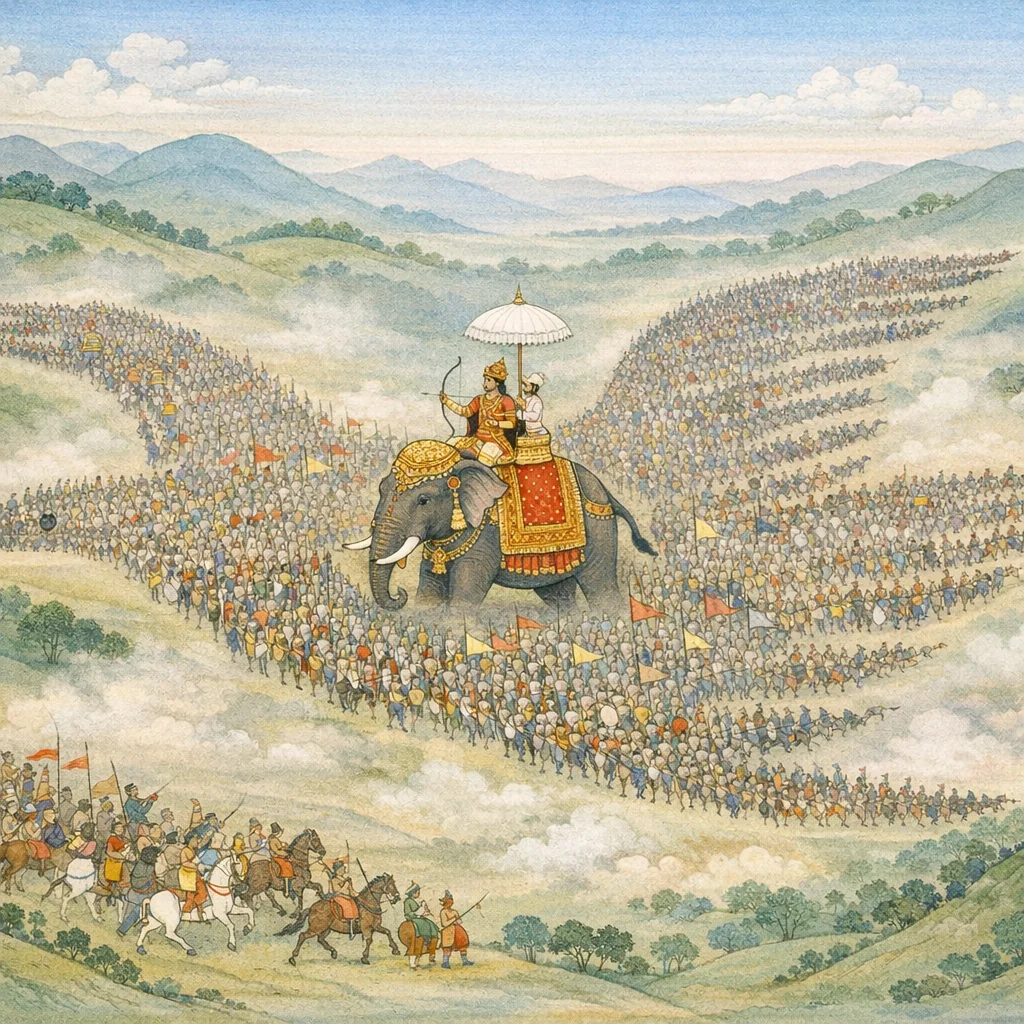
Adhyaya 20
Droṇa’s Renewed Advance toward Yudhiṣṭhira; Fall of Satyajit and Allied Recoil (द्रोणस्य युधिष्ठिरप्रेप्सा—सत्यजितः पतनम्)
Upa-parva: Droṇa’s Assault on the Yudhiṣṭhira-Centered Formations (Chapter-context unit)
Sañjaya reports that Yudhiṣṭhira, seeing Droṇa close, meets him with a heavy missile-volley, triggering alarm within the Pāṇḍava host. Satyajit, characterized as a courageous defender, rushes to intercept Droṇa; a fierce exchange follows in which Droṇa repeatedly severs bows and answers counter-strikes with concentrated, anatomically targeted arrows. Vṛka (a Pāñcāla champion) intensifies the assault, at one point striking Droṇa with a large count of arrows, yet Droṇa regains dominance by cutting down Vṛka and then decisively beheading Satyajit with an ardhacandra shot. Yudhiṣṭhira withdraws rapidly; allied contingents (Pāñcāla, Matsya, Kekaya, Cedi, and others) surge forward but are checked as Droṇa routs multiple groups and is depicted through extended similes as an overwhelming, mobile force. Additional named warriors are struck down or driven back; attempts to proclaim Droṇa’s death prove premature, and the episode closes with the allied coalition shaken as Droṇa, supported by the Kauravas, maintains battlefield control.
Chapter Arc: रात बीतते ही आचार्य द्रोण रणभूमि को एक यंत्र-सा साधते हैं—गरुड़व्यूह की रचना, मानो पंख फैलाए मृत्यु स्वयं उतर आई हो। → द्रोण का लक्ष्य स्पष्ट है: धर्मराज युधिष्ठिर को पकड़ना। पाण्डव-सेना में भय की लहर दौड़ती है; युधिष्ठिर का मन आशंकित होता है। धृष्टद्युम्न उन्हें धैर्य देता है और व्यूह-भेदन का आश्वासन करता है। उधर द्रोण के पीछे-पीछे विविध जनपदों की टुकड़ियाँ—कलिंग, मगध, पौण्ड्र, मद्र, गन्धार, शकुन, पर्वतीय—पीठ और पार्श्वों को भरकर व्यूह को अभेद्य बनाती हैं। → गरुड़व्यूह का मध्य भाग तेजस्वी दृश्य बन उठता है—प्राग्ज्योतिषपुर के राजा भगदत्त हाथी पर आरूढ़, श्वेत छत्र से आच्छादित, देव-समूहों से घिरे इन्द्र की भाँति चमकते हैं; व्यूह वायु-उद्धूत समुद्र-तरंगों जैसा उछलता-गर्जता प्रतीत होता है। इसी उन्मत्त संग्राम में धृष्टद्युम्न और दुर्मुख आमने-सामने आते हैं और उनका युद्ध अध्याय का रक्त-धड़कता केंद्र बनता है। → दिन का आरम्भ ही पाण्डवों के लिए परीक्षा बन जाता है—व्यूह की भव्यता और द्रोण की नीति से भय, पर धृष्टद्युम्न के आश्वासन से संबल भी। रणभूमि पर रथ रथियों से रिक्त, घोड़े सवारों से शून्य, दिशाएँ भयातुर—युद्ध की कीमत तुरंत दिखाई देने लगती है। → गरुड़व्यूह के भीतर युधिष्ठिर की सुरक्षा और द्रोण की पकड़—क्या पाण्डव व्यूह को तोड़कर धर्मराज को बचा पाएँगे, या द्रोण का संकल्प आज फल देगा?
Shlokas
Verse 1
ऑपन-आक्ाा छा 2 विशो<्ध्याय: द्रोणाचार्यके द्वारा गरुड़व्यूहका निर्माण, युधिष्ठिरका भय, धृष्टद्युम्नका आश्वासन, धृष्टद्युम्न और दुर्मुखका युद्ध तथा संकुल युद्धमे गजसेनाका संहार संजय उवाच परिणाम्य निशां तां तु भारद्वाजो महारथ: । उक्त्वा सुबहु राजेन्द्र वचनं वै सुयोधनम्,संजय कहते हैं--राजेन्द्र! महारथी द्रोणाचार्यने वह रात बिताकर दुर्योधनसे बहुत कुछ बातें कहीं और संशप्तकोंके साथ अर्जुनके युद्धका योग लगा दिया। भरतश्रेष्ठ) फिर संशप्तकोंका वध करनेके लिये अर्जुन जब दूर निकल गये, तब सेनाकी व्यूहरचना करके धर्मराज युधिष्ठिरको पकड़नेके लिये द्रोणाचार्यने पाण्डवोंकी विशाल सेनापर आक्रमण किया
Sañjaya said: O King, Droṇa, the great chariot-warrior, son of Bharadvāja, having passed that night, spoke at length with Suyodhana (Duryodhana). Having thus conferred, he set in motion the plan for the Saṃsaptakas to engage Arjuna in battle—so that, with Arjuna drawn away, Droṇa might array the army and press the attack with the aim of seizing Yudhiṣṭhira. The episode frames a strategic diversion in war and the ethical tension between success and the righteousness of the means employed.
Verse 2
विधाय योगं पार्थेन संशप्तकगणै: सह । निष्क्रान्ते च तदा पार्थे संशप्तकवधध॑ं प्रति,संजय कहते हैं--राजेन्द्र! महारथी द्रोणाचार्यने वह रात बिताकर दुर्योधनसे बहुत कुछ बातें कहीं और संशप्तकोंके साथ अर्जुनके युद्धका योग लगा दिया। भरतश्रेष्ठ) फिर संशप्तकोंका वध करनेके लिये अर्जुन जब दूर निकल गये, तब सेनाकी व्यूहरचना करके धर्मराज युधिष्ठिरको पकड़नेके लिये द्रोणाचार्यने पाण्डवोंकी विशाल सेनापर आक्रमण किया
Sañjaya said: O king, having arranged an engagement for Arjuna (Pārtha) with the Saṃsaptaka warriors, and when Arjuna had marched out to slay those Saṃsaptakas, Droṇa seized the moment, set his battle-array, and advanced against the Pāṇḍava host with the aim of capturing Dharmarāja Yudhiṣṭhira. The episode highlights strategic diversion in war and the moral tension between righteous aims and tactical deception.
Verse 3
व्यूढानीकस्ततो द्रोण: पाण्डवानां महाचमूम् । अभ्ययाद् भरतश्रेष्ठ धर्मराजजिघृक्षया,संजय कहते हैं--राजेन्द्र! महारथी द्रोणाचार्यने वह रात बिताकर दुर्योधनसे बहुत कुछ बातें कहीं और संशप्तकोंके साथ अर्जुनके युद्धका योग लगा दिया। भरतश्रेष्ठ) फिर संशप्तकोंका वध करनेके लिये अर्जुन जब दूर निकल गये, तब सेनाकी व्यूहरचना करके धर्मराज युधिष्ठिरको पकड़नेके लिये द्रोणाचार्यने पाण्डवोंकी विशाल सेनापर आक्रमण किया
Sañjaya said: Then Droṇa, having arrayed his forces in battle formation, advanced against the great army of the Pāṇḍavas, O best of the Bharatas, with the intent of seizing Dharmarāja (Yudhiṣṭhira). The episode underscores a strategic aim in war: to break the enemy’s moral and political center by capturing the righteous king rather than merely seeking slaughter.
Verse 4
व्यूढं दृष्टवा सुपर्ण तु भारद्वाजकृतं तदा । व्यूहेन मण्डलार्धेन प्रत्यव्यूहद् युधिष्ठिर:,द्रोणाचार्यके बनाये हुए गरुड़व्यूहको देखकर युधिष्ठिरने अपनी सेनाका मण्डलार्धव्यूह बनाया
Sañjaya said: Seeing at that time the Suparṇa (Garuḍa) battle-formation arranged by Bhāradvāja (Droṇa), Yudhiṣṭhira countered it by drawing up his own forces in a half-circle formation—meeting strategy with strategy amid the demands of righteous war.
Verse 5
मुखं त्वासीत् सुपर्णस्य भारद्वाजो महारथ: । शिरो दुर्योधनो राजा सोदर्य: सानुगैर्व॒त: । चक्षुषी कृतवर्मा5डसीद् गौतमश्चास्यतां वर:,गरुड़व्यूहमें गरुड़के मुँहके स्थानपर महारथी द्रोणाचार्य खड़े थे। शिरोभागमें भाइयों तथा अनुगामी सैनिकोंसहित राजा दुर्योधन उपस्थित हुआ। बाण चलानेवालोंमें श्रेष्ठ कृपाचार्य और कृतवर्मा उस व्यूहकी आँखके स्थानमें स्थित हुए
Sañjaya said: In that Garuḍa-shaped battle formation, the great charioteer Bhāradvāja (Droṇa) stood as the beak/mouth. King Duryodhana, surrounded by his brothers and attendant troops, occupied the head. And as the two eyes of that array were stationed Kṛtavarmā and the Gautama—Kṛpa—foremost among archers. The verse underscores how command, loyalty, and martial skill are deliberately placed within a war-machine, turning personal bonds and expertise into strategic anatomy.
Verse 6
भूतशर्मा क्षेमशर्मा करकाशश्न वीर्यवान् | कलिज्जा: सिंहला: प्राच्या: शूराभीरा दशेरका:
Sañjaya said: “There were also the valiant warriors Bhūtaśarmā, Kṣemaśarmā, and Karakāśa; along with the Kalijjas, the Siṃhalas, the Prācyas (easterners), the Śūrābhīras, and the Daśerakas.”
Verse 7
शका यवनकाम्बोजास्तथा हंसपथाश्न ये । ग्रीवायां शूरसेनाश्व दरदा मद्रकेकया:
Sañjaya said: “The Śakas, the Yavanas, and the Kāmbojas, and also those known as the Haṃsapathas; likewise the Śūrasenas, the Daradas, the Madras, and the Kekayas—these peoples too were present there.”
Verse 8
गजाश्वरथपत्त्योघास्तस्थु: परमदंशिता: । भूतशर्मा, क्षेमशर्मा, पराक्रमी करकाश, कलिंग, सिंहल, पूर्वदिशाके सैनिक, शूर आभीरगण, दाशेरकगण, शक, यवन, काम्बोज, शूरसेन, दरद, मद्र, केकय तथा हंसपथ नामवाले देशोंके निवासी शूरवीर एवं हाथीसवार, घुड़सवार, रथी और पैदल सैनिकोंके समूह उत्तम कवच धारण करके उस गरुड़के ग्रीवाभागमें खड़े थे ।। भूरिश्रवास्तथा शल्य: सोमदत्तश्न बाह्विक:
Sañjaya said: “Masses of elephant-riders, horsemen, charioteers, and infantry—fierce and highly trained—took their positions. Bhūtaśarmā and Kṣemaśarmā, the valiant Karakāśa, along with warriors from Kaliṅga and Siṃhala, troops from the eastern regions, and bands of Ābhīras and Dāśerakas; Śakas, Yavanas, Kāmbojas, Śūrasenas, Daradas, Madras, Kekayas, and heroes from the land called Haṃsapatha—all wearing excellent armor—stood stationed at the neck-region of that ‘Garuḍa’ formation. There too were Bhūriśravā, Śalya, Somadatta, and Bāhlīka.”
Verse 9
विन्दानुविन्दावावन्त्यौ काम्बोजश्च सुदक्षिण:
Sañjaya said: “Vindā and Anuvindā of Avanti, along with the Kāmboja warrior Sudakṣiṇa, were present—named among the prominent fighters as the battle-lines gathered and the war’s momentum intensified.”
Verse 10
पृष्ठे कलिड्भा: साम्बष्ठा मागधा: पौण्ड्रमद्रका:
Sañjaya said: “In the rear were stationed the Kaliṅgas, the Sāmbaṣṭhas, the Māgadhas, and the Pauṇḍras and Madrakas—regional contingents arranged as supporting forces in the battle formation, indicating the breadth of allied participation in the war.”
Verse 11
गान्धारा: शकुना: प्राच्या: पर्वतीया वसातय: । पृष्ठभागमें कलिंग, अम्बष्ठ, मगध, पौण्ड्र, मद्रक, गन्धार, शकुन, पूर्वदेश, पर्वतीय प्रदेश और वसाति आदि देशोंके वीर थे || १० $ ।। पुच्छे वैकर्तन: कर्ण: सपुत्रज्ञातिबान्धव:
Sañjaya said: “There were warriors from Gandhāra and the Śakunas, from the eastern lands, from the mountain regions, and from the Vasāti people. In the rear stood the heroes of Kaliṅga, Ambaṣṭha, Magadha, Pauṇḍra, and Madraka—along with Gandhāra and the Śakunas again, and men from the eastern countries, the hill-tracts, and the Vasātis.”
Verse 12
जयद्रथो भीमरथ: सम्पातिऋषभो जय:,व्यूहस्योरसि ते राजन् स्थिता युद्धविशारदा: । राजन! उस व्यूहके हृदयस्थानमें जयद्रथ, भीमरथ, सम्पाति, ऋषभ, जय, भूमिंजय, वृषक्राथ तथा महाबली निषधराज बहुत बड़ी सेनाके साथ खड़े थे। ये सब-के-सब ब्रह्मलोककी प्राप्तिको लक्ष्य बनाकर लड़नेवाले तथा युद्धकी कलामें अत्यन्त निपुण थे
Sañjaya said: “O King, stationed at the very heart of that battle-formation were Jayadratha, Bhīmaratha, Sampāti, Ṛṣabha, and Jaya—seasoned masters of warfare.”
Verse 13
भूमिंजयो वृषक्राथो नैषधश्च महाबल: । वृता बलेन महता ब्रह्मलोकपुरस्कृता:
Sañjaya said: “Bhūmiṃjaya, Vṛṣakrātha, and the mighty Naiṣadha were surrounded by a great force, and at the fore were placed the most venerable—those held as foremost, as if leading toward the Brahma-world.”
Verse 14
द्रोणेन विहितो व्यूह: पदात्यश्वरथद्विपै:
Sañjaya said: “A battle-formation was arranged by Droṇa, composed of infantry, cavalry, chariots, and elephants.”
Verse 15
तस्य पक्षप्रपक्षेभ्यो निष्पतन्ति युयुत्सव:
Sañjaya said: “From both his wings and counter-wings, eager warriors burst forth—surging out in disciplined waves, driven by the fierce resolve of battle and the duty-bound momentum of the war.”
Verse 16
तस्य प्राग्ज्योतिषो मध्ये विधिवत् कल्पितं गजम्
Sañjaya said: In the very midst of that Prāgjyotiṣa formation, an elephant had been duly arranged according to prescribed military procedure—an emblem of deliberate strategy amid the ordered violence of war.
Verse 17
माल्यदामवता राजन् श्वैतच्छत्रेण धार्यता
Sañjaya said: O King, he was being borne along with garlands and wreaths, and with a white royal parasol held over him—marks of honor and sovereignty amid the tumult of war.
Verse 18
नीलाञ्जनचयप्रख्यो मदान्धो द्विरदो बभौ
Sañjaya said: “He appeared like a heap of dark collyrium—an elephant blinded by rut, surging forward in intoxicated fury.” The image underscores how, in war, unchecked pride and battle-madness can eclipse discernment, turning strength into a peril to all around.
Verse 19
अतिदवृष्टो महामेघैर्यथा स्यात् पर्वतों महान् | राजाका काली कज्जलराशिके समान मदान्ध गजराज अपने मस्तककी मदवर्षके कारण महान् मेघोंकी अतिवृष्टिसे आर्द्र हुए विशाल पर्वतके समान शोभा पा रहा था ।। १८ || नानानूपतिभिवरवरिरविविधायुध भूषणै:
Sañjaya said: The king—like a mighty mountain drenched by the torrential rain of great clouds—appeared splendid. Dark as a heap of collyrium, that rut-maddened lord of elephants, because of the shower of ichor streaming from his own head, looked like a vast mountain made wet by the heavy downpour of monsoon clouds. The image underscores the warlike majesty and intoxicated momentum with which the ruler presses on, heedless of restraint.
Verse 20
ततो युधिष्छिर: प्रेक्ष्य व्यूहं तमतिमानुषम्,इति श्रीमहाभारते द्रोणपर्वणि संशप्तकवधपर्वणि संकुलयुद्धे विंशो5ध्याय:
Sañjaya said: Then Yudhiṣṭhira, beholding that battle-formation—so extraordinary as to seem beyond human measure—prepared to respond amid the dense and confused fighting. (Here ends the twentieth chapter in the Droṇa Parvan of the Śrī Mahābhārata, in the section on the slaying of the Saṃśaptakas, within the tumultuous battle.)
Verse 21
अजय्यमरिभि: संख्ये पार्षतं वाक्यमब्रवीत् । ब्राह्मणस्य वशं नाहमियामद्य यथा प्रभो | पारावतसवर्णाश्व तथा नीतिर्विधीयताम्
Sañjaya said: In the press of battle, the Pārṣata—whom enemies could not overcome—spoke these words: “O lord, today I will not submit to the control of a brāhmaṇa. Let the strategy be arranged accordingly, with horses of dove-like color.”
Verse 22
राजा युधिष्ठिरने द्रोणाचार्यके रचे हुए उस अलौकिक तथा शत्रुओंके लिये अजेय व्यूहको देखकर युद्धस्थलमें धृष्टद्युम्नसे इस प्रकार कहा--“कबूतरके समान रंगवाले घोड़ोंपर चलनेवाले वीर! आज तुम ऐसी नीतिका प्रयोग करो, जिससे मैं उस ब्राह्मणके वशमें न होऊँ' ।। धृष्टह्ुम्न उवाच द्रोणस्प यतमानस्य वशं नैष्यसि सुव्रत । अहमावारयिष्यामि द्रोणमद्य सहानुगम्,धृष्टद्युम्न बोले--उत्तम व्रतका पालन करनेवाले नरेश! द्रोणाचार्य कितना ही प्रयत्न क्यों न करें, आप उनके वशमें नहीं होंगे। आज मैं सेवकोंसहित द्रोणाचार्यको रोकूँगा
Dhṛṣṭadyumna said: “O king of steadfast vows, even though Droṇa strives with all his might, you will not fall under his control. Today I shall hold back Droṇa, together with his followers.”
Verse 23
मयि जीवति कौरव्य नोद्रेगं कर्तुमहसि । न हि शक्तो रणे द्रोणो विजेतुं मां कथंचन,कुरुनन्दन! मेरे जीते-जजी आपको किसी प्रकार भय नहीं करना चाहिये। द्रोणाचार्य रणक्षेत्रमें मुझे किसी प्रकार जीत नहीं सकते
Dhṛṣṭadyumna said: “So long as I am alive, O Kaurava, you ought not to give way to fear. For Droṇa is not capable—by any means—of conquering me in battle.”
Verse 24
संजय उवाच एवमुक्त्वा किरन् बाणान् द्रपदस्य सुतो बली । पारावतसवर्णाश्वः स्वयं द्रोणमुपाद्रवत्,संजय कहते हैं--महाराज! ऐसा कहकर कबूतरके समान रंगवाले घोड़े रखनेवाले महाबली ट्रुपदपुत्रने बाणोंका जाल-सा बिछाते हुए स्वयं द्रोणाचार्यपर धावा किया
Sañjaya said: “Having spoken thus, the mighty son of Drupada—whose horses were the color of a dove—showered arrows in a continuous stream and himself charged straight at Droṇa.”
Verse 25
अनिष्टदर्शनं दृष्टवा धृष्टद्युम्नमवस्थितम् | क्षणेनैवाभवद् द्रोणो नातिहृष्टमना इव,जिसका दर्शन अनिष्टका सूचक था, उस धृष्टद्युम्नको सामने खड़ा देख द्रोणाचार्य क्षणभरमें अत्यन्त अप्रसन्न और उदास हो गये
Sañjaya said: Seeing Dhṛṣṭadyumna standing before him—an apparition whose very sight portended misfortune—Droṇa, in that very instant, became as one whose heart was no longer glad, sinking into visible displeasure and gloom.
Verse 26
(स हि जातो महाराज द्रोणस्य निधन प्रति । मर्त्यधर्मतया तस्माद् भारद्वाजो व्यमुहयत ।।) महाराज! वह द्रोणाचार्यका वध करनेके लिये पैदा हुआ था; इसलिये उसे देखकर मर्त्यभावका आश्रय ले द्रोणाचार्य मोहित हो गये। तं तु सम्प्रेक्ष्य पुत्रस्ते दुर्मुख: शत्रुकर्षण: । प्रियं चिकीर्षद्रोणस्य धृष्टद्युम्मनमवारयत्,राजन! शत्रुओंका संहार करनेवाले आपके पुत्र दुर्मुखने द्रोणाचार्यको उदास देख धष्टद्युम्नको आगे बढ़नेसे रोक दिया। वह द्रोणाचार्यका प्रिय करना चाहता था
Sañjaya said: O King, he was born to bring about Droṇa’s death. Therefore, when Bhāradvāja’s son Droṇa beheld him, he took refuge in the frailty of mortal nature and fell into bewilderment. Seeing Droṇa downcast, your son Durmukha—crusher of foes—wishing to do what was pleasing to Droṇa, held Dhṛṣṭadyumna back from advancing.
Verse 27
स सम्प्रहारस्तुमुल: सुघोर: समपद्यत । पार्षतस्य च शूरस्य दुर्मुखस्य च भारत,भरतनन्दन! उस समय शूरवीर धृष्टद्युम्न तथा दुर्मुखमें तुमुल युद्ध होने लगा, धीरे-धीरे उसने अत्यन्त भयंकर रूप धारण कर लिया
Sañjaya said: Then a tumultuous and exceedingly dreadful clash arose between the heroic Dhṛṣṭadyumna, son of Pṛṣata, and Durmukha, O Bhārata. As the combat pressed on, it swelled into a fearsome engagement.
Verse 28
पार्षत: शरजालेन क्षिप्रं प्रच्छाद्य दुर्मुखम् । भारद्वाजं शरौघेण महता समवारयत्,धष्टद्युम्नने शीघ्र ही अपने बाणोंके जालसे दुर्मुखको आच्छादित करके महान् बाणसमूहद्वारा द्रोणाचार्यको भी आगे बढ़नेसे रोक दिया
Sañjaya said: The son of Pṛṣata (Dhṛṣṭadyumna) swiftly covered Durmukha with a net of arrows; and with a great torrent of shafts he also checked Bhāradvāja’s son, Droṇa, preventing him from advancing.
Verse 29
द्रोणमावारितं दृष्टवा भूशायस्तस्तवात्मज: । नानालिदड्जैः शरव्रातैः पार्षती सममोहयत्,द्रोणाचार्यकोी रोका गया देख आपका पुत्र अत्यन्त प्रयत्न करके नाना प्रकारके बाणसमूहोंद्वारा धृष्टद्युम्मको मोहित करने लगा
Sañjaya said: Seeing Droṇa checked and held back, your son—though hard-pressed—strove intensely and, with volleys of arrows of many kinds, sought to bewilder and overpower Dhṛṣṭadyumna, the son of Pṛṣata.
Verse 30
तयोर्विषक्तयो: संख्ये पाउ्चाल्यकुरुमुख्ययो: । द्रोणो यौधिष्टिरं सैन्यं बहुधा व्यधमच्छरै:,वे दोनों पांचालराजकुमार और कुरुकुलके प्रधान वीर जब युद्धमें पूर्णतः आसक्त हो रहे थे, उसी समय द्रोणाचार्यने युधिष्ठिरकी सेनाको अपनी बाण-वर्षद्वारा अनेक प्रकारसे तहस-नहस कर डाला
Sañjaya said: While those two—the Pañcāla prince and the foremost hero of the Kurus—were wholly engaged in battle, Droṇa, with a rain of arrows, shattered Yudhiṣṭhira’s army in many ways.
Verse 31
अनिलेन यथाभ्राणि विच्छिन्नानि समन्तत: । तथा पार्थस्य सैन्यानि विच्छिन्नानि क्वचित् क्वचित्,जैसे वायुके वेगसे बादल सब ओरसे फट जाते हैं, उसी प्रकार युधिष्ठिरकी सेनाएँ भी कहीं-कहींसे छिन्न-भिन्न हो गयीं
Sañjaya said: “As clouds are torn apart and scattered on every side by the force of the wind, so too were the forces of Pārtha broken up—here and there—amid the press of battle.”
Verse 32
मुहूर्तमिव तद् युद्धमासीन्मधुरदर्शनम् । तत उन्मत्तवद् राजन् निर्मर्यादमवर्तत,राजन! दो घड़ीतक तो वह युद्ध देखनेमें बड़ा मनोहर लगा; परंतु आगे चलकर उनमें पागलोंकी तरह मर्यादाशून्य मारकाट होने लगी
Sañjaya said: “For a brief while that battle appeared almost pleasing to behold; but then, O King, it turned into a frenzy—an unrestrained slaughter in which all bounds of conduct were cast aside.”
Verse 33
नैव स्वे न परे राजन्नाज्ञायन्त परस्परम् | अनुमानेन संज्ञाभियद्धं तत् समवर्तत,नरेश्वरर उस समय वहाँ आपसमें अपने-परायेकी पहचान नहीं हो पाती थी। केवल अनुमान अथवा नाम बतानेसे ही शत्रु-मित्रका विचार करके युद्ध हो रहा था
Sañjaya said: O King, in that tumult they could not recognize one another as ‘our own’ or ‘the enemy.’ The fighting went on only by guesswork or by calling out names—deciding friend and foe amid the confusion.
Verse 34
चुडामणिषु निष्केषु भूषणेष्वपि वर्मसु | तेषामादित्यवर्णाभा रश्मय: प्रचकाशिरे
Sañjaya said: From their crest-jewels, their neck-ornaments, and even from the ornaments set upon their armour, rays shone forth—radiant in hue like the sun.
Verse 35
उन वीरोंके मुकुटों, हारों, आभूषणों तथा कवचोंमें सूर्यके समान प्रभामयी रश्मियाँ प्रकाशित हो रही थीं ।। तत्प्रकीर्णपताकानां रथवारणवाजिनाम् । बलाकाशबलाश्राभं ददृशे रूपमाहवे,उस युद्धस्थलमें फहराती हुई पताकाओंसे युक्त रथों, हाथियों और घोड़ोंका रूप बकपंक्तियोंसे चितकबरे प्रतीत होनेवाले मेघोंके समान दिखायी देता था
Sañjaya said: From the crowns, garlands, ornaments, and armor of those heroes, radiant beams shone forth like the sun. And on that battlefield, the chariots, elephants, and horses—adorned with banners fluttering and scattered in every direction—appeared like clouds mottled with lines of cranes.
Verse 36
नरानेव नरा जघ्नुरुदग्राश्न हया हयान् । रथांश्व॒ रथिनो जष्नुर्वारणा वरवारणान्,पैदल पैदलोंको मार रहे थे, प्रचण्ड घोड़े घोड़ोंका संहार कर रहे थे, रथी रथियोंका वध करते थे और हाथी बड़े-बड़े हाथियोंको चोट पहुँचा रहे थे
Sañjaya said: In that furious mêlée, men struck down men; powerful horses destroyed other horses; chariot-warriors slew chariot-warriors; and elephants battered and brought down great elephants.
Verse 37
समुच्छितपताकानां गजानां परमद्दिपै: । क्षणेन तुमुलो घोर: संग्राम: समपद्यत,जिनके ऊपर ऊँची पताकाएँ फहरा रही थीं, उन गजराजोंका शत्रुपक्षके बड़े-बड़े हाथियोंके साथ क्षणभरमें अत्यन्त भयंकर संग्राम छिड़ गया
Sañjaya said: In an instant, a tumultuous and dreadful battle erupted—those elephants bearing lofty, fluttering banners clashed with the enemy’s mighty war-elephants.
Verse 38
तेषां संसक्तगात्राणां कर्षतामितरेतरम् । दन्तसंघातसंघर्षात् सधूमो5ग्निरजायत,वे एक-दूसरेसे अपने शरीरोंको सटाकर आपसमें खींचातानी करते थे। दाँतोंसे दाँतोंपर टक्कर लगनेसे धूमसहित आग-सी उठने लगती थी
Sañjaya said: As they grappled with limbs locked together, each dragging and wrenching the other, the clash and grinding of their teeth raised, as it were, a fire accompanied by smoke.
Verse 39
विप्रकीर्णपताकास्ते विषाणजनिताग्नय: । बभूवु: खं समासाद्य सविद्युत इवाम्बुदा:
Sañjaya said: Their banners were scattered, and their fires—kindled by the blare of horns—rose up to the sky, like clouds flashing with lightning.
Verse 40
उन हाथियोंकी पीठपर फहराती हुई पताकाएँ वहाँसे टूट-टूटकर गिरने लगीं। उनके दाँतोंक आपसमें टकरानेसे आग प्रकट होने लगी। इससे वे आकाशमें छाये हुए बिजलीसहित मेघोंके समान जान पड़ते थे ।। विक्षिपद्धिर्नदद्धिश्न निपतद्/िश्न वारणै: । सम्बभूव मही कीर्णा मेघैद्यौरिव शारदी,कोई हाथी दूसरे योद्धाओंको उठाकर फेंकते थे, कोई गरज रहे थे और कुछ हाथी मरकर धराशायी हो रहे थे। उनकी लाशोंसे आच्छादित हुई भूमि शरद्-ऋतुके आरम्भमें मेघोंसे आच्छादित आकाशके समान प्रतीत होती थी
Sañjaya said: The banners on the elephants’ backs broke and fell, and from the clash of their tusks fire seemed to spring forth; thus they looked like clouds with lightning spread across the sky. Some elephants lifted and hurled warriors, some trumpeted, and some fell dead; the earth, strewn with their bodies, resembled the autumn sky when it is covered with clouds.
Verse 41
तेषामाहन्यमानानां बाणतोमरऋष्टिभि: । वारणानां रवो जज्ञे मेघानामिव सम्प्लवे,बाण, तोमर तथा ऋष्टि आदि अस्त्र-शस्त्रोंसे मारे जाते हुए गजराजोंका चीत्कार प्रलयकालके मेघोंकी गर्जनाके समान जान पड़ता था
Sañjaya said: As those elephants were being struck down by arrows, javelins, and spears, their cries rose like the thunder of clouds at the time of cosmic dissolution—an ominous roar that marked the battlefield’s plunge into overwhelming ruin.
Verse 42
तोमराभिहता: केचिद् बाणैश्न परमद्दिपा: । वित्रेसु: सर्वनागानां शब्दमेवापरे5व्रजन्,कुछ बड़े हाथी तोमरोंकी मारसे घायल हो रहे थे, कुछ बाणोंकी चोटसे क्षत-विक्षत हो अत्यन्त भयभीत हो गये थे और कुछ सम्पूर्ण हाथियोंके शब्दका अनुसरण करते हुए उन्हींकी ओर बढ़े जा रहे थे
Some were wounded by javelins; some, torn by arrows, were seized by utter terror; and others, following the uproar of the whole herd, pressed on toward the very source of the elephants’ cries.
Verse 43
विषाणाभिहताश्चापि केचित् तत्र गजा गजै: । चक्कुरार्तस्वनं घोरमुत्पातजलदा इव,कुछ हाथी वहाँ हाथियोंद्वारा दाँतोंस घायल किये जानेपर उत्पातकालके मेघोंके समान भयंकर आर्तनाद कर रहे थे
Sañjaya said: There, some elephants, struck by the tusks of other elephants, raised a dreadful cry of pain—like ominous storm-clouds at a time of portents—intensifying the terror and chaos of the battle scene.
Verse 44
प्रतीपा: क्रियमाणाश्न॒ वारणा वरवारणै: । उन्मथ्य पुनराजम्मु: प्रेरिता: परमाड्कुशैः,कितने ही हाथी शत्रुपक्षके श्रेष्ठ हाथियोंद्वारा घायल हो युद्धभूमिसे विमुख कर दिये गये थे। वे पुनः महावतोंद्वारा उत्तम अंकुशोंसे हाँके जानेपर अपनी ही सेनाको रौंदते हुए पुनः लौट आये
Many elephants, wounded by the finest elephants of the enemy host, were driven to turn away from the battlefield. Yet when their drivers urged them back with superior goads (ankushas), they returned again—trampling their own ranks as they wheeled about.
Verse 45
महामात्रैर्महामात्रास्ताडिता: शरतोमरै: । गजेभ्य: पृथिवीं जम्मुर्मुक्तप्रहरणाड्कुशा:,महावतोंने बाणों और तोमरोंसे महावतोंको भी घायल कर दिया था। अतः वे हाथियोंसे पृथ्वीपर गिर पड़े और उनके आयुध एवं अंकुश हाथोंसे छूटकर इधर-उधर जा गिरे
Sañjaya said: The elephant-drivers (mahāmātras), struck down by arrows and javelins, fell from their elephants onto the earth; their weapons and goads slipped from their hands and scattered in all directions.
Verse 46
निर्मनुष्याश्न मातज़ा विनदन्तस्ततस्ततः । छिन्ना भ्राणीव सम्पेतु: सम्प्रविश्य परस्परम्,कितने ही गजराज मनुष्योंसे शून्य हो इधर-उधर चीत्कार करते हुए फिर रहे थे। वे एक-दूसरेकी सेनामें घुसकर फटे हुए बादलोंके समान छित्न-भिन्न हो धरतीपर गिर पड़े
Sañjaya said: The great elephants, now bereft of their riders, roamed here and there, trumpeting in distress. Charging into one another’s ranks, they were shattered and fell to the ground like torn clouds—an image of war’s chaos, where even mighty creatures become helpless amid the collapse of order and restraint.
Verse 47
हतान् परिवहन्तश्न पतितान् पतितायुधान् । दिशो जम्मुर्महानागा: केचिदेकचरा इव,कितने ही बड़े-बड़े हाथी अपनी पीठपर मरकर गिरे हुए आयुधशून्य सवारोंको ढोते हुए अकेले विचरनेवाले गजराजोंके समान सम्पूर्ण दिशाओंमें चक्कर लगा रहे थे
Sañjaya said: Some great war-elephants wandered about in all directions, carrying on their backs slain riders who had fallen and whose weapons had dropped away—moving like solitary lordly elephants roaming alone amid the chaos of battle. The image underscores the war’s moral devastation: even the mightiest instruments of combat become aimless bearers of death when human agency and restraint collapse.
Verse 48
ताडितास्ताड्यमानाशक्ष तोमरघ्टथिपरश्वथै: । पेतुरार्तस्वनं कृत्वा तदा विशसने गजा:,उस समय बहुत-से हाथी उस युद्धस्थलमें तोमर, ऋष्टि तथा फरसोंकी मार खाकर घायल हो आर्तनाद करके धरतीपर गिर जाते थे
Sañjaya said: Struck again and again by tomaras, spears, and battle-axes, many elephants—wounded and overwhelmed—cried out in anguish and then collapsed upon the earth on that field of slaughter. The scene underscores the brutal cost of war, where even mighty creatures become helpless victims amid unchecked violence.
Verse 49
तेषां शैलोपमै: कार्यरनिपतद्धिः समन्ततः । आहता सहसा भूमिश्चकम्पे च ननाद च,उनके पर्वताकार शरीरोंके गिरनेसे सब ओरसे आहत हुई भूमि सहसा काँपने और आर्तनाद करने लगी
Sañjaya said: As those warriors, whose bodies were like mountains, fell down on every side, the earth—struck all around—suddenly began to tremble and to resound with a cry of anguish. The scene underscores the moral weight of war: even the ground seems to protest the mass destruction wrought by human fury and fate.
Verse 50
सादितै: सगजारोहै: सपताकै: समन्तत: । मातद्जैः शुशुभे भूमिर्विकीर्णैरिव पर्वतै:,वहाँ मारे जाकर पताकाओं तथा गजारोहियोंसहित सब ओर गिरे हुए हाथियोंसे आच्छादित हुई वह भूमि ऐसी शोभा पा रही थी, मानो इधर-उधर बिखरे हुए पर्वतखण्डोंसे व्याप्त हो रही हो
Sañjaya said: All around, the ground shone, strewn with elephants brought down in battle—fallen together with their riders and banners. Covered by those massive bodies, the earth looked as though it were spread over with scattered fragments of mountains, a grim splendor born of the war’s ruin.
Verse 51
गजस्थाश्न महामात्रा निर्भिन्नहृदया रणे । रथिश्रि: पातिता भल्लैविंकीर्णाड्कुशतोमरा:,उस रणक्षेत्रमें कितने ही रथियोंने अपने भल्लोंद्वारा हाथीपर बैठे हुए महावतोंकी छाती छेदकर उन्हें सहसा मार गिराया। उन महावतोंके अंकुश और तोमर इधर-उधर बिखर गये थे
Sañjaya said: In the thick of battle, many mahouts seated upon elephants had their chests pierced; struck down by the sharp bhalla arrows of the chariot-warriors, they fell at once. Their elephant-goads and tomara spears lay scattered across the field.
Verse 52
क्रौज्चवद् विनदन्तो<5न्ये नाराचाभिहता गजा: । परान् स्वांश्वापि मृद्नन्तः परिपेतुर्दिशो दश
Sañjaya said: Other elephants, struck by iron nārāca arrows, cried out like krauñca birds. In their frenzy they trampled both foes and their own, then scattered and fled in all ten directions.
Verse 53
कितने हीं हाथी नाराचोंसे घायल हो क्रौंच पक्षीकी भाँति चिग्घाड़ रहे थे और अपने तथा शत्रुपक्षके सैनिकोंको भी रौंदते हुए दसों दिशाओंमें भाग रहे थे ।। गजाश्चरथयोधानां शरीरौघसमावृता । बभूव पृथिवी राजन् मांसशोणितकर्दमा,राजन! हाथी, घोड़े तथा रथ-योद्धाओंकी लाशोंसे ढकी हुई वहाँकी भूमिपर रक्त और मांसकी कीच जम गयी थी
Sañjaya said: O King, many elephants, wounded by nārāca arrows, cried like krauñca birds and fled in all ten directions, trampling both their own and the enemy. And the earth there, covered with heaps of bodies—elephants, horses, and chariot-warriors—became a mire of flesh and blood.
Verse 54
प्रमथ्य च विषाणाग्रै: समुत्क्षिप्ताश्न वारणै: । सचक्राश्न विचक्राश्न रथैरेव महारथा:,कितने ही हाथियोंने अपने दाँतोंके अग्रभागसे पहियेवाले तथा बिना पहियेके बड़े-बड़े रथोंको रथियोंसहित चकनाचूर करके अपनी सूँड़ोंसे उछालकर फेंक दिया
Sañjaya said: Many elephants, goring with the tips of their tusks, crushed great chariots—wheeled and wheel-less alike—together with the mighty chariot-warriors; then, lifting the wreckage with their trunks, they hurled it away.
Verse 55
रथाश्चन रथिभिहीना निर्मनुष्याश्न॒ वाजिन: | हतारोहाश्न मातड़्ा दिशो जम्मुर्भयातुरा:,रथियोंसे रहित रथ, सवारोंसे शून्य घोड़े और जिनके सवार मार डाले गये हैं ऐसे हाथी भयसे व्याकुल हो सम्पूर्ण दिशाओंमें भाग रहे थे
Sañjaya said: Chariots stood bereft of their charioteers, horses ran about as if riderless, and elephants whose riders had been slain—panic-stricken—fled in every direction.
Verse 56
जघानात्र पिता पुत्र पुत्रश्न पितरं तथा । इत्यासीत् तुमुल॑ युद्ध न प्राज़्ायत किंचन,वहाँ पिताने पुत्रको और पुत्रने पिताको मार डाला। ऐसा भयंकर युद्ध हो रहा था कि किसीको कुछ भी ज्ञात नहीं होता था
Sañjaya said: Here, a father struck down his own son, and likewise a son his father. Such was the tumult of the battle that nothing could be clearly known or discerned by anyone.
Verse 57
आगुल्फेभ्योडवसीदन्ते नरा लोहितकर्दमै: । दीप्यमानै: परिक्षिप्ता दावैरिव महाद्रुमा:,मनुष्योंके पैर रक्तकी कीचमें टखनोंतक धँस जाते थे। उस समय वे दहकते हुए दावानलसे घिरे हुए बड़े-बड़े वृक्षोंके समान जान पड़ते थे
Sañjaya said: Men were sinking, up to their ankles, into the red mire of blood. Encircled by blazing fires, they looked like great trees ringed by a forest-conflagration.
Verse 58
शोणितै: सिच्यमानानि वस्त्राणि कवचानि च । छत्राणि च पताकाश्च सर्व रक्तमदृश्यत,योद्धाओंके वस्त्र, कवच, ध्वज और पताकाएँ रक्तसे सींच उठी थीं। वहाँ सब कुछ रक्तसे रँगकर लाल-ही-लाल दिखायी देता था
Sañjaya said: Garments and coats of mail were being drenched with blood; umbrellas and banners too. Everywhere, everything appeared blood-red.
Verse 59
हयौघाश्ष रथौघाक्ष नरीघाश्न निपातिता: । संक्षुण्णा: पुनरावृत्य बहुधा रथनेमिभि:,रणभूमिमें गिराये हुए घोड़ों, रथों और पैदलोंके समुदाय बारंबार आते-जाते रथोंके पहियोंसे कुचलकर टुकड़े-टुकड़े हो जाते थे
Sañjaya said: On that battlefield, masses of horses, chariots, and men lay struck down; and as the chariots surged back and forth again and again, many were crushed repeatedly beneath the rims of the wheels, reduced to fragments.
Verse 60
सगजौघमहावेग: परासुनरशैवल: । रथौघतुमुलावर्त: प्रबभौ सैन्यसागर:,वह सेनाका समुद्र हाथियोंके समूहरूपी महान् वेग, मरे हुए मनुष्यरूपी सेवार तथा रथसमूहरूपी भयंकर भँवरोंके कारण अद्भुत शोभा पा रहा था
Sañjaya said: The ocean-like host of troops shone forth wondrously—its mighty surge formed by masses of elephants, its weed-like scum by men slain in battle, and its dreadful whirlpools by tumultuous clusters of chariots.
Verse 61
त॑ वाहनमहानौभियोंधा जयधनैषिण: । अवगाह्याथ मज्जन्तो नैव मोहं प्रचक्रिरे
Sañjaya said: Those warriors, intent on victory as their prize, plunged into that formidable onslaught without fear. Even as they were being overwhelmed and sinking amid the press of battle, they did not give way to confusion or lose their resolve—holding fast to their martial duty in the face of peril.
Verse 62
विजयरूपी धनकी इच्छा रखनेवाले योद्धारूपी व्यापारी वाहनरूपी बड़ी-बड़ी नौकाओंद्वारा उस सैन्य-समुद्रमें उतरकर डूबते हुए भी प्राणोंका मोह नहीं करते थे ।। शरवर्षाभिवृष्टेषु योधेष्वज्चितलक्ष्मसु । न तेष्वचित्ततां लेभे कश्षिदाहतलक्षण:,वहाँ समस्त योद्धाओंपर बाणोंकी वर्षा हो रही थी। कहीं उनके चिह्न लुप्त नहीं थे। उनमेंसे कोई भी योद्धा अपनी ध्वज आदि चिह्ढोंके नष्ट हो जानेपर भी मोहको नहीं प्राप्त हुआ
Sañjaya said: When showers of arrows rained down upon the warriors, even as their distinguishing marks and standards were struck down, not a single fighter fell into confusion or loss of resolve. Though their outward insignia were shattered, their inner purpose did not waver amid the ocean-like battle.
Verse 63
वर्तमाने तथा युद्धे घोररूपे भयंकरे । मोहयित्वा परान् द्रोणो युधिष्िरमुपाद्रवत्,इस प्रकार जब अत्यन्त भयंकर घोर युद्ध चल रहा था, उस समय शत्रुओंको मोहित करके द्रोणाचार्यने युधिष्ठिरपर आक्रमण किया
Sañjaya said: While that battle was raging—terrible in form and fearsome—Droṇa, having bewildered the opposing warriors, launched an assault upon Yudhiṣṭhira.
Verse 83
अक्षौहिण्या वृता वीरा दक्षिण पार्श्रमास्थिता: । भूरिश्रवा, शल्य, सोमदत्त तथा बाह्लिक--ये वीरगण अक्षौहिणी सेनाके साथ व्यूहके दाहिने पार्श्वमें स्थित थे
Sañjaya said: Those heroes, surrounded by an akṣauhiṇī (a full military division), took their position on the right flank of the battle-array—Bhūriśravas, Śalya, Somadatta, and Bāhlika—forming a formidable guard on that side.
Verse 96
वाम॑ पार्श्व समाश्रित्य द्रोणपुत्राग्रत: स्थिता: । अवन्तीके विन्द और अनुविन्द तथा काम्बोजराज सुदक्षिण--ये बायें पाश्वका आश्रय लेकर द्रोणपुत्र अश्वत्थामाके आगे खड़े हुए
Sañjaya said: Taking position on the left flank, Vinda and Anuvinda of Avanti, along with Sudakṣiṇa, the king of the Kāmbojas, stood in front of Droṇa’s son Aśvatthāmā.
Verse 113
महत्या सेनया तस्थौ नानाजनपदोत्थया । पुच्छभागमें अपने पुत्र, जाति-भाई तथा कुटुम्बके बन्धु-बान्धवोंसहित भिन्न-भिन्न देशोंकी विशाल सेना साथ लिये विकर्तनपुत्र कर्ण खड़ा था
Sañjaya said: At the rear of the host stood Karṇa, son of Vikartana, supported by a vast army drawn from many regions. With him were his own sons, his kinsmen, and the friends and allies of his clan—showing how war gathers not only warriors but whole networks of family loyalty and obligation into a single, fateful alignment.
Verse 136
व्यूहस्योरसि ते राजन् स्थिता युद्धविशारदा: । राजन! उस व्यूहके हृदयस्थानमें जयद्रथ, भीमरथ, सम्पाति, ऋषभ, जय, भूमिंजय, वृषक्राथ तथा महाबली निषधराज बहुत बड़ी सेनाके साथ खड़े थे। ये सब-के-सब ब्रह्मलोककी प्राप्तिको लक्ष्य बनाकर लड़नेवाले तथा युद्धकी कलामें अत्यन्त निपुण थे
Sañjaya said: “O King, stationed at the very heart of your battle-formation stood warriors highly skilled in the art of war. With a vast host were Jayadratha, Bhīmaratha, Sampāti, Ṛṣabha, Jaya, Bhūmiñjaya, Vṛṣakrātha, and the mighty Niṣadha king—fighters who had set their aim on attaining Brahmaloka and who were exceptionally adept in the discipline of battle.”
Verse 143
वातोद्धूतार्णवाकार: प्रवृत्त इव लक्ष्यते । इस प्रकार पैदल, अश्वारोही, गजारोही तथा रथियोंद्वारा आचार्य द्रोणका बनाया हुआ वह व्यूह वायुके झकोरोंसे उछलते हुए समुद्रके समान दिखायी देता था
Sañjaya said: The battle-formation devised by Ācārya Droṇa—thronged with foot-soldiers, horsemen, elephant-riders, and chariot-warriors—appeared like an ocean stirred up by violent gusts of wind, heaving and surging in restless motion.
Verse 153
सविद्युत्स्तनिता मेघा: सर्वदिग्भ्य इवोष्णगे | उसके पक्ष और प्रपक्ष भागोंसे युद्धकी इच्छा रखनेवाले योद्धा उसी प्रकार निकलने लगे, जैसे वर्षाकालमें विद्युत्से प्रकाशित गर्जते हुए मेघ सम्पूर्ण दिशाओंसे प्रकट होने लगते हैं
Sañjaya said: Like rain-clouds in the monsoon—lit by lightning and rumbling with thunder—rising from every quarter, the warriors of both wings and counter-wings, eager for battle, surged forth from all sides.
Verse 163
आस्थित: शुशुभे राजन्नंशुमानुदये यथा । राजन! उस व्यूहके मध्यभागमें विधिपूर्वक सजाये हुए हाथीपर आरूढ़ हो प्राग्ज्योतिषपुरके राजा भगदत्त उदयाचलपर प्रकाशित होनेवाले सूर्यदेवके समान सुशोभित हो रहे थे
Sañjaya said: O King, stationed in the very midst of the battle-array, Bhagādattā—king of Prāgjyotiṣapura—shone splendidly, mounted in due order upon his well-adorned elephant, like the sun blazing as it rises on the eastern mountain.
Verse 193
समन्वितः पर्वतीयै: शक्रो देवगणैरिव । जैसे इन्द्र देवगणोंसे घिरकर सुशोभित होते हैं, उसी प्रकार भाँति-भाँतिके आयुधों और आभूषणोंसे विभूषित, वीर एवं बहुसंख्यक पर्वतीय नृपतियोंसे घिरे हुए भगदत्तकी बड़ी शोभा हो रही थी
Sañjaya said: Surrounded by the mountain kings, Bhagādatta shone in splendid glory—just as Indra appears radiant when encircled by the hosts of gods. Adorned with many kinds of weapons and ornaments, and upheld by the valor and multitude of his highland allies, his royal majesty blazed upon the battlefield, proclaiming authority and heartening his men.
Verse 1737
कृत्तिकायोगयुक्तेन पौर्णमास्यामिवेन्दुना । राजन! सेवकोंने राजा भगदत्तके ऊपर मुक्तामालाओंसे अलंकृत श्वेत छत्र लगा रखा था। उनका वह छत्र कृत्तिका नक्षत्रके योगसे युक्त पूर्णिमाके चन्द्रमाकी भाँति शोभा दे रहा था
Sañjaya said: O King, attendants held aloft above King Bhagadatta a white parasol adorned with strings of pearls. That parasol shone like the full moon on the night of the full-moon, when the lunar mansion Kṛttikā is in conjunction, heightening royal splendor even amid the grimness of war.
Frequently Asked Questions
The chapter implicitly tests how leaders balance protective duty toward a political center (Yudhiṣṭhira) against the costs imposed on defenders; strategic necessity repeatedly overrides personal valor, raising the question of whether ends-driven targeting can remain aligned with dharma under wartime urgency.
Capability-denial and tempo control are decisive: systematically breaking weapons, disrupting mobility (horses/charioteers/standards), and concentrating force against key nodes can reverse apparent pressure even when facing large coalition surges.
No explicit phalaśruti is presented here; the chapter functions as battlefield reportage, using extended similes to frame Droṇa’s agency and to situate the episode within the epic’s broader reflection on power, leadership, and consequence.