Adhyaya 152
Adhyāya 152 — Bhīṣma’s Authorization for Yudhiṣṭhira’s Return to the Capital (नगरप्रवेशानुज्ञा)
Upa-parva: Anuśāsana (Return-to-Capital and Royal Consolation Episode)
Vaiśaṃpāyana narrates that Bhīṣma becomes silent, motionless like a painted figure, whereupon Vyāsa (Satyavatī’s son) reflects briefly and addresses the reclining Gāṅgeya. Vyāsa reports that King Yudhiṣṭhira, having regained composure, stands with all brothers, attendant kings, and the discerning Kṛṣṇa, and requests authorization to proceed to the city. Bhīṣma grants permission and speaks gently to Yudhiṣṭhira: he should enter the capital to relieve mental fever (mānasa-jvara), perform varied yajñas with ample food and properly arranged dakṣiṇā, and satisfy gods and ancestors while remaining devoted to kṣatra-dharma. He further instructs Yudhiṣṭhira to please all subjects, conciliate the prakṛtis, and honor friends and well-wishers with appropriate gifts, so that they may flourish around him like Brahmins around a fruitful tree at a sacred site. Bhīṣma sets a return appointment: Yudhiṣṭhira should come back when the sun’s southern course ends and uttarāyaṇa begins. Yudhiṣṭhira agrees, pays respects, and proceeds with his retinue—placing Dhṛtarāṣṭra and the devoted Gāndhārī at the fore, along with sages, brothers, and Keśava—entering the Kuru city (Nāgasāhvaya/Vāraṇasāhvaya).
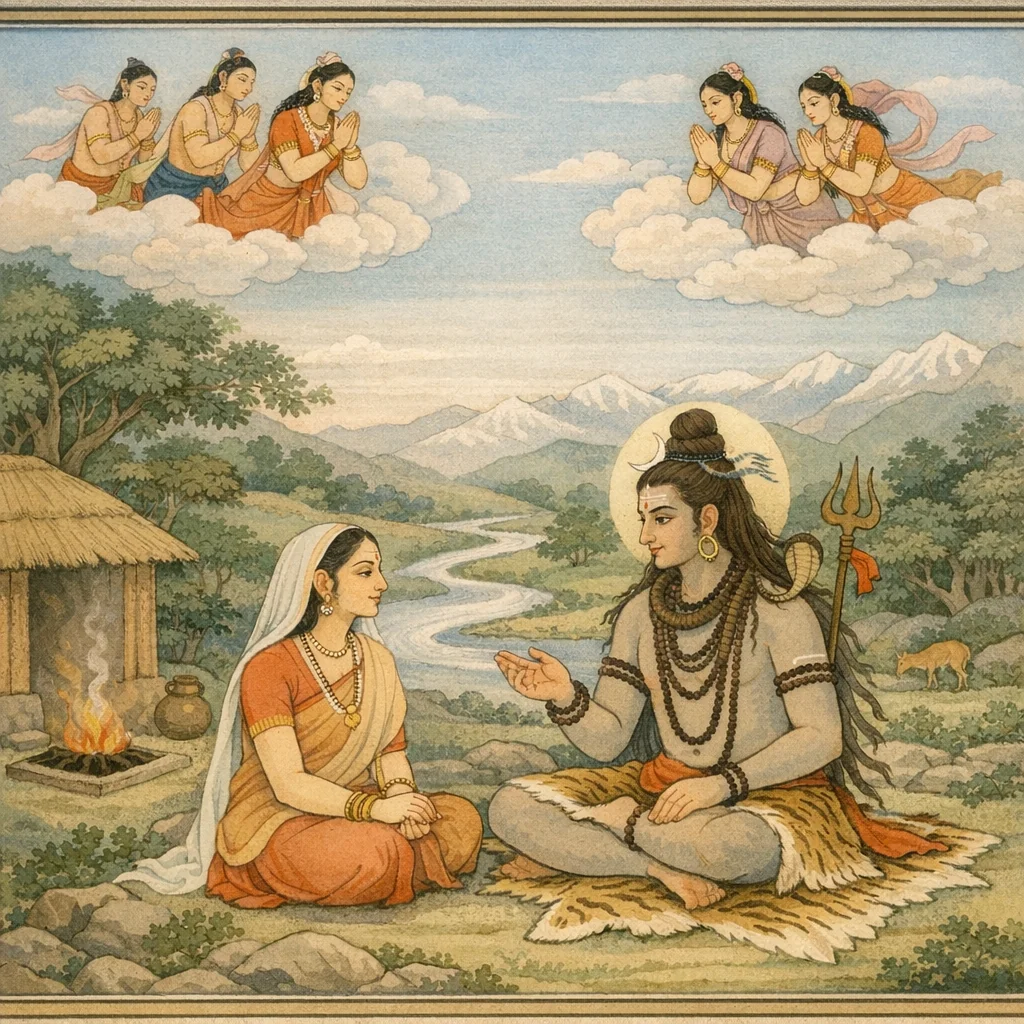
Chapter Arc: भीष्म युधिष्ठिर को उमा–महेश्वर-संवाद की कड़ी में ले जाते हैं—हिमवत्पुत्री पार्वती, तपोवन-निवासी और धर्मज्ञ, स्वयं महादेव से स्त्री-धर्म का मर्म पूछती हैं। → महेश्वर पार्वती की योग्यता (शम, दम, तप, धर्माचरण) की प्रशंसा कर प्रश्नोत्तर का अधिकार देते हैं; पार्वती स्त्री-स्वभाव, अनुकरण-धर्म, तीर्थ-सरिताओं के सम्मान और गृहस्थ-धर्म में नारी की स्थिति जैसे सूक्ष्म विषय उठाती हैं, जहाँ एक ही आचरण से पुण्य भी हो सकता है और लोक-निन्दा भी। → स्त्री-धर्म का निर्णायक सूत्र उभरता है—जिस नारी की स्पृहा काम-भोग-सुख-ऐश्वर्य में नहीं, बल्कि पति में केंद्रित है, वही ‘धर्मभागिनी’ है; साथ ही सभा-वाणी और बुद्धि के भेद का संकेत देकर बताया जाता है कि धर्म का निर्णय केवल वाक्चातुर्य से नहीं, अंतःकरण की निष्ठा से होता है। → उपदेश पूर्ण होने पर महादेव पार्वती का सत्कार कर अपने अनुचरों सहित लोकों को प्रस्थान करते हैं; भूतगण, गन्धर्व और अप्सराएँ प्रणाम कर यथास्थान लौटते हैं—संवाद का फल ‘स्त्री-धर्म’ की मर्यादा-रेखा के रूप में स्थापित होता है।
Shlokas
Verse 1
(दाक्षिणात्य अधिक पाठके १२०९ श्लोक मिलाकर कुल १२७३ श्लोक हैं) ऑपन--माजल बछ। अकाल षट्चत्वारिंशदधिकशततमो<ध्याय: पार्वतीजीके द्वारा स्त्री-धर्मका वर्णन नारद उवाच एवमुक्त्वा महादेव: श्रोतुकाम: स्वयं प्रभु: । अनुकूलां प्रियां भार्या पारश्वस्थां समभाषत,नारदजी कहते हैं--ऐसा कहकर महादेवजी स्वयं भी पार्वतीजीके मुँहसे कुछ सुननेकी इच्छा करने लगे। अतएव स्वयं भगवान् शिवने पास ही बैठी हुई अपनी प्रिय एवं अनुकूल भार्या पार्वतीसे कहा
Narada said: Having spoken thus, Mahadeva—though himself the sovereign Lord—became eager to listen. Therefore he addressed his beloved, agreeable wife Parvati, who was seated close by, inviting her to speak.
Verse 2
श्रीमहेश्वर उवाच परावरज्ञे धर्मज्ञे तपोवननिवासिनि । साध्वि सुभ्रु सुकेशान्ते हिमवत्पर्वतात्मजे
Śrī Maheśvara said: “O noble lady—knower of higher and lower truths, knower of dharma, dweller in the forest of austerities; O virtuous one with fair brows and beautiful hair; O daughter of Himavat, the very soul of the mountain.”
Verse 3
दक्षे शमदमोपेते निर्ममे धर्मचारिणि । पृच्छामि त्वां वरारोहे पृष्टा वद ममेप्सितम्
O capable one, endowed with tranquility and self-restraint, free from pride, and devoted to righteous conduct—O fair-hipped lady, I question you. Since you have been asked, speak what I wish to know.
Verse 4
श्रीमहेश्वर बोले--तपोवनमें निवास करनेवाली देवि! तुम भूत और भविष्यको जाननेवाली, धर्मके तत्त्वको समझनेवाली और स्वयं भी धर्मका आचरण करनेवाली हो। सुन्दर केशों और भौंहोंवाली सती-साध्वी हिमवान्-कुमारी! तुम कार्यकुशल हो, इन्द्रियसंयम और मनोनिग्रहसे भी सम्पन्न हो। तुममें अहंता और ममताका सर्वथा अभाव है; अतः वरारोहे! मैं तुमसे एक बात पूछता हूँ। मेरे पूछनेपर तुम मुझे मेरे अभीष्ट विषयको बताओ ।। सावित्री ब्रह्मण:साध्वी कौशिकस्य शची सती । (लक्ष्मीविंष्णो: प्रिया भार्या धृतिर्भार्या यमस्य तु) मार्कण्डेयस्य धूमोर्णा ऋद्धिवैश्रवणस्य च,ब्रह्माजीकी पत्नी सावित्री साध्वी हैं। इन्द्रपत्नी शची भी सती हैं। विष्णुकी प्यारी पत्नी लक्ष्मी पतिव्रता हैं। इसी प्रकार यमकी भार्या धृति, मार्कण्डेयकी पत्नी धूमोर्णा, कुबेरकी स्त्री ऋद्धि, वरुणकी भार्या गौरी, सूर्यकी पत्नी सुवर्चला, चन्द्रमाकी साध्वी स्त्री रोहिणी, अग्निकी भार्या स्वाहा और कश्यपकी पत्नी अदिति--ये सब-की-सब पतितव्रता देवियाँ हैं। देवि! तुमने इन सबका सदा संग किया है और इन सबसे धर्मकी बात पूछी है
Śrī Maheśvara said: “O Goddess who dwells in the forest of austerities! You know what has been and what will be; you understand the true principles of dharma and you yourself live by dharma. O chaste and virtuous daughter of Himavān, adorned with beautiful hair and brows! You are skilled in action, endowed with restraint of the senses and mastery of the mind. In you there is no trace of egoism or possessiveness. Therefore, O fair-hipped one, I ask you a question; when I ask, tell me what I seek to know. Sāvitrī, the virtuous wife of Brahmā; Śacī, the faithful wife of Indra (Kauśika); Lakṣmī, beloved wife of Viṣṇu; Dhṛti, wife of Yama; Dhūmorṇā, wife of Mārkaṇḍeya; Ṛddhi, wife of Vaiśravaṇa (Kubera); Gaurī, wife of Varuṇa; Suvarcalā, wife of Sūrya; Rohiṇī, the chaste consort of Candra; Svāhā, wife of Agni; and Aditi, wife of Kaśyapa—all these goddesses are devoted to their husbands. O Goddess, you have always kept company with them and have inquired of them about dharma.”
Verse 5
वरुणस्य तथा गौरी सूर्यस्य च सुवर्चला । रोहिणी शशिन: साध्वी स्वाहा चैव विभावसो:,ब्रह्माजीकी पत्नी सावित्री साध्वी हैं। इन्द्रपत्नी शची भी सती हैं। विष्णुकी प्यारी पत्नी लक्ष्मी पतिव्रता हैं। इसी प्रकार यमकी भार्या धृति, मार्कण्डेयकी पत्नी धूमोर्णा, कुबेरकी स्त्री ऋद्धि, वरुणकी भार्या गौरी, सूर्यकी पत्नी सुवर्चला, चन्द्रमाकी साध्वी स्त्री रोहिणी, अग्निकी भार्या स्वाहा और कश्यपकी पत्नी अदिति--ये सब-की-सब पतितव्रता देवियाँ हैं। देवि! तुमने इन सबका सदा संग किया है और इन सबसे धर्मकी बात पूछी है
Maheshvara said: “Varuṇa’s wife is Gaurī; the Sun’s wife is Suvarcalā. Rohiṇī is the chaste consort of the Moon, and Svāhā is likewise the wife of Vibhāvasu (Agni).”
Verse 6
अदिति: कश्यपस्याथ सर्वास्ता: पतिदेवता: । पृष्टाश्नोपासिताश्वैव तास्त्वया देवि नित्यश:,ब्रह्माजीकी पत्नी सावित्री साध्वी हैं। इन्द्रपत्नी शची भी सती हैं। विष्णुकी प्यारी पत्नी लक्ष्मी पतिव्रता हैं। इसी प्रकार यमकी भार्या धृति, मार्कण्डेयकी पत्नी धूमोर्णा, कुबेरकी स्त्री ऋद्धि, वरुणकी भार्या गौरी, सूर्यकी पत्नी सुवर्चला, चन्द्रमाकी साध्वी स्त्री रोहिणी, अग्निकी भार्या स्वाहा और कश्यपकी पत्नी अदिति--ये सब-की-सब पतितव्रता देवियाँ हैं। देवि! तुमने इन सबका सदा संग किया है और इन सबसे धर्मकी बात पूछी है
Śrī Maheśvara said: “Aditi, the wife of Kaśyapa, and indeed all those noble ladies are devoted to their husbands as to a deity. You, O Goddess, have continually approached them, served and honored them, and questioned them about righteous conduct.”
Verse 7
तेन त्वां परिपृच्छामि धर्मज्ञे धर्मवादिनि । स्त्रीधर्म श्रोतुमिच्छामि त्वयोदाह्ृतमादित:,अतः धर्मवादिनि धर्मज्ञे! मैं तुमसे स्त्रीधर्मके विषयमें प्रश्न करता हूँ और तुम्हारे मुखसे वर्णित नारीधर्म आद्योपान्त सुनना चाहता हूँ
Therefore I question you, O knower of dharma and eloquent expounder of dharma. I wish to hear, from your own mouth, the duties and conduct of women—set forth from the beginning in full—so that the proper path of righteous living may be clearly understood.
Verse 8
सधर्मचारिणी मे त्वं समशीला समचव्रता । समानसारवीर्या च तपस्तीव्रं कृतं च ते,तुम मेरी सहधर्मिणी हो। तुम्हारा शील-स्वभाव तथा व्रत मेरे समान ही है। तुम्हारी सारभूत शक्ति भी मुझसे कम नहीं है। तुमने तीव्र तपस्या भी की है
Maheshvara said: “You are my companion in dharma—of the same disposition and the same vows as I. Your essential strength and heroic potency are equal to mine, and you have also performed intense austerities.”
Verse 9
त्वया हुक्तो विशेषेण गुणवान् स भविष्यति । लोके चैव त्वया देवि प्रमाणत्वमुपैष्यति,अतः देवि! तुम्हारे द्वारा कहा गया स्त्रीधर्म विशेष गुणवान् होगा और लोकमें प्रमाणभूत माना जायगा
Śrī Maheśvara said: “Because this has been spoken by you with particular clarity, it will become richly endowed with merit; and, O Goddess, in the world it will attain the status of an authoritative standard. Therefore, O Devi, the women’s dharma you have articulated will be regarded as a guiding norm for conduct.”
Verse 10
स्त्रियश्वैव विशेषेण स्त्रीजनस्य गति: परा । गौर्या गच्छति सुश्रोणि लोकेष्वेषा गति: सदा
Mahādeva said: “Women, and especially the community of women, have a supreme course to attain. O fair-hipped one, by following Gaurī they proceed through the worlds—this is ever the destined path (and highest refuge) for them.”
Verse 11
विशेषतः स्त्रियाँ ही स्त्रियोंकी परम गति हैं। सुश्रोणि! संसारमें भूतलपर यह बात सदासे प्रचलित है ।। मम चार्ध शरीरस्य तव चार्धेन निर्मितम् | सुरकार्यकरी च त्वं लोकसंतानकारिणी,मेरा आधा शरीर तुम्हारे आधे शरीरसे निर्मित हुआ है। तुम देवताओंका कार्य सिद्ध करनेवाली तथा लोक-संततिका विस्तार करनेवाली हो
Śrī Maheśvara said: “My body is formed with your half as its other half. You are the one who accomplishes the works of the gods and who brings forth and sustains the continuity of beings in the world.”
Verse 12
(प्रमदोक्तं तु यत् किंचित् तत् स्त्रीषु बहु मन्यते । न तथा मन्यते स्त्रीषु पुरुषोक्तमनिन्दिते ।।) अनिन्दिते! नारीकी कही हुई जो बात होती है, उसे ही स्त्रियोंमें अधिक महत्त्व दिया जाता है। पुरुषोंकी कही हुई बातको स्त्रियोंमें वैसा महत्त्व नहीं दिया जाता ।। तव सर्व: सुविदित: स्त्रीधर्म: शाश्वत: शुभे । तस्मादशेषतो ब्रूहि स्वधर्म विस्तरेण मे,शुभे! तुम्हें सम्पूर्ण सनातन स्त्रीधर्मका भलीभाँति ज्ञान है; अतः अपने धर्मका पूर्णरूपसे विस्तारपूर्वक मेरे आगे वर्णन करो
Maheshvara said: “Whatever is spoken in a woman’s own voice—even if said in a moment of heedlessness—is often given great weight among women. But what is spoken by a man is not valued among women in the same way, O blameless one. O auspicious lady, you fully know the eternal and beneficent dharma of women. Therefore, tell me completely—set forth your own dharma in detail.”
Verse 13
उमोवाच भगवन् सर्वभूतेश भूतभव्यभवोत्तम । त्वत्प्रभावादियं देव वाक् चैव प्रतिभाति मे
Umā said: “O Blessed Lord, O Sovereign of all beings, O Supreme among what has been, what will be, and what is to come—by the power of Your presence, O God, these words arise clearly within me.”
Verse 14
इमास्तु नद्यो देवेश सर्वतीर्थोदकैर्युता: । उपस्पर्शनहेतोस्त्वामुपयान्ति समीपत:
Mahādeva said: “O Lord of the gods, these rivers—filled with the waters of all sacred fords—draw near to you, coming close for the sake of holy contact (ritual touch and purification).”
Verse 15
एताभि: सह सम्मन्त्र्य प्रवक्ष्याम्यनुपूर्वश: । प्रभवन् यो5नहंवादी स वै पुरुष उच्यते
Having deliberated together with these (principles/virtues), I shall explain them in due order. He who is capable and influential, yet does not speak with self-asserting pride (‘I, I’), is truly called a worthy person.
Verse 16
उमाने कहा--भगवन्! सर्वभूतेश्वर! भूत, भविष्य और वर्तमानकालस्वरूप सर्वश्रेष्ठ महादेव! आपके प्रभावसे मेरी यह वाणी प्रतिभासम्पन्न हो रही है--अब मैं स्त्री-धर्मका वर्णन कर सकती हूँ। किंतु देवेश्वर! ये नदियाँ सम्पूर्ण तीर्थोके जलसे सम्पन्न हो आपके स्नान और आचमन आदिके लिये अथवा आपके चरणोंका स्पर्श करनेके लिये यहाँ आपके निकट आ रही हैं। मैं इन सबके साथ सलाह करके क्रमशः स्त्रीधर्मका वर्णन करूँगी। जो व्यक्ति समर्थ होकर भी अहंकारशून्य हो, वही पुरुष कहलाता है ।। स्त्री च भूतेश सततं स्त्रियमेवानुधावति । मया सम्मानिताश्रैव भविष्यन्ति सरिद्वरा:
Umā said: “O Blessed Lord, sovereign of all beings—O Mahādeva, supreme and embodying past, future, and present—by Your power my speech has become inspired; now I am able to describe the dharma of women. Yet, O Lord of the gods, these excellent rivers, filled with the waters of all sacred fords, are coming near You for Your bathing and sipping rites, or to touch Your feet. After consulting with them, I shall set forth, in due order, the duties of women. A man is truly called ‘man’ only when, though capable, he is free from arrogance.” (Verse) “And, O Lord of beings, a woman continually follows after a woman; and those best of rivers, honored by me, will indeed come to be (well-disposed/auspicious).”
Verse 17
भूतनाथ! स्त्री सदा स्त्रीका ही अनुसरण करती है। मेरे ऐसा करनेसे ये श्रेष्ठ सरिताएँ मेरे द्वारा सम्मानित होंगी ।। एषा सरस्वती पुण्या नदीनामुत्तमा नदी । प्रथमा सर्वसरितां नदी सागरगामिनी,(यमुना नर्मदां चैव कावेरीमथ निम्नगाम) ये नदियोंमें उत्तम पुण्यसलिला सरस्वती विराजमान हैं, जो समुद्रमें मिली हुई हैं। ये समस्त सरिताओंमें प्रथम (प्रधान) मानी जाती हैं। इनके सिवा विपाशा (व्यास), वितस्ता (झेलम), चन्द्रभागा (चनाव), इरावती (रावी), शतद्रू (शतलज), देविका, सिन्धु, कौशिकी (कोसी), गौतमी (गोदावरी), यमुना, नर्मदा तथा कावेरी नदी भी यहाँ विद्यमान हैं
Maheshvara said: “O Lord of beings! A woman ever follows the way of womanhood. By my acting thus, these excellent rivers will be honored through me. Here stands the holy Sarasvatī, the best among rivers—foremost of all streams, flowing on to the ocean. And here too are the Yamunā, the Narmadā, and the Kāverī, along with other rivers that run down to the sea.”
Verse 18
विपाशा च वितस्ता च चन्द्रभागा इरावती । शतद्भूदेंविका सिन्धु: कौशिकी गौतमी तथा,(यमुना नर्मदां चैव कावेरीमथ निम्नगाम) ये नदियोंमें उत्तम पुण्यसलिला सरस्वती विराजमान हैं, जो समुद्रमें मिली हुई हैं। ये समस्त सरिताओंमें प्रथम (प्रधान) मानी जाती हैं। इनके सिवा विपाशा (व्यास), वितस्ता (झेलम), चन्द्रभागा (चनाव), इरावती (रावी), शतद्रू (शतलज), देविका, सिन्धु, कौशिकी (कोसी), गौतमी (गोदावरी), यमुना, नर्मदा तथा कावेरी नदी भी यहाँ विद्यमान हैं
Śrī Maheśvara said: “Vipāśā, Vitastā, Candrabhāgā, Irāvatī, Śatadrū, Devikā, Sindhu, Kauśikī, and Gautamī—as well as Yamunā, Narmadā, and Kāverī, the river that flows down to the sea—are all present here. Among rivers, Sarasvatī shines forth as the most excellent, her waters holy, and she is spoken of as joining the ocean. These are regarded as foremost among all streams.”
Verse 19
तथा देवनदी चेयं सर्वतीर्थाभिसम्भूृता । गगनाद् गां गता देवी गड्जा सर्वसरिद्वरा,ये समस्त तीर्थोंसे सेवित तथा सम्पूर्ण सरिताओंमें श्रेष्ठ देवनदी गंगादेवी भी, जो आकाशसे पृथ्वीपर उतरी हैं, यहाँ विराजमान हैं
“Likewise, this divine river—Gaṅgā—revered as the gathering-place of all sacred fords, the foremost among all streams, has descended from the heavens to the earth and is present here.”
Verse 20
इत्युक्त्वा देवदेवस्य पत्नी धर्मभृतां वरा । स्मितपूर्वमथाभाष्य सर्वास्ता: सरितस्तथा,ऐसा कहकर देवाधिदेव महादेवजीकी पत्नी, धर्मात्माओंमें श्रेष्ठ, धर्मवत्सला, देवमहिषी उमाने स्त्री-धर्मके ज्ञानमें निपुण गंगा आदि उन समस्त श्रेष्ठ सरिताओंको मन्द मुसकानके साथ सम्बोधित करके उनसे स्त्रीधर्मके विषयमें प्रश्न किया
Having spoken thus, the consort of the God of gods—Uma, foremost among the righteous and devoted to dharma—then, with a gentle smile, addressed all those rivers (such as Gaṅgā) and questioned them concerning the duties and conduct of women (strī-dharma).
Verse 21
अप्च्छद् देवमहिषी स्त्रीधर्म धर्मवत्सला । स्त्रीधर्मकुशलास्ता वै गड़ाद्या: सरितां वरा:,ऐसा कहकर देवाधिदेव महादेवजीकी पत्नी, धर्मात्माओंमें श्रेष्ठ, धर्मवत्सला, देवमहिषी उमाने स्त्री-धर्मके ज्ञानमें निपुण गंगा आदि उन समस्त श्रेष्ठ सरिताओंको मन्द मुसकानके साथ सम्बोधित करके उनसे स्त्रीधर्मके विषयमें प्रश्न किया
Then the divine queen Umā—devoted to dharma and foremost among the righteous—addressed with a gentle smile the excellent rivers beginning with Gaṅgā, who were well-versed in the duties of women, and questioned them about strī-dharma (the ethical and religious conduct proper to women).
Verse 22
उमोवाच (हे पुण्या: सरित: श्रेष्ठा: सर्वपापविनाशिका: । ज्ञानविज्ञानसम्पन्ना: शृणुध्वं वचनं मम ।।) अयं भगवता प्रोक्ता: प्रश्न: स्त्रीधर्मसंश्रित: । तं तु सम्मन्त्र्य युष्माभिवरक्तुमिच्छामि शंकरम्,उमा बोलीं--हे समस्त पापोंका विनाश करनेवाली, ज्ञान-विज्ञानसे सम्पन्न पुण्यसलिला श्रेष्ठ नदियो! मेरी बात सुनो। भगवान् शिवने यह स्ट्रीधर्मसम्बन्धी प्रश्न उपस्थित किया है। उसके विषयमें मैं तुमलोगोंसे सलाह लेकर ही भगवान् शंकरसे कुछ कहना चाहती हूँ
Umā said: “O holy rivers—foremost among streams, destroyers of all sin, endowed with knowledge and discernment—listen to my words. The Blessed Lord (Śiva) has raised a question concerning the dharma of women. I wish to speak to Śaṅkara about it only after taking counsel with you.”
Verse 23
न चैकसाध्यं पश्यामि विज्ञानं भुवि कस्यचित् | दिवि वा सागरगमास्तेन वो मानयाम्यहम्
Mahēśvara said: “I do not see any knowledge that is attainable by only one means for anyone on earth—or even in heaven. Therefore, I honor you all, for you have undertaken the arduous path that leads across the ocean (of worldly existence).”
Verse 24
समुद्रगामिनी सरिताओ! पृथ्वीपर या स्वर्गमें मैं किसीका भी ऐसा कोई विज्ञान नहीं देखती, जिसे उसने अकेले ही--दूसरोंका सहयोग लिये बिना ही सिद्ध कर लिया हो, इसीलिये मैं आपलोगोंसे सादर सलाह लेती हूँ ।। एवं सर्वाः सरिच्छेष्ठा: पृष्टा: पुण्यतमा: शिवा: । ततो देवनदी गड़्ा नियुक्ता प्रतिपूज्य च,इस प्रकार उमाने जब समस्त कल्याणस्वरूपा परम पुण्यमयी श्रेष्ठ सरिताओंके समक्ष यह प्रश्न उपस्थित किया, तब उन्होंने इसका उत्तर देनेके लिये देवनदी गंगाको सम्मानपूर्वक नियुक्त किया
“O rivers that flow to the ocean! Whether on earth or in heaven, I do not see any true knowledge or accomplishment that a person has perfected entirely alone, without the help of others. Therefore I respectfully seek counsel from you.” When Umā thus placed her question before all the auspicious, supremely holy, best of rivers, they, in order to reply, honored the divine river Gaṅgā and appointed her to speak.
Verse 25
बद्दीभिवद्धिभि: स्फीता स्त्रीधर्मज्ञा शुचिस्मिता । शैलराजसूुतां देवीं पुण्या पापभयापहा,पवित्र मुसकानवाली गंगाजी अनेक बुद्धियोंसे बढ़ी-चढ़ी, स्त्री-धर्मको जाननेवाली, पाप-भयको दूर करनेवाली, पुण्यमयी, बुद्धि और विनयसे सम्पन्न, सर्वधर्मविशारद तथा प्रचुर बुद्धिसे संयुक्त थीं। उन्होंने गिरिराजकुमारी उमादेवीसे मन्द-मन्द मुसकराते हुए कहा
Mahēśvara said: “Gaṅgā, endowed with abundant intelligence and mature discernment, well-versed in the duties and conduct proper to women, and smiling with pure gentleness, was herself holy and a remover of the fear born of sin. Turning to the goddess Umā, daughter of the Lord of Mountains, she addressed her with a soft smile.”
Verse 26
बुद्ध्या विनयसम्पन्ना सर्वधर्मविशारदा । सस्मितं बहुबुद्धयाढद्या गज़ा वचनमब्रवीत्,पवित्र मुसकानवाली गंगाजी अनेक बुद्धियोंसे बढ़ी-चढ़ी, स्त्री-धर्मको जाननेवाली, पाप-भयको दूर करनेवाली, पुण्यमयी, बुद्धि और विनयसे सम्पन्न, सर्वधर्मविशारद तथा प्रचुर बुद्धिसे संयुक्त थीं। उन्होंने गिरिराजकुमारी उमादेवीसे मन्द-मन्द मुसकराते हुए कहा
Endowed with discernment and humility, and well-versed in all aspects of dharma, the holy Gaṅgā—rich in intelligence—spoke with a gentle smile. In a purified and auspicious manner, she addressed Umādevī, the daughter of the Lord of Mountains, as if to guide her with calm, fear-dispelling counsel grounded in righteous conduct.
Verse 27
गजड़ोवाच धन्यास्म्यनुगृहीतास्मि देवि धर्मपरायणे । या त्वं सर्वजगन्मान्या नदीं मानयसे5नघे,गंगाजीने कहा--देवि! धर्मपरायणे! अनघे! मैं धन्य हूँ। मुझपर आपका बहुत बड़ा अनुग्रह है; क्योंकि आप सम्पूर्ण जगत्की सम्माननीया होनेपर भी एक तुच्छ नदीको मान्यता प्रदान कर रही हैं
Gajaḍa said: “O Goddess devoted to dharma, I am blessed; I have been shown great favor. For though you are revered by the entire world, O sinless one, you still choose to honor even a mere river.”
Verse 28
प्रभवन् पृच्छते यो हि सम्मानयति वा पुन: । नूनं जनमदुष्टात्मा पण्डिताख्यां स गच्छति
Maheshvara said: “Whoever, being capable or eminent, still asks questions humbly, or again shows respect to others—such a person is surely not of a wicked disposition. He attains the repute and standing of a learned man.”
Verse 29
जो सब प्रकारसे समर्थ होकर भी दूसरोंसे पूछता तथा उन्हें सम्मान देता है और जिसके मनमें कभी दुष्टता नहीं आती, वह मनुष्य निस्संदेह पण्डित कहलाता है ।। ज्ञानविज्ञानसम्पन्नानूहापोहविशारदान् । प्रवक्तून् पृच्छते योडन्यान् स वै नापदमृच्छति,जो मनुष्य ज्ञान-विज्ञानसे सम्पन्न और ऊहापोहमें कुशल दूसरे-दूसरे वक्ताओंसे अपना संदेह पूछता है, वह आपत्तिमें नहीं पड़ता है। विशेष बुद्धिमान् पुरुष सभामें और तरहकी बात करता है और अहंकारी मनुष्य और ही तरहकी दुर्बलतायुक्त बातें करता है
Maheshvara said: One who, though fully capable, still asks others, honors them, and never allows malice to arise in his mind is truly called a learned person. The man who is endowed with knowledge and realized understanding, skilled in weighing alternatives, and who questions various teachers to clear his doubts, does not fall into calamity. In an assembly, the truly intelligent speak with discernment, whereas the arrogant speak differently—revealing weakness and lack of steadiness.
Verse 30
अन्यथा बहुबुद्धयाढ्यो वाक््यं वदति संसदि । अन्यथैव हाहंवादी दुर्बलं वदते वच:,जो मनुष्य ज्ञान-विज्ञानसे सम्पन्न और ऊहापोहमें कुशल दूसरे-दूसरे वक्ताओंसे अपना संदेह पूछता है, वह आपत्तिमें नहीं पड़ता है। विशेष बुद्धिमान् पुरुष सभामें और तरहकी बात करता है और अहंकारी मनुष्य और ही तरहकी दुर्बलतायुक्त बातें करता है
Maheshvara said: “A man rich in understanding speaks in one manner in the assembly—measured, discerning, and suited to the occasion. But the self-assertive braggart speaks quite differently, uttering weak and unreliable words. One who is endowed with knowledge and practical discernment, skilled in weighing alternatives, and who asks his doubts of various competent speakers, does not fall into distress.”
Verse 31
दिव्यज्ञाने दिवि श्रेष्ठे दिव्यपुण्यै: सहोत्थिते । त्वमेवा्हसि नो देवि स्त्रीधर्माननुभाषितुम्
Maheshvara said: “O Goddess, you alone are truly fit to expound to us the duties of women—those lofty principles grounded in divine knowledge, supreme in heaven, and arisen together with divine merit.”
Verse 32
देवि! तुम दिव्य ज्ञानसे सम्पन्न और देवलोकमें सर्वश्रेष्ठ हो। दिव्य पुण्योंके साथ तुम्हारा प्रादुर्भाव हुआ है। तुम्हीं हम सब लोगोंको स्त्री-धर्मका उपदेश देनेके योग्य हो ।। ततः सा<<राधिता देवी गड्या बहुभिगुणै: । प्राह सर्वमशेषेण स्त्रीधर्म सुरसुन्दरी,तदनन्तर गंगाजीके द्वारा अनेक गुणोंका बखान करके पूजित होनेपर देवसुन्दरी देवी उमाने सम्पूर्ण स्त्री-धर्मका पूर्णतः: वर्णन किया
Maheshvara said: “Goddess, you are endowed with divine knowledge and are the foremost in the world of the gods. Your manifestation has arisen together with divine merit. You alone are fit to instruct all of us in strī-dharma—the duties and conduct proper to women.” Thereupon, when the goddess Uma—celebrated and worshipped by Ganga with many praises of her virtues—set forth, without omission, the complete teaching on strī-dharma, as befits a celestial lady.
Verse 33
उमोवाच स्त्रीधर्मो मां प्रति यथा प्रतिभाति यथाविधि । तमहं कीर्तयिष्यामि तथैव प्रश्निता भव,उमा बोलीं--स्त्री-धर्मका स्वरूप मेरी बुद्धिमें जैसा प्रतीत होता है, उसे मैं विधिपूर्वक बताऊँगी। तुम विनय और उत्सुकतासे युक्त होकर इसे सुनो
Umā said: “As the dharma of women appears to my understanding, and in the proper manner, I shall set it forth. Therefore, be one who asks with humility and earnest desire to know, and listen accordingly.”
Verse 34
स्त्रीधर्म: पूर्व एवायं विवाहे बन्धुभि: कृत: । सहधर्मचरी भर्तुर्भवत्यग्निसमीपत:,विवाहके समय कन्याके भाई-बन्धु पहले ही उसे स्त्री-धर्मका उपदेश कर देते हैं। जब कि वह अग्निके समीप अपने पतिकी सहधर्मिणी बनती है
Maheshvara said: “This duty of a wife is already established beforehand at the time of marriage by her own kinsmen. For it is beside the sacred fire that she becomes her husband’s companion in dharma—bound to share his righteous course of life.”
Verse 35
सुस्वभावा सुवचना सुवृत्ता सुखदर्शना । अनन्यचित्ता सुमुखी भर्तु: सा धर्मचारिणी,जिसके स्वभाव, बात-चीत और आचरण उत्तम हों, जिसको देखनेसे पतिको सुख मिलता हो, जो अपने पतिके सिवा दूसरे किसी पुरुषमें मन नहीं लगाती हो और स्वामीके समक्ष सदा प्रसन्नमुखी रहती हो, वह स्त्री धर्माचरण करनेवाली मानी गयी है। जो साध्वी स्त्री अपने स्वामीको सदा देवतुल्य समझती है, वही धर्मपरायणा और वही धर्मके फलकी भागिनी होती है
Maheshvara said: A woman is regarded as one who practices dharma when her nature is good, her speech is gracious, her conduct is virtuous, her very presence brings her husband joy, her mind does not turn toward any man other than her husband, and she remains cheerful-faced before her lord. Such fidelity and respectful devotion to the husband are presented here as the ethical marks of a dharma-centered household life and as the basis for sharing in the fruits of dharma.
Verse 36
सा भवेद् धर्मपरमा सा भवेद् धर्मभागिनी । देववत् सततं साध्वी या भर्तरें प्रपश्यति,जिसके स्वभाव, बात-चीत और आचरण उत्तम हों, जिसको देखनेसे पतिको सुख मिलता हो, जो अपने पतिके सिवा दूसरे किसी पुरुषमें मन नहीं लगाती हो और स्वामीके समक्ष सदा प्रसन्नमुखी रहती हो, वह स्त्री धर्माचरण करनेवाली मानी गयी है। जो साध्वी स्त्री अपने स्वामीको सदा देवतुल्य समझती है, वही धर्मपरायणा और वही धर्मके फलकी भागिनी होती है
She is to be regarded as supremely devoted to dharma; she is a sharer in the fruits of dharma—the virtuous woman who continually looks upon her husband as a god. The ethical point is that steadfast fidelity, reverence, and well-conduct within marriage are presented as a primary form of righteous living and a source of religious merit.
Verse 37
शुश्रूषां परिचारं च देववद् या करोति च । नान्यभावा हाविमना: सुव्रता सुखदर्शना
Śrī Maheśvara said: “She who offers attentive service and close personal care to her husband as though to a deity—whose mind turns nowhere else, free from wavering intent—such a woman, steadfast in noble vows and gentle to behold, embodies the devoted dharma of the household.”
Verse 38
पुत्रवक्त्रमिवाभी क्षणं भर्तुर्वदनमी क्षते । या साध्वी नियताहारा सा भवेद् धर्मचारिणी
Maheshvara said: “She who again and again looks upon her husband’s face as though it were the face of her own son—gentle, affectionate, and without suspicion—and who is virtuous, disciplined in conduct and restrained in food, truly becomes one who walks in dharma.”
Verse 39
जो पतिकी देवताके समान सेवा और परिचर्या करती हैं, पतिके सिवा दूसरे किसीसे हार्दिक प्रेम नहीं करती, कभी नाराज नहीं होती तथा उत्तम व्रतका पालन करती है, जिसका दर्शन पतिको सुखद जान पड़ता है, जो पुत्रके मुखकी भाँति स्वामीके मुखकी ओर सदा निहारती रहती है तथा जो साध्वी एवं नियमित आहारका सेवन करनेवाली है, वह स्त्री धर्मचारिणी कही गयी है ।। श्रुत्वा दम्पतिधर्म वै सहधर्म कृतं शुभम् । या भवेद् धर्मपरमा नारी भर्तसमव्रता,“पति और पत्नीको एक साथ रहकर धर्माचरण करना चाहिये।” इस मंगलमय दाम्पत्य धर्मको सुनकर जो स्त्री धर्मपरायण हो जाती है, वह पतिके समान व्रतका पालन करनेवाली (पतिव्रता) है
Maheshvara declares that a woman is called a true practitioner of dharma when she serves and attends upon her husband as one would a deity, gives her heartfelt love to none but him, does not fall into anger, and faithfully keeps noble vows. Her very presence is pleasing to her husband; she continually looks toward her lord’s face as one looks upon a child’s face with steady affection; she is chaste and disciplined, taking regulated food. Having heard this auspicious dharma of married life—that husband and wife should live together and practice righteousness jointly—the woman who becomes devoted to dharma and observes vows in harmony with her husband is called a pativratā (one faithful to her husband’s vow).
Verse 40
देववत् सततं साध्वी भर्तारमनुपश्यति । दम्पत्योरेष वै धर्म: सहधर्मकृत: शुभ:
Maheshvara said: “Like a deity, the virtuous wife continually looks upon and attends to her husband. This indeed is the dharma of husband and wife—a blessed path of shared righteousness, performed together as partners in duty.”
Verse 41
साध्वी स्त्री सदा अपने पतिको देवताके समान समझती है। पति और पत्नीका यह सहधर्म (साथ-साथ रहकर धर्माचरण करना) रूप धर्म परम मंगलमय है ।। शुश्रूषां परिचारं च देवतुल्यं प्रकुर्वती । वश्या भावेन सुमना: सुव्रता सुखदर्शना । अनन्यचित्ता सुमुखी भर्तु: सा धर्मचारिणी,जो अपने हृदयके अनुरागके कारण स्वामीके अधीन रहती है, अपने चित्तको प्रसन्न रखती है, देवताके समान पतिकी सेवा और परिचर्या करती है, उत्तम व्रतका आश्रय लेती है ओर पतिके लिये सुखदायक सुन्दर वेष धारण किये रहती है, जिसका चित्त पतिके सिवा और किसीकी ओर नहीं जाता, पतिके समक्ष प्रसन्नचदन रहनेवाली वह स्त्री धर्मचारिणी मानी गयी है। जो स्वामीके कठोर वचन कहने या दोषपूर्ण दृष्टिसे देखनेपर भी प्रसन्नतासे मुसकराती रहती है, वही स्त्री पतिव्रता है
Śrī Maheśvara said: A virtuous wife regards her husband as a deity. This shared way of life—husband and wife practicing dharma together—is supremely auspicious. She who renders attentive service and care to her husband as to a god; who remains willingly devoted to him with a gentle, compliant disposition; who keeps her mind cheerful; who undertakes noble vows and maintains a pleasing appearance for her husband’s happiness; whose heart does not turn toward anyone else; and who meets her husband with a bright, gracious face—such a woman is called a practitioner of dharma. And she who, even when her husband speaks harshly or looks upon her with fault-finding eyes, continues to smile with serenity—she alone is truly called devoted to her husband (pativratā).
Verse 42
परुषाण्यपि चोक्ता या दृष्टा दृष्टेन चक्षुषा । सुप्रसन्नमुखी भर्तुर्या नारी सा पतिव्रता,जो अपने हृदयके अनुरागके कारण स्वामीके अधीन रहती है, अपने चित्तको प्रसन्न रखती है, देवताके समान पतिकी सेवा और परिचर्या करती है, उत्तम व्रतका आश्रय लेती है ओर पतिके लिये सुखदायक सुन्दर वेष धारण किये रहती है, जिसका चित्त पतिके सिवा और किसीकी ओर नहीं जाता, पतिके समक्ष प्रसन्नचदन रहनेवाली वह स्त्री धर्मचारिणी मानी गयी है। जो स्वामीके कठोर वचन कहने या दोषपूर्ण दृष्टिसे देखनेपर भी प्रसन्नतासे मुसकराती रहती है, वही स्त्री पतिव्रता है
Mahādeva said: Even when her husband speaks harshly, or even when he looks at her with a fault-finding gaze, the woman who still keeps a serene, cheerful face toward her husband—remaining gracious and unshaken—is to be known as a pativratā, a wife steadfast in her vow of fidelity and devoted conduct. The verse frames such steadiness not as mere outward compliance, but as a disciplined ethical posture of constancy in service and goodwill within marriage.
Verse 43
न चन्द्रसूर्यों न तरुं पुंनाम्ना या निरीक्षते । भर्त॒वर्ज वरारोहा सा भवेद् धर्मचारिणी
Śrī Maheśvara said: “That noble lady who does not look upon the moon, the sun, or even a tree by the name of a man—except in the presence of her husband—should be regarded as one who practices dharma.”
Verse 44
दरिद्रं व्याधितं दीनमध्वना परिकर्शितम् | पतिं पुत्रमिवोषपास्ते सा नारी धर्मभागिनी
Maheshvara said: Even if her husband is poor, sick, wretched, and worn down by the hardships of the road, that woman who serves him as she would her own son is truly a sharer in dharma—one who participates in righteousness through steadfast care and loyal service.
Verse 45
जो सुन्दरी नारी पतिके सिवा पुरुष नामधारी चन्द्रमा, सूर्य और किसी वृक्षकी ओर भी दृष्टि नहीं डालती, वही पातिव्रतधर्मका पालन करनेवाली है। जो नारी अपने दरिद्र, रोगी, दीन अथवा रास्तेकी थकावटसे खिन्न हुए पतिकी पुत्रके समान सेवा करती है, वह धर्मफलकी भागिनी होती है ।। या नारी प्रयता दक्षा या नारी पुत्रिणी भवेत् पतिप्रिया पतिप्राणा सा नारी धर्मभागिनी,जो स्त्री अपने हृदयको शुद्ध रखती, गृहकार्य करनेमें कुशल और पुत्रवती होती, पतिसे प्रेम करती और पतिको ही अपने प्राण समझती है, वही धर्मफल पानेकी अधिकारिणी होती है। जो सदा प्रसन्नचित्तसे पतिकी सेवा-शुश्रूषामें लगी रहती है, पतिके ऊपर पूर्ण विश्वास रखती और उसके साथ विनयपूर्ण बर्ताव करती है, वही नारी धर्मके श्रेष्ठ फलकी भागिनी होती है
Śrī Maheśvara said: A virtuous wife is she who, apart from her husband, does not even cast her gaze toward any male—whether the Moon, the Sun, or any other object that might be imagined as masculine. The woman who serves her husband—though he be poor, sick, destitute, or wearied by the road—as tenderly as she would serve a son, becomes a sharer in the fruits of dharma. The woman who is disciplined and capable, who is blessed with children, who loves her husband and holds him as her very life-breath—she is entitled to the reward of righteousness. She who keeps her heart pure, is skilled in household duties, remains devoted in affection, and treats her husband as her own vital principle; and she who, with a cheerful mind, continually attends upon him, trusts him fully, and behaves toward him with humility—such a woman attains the highest fruit of dharma.
Verse 46
शुश्रूषां परिचर्या च करोत्यविमना: सदा । सुप्रतीता विनीता च सा नारी धर्मभागिनी,जो स्त्री अपने हृदयको शुद्ध रखती, गृहकार्य करनेमें कुशल और पुत्रवती होती, पतिसे प्रेम करती और पतिको ही अपने प्राण समझती है, वही धर्मफल पानेकी अधिकारिणी होती है। जो सदा प्रसन्नचित्तसे पतिकी सेवा-शुश्रूषामें लगी रहती है, पतिके ऊपर पूर्ण विश्वास रखती और उसके साथ विनयपूर्ण बर्ताव करती है, वही नारी धर्मके श्रेष्ठ फलकी भागिनी होती है
Maheshvara said: A woman who, with an untroubled mind, continually engages in attentive service and proper household care—who is fully trusting and modest in conduct—becomes a rightful sharer in dharma and its fruits. The verse frames marital fidelity and willing service, performed with inner cheer and humility, as a disciplined ethical path that yields the highest religious merit within the household order.
Verse 47
न कामेषु न भोगेषु नैश्वर्ये न सुखे तथा । स्पृहा यस्या यथा पत्यौ सा नारी धर्मभागिनी,जिसके हृदयमें पतिके लिये जैसी चाह होती है, वैसी काम, भोग और सुखके लिये भी नहीं होती। वह स्त्री पातिव्रतरर्मकी भागिनी होती है
Śrī Maheśvara said: The woman whose longing is fixed upon her husband—so that she feels no comparable craving for sensual pleasures, enjoyments, worldly power, or even comfort—such a woman is a true sharer in dharma, a partner in righteousness through her steadfast marital fidelity.
Verse 48
कल्योत्थानरतिर्नित्यं गहशुश्रूषणे रता । सुसम्मृष्टक्षया चैव गोशकृत्कृतलेपना,जो प्रतिदिन प्रातःकाल उठनेमें रुचि रखती है, घरोंके काम-काजमें योग देती है, घरको झाड़-बुहारकर साफ रखती है और गोबरसे लीप-पोतकर पवित्र बनाये रखती है, जो पतिके साथ रहकर प्रतिदिन अग्निहोत्र करती है, देवताओंको पुष्प और बलि अर्पण करती है तथा देवता, अतिथि और पोष्यवर्गको भोजनसे तृप्त करके न्याय और विधिके अनुसार शेष अन्नका स्वयं भोजन करती है तथा घरके लोगोंको हृष्ट-पुष्ट एवं संतुष्ट रखती है, ऐसी ही नारी सती-धर्मके फलसे युक्त होती है
Mahādeva said: “She who delights every day in rising at the proper time, who is devoted to the attentive service and management of the household, who keeps the home well-swept and orderly, and who purifies it by smearing it with cow-dung—such a woman embodies the disciplined conduct of a virtuous wife. Through this steady domestic dharma, she becomes endowed with the fruits of satī-dharma.”
Verse 49
अग्निकार्यपरा नित्यं सदा पुष्पबलिप्रदा । देवतातिथि भृत्यानां निर्वाप्प पतिना सह,जो प्रतिदिन प्रातःकाल उठनेमें रुचि रखती है, घरोंके काम-काजमें योग देती है, घरको झाड़-बुहारकर साफ रखती है और गोबरसे लीप-पोतकर पवित्र बनाये रखती है, जो पतिके साथ रहकर प्रतिदिन अग्निहोत्र करती है, देवताओंको पुष्प और बलि अर्पण करती है तथा देवता, अतिथि और पोष्यवर्गको भोजनसे तृप्त करके न्याय और विधिके अनुसार शेष अन्नका स्वयं भोजन करती है तथा घरके लोगोंको हृष्ट-पुष्ट एवं संतुष्ट रखती है, ऐसी ही नारी सती-धर्मके फलसे युक्त होती है
Maheshvara said: “She who is ever devoted to the sacred fire-rites, who constantly offers flowers and ritual oblations, and who—together with her husband—first satisfies the gods, guests, and those dependent upon the household with their due portions of food, embodies the disciplined order of a righteous home. Such a woman, by the fruit of satī-dharma (faithful wifely virtue), becomes endowed with merit.”
Verse 50
शेषान्नमुपभुञ्जाना यथान्यायं यथाविधि । तुष्टपुष्टजना नित्यं नारी धर्मेण युज्यते,जो प्रतिदिन प्रातःकाल उठनेमें रुचि रखती है, घरोंके काम-काजमें योग देती है, घरको झाड़-बुहारकर साफ रखती है और गोबरसे लीप-पोतकर पवित्र बनाये रखती है, जो पतिके साथ रहकर प्रतिदिन अग्निहोत्र करती है, देवताओंको पुष्प और बलि अर्पण करती है तथा देवता, अतिथि और पोष्यवर्गको भोजनसे तृप्त करके न्याय और विधिके अनुसार शेष अन्नका स्वयं भोजन करती है तथा घरके लोगोंको हृष्ट-पुष्ट एवं संतुष्ट रखती है, ऐसी ही नारी सती-धर्मके फलसे युक्त होती है
Maheshvara said: A woman who, in accordance with justice and prescribed rule, eats only the remaining food after others have been duly satisfied, and who keeps the members of the household continually content and well-nourished—such a woman is united with dharma.
Verse 51
श्वश्रूश्वशुरयो: पादौ जोषयन्ती गुणान्विता । मातापितृपरा नित्यं या नारी सा तपोधना,जो उत्तम गुणोंसे युक्त होकर सदा सास-ससुरके चरणोंकी सेवामें संलग्न रहती है तथा माता-पिताके प्रति भी सदा उत्तम भक्तिभाव रखती है, वह स्त्री तपस्यारूपी धनसे सम्पन्न मानी गयी है। जो नारी ब्राह्मणों, दुर्बलों, अनाथों, दीनों, अन्धों और कृपणों (कंगालों) का अन्नके द्वारा भरण-पोषण करती है, वह पातिव्रतधर्मके पालनका फल पाती है
Mahādeva said: The woman who, endowed with good qualities, continually attends upon the feet of her mother-in-law and father-in-law, and who remains ever devoted to her own mother and father as well—such a woman is regarded as rich in the wealth of austerity (tapas).
Verse 52
ब्राह्मणान् दुर्बलानाथान् दीनान्धकृपणांस्तथा । बिभर्त्यन्नेन या नारी सा पतिव्रतभागिनी,जो उत्तम गुणोंसे युक्त होकर सदा सास-ससुरके चरणोंकी सेवामें संलग्न रहती है तथा माता-पिताके प्रति भी सदा उत्तम भक्तिभाव रखती है, वह स्त्री तपस्यारूपी धनसे सम्पन्न मानी गयी है। जो नारी ब्राह्मणों, दुर्बलों, अनाथों, दीनों, अन्धों और कृपणों (कंगालों) का अन्नके द्वारा भरण-पोषण करती है, वह पातिव्रतधर्मके पालनका फल पाती है
Maheshvara said: The woman who sustains with food the Brahmanas, the weak, the helpless, the poor, the blind, and the destitute—she is a true sharer in the merit of pativratā-dharma. Her fidelity is shown not merely in private conduct but in compassionate household duty, where nourishment given to the vulnerable becomes an ethical act that yields the fruit of wifely virtue.
Verse 53
व्रतं चरति या नित्यं दुश्चवरं लघुसत्त्वया । पतिचित्ता पतिहिता सा पतिव्रतभागिनी
Maheshvara said: “She who, though of delicate strength, constantly undertakes and maintains a difficult vow—whose mind is fixed on her husband and whose actions are for his welfare—she is truly a sharer in the status and merit of a pativratā (a wife devoted to her husband).”
Verse 54
जो प्रतिदिन शीघ्रतापूर्वक मर्यादाका बोध करानेवाली बुद्धिके द्वारा दुष्कर व्रतका आचरण करती है, पतिमें ही मन लगाती है और निरन्तर पतिके हित-साधनमें लगी रहती है, उसे पतिव्रत- धर्मके पालनका सुख प्राप्त होता है ।। पुण्यमेतत् तपश्चैतत् स्वर्गश्षैष सनातन: । या नारी भर्त॒परमा भवेद् भर्त॒व्रता सती,जो साध्वी नारी पतिव्रत-धर्मका पालन करती हुई पतिकी सेवामें लगी रहती है, उसका यह कार्य महान् पुण्य, बड़ी भारी तपस्या और सनातन स्वर्गका साधन है
Maheshvara said: This is a deed of great merit; it is itself a form of austerity, and it becomes an eternal means to heaven: when a woman is devoted above all to her husband, steadfast in the vow of fidelity, and lives as a virtuous wife—continually engaged in her husband’s welfare and service—she attains the happiness that comes from fulfilling the dharma of a pativratā.
Verse 55
पतिर्ि देवो नारीणां पतिर्बन्धु: पतिर्गति: । पत्या समा गतिर्नास्ति दैवतं वा यथा पति:,पति ही नारियोंका देवता, पति ही बन्धु-बान्धव और पति ही उनकी गति है। नारीके लिये पतिके समान न दूसरा कोई सहारा है और न दूसरा कोई देवता
Mahādeva said: “For women, the husband is their very deity; the husband is their kinsman and protector; the husband is their refuge and final recourse. There is no other support equal to the husband, nor any divinity comparable to him.”
Verse 56
पतिप्रसाद: स्वर्गो वा तुल्यो नार्या न वा भवेत् । अहं स्वर्ग न हीच्छेयं त्वय्यप्रीते महेश्वरे,एक ओर पतिकी प्रसन्नता और दूसरी ओर स्वर्ग--ये दोनों नारीकी दृष्टिमें समान हो सकते हैं या नहीं, इसमें संदेह है। मेरे प्राणनाथ महेश्वर! मैं तो आपको अप्रसन्न रखकर स्वर्गको नहीं चाहती
“Whether a husband’s gracious approval and heaven can truly be considered equal in a woman’s eyes is itself doubtful. O Maheśvara, my lord of life—I would not desire heaven if it meant leaving you displeased.”
Verse 57
यद्यकार्यमधर्म वा यदि वा प्राणनाशनम् । पतिर्ब्रूयाद् दरिद्रो वा व्याधितो वा कथंचन,पति दरिद्र हो जाय, किसी रोगसे घिर जाय, आपत्तिमें फँस जाय, शत्रुओंके बीचमें पड़ जाय अथवा ब्राह्मणके शापसे कष्ट पा रहा हो, उस अवस्थामें वह न करनेयोग्य कार्य, अधर्म अथवा प्राणत्यागकी भी आज्ञा दे दे, तो उसे आपत्तिकालका धर्म समझकर नि:शंकभावसे तुरंत पूरा करना चाहिये
Mahādeva said: “Even if the husband—whether brought low by poverty or afflicted by some illness—should command what ought not be done, what is adharma, or even what leads to the loss of life, then, taking it as the duty for a time of calamity (āpaddharma), it should be carried out at once without hesitation.”
Verse 58
आपन्नो रिपुसंस्थो वा ब्रह्मशापार्दितो5पि वा । आपद्धर्माननुप्रेक्ष्य तत्कार्यममविशड्कया,पति दरिद्र हो जाय, किसी रोगसे घिर जाय, आपत्तिमें फँस जाय, शत्रुओंके बीचमें पड़ जाय अथवा ब्राह्मणके शापसे कष्ट पा रहा हो, उस अवस्थामें वह न करनेयोग्य कार्य, अधर्म अथवा प्राणत्यागकी भी आज्ञा दे दे, तो उसे आपत्तिकालका धर्म समझकर नि:शंकभावसे तुरंत पूरा करना चाहिये
Maheśvara said: “If a person has fallen into calamity—whether trapped among enemies or even afflicted by a brāhmaṇa’s curse—then, considering the duties for times of distress (āpaddharma), one should do what is required without hesitation.”
Verse 59
एष देव मया प्रोक्तः स्त्रीधर्मो वचनात् तव । या त्वेवंभाविनी नारी सा पतिव्रतभागिनी,देव! आपकी आज्ञासे मैंने यह स्त्रीधर्मका वर्णन किया है। जो नारी ऊपर बताये अनुसार अपना जीवन बनाती है, वह पातिव्रत-धर्मके फलकी भागिनी होती है
Maheshvara said: “O Lord, in obedience to your command I have set forth this dharma of women. The woman who shapes her life in the manner described becomes a rightful sharer in the fruit of pativratā—steadfast, devoted fidelity to her husband as a sacred vow.”
Verse 60
भीष्म उवाच इत्युक्त: स तु देवेश: प्रतिपूज्य गिरे: सुताम् । लोकान् विसर्जयामास सर्वैरनुचरैर्वृतान्,भीष्मजी कहते हैं--युधिष्ठिर! पार्वतीजीके द्वारा इस प्रकार नारीधर्मका वर्णन सुनकर देवाधिदेव महादेवजीने गिरिराजकुमारीका बड़ा आदर किया और वहाँ समस्त अनुचरोंके साथ आये हुए लोगोंको जानेकी आज्ञा दी। तब समस्त भूतगण, सरिताएँ गन्धर्व और अप्सराएँ भगवान् शंकरको सिरसे प्रणाम करके अपने-अपने स्थानको चली गयीं
Bhishma said: Having thus been addressed, the Lord of the gods—after honoring the daughter of the Mountain (Pārvatī)—dismissed the assembled beings who had come surrounded by all their attendants. Thereupon the hosts of spirits, the rivers, the Gandharvas, and the Apsarases bowed to Lord Śaṅkara and departed, each to their own abodes.
Verse 61
ततो ययुर्भूतगणा: सरितश्न॒ यथागतम् | गन्धर्वाप्सरसश्वैव प्रणम्य शिरसा भवम्,भीष्मजी कहते हैं--युधिष्ठिर! पार्वतीजीके द्वारा इस प्रकार नारीधर्मका वर्णन सुनकर देवाधिदेव महादेवजीने गिरिराजकुमारीका बड़ा आदर किया और वहाँ समस्त अनुचरोंके साथ आये हुए लोगोंको जानेकी आज्ञा दी। तब समस्त भूतगण, सरिताएँ गन्धर्व और अप्सराएँ भगवान् शंकरको सिरसे प्रणाम करके अपने-अपने स्थानको चली गयीं
Then the hosts of spirits, and the rivers as well, departed—each returning as they had come. The Gandharvas and the Apsarases too, having bowed with their heads to Bhava (Śiva), went back to their respective abodes.
Verse 146
इति श्रीमहाभारते अनुशासनपर्वणि दानधर्मपर्वणि उमामहेश्वरसंवादे स्त्रीधर्मक थने षट्चत्वारिंशदधिकशततमो< ध्याय:,इस प्रकार श्रीमह्याभारत अनुशासनपर्वके अन्तर्गत दानधर्मपर्वमें उमा-महेश्वरसंवादके प्रसड़में सत्रीधर्मका वर्णणविषयक एक सौ छियालिसवाँ अध्याय पूरा हुआ
Thus, in the Śrī Mahābhārata, within the Anuśāsana Parva—specifically in the section on the Dharma of giving—during the dialogue between Umā and Maheśvara, the chapter narrating the duties and conduct of women comes to an end: this is the one hundred and forty-sixth chapter. (This verse serves as a colophon marking the close of the chapter rather than advancing the story.)
Frequently Asked Questions
How a ruler should respond to post-conflict psychological distress: Bhīṣma redirects Yudhiṣṭhira from inward grief toward outwardly accountable action—ritual duty, public welfare, and respectful alliance-management—without abandoning kṣatra-dharma.
Legitimacy is rebuilt through disciplined public duties: perform yajñas with proper dakṣiṇā, honor gods and ancestors, pacify the prakṛtis, and sustain social bonds through appropriate gifts and recognition of allies and counselors.
Rather than an explicit phalaśruti, the chapter embeds outcome-language: relief of “mānasa-jvara” (mental fever) and the flourishing of friends and subjects around the king, indicating the practical ‘fruit’ of dharmic administration.