Adhyaya 20
Entry into Yama’s Abode; Nature, Causes, and Signs of the Preta-State
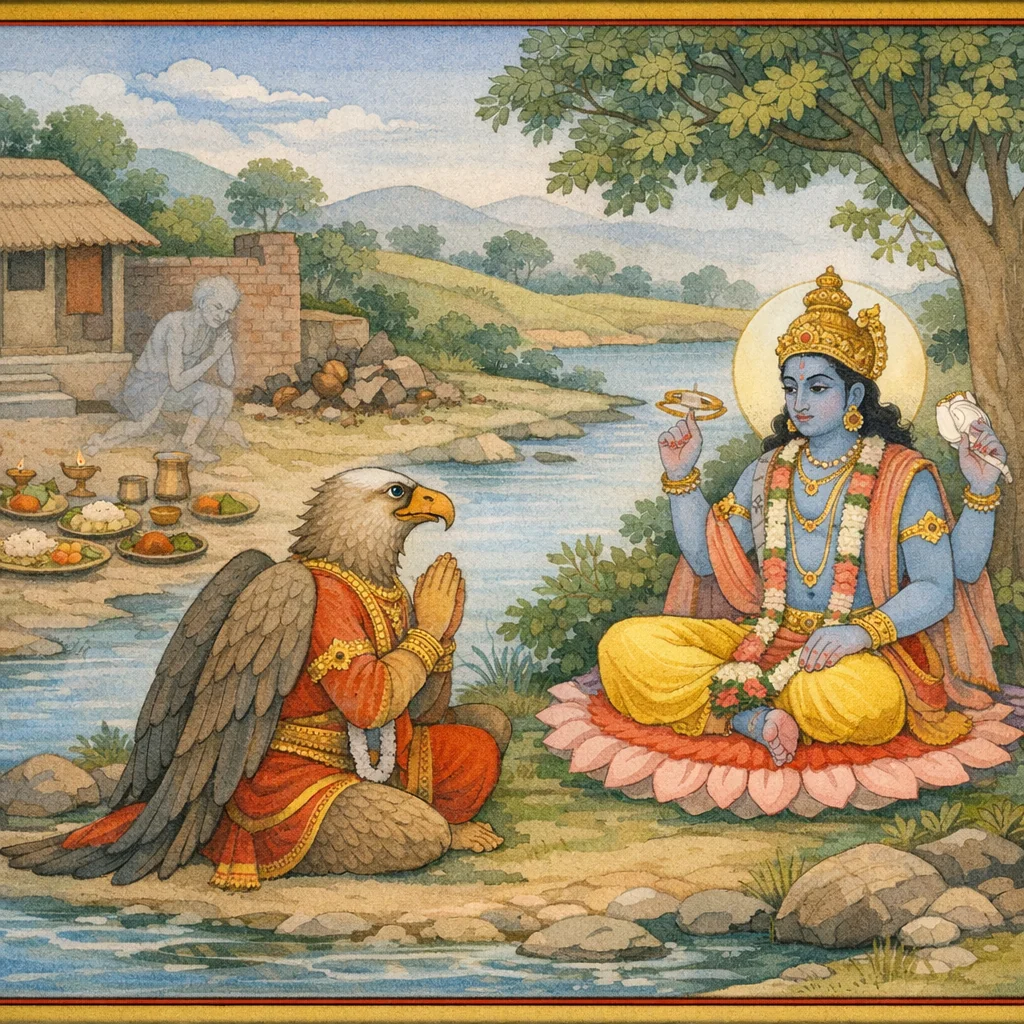
Continuing the afterlife itinerary under Yama’s authority, Garuḍa asks how beings who have dwelt as pretas proceed after release from the preta-world and after emerging from the hells. Viṣṇu replies by placing pretas within Yama’s vast punitive order and describing a particular preta-realm where offenders—those who seize others’ wealth or spouses and treacherous wrongdoers—become niśācaras and bodiless wanderers, tormented by hunger and thirst. The chapter then explains their dealings with the living: obstructing pitṛ-offerings (śrāddha), haunting former homes, and appearing as fevers and many diseases near impure places. In response to Garuḍa’s diagnostic questions, Viṣṇu identifies who is vulnerable in Kali-yuga—unbelievers, dharma-revilers, and those who abandon daily duties, japa-homa, and śrāddha—and lists signs of “preta-doṣa”: infertility, loss of children, ruin of wealth, quarrels, social disorder, and mental cruelty. It concludes by stressing proper rites (antyeṣṭi, vṛṣotsarga, annual śrāddha) and dharmic living as remedies, warning that neglect of pretas leads to preta-hood, and depicting terrifying preta-forms bound to ripening karma, preparing for the next discussion of specific means and ritual procedures for release.
Shlokas
Verse 1
यममन्दिरप्रवेशतदाज्ञालब्धमनुष्यादि देहांन्तरप्राप्तिनिरूपणं नामैकोनविंशो ऽध्यायः गरुड उवाच / ये केचित्प्रेतरूपेण कुत्र वासं लभन्ति ते / प्रेतलोकाद्विनिर्मुक्ताः कथं कुत्र व्रजन्ति ते
This is the chapter describing entry into Yama’s abode and, by his command, the gaining of another body—human and the like. Garuḍa said: “Those who, in the form of pretas, obtain residence somewhere—when released from the world of pretas, how and to where do they go?”
Verse 2
चतुर्युक्ताशीति लक्षैर्नरकैः पर्युपासिताः / यमेन रक्षितास्तत्र भूतैश्चैव सहस्रशः
There, the hells—eighty-four lakhs in number—stand arrayed all around; they are guarded by Yama, and also by thousands upon thousands of bhūtas, dread beings.
Verse 3
विचरन्ति कथं लोके नरकाच्च विनिर्गताः / गरुडोदीरितं श्रुत्वा लक्ष्मीनाथो ऽब्रवीदिदम्
“How do those who have come out from hell then move about in the world?” After hearing Garuḍa’s question, Lakṣmī’s Lord (Viṣṇu) spoke these words.
Verse 4
श्रीकृष्ण उवाच / पक्षिराज शृणुष्व त्वं यत्र प्रेताश्चरन्ति वै / परार्थदारग्रहणाच्छ (ब) लाद्द्रोहान्निशाचराः
Śrī Kṛṣṇa said: O king of birds, listen—there is a realm where pretas truly wander; those who seize another’s wealth and spouse, and those who commit treachery by force, become niśācaras, night-roaming beings, there.
Verse 5
तथैव सर्वपापिष्ठः स्वात्मजान्वेषणे रताः / विचरन्त्यशरीरास्ते क्षुप्तिपासार्दिता भृशम्
Likewise, the most sinful—intent on seeking their own children—wander as bodiless beings, fiercely tormented by hunger and thirst.
Verse 6
बन्दीगृहवि निर्मुक्ता येभ्यो नश्यन्ति जन्तवः / ते व्यवस्यन्ति च प्रेता वधोपायं च बन्धुषु
Those through whom creatures perish—like prisoners released from a jail—such pretas deliberately resolve upon means of killing, even against their own kinsmen.
Verse 7
पितृद्वदाराणि रुन्धन्ति तन्मार्गोच्छेदकास्तथा / पितृभा गान्विगृह्णन्ति पान्थेभ्यस्तस्करा इव
They bar the very “doors” of the Pitṛs and cut off that path; and, like thieves robbing travelers on the road, they seize the offerings meant for the Pitṛs.
Verse 8
स्वं वेश्म पुनरागत्य मित्रस्थाने विशन्ति ते / तत्र स्थिता निरीक्षन्ते रोगशोकादिबन्धनाः
Returning again to their own home, they enter the places where their friends dwell; standing there, bound by disease, grief, and the like, they merely look on.
Verse 9
पीडयन्ति ज्वरीभूय एकान्तरमिषेण तु / तृतीयकज्वरा भूत्वा शीतवातादिपीडया
They torment him by becoming fevers—first as an intermittent fever on alternate days, then as a tertian fever—afflicting him with chills, wind-disorders (vāta), and like agonies.
Verse 10
अन्यांश्च विविधान्रोगाञ्छिरो ऽर्तिं च विषूचिकाम् / चिन्त यन्ति सदा तेषामुच्छिष्टादिस्थलस्थिताः
And they continually inflict other diverse diseases—headache and cholera-like afflictions as well—upon them; for such beings, stationed around places of leftovers and other impurities, constantly torment those persons.
Verse 11
आत्मजानां छलाल्लोका भूतसङ्घैश्च रक्षिताः / पिबन्ति ते च पानीयं भोजनोच्छिष्टयोजितम्
Deceived by their own offspring and kept under guard by hordes of spirits, they drink water mixed with the leftovers of food.
Verse 12
एवं प्रेताः प्रवर्तन्ते नानादोषैर्विकर्मिणः
Thus do the pretas—those who have acted contrary to dharma—continue on their course, burdened with many kinds of faults.
Verse 13
गरुड उवाच / कथं कुर्वन्ति ते प्रेताः केन रूपेण कस्य किम् / ज्ञायते केन विधिना जल्पन्ति न वदन्ति वा
Garuḍa said: “How do those pretas act? In what form do they exist, and what belongs to whom? By what method is it known whether they can speak, or whether they do not speak at all?”
Verse 14
एनं छिन्धि मनोमोहं मम चेदिच्छसि प्रियम् / कलिकाले हृषीकेश प्रेतत्वं जायते बहु
O Hṛṣīkeśa, if you wish to do what is dear to me, cut through the delusion of my mind; for in the age of Kali, the state of becoming a preta arises in many ways for many beings.
Verse 15
श्रीविष्णुरुवाच / स्वकुलं पीडयेत्पेतः परच्छिद्रेण पीडयेत् / जीवन्स दृश्यते स्नेही मृतो दुष्टत्वमाप्नुयात्
Śrī Viṣṇu said: A preta torments its own family, and torments them through the weaknesses (faults) of others. While alive, such a person is seen as affectionate; but after death, he attains a cruel, harmful nature.
Verse 16
रुद्रजापी धर्मरतो देवतातिथिपूजकः / सत्यवाक् प्रियवादी च न प्रेतैः स हि पीड्यते
One who recites Rudra’s sacred names, delights in dharma, worships the deities and honors guests, who speaks truth and speaks kindly—such a person is not afflicted by pretas after death.
Verse 17
सर्वक्रियापरिभ्रष्टो नास्तिको धर्मनिन्दकः / असत्यवादनिरतो नरः प्रेतैः स पीड्यते / कलौ प्रेतत्वमाप्नोति तार्क्ष्याशुद्धक्रियापरः
A man who has fallen away from all sacred duties—an unbeliever who reviles dharma and is devoted to false speech—is tormented by pretas. O Tārkṣya (Garuda), in the Kali age, one who persists in impure and improper rites attains the state of a preta.
Verse 18
कृतादौ द्वापरान्ते च न प्रेतो नैव पीडनम् / बहूनामेकजातानामेकः सौख्यं समश्नुते
In the beginning of the Kṛta (Satya) age and at the end of the Dvāpara age, there is no state of being a preta, nor any torment. Among many who are born in the same class of beings, one alone attains and enjoys happiness.
Verse 19
एको दुष्कृतकर्मा च एकः सन्ततिमाञ्जनः / एकः सम्पीड्यते प्रेतैरेकः सुतधनान्वितः
One person performs sinful deeds; another is blessed with progeny. One is tormented by pretas (restless spirits), while another is endowed with sons and wealth.
Verse 20
एकस्य पुत्रनाशः स्यादेको दुहितृमान् भवेत् / विरोधो बन्धुभिः सार्धं प्रेतदोषेण काश्यप
O Kāśyapa, because of the fault connected with a preta (restless departed spirit), one may lose a son, another may be blessed with a daughter, and conflict may arise with one’s relatives.
Verse 21
सन्ततिर्दृश्यते नैव समुत्पन्ना विनश्यति / पशुद्रव्यविनाशश्च सा पीडा प्रेतसम्भवा
No offspring is seen; or, if offspring is born, it perishes. There is also loss of cattle and wealth—such suffering is said to arise from a preta.
Verse 22
प्रकृतेः परिवर्तः स्याद्विद्वेषः सह बन्धुभिः / अकस्माद्व्यसनप्राप्तिः सा पीडा प्रेतसम्भवा
A sudden change in one’s natural disposition, hatred even toward one’s own relatives, and the unexpected onset of calamities—such suffering is said to arise from the influence of a preta.
Verse 23
नास्तिक्यं वृत्तिलोपश्च महालोभस्तथैव च / स्याद्धन्तकलहो नित्यं सा पीडा प्रेतसम्भवा
From the state of becoming a preta arises this torment: disbelief in dharma, loss of right conduct, overwhelming greed, and constant quarrelling—gnashing contention, again and again.
Verse 24
पितृमातृनिहन्ता च देवब्राह्मणनिन्दकः / इत्यादोषमवाप्नोति सा पीडा प्रेतसम्भवा
One who kills one’s father or mother, and one who reviles the Devas and the Brāhmaṇas—such persons incur the suffering belonging to the state of a preta.
Verse 25
नित्यकर्मविनिंमुक्तो जपहोमविवर्जितः / परद्रव्याणां च हर्ता सा पीडा प्रेतसम्भवा
One who abandons daily obligatory duties, is devoid of japa and homa, and steals the wealth of others suffers the affliction of a preta.
Verse 26
सुवृष्टौ कृषिनाशश्च व्यवहारो विनश्यति / लोके कलहकारी च सा पीडा प्रेतसम्भवा
When agriculture is ruined despite good rain, business collapses, and quarrels arise in society—such suffering comes from a preta.
Verse 27
मार्गे जङ्गम्यमानं तं पीडयेद्वातमण्डली / प्रेतपीडा तु सा ज्ञेया सत्यंसत्यं खगेश्वर
As he moves along the path, a whirling circle of winds torments him. Know that to be the suffering of the preta, truly, O Lord of Birds.
Verse 28
हीनजात्या च सम्बन्धो हीनकर्म करोति यः / अधर्मे रमते नित्यं सा पीडा प्रेतसम्भवा
One who associates with the base-born, performs degrading actions, and delights in unrighteousness—such suffering arises from pretas.
Verse 29
व्यसनैर्द्रव्यनाशः स्यादुपक्रान्तं विनश्यति / चौराग्निराजभिर्हानिः सा पीडा प्रेतसम्भवा
Through addictions and ruinous vices, one’s wealth is destroyed; what has been set in motion—undertakings and gains—comes to ruin. Loss also arises through thieves, fire, and rulers (state power). Such suffering is said to be born of the preta-condition.
Verse 30
महारोगोपलब्धिश्च बालकानां च पीडनम् / जाया संपीढ्यते यच्च सा पीडा प्रेतसम्भवा
The arising of severe diseases, the affliction of children, and the oppression or suffering that befalls one’s wife—such distress is said to be caused by a preta, a restless departed spirit.
Verse 31
श्रुतिस्मृतिपुराणेषु धर्मशास्त्रसमुद्भवे / अभावो जायते धर्मे सा पीडा प्रेतसम्भवा
When the teachings of Śruti, Smṛti, and the Purāṇas—the sources from which Dharma-śāstra arises—are neglected, dharma declines; that decline becomes a torment that leads to the preta state.
Verse 32
देवतीर्थद्विजानां तु निन्दांयः कुरुते नरः / प्रत्यक्षं वा परोक्षं वा सा पीडा प्रेतसम्भवा
A man who reviles the gods, sacred pilgrimage places (tīrthas), or the twice-born (dvija, Brahmins)—whether openly or behind their backs—incurs a torment said to arise in the preta state.
Verse 33
स्ववृत्तिहरणं यच्च स्वप्रतिष्ठाहतिस्तथा / वंशच्छेदः नदृश्येत प्रेतदोषाद्विनान्यथा
The loss of one’s livelihood, the ruin of one’s reputation and standing, and even the cutting off of one’s family line—these are not seen to occur without the fault connected with a preta; it is not otherwise.
Verse 34
स्त्रीणां गर्भविनाशः स्यान्न पुष्पं दृश्यते तथा / बालानां मरणं यत्र सा पीडा प्रेतसम्भवा
Where women suffer repeated miscarriage and no flowering is seen in the land or its produce, and where children die—such affliction is said to arise from the influence of a preta, a restless departed spirit.
Verse 35
भावशुद्ध्या न कुरुते श्राद्धं सांवत्सरादिकम् / स्वयमेव न कुर्वीत सा पीडा प्रेतसम्भवा
If, with purity of intention, one does not perform the annual śrāddha and related rites—or does not undertake them oneself—then that suffering is said to arise for the departed in the preta condition.
Verse 36
तीर्थे गत्त्वा परासक्तः स्वकृत्यं च परित्यजेत् / धर्मकार्ये न सम्पत्तिः सा पीडा प्रेतसम्भवा
Having gone to a tīrtha (sacred ford), one may become overly attached and abandon one’s proper duties; when works of dharma do not succeed, that affliction is said to arise from preta-related influence.
Verse 37
दम्पत्योः कलहश्चैव भोजने कोपसंयुतः / परद्रोहे मतिश्चैव सा पीडा प्रेतसंभवा
Quarrels between husband and wife, anger arising even during meals, and a mind inclined toward harming others—such suffering is said to be born of the preta condition.
Verse 38
पुष्पं यत्र न दृश्येन फलं तथा / विरहो भार्यया यत्र सा पीडा प्रेतसग्भवा
In that realm, flowers are not seen, yet fruits appear; and there, separation from one’s wife becomes a torment—such is the pain said to arise for the preta (departed spirit).
Verse 39
येषां वै जायते चिह्नं सदोच्चाटपरं नृणाम् / स्वक्षेत्रे निष्फलं तेजः सा पीडा प्रेतसम्भवा
In those people in whom this sign appears—ever intent on driving others away or stirring disturbance—their own radiance and effectiveness become fruitless even within their own sphere; that torment is born of a preta, a restless departed spirit.
Verse 40
स्वगोत्रघातकश्चैव हन्ति शत्रुमिवात्मजम् / न प्रीतिर्नापि सौख्यं च सा पीडा प्रेतसम्भवा
The slayer of his own lineage strikes even his own son as though he were an enemy. Then there is neither affection nor happiness—this is an affliction arising from the preta, the unappeased departed spirit.
Verse 41
पितृवाक्यं न कुरुते स्वपत्नीं च न सेवते / सदा क्रूरमतिर्व्यग्रः सा पीडा प्रेतसम्भवा
One who does not heed his father’s words and does not honor and care for his own wife—ever cruel in intent and restless—suffers an affliction arising from the preta-state, the condition of the departed spirit.
Verse 42
विकर्मा जायते प्रेतो ह्यविधिक्रियया तथा / तत्कालदुष्टसंसर्गाद्वृषोत्सर्गादृते तथा
One who performs vikarma—forbidden and perverse deeds—becomes a preta; likewise, one becomes a preta when funerary rites are done contrary to proper rule. Moreover, by keeping company with the wicked at the critical time (of death or the rites), and by neglecting the vṛṣotsarga rite, one similarly falls into the preta-state.
Verse 43
दृष्टगृत्युवशाद्वापि अदग्धवपुषस्तथा / प्रेतत्वं जायते तार्क्ष्य पीड्यन्ते येन जन्तवः
O Tārkṣya (Garuda), whether through the overpowering influence of a harmful spirit or black rite, or because the body remains uncremated, the preta-state arises—by which living beings are afflicted and tormented.
Verse 44
एवं ज्ञात्वा खगश्रेष्ठ प्रेतमुक्तिं समाचरेत् / यो वै न मन्यते प्रेतान्मृतः प्रेतत्वमाप्नुयात्
Knowing thus, O Garuḍa, best of birds, one should diligently perform the rites and means that grant release from the preta-state. For whoever does not acknowledge or honor the pretas, upon death attains the condition of a preta himself.
Verse 45
प्रेतदोषः कुले यस्य सुखं तस्य न विद्यते / मतिः प्रीती रतिर्बुद्धिर्लक्ष्मीः पञ्चविनाशनम्
In a family afflicted by the fault of an unsettled preta, happiness is not found. There follows the ruin of five: sound judgment, affection, delight, intelligence, and prosperity—Lakṣmī’s favor.
Verse 46
तृतीये पञ्चमे पुंसि वंशच्छेदो हि जायते / दरिद्रो निर्धनश्चैव पापकर्मा भवेभवे
In the third and in the fifth generation of a man, a severing of the lineage indeed arises; and he becomes wretched and destitute, performing sinful deeds—birth after birth.
Verse 47
ये केचित्पेतरूपा विकृतमुखदृशो रौद्ररूपाः कराला मन्यन्ते नैव गोत्रं सुतदुहितृपितॄन् भ्रातृजायां वधूं वा / कृत्वा काम्यं च रूपं सुखगतिरहिता भाषमाणा यथेष्टं हा कष्टं भोक्तुकामा विधिवशपतिताः संस्मरन्ति स्वपाकम्
Some beings take on preta-forms—faces distorted, dreadful to behold, fierce and terrifying. They recognize neither their lineage nor their sons and daughters, nor their ancestors (pitṛs), nor a brother’s wife, nor even their own bride. Though they may assume whatever form they wish and speak as they please, they are bereft of any happy state; driven by destiny’s compulsion and yearning to taste the fruit of karma, they cry out in anguish and remember the ripening of their own deeds.
Frequently Asked Questions
The chapter emphasizes adharma and ritual neglect: seizing others’ wealth/spouse, treachery and violence, reviling dharma and the devas/brāhmaṇas, abandoning nitya-karmas, japa-homa, stealing, performing forbidden acts, improper funerary rites, failing vṛṣotsarga, and leaving a body uncremated—especially in Kali-yuga.
It describes pretas obstructing the pitṛ-path and seizing śrāddha offerings, revisiting homes and watching helplessly, and tormenting relatives through fevers and other diseases, quarrels, hatred within kin, loss of wealth/cattle, infertility or repeated miscarriage, and sudden reversals in livelihood and reputation.
Viṣṇu states that one devoted to dharma—truthful and kind speech, deva-pūjā, honoring guests, and especially Rudra’s sacred names—does not suffer preta-affliction. The chapter also implies śrāddha, correct antyeṣṭi, and related rites as primary supports preventing preta unrest.
It portrays Kali-yuga as a period where impure and improper rites, disbelief, and dharma-decline are widespread, increasing the likelihood of preta-hood and its ripple effects. By contrast, it claims the preta-state is absent in early Kṛta-yuga and at the end of Dvāpara.