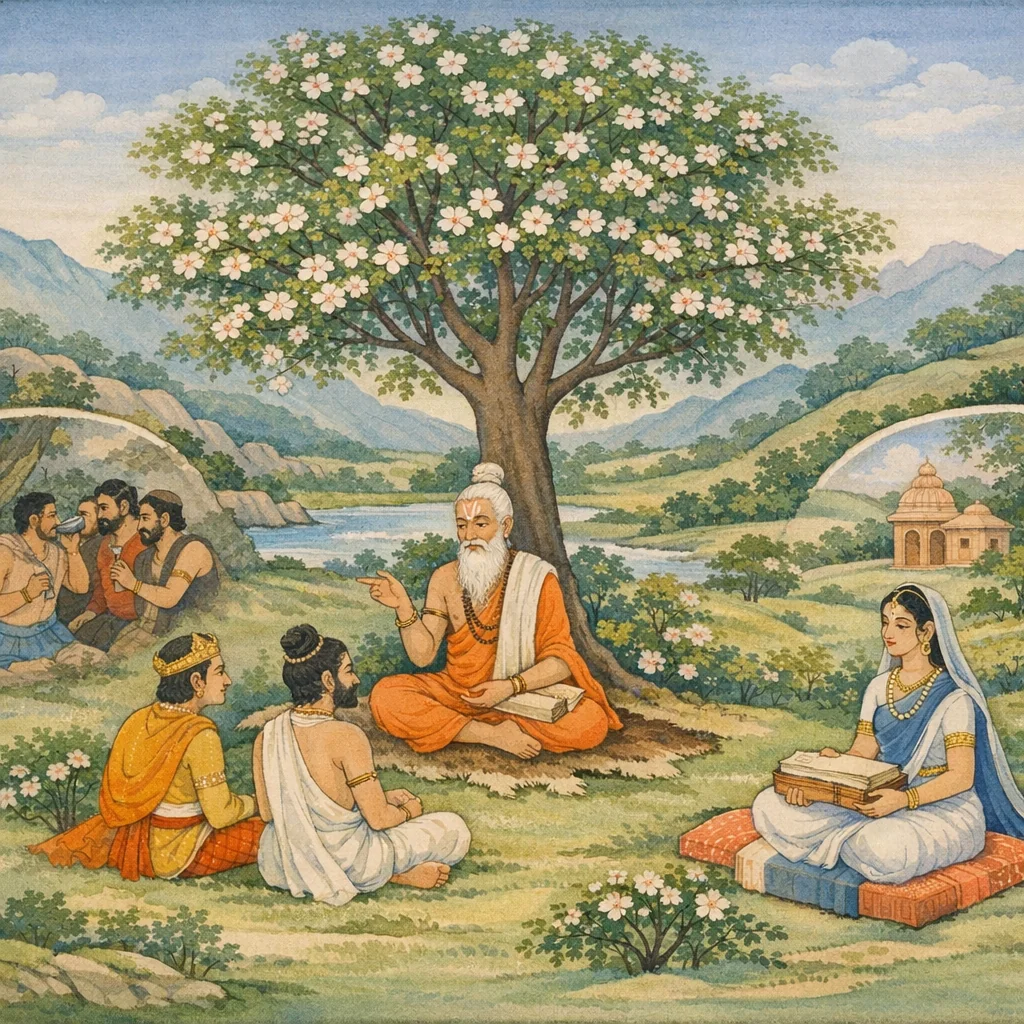
Adhyaya 115
Nīti-saṅgraha: Conduct, Association, Kali-yuga Decline, and the Supremacy of Vidyā
Continuing the ācāra-centered teachings, Sūta delivers a dense set of nīti maxims: avoid morally perilous people and settings (corrupt friends, unjust rulers, destabilizing ties) and recognize Kali-yuga as an age where dharma, tapas, and satya decline while social inversions and greed rise. The central theme is saṅga (association): impurity and sin are said to spread through intimacy and shared living, so one must be vigilant about company, food-sharing, and trust. The chapter then turns to inner formation—discipline over indulgence, safeguarding honor, and cultivating discernment—repeatedly reminding that youth, wealth, power, and alliances are fleeting. It offers practical counsel on debt, disease, dealing with the wicked, political dependence, and the marks of fear and poverty. It culminates by exalting vidyā as the safest wealth and the source of nobility, and seals its authority by citing the transmission lineage (Viṣṇu → Śaunaka/Śaṅkara → Vyāsa → Sūta), preparing for the chapters that follow.
Shlokas
Verse 1
ऽध्यायः सूत उवाच / कुमार्यां च कुमित्रं च कुराजानं कुपुत्रकम् / कुकन्यां च कुदेशं च दूरतः परिवर्जयेत्
Sūta said: One should keep far away from an unmarried girl, a bad friend, a wicked king, a bad son, an immoral daughter, and an evil country.
Verse 2
धर्मः प्रव्रजितस्तपः प्रचलितं सत्यं च दूरं गतं पृथ्वी वन्ध्यफला जनाः कपटिनो लौल्ये स्थिता ब्राह्मणाः / मर्त्याः स्त्रीवशगाः स्त्रियश्च चपला नीचा जना उन्नताः हा कष्टं खलुजीवितं कलियुगे धन्या जना ये मृताः
In the age of Kali, righteousness has departed; austerity has gone astray, and truth has gone far away. The earth becomes barren of good results; people are deceitful; and even brāhmaṇas stand established in greed. Men are ruled by women, and women are fickle; the lowly rise to high positions. Alas—life indeed is miserable in the Kali age; blessed are those people who have already died.
Verse 3
धन्यास्ते ये न पश्यन्ति देशभङ्गं कुलक्षयम् / परचित्तगतान् दारान्पुत्रं कुव्यसने स्थितम्
Blessed are those who do not have to witness the ruin of their land, the destruction of their lineage, wives whose hearts have turned to another, and a son fallen into vile addictions and vices.
Verse 4
कुपुत्रे निर्वृतिर्नास्ति कुभार्यायां कुतो रतिः / सुमित्र नास्ति विश्वासः कुराज्ये नास्ति जीवितम्
From a wicked son there is no peace; with a wicked wife, where can love abide? In a wicked friend there is no trust; under unrighteous rule there is no safety of life.
Verse 5
परान्नं च परस्वं च परशय्याः परस्त्रियः / परवेश्मनि वासश्च शक्रादपि हरेच्छ्रियम्
Another’s food, another’s wealth, another man’s bed, another man’s wife, and dwelling in another’s house—these can strip away prosperity even from Indra himself.
Verse 6
आलापाद्गात्रसंस्पर्शात्संसर्गात्सह भोजनात् / आसनाच्छयनाद्यानात्पापं संक्रमते नृणाम्
Through conversation, bodily touch, close association, and eating together—and also through sharing seats, beds, and conveyances—sin is transmitted among human beings.
Verse 7
स्त्रियो नश्यन्ति रूपेण तपः क्रोधन नश्यति / गावो द्वरप्रचारेण शूद्रान्नेन द्विजोत्तमः
Women are undone by over-attachment to beauty; austerity (tapas) is destroyed by anger. Cows are harmed by constant passing through doorways; and even a foremost twice-born is degraded by eating a Śūdra’s food.
Verse 8
आसनादेकशय्यायां बोजनात्पङ्क्तिसङ्करात् / ततः संक्रमते पापं घटाद्धट इवोदकम्
By sharing a seat, sharing a single bed, or eating in a mixed and impure dining row, sin is transmitted from one person to another—just as water passes from one pot into another.
Verse 9
लालने बहवो दोषास्ताडने बहवो गुणाः / तस्माच्छिष्यं च पुत्रं च ताडयेन्न तु लालयेत्
Indulgent pampering breeds many faults, while firm correction nurtures many virtues. Therefore one should discipline both the disciple and the son, and not merely coddle them.
Verse 10
अध्वा जरा देहवतां पर्वतानां जलं जरा / असंभोगश्च नारीणां वस्त्राणामातपो जरा
For embodied beings, the journey itself is a kind of wearing-out; for mountains, water is their wearing-away. For women, lack of conjugal union is a wearing-away; and for garments, sunlight is their wearing-away.
Verse 11
अधमाः कलिमिच्छन्ति सन्धिमिच्छति मध्यमाः / उत्तमा मानमिच्छन्ति मानो हि महतां धनम्
The base seek quarrel; the middling seek reconciliation; the noble seek honor—indeed, honor is the wealth of the great.
Verse 12
मानो हि मूलमर्थस्य माने सति धनेन किम् / प्रभ्रष्टमानदर्पस्य किं धनेन किमायुषा
Honor—self-respect—is truly the root of all prosperity; if honor is present, what need is there for wealth? But for one whose honor and dignity have fallen away, what is the use of wealth—or even of a long life?
Verse 13
अधमा धनमिच्छन्ति धनमानौ हि मध्यमाः / उत्तमा मानमिच्छन्ति मानो हि महतां धनम्
The low seek wealth; the middling seek both wealth and honor. The noble seek honor alone—for honor is the true wealth of the great.
Verse 14
वने ऽपि सिंहा न नमन्ति कं च बुभु क्षिता मांसनिरीक्षणं च / धनैर्विहीनाः सुकुलेषु जाता न नीचकर्माणि समारभन्ते
Even in the forest, a lion bows to none; though hungry, it seeks only meat. So too, those born in noble families—even when bereft of wealth—do not set their hands to base and degrading deeds.
Verse 15
नाभिषेको न संस्कारः सिंहस्य क्रियते वने / नित्यमूर्जितसत्त्वस्य स्वयमेव मृगेन्द्रता
In the forest, no coronation and no consecratory rite is performed for a lion; for one whose strength and courage are ever vigorous, kingship among beasts arises of itself.
Verse 16
वणिक्प्रमादी भृकश्च मानी भिक्षुर्विलासी ह्यधनश्च कामी / वराङ्गना चाप्रियवादिनी च न ते च कर्माणि समारभन्ते
A negligent merchant, a deceitful rogue, a proud man, a pleasure-seeking mendicant, a penniless yet lust-driven person, a courtesan, and one who speaks harshly—such people do not truly undertake righteous actions in accord with dharma.
Verse 17
दाता दरिद्रः कृपणोर्ऽथयुक्तः पुत्त्रो ऽविधेयः कुजनस्य सेवा / परोपकारेषु नरस्य मृत्युः प्रजायते दुश्चरितानि पञ्च
From evil conduct arise five misfortunes: a generous man becomes poor; a miser becomes wealthy; a son turns disobedient; one ends up serving wicked people; and a man meets death while engaged in helping others.
Verse 18
कान्तावियोगः स्वजनापमानं ऋणस्य शेषः कुजनस्य सेवा / दारिद्रयाभावाद्विमुखाश्च मित्रा विनाग्निना पञ्च दहन्ति तीव्राः
Separation from one’s beloved, humiliation by one’s own people, the remaining burden of debt, service to wicked persons, and friends who turn away when prosperity is gone—these five burn fiercely even without fire.
Verse 19
चिन्तासहस्रेषु च तेषु मध्ये चिन्ताश्चतस्रो ऽप्यसिधारतुल्याः / नीचापमानं क्षुधितं कलत्रं भार्या विरक्ता सहजोपरोधः
Among thousands of anxieties, four are as sharp as a sword’s edge: humiliation at the hands of the low; a hungry, dependent spouse; a wife grown dispassionate toward her husband; and obstruction arising from one’s own kin.
Verse 20
वश्यश्च पुर्त्रेर्ऽथ करी च विद्या अरोगिता सज्जनसङ्गतिश्च / इष्टा च भार्या वशवर्तिनी च दुः खस्य मूलोद्धरणानि पञ्च
Five things uproot the very source of sorrow: an obedient son; wealth that is truly of use; knowledge; good health; the company of the virtuous; and a beloved wife who is devoted and harmonious.
Verse 21
कुरङ्गमातङ्गपतङ्गंभृग मीना हताः पञ्चबिरेव पञ्च / एकः प्रमाथी स कथं न घात्यो यः सेवते पञ्चभिरेव पञ्च
The deer, the elephant, the moth, the bee, and the fish—these five are each destroyed by but one sense-object. How then should a man, driven by passion, not be destroyed, when he indulges in all five through all five senses?
Verse 22
अधीरः कर्कशः स्तब्धः कुचेलः स्वयमागतः / पञ्च विप्रा न पूज्यन्ते बृहस्पतिसमा अपि
Even if equal to Bṛhaspati in learning, five kinds of brāhmaṇas are not worthy of honor: the impatient, the harsh-spoken, the arrogant and obstinate, the filthy or ill-clad, and the one who comes uninvited of his own accord.
Verse 23
आयुः कर्म च वित्तं च विद्या निधनमेव च / पञ्चैतानि विविच्यन्ते जायमानस्य देहिनः
At the very birth of an embodied being, five things are determined: lifespan, actions (karma), wealth, knowledge, and also death.
Verse 24
पर्वतारोहणे तोये गोकुले दुष्टनिग्रहे / पतितस्य समुत्थाने शस्ताः पञ्च (ह्येते) गुणाः स्मृताः
In climbing mountains, in crossing waters, in guarding the cattle-herds, in restraining the wicked, and in raising up one who has fallen—these five qualities are remembered as worthy of praise.
Verse 25
अभ्रच्छाया खले प्रीतिः परनारीषु संगतिः / पञ्चैते ह्यस्थिरा भावा यौवनानि धनानि च
Like the shadow of a cloud, affection for a wicked person and association with another man’s wife are fleeting. These five conditions are indeed unstable: such dispositions, youth, and wealth.
Verse 26
अस्थिरं जीवितं लोके अस्थिरं धनयौवनम् / अस्थिरं पुत्त्रदाराद्यं धर्मः कीर्तिर्यशः स्थिरम्
In this world, life is unstable; wealth and youth are unstable. Sons, wife, and the rest are also unstable—only dharma, true renown, and lasting honor remain steady.
Verse 27
शत जीवितमत्यल्पं रात्रिस्तस्यार्धहारिणी / व्याधिशोकजरायासैरर्धं तदपि निष्फलम्
Even a hundred-year lifespan is extremely short; night itself steals away half of it. Of what remains, even that half becomes fruitless through disease, grief, old age, and exhaustion.
Verse 28
आयुर्वर्षशतं नृणां परिमितं रात्रौ तदर्धं गतं तस्यार्धस्थितकिञ्चिदर्धमधिकं बाल्यस्य काले गतम् / किञ्चिद्वन्धुवियोगदुः खमरणैर्भूपालसेवागतं शेषं वारितरङ्गगर्भचपलं मानेन किं मानिनाम्
A human lifespan is measured as a hundred years. Half of it passes in nights (sleep). Of what remains, more than half is spent in childhood and other dependent stages. Some time is consumed by the sorrow of separation from relatives and by deaths; some is lost in the service of kings (worldly authorities). The little that is left is as unsteady as a wave on water—so what room is there for the proud to cling to pride?
Verse 29
अहोरात्रमयो लोके जरारूपेण संचरेत् / मृत्युर्ग्रसति भूतानि पवनं पन्नगो यथा
In this world, Time—made of day and night—moves about in the form of aging; and Death devours living beings, as a serpent swallows the wind.
Verse 30
गच्छतस्तिष्ठतो वापि जाग्रतः स्वपतो न चेत् / सर्वसत्त्वहितार्थाय पशोरिव विचेष्टितम्
Whether walking or standing, awake or asleep—if one is not consciously oriented toward the welfare of all beings, one’s activity is merely animal-like motion.
Verse 31
अहितहितविचारशून्यबुद्धेः श्रुतिसमये बहुभिर्वितर्कितस्य / उदरभरणमात्रतुष्टबुद्धेः पुरुषपशोश्च पशोश्च को विशेषः
What difference is there between a “human-beast” and an actual beast—one whose intellect lacks discernment of the wholesome and unwholesome, who argues much when hearing the scriptures, yet is satisfied only with filling the belly?
Verse 32
शौर्ये तपसि दाने च यस्य न प्रथितं यशः / विद्यायामर्थलाभे वा मातुरुच्चार एव सः
He whose fame is not renowned for valor, austerity, or charity—and who is known neither for learning nor for the gaining of wealth—amounts, in truth, only to his mother’s utterance, merely a name spoken by her.
Verse 33
यज्जीव्यते क्षणमपि प्रथितं मनुष्यैर्विज्ञानविक्रमयशोभिरभग्नमानैः / तन्नाम जीवितमिति प्रवदन्ति तज्ज्ञाः काको ऽपि जीवति चिरं च बलिं च भुङ्क्ते
That life which is lived even for a moment yet becomes renowned among people—through wisdom, valor, and worthy fame, with one’s honor unbroken—this alone the wise call ‘life’. For even a crow lives long, and eats offerings (bali) as well.
Verse 34
किं जीवितेन धनमानविवर्जितेन मित्रेण किं भवति भीतिसशङ्कितेन / सिंहव्रतं चरत गच्छत मा विषादं काको ऽपि जीवति चिरं च बलिं च भुङ्क्ते
What use is life without wealth and honor? What use is a friend shaken by fear and suspicion? Live with a lion’s resolve—go forward, do not grieve; even a crow lives long and eats its share of the bali-offerings.
Verse 35
यो वात्मनीह न गुरौ न च भृत्यवर्गे दीने दयां न कुरुते न च मित्रकार्ये / किं तस्य जीवितफलेनमनुष्यलोके काको ऽपि जीवति चिरं च बलिं च भुङ्क्ते
What fruit is there in a person’s life in this human world if he cares not even for himself, nor for his guru, nor for those who depend on him; if he shows no compassion to the helpless and does not stand by a friend in need? Even a crow lives long and eats the bali-offerings.
Verse 36
यस्य त्रिवर्गशून्यानि दिनान्यायान्ति यान्ति च / स लौहकारभस्त्रेव श्वसन्नपि न जीवति
One whose days come and go devoid of the three aims of life—dharma, artha, and kāma—though breathing, does not truly live, like the blacksmith’s bellows.
Verse 37
स्वाधीनवृत्तेः साफल्यं न पराधीनवर्तिता / ये पराधीनकर्माणो जीवन्तो ऽपि च ते मृताः
Fulfilment lies in living by one’s own rightful agency, not in living under another’s control. Those whose actions depend on others are, though alive, as good as dead.
Verse 38
सु(स्व) पूरा वै कापुरुषाः सु(स्व) पूरो मूषिकाञ्जलिः / असन्तुष्टः कापुरुषः स्वल्पकेनापि तुष्यति
Base men seem ‘fully satisfied’ with a mere mouse’s handful; yet the petty, discontented man is not truly satisfied even by a small gain.
Verse 39
अभ्रच्छाया तृणादग्निर्नोचसेवा पथो जलम् / वेश्यारागः खले प्रीतिः षडेते बुद्वुदोपमाः
The shadow of a cloud, fire from dry grass, service to a wicked man, water found upon the road, passion for a prostitute, and affection toward a scoundrel—these six are like bubbles: fleeting and untrustworthy.
Verse 40
वाचा विहितसार्थेन लोको न च सुखायते / जीवितं मानमूलं हि माने म्लाने कुतः सुखम्?
Even if one’s speech is well-shaped and rich in meaning, the world is not made happy thereby. For life rests upon honor; when honor withers, how can happiness arise?
Verse 41
अबलस्य बलं राजा बालस्य रुदितं बलम् / बलं मूर्खस्य मौनं हि तस्करस्यानृतं बलम्
For the powerless, the king is strength; for a child, crying is strength. For a fool, silence indeed is strength; and for a thief, falsehood is strength.
Verse 42
यथायथा हि पुरुषः शास्त्रं समधिगच्छति / तथातथास्य मेधा स्याद्विज्ञानं चास्य रोचते
As a person progressively comes to understand the sacred teachings, so too does his intellect grow accordingly, and true discernment becomes clear and pleasing to him.
Verse 43
यथायथा हि पुरुषः कल्याणे कुरुते मतिम् / तथातथा हि सर्वत्र श्लिष्यते लोकसुप्रियः
As a person turns his mind toward what is wholesome and virtuous, so too, everywhere, he is embraced and accepted as one who is dear to the world.
Verse 44
लोभप्रमादविश्वासैः पुरुषो नश्यति त्रिभिः / तस्माल्लोभो न कर्तव्यः प्रमादो नोन विश्वसेत्
A person is ruined by three—greed, heedlessness, and misplaced trust. Therefore do not indulge in greed, do not be careless, and do not trust blindly.
Verse 45
तावद्भयस्य भेतव्यं यावद्भयमनागतम् / उत्पन्ने तु भये तीव्रे स्थातव्यं वै ह्यभीतवत्
Fear danger only so long as it has not yet arrived. But when fierce danger has truly arisen, stand firm—indeed, as though fearless.
Verse 46
ऋणशेषं चाग्निशेषं व्याधिशेषं तथैव च / पुनः पुनः प्रवर्धन्ते तस्माच्छेषं न कारयेत्
The remainder of a debt, the remaining embers of a fire, and the residue of a disease grow again and again; therefore leave no remainder—finish it completely.
Verse 47
कृते प्रतिकृतं कुर्याद्धिंसिते प्रतिहिंसितम् / न तत्र दोषं पश्यामि दुष्टे दोषं समाचरेत्
If someone has acted against you, you may act in return; if you have been harmed, you may respond in kind. I see no fault in this—toward the wicked, one may answer in the same manner.
Verse 48
परोक्षे कार्यहन्तारं प्रत्यक्षे प्रियवादिनम् / वर्जयेत्तादृशं मित्रं मायामयमरिं तथा
Avoid the friend who, behind your back, ruins your work, yet to your face speaks sweetly. Such a one is a deceptive enemy, made of māyā—mere illusion.
Verse 49
दुर्जनस्य हि संगेन सुजनो ऽपि विनश्यति / प्रसन्नमपि पानीयं कर्दमैः कलुषीकृतम्
By keeping company with the wicked, even the virtuous are ruined—just as clear water becomes foul when mixed with mud.
Verse 50
स भुङ्क्ते सद्विजो भुङ्क्ते समशेषनिरूपणम् / तस्मात्सर्वप्रयत्नेन द्विजः पूज्यः प्रयत्नतः
He truly partakes of the merit, and the virtuous twice-born (dvija) partakes as well—this is the settled teaching in full. Therefore, with every effort, the dvija should be honored with due care.
Verse 51
तद्भुज्यते यद्द्विजभुक्तशेषं स बुद्धिमान्यो न करोति पापम् / तत्सौहृदं यक्रियते परोक्षे दम्भैर्विना यः क्रियते स धर्मः
Wise indeed is the one who eats what remains after a twice-born (brāhmaṇa) has eaten—such a person does not commit sin. And that friendship shown in one’s absence, and that conduct performed without hypocrisy—this alone is true dharma.
Verse 52
न सा सभा यत्र न सन्ति वृद्धाः वृद्धा न ते ये न वदन्ति धर्मम् / धर्मः स नो यत्र न सत्यमस्ति नैतत्सत्यं यच्छलेनानुविद्धम्
That is not an assembly where the elders are absent; and they are not truly elders who do not speak of dharma. Dharma does not exist where truth is not present; and that is not truth which is tainted by deceit.
Verse 53
ब्राह्मणो ऽपि मनुष्याणामादित्यश्चैव तेजसाम् / शिरो ऽपि सर्वगात्राणां व्रतानां सत्यमुत्तमम्
Among human beings, the Brāhmaṇa is foremost; among sources of radiance, the Sun is foremost. As the head is supreme among all limbs, so truthfulness is the highest of all vows.
Verse 54
तन्मङ्गलं यत्र मनः प्रसन्नं तज्जीवनं यन्न परस्य सेवा / तदर्जितं यत्स्वजनेन भुक्तं तद्गर्जितं यत्समरे रिपूणाम्
Auspicious is the place where the mind becomes serene. True living is that which is not servile dependence on another. Truly earned is that wealth which is enjoyed by one’s own kin. True roaring valour is that which is shown in battle against enemies.
Verse 55
सा स्त्रीया न मदं कुर्यात्स सुखी तृष्णयोज्झितः / तन्मित्रं यत्र विश्वासः पुरुषः स जितेन्द्रियः
A man should not become intoxicated with pride or delusion because of a woman; truly happy is one who is free from craving. Only where there is trust is there a friend. He who has conquered his senses is the self-controlled one.
Verse 56
तत्र मुक्तादरस्नेहो विलुप्तं यत्र सौहृदम् / तदेव केवलं श्लघ्यं यस्यात्मा क्रियते स्तुतौ
Where respect and affection have been cast off and friendship has vanished—only that is truly praiseworthy in which one does not make one’s own self the object of praise.
Verse 57
नदीनामग्निहोत्राणां भारतस्य कलस्य च / मूलान्वेषो न कर्तव्यो मूलाद्दोषो न हीयते
One should not investigate the origins of rivers, of the Agnihotra rites, of the Mahābhārata, or of Time (Kāla); for even when one searches to the root, the defect does not diminish, and such inquiry does not remove it.
Verse 58
लवणजलान्ता नद्यः स्त्रीभेदान्तं च मैथुनम् / षैशुन्यं जनवार्तान्तं वित्तं दुः खत्रयान्तकम्
Rivers end in the salt ocean; sexual union culminates in the distinction between man and woman. Petty talk ends in public gossip; and wealth ends in threefold misery.
Verse 59
राज्यश्रीर्ब्रह्मशापान्ता पापान्तं ब्रह्मवर्चसम् / आचान्तं घोषवासान्तं कुलस्यान्तं स्त्रिया प्रभो (भुः)
O Lord, royal prosperity ends through a brāhmaṇa’s curse; the radiance of sacred learning (brahma-varchas) is cut off by sin. Purity is ended by neglect of ācamanā; life in a pastoral settlement (ghoṣa) is ruined by constant dwelling there; and a family line is brought to an end because of a woman.
Verse 60
सर्वे क्षयान्ता निलयाः पतनान्ताः समुच्छ्रयाः / संयोगा विप्रयोगान्ता मरणान्तं हि जीवितम्
All dwellings end in decay; all elevations end in a fall. Every union ends in separation—indeed, life itself ends in death.
Verse 61
यदीच्छेत्पुनरागन्तुं नातिदूरमनुव्रजेत् / उदकान्तान्निवर्तेत स्निग्धवर्णाच्च पादपात्
If one wishes to return again, one should not follow too far; one should turn back at the water’s edge, and also withdraw from a tree that appears glossy in colour.
Verse 62
अनायके न वस्तव्यं न चैव बहुनायके / स्त्रीनायके न वस्तव्यं वस्तव्यं बालनायके
One should not reside where there is no leader, nor where there are many leaders. One should not reside where a woman is the leader; one may reside where a child is the leader.
Verse 63
पिता रक्षति कौमारे भत्ता रक्षति यौवने / पुत्रस्तु स्थविरे काले न स्त्री स्वातन्त्र्यमर्हति
In childhood the father protects her; in youth the husband protects her; and in old age the son protects her—thus, a woman is not considered fit for independence.
Verse 64
त्यजेद्वन्ध्यामष्टमे ऽब्दे नवमे तु मृतप्रिजाम् / एकादशे स्त्रीजननीं सद्यश्चाप्रियावादिनीम्
In the eighth year one may abandon a barren wife; in the ninth, a wife whose children die; in the eleventh, a wife who bears only daughters; and at once, a wife who speaks harshly or utters what is displeasing.
Verse 65
अनर्थित्वान्मनुष्याणां भिया परिजनस्य च / अर्थादपेतमर्यादास्त्रयस्तिष्ठन्ति भर्तृषु
Because people are helpless and their households are afraid, there are three kinds of men who, for the sake of wealth, cast off all restraint and cling to those who hold authority.
Verse 66
अश्वं श्रान्तं गजं मत्तं गावः प्रथमसूतिकाः / अनूदके च मण्डूकान्प्राज्ञो दूरेण वर्जयेत्
A wise person should keep well away from a tired horse, an elephant intoxicated with musth, cows that have newly calved for the first time, and frogs found in places without water.
Verse 67
अर्थातुराणां न सुहृन्न बन्धुः कामातुराणां न भयं न लज्जा / चिन्तातुराणां न सुखं न निद्रा क्षुधातुराणां न बलं न तेजः
For those distressed by wealth, there is neither friend nor kinsman; for those distressed by desire, there is neither fear nor shame. For those distressed by anxiety, there is neither happiness nor sleep; for those distressed by hunger, there is neither strength nor radiance.
Verse 68
कुतो निद्रा दरिद्रस्य परप्रेष्यवरस्य च / परनारीप्रसक्तस्य परद्रव्यहरस्य च
How can there be sleep for the poor, for one who lives by serving others, for one addicted to another man’s wife, and for one who steals another’s property?
Verse 69
सुखं स्वपित्यनृणवान्व्याधिमुक्तश्च यो नरः / सावकाशस्तु वै भुङ्क्ते यस्तु दारैर्न सङ्गतः
That man sleeps in happiness who is free from debt and released from illness; and he truly enjoys life with leisure who is not entangled in attachment to a wife and the bonds of household life.
Verse 70
अम्भसः परिमाणे उन्नतं कमलं भवेत् / स्वस्वामिना बलवता भृत्यो भवति गर्वितः
In proportion to the amount of water, the lotus rises higher; likewise, a servant becomes proud when supported by a powerful master of his own.
Verse 71
स्थानस्थितस्य पद्मस्य मित्रे वरुणभास्करौ / स्थानच्युतस्य तस्यैव क्लेदशोषणकारकौ
For a lotus that remains in its proper place, Mitra, Varuṇa, and the Sun sustain it; but when that very lotus is displaced from its place, those same powers become the causes of its moisture being dried up.
Verse 72
ये पदस्थस्य मित्त्राणि ते तस्य रिपुतां गताः / भानोः पद्मे जले प्रीतिः स्थलोद्धरणशोषणः
Those who are friends of a person while he is in power later turn into his enemies. Just as the sun delights in a lotus in water, yet when the lotus is lifted onto dry land it dries it up.
Verse 73
स्थानस्थितानि पूज्यन्ते पूज्यन्ते च पदे स्थिताः / स्थानभ्रष्टा न पूज्यन्ते केशा दन्ता नखा नराः
Things that remain in their proper place are honored; people too are honored when they stand in their rightful station. But when displaced from their proper place, they are not honored—like hair, teeth, nails, and even a man when fallen from proper conduct.
Verse 74
आचारः कुलमाख्यति देशमाख्याति भाषितम् / सम्भ्रमः स्नेहमाख्याति वपुराख्याति भोजनम्
Conduct reveals one’s family; speech reveals one’s region. Reverent attentiveness reveals affection; and the body reveals one’s food and manner of eating.
Verse 75
वृथा वृष्टिः समुद्रस्य वृथा तृप्तस्य भोजनम् / वृथा दानं समृद्धस्य नीचस्य सुकृतं वथा
Rain poured into the ocean is futile; food given to one already satiated is futile. Charity offered to the already wealthy is futile; and so too is merit performed for a low and unworthy person.
Verse 76
दूरस्थो ऽपि समीपस्थो यो यस्य हृदये स्थितः / हृदयादपि निष्क्रान्तः समीपस्थो ऽपि दूरतः
Even if far away, one is truly near when he abides in another’s heart; but even if physically close, one is far away when he has departed from the heart.
Verse 77
मुखभङ्गः स्वरो दीनो गात्रस्वेदो महद्भयम् / मरणे यानि चिह्नानि तानि चिह्नानि याचके
A distorted face, a feeble voice, sweating of the limbs, and intense fear—whatever signs are seen at the time of death, those very signs are seen in a beggar.
Verse 78
कुब्जस्य कीटघातस्य वातान्निष्कासितस्य च / शिखरे वसतस्तस्य वरं जन्म न याचितम्
For one who is hunchbacked, or crushed by insects, or driven out by the wind, or forced to live on a peak—such a birth is not something to be sought even as a boon.
Verse 79
जगत्पतिर्हि याचित्वा विष्णुर्वामनतां यतः / कान्यो ऽधिकतरस्तस्य योर्ऽथो याति न लाघवम्
Even Viṣṇu, Lord of the universe, after making a request, assumed the form of Vāmana; who, then, could be greater than He—He whose intended purpose never falls into insufficiency?
Verse 80
माता शत्रुः पिता वैरी बाला येन न पाठिताः / सभामध्ये न शोभन्ते हंसमध्ये बकायथा
A mother becomes like an enemy and a father like a foe to children whom they do not educate; such children do not shine in an assembly—just as a crane does not stand out among swans.
Verse 81
विद्या नाम कुरूपरूपमधिकं विद्यातिगुप्तं धनं विद्या साधुकरी जनप्रियकरी विद्या गुरूणां गुरुः / विद्या बन्धुजनार्तिनाशनकरी विद्या परं दैवतं विद्या राजसु पूजिता हि मनुजो विद्यविहीनः पशुः
Vidyā (knowledge) is an ornament surpassing beauty even in one of poor appearance; vidyā is wealth most securely hidden. Vidyā makes one noble and dear to people; vidyā is the teacher of teachers. Vidyā destroys the distress of one’s kinsmen; vidyā is the highest deity. Vidyā is honored among kings—while a human being without vidyā is as good as a beast.
Verse 82
गृहे चाभ्यन्तरे द्रव्यं लग्नं चैव तु दृश्यते / अशेषं हरणीयं च विद्या न ह्रियते परैः
We see wealth stored and held within the house; it can all be taken away entirely. But vidyā—knowledge—is not taken away by others.
Verse 83
शौनकीयं नीतिसारं विष्णुः सर्वत्रतानि च / कथयामास वैपूर्वं तत्र शुश्राव शङ्करः / शङ्करादशृणोद्व्यासो व्यासादस्माभिरेव च
Formerly, Lord Viṣṇu expounded Śaunaka’s Nītisāra—the essence of ethics—and also the teachings on His all-pervasiveness. There Śaṅkara (Śiva) listened; from Śaṅkara Vyāsa heard it; and from Vyāsa we have heard it as well.
Frequently Asked Questions
It implies life is ‘life’ when marked by wisdom, valor/austerity/charity, worthy fame, and unbroken dignity; otherwise one merely exists biologically (likened to bellows) or lives like a crow that survives long without higher purpose.
Greed, heedlessness, and misplaced trust are named as three ruinous causes; the chapter also warns against corrupt companionship, dependence that erodes agency, and leaving ‘remainders’ of debt, disease, or conflict unresolved.