Adhyaya 21
अधोलोकवर्णनम् (Adholoka-varṇana) — Description of the Lower Worlds and Cosmographic Measures
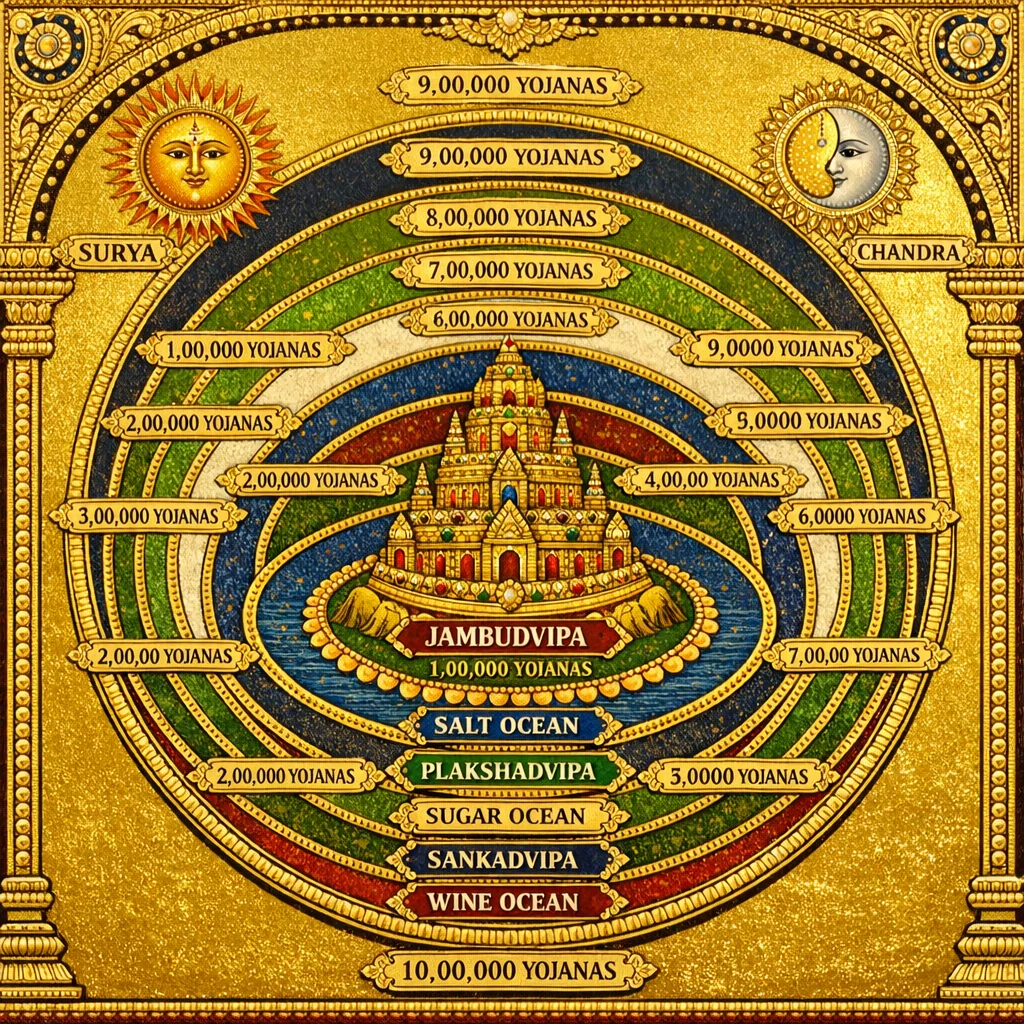
Led by Sūta, this chapter turns to technical cosmology: the Sun (sūrya/ravi/bhāskara) and Moon (candra/śaśin) are portrayed as moving luminaries whose radiance makes their discs (maṇḍalas) manifest. It then presents Purāṇic geography and metrology—the spread of the seven oceans and seven dvīpas, the proportional reasoning behind the earth’s extent, and the linkage between celestial and terrestrial measures. Yojana-based figures are given, including the Sun’s diameter and pariṇāha (circumference-like expansion), the Moon’s comparative size (often said to be twice the Sun’s disc), and the total measure of the earth-system within the saptadvīpa–samudra complex. Mount Meru serves as the axial reference for directions, with distances radiating from its center. Overall, the chapter reads like a cosmological data-sheet, anchoring a Meru-centered world model and supplying quantitative bases for later loka and bhuvana-kośa descriptions.
Shlokas
Verse 1
इति श्रीब्रह्माण्डे महापुराणे वायुप्रोक्ते पूर्वभागे द्वितीये ऽनुषङ्गपादे ऽधोलोकवर्णनं नाम विंशतितमो ऽध्यायः सूत उवाच सूर्या चन्द्रमसावेतौ भ्रमतो यावदेव तु / प्रकाशैस्तु प्रभाभिस्तौ मण्डलाभ्यां समुच्छ्रितौ
Thus, in the Śrī Brahmāṇḍa Mahāpurāṇa, in the former section spoken by Vāyu, in the second Anuṣaṅga-pāda, is the twentieth chapter called “Description of the Lower Worlds.” Sūta said: So long as the Sun and the Moon revolve, they rise aloft with their discs, shining with light and radiance.
Verse 2
सप्तानां तु समुद्राणां द्वीपानां सतु विस्तरः / विस्तरार्द्धे पृथिव्यास्तु भवेदन्यत्र बाह्यतः
The expanse of the seven oceans and the continents (dvīpas) lies within half the breadth of the earth; the remainder is held to be outside, in the outer region elsewhere.
Verse 3
पर्यासपरिमाणं तु चन्द्रादित्यौ प्रकाशतः / पर्यास्तात्पारिमाण्येन भूमेस्तुल्यं दिवं स्मृतम्
By the measure of the circle illumined by the Moon and the Sun, according to that very measure the heaven (diva) is remembered as equal to the earth.
Verse 4
अवति त्रीनिमांल्लोकान् यस्मात्सूर्यः परिभ्रमन् / अविधातुः प्रकाशाख्यो ह्यवनात्स रविः स्मृतः
For the Sun, as it revolves, protects these three worlds and is called the luminous one of the nature of Avidhātṛ; therefore, by virtue of such ‘avana’ (protection), it is remembered as Ravi.
Verse 5
अतः परं प्रवक्ष्यामि प्रमाणं चन्द्रसूर्ययोः / महित्तत्त्वान्महीशब्दो ऽह्यस्मिन्वर्षे निपाद्यते
Now I shall declare the measure of the Moon and the Sun. From the principle of Mahat-tattva, in this varṣa the name “Mahī” is established.
Verse 6
अस्य भारतवर्षस्य विष्कंभात्तुल्यविस्तृतम् / मण्डलं भास्करस्याथ योजनानि निबोधत
The orb of Bhāskara, the Sun, is spread as wide as the diameter of this Bhāratavarṣa; know its measure in yojanas.
Verse 7
नवयोजनसाहस्रो विस्तारो भास्करस्य तु / विस्तारात्र्रिगुणश्चास्य परिणाहस्तु मण्डले
Bhāskara, the Sun, has a breadth of nine thousand yojanas; and upon his disk the circumference is three times that breadth.
Verse 8
विष्कंभमण्डलाच्चैव भास्कराद्द्विगुणः शशी / अथ पृथिव्या वक्ष्यामि प्रमाणं योजनैः सह
In diameter and in disk, Śaśī, the Moon, is twice Bhāskara, the Sun. Now I shall speak of the Earth’s measure together with its yojanas.
Verse 9
सप्तद्वीपसमुद्राया विस्तारो मण्डलं च यत् / इत्येतदिह संख्यातं पुराणे परिमाणतः
Thus the extent and circular measure of the seven dvīpas and their oceans are here enumerated in the Purāṇa according to their proper dimensions.
Verse 10
तद्वक्ष्यामि समाख्याय सांप्रतैरभिमानिभिः / अभिमानिनोव्यतीता ये तुल्यास्ते सांप्रतैस्त्विह
Now I shall explain and recount the abhimānī deities of the present time; those abhimānīs who have passed before, and those equal to them, are here regarded as the present ones.
Verse 11
देवा ये वै व्यतीतास्तु रूपैर्नामभिरेव च / तस्मात्तु सांप्रतैर्देवैर्वक्ष्यामि वसुधातलम्
The gods who have passed away did so with their forms and their names; therefore, in accordance with the gods of the present, I shall describe the surface of the earth.
Verse 12
दिवास्तु सन्निवेशं वै सांप्रतैरेव कृत्स्नशः / शतार्द्धकोटिविस्तारा पृथिवी कृत्स्नशः स्मृता
The entire arrangement of the days is indeed according to the present order; and the whole earth is remembered as having an extent of ‘śatārdha-koṭi’ (fifty koṭi).
Verse 13
तस्या ऊर्द्ध्वप्रमाणेन मेरोर्यावत्तु संस्थितिः / पृथिव्या ह्यर्द्धविस्तारो योजनाग्रात्प्रकीर्त्तितः
By its (the earth’s) vertical measure, Meru stands established up to such a height; and the earth’s half-extent is famously proclaimed in yojanas.
Verse 14
मेरोर्मध्यात्प्रतिदिशं कोटिरेका तु सा स्मृता / तथा शातसहस्राणामेकोन नवतिः पुनः
From the middle of Meru, in each direction, one koṭi is remembered for each quarter; and again it is said: among the hundred-thousands, ninety minus one—namely, eighty-nine.
Verse 15
पञ्चाशत्तु सहस्राणि पृथिव्यर्द्धस्य मण्डलम् / गणितं योजनाग्रात्तु कोट्यस्त्वेकादश स्मृताः
The circuit of the Earth’s half-sphere is reckoned as fifty thousand yojanas; and by the yojana-count it is remembered as eleven koṭis.
Verse 16
तथा शतसहस्राणि सप्तत्रिंशाधिकानि तु / इत्येतदिह संश्यातं पृथिव्यन्तस्य मण्डलम्
Likewise, one hundred thousand (yojanas) with thirty-seven added—thus is the measure of the Earth’s outermost circle reckoned here.
Verse 17
तारकासंनिवेशास्य दिवि याव च्च मण्डलम् / पर्याससन्निवेशश्च भूमेर्यावत्तु मण्डलम्
As far as extends the circle of the stars’ array in heaven, so far extends the circle of the Earth’s encircling arrangement.
Verse 18
पर्यासपरिमाणेन भूमेस्तुल्यं दिवः स्मृतम् / सप्तानामपि द्वीपानामेत त्स्थानं प्रकीर्तितम्
By the measure of its circumference, the circle of heaven is remembered as equal to that of the Earth; and this is proclaimed as the station of the seven dvīpas.
Verse 19
पर्यायपरिमाणेन मण्डलानुगतेन च / उपर्युपरि लोकानां छत्रवत्परिमण्डलम्
By successive measure and in keeping with the circles, above the worlds—one upon another—there spreads a circular expanse like a royal parasol.
Verse 20
संस्थितिर्विहिता सर्वा येषु तिष्ठन्ति जन्तवः / एतदण्डकपालस्य प्रमाणं परिकीर्त्तितम्
In those realms where beings abide, every order of existence has been duly ordained; thus is declared the measure of the aṇḍa-kapāla, the shell of the cosmic egg.
Verse 21
अण्डस्यान्तस्त्विमे लोकाः सप्तद्वीपा च मेदिनी / भूर्लोकश्च भुवर्ल्लोकस्तृतीयस्सृरिति स्स्वतः
Within this cosmic egg are these worlds and the earth with its seven dvīpas: Bhūrloka, Bhuvarloka, and by its very nature the third, Svarloka.
Verse 22
महर्ल्लोको जनश्चैव तपः सत्यं च सप्तमम् / एते सप्त कृता लोकाश्छत्राकारा व्यवस्थिताः
Maharloka, Janaloka, Tapoloka, and as the seventh, Satyaloka—these seven worlds are arrayed in the form of a sacred canopy.
Verse 23
स्वकैरावरणैः सूक्ष्मैर्धार्यमाणाः पृथक्पृथक् / दशभागाधिकाभिश्च ताभिः प्रकृतिभिर्बहिः
Each is upheld separately by its own subtle coverings; and outwardly those very Prakṛtis increase tenfold, becoming the encasing layers.
Verse 24
पूर्यमाणा विशेषैश्च समुत्पन्नैः परस्परात् / अस्याण्डस्य समन्ताच्च सन्निविष्टो घनोदधिः
They are filled with distinct elements arising one from another; and all around this cosmic egg, on every side, is set the dense ocean, the ghanodadhi.
Verse 25
पृथिव्या मण्डलं कृत्स्नं घनतोयेन धार्यते / घनोदधिः परेणाथ धार्य्यते घनतेजसा
The entire circle of the earth is upheld by dense waters; and that dense ocean, O Lord, is upheld by the dense radiance beyond.
Verse 26
बाह्यतो घनतेजस्च तिर्य्यगूर्द्ध्वं तु मण्डलम् / संमताद्धनवातेन धार्यमाणं प्रतिष्ठितम्
On the outside is dense radiance; and this mandala extends sideways and upward. Upheld by the ordained dense wind, it stands firm and established.
Verse 27
घनवातं तथाकाशमाकाशं च महात्मना / भूतादिना वृतं सर्वं भूतादिर्महता वृतः
Dense wind and also ākāśa—indeed ākāśa itself—are enveloped by the Great Self. All is enclosed by Bhūtādi, and Bhūtādi is enclosed by Mahat.
Verse 28
वृतो महाननन्तेन प्रधानेनाव्य यात्मना / पुराणि लोकपालानां प्रवक्ष्यामि यथाक्रमम्
Mahat is enveloped by the Infinite—Pradhāna, the imperishable Self. Now I shall describe, in due order, the cities of the Lokapālas.
Verse 29
ज्योतिर्गुणप्रचारस्य प्रमाणपरिसिद्धये / मेरोः प्राच्यां दिशि तथा मानसस्यैव मूर्द्धनि
For the sure establishment of the measure of the spread of the qualities of light—(it is) in the eastern direction of Meru, and upon the very summit of Mānasa.
Verse 30
वस्वौकसारा माहेन्द्री पुरी हेमपरिष्कृता / दक्षिणेन पुनर्मेरोर्मानसस्यैव मूर्द्धनि
The Mahendri city called Vasvaukasara is adorned with gold; it lies to the south of Punarmeru, upon the summit of Mount Manasa.
Verse 31
वैवस्वतो निव सति यमः संयमने पुरे / प्रतीच्यां तु पुनर्मेरोर्मानसस्यैव मूर्द्धनि
Yama, son of Vivasvat, dwells in the city of Samyamana; it lies to the west of Punarmeru, upon the summit of Mount Manasa.
Verse 32
सुखा नाम पुरी रम्या वरुणस्यापि धीमतः / वरुणो यादसां नाथस्सुखाख्ये वसते पुरे
The lovely city of the wise Varuna is called Sukha; Varuna, lord of the water-born beings, dwells in that city named Sukha.
Verse 33
दिश्युत्तरस्यां मेरोस्तु मानसस्यैव मूर्द्धनि / तुल्या महेन्द्रपुर्य्यास्तु सोमस्यापि विभावरी
To the north of Meru, upon the summit of Mount Manasa, stands Soma’s city Vibhavari, equal in splendor to Mahendrapuri.
Verse 34
मानसोत्तरवृष्टे तु लोकपालाश्चतुर्दिशम् / स्थिता धर्मव्यवस्थार्थ लोकमंरक्षणाय च
In Manasottaravarsha, the Lokapalas stand in the four directions, to uphold the order of dharma and to safeguard the world.
Verse 35
लोकपालोपरिष्टात्तु सर्वतो दक्षिणायने / काष्ठागतस्य सूर्यस्य गतिया तां निबोधत
Above the Lokapālas, when everywhere the season of Dakṣiṇāyana prevails, understand that course of the Sun as it reaches the quarters.
Verse 36
दक्षिणो ऽपक्रमे सूर्य्यः क्षिप्तेषुरिव सर्पति / ज्योतिषां चक्रमादाय सततं परिगच्छति
As the Sun turns away toward the south, it glides like an arrow shot forth; bearing the wheel of the luminaries, it ever moves in ceaseless circuit.
Verse 37
मध्यगश्चामरावत्यां यदा भवति भास्करः / वैवस्वते संयमते उदयस्तत्र दृश्यते
When Bhāskara stands at the midpoint in Amarāvatī, then in Vaivasvata’s realm of Saṃyama, his rising is seen there.
Verse 38
सुखायामर्द्धरात्रं स्याद्विभायामस्तमेति च / वैवस्वते संयमने मध्यगः स्याद्रविर्यदा / सुखायामथ वारुण्यामुत्तिष्ठन्स तु दृश्यते
In Sukhā it is midnight, and in Vibhā the Sun sets. When Ravi stands at the center in Vaivasvata’s Saṃyama realm, he is seen rising in Sukhā and in Vāruṇī.
Verse 39
विभाया मर्द्धरात्रं स्यान्माहेन्द्यामस्तमेति च / यदा दक्षिणपुर्वेषामपराह्णो विधीयते
In Vibhā it is midnight, and in Māhendī the Sun sets, when in the lands of the southeast the time of aparāhna (afternoon) is ordained.
Verse 40
दक्षिणापरदेश्यानां पूर्वह्णः परिकी र्त्तितः / तेषामपररात्रश्च ये जना उत्तराः परे
For the peoples of the south‑western lands, that time is spoken of as the forenoon; but for those who dwell far to the north, the very same time is counted as the latter part of the night.
Verse 41
देशा उत्तरपूर्वा ये पूवरात्रस्तु तान्प्रति / एवमेवोत्तरेष्वर् के भुवनेषु विराजते
For the lands that lie to the north‑east, that time is the first part of night; thus, in the northern worlds as well, the order of Time shines forth.
Verse 42
सुखायासथ वारुण्यां मध्याह्ने चार्यमा यदा / विभायां सोमपुर्यां वा उत्तिष्ठति विभावसुः
When in Varuṇī, in the realms of Sukhāyāsa and of Aryamā, it is midday, then in Vibhā or in Soma‑purī Vibhāvasu—the Sun—rises up.
Verse 43
रात्र्यर्द्ध चामरावत्यामस्तमेति यमस्य च / सोमपुर्या विभायां तु मध्याह्ने स्याद्दिवाकरः
In Amarāvatī, at the midpoint of night—and in Yama’s realm as well—the Sun sets; yet in Soma‑purī and in Vibhā, at that very time, the Day‑maker stands at noon.
Verse 44
महेद्रस्यामरावत्यां सूर्य उत्तिष्ठते तदा / अर्द्धरात्रं संयमने वारुण्यामस्तमेति च
At that time, in Mahendra’s Amarāvatī the Sun rises; and when it is midnight in Saṃyamana, in Varuṇī the Sun sets as well.
Verse 45
स शीघ्रमेव पर्येति भास्करो ऽलातच त्रवत् / भ्रमन्वै भ्रममार्णानि ऋक्षाणि चरते रविः
Bhāskara swiftly makes his circuit, like a whirling wheel of fire. As Ravi moves in rotation, he sets the constellations and starry hosts in motion as well.
Verse 46
एवं चतुर्षु पार्श्वेषु दक्षिणां तेन सर्पति / उदयास्तमने चासावृत्ति ष्ठति पुनः पुनः
Thus, on all four sides, he moves in a rightward (clockwise) course. Through rising and setting, he repeats his cycle of revolution again and again.
Verse 47
पूवाह्णे चापराह्णे च द्वौ द्वौ देवालयौ तु सः / तपत्यर्कश्च मध्याह्ने तैरेव च स्वरश्मिभिः
In the forenoon and in the afternoon, he has two and two divine abodes. At midday, Arka blazes with heat by those very rays of his own.
Verse 48
उदितो वर्द्धमानाभिरामध्याह्नं तपन्रविः / अतः परं ह्रसंतीभिर्गोभिरस्तं निगच्छति
Having risen, Ravi burns until midday with rays that steadily increase. Thereafter, with rays that gradually diminish, he proceeds to his setting.
Verse 49
उदयास्तमयाभ्यां च स्मृते पूर्वापरे दिशौ / यावत्पुरस्तात्तपति तापत्पृष्ठे ऽथ पार्श्वयोः
By rising and setting, the eastern and western directions are known. For as long as he heats the front, for that same span (in his circuit) he heats the back, and then both sides.
Verse 50
यत्रोद्यन्दृश्यते सूर्यस्तेषां स उदयः समृतः / प्रणाशं गच्छते यत्र तेषामस्तः स उच्यते
Where the rising Sun is seen, that is deemed their sunrise; and where it passes into disappearance, that is called their sunset.
Verse 51
सर्वेषामुत्तरे मेरुलोङ्कालोकश्च दक्षिणे / विदूरभावादर्कस्य भूमिलेखावृतस्य च
For all beings, Meru lies to the north and Loṅkāloka to the south, because the Sun is far away and is veiled by the earth’s horizon-line.
Verse 52
लीयन्ते रश्मयो यस्मात्तेन रात्रौ न दृश्यते / ग्रहनक्षत्रसोमानां दर्शनं भास्करस्य च
Because his rays withdraw and merge away, (the Sun) is not seen at night; then the planets, the stars, and the Moon come into view.
Verse 53
उच्ध्रयस्य प्रमाणेन ज्ञेयमस्तमथोदयम् / शुक्लच्छायो ऽग्निरा पश्च कृष्णच्छाया च मेदिनी
By the measure of elevation one should discern sunset and sunrise. Fire and water bear a bright shadow, while the earth bears a dark shadow.
Verse 54
विदूरभावादर्कस्य ह्युद्यते ऽपि विरशिमता / रक्तभावो विरश्मत्वाद्रक्तत्वाच्जाप्यनुष्णता
Because the Sun is far away, even as he rises he seems as though bereft of rays. From the weakening of the rays comes a ruddy hue, and by that redness his heat is not felt as intense.
Verse 55
लेखायामास्थितः सूर्यो यत्र यत्र च दृश्यते / ऊर्द्ध्व शातसहस्र तु योजनानां स दृश्यते
The Sun, abiding upon its line, is seen wherever it is beheld; it appears at a height of a hundred thousand yojanas above.
Verse 56
प्रभा हि सौरी पादेन ह्यस्तं गच्छति भास्करे / अग्निमाविशते राद्रौ तस्माद्दूरात्प्रकाशते
When Bhāskara sets, the solar radiance, with a portion of itself, goes to the westering; at night it enters into fire, and therefore shines even from afar.
Verse 57
उदिते हि पुनः सूर्ये ह्यौष्ण्यमाग्नेयमाविशेत् / संयुक्तो वह्निना सूर्यस्तपते तु ततो दिवा
When the Sun rises again, the fiery warmth enters into it; joined with Vahni, the Sun then burns forth through the day.
Verse 58
प्राकाश्यं च तथौष्ण्यं च सौराग्नेये च तेजसी / परस्परानुप्रवेशाद्दीप्येते तु दिवानिशम्
In the two splendors—solar and fiery—are both radiance and heat; by their mutual interpenetration they blaze through day and night.
Verse 59
उत्तरे चैव भूम्यर्द्धे तथा तस्मिंश्च दक्षिणे / उत्तिष्ठति तथा सूर्ये रात्रिराविशतत्वपः
In the northern half of the earth, and likewise in the southern, when the Sun rises, night enters into darkness and withdraws.
Verse 60
तस्माच्छीता भक्त्यांपो दिवारात्रिप्रवेशनात् / अस्तं याति पुनः सूर्ये दिनमाविशते त्वषः
Therefore, by the ordered entering of day and night, the waters become cool in a spirit of bhakti; when the Sun sets, they again enter the day, and their radiance is revealed.
Verse 61
तस्मादुष्णा भवत्यापो नक्तमह्नः प्रवेशनात् / एतेन क्रमयोगेन भूम्यर्द्धे दक्षिणोत्तरे
Therefore, by the entering of night and day, the waters become warm; by this stepwise order, this arrangement prevails in the southern and northern halves of the earth.
Verse 62
उदयास्तमनेर्ऽकस्य अहोरात्रं विशत्यपः / देनं सूर्यप्रकाशाख्यं तामसी रात्रिरूच्यते
By the Sun’s rising and setting, the waters enter the cycle of day and night; what is called the Sun’s illumination is ‘day’, and what is dark is spoken of as ‘night’.
Verse 63
तस्माद्व्यवस्थिता रात्रिः सूर्यापेक्षमहः स्मृतम् / एवं पुष्करमध्येन यदा सर्पति भास्करः
Thus night is duly established, and ‘ahaḥ’—day—is understood in dependence upon the Sun; likewise, when Bhāskara moves gliding through the midst of Puṣkara.
Verse 64
अंशांशकं तु मेदिन्यां मुहूर्त्तेनैव गच्छति / योजनाग्रान्मुहूर्त्तस्य इह संख्यां निबोधत
He traverses the earth portion by portion in a single muhūrta; here, understand the number of yojanas that correspond to one muhūrta.
Verse 65
पूर्णे शतसहस्राणामेकत्रिंशाधिकं स्मृतम् / पञ्चाशत्तु तथान्यानि सहस्राण्यधिकानि च
Within the full count of a hundred thousand, it is remembered as thirty‑one more; and likewise another fifty thousand are added.
Verse 66
मौहूर्त्ति की गतिर्ह्येषा सूर्यस्य तु विधीयते / एतेन गतियोगेन यदा काष्ठां तु दक्षिणाम्
Thus is ordained the Sun’s mauhūrtika course; by this rule of motion, when it moves toward the southern kāṣṭhā.
Verse 67
पर्यागच्छेत्पतङ्गो ऽसौ मध्ये काष्ठान्तमेव हि / मध्येन पुष्करस्याथ भ्रमते दक्षिणायने
That Patanga, the Sun, reaches the very end of the kāṣṭhā at the middle; then, in the dakṣiṇāyana, it revolves through the midst of Puṣkara.
Verse 68
मानसोत्तरशैले तु अन्तरे विषुवं च तत् / सर्पते दक्षिणायां तु काष्ठायां वै निबोधत
Between Mount Mānasottara lies that viṣuva, the point of balance; and it glides toward the southern kāṣṭhā—know this well.
Verse 69
नवकोट्यः प्रसंख्याता योजनैः परिमण्डलम् / तथा शतसहस्राणि चत्वारिंशच्च पञ्च च
Its circumference is reckoned as nine koṭis of yojanas; and further, a hundred thousand, forty, and five are added.
Verse 70
अहोरात्रात्पतङ्गस्य गतिरेषा विधीयते / दक्षिणाद्विनिवृत्तो ऽसौ विषुवस्थो यदा रविः
Thus is ordained the Sun’s course through day and night: when Ravi turns back from the south and abides at the equinox.
Verse 71
क्षीरोदस्य समुद्रस्योत्तरतश्चाद्रितश्चरन् / मण्डलं विषुवत्तस्य योजनैस्तन्निबोधत
Moving north of the Kṣīroda Ocean and along the mountains, know the measure of his equinoctial circle in yojanas.
Verse 72
तिस्रः कोट्यस्तु संख्याता विषुवस्यापि मण्डलम् / तथा शतसहस्राणामशीत्येकाधिका पुनः
The equinoctial circle is reckoned as three koṭis, and again one hundred thousand, increased by eighty-one.
Verse 73
श्रवणे चोत्तरषाढे चित्रभानुर्यदा भवेत् / शाकद्वीपस्य षष्ठस्य उत्तरातो दिशश्चरन्
When Citrabhānu (the Sun) is in Śravaṇa and Uttarāṣāḍhā, he moves along the northern quarter of the sixth region of Śākadvīpa.
Verse 74
उतरायाः प्रमाणं च काष्ठाया मण्डलस्य च / योजनाग्रात्प्रसंख्याता कोटिरेका तु स द्विजाः
The measure of Uttarāyaṇa, and of the circle of Kāṣṭhā as well, is reckoned in yojanas; O dvijas, it is one koṭi.
Verse 75
अशीतिर्नियुतानीह योजनानां तथैव च / अष्टपञ्चाशतं चव योजनान्यधिकानि तु
Here the measure is eighty niyutas of yojanas; and beyond that, fifty-eight yojanas more are added.
Verse 76
नागवीथ्युत्तरावीथी ह्यज वीथी च दक्षिणा / मूलं चैव तथाषाढे त्वजवीथ्युदयास्त्रयः
Nāgavīthī is the northern course, while Ajavīthī is the southern; and at Mūla and Āṣāḍha are spoken of three risings of Ajavīthī.
Verse 77
अश्विनी कृत्तिका याम्यं नागवीथ्युदयास्त्रयः / काष्ठयोरन्तरं यच्च तद्वक्ष्येयजनैः पुनः
Aśvinī, Kṛttikā, and Yāmya—these are the three risings of Nāgavīthī; and the interval between the two kāṣṭhas I shall again declare by the measure of yajanas.
Verse 78
एतच्छतसहस्राणामष्टाभिश्चोत्तरं शतम् / त्रयः शताधिकाश्चन्ये त्रयस्त्रिंशच्च योजनैः
To these hundreds of thousands, a hundred together with eight is added; and by another reckoning, more than three hundred, with thirty-three yojanas besides.
Verse 79
काष्ठयोरन्तरं ह्येतद्योजनाग्रात्प्रकीर्तितम् / काष्ठयोर्लेखयोश्चैव ह्यन्तरं दक्षिणोत्तरे
This interval between the two kāṣṭhas is proclaimed by the foremost measure of the yojana; and the interval between the kāṣṭha-lines likewise lies along the south–north direction.
Verse 80
तेन्ववक्ष्ये प्रसंख्याय चोजनैस्तन्निबोधत / एकैकमन्तरं तस्य वियुतान्येकसप्ततिः
Now I shall declare it, reckoning in yojanas—understand well: each and every interval thereof measures seventy-one viyutas.
Verse 81
सहस्राण्यतिरिक्ताश्च ततो ऽन्या पञ्चसप्ततिः / लेखयोः काष्ठयोश्चैव बाह्याभ्यन्तरयोः स्मृतम्
Beyond the thousands, there are another seventy-five—remembered in tradition as the outer and inner divisions of the lines and the wooden measures.
Verse 82
अभ्यन्तरं तु पर्येति मण्डलान्युत्तरायणे / बाह्यतो दक्षिणे चैव सततं तु यथाक्रमम्
In the Uttarāyaṇa it moves along the inner course of the circles; in the Dakṣiṇāyaṇa, along the outer—unceasingly, in due order.
Verse 83
मण्डलानां शतं पूर्मं त्र्यशीत्यधिकमुत्तरम् / चरते दक्षिणे चापि तावदेव विभावसुः
Vibhāvasu (the Sun) travels northward through a hundred circles first, and then eighty-three more; southward too it traverses the very same number.
Verse 84
प्रमाणं मण्डलस्याथ योजनाग्रं निबोधत / योजनानां सहस्राणि सप्तादश समासतः
Now know the measure of the circle and its extent in yojanas: in brief, it is seventeen thousand yojanas.
Verse 85
शते द्वे पुनरप्यन्ये योजनामां प्रकीर्त्तिते / एकविंशतिभिश्चैव योजनैरधिकैर्हि ते
Another measure is also proclaimed: two hundred yojanas, and to that are indeed added twenty-one yojanas more.
Verse 86
एतत्प्रमाणमाख्यातं योजनैर्मण्डलस्य च / विष्कंभो मण्डलस्याथ तिर्यक् स तु विधीयते
Thus the measure of the maṇḍala is declared in yojanas; and the maṇḍala’s diameter is likewise fixed across, in the transverse direction.
Verse 87
प्रत्यहं चरते तानि सूर्या वै मण्डलक्रमात् / कुलालचक्रपर्यन्तो यथा शीघ्रं निवर्त्तते
Each day the Sun traverses those courses in the order of the maṇḍala, like the potter’s wheel that swiftly turns and comes back around.
Verse 88
दक्षिणप्रक्रमे सूर्यस्तथा शीघ्रं प्रवर्त्तते / तस्मात्प्रकृष्टां भूमिं तु कालेनाल्पेन गच्छति
In the southern course the Sun moves with the same swiftness; therefore it passes over the excellent regions of the earth in a short time.
Verse 89
सूर्यो द्वादशभिः शैर्घ्यान्मुहूर्तैर्दक्षिणायने / त्रयोदशार्द्धमृक्षाणामह्ना तु चरते रविः
In the dakṣiṇāyana the Sun moves through twelve long muhūrtas; and in the course of a day, Ravi traverses thirteen and a half portions of the nakṣatras.
Verse 90
मुहूर्तै स्तावदृक्षाणि नक्तमष्टादशैश्चरन् / कुलालचक्रमध्ये तु यथा मन्दं प्रसर्पति
In the night of eighteen muhūrtas, moving among the constellations, he creeps on slowly—like one gliding at the center of a potter’s wheel.
Verse 91
तथोदगयने सूर्यः सर्पते मन्दविक्रमः / तस्मा द्दीर्घेन कालेन भूमिं स्वल्पानि गच्छति
So too in the Udāgayana the Sun moves with gentle, slow stride; therefore, over a long span, he traverses the earth only little by little.
Verse 92
अष्टादश मुहूर्त तु उत्तरायणपश्चिमम् / अहो भवति तच्चापि चरते मन्दविक्रमः
In the western region of the Uttarāyaṇa, the day becomes eighteen muhūrtas; even there he proceeds with slow, gentle pace.
Verse 93
त्रयोदशार्द्धं माद्येन त्वृक्षाणां चरते रविः / मुहूर्तैस्तावदृक्षाणि नक्तं द्वादशभिश्चरन्
Ravi moves among the constellations for thirteen and a half (muhūrtas); and at night, in twelve muhūrtas, he passes through that same measure of stars.
Verse 94
ततो मन्दतरं नाभ्यां चक्रं भ्रमति वै यथा / मृत्पिण्ड इव मध्यस्थो ध्रुवो भ्रमति वै तथा
Then, just as a wheel turns more slowly near its hub, so too Dhruva, stationed at the center, appears to revolve like a lump of clay.
Verse 95
त्रिंशन्मुहूर्तानेवाहुरहोरात्रं ध्रुवो भ्रमन् / उभयोः काष्ठयोर्मध्ये भ्रमते मण्डलानि तु
Thirty muhūrtas are said to make a day and a night. Dhruva, revolving, abides between the two kāṣṭhas, and there the celestial circles (maṇḍalas) revolve.
Verse 96
कुलालचक्रनाभिश्च यथा तत्रैव वर्त्तते / ध्रुवस्तथा हि विज्ञेयस्तत्रैव परीवर्त्तते
As the hub of a potter’s wheel remains right there, so should Dhruva be understood: he turns about, yet abides in that very place.
Verse 97
उभयोः काष्ठयोर्मध्ये भ्रमते मण्डलानि सः / दिवानक्तं च सूर्यस्य मन्दा शीघ्रा च वै गातिः
Between the two kāṣṭhas he sets the circles in motion. The Sun’s course, by day and by night, is indeed sometimes slow and sometimes swift.
Verse 98
उत्तरप्रक्रमे चापि दिवा मन्दा गतिस्तथा / तथैव च पुनर्नक्तं शीघ्रा सूर्यस्य वै गातिः
In the northward course, the daytime motion is slow; likewise again, at night the Sun’s motion is swift.
Verse 99
दक्षिणप्रक्रमेणैव दिवा शीघ्रं विधीयते / गतिः सूर्यस्य नक्तं च मन्दा चैव गतिस्तथा
In the southward course, the Sun’s motion by day is made swift; and by night its motion becomes slow.
Verse 100
एवं गतिविशेषेण विभजन् रात्र्यहानि तु / तजापि संचरन्मार्गं समेन विषमेण च
Thus, by the distinct modes of motion, he divides night and day; yet he still traverses the path, both even and uneven.
Verse 101
लोकालोकस्थिता ह्येते लोकपालाश्चतुर्दिशम् / अगस्त्यश्चरते तेषामुपरिष्टाज्जवेन तु
These are the Lokapālas of the four directions, stationed in Lokāloka; and Agastya moves above them with swift speed.
Verse 102
भुञ्जन्नसापहोरा त्रमेवं गतिविशेषणम् / दक्षिणे नागवीथ्यास्तु लोकालोकस्य चोत्तरे
Enjoying the sequence of Asāpahorā, this is the distinctive mode of motion: south of Nāgavīthī and north of Lokāloka.
Verse 103
लोकसन्तानको ह्येष वैश्वानरपथाद्वहिः / पृष्टे यावत्प्रभा सौरी पुरस्तात्संप्रकाशते
This Lokasantānaka lies outside the path of Vaiśvānara; and as far as the sun’s radiance is behind, so far it shines forth in front.
Verse 104
पार्श्वतः पृष्ठतश्चैव लोकालोकस्य वर्त्तते / योजनानां सहस्राणि दशकं तुच्छ्रितो गिरिः
It extends along the sides and the rear of Lokāloka; and that mountain rises to a height of ten thousand yojanas.
Verse 105
प्रकाशश्चाप्रकाशश्च सर्वतः परिमण्डलः / नक्षत्रचन्द्रसूर्यश्च ग्रहैस्तारागणैः सह
It is a sphere encircled on every side by light and by non-light; there are the stars, the Moon, and the Sun, together with the planets and hosts of constellations.
Verse 106
अभ्यन्तरं प्रकाशन्ते लोकालोकस्य वै गिरेः / एतावानेव लोकस्तु निरालोकस्ततः परम्
The inner reaches of Mount Lokāloka shine with light; only so far extends the world, and beyond it lies Nirāloka, the realm without light.
Verse 107
लोकेनालोकवानेष निरालोकस्त्वलोकतः / लोकालोकं तु संधत्ते यस्मात्सुर्यपरिग्रहम्
By the presence of the world it is filled with light, and by that very light it is also spoken of as beyond light; for it joins Lokāloka to the Sun’s encompassing course, establishing the boundary.
Verse 108
तस्मात्सन्ध्येति तामाहुरुषाव्युष्ट्योर्यदन्तरम् / उषा रात्रिः स्मृता विप्रैर्व्युष्टिश्चापि त्वहः स्मृतम्
Therefore the interval between Uṣā and Vyuṣṭi is called Sandhyā; the sages remember Uṣā as night, and Vyuṣṭi as day.
Verse 109
सूर्याग्निग्रसमानानां संध्याकाले हि रक्षसाम् / प्रजापतिनियोगेन शापस्त्वेषां दुरात्मनाम्
At the time of Sandhyā, the rākṣasas who seem to swallow the Sun and the sacred Fire are under a curse; by Prajāpati’s ordinance, that malediction rests upon those evil-souled beings.
Verse 110
अक्षयत्वं तु देहस्य प्रापिताम्रणं तथा / तिस्रः कोट्यस्तु विख्याता मन्देहा नाम राक्षसाः
Their bodies had attained imperishability and even immortality. Three kroṭis of rākṣasas, famed as the Mandehas, were known.
Verse 111
प्रार्थयन्ति सहस्रांशुभुदयन्तं दिनेदिने / तापयन्तं दुरात्मानः सूर्यमिच्छन्ति खादितुम्
Those wicked-souled ones, day after day, beseech the thousand-rayed Sun as he rises; yet they desire to devour that Sun who scorches the world with heat.
Verse 112
अथ सूर्यस्य तेषां च युद्धमासीत्सुदारुणम् / ततो ब्रह्मा च देवाश्च ब्राह्ममाश्चैव सत्तमाः
Then there arose a most dreadful battle between the Sun and them. Thereupon Brahmā, the gods, and the noblest of brāhmaṇas also came forth.
Verse 113
संध्यां तु समुपासीनाः प्रक्षिपन्ति जलं सदा / ओङ्कारब्रह्मसंयुक्तं गायत्र्या चाभिमन्त्रितम्
Seated in the worship of Sandhyā, they ever cast forth the water-offering—joined with Oṃkāra-Brahman and consecrated by the Gāyatrī.
Verse 114
स्फूर्जज्ज्योतिश्च चण्डांशुस्तथा दीप्यति भास्करः / ततः पुनर्महातेजा महाबलपराक्रमः
Then the flashing radiance of Bhāskara, with his fierce rays, blazed ever brighter. Thereafter that one of mighty tejas—of great strength and valor—grew yet more powerful.
Verse 115
योजनानां सहस्राणि ऊर्द्ध्वमुत्तिष्ठते शतम् / प्रयाति भगवानाशु ब्राह्मणैरभिरक्षितः / वालखिल्यैश्च मुनिभिर्धृतार्चिः समरीचिभिः
Guarded by the brahmanas and encircled by the steadfast radiance of the sages Vālakhilya and Samarīci, the Blessed Lord swiftly ascends upward, reaching a hundred thousand yojanas.
Verse 116
काष्ठा निमेषा दश पञ्च चैव त्रिंशच्च काष्ठा गणयेत्कलां तु / त्रिंशत्कलाश्चापि भवेन्मुहूर्त्तस्तैस्त्रिंशता रात्र्यहनी समेते
Ten and five nimeṣas make one kāṣṭhā; thirty kāṣṭhās are reckoned as one kalā; thirty kalās become one muhūrta; and by thirty muhūrtas, night and day are made complete.
Verse 117
ह्रासवृद्धी त्वहर्भागैर्दिवसानां यथाक्रमात्
According to the successive portions of daylight, the days undergo decrease and increase in due order.
Verse 118
संध्या मुहूर्त्तमात्रा तु ह्रासवृद्धिस्तु सा स्मृता / लेखाप्रभृत्यथादित्ये त्रिमुहूर्त्तगते तु वै
Sandhyā lasts only a single muhūrta; that itself is remembered as the measure of decrease and increase. And in the course of Āditya, reckonings such as “lekhā” are taken when three muhūrtas have passed.
Verse 119
प्रातस्ततः स्मृतः कालो भागश्चाह्नः स पञ्चमः / तस्मात्प्रातस्तनात्कालात्र्रिमुहूर्त्तस्तु संगवः
Thereafter is the time called prātaḥkāla, the fifth portion of the day. And from that morning time, the span of three muhūrtas is called saṃgava.
Verse 120
मध्याह्नस्त्रिमुहूर्त्तस्तु तस्मात्कालश्च संगवात् / तस्मान्मध्यन्दिनात्कालादपराह्ण इति स्मृतः
Midday lasts for three muhūrtas; the time after saṅgava is called madhyandina. After the madhyandina period, the time is remembered as aparāhṇa.
Verse 121
त्रय एव मुहूर्त्तास्तु कालागः स्मृतो बुधैः / अपराह्णे व्यतीते तु कालः सायाह्न उच्यते
The wise remember kālāga as consisting of only three muhūrtas. When aparāhṇa has passed, that time is called sāyāhna.
Verse 122
दशपञ्च मुहूर्ताह्नो मुहूर्त्तास्त्रय एव च / दशपञ्चमुहूर्त्त वै ह्यहर्वैषुवतं स्मृतम्
Daytime consists of fifteen muhūrtas, and (the night too) is reckoned in three praharas. A day of fifteen muhūrtas is remembered as viṣuvat, the equinoctial measure.
Verse 123
वर्द्धन्ते च ह्रसंते च ह्ययने दक्षिणोत्तरे / अहस्तु ग्रसते रात्रिं रात्रिश्च ग्रसते त्वहः
In the southern and northern ayanas, day and night wax and wane. At times the day devours the night, and at times the night devours the day.
Verse 124
शरद्वसंतयोर्मध्यं विषुवत्परिभाव्यते / अहोरात्रे कलाश्चैव समं सोमः समश्नुते
The middle between śarad and vasantā is contemplated as viṣuvat. Then the portions of day and night are equal, and Soma—the Moon—likewise partakes of that balance.
Verse 125
तथा पञ्चदशाहानि पक्ष इत्यभिधीयते / द्वौच पक्षौभवेन्मासो द्वौमासावर्कजावृतुः
Thus fifteen days are called a pakṣa (fortnight). Two pakṣas make a month, and two months make a solar ṛtu (season).
Verse 126
ऋतुत्रितयमयने द्वे हि वर्षं तु सौरकम् / निमेषा विद्युतश्चैव काष्टास्ता दश पञ्च च
Three ṛtus (seasons) make an ayana, and two ayanas make the solar year. Also, nimeṣas, vidyuts, and kāṣṭhās are set in the reckoning as ten and five.
Verse 127
कलास्तास्त्रिशतः काष्ठा मात्रा शीतिद्वयात्मिका / सप्तैका द्व्यधिका त्रिशन्मात्रा षटत्रिंशदुत्तरा
The kalās are three hundred; and the mātrā of a kāṣṭhā is said to be of the nature of twenty-two. Then come seven, one, two more, and thirty mātrās—set beyond thirty-six.
Verse 128
द्विषाष्टिना त्रयोविंशन्मात्रायाश्च कला भवेत् / चत्वारि शत्सहस्राणि शतान्यष्टौ च विद्युतः
From twenty-three mātrās, by the count of sixty-two, a kalā is formed. And the number of vidyuts is said to be four to six thousand, and eight hundred besides.
Verse 129
सप्ततिश्चैव तत्रापि नवतिं विद्धि निश्चये / चत्वार्येव शतान्याहुर्विद्युते द्वे च संयुते
There too is seventy—know also, with certainty, ninety. For the vidyuts, four hundred are spoken of, and with them the joining of two as well.
Verse 130
वरांशो ह्येष विज्ञेयो नाडिका चात्र कारणम् / संवत्सरादयः पञ्च चतुर्मानविकल्पिताः
This ‘varāṃśa’ is to be understood; here the nāḍikā is the determining cause. The five measures beginning with the saṃvatsara are set forth in four human reckonings.
Verse 131
निश्चयः सर्वकालस्य युगमित्यभिधीयते / संवत्सरस्तु प्रथमो द्वितीयः परिवत्सरः
The fixed measure of all time is called a ‘yuga’. Of these, the first is saṃvatsara, and the second is parivatsara.
Verse 132
इडावत्सरस्तृतीयस्तु चतुर्थश्चानुवत्सरः / पञ्चमोवत्सरस्तेषां कालस्तु युगसंहितः
The third is iḍāvatsara, and the fourth is anuvatsara. The fifth is vatsara; the time comprising them is gathered together as a ‘yuga’.
Verse 133
त्रिंशच्छतं भवेत्पूर्णं पर्वणां तु रवेर्युगे / शतान्यष्टादश त्रिंशदुदयाद्भास्करस्य च
In the yuga of Ravi, the full number of parvas is three hundred and thirty. And from the risings of Bhāskara, eighteen hundred and thirty risings are counted.
Verse 134
ऋतवस्त्रिंशतः सौरादयनानि दशैव तु / पञ्च च त्रिशतं चापि षष्टिवर्षं च भास्करम्
In the solar reckoning, the ṛtus are thirty, and the ayanas are only ten. And for Bhāskara there are also said to be three hundred and five, and a cycle of sixty years.
Verse 135
त्रिशदेव त्वहोरात्रास्तैस्तु मासस्तु भास्करः / एकषष्टि त्वहोरात्रमृतुरेको विभाव्यते
Thirty days and nights are reckoned as one month of the Sun (Bhāskara); sixty-one days and nights are understood as one season (ṛtu).
Verse 136
अह्नां तु त्र्यधिकाशीतिः शतं चाप्यधिकं भवेत् / मानं तच्चित्रभानोस्तु विज्ञेयमयनस्य ह
The count of days exceeds eighty-three and even becomes more than a hundred; this is to be known as the measure of the Sun, Citrabhānu’s ayana.
Verse 137
सौरं सौम्यं तु विज्ञेयं नाक्षत्रं सावनं तथा / मानान्येतानि चत्वारि यैःपुराणे हि निश्चयः
Know the four measures: solar (saura), lunar (saumya), stellar (nākṣatra), and civil (sāvana); by these four, the Purāṇa establishes its determinations.
Verse 138
यः श्वेतस्योत्तरश्चैव शृङ्गवान्नाम पर्व्वतः / त्रीणितस्य तु शृङ्गाणि स्पृशन्तीव नभस्तलम्
North of Mount Śveta stands the mountain called Śṛṅgavān; its three peaks seem to touch the very vault of the sky.
Verse 139
तैश्चापि शृङ्गैस्सनगः शृङ्गवा निति कथ्यते / एकश्च मार्गविष्कंभविस्तारश्चास्य कीर्तितः
With those peaks and the mountain itself, it is called Śṛṅgavān; and the breadth and expanse of its route (mārga-viṣkambha-vistāra) is declared to be one.
Verse 140
तस्य वै पूर्वतः शृङ्गं मध्यमं तद्धिरण्मयम् / दक्षिणं राजतं चैव शृङ्गं तु स्फटिकप्रभम्
Its eastern peak and its middle peak are of gold; its southern peak is of silver, shining with the radiance of crystal.
Verse 141
सर्वरत्नमयं चैव शृङ्गमुत्तरमुत्तमम् / एवं कूटैस्त्रिभिः शैलः शृङ्गवानिति विश्रुतः
Its northern peak is made of all gems, the most excellent; thus, with three summits, that mountain is famed as “Śṛṅgavān”.
Verse 142
यत्तद्वै पूर्वतः शृङ्गं तदर्कः प्रतिपद्यते / शरद्वसंतयोर्मध्ये मध्यमां गतिमास्थितः
It is to that eastern peak that the Sun attains; between autumn and spring he abides in a middle course.
Verse 143
अतस्तुल्यमहोरात्रं करोति तिमिरा पहः / हरिताश्च हया दिव्यास्तस्य युक्ता महारथे / अनुलिप्ता इवाभान्ति पद्मरक्तैर्गभस्तिभिः
Therefore the Sun, dispeller of darkness, makes day and night equal; the divine green steeds yoked to his great chariot shine as though anointed with lotus-red rays.
Verse 144
मेषति च तुलान्ते च भास्करोदयतः स्मृताः / मुहूर्त्ता दश पञ्चैव अहो रात्रिश्च तावती
In Meṣa and at the end of Tulā, the measure of day and night is reckoned from the Sun’s rising; then the day is fifteen muhūrtas, and the night the same.
Verse 145
कृत्तिकानां यदा सूर्यः प्रथमां शगतो भवेत् / विशाखानां तदा ज्ञेयश्चतुर्थांश निशाकरः
When the Sun reaches the first quarter of Kṛttikā, one should know that in Viśākhā the Moon stands in its fourth part.
Verse 146
विशाखानां यदा सूर्यश्चरतेंशं तृतीयकम् / तदा चन्द्रं विजानीयात्कृत्तिकाशिरसि स्थितम्
When the Sun moves through the third portion of Viśākhā, then one should know the Moon to be stationed upon the head of Kṛttikā.
Verse 147
विषुवं तं विजानीयादेवमाहुर्महर्षयः
Know that to be the Viṣuva (equinox); thus have the great seers declared.
Verse 148
सूर्येण विषुवं विद्या त्कालं सोमेन लक्षयेत् / समा रात्रिरहश्चैव यदा तद्विषुवं भवेत्
The Viṣuva is known by the Sun, and its time is marked by Soma, the Moon. When night and day are equal, then the Viṣuva occurs.
Verse 149
तदा दानानि देयानि पितृभ्यो विषुवेषु च / ब्राह्मणेभ्यो विशेषेण मुखमेतत्तु दैवतम्
Then, on the Viṣuvas, gifts should be given to the Pitṛs, and especially to the brāhmaṇas; for they are said to be the very mouth of the Divine.
Verse 150
ऊनमासाधिमासौ च कला काष्ठा मुहूर्त्तकाः / पौर्णमासी तथा ज्ञेया अमावास्या तथैव च / सिनीवाली कुहूश्चैव राका चानुमतिस्तथा
Know the deficient month and the intercalary month, and also the measures of time—kalā, kāṣṭhā, and muhūrta. Likewise are to be known the Full-moon day (Paurṇamāsī) and the New-moon day (Amāvāsyā), and also Sinīvālī, Kuhū, Rākā, and Anumatī.
Verse 151
तपस्तपस्यौ मदुमाधवौ च शुक्रःशुचिश्चायनमुत्तरं स्यात् / नभोनभस्याविषऊर्जसंज्ञौ सहःसहस्याविति दक्षिणं स्यात्
Tapas and Tapasya, Madhu and Mādhava, Śukra and Śuci—these are said to be the months of Uttarāyaṇa. Nabha and Nabhasya, Iṣa and Ūrja, Saha and Sahasya—these are said to be the months of Dakṣiṇāyaṇa.
Verse 152
आर्तवाश्च ततो ज्ञेया पञ्चाब्दा ब्रह्मणाः सुताः
Thereafter, know the five years called Ārtava as the sons of Brahmā.
Verse 153
तस्माच्च ऋतवो ज्ञेया ऋतुभ्यो ह्यार्त्तवाः स्मृताः / तस्मादृतुमुखी ज्ञेया अमावास्यास्य पर्वणः
Therefore the seasons (ṛtu) are to be known, and from the seasons the Ārtavas are remembered. Hence, in the observance (parva) of Amāvāsyā, that called Ṛtumukhī is to be understood.
Verse 154
तस्मात्तु विषुवं ज्ञेयं पितृदेवहितं सदा / पर्व ज्ञात्वा न मुह्येत पित्र्ये दैवे च मानवः
Therefore, know the Viṣuva (equinox/solstice point) as ever beneficial to the Pitṛs and the Devas. Knowing the sacred observance (parva), a person is not deluded in rites for the ancestors or for the gods.
Verse 155
तस्मात्स्मृतं प्रचानां वै विषुवत्सर्वगं सदा / आलोकात्तु स्मृतो लोको लोकालोकः स उच्यते
Therefore, for all beings it is remembered as viṣuvat—ever pervasive everywhere. And the world known through light is called Lokāloka.
Verse 156
लोकपालाः स्थितास्तत्र लोकालोकस्य मध्यतः / चत्वारस्ते महात्मानस्तिष्टन्त्याभूतसंप्लवात्
There, in the midst of Lokāloka, the Lokapālas stand. Those four great-souled guardians remain steadfast until the cosmic dissolution (pralaya).
Verse 157
सुधामा चैव वैराजः कर्दमः शङ्खपास्तथा / हिरण्यरोमा पर्जन्यः केतुमान्राजसश्च यः
Sudhāmā and Vairāja, Kardama and Śaṅkhapa; likewise Hiraṇyaromā, Parjanya, Ketumān, and Rājasa—these are their names.
Verse 158
निर्द्वन्द्वा निरभीमाना निः सीमा निष्परिग्रहाः / लोकपालाः स्थिता ह्येते लोकालोके चतुर्दिशम्
These Lokapālas are free from dualities, without pride, boundless, and without possessions. In Lokāloka they stand established in the four directions.
Verse 159
उत्तरं यदपस्तस्य ह्यजवीथ्याश्च दक्षिणाम् / पितृयानः स वै पन्था वैश्वानरपथाद्वहिः
That which lies north of Apas and south of Ajavīthī is indeed the path of Pitṛyāna, lying outside the course of Vaiśvānara.
Verse 160
तत्रासते प्रजावन्तो मुनयो ये ऽग्निहोत्रिणः / लोकस्य संतानकराः पितृयानपथे स्थिताः
There dwell the munis, rich in progeny, who perform the Agnihotra, abiding on the path of Pitṛyāna; they sustain the world’s line of descent.
Verse 161
भूतारंभकृतं कर्म आशिषो ऋत्विगुद्यताः / प्रारभन्ते लोककामास्तेषां पन्थाः स दक्षिणाः
The rite grounded in the very beginning of beings—together with blessings and the ready ṛtvij priests—they undertake for the world’s good; their path is the southern course, Dakṣiṇāyana.
Verse 162
चलितं ते पुनर्धर्मं स्थापयन्ति युगेयुगे / संतप्तास्तपसा चैव मर्यादाभिः श्रुतेन च
When Dharma has faltered, they re-establish it age after age; refined by tapas, and guided by sacred bounds and by Śruti.
Verse 163
जायमानास्तु पूर्वे वै पश्चिमानां गृहे ष्विह / पश्चिमाश्चैव पूर्वेषां जायन्ते निधनेष्वपि
Here the former are born in the houses of the latter, and the latter are born in the houses of the former—even after death as well.
Verse 164
एवमावर्त्तमानास्ते तिष्ठन्त्याभूतसंप्लवात् / अष्टाशीतिसहस्राणि ऋषीमाङ्गृहमेधिनाम्
Thus, revolving again and again, they endure until the bhūta-saṃplava (cosmic dissolution); the gṛhamedhin sages are eighty-eight thousand in number.
Verse 165
सवितुर्दक्षिणं मार्गश्रिता ह्याचन्द्रतारकम् / क्रियावतां प्रसंख्यैषा ये श्मशानानि भेजिरे
Abiding on Savitṛ’s southern path, reaching to the moon and stars—this is the reckoning of those devoted to rites, who resorted to the cremation-grounds.
Verse 166
लोकसंव्यवहाराश्च भूतारंभकृतेन च / इच्छाद्वेषप्रवृत्त्या च मैथुनोपगमेन वै
Worldly dealings, the cause that sets beings in motion, the stirrings of desire and aversion, and the approach to sexual union—these too are causes.
Verse 167
तथा कामकृतेनेह सेवनाद्विषयस्य च / एतैस्तैः कारणैः सिद्धा ये श्मशानानि भेजिरे
So too, through desire and through indulgence in sense-objects—by such causes were perfected those siddhas who resorted to the cremation-grounds.
Verse 168
प्रचैषिणस्ते मुनयो द्वापरेष्विह जज्ञिरे / नागवीथ्युत्तरो यश्च सप्तर्षिगणदक्षिणः
Those sages called Pracaiṣiṇa were born here in the Dvāpara ages, to the north of Nāgavīthī and to the south of the host of the Seven Ṛṣis.
Verse 169
उत्तरः सवितुः पन्था देवयानश्च स स्मृतः / यत्र ते वासिनः सिद्धा विमला ब्रह्मचारिणः
Savitṛ’s northern path is remembered as the Devayāna, where dwell those siddhas—stainless brahmacārins, pure in vow.
Verse 170
संततिं ते जुगुप्संते तस्मान्मृत्युस्तु तैर्जितः / अष्टाशीतिसहस्राणि ऋषीणामूर्द्ध्वरेतसाम्
They shunned progeny; therefore Death itself was conquered by them. There were eighty‑eight thousand sages of upward‑drawn seed (ūrdhva-retas).
Verse 171
उदक्पन्थानमत्यर्थं श्रिता ह्याश्रितसंप्लवात् / ते संप्रयोगाल्लोकस्य मैथुनस्य च वर्जनात्
Taking refuge in the state of pralaya, they firmly embraced the northern path. This was through renouncing worldly association and sexual union.
Verse 172
इच्छाद्वेषनिवृत्त्या च भूतारंभविवर्जनात् / पुनश्चाकामसंयोगाच्छब्दादेर्देषदर् शनात्
By the cessation of desire and aversion, and by abandoning bhūtārambha (the initiating of new karmic activity); again, through passionless association and by discerning the fault in sound and the rest (they attained perfection).
Verse 173
इत्येतैः कारणैः सिद्धास्ते ऽमृतत्वं हि भेजिरे / आभूतसंप्लवस्थानाममृतत्वं विभाव्यते
For these reasons, perfected as siddhas, they indeed attained immortality. Thus is understood the immortality of those who abide until the bhūta-saṃplava (cosmic dissolution).
Verse 174
त्रैलोक्यस्थिति कालाय पुनर्दाराभिगमिनाम् / ब्रूणहत्याश्वमेधाभ्यां पुण्यपापकृतो ऽपरे
For as long as the three worlds endure, among those who return again to conjugal approach, there are others who perform merit and sin—through brūṇa-hatyā (brahmin-slaying) and through the aśvamedha (horse-sacrifice), respectively.
Verse 175
आभूतसंप्लवान्ते तु क्षीयं ते ह्यूर्ध्वरेतसः / उर्द्ध्वोत्तरमृषिभ्यस्तु ध्रुवो यत्र स वै स्मृतः
At the end of the great cosmic dissolution, the splendor of the ūrdhvaretas ascetics wanes; above the seers, toward the higher northern quarter, where Dhruva abides—there he is remembered as Dhruva.
Verse 176
एतद्विष्णुपदं दिव्यं तृतीयं व्योम्नि भास्वरम् / यत्र गत्वा न शोचन्ति तद्विष्णोः परमं पदम् / धर्मध्रुवाद्यास्तिष्ठन्ति यत्र ते लोकसाधकाः
This is the divine Viṣṇupada, the third, radiant realm in the sky; having reached it, none grieve—this is Viṣṇu’s supreme abode. There stand Dharma, Dhruva, and other upholders of the worlds.
Frequently Asked Questions
A cosmographic-measurement passage: it correlates sun and moon discs (maṇḍalas), their radiance and motion, and the quantified layout of the earth-system (sapta-dvīpa and sapta-samudra) using yojana-based metrology anchored around Meru.
Yojana-based magnitudes for the sun’s disc and its expanded measure (pariṇāha), a comparative statement that the moon’s disc is larger (commonly ‘double’ the sun’s), plus the stated extent of the saptadvīpa-samudra complex and Meru-referenced directional distances.
No—based on the sampled verses, the chapter is cosmological and metrological (bhuvana-kośa), not dynastic genealogy (vaṃśa) and not part of the Lalitopākhyāna narrative cycle.