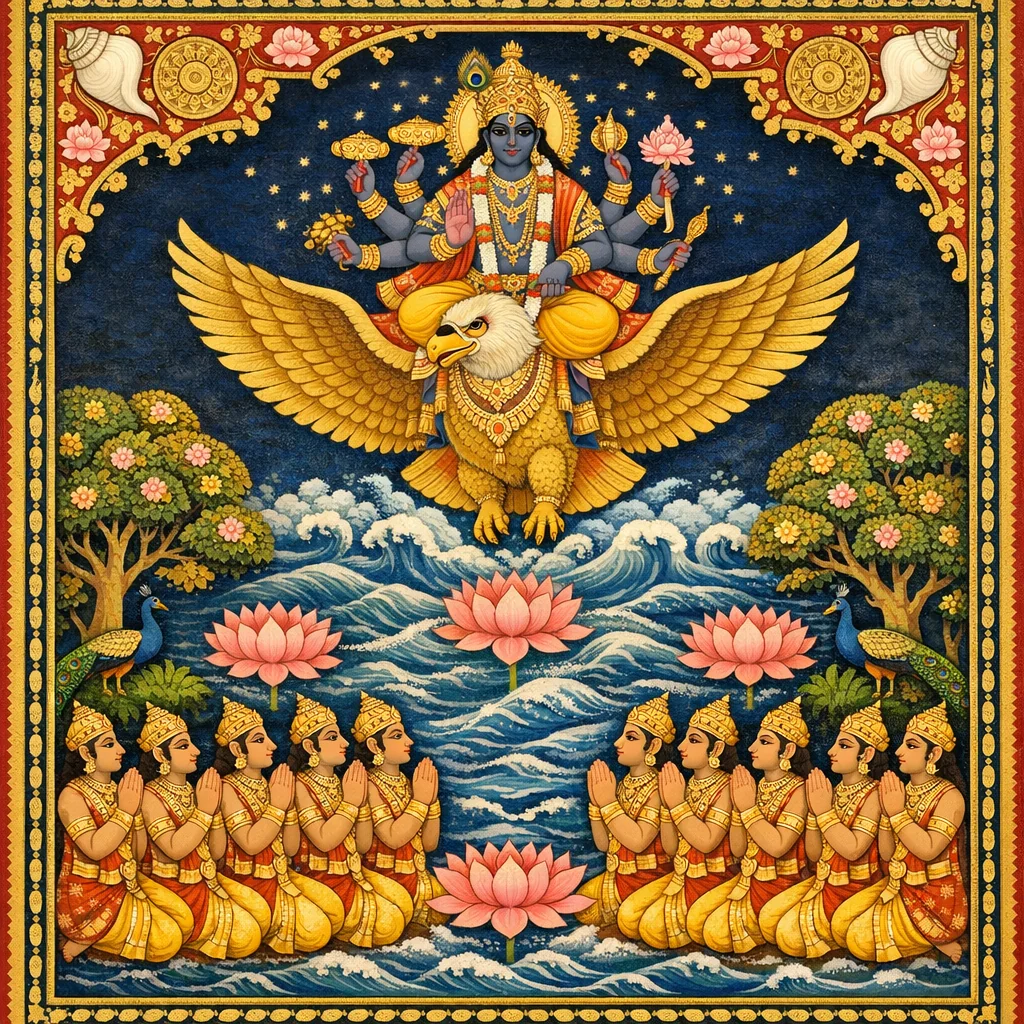
Adhyaya 30
The Pracetās Meet Lord Viṣṇu—Benedictions, Pure Prayer, and the Birth of Dakṣa
Vidura asks Maitreya what the Pracetās gained by chanting Śiva’s prayer and pleasing Viṣṇu. Maitreya describes their ten-thousand-year austerity in the ocean and the Lord’s appearance on Garuḍa in a radiant eight-armed form. Delighted especially by their mutual friendship and single-minded bhakti, Viṣṇu grants benedictions—fame, the future birth of an extraordinary son, and long enjoyment of worldly and heavenly facilities—culminating inevitably in purification into pure devotion and return to Godhead. The Pracetās reply with a theology-rich stuti, seeking not wealth but the Lord’s satisfaction and devotees’ association life after life, praising saṅkīrtana and the incomparable value of sādhu-saṅga. After the Lord departs, they find the earth choked with trees and, in anger, burn them with fire and air from their mouths. Brahmā pacifies them; the remaining trees offer Māriṣā, whom the Pracetās marry. From her is born Dakṣa (reborn due to an offense to Śiva), who resumes the work of populating the world, setting up the next arc on progeny, ritual power, and its purification.
Shlokas
Verse 1
विदुर उवाच ये त्वयाभिहिता ब्रह्मन् सुता: प्राचीनबर्हिष: । ते रुद्रगीतेन हरिं सिद्धिमापु: प्रतोष्य काम् ॥ १ ॥
Vidura asked: O brāhmaṇa, you once spoke of the sons of Prācīnabarhi, saying they pleased Śrī Hari by chanting Rudra’s hymn. What sacred perfection did they attain thereby?
Verse 2
किं बार्हस्पत्येह परत्र वाथ कैवल्यनाथप्रियपार्श्ववर्तिन: । आसाद्य देवं गिरिशं यदृच्छया प्रापु: परं नूनमथ प्रचेतस: ॥ २ ॥
My dear Bārhaspatya, after the Pracetās happened to meet Girīśa (Śiva), the beloved associate of the Lord, bestower of liberation, what did they gain in this world or the next? They surely attained the supreme abode—yet what else did they obtain?
Verse 3
मैत्रेय उवाच प्रचेतसोऽन्तरुदधौ पितुरादेशकारिण: । जपयज्ञेन तपसा पुरञ्जनमतोषयन् ॥ ३ ॥
Maitreya said: The Pracetās, obeying their father’s command, performed severe austerities within the ocean. By the sacrifice of japa—repeating the mantras given by Śiva—they satisfied Purañjana, Śrī Viṣṇu, the Supreme Lord.
Verse 4
दशवर्षसहस्रान्ते पुरुषस्तु सनातन: । तेषामाविरभूत्कृच्छ्रं शान्तेन शमयन् रुचा ॥ ४ ॥
When ten thousand years of severe austerity were completed, the eternal Puruṣa—the Supreme Lord—appeared before them in a most pleasing form, and by His शांत, radiant splendor He soothed the toil of their penance.
Verse 5
सुपर्णस्कन्धमारूढो मेरुशृङ्गमिवाम्बुद: । पीतवासा मणिग्रीव: कुर्वन्वितिमिरा दिश: ॥ ५ ॥
The Lord, seated upon Garuḍa’s shoulder, appeared like a cloud resting on Meru’s peak. Clad in yellow garments and adorned at the neck with the Kaustubha jewel, His bodily effulgence drove away the darkness from all directions of the universe.
Verse 6
काशिष्णुना कनकवर्णविभूषणेन भ्राजत्कपोलवदनो विलसत्किरीट: । अष्टायुधैरनुचरैर्मुनिभि: सुरेन्द्रै- रासेवितो गरुडकिन्नरगीतकीर्ति: ॥ ६ ॥
The Lord’s face was exquisitely beautiful, radiant with golden ornaments and a shining crown. With eight arms He bore various weapons, while demigods, great sages, and Indra and others stood around Him in devoted service. Garuḍa, beating his wings, chanted Vedic hymns to glorify the Lord’s fame, appearing like a resident of Kinnaraloka.
Verse 7
पीनायताष्टभुजमण्डलमध्यलक्ष्म्या स्पर्धच्छ्रिया परिवृतो वनमालयाद्य: । बर्हिष्मत: पुरुष आह सुतान् प्रपन्नान् पर्जन्यनादरुतया सघृणावलोक: ॥ ७ ॥
A forest garland hung from the Lord’s neck down to His knees, adorning His strong, elongated eight arms and seeming to rival even Lakṣmī’s splendor. With a compassionate glance and a voice like thunder, He addressed the surrendered sons of King Prācīnabarhiṣat.
Verse 8
श्रीभगवानुवाच वरं वृणीध्वं भद्रं वो यूयं मे नृपनन्दना: । सौहार्देनापृथग्धर्मास्तुष्टोऽहं सौहृदेन व: ॥ ८ ॥
The Supreme Lord said: O sons of the king, may auspiciousness be yours. I am greatly pleased by the friendship among you, for you are all engaged in one dharma—devotional service. Delighted by your mutual affection, you may now ask a benediction from Me.
Verse 9
योऽनुस्मरति सन्ध्यायां युष्माननुदिनं नर: । तस्य भ्रातृष्वात्मसाम्यं तथा भूतेषु सौहृदम् ॥ ९ ॥
Whoever remembers you each day at evening will develop heartfelt equality with his brothers and friendship toward all living beings.
Verse 10
ये तु मां रुद्रगीतेन सायं प्रात: समाहिता: । स्तुवन्त्यहं कामवरान्दास्ये प्रज्ञां च शोभनाम् ॥ १० ॥
Those who, with steady mind, praise Me morning and evening with the prayers composed by Lord Rudra will receive from Me their desired blessings, along with beautiful and noble intelligence.
Verse 11
यद्यूयं पितुरादेशमग्रहीष्ट मुदान्विता: । अथो व उशती कीर्तिर्लोकाननु भविष्यति ॥ ११ ॥
Because you joyfully accepted your father’s command within your hearts and carried it out with faithful resolve, your noble fame will be celebrated throughout the worlds.
Verse 12
भविता विश्रुत: पुत्रोऽनवमो ब्रह्मणो गुणै: । य एतामात्मवीर्येण त्रिलोकीं पूरयिष्यति ॥ १२ ॥
You will have a renowned son, in no way inferior to Lord Brahmā in virtue; by his own spiritual prowess he will fill the three worlds, and his descendants will spread throughout the triloka.
Verse 13
कण्डो: प्रम्लोचया लब्धा कन्या कमललोचना । तां चापविद्धां जगृहुर्भूरुहा नृपनन्दना: ॥ १३ ॥
The lotus-eyed daughter born from the union of the sage Kaṇḍu and the apsarā Pramlocā was left by Pramlocā in the care of the forest trees, and she returned to the heavenly realm. O princes, the trees received that forsaken child.
Verse 14
क्षुत्क्षामाया मुखे राजा सोम: पीयूषवर्षिणीम् । देशिनीं रोदमानाया निदधे स दयान्वित: ॥ १४ ॥
Then the child left in the trees’ care began to cry from hunger. The king of the forest—the Moon-god—moved by compassion, placed his nectar-flowing finger in her mouth; thus she was nourished by the mercy of the lunar king.
Verse 15
प्रजाविसर्ग आदिष्टा: पित्रा मामनुवर्तता । तत्र कन्यां वरारोहां तामुद्वहत मा चिरम् ॥ १५ ॥
Since you are obedient to My command and your father has ordered you to create progeny, marry at once that beautiful, virtuous maiden, and through her bring forth descendants.
Verse 16
अपृथग्धर्मशीलानां सर्वेषां व: सुमध्यमा । अपृथग्धर्मशीलेयं भूयात्पत्न्यर्पिताशया ॥ १६ ॥
You brothers are all of one nature—My devotees and obedient sons of your father. In the same way, that slender-waisted maiden is of the same disposition and has dedicated her intention to all of you; thus you, the sons of Prācīnabarhiṣat, and she stand on the same platform, united by a common principle of dharma.
Verse 17
दिव्यवर्षसहस्राणां सहस्रमहतौजस: । भौमान् भोक्ष्यथ भोगान् वै दिव्यांश्चानुग्रहान्मम ॥ १७ ॥
My dear princes, by My mercy you will enjoy the pleasures of this world and of the heavenly realms as well, without hindrance and with full strength, for one million celestial years.
Verse 18
अथ मय्यनपायिन्या भक्त्या पक्वगुणाशया: । उपयास्यथ मद्धाम निर्विद्य निरयादत: ॥ १८ ॥
Thereafter you will develop pure, unbroken devotional service to Me and be freed from all material taint. Then, completely unattached to both heavenly enjoyment and hellish conditions, you will return to My abode.
Verse 19
गृहेष्वाविशतां चापि पुंसां कुशलकर्मणाम् । मद्वार्तायातयामानां न बन्धाय गृहा मता: ॥ १९ ॥
For those who perform auspicious deeds in devotional service and always pass their lives in the Lord’s topics, the home is not considered bondage, even though they live within household life.
Verse 20
नव्यवद्धृदये यज्ज्ञो ब्रह्मैतद्ब्रह्मवादिभि: । न मुह्यन्ति न शोचन्ति न हृष्यन्ति यतो गता: ॥ २० ॥
Devotees, always engaged in devotional service, feel everything ever fresh and new within the heart, for the all-knowing Paramātmā dwelling there renews all experience. The knowers of the Absolute call this the Brahman position; in that liberated state one is neither bewildered, nor lamenting, nor needlessly jubilant.
Verse 21
मैत्रेय उवाच एवं ब्रुवाणं पुरुषार्थभाजनं जनार्दनं प्राञ्जलय: प्रचेतस: । तद्दर्शनध्वस्ततमोरजोमला गिरागृणन् गद्गदया सुहृत्तमम् ॥ २१ ॥
Maitreya said: When Janārdana, the Supreme Lord, had spoken thus, the Pracetās, with folded palms, began to offer prayers to Him—the bestower of life’s true success, the supreme benefactor, and the dearest friend of the devotee who removes all misery. Seeing the Lord face to face, their darkness and impurity were dispelled, and in voices choked with ecstasy they glorified Him.
Verse 22
प्रचेतस ऊचुः । नमो नमः क्लेशविनाशनाय । निरूपितोदारगुणाह्वयाय । मनोवचोवेगपुरोजवाय । सर्वाक्षमार्गैरगताध्वने नमः ॥ २२ ॥
The Pracetās said: O Lord, destroyer of all distress, we bow to You again and again. Your holy name and Your magnanimous transcendental qualities are supremely auspicious—this is already established. You outstrip the speed of mind and speech, and You are beyond the reach of material senses; therefore we offer You repeated obeisances.
Verse 23
शुद्धाय शान्ताय नम: स्वनिष्ठया मनस्यपार्थं विलसद्द्वयाय । नमो जगत्स्थानलयोदयेषु गृहीतमायागुणविग्रहाय ॥ २३ ॥
O Lord, pure and peaceful, we offer You our obeisances. For one whose mind is firmly fixed upon You, this world of duality—though seemingly meant for enjoyment—appears meaningless. For the creation, maintenance, and dissolution of the cosmos, You manifest as Brahmā, Viṣṇu, and Śiva, assuming forms connected with the guṇas of māyā; we bow to You.
Verse 24
नमो विशुद्धसत्त्वाय हरये हरिमेधसे । वासुदेवाय कृष्णाय प्रभवे सर्वसात्वताम् ॥ २४ ॥
Obeisances to Hari, whose being is utterly pure sattva, and to Hari-medhas, the Lord whose wisdom removes the devotee’s misery. Obeisances to Vāsudeva, who dwells everywhere; to Kṛṣṇa, the son of Vasudeva; and to Prabhava, who ever increases the strength and influence of all Sātvata devotees.
Verse 25
नम: कमलनाभाय नम: कमलमालिने । नम: कमलपादाय नमस्ते कमलेक्षण ॥ २५ ॥
Obeisances to the Lord of the lotus navel; obeisances to Him who wears a garland of lotuses. Obeisances to Him whose feet are lotus-like; O lotus-eyed Lord, obeisances unto You.
Verse 26
नम: कमलकिञ्जल्कपिशङ्गामलवाससे । सर्वभूतनिवासाय नमोऽयुङ्क्ष्महि साक्षिणे ॥ २६ ॥
O Lord, Your garment is yellow like the pollen of a lotus, yet it is not material. Dwelling in every heart, You are the direct witness of all beings’ deeds; again and again we offer You our reverent obeisances.
Verse 27
रूपं भगवता त्वेतदशेषक्लेशसङ्क्षयम् । आविष्कृतं न: क्लिष्टानां किमन्यदनुकम्पितम् ॥ २७ ॥
O Bhagavān, this form of Yours brings the complete destruction of all affliction. For us suffering, conditioned souls You have revealed Yourself thus—clear proof of Your limitless, causeless mercy; what then to speak of Your ever-favorable grace toward Your devotees?
Verse 28
एतावत्त्वं हि विभुभिर्भाव्यं दीनेषु वत्सलै: । यदनुस्मर्यते काले स्वबुद्ध्याभद्ररन्धन ॥ २८ ॥
O Lord, destroyer of all inauspiciousness, the compassionate great souls cherish this alone: that in due time You may be remembered through Your expansion as the arcā-vigraha. Please regard us as Your eternal servants.
Verse 29
येनोपशान्तिर्भूतानां क्षुल्लकानामपीहताम् । अन्तर्हितोऽन्तर्हृदये कस्मान्नो वेद नाशिष: ॥ २९ ॥
Though we are insignificant, when the Lord, by His natural compassion, turns His thought to His devotee, by that alone the desires of the neophyte are pacified and fulfilled. Hidden within every heart, how could He not know our longings?
Verse 30
असावेव वरोऽस्माकमीप्सितो जगत: पते । प्रसन्नो भगवान् येषामपवर्गगुरुर्गति: ॥ ३० ॥
O Lord of the universe, You are the true teacher of the science of bhakti. The boon we seek is only this: that You be pleased with us, for You are the guru of liberation and the supreme destination. We desire nothing beyond Your full satisfaction.
Verse 31
वरं वृणीमहेऽथापि नाथ त्वत्परत: परात् । न ह्यन्तस्त्वद्विभूतीनां सोऽनन्त इति गीयसे ॥ ३१ ॥
O Lord, we pray for Your benediction, for You are the Supreme beyond all transcendence. Your opulences have no end; therefore You are glorified as Ananta, the Infinite.
Verse 32
पारिजातेऽञ्जसा लब्धे सारङ्गोऽन्यन्न सेवते । त्वदङ्घ्रिमूलमासाद्य साक्षात्किं किं वृणीमहि ॥ ३२ ॥
O Lord, when a bee reaches the heavenly pārijāta tree, it seeks nothing else. Likewise, having taken shelter at Your lotus feet, what further benediction could we ask from You?
Verse 33
यावत्ते मायया स्पृष्टा भ्रमाम इह कर्मभि: । तावद्भवत्प्रसङ्गानां सङ्ग: स्यान्नो भवे भवे ॥ ३३ ॥
O Lord, as long as, touched by Your māyā, we must wander in this world by karma—from body to body and from planet to planet—may we, life after life, have the association of devotees who discuss Your pastimes.
Verse 34
तुलयाम लवेनापि न स्वर्गं नापुनर्भवम् । भगवत्सङ्गिसङ्गस्य मर्त्यानां किमुताशिष: ॥ ३४ ॥
Even a moment’s association with a pure devotee cannot be compared to attaining heaven or even merging into Brahman’s effulgence in liberation. For mortal beings, the company of pure devotees is the highest benediction.
Verse 35
यत्रेड्यन्ते कथा मृष्टास्तृष्णाया: प्रशमो यत: । निर्वैरं यत्र भूतेषु नोद्वेगो यत्र कश्चन ॥ ३५ ॥
Wherever the pure and delightful narrations of the Lord are honored and heard, the thirst of material desire is calmed. There, among all beings, there is no enmity, and no one is troubled by anxiety or fear.
Verse 36
यत्र नारायण: साक्षाद्भगवान्न्यासिनां गति: । संस्तूयते सत्कथासु मुक्तसङ्गै: पुन: पुन: ॥ ३६ ॥
Where the liberated devotees, free from all attachment, glorify the Lord in sacred narrations and chant again and again the holy name of Bhagavān Nārāyaṇa, there Nārāyaṇa is present directly; He is the supreme goal of the sannyāsīs.
Verse 37
तेषां विचरतां पद्भ्यां तीर्थानां पावनेच्छया । भीतस्य किं न रोचेत तावकानां समागम: ॥ ३७ ॥
O Lord, Your own associates—the devotees—wander everywhere, desiring to purify even the holy places of pilgrimage. For one truly afraid of material existence, how could the meeting with Your people not be pleasing?
Verse 38
वयं तु साक्षाद्भगवन् भवस्य प्रियस्य सख्यु: क्षणसङ्गमेन । सुदुश्चिकित्स्यस्य भवस्य मृत्यो- र्भिषक्तमं त्वाद्य गतिं गता: स्म ॥ ३८ ॥
O Bhagavān, by a moment’s association with Śambhu (Śiva), Your most intimate friend and very dear to You, we were blessed to attain You. You are the supreme physician who cures the otherwise incurable disease of samsāra; we have taken shelter of Your lotus feet.
Verse 39
यन्न: स्वधीतं गुरव: प्रसादिता विप्राश्च वृद्धाश्च सदानुवृत्त्या । आर्या नता: सुहृदो भ्रातरश्च सर्वाणि भूतान्यनसूययैव ॥ ३९ ॥ यन्न: सुतप्तं तप एतदीश निरन्धसां कालमदभ्रमप्सु । सर्वं तदेतत्पुरुषस्य भूम्नो वृणीमहे ते परितोषणाय ॥ ४० ॥
O Lord, we have studied the Vedas, pleased our spiritual teachers, and served brāhmaṇas and spiritually advanced elders; we have bowed to the noble, to friends and brothers, and remained free from envy toward any being. O Purusottama, we offer all these merits solely for Your satisfaction.
Verse 40
यन्न: स्वधीतं गुरव: प्रसादिता विप्राश्च वृद्धाश्च सदानुवृत्त्या । आर्या नता: सुहृदो भ्रातरश्च सर्वाणि भूतान्यनसूययैव ॥ ३९ ॥ यन्न: सुतप्तं तप एतदीश निरन्धसां कालमदभ्रमप्सु । सर्वं तदेतत्पुरुषस्य भूम्नो वृणीमहे ते परितोषणाय ॥ ४० ॥
O Īśa, we performed severe austerities within the water, fasting for a long time, free from the pride of time and from delusion. O Purusottama, we offer all of this only for Your satisfaction; we ask for nothing else.
Verse 41
मनु: स्वयम्भूर्भगवान् भवश्च येऽन्ये तपोज्ञानविशुद्धसत्त्वा: । अदृष्टपारा अपि यन्महिम्न: स्तुवन्त्यथो त्वात्मसमं गृणीम: ॥ ४१ ॥
O Lord, even Manu, Brahmā the self-born, Bhagavān Śiva, and the great yogīs purified by austerity and knowledge, established in pure being, cannot fully fathom Your glories and potencies. Yet they praise You according to their capacity; in the same way we too, though far lesser, offer prayers to You as we are able.
Verse 42
नम: समाय शुद्धाय पुरुषाय पराय च । वासुदेवाय सत्त्वाय तुभ्यं भगवते नम: ॥ ४२ ॥
O Bhagavān, You are equal to all, perfectly pure, and the Supreme Purusha. Dwelling everywhere within all existence, You are known as Vāsudeva; You are of the nature of sattva and beyond all material contamination. We offer You our respectful obeisances.
Verse 43
मैत्रेय उवाच इति प्रचेतोभिरभिष्टुतो हरि: प्रीतस्तथेत्याह शरण्यवत्सल: । अनिच्छतां यानमतृप्तचक्षुषां ययौ स्वधामानपवर्गवीर्य: ॥ ४३ ॥
Maitreya said: O Vidura, thus praised by the Pracetās, Hari—the protector of the surrendered and affectionate to His devotees—was pleased and replied, “So be it; may your prayers be fulfilled.” Having spoken, the Lord, whose prowess is unconquered, departed to His own abode. The Pracetās, their eyes not yet satisfied, did not wish to be separated from Him.
Verse 44
अथ निर्याय सलिलात्प्रचेतस उदन्वत: । वीक्ष्याकुप्यन्द्रुमैश्छन्नां गां गां रोद्धुमिवोच्छ्रितै: ॥ ४४ ॥
Thereafter the Pracetās emerged from the waters of the ocean. They saw that the trees upon the earth had grown exceedingly tall, as if rising to block the path to the heavenly realms, and that the whole surface of the world was covered by them. Seeing this, the Pracetās became very angry.
Verse 45
ततोऽग्निमारुतौ राजन्नमुञ्चन्मुखतो रुषा । महीं निर्वीरुधं कर्तुं संवर्तक इवात्यये ॥ ४५ ॥
O King, just as at the time of devastation Rudra, in anger, emits fire and wind from his mouth, so the Pracetās too, enraged, released fire and air from their mouths to make the earth entirely without trees and vegetation.
Verse 46
भस्मसात्क्रियमाणांस्तान् द्रुमान्वीक्ष्य पितामह: । आगत: शमयामास पुत्रान् बर्हिष्मतो नयै: ॥ ४६ ॥
Seeing the trees upon the earth being reduced to ashes, Grandfather Brahmā at once came and pacified the sons of King Barhiṣmān with words of sound reason.
Verse 47
तत्रावशिष्टा ये वृक्षा भीता दुहितरं तदा । उज्जह्रुस्ते प्रचेतोभ्य उपदिष्टा: स्वयम्भुवा ॥ ४७ ॥
The trees that remained, terrified of the Pracetās, at once presented their daughter, acting on the counsel of Svayambhū Brahmā.
Verse 48
ते च ब्रह्मण आदेशान्मारिषामुपयेमिरे । यस्यां महदवज्ञानादजन्यजनयोनिज: ॥ ४८ ॥
Obeying Brahmā’s command, the Pracetās accepted Māriṣā as their wife. From her womb was born Dakṣa, a son of Brahmā; because he had disobeyed and disrespected Mahādeva (Śiva), he had to be born from Māriṣā and thus abandoned his body twice.
Verse 49
चाक्षुषे त्वन्तरे प्राप्ते प्राक्सर्गे कालविद्रुते । य: ससर्ज प्रजा इष्टा: स दक्षो दैवचोदित: ॥ ४९ ॥
In the Cākṣuṣa manvantara, though his former body had been destroyed in the previous creation by the course of time, that same Dakṣa—impelled by divine will—created all the desired living beings.
Verse 50
यो जायमान: सर्वेषां तेजस्तेजस्विनां रुचा । स्वयोपादत्त दाक्ष्याच्च कर्मणां दक्षमब्रुवन् ॥ ५० ॥ तं प्रजासर्गरक्षायामनादिरभिषिच्य च । युयोज युयुजेऽन्यांश्च स वै सर्वप्रजापतीन् ॥ ५१ ॥
Upon his birth, Dakṣa, by the surpassing radiance of his bodily luster, eclipsed the splendor of all who were brilliant. Because he was supremely skilled in the performance of karma, he was called “Dakṣa,” meaning “the very expert.”
Verse 51
यो जायमान: सर्वेषां तेजस्तेजस्विनां रुचा । स्वयोपादत्त दाक्ष्याच्च कर्मणां दक्षमब्रुवन् ॥ ५० ॥ तं प्रजासर्गरक्षायामनादिरभिषिच्य च । युयोज युयुजेऽन्यांश्च स वै सर्वप्रजापतीन् ॥ ५१ ॥
Upon his birth, Dakṣa, by the surpassing radiance of his own body, eclipsed the splendor of all others. Because he was exceedingly expert in the performance of karmic works, he was called Dakṣa—“the most capable.” Therefore Lord Brahmā appointed him to the task of generating and protecting the living beings, and in due course Dakṣa engaged the other Prajāpatis as well in the work of creation and maintenance.
Frequently Asked Questions
Their unity shows purified consciousness: no envy, one purpose, and cooperative devotional service. In Bhāgavata theology, such non-envious harmony is a sign of sattva refined by bhakti; it is especially pleasing to the Lord because it mirrors the spiritual world’s relational fabric, where devotion is expressed through loving cooperation rather than competition.
The Lord frames their enjoyment as non-obstructive because it is granted under His shelter and followed by the rise of unadulterated bhakti. The chapter explicitly states the bhakti principle: one who offers the results of action to Bhagavān is not bound even while living in family life. Thus, enjoyment does not become bondage when detached and dedicated to the Supreme.
It expresses mature bhakti: they value the means that continually awakens love of God—association and hari-kathā—above heaven, mystic success, or even impersonal liberation. The chapter asserts that even a moment with a pure devotee surpasses heavenly promotion and Brahman merging, because sādhu-saṅga directly plants and nourishes devotion.
Māriṣā is the daughter connected to Pramlocā and Kaṇḍu, cared for by the trees and nourished by the Moon’s nectar. Her marriage to the Pracetās fulfills the cosmic order to generate progeny while keeping their shared unity intact; it also becomes the instrument for Dakṣa’s rebirth, linking this chapter to the broader Dakṣa–Śiva narrative tensions in the Purāṇa.
Dakṣa’s rebirth is attributed to disobedience and disrespect toward Śiva (Mahādeva), showing that even powerful administrators are accountable to dharma and Vaiṣṇava principles. The narrative uses Dakṣa to illustrate how pride in ritual power can lead to downfall, and how cosmic administration (visarga/prajā-sarga) must remain aligned with devotion and respect for the Lord’s devotees.