Adhyaya 266
Māheśvara-snāna: Lakṣa/Koṭi-homa, Protective Baths, Unguents, and Graha-Śānti
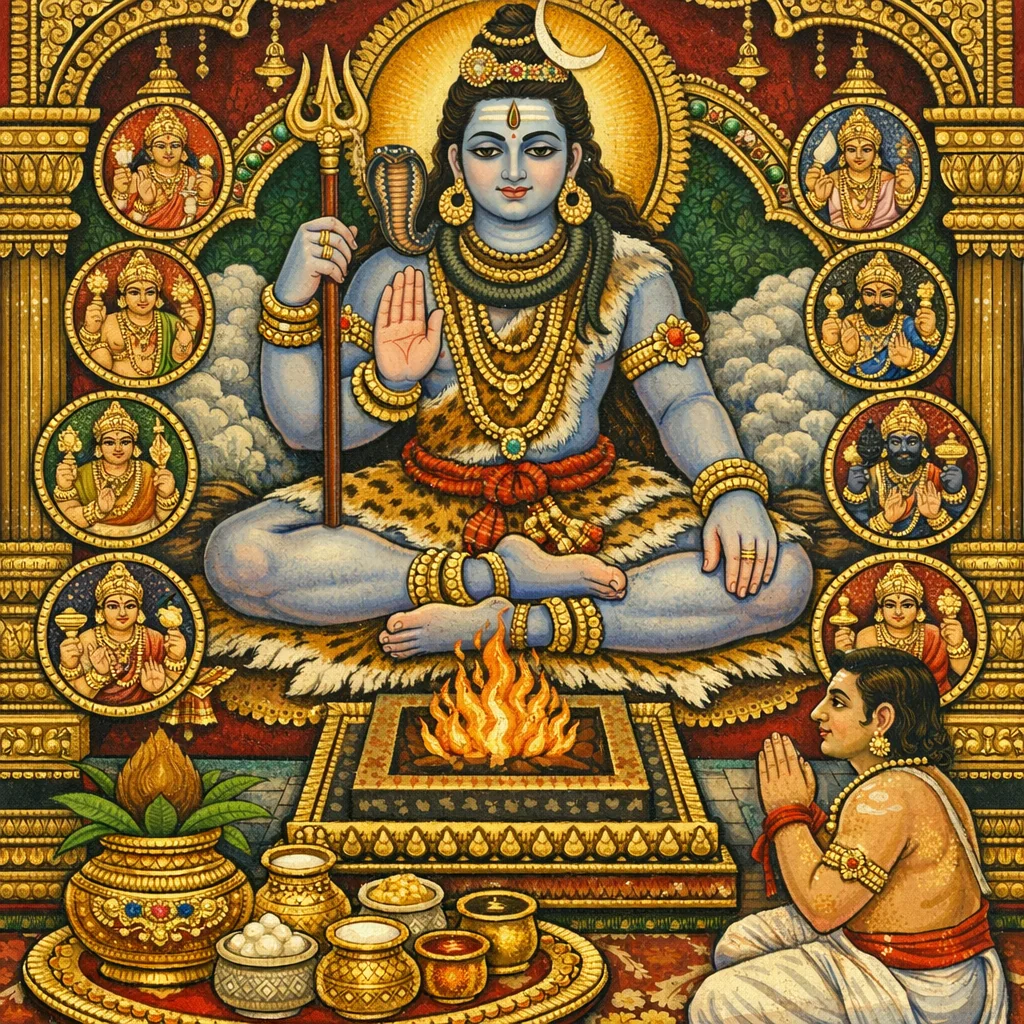
This chapter transitions from the prior Vināyaka-snāna and teaches the Māheśvara bath as a victory-enhancing rite for kings and leaders, traced to Uśanā’s instruction to Bali. Before dawn one bathes the pedestal/deity with pots of water, reciting a mantra that breaks the force of disputes and a protection formula invoking fierce solar power and Śiva as Tripurāntaka, like the saṃvartaka fire. Afterward sesame and rice oblations are offered; pañcāmṛta bathing and worship of Śūlapāṇi follow. The text then classifies snāna substances—ghee, cow products, milk/curd, kuśa-water, śatamūla, horn-sanctified water, and botanical/medicinal mixtures—assigning results such as āyuḥ, lakṣmī, pāpa-kṣaya, rakṣā, and medhā. It exalts Viṣṇu-pāda-udaka as supreme, adds solitary Arka worship with amulet-binding, and prescribes therapeutic offerings and unctuous baths for pitta, atisāra, vāta, and kapha. The chapter culminates in large-scale lakṣa/koṭi-homa in a square kuṇḍa with specified offerings, and a graha-pūjā using the Gāyatrī for progressive, comprehensive śānti.
Shlokas
Verse 1
ये महापुराणे विनायकस्नानं नाम पञ्चषष्ट्यधिकद्विशततमो ऽध्यायः वषट्कारसमन्वितैर् इति घ , ज , ञ , ट च अथ षट्षष्ठ्यधिकद्विशततमो ऽध्यायः माहेश्वरस्नानलक्षकोटिहोमादयः पुष्कर उवाच स्नानं माहेश्वरं वक्ष्ये राजादेर्जयवर्धनम् दानवेन्द्राय बलये यज्जगादोशनाः पुरा
In this Mahāpurāṇa ends the chapter called “Vināyaka-bath,” the two-hundred-and-sixty-fifth (counted as two hundred plus sixty-five); its closing formula is “with the utterance ‘vaṣaṭ’,” as read in the Gha, Ja, Ña and Ṭa recensions. Now begins the two-hundred-and-sixty-sixth chapter: “The Māheśvara bath, (merit) in lakhs and crores, fire-offerings and related rites.” Puṣkara said: I shall describe the Māheśvara (Śiva-related) bath, which increases victory for kings and the like—the very bath which Uśanā (Śukra) formerly taught to Bali, lord of the Dānavas.
Verse 2
भास्करे ऽनुदिते पीठे प्रातः संस्नापयेद् घटैः वादेषु भञ्जय ॐ मथ मथ सर्वपथिकान्योसौ युगान्तकाले दिधक्षति इमां पूजां रौद्रमूर्तिः सहस्रांशुः शुक्रः स ते रक्षतु जीवितं सम्बर्तकाग्नितुल्यश् च त्रिपुरान्तकरः शिवः सर्वदेवमयः सोपि तव रक्षतु जीवितं लिखि लिखि खिलि स्वाहा एवं स्नतस्तु मन्त्रेण जुहुयात्तिलतण्डुलम्
Before the Sun has risen, in the morning, one should bathe (the sacred seat/pedestal) with pots of water upon the pīṭha. In disputes and hostile contentions, “break” their force. “Oṃ—churn, churn! He who at the end of the age burns up all wayfarers: may that fierce-formed one—the thousand-rayed Sun, and Śukra—protect your life. And Śiva, the destroyer of Tripura, equal to the cosmic Saṃvartaka fire—he too, being constituted of all the gods—may protect your life. likhi likhi, khili—svāhā.” Having thus bathed with this mantra, one should offer oblations using sesame and rice-grains.
Verse 3
पञ्चामृतैस्तु संस्नाप्य पूजयेच्छूलपाणिनं स्नानान्यन्यानि वक्ष्यामि सर्वदा विजयाय ते
After bathing (the deity) with the five nectars (pañcāmṛta), one should worship Śūlapāṇi (Śiva, the trident-bearer). I shall describe other forms of ritual bathing as well—rites that are always for your victory.
Verse 4
स्नानं घृतेन कथितमायुष्यवर्धनं परम् गोमयेन च लक्ष्मीः स्याद्गोमूत्रेणाघमर्दनम्
Bathing with ghee (ghṛta) is declared to be supremely life-promoting. With cow-dung, prosperity (Lakṣmī) arises; with cow-urine, sin and impurity are destroyed.
Verse 5
क्षीरेण बलबुद्धिः स्याद्दध्ना लक्ष्मीविवर्धनं कुशोदकेन पापान्तः पञ्चगव्येन सर्वभाक्
By milk, strength and clarity of intellect arise; by curd, prosperity increases; by water infused with kuśa, sin is brought to an end; and by pañcagavya one becomes purified and fit to partake of all.
Verse 6
शतमूलेन सर्वाप्तिर्गोशृङ्गोदकतो ऽघजित् पलाशबिल्वकमलकुशस्नानन्तु सर्वदं
By bathing with the preparation called Śatamūla one gains complete attainment of desired results. By water sanctified with a cow’s horn, sins are conquered. A bath using palāśa, bilva, lotus, and kuśa bestows all benefits.
Verse 7
वचा हरिद्रे द्वे मुस्तं स्नानं रक्षोहणं परं आयुष्यञ्च यशस्यञ्च धर्ममेधाविवर्धनम्
A bath prepared with vacā (sweet flag), the two haridrā (two turmerics), and mustā (nut-grass) is supremely protective against malignant beings; it promotes longevity and fame, and increases dharma and intelligence.
Verse 8
हैमाद्भिश् चैव माङ्गल्यं रूप्यताम्रोदकैस् तथा रत्नोदकैस्तु विजयः सौभाग्यं सर्वगन्धकैः
With water associated with gold comes auspiciousness; likewise with water associated with silver and copper. With water empowered by gems comes victory; and with water made fragrant with all perfumes comes good fortune (saubhāgya).
Verse 9
फलाद्भिश् च तथारोग्यं धात्र्यद्भिः परमां श्रियम् तिलसिद्धार्थकैर् लक्ष्मीः सौभाग्यञ्च प्रियङ्गुणा
By water infused with fruits one gains health; by water infused with dhātrī/āmalakī one attains supreme prosperity. By bathing with sesame and siddhārthaka (white mustard), Lakṣmī (fortune) is obtained, and likewise saubhāgya along with lovable virtues.
Verse 10
पद्मोत्पलकदम्बैश् च श्रीर्बलं बलाद्रुमोदकैः विष्णुपादोदकस्नानं सर्वस्नानेभ्य उत्तमम्
With lotus, blue-lotus, and kadamba flowers, with auspiciousness and strength, and with the water of the balā-tree—bathing in the water that has washed Viṣṇu’s feet is the supreme among all baths.
Verse 11
एकाकी एककामायेत्येकोर्कं विधिवच्चरेत् अक्रन्दयतिसूक्तेन प्रबध्नीयान्मणिं करे
Being alone, intent upon a single aim, one should ritually worship the Sun (Arka) in due accordance with the rule. Then, using the hymn that begins “akrandayati…”, one should firmly bind the gem-amulet (maṇi) upon the hand.
Verse 12
कुष्ठपाठा वाचा शुण्ठी शङ्खलोहादिको मणिः सर्वेषामेवकामानामीश्वरो भगवान् हरिः
Kuṣṭha, pāṭhā, vācā, and śuṇṭhī—together with a maṇi (amulet-gem) such as conch and iron—are prescribed for the fulfillment of all desires; and the Lord, Bhagavān Hari, is the sovereign over all desires.
Verse 13
तस्य संपूजनादेव सर्वान्कामान्समश्नुते स्नापयित्वा घृतक्षीरैः पूजयित्वा च पित्तहा
By merely performing complete worship of that (deity/remedy), one attains all desired aims. Having bathed (the image/liṅga) with ghee and milk and then worshipped it, it becomes a destroyer of pitta (bile-disorder).
Verse 14
पञ्चमुद्गबलिन्दत्वा अतिसारात् प्रमुच्यते पञ्चगव्येन संस्नाप्य वातव्याधिं विनाशयेत्
By offering a bali (oblation) of five measures of mung-beans, one is freed from diarrhoea. By bathing (the patient) with pañcagavya (the five products of the cow), one should destroy diseases arising from vāta.
Verse 15
द्विस्नेहस्नपनात् श्लेष्मरोगहा चातिपूजया घृतं तैलं तथा क्षौद्रं स्नानन्तु त्रिरसं परं
By bathing with two oleaginous substances (dvi-sneha-snāna, double-unction bathing), disorders arising from kapha (phlegm) are destroyed. For special efficacy, ghee, oil, and honey are prescribed; this bath—endowed with the three tastes/essences—is regarded as excellent.
Verse 16
स्नानं घृताम्बु द्विस्नेहं समलं घृततैलकम् क्षौद्रमिक्षुरसं क्षीरं स्नानं त्रिमधुरं स्मृतम्
A bath prepared with ghee-water (ghṛtāmbu) is called the “two-unctuous” (dvi-sneha) bath, compounded of ghee and sesame oil. A bath consisting of honey, sugarcane juice, and milk is remembered as the “three-sweet” (tri-madhura) bath.
Verse 17
घृतमिशुरसं तैलं क्षौद्रञ्च त्रिरसं श्रिये यवकामायेत्येकोर्कमिति क , छ च अनुलेपस्त्रिशुक्रस्तु कर्पूरोशीरचन्दनैः
Oil blended with ghee and also with honey—prepared as a “three-essence” (tri-rasa) mixture—is applied for śrī, prosperity. The unguent (anulepa) called Triśukra is prepared with camphor, vetiver (uśīra), and sandalwood.
Verse 18
चन्दनागुरुकर्पूरमृगदर्पैः सकुङ्कुमैः पञ्चानुलेपनं विष्णोः सर्वकामफलप्रदं
The fivefold sacred unguent for Viṣṇu—made with sandalwood, agaru, camphor, musk, and saffron (kuṅkuma)—bestows the fruits of all desired aims.
Verse 19
त्रिसुगन्धञ्च कर्पूरं तथा चन्दनकुङ्कुमैः मृगदर्पं सकर्पूरं मलयं सर्वकामदम्
“Trisugandha” with camphor, likewise combined with sandalwood and saffron; and musk-fragrance together with camphor—this compound called “Malaya” is said to bestow all desired aims.
Verse 20
जातीफलं सकर्पूरं चन्दनञ्च त्रिशीतकम् पीतानि शुक्लवर्णानि तथा शुक्लानि भार्गव
Nutmeg (jātīphala), together with camphor and sandalwood—these three are cooling substances. They are classed among the pale-yellow and white-colored drugs; likewise they are regarded as “white” (śukla) substances, O Bhārgava.
Verse 21
कृष्णानि चैव रक्तानि पञ्चवर्णानि निर्दिशेत् उत्पलं पद्मजाती च त्रिशीतं हरिपूजने
For the worship of Hari (Viṣṇu), one should prescribe the selection of flowers of five colours, including dark (black/blue-hued) and red ones—such as the blue lotus (utpala), the lotus species (padma-jātī), and the triśīta flower—for Hari’s adoration.
Verse 22
कुङ्कुमं रक्तपद्मानि त्रिरक्तमुत्पलं धूपदीपादिभिः प्रार्च्य विष्णुं शान्तिर्भवेन्नृणां
Having worshipped Viṣṇu with saffron (kuṅkuma), red lotuses, the deep-red (“threefold-red”) utpala, and with incense, lamps, and the like, peace and appeasement arise for human beings.
Verse 23
चतुरस्रकरे कुण्डे ब्राह्मणाश्चाष्ट शोडश लक्षहोमङ्कोटिहोमन्तिलाज्ययवधान्यकैः
In a square-shaped fire-pit (kuṇḍa), the rite should be performed by eight or sixteen Brāhmaṇas, with homa oblations numbering a lakh (100,000) or even a koṭi (ten million), using sesame, ghee, barley, and grains as the offering materials.
Verse 24
ग्रहानभ्यर्च्य गायत्र्या सर्वशान्तिः क्रमाद्भवेत्
Having duly worshipped the grahas (planets) with the Gāyatrī mantra, complete pacification of all afflictions arises gradually, in due order.
Frequently Asked Questions
It is presented as a Śiva-related bath rite that increases victory (jaya-vardhana), especially for rulers and those engaged in conflict, while also functioning as a broad protective and purificatory discipline.
Bathing with Viṣṇu-pāda-udaka (water that has washed Viṣṇu’s feet, i.e., caraṇāmṛta) is declared the supreme (uttama) among all snānas.
It assigns specific rites and substances to conditions resembling doṣa disorders—e.g., ghee-and-milk worship as pitta-hara, pañcagavya bathing for vāta disorders, and double-unctuous bathing for kapha-related ailments.
It prescribes lakṣa or koṭi oblations in a square (caturasra) fire-pit, performed by eight or sixteen brāhmaṇas using tila, ājya, yava, and grains, culminating in graha worship with the Gāyatrī for complete pacification.