Adhyaya 271
Dānādi-māhātmya — The Glory of Gifts, Manuscript-Donation, and Purāṇic Transmission
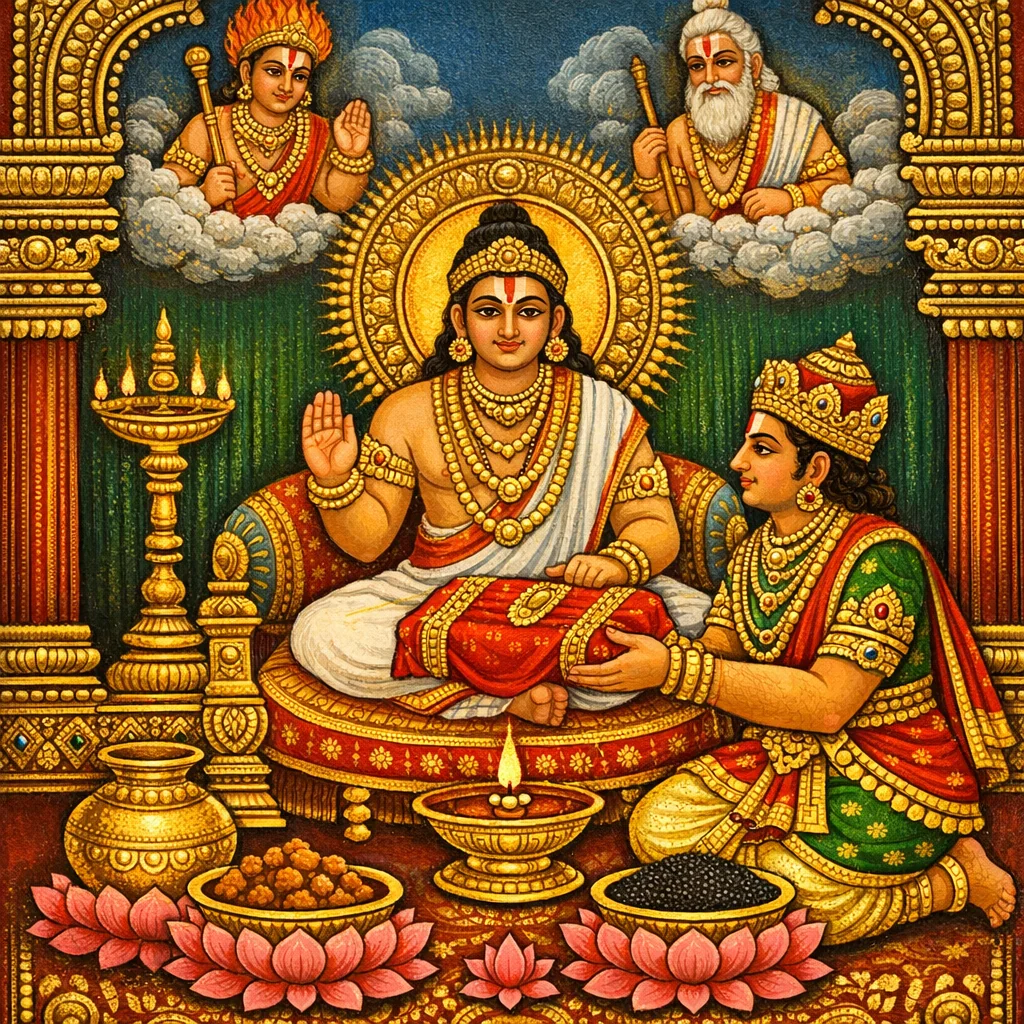
This chapter, following the close of the discussion on Vedic branches, turns to dāna as a chief instrument of dharma and as a means of preserving revelation through lines of transmission. Puṣkara sets out merit-bearing gifts keyed to calendrical markers—full-moon days, months, nakṣatras, equinoxes, and ayana. A distinctive stress falls on “knowledge as gift”: having sacred teachings written out and properly presented, especially Itihāsa and Purāṇa texts. The teaching interweaves symbolic dhenu-gifts (water-cow, jaggery-cow, sesame-cow) and emblematic golden forms (lion, tortoise, fish, haṃsa, garuḍa) with references to Purāṇic corpora, their verse-counts, and their revelatory lineages (e.g., Agni to Vasiṣṭha; Bhava to Manu; Sāvarṇi to Nārada). It culminates in a ritual model for honoring reciters and manuscripts during Bhārata recitation cycles, prescribing feeding, honoring, and repeated gifting. The theological throughline is that preserving, transmitting, and generously patronizing dharma-literature yields worldly well-being (āyuḥ, ārogya) and the highest ends (svarga, mokṣa).
Shlokas
Verse 1
इत्याग्नेये महापुराणे वेदशाखादिकीर्तिनं नाम सप्तत्यधिकद्विशततमो ऽध्यायः अथैकसप्तत्यधिकद्विशततमो ऽध्यायः दानादिमाहत्म्यं पुष्कर उवाच ब्रह्मणाभिहितं पूर्वं यावन्मात्रं मरीचये लक्षार्धाद्धन्तु तद्ब्राह्मं लिखित्वा सम्प्रदापयेत्
Thus, in the Agni Mahāpurāṇa ends the two-hundred-and-seventy-first chapter, called “The Enumeration of the Vedic Branches and the Like.” Now begins the two-hundred-and-seventy-second chapter, “The Glory of Gifts and Related Acts.” Puṣkara said: “Whatever measure of sacred teaching was formerly taught by Brahmā to Marīci—one should give half a lakh (of units/coins) for that Brahma-teaching, and, having it written out, should duly present it as a gift.”
Verse 2
वैशाख्याम्पौर्णमास्याञ्च स्वर्गार्थी जलधेनुमत् पाद्मं द्वादशसाहस्रं द्यैष्ठे दद्याच्च धेनुमत्
On the full-moon day in Vaiśākha, one who seeks heaven should give the gift called the “Water-Cow” (jala-dhenu). In Jyeṣṭha, one should give a Padma-gift of twelve thousand (units), and also a cow as a gift.
Verse 3
वराहकल्पवृत्तान्तमधिकृत्य पराशरः त्रयोविंशतिसाहस्रं वैष्णवं प्राह चार्पयेत्
Basing himself on the account of the Varāha-kalpa, Parāśara expounded a Vaiṣṇava Purāṇa consisting of twenty-three thousand verses, and it is to be transmitted onward in the tradition.
Verse 4
जलधेनुमदाषाढ्यां विष्णोः पदमवाप्नुयात् चतुर्दशसहस्राणि वायवीयं हरिप्रियं
By donating a “water-cow” (jaladhenu) together with the Āṣāḍhā offering, one attains the abode of Viṣṇu; this act yields fourteen thousand measures of merit, Vāyavīya in character and dear to Hari.
Verse 5
श्वेतकल्पप्रसङ्गेन धर्मान् वायुरिहाब्रवीत् दद्याल्लिखित्वा तद्विप्रे श्रावण्यां गुडधेनुमत्
In the course of the Śvetakalpa narrative, Vāyu here proclaimed the ordinances of Dharma: one should have them written down and, on the Śrāvaṇī day, give to a brāhmaṇa a “molasses-cow” (guḍadhenu)—a cow-offering whose principal substance is jaggery.
Verse 6
यत्राधिकृत्य गायत्रीं कीर्त्यते धर्मविस्तरः वृत्रासुरबधोपेतं तद्भागवतमुच्यते
That (Purāṇa) in which—taking the Gāyatrī as the starting point—the extensive exposition of dharma is proclaimed, and which includes the slaying of the demon Vṛtrāsura, is called the Bhāgavata (Purāṇa).
Verse 7
सारस्वतस्त कल्पस्य प्रोष्ठपद्यान्तु तद्ददेत् अष्टादशसहस्राणि हेमसिंहसमन्वितं
In the Sārasvata rite (kalpa), on the occasion of Proṣṭhapadā, one should give that—eighteen thousand (units of wealth)—together with a golden lion as an attached emblem.
Verse 8
यत्राह नारदो धर्मान् वृहत्कल्पाश्रितानिहं पञ्चविंशसहस्राणि नारदीयं तदुच्यते
That (treatise) in which Nārada here expounded the laws (dharmas) grounded in the Great Kalpa—amounting to twenty-five thousand (verses)—is called the Nāradiya.
Verse 9
सधेनुञ्चाश्विने दद्यात्सिद्धिमात्यन्तिकीं लभेत् यत्राधिकृत्य शत्रूनान्धर्माधर्मविचारणा
One should gift a cow to the Aśvins; thereby one attains the ultimate siddhi. In that context, taking up the matter of enemies, there is an inquiry into what is dharma and what is adharma.
Verse 10
कार्त्तिक्यां नवसाहस्रं मार्कण्डेयमथार्पयेत् अग्निना यद्वशिष्ठाय प्रोक्तञ्चाग्नेयमेव तत्
In the Purāṇa called Kārttikya there are nine thousand verses; then one should record the count for the Mārkaṇḍeya (Purāṇa). And what Agni taught to Vasiṣṭha is indeed the Agneya (Purāṇa) itself.
Verse 11
लिखित्वा पुस्तकं दद्यान्मार्गशीर्ष्यां स सर्वदः द्वादशैव सहस्राणि सर्वविद्यावबोधनं
Having written out a book, one should donate it in the month of Mārgaśīrṣa; such a donor becomes a bestower of knowledge at all times. The merit is said to be twelve thousand, awakening understanding of all branches of learning.
Verse 12
चतुर्दशसहस्राणि भविष्यं सूर्यसम्भवं भवस्तु मनवे प्राह दद्यात् पौष्यां गुडादिमत्
The Bhaviṣya (Purāṇa), born of the Sun, comprises fourteen thousand verses. Bhava spoke this to Manu: on the Puṣyā nakṣatra one should give a gift consisting of guda (jaggery) and similar items.
Verse 13
सावर्णिना नारदाय ब्रह्मवैवर्तमीरितं रथान्तरस्य वृत्तान्तमष्टादशसहस्रकं
By Sāvarṇi, the Brahmavaivarta (Purāṇa) was declared to Nārada—containing the account of Rathāntara—in an extent of eighteen thousand verses.
Verse 14
माघ्यान्दद्याद्वराहस्य चरितं ब्रह्मलोकभाक् यत्रग्निलिङ्गमध्यस्थो धर्मान्प्राह महेश्वरः
In the month of Māgha, one should give in charity the account of Varāha, the Boar incarnation. By that merit one becomes a partaker of Brahmaloka, for this is the sacred narrative in which Maheśvara, seated within the Agni-liṅga, proclaimed the ordinances of dharma.
Verse 15
आग्नेयकल्पे तल्लिङ्गमेकादशसहस्रकम् तद्दत्वा शिवमाप्नोति फाल्गुन्यां तिलधेनुमत्
In the Agneya-kalpa rite described here, that liṅga—made in the measure of eleven thousand—when given as a donation enables one to attain Śiva; and in the month of Phālguna one should also give a “sesame-cow” (tila-dhenu).
Verse 16
चतुर्दशसहस्राणि वाराहं विष्णुणेरितम् भूमौ वराहचरितं मानवस्य प्रवृत्तितः
Fourteen thousand (verses) make up the Varāha teaching, proclaimed by Viṣṇu; it sets forth on earth the deeds of Varāha, arranged according to the human tradition of narration.
Verse 17
सहेमगरुडञ्चैत्र्यां पदमाप्नोति वैष्णवम् सर्वविद्यावधारणमिति ञ चतुरशीतिसाहस्रं स्कान्दं स्कन्देरितं महत्
In the holy observance called Caitrī, one attains the Vaiṣṇava state, the abode of Viṣṇu, together with the merit symbolized by the golden Garuḍa; and one gains the power to retain and command all branches of knowledge. Thus is proclaimed the great Skanda-Purāṇa, consisting of eighty-four thousand (verses), as spoken by Skanda.
Verse 18
अधिकृत्य सधर्मांश् च कल्पे तत्पुरुषे ऽर्पयेत् वामनं दशसाहस्रं धौमकल्पे हरेः कथां
Having duly undertaken the prescribed procedure, one should offer it to Tatpuruṣa in that Kalpa, together with the allied dharmas. In the Vāmana-kalpa it is said to consist of ten thousand (verses/units); and in the Dhauma-kalpa it is the narrative of Hari (Viṣṇu).
Verse 19
दद्यात् शरदि विषुवे धर्मार्थादिनिबोधनम् कूर्मञ्चाष्टसहस्रञ्च कूर्मोक्तञ्च रसातले
At the autumnal equinox one should give, as a gift, a manual of instruction teaching Dharma, Artha, and the other aims; and also a tortoise, eight thousand (coins/cowries), and whatever the Kūrma(-purāṇa) prescribes concerning Rasātala.
Verse 20
इन्द्रद्युम्नप्रसङ्गेन दद्यात्तद्धेमकूर्मवत् त्रयोदशसहस्राणि मात्स्यं कल्पादितो ऽब्रवीत्
In connection with the episode of Indradyumna, one should make that gift in the manner of a golden tortoise; the Matsya (Purāṇa) has declared—beginning from the Kalpa section—that its merit equals thirteen thousand.
Verse 21
मत्स्यो हि मनवे दद्याद्विषुवे हेममत्स्यवत् गारुडञ्चाष्टसाहस्रं विष्णूक्तन्तार्क्षकल्पके
Indeed, on the equinox one should give to a brāhmaṇa a fish made of gold, fashioned in the form of a fish. Likewise, in the Tārkṣa-kalpa proclaimed by Viṣṇu, a gift connected with the Gāruḍa is said to yield eight thousand in merit.
Verse 22
विश्वाण्डाद्गरुडोत्पत्तिं तद्दद्याद्धेमहंसवत् ब्रह्मा ब्रह्माण्डमाहात्म्यमधिकृत्याब्रबीत्तु यत्
He should narrate the arising of Garuḍa from the Cosmic Egg (Viśvāṇḍa), presenting it in the manner of the Golden Haṃsa. Thus did Brahmā speak, taking as his subject the greatness of the Brahmāṇḍa, the Cosmic Egg.
Verse 23
तच्च द्वादशसाहस्रं ब्रह्माण्डं तद्द्विजे ऽर्पयेत् भारते पर्वसमाप्तौ वस्त्रगन्धस्रगादिभिः
And one should present that Brahmāṇḍa Purāṇa of twelve thousand (verses) to that brāhmaṇa; and, at the completion of a parvan of the Bhārata (Mahābhārata), one should honor him with garments, perfumes, garlands, and the like.
Verse 24
वाचकं पूजयेदादौ भोजयेत् पायसैर् द्विजान् गोभूग्रामसुवर्णादि दद्यात्पर्वणि पर्वणि
First one should honor the reciter; then one should feed the twice-born (dvija) with milk-rice (pāyasa). And at each sacred occasion (parvan), one should give gifts such as cows, land, villages, gold, and the like.
Verse 25
समाप्ते भारते विप्रं संहितापुस्तकान्यजेत् शुभे देशे निवेश्याथ क्षौमवस्त्रादिनावृतान्
When the recitation (or completion) of the Mahābhārata is finished, O brāhmaṇa, one should set down the volumes of the compiled text (saṃhitā), placing them in an auspicious spot and then covering them with linen (kṣauma) cloth and the like.
Verse 26
नरनारयणौ पूज्यौ पुस्तकाः कुसुमादिभिः गो ऽन्नभूहेम दद्वाथ भोजयित्वा क्षमापयेत्
One should worship Nara and Nārāyaṇa, and also venerate the books with flowers and the like. Then, having given a cow, food, land, and gold, and having fed the worthy, one should seek forgiveness for any faults in the rite.
Verse 27
महादानानि देयानि रत्नानि विविधानि च मासकौ द्वौ त्रयश् चैव मासे मासे प्रदापयेत्
One should make great charitable gifts (mahādāna), and also various kinds of gems; and each month one should donate a measured amount of two or three māṣakas.
Verse 28
अयनादौ श्राबकस्य दानमादौ विधीयते श्रोतृभिः सकलैः कार्यं श्रावके पूजनं द्विज
At the beginning of the ayana (the solstitial course), it is prescribed that gifts should first be given to the śrāvaka, the pious lay devotee. All the listeners should perform worship of the śrāvaka, O brāhmaṇa.
Verse 29
इतिहासपुराणानां पुस्तकानि प्रयच्छति पूजयित्वायुरारोग्यं स्वर्गमोक्षमवाप्नुयात्
One who donates books of the Itihāsas and Purāṇas, having first honored them, gains long life and freedom from disease, and attains heaven and liberation (mokṣa).
Frequently Asked Questions
It elevates textual transmission into a primary form of dāna: writing out sacred instruction and donating manuscripts of Itihāsa–Purāṇa is treated as a meritorious act that supports both social dharma and liberation.
By linking disciplined giving, correct timing, and reverence for scripture/recitation to puṇya (svarga, health, longevity) while explicitly extending the fruit to mokṣa through honoring and donating dharma-literature.