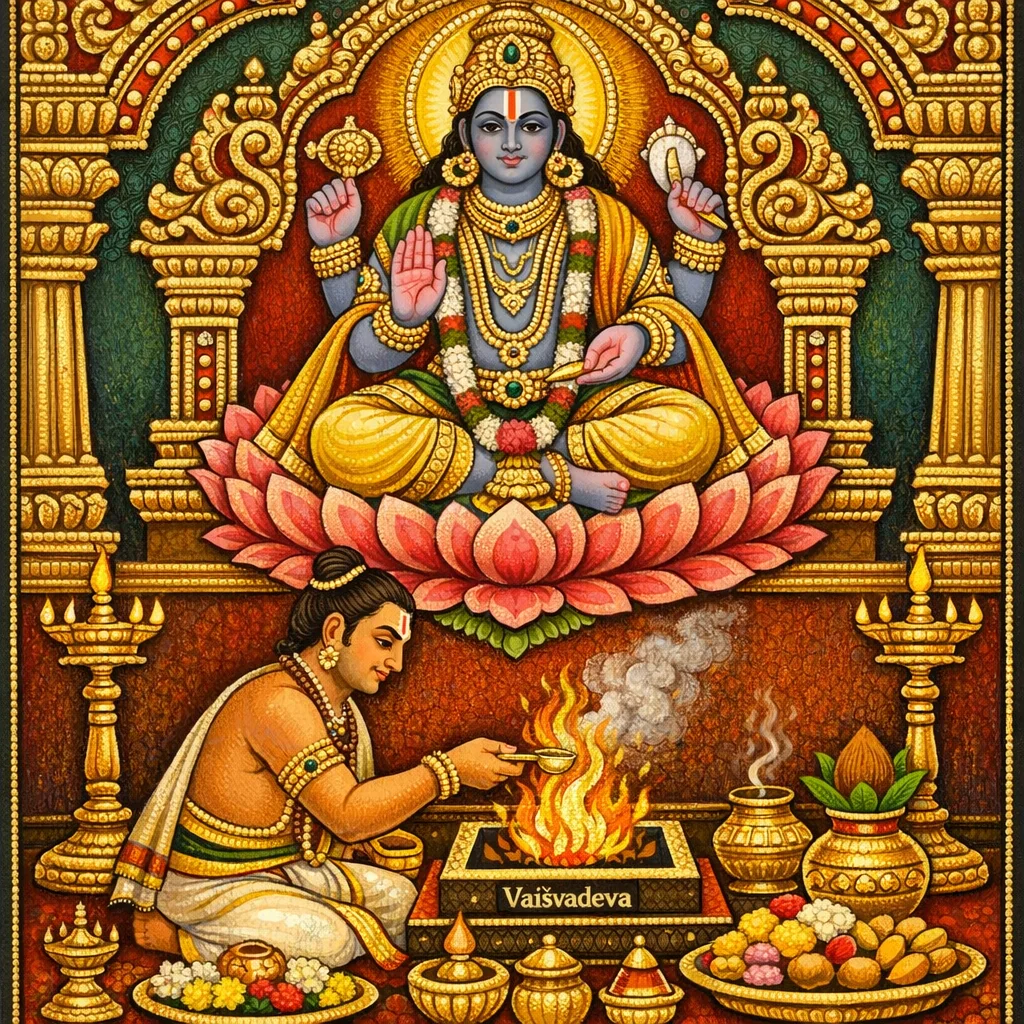
Adhyaya 263
Devapūjā, Vaiśvadeva Offering, and Bali (देवपूजावैश्वदेवबलिः)
This chapter shifts from utpāta-śānti (the pacifying of portents) to a structured household ritual regimen centered on Viṣṇu. Puṣkara lays out a mantra-governed sequence: ritual bathing with the «Āpo hi ṣṭhā» verses, arghya to Viṣṇu, and specific mantras for pādya, ācamanā, and abhiṣecana. It then consecrates common upacāras—fragrance, cloth, flowers, incense, lamp, madhuparka, and naivedya—showing how offerings are sacralized through Vedic formulas, including the Hiraṇyagarbha set. A homa follows, with purified preparation and a deity-wise order of oblations: Vāsudeva; key Vedic deities (Agni, Soma, Mitra, Varuṇa, Indra); the Viśvedevas; Prajāpati; Anumati; Rāma; Dhanvantari; Vāstoṣpati; the Devī; and Sviṣṭakṛt Agni; thereafter bali is distributed by direction to cosmic regulators and attendant beings. The chapter also integrates bhūta-bali, daily piṇḍa offerings to the pitṛs, symbolic feedings for crows and the two dogs of Yama’s lineage, honoring guests and aiding the needy, and concludes with avayajana expiation mantras—presenting daily worship as social ethics and metaphysical protection.
Shlokas
Verse 1
इत्य् आग्नेये महापुराणे उत्पातशान्तिर्नाम द्विषष्ट्यधिकद्विशततमो ऽध्यायः अथ त्रिषष्ट्यधिकद्विशततमो ऽध्यायः देवपूजावैश्वदेवबलिः पुष्कर उवाच देवपूजादिकं कर्म वक्ष्ये चोत्पातमर्दनम् आपोहिष्टेति तिसृभिः स्नातो ऽर्घ्यं विओष्णवेर्पयेत्
Thus, in the Agni Mahāpurāṇa ends the two-hundred and sixty-second chapter called “Pacification of Portents (Utpāta-śānti).” Now begins the two-hundred and sixty-third chapter on “Worship of the Deity, the Vaiśvadeva offering, and Bali.” Puṣkara said: “I shall explain the rites beginning with divine worship, and also the means for suppressing portents. Having bathed while reciting the three verses beginning with ‘Āpo hi ṣṭhā…’, one should offer arghya (a respectful water-oblation) to Viṣṇu.”
Verse 2
हिरण्यवर्णा इति च पाद्यञ्च तिसृभिर्द्विज शन्न आपो ह्य् आचमनमिदमापो ऽभिषेचनं
“Hiraṇyavarṇā (the waters of golden hue)”—with this mantra one should offer the foot-water (pādya). O twice-born, with the three verses beginning “Śaṃ na āpo…,” one is to perform ācamanā, the rite of sipping purifying water; and with “Idam āpaḥ…,” one is to perform abhiṣecana, the ritual sprinkling/ablution.
Verse 3
रथे अक्षे च तिसृभिर्गन्धं युवेति वस्त्रकं पुष्पं पुष्पवतीत्येवं धूपन्धूपोसि चाप्यथ
With three (mantras), one should ritually infuse fragrance into the chariot and its axle. By the formula “yuve” one consecrates the cloth; by “puṣpam” the flower; by “puṣpavatī” likewise; then one consecrates the incense with “dhūpa,” and also with “dhūposi.”
Verse 4
तेजोसि शुक्रं दीपं स्यान्मधुपर्कं दधीति च हिरण्यगर्भ इत्य् अष्टावृचः प्रोक्ता निवेदने
“(Recite) ‘You are splendour; you are the bright and pure one; you are the lamp’; and also the formulas ‘madhuparka’ and ‘dadhī’. Likewise, the set beginning with ‘Hiraṇyagarbha’—these are declared to be the eight ṛc-verses to be used at the time of presenting the naivedya (food-offering).”
Verse 5
अन्नस्य मनुजश्रेष्ठ पानस्य च सुगन्धिनः चामरव्यजनोपानच्छत्रं यानासने तथा
O best of men, one should make gifts of food and also of fragrant drinks; likewise one may give a cāmara (yak-tail fly-whisk) and a fan, footwear and an umbrella, as well as conveyances and seats.
Verse 6
गन्धं स्वधेति क , ग ,घ , ज च यत् किञ्चिदेवमादि स्यात्सावित्रेण निवेदयेत् पौरुषन्तु जपेत् सूक्तं तदेव जुहुयात्तथा
If anything such as fragrance (gandha) and the like is to be offered—classified under the groups ka, ga, gha, and ja—one should present it with the Sāvitrī (Gāyatrī) formula. Then one should recite the Pauruṣa-sūkta, and with that very mantra one should likewise offer it into the fire (homa).
Verse 7
अर्चाभवे तथा वेद्याञ्जले पूर्णघते तथा नदीतीरे ऽथ कमले शान्तिः स्याद्विष्णुपूजनात्
Likewise, when an idol (arcā) is unavailable, worship may be performed at the edge of the altar; also by venerating a full water-pot; likewise on a riverbank or upon a lotus—peace (śānti) is attained through the worship of Viṣṇu.
Verse 8
ततो होमः प्रकर्तव्यो दीप्यमाने विभावसौ परिसम्मृज्य पर्युक्ष्य परिस्तीर्य परिस्तरैः
Then the fire-offering (homa) should be performed when Vibhāvasu (Agni) is blazing—having first cleansed the area all around, sprinkled (with water), and spread the prescribed ritual coverings (kuśa-grass layers).
Verse 9
सर्वान्नाग्रं समुद्धृत्य जुहुयात् प्रयतस्ततः वासुदेवाय देवाय प्रभवे चाव्ययाय च
Having lifted up the foremost portion of all food as the first offering, one should then, with purity and attentive care, cast it into the fire as an oblation—unto Vāsudeva, the God; unto Prabhava, the Lord who is the Source of all; and unto the Imperishable (Avyaya).
Verse 10
अग्नये चैव सोमाय मित्राय वरुणाय च इन्द्राय च महाभाग इन्द्राग्निभ्यां तथैव च
(Offer) to Agni and also to Soma; to Mitra and to Varuṇa; to Indra as well, O greatly fortunate one—and likewise to Indra-and-Agni together.
Verse 11
विश्वेभ्यश् चैव देवेभ्यः प्रजानां पतये नमः अनुमत्यै तथा राम धन्वन्तरय एव च
Salutation indeed to the Viśvedevas and to the gods; salutation to Prajāpati, the Lord of creatures; likewise to Anumati; to Rāma; and also to Dhanvantari.
Verse 12
वास्तोष्पत्यै ततो देव्यै ततः स्विष्टिकृते ऽग्नये सचतुर्थ्यन्तनाम्ना तु हुत्वैतेभ्यो बलिं हरेत्
Then one should offer oblations to Vāstoṣpati, then to the Goddess, and thereafter to Agni as Sviṣṭakṛt; and having offered these with the prescribed names in the dative (fourth case), one should present a bali-offering to these deities.
Verse 13
तक्षोपतक्षमभितः पूर्वेणाग्निमतः परम् अश्वानामपि धर्मज्ञ ऊर्णानामानि चाप्यथ
O knower of dharma, the term “takṣa–upatakṣa” is used for the carpenters/wood-workers all around; further, to the east of the Agnimat (region or marker) are given the designations relating to horses, and then also the names of wool and woollen materials.
Verse 14
निरुन्धी धूम्रिणीका च अस्वपन्ती तथैव च मेघपत्नी च नामानि सर्वेषामेव भार्गव
“Nirundhī”, “Dhūmriṇīkā”, “Asvapantī”, and likewise “Meghapatnī”—these are the names of them all, O Bhārgava.
Verse 15
आग्नेयाद्याः क्रमेणाथ ततः शक्तिषु निक्षिपेत् नन्दिन्यै च सुभाग्यै च सुमङ्गल्यै च भार्गव
Then, beginning with the Agneya (fire) quarter, one should place them in due order into the Śaktis (divine powers)—into Nandinī, Subhāgyā, and Sumaṅgalyā, O Bhārgava.
Verse 16
स चतुर्थीकनाम्नेति पाठः साधुः अश्वपर्णीति ज मेघपर्णीति ज भद्रकाल्यै ततो दत्वा स्थूणायाञ्च तथा श्रिये हिरण्यकेश्यै च तथा वनस्पतय एव च
The correct reading is: “with the name in the dative (fourth case).” One should also recite, “to Aśvaparṇī,” and “to Meghaparṇī.” Thereafter, having made the offering to Bhadrakālī, one should likewise offer to Sthūṇā, to Śrī, to Hiraṇyakeśī, and also to the Vanaspatis, the deities presiding over vegetation and trees.
Verse 17
धर्माधर्ममयौ द्वारे गृहमध्ये ध्रुवाय च मृत्यवे च वहिर्दद्याद्वरुणायोदकाशये
At the doorway one should offer to Dharma and Adharma; in the middle of the house to Dhruva; outside to Mṛtyu; and at the water-stand, where water is kept, to Varuṇa.
Verse 18
भूतेभ्यश् च बहिर्दद्याच्छरणे धनदाय च इन्द्रायेन्द्रपुरुषेभ्यो दद्यात् पूर्वेण मानवः
And outside one should offer for the bhūtas (beings); at the threshold, the place of refuge, one should give to Dhanada (Kubera); and, following the preceding order, a person should give to Indra and to the indrapuruṣas, Indra’s attendants.
Verse 19
यमाय तत्पुरुषेभ्यो दद्याद्दक्षिणतस् तथा वरुणाय तत्पुरुषेभ्यो दद्यात्पश्चिमतस् तथा
Likewise, on the southern side one should present the offering to Yama and to his attendant beings; and on the western side one should present the offering to Varuṇa and to his attendant beings.
Verse 20
सोमाय सोमपुरुषेभ्य उदग्दद्यादनन्तरं ब्रह्मणे ब्रह्मपुरुषेभ्यो मध्ये दद्यात्तथैव च
He should then offer, facing north, to Soma and to the Soma-beings; immediately thereafter to Brahmā and to the Brahmā-beings; likewise, he should place the offering in the middle.
Verse 21
आकाशे च तथा चोर्ध्वे स्थण्डिलाय क्षितौ तथा दिवा दिवाचरेभ्यश् च रात्रौ रात्रिचरेषु च
Likewise, the offering or appeasement should be made in the sky and above; also upon the prepared earth-altar (sthāṇḍila) on the ground; by day for the day-roaming beings, and at night among the night-roaming ones.
Verse 22
बलिं वहिस् तथा दद्यात्सायं प्रातस्तु प्रत्यहं पिण्डनिर्वपणं कुर्यात् प्रातः सायन्न कारयेत्
One should offer the bali and also pour the āhuti into the sacred fire, in the evening and in the morning. Each day one should perform the rite of placing the piṇḍa (food‑balls/portions), as its own daily observance, not merely as a twice‑daily substitute at morning and evening.
Verse 23
पित्रे तु प्रथमं दद्यात्तत्पित्रे तदनन्तरम् प्रपितामहाय तन्मात्रे पितृमात्रे ततो ऽर्पयेत्
One should first make the offering to one’s father; thereafter to his father (the paternal grandfather). Next one should offer to the great‑grandfather, then to his mother, and thereafter to the mother of one’s father.
Verse 24
तन्मात्रे दक्षिणाग्रेषु कुशेष्वेवं यजेत् पितॄन् इन्द्रवारुणवायव्या याम्या वा नैरृताय ये
On that measured ritual space—using kuśa grass with the tips oriented to the south—one should worship the Pitṛs in this manner, invoking those connected with Indra, Varuṇa, and Vāyu, or those of Yama’s quarter, or those belonging to the Nairṛta (south‑west) direction.
Verse 25
ते काकाः पितृगृहन्तु इमं पिण्डं मयोद्वृतम् काकपिण्डन्तु मन्त्रेण शुनः पिण्डं प्रदापयेत्
“May these crows—acting as the Fathers—accept this piṇḍa offered by me.” And, with the prescribed mantra, one should present the ‘crow‑piṇḍa’; likewise one should give a piṇḍa to a dog.
Verse 26
विवस्वतः कुले जातौ द्वौ श्यावशबलौ शुनौ तेषां पिण्डं प्रदास्यामि पथि रक्षन्तु मे सदा
Two dogs—dark and variegated—born in the lineage of Vivasvat: to them I shall offer a piṇḍa. May they always protect me on the road.
Verse 27
श्यामशबलाविति ज , ञ , ट च सौरभेय्यः सर्वहिताः पवित्राः पापनाशनाः प्रतिगृह्णन्तु मे ग्रासं गावस्त्रैलोक्यमातरः
“Śyāma” and “Śabalā”—and (the seed-syllables) ja, ña, and ṭa—thus invoking the Saurabheya cows: may those cows, beneficial to all, purifying and destroyers of sin, the mothers of the three worlds, accept my morsel of offering.
Verse 28
ग्रोग्रासञ्च स्वस्त्ययनं कृत्वा भिक्षां प्रदापयेत् अतिथीन्दीनान् पूजयित्वा गृही भुञ्जीत च स्वयं
Having performed the auspicious rite (svastyayana) and offered the first morsel, one should give alms/food; and, after honoring guests and the needy, the householder should then eat himself.
Verse 29
इ स्वाहा ॐ आत्मकृतस्यैनसो ऽवयजनमसि स्वाहा ॐ मनुष्यकृतस्यैनसो ऽवयजनमसि स्वाहा ॐ एनस एनसो ऽवयजनमसि स्वाहा यच्चाहमेनो विद्वांश् चकार यच्चविद्वांस्तस्य सर्वस्यैनसो ऽवयजनमसि स्वाहा अग्नये स्विष्टिकृते स्वाहा ॐ प्रजापतये स्वाहा विष्णुपूजावैश्वदेवबलिस्ते कीर्तितो मया
“I—svāhā. Oṃ, you are the rite of expiation (avayajana) for the sin arising from what is done by oneself—svāhā. Oṃ, you are the rite of expiation for the sin arising from what is done by another—svāhā. Oṃ, you are the rite of expiation for sin—svāhā. And whatever sin I have committed knowingly, and whatever unknowingly—of all that sin you are the rite of expiation—svāhā. Oblation to Agni, Sviṣṭakṛt, who perfects the well-offered sacrifice—svāhā. Oṃ, oblation to Prajāpati—svāhā. Thus have I described to you the worship of Viṣṇu and the Vaiśvadeva-bali.”
Frequently Asked Questions
Mantra-bath (Āpo hi ṣṭhā) → arghya to Viṣṇu → pādya/ācamanā/abhiṣecana with specified water-mantras → consecration of upacāras (gandha, vastra, puṣpa, dhūpa, dīpa, naivedya) → homa with prescribed preparations → Vaiśvadeva-style deity oblations → bali distribution by deities/directions and beings → daily piṇḍa rites (pitṛs; crow/dog offerings) → atithi-sevā and feeding → avayajana expiation formulas.
By establishing Viṣṇu-centered śānti through mantra-purification, correctly ordered homa and bali, and comprehensive appeasement of deities, directional powers, bhūtas, and pitṛs—treating omen-control as a byproduct of restored ritual and cosmic order.
Worship may be performed at the altar-edge, through a full water-pot (pūrṇa-ghaṭa), on a riverbank, or upon a lotus; peace is still attained through Viṣṇu worship even without a formal image.
A set of svāhā formulas declaring the offering as expiation for sins done by oneself, by others, and for sins committed knowingly and unknowingly, followed by oblations to Sviṣṭakṛt Agni and Prajāpati.