Adhyaya 262
Utpāta-śānti (Pacification of Portents)
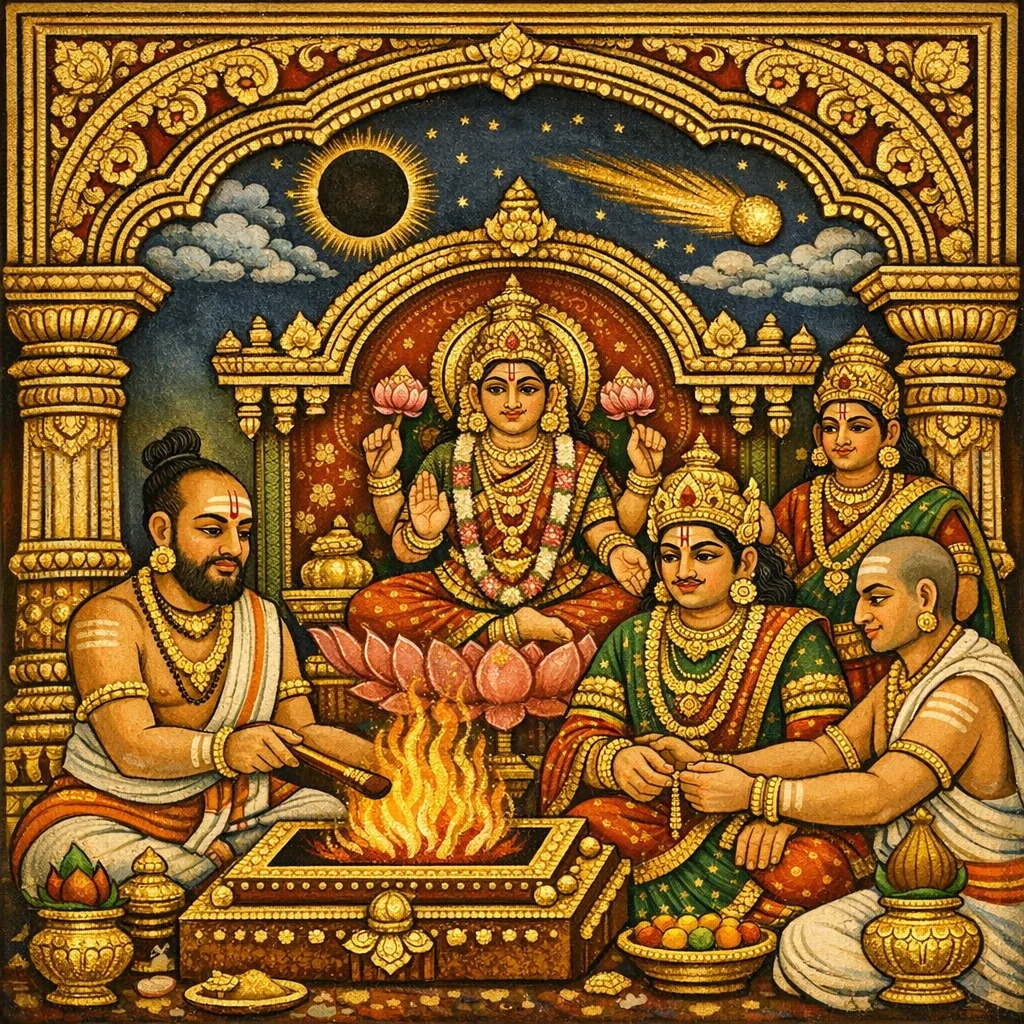
This chapter shifts from the earlier Atharva-vidhāna material to a focused manual of utpāta-śānti, prescribing rites to neutralize ominous disturbances affecting kingship, society, and personal welfare. Puṣkara teaches that prosperity and stability are fostered through Vedic hymnology: the Śrīsūkta (with prativeda) is taught as Lakṣmī-vivardhana, supported by Yajurvedic and Sāmavedic Śrī-invocations. It then lays out practical observances—japa, homa, purificatory bathing, charity, and offerings to Viṣṇu—highlighting the Pauruṣa Sūkta as a universal giver and purifier, even for great sins. Next come śānti classifications and three named pacifications (Amṛtā, Abhayā, Saumyā), including deity-linked gem amulets (maṇi) and their mantra consecration. Finally, portents are grouped as celestial, atmospheric, and terrestrial (meteors, halos, abnormal rains, earthquakes, icon phenomena, fire anomalies, tree omens, water corruption, abnormal births, animal inversions, eclipses), with targeted remedies—worship of Prajāpati/Agni/Śiva/Parjanya-Varuṇa—concluding that honoring Brahmins and deities, along with japa and homa, are the core pacifiers.
Shlokas
Verse 1
इत्य् आग्नेये महापुराणे अथर्वविधानं नामैकषष्ट्यधिकद्विशततमो ऽध्यायः क्रुद्धं भूपं प्रसादयेदिति घ , ज , झ च अथ द्विषष्ठ्यधिकद्विशततमो ऽध्यायः उत्पातशान्तिः पुष्कर उवाच श्रीसूक्तं प्रतिवेदञ्च ज्ञेयं लक्ष्मीविवर्धनं हिरण्यवर्णा हरिणीमृचः पञ्चदश श्रियः
Thus, in the Agni Mahāpurāṇa, the chapter called “Atharva-vidhāna” is the two-hundred-and-sixty-first; and there are also sections marked by the letters gha, ja, and jha, stating, “one should appease an enraged king.” Now begins the two-hundred-and-sixty-second chapter, “Pacification of Portents (Utpāta-śānti).” Puṣkara said: “The Śrīsūkta, together with the supplementary Vedic recitation (prativeda), should be known as that which increases Lakṣmī; the fifteen ṛk-verses beginning with ‘hiraṇyavarṇā’ are the hymn of Śrī.”
Verse 2
रथेष्वक्षेषु वाजेति चतस्रो यजुषि श्रियः स्रावन्तीयं तथा साम श्रीसूक्तं सामवेदके
In the Yajurveda, the four invocations of Śrī (Prosperity) occur in the formulas beginning with “ratheṣu”, “akṣeṣu”, and “vājeti”; likewise, in the Sāmaveda there is the Sāman called “Srāvantīya”, and the Śrī-sūkta as well, in the Sāmavedic recension.
Verse 3
श्रियं धातर्मयि धेहि प्राक्तमाथर्वणे तथा श्रीसूक्तं यो जपेद्भक्त्या हुत्वा श्रीस्तस्य वै भवेत्
“O Dhātṛ, Sustainer, place prosperity (Śrī) within me.” Likewise, in accordance with the ancient Atharvan tradition: whoever, with devotion, recites the Śrī-sūkta and performs oblations, prosperity indeed becomes his.
Verse 4
पद्मानि चाथ विल्वानि हुत्वाज्यं वा तिलान् श्रियः एकन्तु पौरुषं सूक्तं प्रतिवेदन्तु सर्वदं
Having offered lotuses and bilva leaves—or having made oblations of ghee or sesame—for the attainment of Śrī (prosperity), one should in particular recite the Pauruṣa-sūkta; it is declared to be a bestower of all desired results at all times.
Verse 5
सूक्तेन द्दद्यान्निष्पापो ह्य् एकैकया जलाञ्जलिं स्नात एकैकया पुष्पं विष्णोर्दत्वाघहा भवेत्
By making the offering accompanied by a sūkta (hymn), one becomes free from sin. After bathing, offering water as single-handed libations one by one, and likewise offering flowers one by one to Viṣṇu, one becomes a destroyer of sin.
Verse 6
स्नात एकैकया दत्वा फलं स्यात् सर्वकामभाक् महापापोपपान्तो भवेज्जप्त्वा तु पौरुषं
After bathing, if one gives in charity each time even a single unit (a coin), one gains the fruit of that act and becomes a fulfiller of all desires. And by reciting the Pauruṣa (mantra/hymn), one is cleansed of great sins.
Verse 7
कृच्छ्रैर् विशुद्धो जप्त्वा च हुत्वा स्नात्वाथ सर्वभाक् अष्टादशभ्यः शान्तिभ्यस्तिस्रो ऽन्याः शान्तयो वराः
Having purified himself by performing the kṛcchra (austerity/expiatory observance), and then having done japa, offered oblations, and bathed, he becomes entitled to all rites and benefits. Beyond the eighteen śānti-rites, there are three other excellent pacifications.
Verse 8
अमृता चाभयवा सौम्या सर्वोत्पातविमर्दनाः अमृता सर्वदवत्या अभया ब्रह्मदैवता
‘Amṛtā’ and also ‘Abhayā’, ‘Saumyā’—these are destroyers of every evil portent. Amṛtā is ever protective; Abhayā has Brahmā as her presiding deity.
Verse 9
सौम्या च सर्वदैवत्या एका स्यात्सर्वकामदा ह्य् एकैकश इति क , घ , छ , ञ च अभयाया मणिः कार्यो वरुणस्य भृगूत्तम
Saumyā (the gem/amulet) is connected with all the deities; it is one and is said to bestow all desired aims. “Individually, one by one”—it is assigned through the letters ka, gha, cha, and ña. O best of the Bhṛgus, a protective gem (maṇi) of Abhayā is to be made for Varuṇa.
Verse 10
शतकाण्डो ऽमृतायाश् च सौम्यायाः शङ्कजो मणिः तद्दैवत्यास् तथा मन्त्राः सिद्धौ स्यान्मणिबन्धनं
For Amṛtā, the gem is Śatakāṇḍa; and for Saumyā, the gem is the conch-born jewel (śaṅkaja). Together with the mantras belonging to those very deities—when duly accomplished—the binding, consecration, and wearing of the gem becomes efficacious.
Verse 11
दिव्यान्तरीक्षभौमादिसमुत्पातार्दना इमाः दिव्यान्तरीक्षभौमन्तु अद्भुतं त्रिविधं शृणु
These are the calamity-causing portents arising in the celestial, atmospheric, and terrestrial realms. Now listen to the threefold classification of marvels and omens as celestial, atmospheric, and terrestrial.
Verse 12
ग्रहर्क्षवैकृतं दिव्यमान्तरीक्षन्निबोध मे उल्कापातश् च दिग्दाहः परिवेशस्तथैव च
Learn from me the celestial and atmospheric portents arising from disturbances in planets and stars: the fall of meteors (ulkā), the burning or reddening of the quarters of the sky, and the appearance of halos (pariveśa).
Verse 13
गन्धर्वनगरञ्चैव वृष्टिश् च विकृता च या चरस्थिरभवं भूमौ भूकम्पमपि भूमिजं
And also the appearance of a “Gandharva-city” (a mirage-like illusory city), and rains that are abnormal; and on the earth, the earthquake—an earth-born disturbance—affecting both the moving and the unmoving.
Verse 14
सप्ताहाभ्यनतरे वृष्टावद्भुतं भयकृद्भवेत् शान्तिं विना त्रिभिर्वषैर् अद्भुतं भयकृद्भवेत्
If an extraordinary rainfall (untimely or unnatural) occurs within a week, it becomes a fear-causing portent. Likewise, if no pacificatory rite (śānti) is performed, then within three years that portent becomes fear-causing, yielding its harmful result.
Verse 15
देवतार्चाः प्रनृत्यन्ति वेपन्ते प्रज्वलन्ति च आरठन्ति च रोदन्ति प्रस्विद्यन्ते हसन्ति च
The deity-images under worship dance, tremble, and blaze forth; they also cry out, weep, perspire, and laugh.
Verse 16
अर्चाविकारोपशमो ऽभ्यर्च्य हुत्वा प्रजापतेः अनग्निर्दीप्यते यत्र राष्ट्रे च भृशनिस्वनं
Having duly worshipped and offered oblations to Prajāpati, the disturbances or defects affecting icon-worship are pacified; and in that realm even a fireless place seems to blaze, and a great roaring sound is heard—taken as potent signs of the rite’s efficacy.
Verse 17
न दीप्यते चेन्धनवांस्तद्राष्ट्रं पाड्यते नृपैः अग्निवैकृत्यशमनमग्निमन्त्रैश् च भार्गव
If, even when supplied with fuel, the fire does not blaze, that kingdom is afflicted and harassed by kings. The pacification of such abnormal conditions of fire is to be performed by means of Agni-mantras, O Bhārgava.
Verse 18
अकाले फलिता वृक्षाः क्षीरं रक्तं स्रवन्ति च वृक्षोत्पातप्रशमनं शिवं पूज्य च कारयेत्
When trees bear fruit out of season, and when they ooze milk or even blood, one should have a Śiva-pūjā performed—worshipping Śiva as the pacifier of such tree-omens—in order to avert the portent.
Verse 19
अतिवृष्टिरनावृष्टिर्दुर्भिक्षायोभयं मतं सिद्ध्या इति घ , ञ च देवताश्चेति ख , छ च आवटन्तीति ख , घ , छ , ञ च अनृतौ त्रिदिनारब्धवृष्टिर्ज्ञेया भयाय हि
Both excessive rainfall and lack of rainfall are regarded as causes of famine. Likewise, rain that begins out of season and continues for three days should indeed be understood as an omen of danger.
Verse 20
वृष्टिवैकृत्यनाशः स्यात्पर्जण्येन्द्वर्कपूजनात् नगरादपसर्पन्ते समीपमुपयान्ति च
The destruction of abnormality in rainfall is brought about by worship of Parjanya, the Moon, and the Sun. Thereby the harmful forces retreat from the city and return to a favorable, controlled proximity.
Verse 21
नद्यो ह्रदप्रश्रवणा विरसाश् च भवन्ति च शलिलाशयवैकृत्ये जप्तव्यो वारुणो मनुः
Rivers, lakes, and springs become tasteless, bereft of their proper quality. When reservoirs and bodies of water are corrupted or abnormal, the Varuṇa-mantra is to be recited.
Verse 22
अकालप्रसवा नार्यः कालतो वाप्रजास् तथा विकृतप्रसवाश् चैव युग्मप्रसवनादिकं
Women may deliver out of season; likewise, offspring may be born at the proper time. There are also abnormal deliveries, such as twin births and other such cases.
Verse 23
स्त्रीणां प्रसववैकृत्ये स्त्रीविप्रादिं प्रपूजयेत् वडवा हस्तिनी गौर्वा यदि युग्मं प्रसूयते
When there is an abnormality in a woman’s delivery, one should duly honor—by worship and gifts—a female brāhmaṇa (brāhmaṇī) and others as prescribed. Likewise, if a mare, a female elephant, or a cow gives birth to twins, the same propitiatory honoring is to be performed.
Verse 24
विजात्यं विकृतं वापि षड्भिर्मासैर् म्रियेत वै विकृतं वा प्रसूयन्ते परचक्रभयं भवेत्
If an offspring is of an alien kind (vijātya) or is deformed, it indeed dies within six months; or, if deformed young are born, fear arises from an enemy army.
Verse 25
होमः प्रसूतिवैकृत्ये जपो विप्रादिपूजनं यानि यानान्ययुक्तानि युक्तानि न वहन्ति च
In cases of complications or abnormalities in childbirth, one should perform homa (a fire-offering), undertake japa (mantra-recitation), and worship Brahmins and other worthy persons. Likewise, vehicles that are improperly fitted do not carry their load, even if later fitted.
Verse 26
आकाशे तूर्यनादाश् च महद्भयमुपस्थितं प्रविशन्ति यदा ग्राममारण्या मृगपक्षिणः
When drum- and trumpet-like sounds resound in the sky, and when wild animals and birds from the forest enter the village, it indicates that great danger has arisen and is near at hand.
Verse 27
अरण्यं यान्ति वा ग्राम्याः जलं यान्ति स्थलोद्भवाः स्थलं वा जलजा यान्ति राजद्वारादिके शिवाः
Village-dwelling creatures may go to the forest; those born on dry land may go to the water; and those born in water may go onto land—such occurrences, when seen at the king’s gate and similar public places, are auspicious (good omens).
Verse 28
प्रदोषे कुक्कुटो वासे शिवा चार्कोदये भवेत् गृहङ्कपोतः प्रविशेत् क्रव्याहा मूर्ध्नि लीयते
If a cock crows at dusk within the dwelling, or a jackal howls at sunrise, these are taken as omens. If a pigeon enters the house, or a flesh-eating bird settles upon one’s head, these too are regarded as inauspicious portents.
Verse 29
मधुरां मक्षिकां कुर्यात् काको मैथुनगो दृशि प्रासादतोरणोद्यानद्वारप्राकारवेश्मनां
If a bee appears or settles in a sweet and auspicious manner, it should be taken as favorable; but if a crow is seen engaged in mating, it is an omen concerning palaces, toranas (ornamental gateways), gardens, doors, ramparts/walls, and dwellings.
Verse 30
अनिमित्तन्तु पतनं दृढानां राजमृत्यवे रजसा वाथ धूमेन दिशो यत्र समाकुलाः
But when even the steadfast fall without any apparent cause, and when the quarters become confused—filled with dust or else with smoke—these are omens of a king’s death.
Verse 31
केतूदयोपरागौ च छिद्रता शशिसूर्ययोः ग्रहर्क्षविकृतिर्यत्र तत्रापि भयमादिशेत्
Wherever there occur a rising of a comet, an eclipse, a blemish as if ‘pierced’ in the Moon or the Sun, or any abnormal change in planets and constellations—there too one should predict and proclaim fear and danger.
Verse 32
अग्निर्यत्र म दीप्येत स्रवन्ते चोदकम्भकाः मृतिर्भयं शून्यतादिरुत्पातानां फलम्भवेत्
Wherever the fire does not blaze and the water-pots begin to leak, the fruits of such portents are death, fear, and emptiness (desolation), and the like.
Verse 33
द्विजदेवादिपूजाभ्यः शान्तिर्जप्यैस्तु होमतः
Pacification (śānti) is achieved by worship of Brahmins and the gods (and other venerable beings), and also by recitations (japa) and by fire-offerings (homa).
Frequently Asked Questions
It identifies the Śrīsūkta (with prativeda) as Lakṣmī-increasing, notes fifteen ṛks beginning with “hiraṇyavarṇā,” mentions four Yajurvedic Śrī-invocations (ratheṣu/akṣeṣu/vājeti set), and refers to Sāmavedic materials including the Srāvantīya Sāman and the Śrīsūkta in that recension.
The chapter repeatedly centers japa (recitation), homa (oblations), snāna (ritual bathing), dāna (repeated small gifts), and devatā-pūjā (deity worship), with targeted rites to Prajāpati (icon disturbances), Agni (fire anomalies), Śiva (tree-omens), Parjanya–Candra–Sūrya (rain disorders), and Varuṇa (water corruption).
Portents are grouped into divya (celestial), āntarikṣa (atmospheric), and bhauma (terrestrial). This taxonomy guides remedy selection: specific deities and mantras correspond to the domain and symptom (e.g., graha/ṛkṣa disturbances, abnormal rains, earthquakes), making śānti a structured, diagnostic ritual science.
It is presented as especially effective and universally bestowing (sarvada/sarvakāmada): recitation alongside offerings and disciplined acts (bathing, charity) is said to cleanse even great sins and confer broad attainments, functioning as a high-utility mantra within śānti practice.