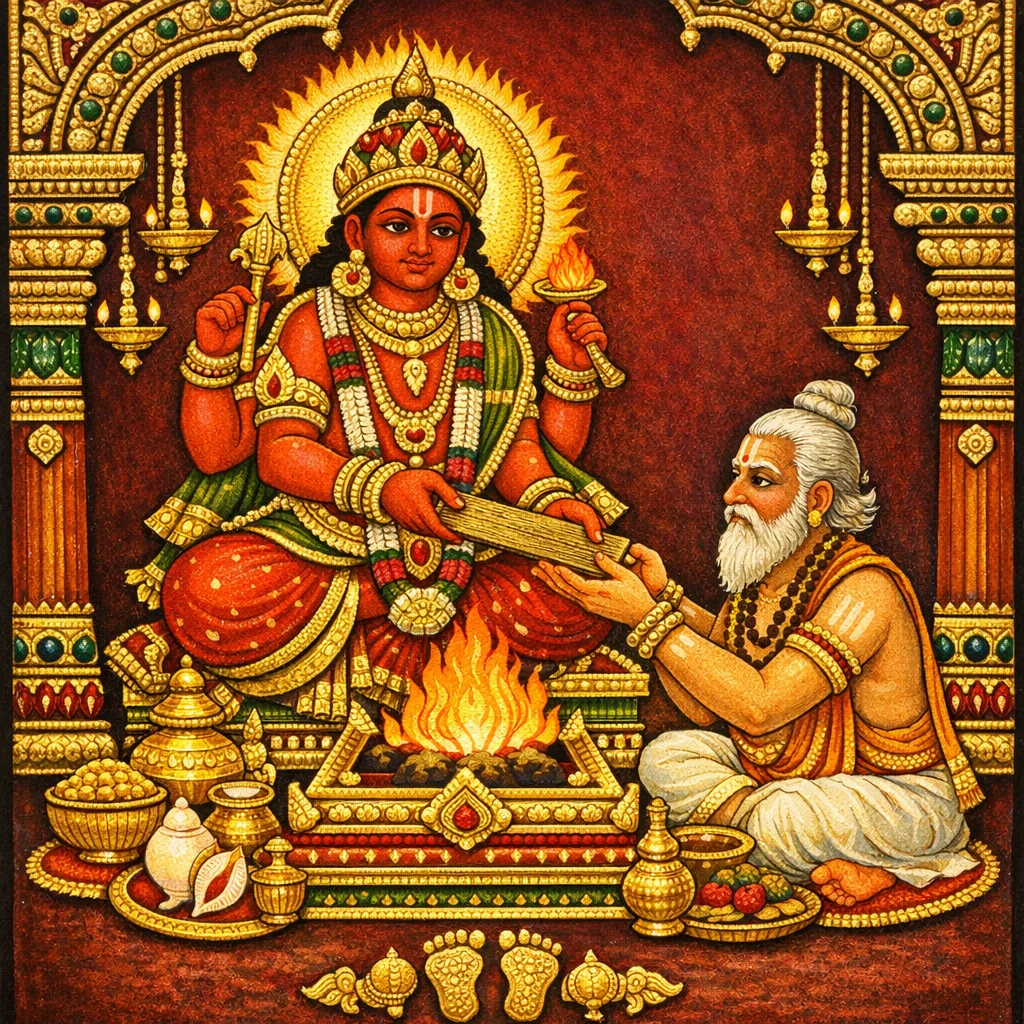
Adhyaya 259
अध्याय १ — यजुर्विधानम् (Agni Purana, Chapter 259: Yajur-vidhāna)
This chapter shifts from Ṛg-vidhāna to Yajur-vidhāna as Puṣkara teaches Rāma that Yajur-based ritual ordinances bestow both bhukti (worldly enjoyment and success) and mukti (liberation), beginning with the primacy of Oṃ and the great Vyāhṛtis. It then serves as a compact ritual encyclopedia, prescribing homa-dravyas (ghee, barley, sesame, grains, curd, milk, pāyasa), samidh (udumbara, apāmārga, palāśa, etc.), and mantra-sets for specific aims—śānti (pacification), pāpa-nāśa (sin-removal), puṣṭi (nourishment), ārogya (health), dhana/lakṣmī (wealth), vaśya/vidveṣa/uccāṭana (influence, hostility, expulsion), victory in battle, protection of weapons and chariots, rainmaking, and warding off thieves, serpents, rākṣasa-forces, and sorcery (abhicāra). The chapter stresses numerical discipline (thousand-fold and lakh/crore homas), timed observances (such as during a lunar eclipse), and domestic/public uses (removing house vāstu-doṣa, pacifying village or regional epidemics, offerings at crossroads). It concludes by affirming Gāyatrī’s Vaiṣṇavī nature as Viṣṇu’s supreme station, placing these pragmatic rites within a purificatory path that upholds dharma and supports ultimate spiritual attainment.
Shlokas
Verse 1
इत्य् आग्नेये महापुराणे ऋग्विधानं नामाष्टपञ्चाशदधिकद्विशततमो ऽध्यायः अथोनषष्ट्यधिकद्विशततमो ऽध्यायः यजुर्विधानं पुष्कर उवाच यजुर्विधानं वक्ष्यामि भुक्तिमुक्तिप्रदं शृणु ओंकारपूर्विका राम महाव्याहृतयो मताः
Thus, in the Agni Mahāpurāṇa, the chapter called “Ṛg-vidhāna” is the two-hundred-and-fifty-eighth. Now begins the two-hundred-and-fifty-ninth chapter: “Yajur-vidhāna.” Puṣkara said: “I shall teach the Yajur-vidhāna—listen, for it bestows both worldly enjoyment and liberation. O Rāma, the great Vyāhṛtis are held to be preceded by the syllable Oṃ.”
Verse 2
सर्वकल्मषनाशिन्यः सर्वकामप्रदास् तथा आज्याहुतिसहस्रेण देवानाराधयेद्बुधः
They destroy all taints and also grant every desired aim. Therefore, a wise person should propitiate the gods by means of a thousand oblations of ghee.
Verse 3
मनसः काङ्क्षितं राम मनसेप्सितकामदं शान्तिकामो यवैः कुर्यात्तिलैः पापापनुत्तये
O Rāma, that which is desired in the mind—granting the wished-for object—should be performed by one seeking pacification using barley; and with sesame (tila) it should be performed for the removal of sin.
Verse 4
धान्यैः सिद्धार्थकैश् चैव सर्वकाम करैस् तथा औदुम्बरीभिरिध्माभिः पसुकामस्य शस्यते
For one who desires cattle and livestock, it is prescribed to perform offerings with grains and white mustard seeds (siddhārthaka), and likewise with materials that fulfill all desires, using fuel-sticks of the udumbara (cluster fig) tree.
Verse 5
दध्ना चैवान्नकामस्य पयसा शान्तिमिच्छतः अपामार्गसमिद्धस्तु कामयन् कनकं बहु
For one who desires food, the oblation should be with curd; for one who seeks peace, with milk. And one who desires abundant gold should perform the rite with the sacred fire kindled by apāmārga fuel.
Verse 6
कन्याकामो घृताक्तानि युग्मशो ग्रथितानि तु जातीपुष्पाणि जुहुयाद्ग्रामार्थी तिलतण्डुलान्
One who desires a maiden (as wife) should offer into the fire jasmine (jāti) blossoms, smeared with ghee and strung in pairs; and one who seeks a village (a settlement or land-grant) should offer sesame and rice-grains.
Verse 7
वश्यकर्मणि शाखोढवासापामार्गमेव च विषासृङ्मिश्रसमिधो व्याधिघातस्य भार्गव
For rites of subjugation (vaśyakarma), use oblation-sticks (samidh) of śākhōḍha, vāsa, and apāmārga; and for destroying disease, O Bhārgava, use offering-sticks mixed with poison and blood.
Verse 8
क्रुद्धस्तु जुहुयात्सम्यक् शत्रूणां बधकाम्यया सर्वव्रीहिमयीं कृत्वा राज्ञः प्रतिकृतिं द्विज
But when enraged, O Brahmin, one should duly offer oblations, desiring the slaying of enemies, having fashioned an effigy of the king entirely out of rice-grains.
Verse 9
सहस्रशस्तु जुहुयाद्राजा वशगतो भवेत् वस्त्रकामस्य पुष्पाणि दर्वा व्याधिविनाशिनी
If one offers oblations a thousand times, even a king comes under one’s influence. For one who desires garments, offer flowers; and darvā-grass is a destroyer of diseases.
Verse 10
ब्रह्मवर्चसकामस्य वासोग्रञ्च विधीयते प्रत्यङ्गिरेषु जुहुयात्तुषकण्टकभस्मभिः
For one who desires brahma-varcas (sacred radiance and spiritual luster), an upper garment is prescribed; and in the rites addressed to the Praty-aṅgirases, one should offer oblations using the ashes of chaff and thorns.
Verse 11
विद्वेषणे च पक्ष्माणि काककौशिकयोस् तथा कापिलञ्च घृतं हुत्वा तथा चन्द्रग्रहे द्विज
For rites intended to provoke enmity (vidveṣaṇa), one should offer as oblations the pakṣmāṇi (eyelashes or fine hairs) of a crow and an owl; likewise, one should offer tawny (kāpila) ghee—especially at the time of a lunar eclipse, O twice-born one.
Verse 12
वचाचूर्णेन सम्पातात्समानीय च तां वचां सहस्रमन्त्रितां भुक्त्वा मेधावी जायते नरः
By coating it with powdered vacā, and then preparing that vacā after it has been empowered with a thousand mantra-recitals, a man who consumes it becomes intellectually acute.
Verse 13
एकादशाङ्गुलं शङ्कु लौहं खादिरमेव च द्विषतो बधोसीति जपन्निखनेद्रिपुवेश्मनि
Reciting (the mantra), “You are the slaying of the enemy,” one should bury, in the enemy’s dwelling, an iron stake of eleven finger-breadths, made of khadira-wood.
Verse 14
उच्चाटनमिदं कर्म शत्रूणां कथितं तव चक्षुष्या इति जप्त्वा च विनष्टञ्चक्षुराप्नुयात्
This rite of uccāṭana (driving away/expulsion) against enemies has been taught to you. And by reciting the mantra ending with “cakṣuṣyā,” one may regain vision that has been lost.
Verse 15
उपयुञ्जत इत्य् एदनुवाकन्तथान्नदं तनूनपाग्ने सदिति दूर्वां हुत्वार्तिवर्जितः
Reciting the anuvāka that begins with “upayuñjata”, and likewise the formulas “annada”, “tanūnapāgne”, and “sad iti”, one should offer dūrvā-grass as an oblation (āhuti) into the fire; having done so, he becomes free from affliction and distress.
Verse 16
भेषजमसीति दध्याज्यैर् होमः पशूपसर्गनुत् खादिरमेव वेति ग , घ , ञ च पशूपसर्गहेति क , छ च त्र्यम्वकं यजामहे होमः सौभाग्यवर्धनः
With curds and ghee one should offer homa-oblations while reciting, “You are the medicine”; this removes harmful afflictions that befall cattle. For the same purpose, the formulas “Khādira indeed…”—for the groups ga, gha, and ña—and “(You are) the remedy for cattle-afflictions”—for ka and cha—are also prescribed. The homa performed with the mantra “Tryambakaṃ yajāmahe” increases good fortune.
Verse 17
कन्यानाम गृहीत्वा तु कन्यलाभकरः परः भयेषु तु जपन्नित्यं भयेभ्यो विप्रमुच्यते
Reciting the names of maidens becomes a supreme means for obtaining a maiden as a bride. And one who constantly repeats it in times of fear is quickly released from fears.
Verse 18
धुस्तूरपुष्पं सघृतं हुत्वा स्यात् सर्वकामभाक् हुत्वा तु गुग्गुलं राम स्वप्ने पश्यति शङ्करं
Having offered dhustūra-flowers together with ghee into the fire, one becomes a fulfiller of all desires. But having offered guggulu, O Rāma, one beholds Śaṅkara in a dream.
Verse 19
युञ्जते मनो ऽनुवाकं जप्त्वा दीर्घायुराप्नुयात् विष्णोरवाटमित्येतत् सर्वबाधाविनाशनं
Having performed japa of the formula known as the “Mano-’nuvāka”, one attains long life. This mantra beginning with “viṣṇor avāṭam” is a destroyer of all afflictions and obstacles.
Verse 20
रक्षोघ्नञ्च यशस्यञ्च तथैव विजयप्रदं अयत्नो अग्निरित्येतत् संग्रामे विजयप्रदं
(This formula) slays rākṣasas (hostile/demonic forces), bestows fame, and likewise grants victory. The utterance “ayatno ’gnir”—this very formula—gives victory in battle.
Verse 21
इदमापः प्रवहत स्नाने पापापनोदनं विश्वकर्मन्नु हविषा सूचीं लौहीन्दशाङ्गुलाम्
“O Waters, flow forth”—when one bathes, (this rite) becomes a remover of sins. And (invoke) Viśvakarman; with an oblation (havis), offer an iron needle ten aṅgulas in length.
Verse 22
कन्याया निखनेद्द्वारि सान्यस्मै न प्रदीयते देव सवितरेतेन जुहुयाद्बलकामो द्विजोत्तम
He should bury (this rite/amulet) at the doorway for the maiden; then she is not given to another. O best of the twice-born, one who desires strength should offer oblations with this (mantra/rite) to the god Savitṛ.
Verse 23
अग्नौ स्वाहेति जुहुयाद्बलकामो द्विजोत्तम तिलैर् यवैश् च धर्मज्ञ तथापामार्गतण्डुलैः
O best of the twice-born, one who desires strength should offer oblations into the fire with the utterance “svāhā,” using sesame and barley; O knower of dharma, likewise (use) grains of apāmārga.
Verse 24
सहस्रमन्त्रितां कृत्वा तथा गोरोचनां द्विज तिलकञ्च तथा कृत्वा जनस्य प्रियतामियात्
O twice-born one, having empowered gorocanā by reciting the mantra a thousand times, and then applying it likewise as a tilaka, one becomes dear to people.
Verse 25
रुद्राणाञ्च तथा जप्यं सर्वाघविनिसूदनं सर्वकर्मकरो होमस् तथा सर्वत्र शन्तिदः
Likewise, the japa of the Rudra-mantras should be performed; it destroys all sin. The homa (fire-offering) accomplishes every rite and bestows peace everywhere.
Verse 26
अजाविकानामश्वानां कुञ्जराणां तथा गवां मनुष्याणान्नरेन्द्राणां बालानां योषितामपि
Of goats and sheep, of horses, of elephants, and likewise of cattle—of human beings, of kings, of children, and of women as well (the following omens/results are to be understood accordingly).
Verse 27
ग्रामाणां नगरानाञ्च देशानामपि भार्गव विष्णोर्विराटमित्येतदिति घ , ञ च विष्टोरराटमित्येतदिति क , ज , ट च उपद्रुतानां धर्मज्ञ व्याधितानां तथैव च
O Bhārgava, for the protection of villages, cities, and even whole regions, one should employ the formula “(of) Viṣṇu—Virāṭ” together with the syllables gha and ña; and the formula “(of) Viṣṭora—Rāṭ” together with the syllables ka, ja, and ṭa—likewise for those afflicted by calamities, O knower of dharma, and also for the sick.
Verse 28
मरके समनुप्राप्ते रिपुजे च तथा भये रुद्रहोमः परा शान्तिः पायसेन घृतेन च
When a deadly affliction approaches, and likewise in fear arising from enemies or in times of danger, the Rudra-homa is the supreme pacificatory rite—performed with rice-milk (pāyasa) and with ghee.
Verse 29
कुष्माण्डघृतहोमेन सर्वान् पापान् व्यपोहति शक्तुयावकभैक्षाशी नक्तं मनुजसत्तम
By performing a ghee oblation (homa) with kuṣmāṇḍa (ash-gourd/winter melon), one removes all sins. O best of men, the practitioner should subsist on flour (śaktu), gruel (yāvaka), and alms-food (bhaikṣa), eating only at night.
Verse 30
बहिःस्नानरतो मासान्मुच्यते ब्रह्महत्यया मधुवातेति मन्त्रेण होमादितो ऽखिलं लभेत्
By remaining devoted to bathing outdoors for a month, one is released from the sin of brahmin-slaying. And by performing homa (the fire-offering) and related rites with the mantra beginning “madhu-vāta…”, one obtains every purificatory result in full.
Verse 31
दधि क्राव्नेति हुत्वा तु पुत्रान् प्राप्नोत्यसंशयं तथा घृतवतीत्येतदायुष्यं स्यात् घृतेन तु
Having made an oblation with the mantra “dadhi krāvṇe”, one assuredly obtains sons. Likewise, the mantra “ghṛtavatī” is for longevity, and is to be offered with ghee.
Verse 32
स्वस्तिन इन्द्र इत्य् एतत्सर्वबाधाविनाशनं इह गावः प्रज्यायध्वमिति पुष्टिविवर्धनम्
The mantra beginning with “svastina indra” destroys all obstacles and afflictions; and the utterance “iha gāvaḥ prajyāyadhvam” is a mantra that increases nourishment, prosperity, and well-being.
Verse 33
घृताहुतिसहस्रेण तथा लक्ष्मीविनाशनं श्रुवेण देवस्य त्वेति हुत्वापामार्गतण्डुलं
Likewise, for the destruction of prosperity (Lakṣmī), one should offer a thousand oblations of ghee; and, having offered apāmārga rice-grains with the ladle while reciting “devasya tvā,” the rite is accomplished.
Verse 34
मुच्यते विकृताच्छीघ्रमभिचारान्न संशयः रुद्र पातु पलशस्य समिद्भिः कनकं लभेत्
One is quickly freed from affliction and distortion caused by sorcery (abhicāra)—of this there is no doubt. May Rudra protect him; by offering palāśa kindling-sticks in the fire rite, one obtains gold.
Verse 35
शिवो भवेत्यग्न्युत्पाते व्रीहिभिर्जुहुयान्नरः याः सेना इति चैतच्च तस्करेभ्यो भयापहम्
When an inauspicious portent connected with fire (agni-utpāta) arises, a man should offer rice-grains (vrīhi) into the fire, reciting, “śivo bhavet” (“may it be auspicious”). Likewise he should employ the formula “yāḥ senāḥ”; this rite removes fear of thieves.
Verse 36
यो अस्मभ्यमवातीयाद्धुत्वा कृष्णतिलान्नरः सहस्रशो ऽभिचाराच्च मुच्यते विकृताद्द्विज
O twice-born (dvija), if a man offers black sesame (kṛṣṇa-tila) into the fire to propitiate Agni, he is freed—thousandfold—from the effects of sorcery (abhicāra) and from harmful distortions and afflictions.
Verse 37
अन्नेनान्नपतेत्येवं हुत्वा चान्नमवाप्नुयात् हंसः शुचिः सदित्येतज्जप्तन्तोये ऽघनाशनं
Having offered oblations while reciting, “annena annapate” (“with food I worship the Lord of food”), one obtains food and abundance. And this mantra—“Haṃsaḥ, Śuciḥ, Sat”—when muttered over water becomes a destroyer of sin.
Verse 38
चत्वारि भङ्गेत्येतत्तु सर्वपापहरं जले देवा यज्ञेति जप्त्वा तु ब्रह्मलोके महीयते
But the mantra beginning with “catvāri bhaṅge…” removes all sins when recited in water. And having recited “devā yajñe…,” one is honored and exalted in the world of Brahmā (Brahmaloka).
Verse 39
वसन्तेति च हुत्वाज्यं आदित्याद्वरमाप्नुयात् सुपर्णोसीति चेत्यस्य कर्मव्याहृतिवद्भवेत्
Having offered ghee (ā́jya) as an oblation while uttering the mantra beginning with “vasanta-”, one obtains a boon from Āditya (the Sun). As for the mantra “suparṇo ’si”, its ritual application should be performed in the manner of the karmavyāhṛtis (the operative vyāhṛti-formulas used in rites).
Verse 40
नमः स्वाहेति त्रिर्जप्त्वा बन्धनान्मोक्षमाप्नुयात् अन्तर्जले त्रिरावर्त्य द्रुपदा सर्वपापमुक्
Having recited the mantra “namaḥ svāhā” three times, one attains release from bondage. And, while in the water, having immersed (or turned) three times, one becomes firm-footed and is freed from all sins.
Verse 41
इह गावः प्रजायध्वं मन्त्रोयं बुद्धिवर्धनः हुतन्तु सर्पिषा दध्ना पयसा पायसेन वा
“Here, O cows, be fruitful and multiply. This mantra increases intelligence. Let the oblation be offered with ghee, with curd, with milk, or with pāyasa (milk-rice).”
Verse 42
शतम् य इति चैतेन हुत्वा पर्णफलाणि च आरोग्यं श्रियमाप्नोति जीवितञ्च चिरन्तथा
Having offered leaves and fruits into the fire with this mantra “śatam ya…”, one attains health and prosperity, and likewise a long life.
Verse 43
ओषधीः प्रतिमोदग्ध्वं वपने लवने ऽर्थकृत् अश्वावती पायसेन होमाच्छान्तिमवाप्नुयात्
Having duly fumigated (or lightly scorched) the medicinal herbs, one should apply them at sowing and at reaping to secure prosperity. By performing a homa with pāyasa (milk-rice) together with the herb called Aśvāvatī, one attains pacification (śānti).
Verse 44
तस्मा इति च मन्त्रेन बन्धनस्थो विमुच्यते युवा सुवासा इत्य् एव वासांस्याप्नोति चोत्तमम्
By the mantra beginning with “tasmā …”, one who is in bondage is released. And by (the mantra) “yuvā suvāsā …”, one obtains excellent garments, fine clothing.
Verse 45
मुञ्चन्तु मा शपथ्यानि सर्वान्तकविनाशनम् मा माहिंसीस्तिलाज्येन हुतं रिपुविनाशनं
May all imprecations bound by oath release me; this rite/mantra is the destroyer of every deadly calamity. Do not harm me—for an oblation offered with sesame and ghee is a destroyer of enemies.
Verse 46
नमो ऽस्तु सर्वसर्पेभ्यो घृतेन पायसेन तु कृणुधवं राज इत्य् एतदभिचारविनाशनं
Salutations to all serpents. Offer with ghee and pāyasa (rice-milk), saying: “Perform (this), O King”—this is a rite/mantra for the destruction of hostile sorcery (abhicāra).
Verse 47
दूर्वाकाण्डायुतं हुत्वा काण्डात् काण्डेति मानवः ग्रामे जनपदे वापि मरकन्तु शमन्नयेत्
Having offered into the fire ten thousand stalks of dūrvā grass, and performing the oblation with the mantra “kāṇḍāt kāṇḍe”, a person may bring about the pacification of epidemic death in a village or even across an entire region.
Verse 48
रोगार्तो मुच्यते रोगात् तथा दुःखात्तु दुःखितः शतञ्चेति ट शतं वेति क औषधयः प्रतिमोदध्यमिति ज सर्वकिल्विषनाशनमिति घ , ञ च विघ्नविनाशनमिति क , छ च औडुम्बरीश् च समिधो मधुमान्नो वनस्पतिः
One afflicted by disease is freed from disease; likewise, one afflicted by sorrow is freed from sorrow. In the prescribed sequence of letters/words: ‘śatam’ is indicated by ṭa; ‘śatam’ by ka; ‘auṣadhayaḥ’ (medicinal herbs) by ja; ‘pratimodadhyam’ by ja; ‘the destroyer of all sins’ by gha (and also ña); ‘the destroyer of obstacles’ by ka (and also cha). The offering-fuel (samidh) is auḍumbarī (udumbara/cluster fig), and the offered plant/food is madhumānna (a honeyed sweet preparation).
Verse 49
हुत्वा सहस्रशो राम धनमाप्नोति मानवः सौभाग्यं महदाप्नोति व्यवहारे तथा त्रयम्
O Rāma, a person who performs oblations a thousandfold attains wealth; he attains great good fortune, and in worldly dealings likewise gains threefold success.
Verse 50
अपां गर्भमिति हुत्वा देवं वर्षापयेद्ध्रुवम् अपः पिवेति च तथा हुत्वा दधि घृतं मधु
Having offered an oblation with the mantra “apāṃ garbham” (“the embryo/seed of the waters”), one surely causes the deity to send rain. Likewise, having offered with the mantra “apaḥ pive” (“drink the waters”), one should offer curd, ghee, and honey as oblations.
Verse 51
प्रवर्तयति धर्मज्ञ महावृष्टिमनन्तरं नमस्ते रुद्र इत्य् एतत् सर्वोपद्रवनाशनं
O knower of dharma, immediately thereafter it sets in motion a great rainfall. This formula—“namas te rudra” (“Homage to you, O Rudra”)—is a destroyer of all calamities.
Verse 52
सर्वशान्तिकरं प्रोक्तं महापातकनाशनं अध्यवोचदित्यनेन रक्षणं व्याधितस्य तु
It is declared to bring about all pacification and to destroy great sins; thus, by reciting “adhyavocad”, protection is ensured—especially for one afflicted by disease.
Verse 53
रक्षोघ्नञ्च यशस्यञ्च चिरायुःपुष्टिवर्धनम् सिद्धार्थकानां क्षेपेण पथि चैतज्जपन् सुखी
This japa destroys rākṣasas (harmful forces) and brings fame; it increases long life and nourishment. Even by merely casting siddhārthaka seeds (mustard) and reciting this while on the road, one becomes happy—safe and at ease.
Verse 54
असौ यस्ताम्र इत्य् एतत् पठन्नित्यं दिवाकरं उपतिष्ठेत धर्मज्ञ सायं प्रातरतन्द्रितः
O knower of dharma, one should regularly stand in reverent attendance upon the Sun (Divākara), reciting the formula beginning “asau yaḥ tāmraḥ …”, diligently, both in the evening and in the morning.
Verse 55
अन्नमक्षयमाप्नोति दीर्घमायुश् च विन्दति प्रमुञ्च धन्वन्नित्येतत् षड्भिरायुधमन्त्रणं
He attains an unfailing supply of food and also gains long life. “Release, O bowman, always!”—this is the weapon-mantra instruction consisting of six syllables/words.
Verse 56
रिपूणां भयदं युद्धेनात्रकार्या विचारणा मानो महान्त इत्य् एवं बालानां शान्तिकारकं
In this matter one should not hesitate in deliberating about war, for it becomes a source of fear to enemies. Saying, “My honor is great,” in this way serves as a means of pacifying the immature (the childish).
Verse 57
नमो हिरण्यवाहवे इत्य् अनुवाकसप्तकम् राजिकां कटुतैलाक्तां जुहुयाच्छत्रुनाशनीं
Reciting the sevenfold anuvāka beginning with “namo hiraṇyavāhave,” one should offer oblations of mustard seed anointed with pungent oil; this rite is taught as a destroyer of enemies.
Verse 58
नमो वः किरिकेभ्यश् च पद्मलक्षाहुतैर् नरः राज्यलक्ष्मीमवाप्नोति तथा बिल्वैः सुवर्णकम्
“Salutation to you, O Kirikās.” By offering a hundred-thousand oblations of lotus, a man attains royal fortune (sovereign prosperity); likewise, by offering bilva (leaves/fruits), he obtains gold.
Verse 59
इमा रुद्रायेति तिलैर् होमाच्च धनमाप्यते प्रयुञ्जेति ग , घ , ञ च दूर्वाहोमेन चान्येन सर्वव्याधिविवर्जितः
By offering sesame seeds into the fire with the mantra “imā rudrāya…,” one obtains wealth. By another rite—an oblation of dūrvā grass accompanied by the syllables/letters “ga, gha, ña” (as employed in the formula “prayuñje…”)—one becomes free from all diseases.
Verse 60
आशुः शिशान इत्य् एतदायुधानाञ्च रक्षणे संग्रामे कथितं राम सर्वशत्रुनिवर्हणं
The mantra beginning with “āśuḥ śiśāna” is taught for the protection of weapons in battle, O Rāma; it repels and drives away all enemies.
Verse 61
राजसामेति जुहुयात् सहस्रं पञ्चभिर्द्विज आज्याहुतीनां धर्मज्ञ चक्षूरोगाद्विमुच्यते
O learned twice-born, one should offer a thousand ghee oblations with the mantra “rājasāmeti”; thereby the knower of dharma is freed from diseases of the eyes.
Verse 62
शन्नो वनस्पते गेहे होमः स्याद्वास्तुदोषनुत् अग्न आयूंसि हुत्वाज्यं द्वेषं नाप्नोति केनचित्
In the house, the fire-offering accompanied by the mantra “śaṃ no vanaspate” removes defects of the dwelling (vāstu-doṣas). And, O Agni, having offered ghee into the fire for the sake of longevity, one does not incur hatred from anyone.
Verse 63
अपां फेनेति लाजाभिर्हुत्वा जयमवाप्नुयात् भद्रा इतीन्द्रियैर् हीनो जपन् स्यात् सकलेन्द्रियः
Having offered parched grains (lājā) into the fire with the mantra “apāṃ phena” (“foam of the waters”), one attains victory. And one who is deficient in the faculties (indriyas), by repeating the mantra “bhadrā,” becomes possessed of complete faculties.
Verse 64
अग्निश् च पृथिवी चेति वशीकरणमुत्तमम् अध्वनेति जपन् मन्त्रं व्यवहारे जयी भवेत्
The formula “Agni and Earth (Pṛthivī)” is the supreme means of vaśīkaraṇa (bringing under control). Reciting the mantra with the utterance “adhvane,” one becomes victorious in worldly dealings—transactions and disputes.
Verse 65
ब्रह्म राजन्यमिति च कर्मारम्भे तु सिद्धिकृत् संवत्सरोसीति धृतैर् लक्षहोमादरोगवान्
At the commencement of a rite, the mantra beginning “brahma rājanyam …” bestows siddhi (successful attainment). And by the mantra “saṃvatsaro ’si—You are the Year,” when performed with steadfastness, one becomes free from disease by offering a hundred thousand oblations in homa.
Verse 66
केतुं कृण्वन्नितीत्येतत् संग्रामे जयवर्धनम् इन्द्रोग्निर्धर्म इत्य् एतद्रणे धर्मनिबन्धनम्
“ketuṃ kṛṇvan nīti”—the formula “fashioning the banner (ketu)” is said to increase victory in battle. And “indra agni dharma”—this formula, when employed in warfare, functions as a binding invocation of dharma (righteous order) amid combat.
Verse 67
धन्वा नागेति मन्त्रश् च धनुर्ग्राहनिकः परः यजीतेति तथा मन्त्रो विज्ञेयो ह्य् अभिमन्त्रणे
The mantra beginning “dhanvā nāga …” is the excellent formula for taking up the bow. Likewise, the mantra beginning “yajīta …” should be understood as the formula used for abhimantraṇa—mantric consecration and empowerment.
Verse 68
मन्त्रश्चाहिरथेत्येतच्छराणां मन्त्रणे भवेत् वह्नीनां पितरित्येतत्तूर्णमन्त्रः प्रकीर्तितः
The mantra beginning “āhirathe …” is to be used for the mantric empowering of arrows. The formula “vahnīnāṃ pitar …” is declared to be the tūrṇa mantra—swift in its effect.
Verse 69
युञ्जन्तीति तथाश्वानां योजने मन्त्र उच्यते आशुः शिशान इत्य् एतद्यत्रारम्भणमुच्यते
“yuñjantī …” is stated as the mantra to be used when yoking the horses. And “āśuḥ śiśāna …” is the formula to be recited at the very moment an undertaking is set in motion—at its commencement.
Verse 70
धर्मविवर्धनमिति ज मन्त्रश् च हि रथ ह्य् एतच्छराणामिति क , छ ,च विष्णोः क्रमेति मन्त्रश् च रथारोहणिकः परः आजङ्घेतीति चाश्वानां ताडनीयमुदाहृतं
“Dharmavivardhana”—this is the ja-mantra. “This chariot is indeed furnished with these arrows”—this is the ka-, cha-, and ca-mantra. “In Viṣṇu’s stride”—this mantra is the superior formula for mounting the chariot. “Ājaṅgheti” is taught as the striking/urging call to drive on the horses.
Verse 71
याः सेना अभित्वरीति परसैन्यमुखे जपेत् दुन्दुभ्य इति चाप्येतद्दुन्दुभीताड्नं भवेत्
Facing the front of the enemy army, one should recite the mantra beginning “yāḥ senā abhitvarīti”; and reciting “dundubhya” as well—this becomes the rite for striking the war-drum.
Verse 72
एतैः पूर्वहुतैर् मन्त्रैः कृत्वैवं विजयी भवेत् यमेन दत्तमित्यस्य कोटिहोमाद्विचक्षणः
Having performed in this manner with these mantras previously offered into the fire, one becomes victorious. A discerning practitioner is said to gain victory by performing a koṭi (crore) of oblations of the mantra beginning “given by Yama.”
Verse 73
रथमुत्पादयेच्छीघ्रं संग्रामे विजयप्रदम् आ कृष्णेति तथैतस्य कर्मव्याहृतिवद्भवेत्
One should quickly bring forth (deploy) the chariot, which bestows victory in battle. For this, the utterance “ā kṛṣṇa” is to be used; it functions like a ritual vyāhṛti appended to an act (karman).
Verse 74
शिवसंकल्पजापेन समाधिं मनसो लभेत् पञ्चनद्यः पञ्चलक्षं हुत्वा लक्ष्मीमवाप्नुयात्
By the japa (repetition) of the Śiva-saṅkalpa—Śiva-oriented resolve/mantra—one attains mental samādhi. And by performing five hundred thousand oblations in the rite of the “five rivers”, one obtains Lakṣmī: prosperity and good fortune.
Verse 75
यदा बधून्दक्षायणां मन्त्रेणानेन मन्त्रितम् सहस्रकृत्वः कनकं धारयेद्रिपुवारणं
When a bride of Dakṣāyaṇa lineage (a Dakṣāyaṇī maiden) has consecrated gold with this mantra by reciting it a thousand times, that gold should be worn as a ward against enemies.
Verse 76
इमं जीवेभ्य द्रति च शिलां लोष्ट्रञ्चतुर्दिशं क्षिपेद्गृहे तदा तस्य न स्याच्चौरभयं निशि
Having cast this (protective substance or rite) for living beings, and also throwing a stone and a clod of earth toward the four directions within the house, then for that person there will be no fear of thieves at night.
Verse 77
परिमेगामनेनेति वशीकरणमुत्तमं हन्तुमभ्यागतस्तत्र वशीभवति मानवः
With the mantra beginning “parimegāmanena iti” the supreme rite of vaśīkaraṇa (subjugation) is taught: even a man who comes there intending to kill becomes submissive, brought under control.
Verse 78
भक्ष्यताम्वूलपुष्पाद्यं मन्त्रितन्तु प्रयच्छति यस्य धर्मज्ञ वशगः सोम्य शीघ्रं भविष्यति
But if one gives the intended person edible items—roots, flowers, and the like—after consecrating them with mantras, then, O gentle one, O knower of dharma, that person will quickly come under the influence of the giver.
Verse 79
शन्नो मित्र इतीत्येतत् सदा सर्वत्र शान्तिदं गणानां त्वा गणपतिं कृत्वा होमञ्चतुष्पथे
“śaṃ no mitraḥ …”—this mantra is always and everywhere a bestower of peace. Having invoked “gaṇānāṃ tvā gaṇapatiṃ” (Gaṇapati) and performed the fire-offering (homa), one should do so at the crossroads (catuṣpatha).
Verse 80
वशीकुर्याज्जगत्सर्वम् सर्वधान्यैर् असंशयम् शिवसंकल्प इत्य् एतदिति घ , ज च पराङ्ने गायनेनेतीति क हिरण्यवर्णाः शुचयो मन्त्रोयमभिषेचने
With all kinds of grains, one may without doubt bring the entire world under one’s influence. Here the mantra beginning “śiva-saṃkalpa” is to be applied (as indicated in the textual recensions). In another recension, the mantra beginning “parāṅne gāyanena” is also prescribed. The mantra “hiraṇyavarṇāḥ śucayaḥ” is a mantra for ritual consecration (abhiṣeka).
Verse 81
शन्नो देवीरभिष्टये तथा शान्तिकरः परः एकचक्रेति मन्त्रेण हुतेनाज्येन भागशः
“May the goddesses be auspicious to us for the attainment of what is desired”—thus the supreme pacifier is invoked. With the mantra “ekacakra,” one should offer clarified butter (ghee) into the fire in allotted portions.
Verse 82
ग्रहेभ्यः शान्तिमाप्नोति प्रसादं न च संशयः गावो भग इति द्वाभ्यां हुत्वाज्यङ्गा अवाप्नुयात्
One obtains pacification from the planets (graha) and their grace—of this there is no doubt. Having offered oblations with ghee using the two mantras beginning with “gāvo” and “bhaga,” one should attain the desired auspicious result.
Verse 83
प्रवादांशः सोपदिति गृहयज्ञे विधीयते देवेभ्यो वनस्पत इति द्रुमयज्ञे विधीयते
The formula/utterance called “pravādāṃśaḥ, sopad” is prescribed for the domestic sacrifice (gṛhya-yajña); and the formula “devebhyo vanaspate” is prescribed for the tree-offering (druma-yajña).
Verse 84
गायत्री वैष्णवी ज्ञेया तद्विष्णोः परमम्पदं सर्वपापप्रशमनं सर्वकामकरन्तथा
The Gāyatrī is to be understood as Vaiṣṇavī; it is the supreme station of Viṣṇu—one that pacifies all sins and likewise fulfills all desires.
Frequently Asked Questions
It maps desired outcomes (śānti, health, wealth, victory, protection, rain, purification) to precise ritual inputs—specific Yajur-linked mantras, counts of oblations (often 1,000+), and carefully chosen offerings and fuels—creating a practical index of mantra–dravya–phala correspondences.
It repeatedly frames efficacy as purification: taint-destruction, sin-removal, obstacle-clearing, and peace are treated as dharmic disciplines. The closing emphasis on Vaiṣṇavī Gāyatrī and Viṣṇu’s supreme station places ritual success within a larger trajectory of inner refinement leading toward liberation.