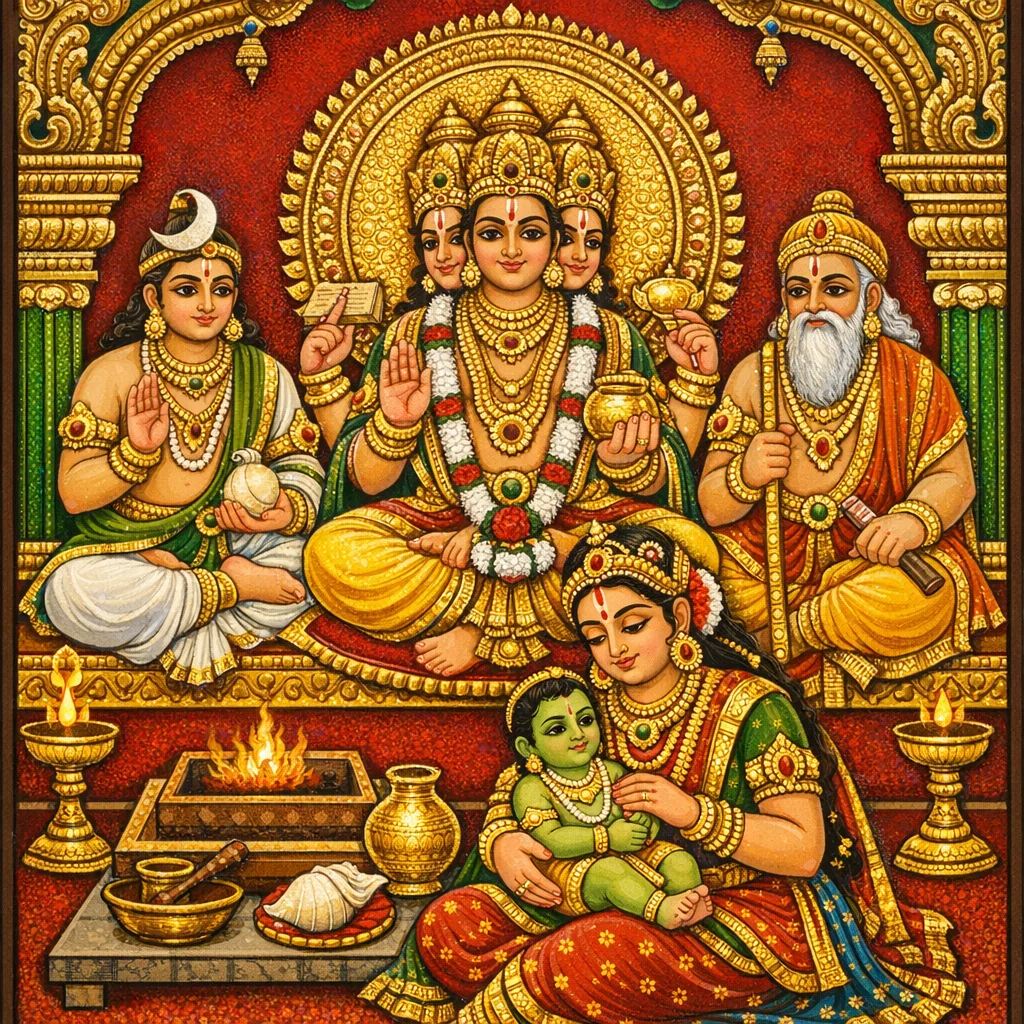
Adhyaya 273
Somavaṁśa-varṇanam (Description of the Lunar Dynasty)
Lord Agni begins a sin-destroying recitation of the Somavaṁśa (Lunar Dynasty), tracing the line from the cosmic origin of Brahmā—born from Viṣṇu’s navel—through Atri and the earliest descendants. Soma’s royal consecration (rājasūya) establishes his sovereignty, yet desire disrupts order: divine women, afflicted by Kāma, take mortal consorts, and Soma’s own transgressive longing culminates in the abduction of Tārā, wife of Bṛhaspati. This sparks the catastrophic Tārakāmaya war, checked only by Brahmā’s intervention, after which the radiant child Budha is born from Soma. The genealogy then turns to kingship history: Budha begets Purūravas, whose union with Urvāśī yields multiple royal heirs. From Āyu arise Nahuṣa and his sons, including Yayāti; Yayāti’s marriages to Devayānī and Śarmiṣṭhā generate the major progenitor lines—Yadu, Turvasu, Druhyu, Anu, and Pūru—establishing Yadu and Pūru as the principal expanders of dynastic tradition. Thus the chapter binds royal ritual, moral causality, and lineage transmission into a single dharmic narrative arc.
Shlokas
Verse 1
इत्य् आग्नेये महापुराणे सुर्यवंशकीर्तनं नाम द्विसप्तत्यधिकद्विशततमो ऽध्यायः सकर्माभूदिति ख , छ , च अथ त्रिसप्तत्यधिकद्विशततमो ऽध्यायः सोमवंशवर्णनं अग्निर् उवाच सोमवंशं प्रवक्ष्यामि पठितं पापनाशनम् विष्णुनाभ्यब्जजो ब्रह्मा ब्रह्मपुत्रो ऽत्रिरत्रितः नीलाञ्जको रधुः क्रोष्टुः शतजिच्च सहस्रजित्
Thus, in the Agni Mahāpurāṇa, the two-hundred-and-seventy-second chapter is called “The Account of the Solar Dynasty” (in some recensions: “that became an act/rite”). Now begins the two-hundred-and-seventy-third chapter, “Description of the Lunar Dynasty.” Agni said: “I shall expound the Lunar Dynasty; when recited, it destroys sin. From the lotus born from Viṣṇu’s navel arose Brahmā; his son here was Atri (Atratī). From him came Nīlāñjaka, Radhu, Kroṣṭu, Śatajit, and Sahasrajit.”},{
Verse 2
सोमश् चक्रे राजसूयं त्रैलोक्यं दक्षिणान्ददौ समाप्ते ऽवभृथे सोमं तद्रूपालोकनेच्छवः शतजिद्धैहयो रेणुहयो हय इति त्रयः
Soma performed the Rājasūya (royal consecration). As sacrificial fees (dakṣiṇā), he bestowed the three worlds. When the concluding avabhṛtha bath was completed, three persons desiring to behold Soma in that very form came forth—Śatajīt, the Haihaya; Reṇuhaya; and one named Haya—thus the three.
Verse 3
कामवाणाभितप्ताङ्ग्यो नरदेव्यः सिषेविरे लक्ष्मीर् नरायणं त्यक्त्वा सिनीवाली च कर्दमम
Tormented in their bodies by the arrows of Kāma, the god of desire, those divine women resorted to mortal men as consorts. Lakṣmī, abandoning Nārāyaṇa, went to Kardama, and Sinīvālī too went to Kardama.
Verse 4
द्युतिं विभावसुन्त्यक्त्वा पुष्टिर्धातारमव्ययम् प्रभा प्रभाकरन्त्यक्त्वा हविष्मन्तं कुहूः स्वयम्
Casting aside the designation “Dyuti” and taking up “Vibhāvasu”, Puṣṭi is to be understood as the imperishable Dhātṛ. And casting aside the designation “Prabhā” and taking up “Prabhākara”, Kuhū herself is to be understood as Haviṣmant.
Verse 5
कीर्तिर्जयन्तम्भर्तारं वसुर्मारीचकश्ययम् धृतिस्त्यक्त्वा पतिं नन्दीं सोममेवाभजत्तदा
Kīrti had Jayanta as her husband; Vasu had Mārīcakaśyaya. Dhṛti, having abandoned her husband Nandī, then devoted herself to Soma alone.
Verse 6
स्वकीया इव सोमो ऽपि कामयामास तास्तदा एवं कृतापचारस्य तासां भर्तृगणस्तदा
Then Soma too desired them, as though they were his own; and because he had thus committed an offence, at that time the husbands of those women were provoked and arrayed against him.
Verse 7
न शशाकापचाराय शापैः शस्त्रादिभिः पुनः सप्तलोकैकनाथत्वमवाप्तस्तपसा ह्य् उत
He could not again be brought to ruin for any offence—whether by curses or by weapons and the like—having indeed attained, through austerity, the status of the sole lord of the seven worlds.
Verse 8
विवभ्राम मतिस्तस्य विनयादनया हता वृहस्पतेः स वै भार्यां तारां नाम यशस्विनीम्
His mind became unsteady; his modesty was destroyed by wrongful conduct. Indeed, he then turned toward Tārā, the illustrious wife of Bṛhaspati.
Verse 9
जहार तरसा सोमो ह्य् अवमन्याङ्गिरःसुतम् ततस्तद्युद्धमभवत् प्रख्यातं तारकामयम्
Soma, in a surge of force, carried her off, indeed scorning the son of Aṅgiras; and from that there arose the battle renowned as the Tārakāmaya war.
Verse 10
न शशाकापकारायेति ञ देवानां दानवानाञ्च लोकक्षयकरं महत् ब्रह्मा निवार्योशनसन्तारामङ्गिरसे ददौ
Unable to counter it so as to prevent harm—since that power was immense and capable of bringing about the destruction of the worlds for both gods and Dānavas—Brahmā restrained its use and bestowed upon Aṅgiras the saving remedy/means connected with Uśanas.
Verse 11
तामन्तःप्रसवां दृष्ट्वा गर्भं त्यजाब्रवीद्गुरुः गर्भस्त्यक्तः प्रदीप्तो ऽथ प्राहाहं सोमसन्भवः
Seeing her in labor from within, the teacher said, “Cast out the embryo.” When the embryo was expelled, it blazed forth; then it declared, “I am Soma, come into being.”
Verse 12
एवं सोमाद्बुधः पुत्त्रः पुत्त्रस्तस्य पुरूरवाः स्वर्गन्त्यक्त्वोर्वशी सा तं वरयामास चाप्सराः
Thus, from Soma was born Budha; and his son was Purūravas. Having abandoned heaven, the Apsaras Urvaśī chose him (Purūravas) as her husband.
Verse 13
तया सहाचरद्राजा दशवर्षाणि पञ्च च पञ्च षट् सप्त चाष्टौ च दश चाष्टौ महामुने
O great sage, the king lived together with her for years—ten, five, five, six, seven, eight, ten, and eight.
Verse 14
एको ऽग्निरभवत् पूर्वं तेन त्रेता प्रवर्तिता पुरूरवा योगशीलो गान्धर्वलोकमीयिवान्
In the beginning there was but one Fire; through that (Fire) the Tretā Age was set in motion. Purūravas—devoted to yogic discipline—went to the world of the Gandharvas.
Verse 15
आयुर्दृढायुरश्वायुर्धनायुर्धृतिमान् वसुः दिविजातः शतायुश् च सुषुवे चोर्वशी नृपान्
Queen Urvaśī gave birth to the kings named Āyu, Dṛḍhāyu, Aśvāyu, Dhanāyu, Dhṛtimān, Vasu, Divijāta, and Śatāyu.
Verse 16
आयुषो नहुषः पुत्रो वृद्धशर्मा रजिस् तथा दर्भो विपाप्मा पञ्चाग्न्यं रजेः पुत्रशतं ह्य् अभूत्
From Āyu sprang Nahuṣa. His sons were Vṛddhaśarmā, Raji, Darbha, Vipāpmā, and Pañcāgnya; and from Raji, indeed, there were a hundred sons.
Verse 17
राजेया इति विख्याता विष्णुदत्तवरो रजिः देवासुरे रणे दैत्यानबधीत्सुरयाचितः
Raji, famed as Rājeyā and blessed with a boon granted by Viṣṇu, slew the Daityas in the battle of Devas and Asuras, at the gods’ request.
Verse 18
गतायेन्द्राय पुत्रत्वं दत्वा राज्यं दिवङ्गतः रजेः पुत्रैर् हृतं राज्यं शक्रस्याथ सुदुर्मनाः
Having granted Indra the status of a son and bestowed the kingdom, he passed away and went to heaven. Then Raji’s sons seized Indra’s realm, and Śakra (Indra) became deeply dejected.
Verse 19
ग्रहशान्त्यादिविधिना गुरुरिन्द्राय तद्ददौ मोहयित्वा रजिसुतानासंस्ते निजधर्मगाः
By the prescribed procedures—beginning with the rites of planetary pacification (graha-śānti) and the like—Bṛhaspati, the Guru, bestowed that upon Indra; and, having deluded Raji’s sons, he made them sit withdrawn (subdued), while they yet remained within their own dharma.
Verse 20
नहुषस्य सुताः सप्त यतिर्ययातिरुत्तमः उद्भवः पञ्चकश् चैव शर्यातिमेघपालकौ
Nahuṣa had seven sons: Yati; the excellent Yayāti; Udbhava; Pañcaka; and also Śaryāti, Megha, and Pālaka.
Verse 21
पञ्चाग्न्या इति ज पञ्चाग्न्यमिति ञ यतिः कुमारभावे ऽपि विष्णुं ध्यात्वा हरिं गतः देवयानी शक्रकन्या ययातेः पत्न्य् अभूत् तदा
“(Read) ‘pañcāgnyā’—thus in the ja-recension; (or) ‘pañcāgnyam’—thus in the ña-recension. Yati, even in boyhood, meditated upon Viṣṇu and attained Hari. Then Devayānī, daughter of Śakra (Indra), became the wife of Yayāti.”
Verse 22
वृषपर्वजा शर्मिष्ठा ययातेः पञ्च तत्सुताः यदुञ्च तुर्वसुञ्चैव देवयानी व्यजायत
Śarmiṣṭhā, daughter of Vṛṣaparvan, bore to Yayāti five sons; and Devayānī also gave birth to Yadu and Turvasu.
Verse 23
द्रुह्यञ्चानूञ्च पूरुञ्च शर्मिष्ठा वार्षपर्वणी यदुः पूरुश्चाभवतान्तेषां वंशविवर्धनौ
Śarmiṣṭhā, daughter of Vṛṣaparvan, bore Druhyu, Anu, and Pūru; and among them, Yadu and Pūru became the foremost expanders of their respective lineages.
Frequently Asked Questions
The pivot is Soma’s transgression—abducting Tārā—which triggers the Tārakāmaya war and leads to the birth of Budha, after which the text resumes structured dynastic transmission through Purūravas, Nahuṣa, and Yayāti.
Soma’s rājasūya signals legitimate sovereignty, yet unchecked desire produces social and cosmic conflict (the Tārakāmaya war), showing that kingship and power remain accountable to dharma, with Brahmā restoring order.