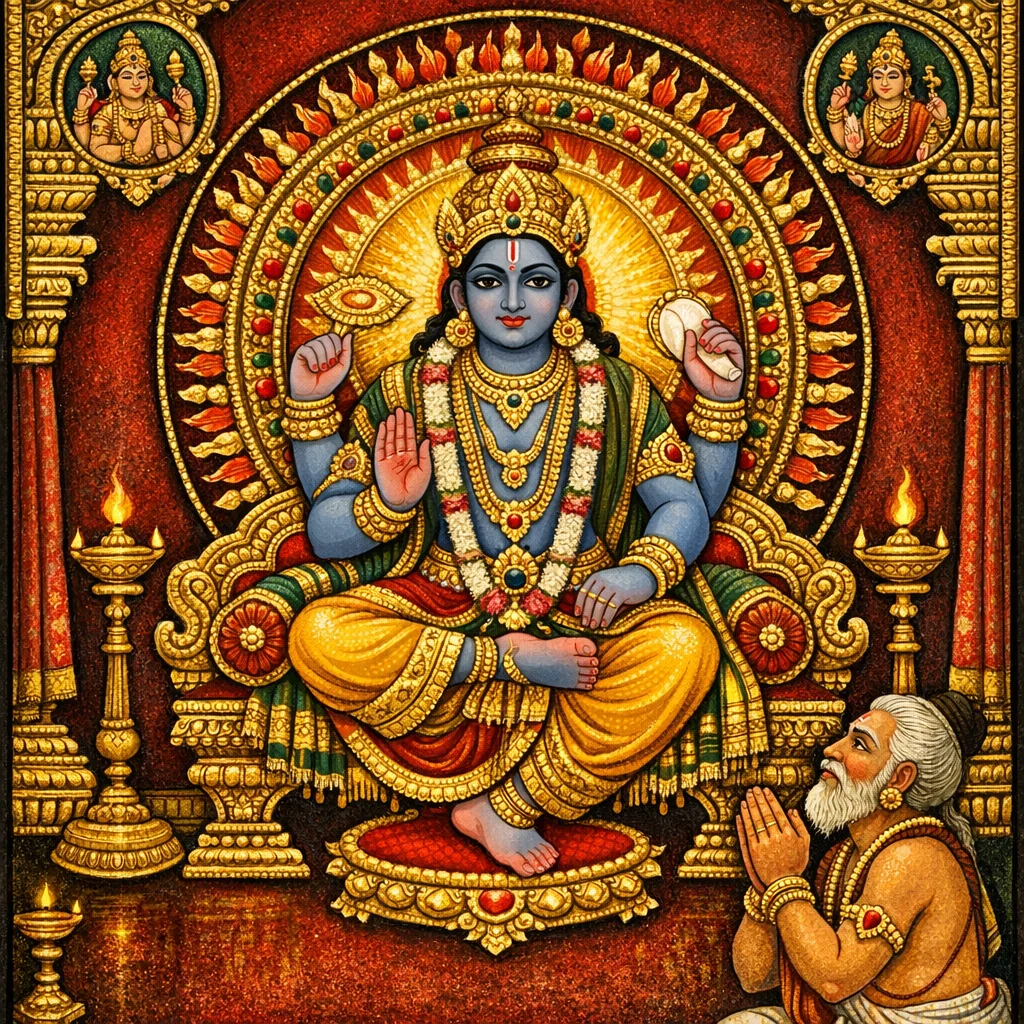
Adhyaya 269
Viṣṇu-Pañjara (विष्णुपञ्जरम्) — The Protective Armor of Viṣṇu
This chapter teaches the “Viṣṇu-Pañjara” (kavaca) as an authoritative rite of protection: before Śiva’s cosmic battle to slay Tripura, Brahmā prescribes this armor for Śaṅkara, showing that even the highest deities act through ordained protective vidhi. Puṣkara explains protection by mapping Viṣṇu’s forms and weapons onto space—discus in the east, mace in the south, bow in the west, sword in the north—extending guardianship to intermediate directions, bodily apertures, earth as Varāha, and sky as Narasiṁha. It details the apotropaic power of Sudarśana, the blazing gadā, and the thunderous Śārṅga to repel and destroy hostile beings (rākṣasas, bhūtas, piśācas, ḍākinīs, pretas, vināyakas, kuṣmāṇḍas) and other dangers, including animals and serpents. The chapter concludes by linking protection with inner well-being—health of intellect, mind, and senses—through kīrtana of Vāsudeva, and by affirming Viṣṇu as Supreme Brahman whose truthful name-recitation destroys the “threefold inauspiciousness” (trividha aśubha), uniting ritual protection with nondual theistic metaphysics.
Shlokas
Verse 1
अ प्रणीतम् श्रीलश्री वङ्गदेशीयासियातिक्-समाजानुज्ञया श्रीराजेन्द्रलालमित्रेण परिशोधितम् कलिकाताराजधान्यां गणेशयन्त्रे मुद्रितञ्च संवत् अग्निपुराणम् अथोनसप्तत्यधिकद्विशततमो ऽध्यायः विष्णुपञ्जरं पुष्कर उवच त्रिपुरञ्जघ्नुषः पूर्वं ब्रह्मणा विष्णुपञ्जरं शङ्करस्य द्विजश्रेष्थ रक्षणाय निरूपितं
Puṣkara said: Before (Śiva) slew Tripura, Brahmā prescribed for Śaṅkara—O best of the twice-born—a protective “armor” (kavaca) of Viṣṇu for his safeguarding. This is the two-hundred-and-sixty-ninth chapter, “The Viṣṇu-Pañjara.”
Verse 2
वागीशेन च शक्रस्य बलं हन्तुं प्रयास्यतः तस्य स्वरूपं वक्ष्यामि तत्त्वं शृणु जयादिमत्
And when Vāgīśa set out to slay Śakra’s (Indra’s) army, I shall describe his true form; listen to its essential reality (tattva), O Jayādimat.
Verse 3
विष्णुः प्राच्यां स्थितश् चक्री हरिर्दक्षिनणतो गदी प्रतीच्यां शार्ङ्गधृग्विष्णुर्जिष्णुः खड्गी ममोत्तरे
May Viṣṇu, stationed in the east as the discus-bearer, and Hari in the south as the mace-bearer; may Viṣṇu in the west as the bearer of Śārṅga (the bow), and Jiṣṇu in the north as the sword-bearer, protect me.
Verse 4
हृषीकेशो विकोणेषु तच्छिद्रेषु जनार्दनः क्रोडरूपी हरिर्भूमौ नरसिंहो ऽम्बरे मम
May Hṛṣīkeśa abide in the intermediate directions; may Janārdana guard the apertures and openings. May Hari, in the form of the Boar (Varāha), protect me on the earth; and may Narasiṁha protect me in the sky.
Verse 5
क्षुरान्तममलञ्चक्रं भ्रमत्येतत् सुदर्शनं अस्यांशुमाला दुष्प्रेक्ष्या हन्तुं प्रेतनिशाचरान्
This spotless Sudarśana discus, edged like a razor, whirls swiftly; its garland of rays is unbearable to behold—meant to slay ghosts and night-roaming fiends.
Verse 6
गदा चेयं सहस्रार्चिःप्रदीप्तपावकोज्ज्वला रक्षोभूतपिशाचानां डाकिनीनाञ्च नाशनी
This very mace is thousand-flamed, blazing like kindled fire; it is the destroyer of rākṣasas, bhūtas, piśācas, and also ḍākinīs.
Verse 7
शार्ङ्गविस्फूर्जितञ्चैव वासुदेवस्य मद्रिपून् तिर्यङ्मनुष्यकुष्माण्डप्रेतादीन् हन्त्वशेषतः
And may the thunderous twang of Vāsudeva’s Śārṅga (bow) utterly destroy my enemies—whether they be animals, humans, kuṣmāṇḍas, pretas, and the like—without remainder.
Verse 8
खड्गधारोज्ज्वलज्जो ऽत्स्नानिर्धूता ये समाहिताः ते यान्तु शाम्यतां सद्यो गरुडेनेव पन्नगाः
May those hostile forces, blazing like the edge of a sword—shaken off by the bath-rite and subdued by concentrated ritual focus—depart and be pacified at once, just as serpents are subdued by Garuḍa.
Verse 9
ये कुष्माण्डास्था यक्षा ये दैत्या ये निशाचराः प्रेता विनायकाः क्रूरा मनुष्या जम्भगाः खगाः
Whether they are beings abiding among the Kuṣmāṇḍas, Yakṣas, Daityas, night-roaming demons, Pretas (restless spirits), Vināyakas (obstructive spirits), cruel men, Jambhagas, or hostile birds—all such harmful entities are here named for warding off.
Verse 10
सिंहादयश् च पशवो दन्दशूकाश् च पन्नगाः सर्वे भवन्तु ते सौम्याः कृष्णशङ्खरवाहताः
May the beasts beginning with lions, and the biting creatures and serpents—all of them—become gentle toward you, being subdued by the resounding call of the black conch.
Verse 11
चित्तवृत्तिहरा ये मे ये जनाः स्मृतिहारकाः बलौजसञ्च हर्तारश्छायाविभ्रंशकाश् च ये
May those beings who rob me of the movements of the mind, those persons who steal away memory, those who take away strength and vital vigor, and those who cause distortion or loss of one’s shadow—may they be repelled.
Verse 12
ये चोपभोगहर्तारो ये च लक्षणनाशकाः कुष्माण्डास्ते प्रणश्यन्तु विष्णुचक्ररवाहताः
May those Kuṣmāṇḍas who steal one’s enjoyments, and those who destroy auspicious marks and signs, be utterly destroyed—struck down by the roaring onrush of Viṣṇu’s discus.
Verse 13
बुद्धिस्वास्थ्यं मनःस्वास्थ्यं स्वास्थ्यमैन्द्रियकं तथा ममास्तु देवदेवस्य वासुदेवस्य कीर्तनात्
May I attain sound health of intellect, sound health of mind, and likewise health of the senses—through the praise (kīrtana) of Vāsudeva, the God of gods.
Verse 14
पृष्ठे पुरस्तान्मम दक्षिणोत्तरे विकोणतश्चास्तु जनार्दनोहरिः तमीड्यमीशानमनन्तमच्युतं जनार्दनं प्रणिपतितो न सीदति
May Janārdana Hari be behind me and in front of me; may He be to my right and to my left, and also in the intermediate (diagonal) directions. One who bows down to that praiseworthy Lord—Janārdana, the Sovereign, the Infinite, the Unfailing—does not fall into misery.
Verse 15
यथा परं ब्रह्म हरिस् तथा परः जगत्स्वरूपश् च स एव केशवः सत्येन तेनाच्युतनामकीर्तनात् प्रणाशयेत्तु त्रिविधंममाशुभं
Just as Hari is the Supreme Brahman, so too is He the Highest; and He alone—Keśava—is also the very form of the universe. By that truth, through the chanting of Acyuta’s name, may my threefold inauspiciousness be destroyed.
Frequently Asked Questions
Protection is constructed as a spatial grid (dikbandhana): Viṣṇu’s weapon-bearing forms are stationed in the cardinal and intermediate directions, with additional guardianship over apertures, earth (Varāha), and sky (Narasiṁha).
It names multiple categories of harmful beings and forces—rākṣasas, bhūtas, piśācas, ḍākinīs, pretas, vināyakas, kuṣmāṇḍas, night-roamers, hostile animals and serpents—along with afflictions such as memory-loss, mind-disturbance, vitality-theft, and shadow-distortion.
It culminates in theological identity: Viṣṇu/Hari as Parabrahman and the universe-form, asserting that nāma-kīrtana of Acyuta/Vāsudeva grants inner health and destroys trividha aśubha, aligning apotropaic practice with devotion and metaphysical truth.